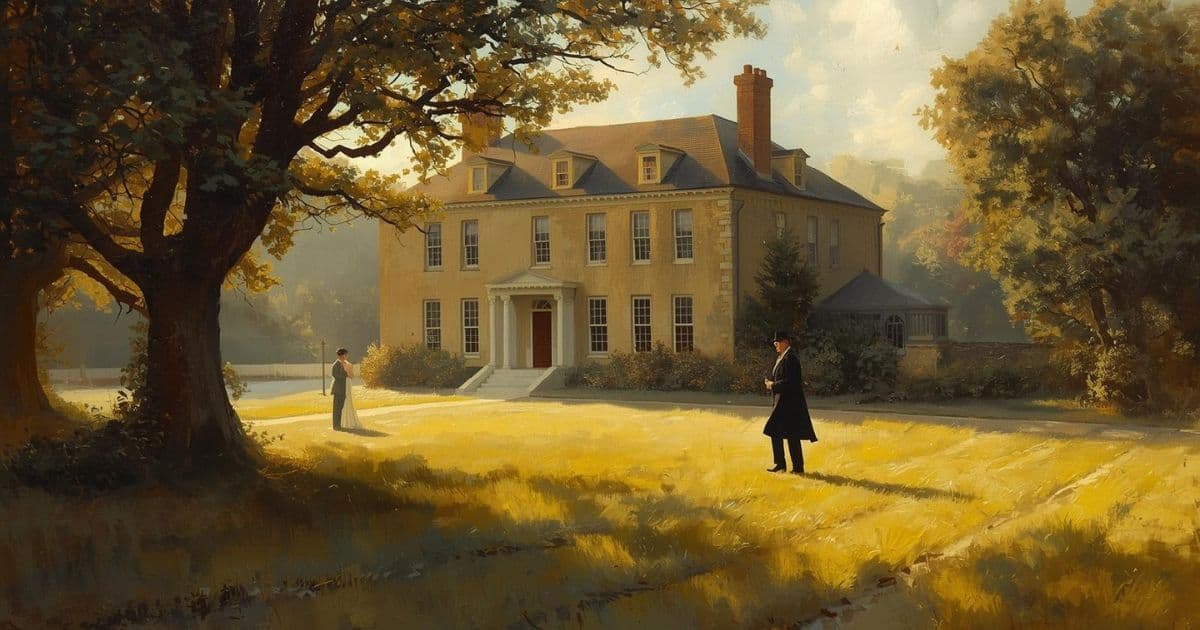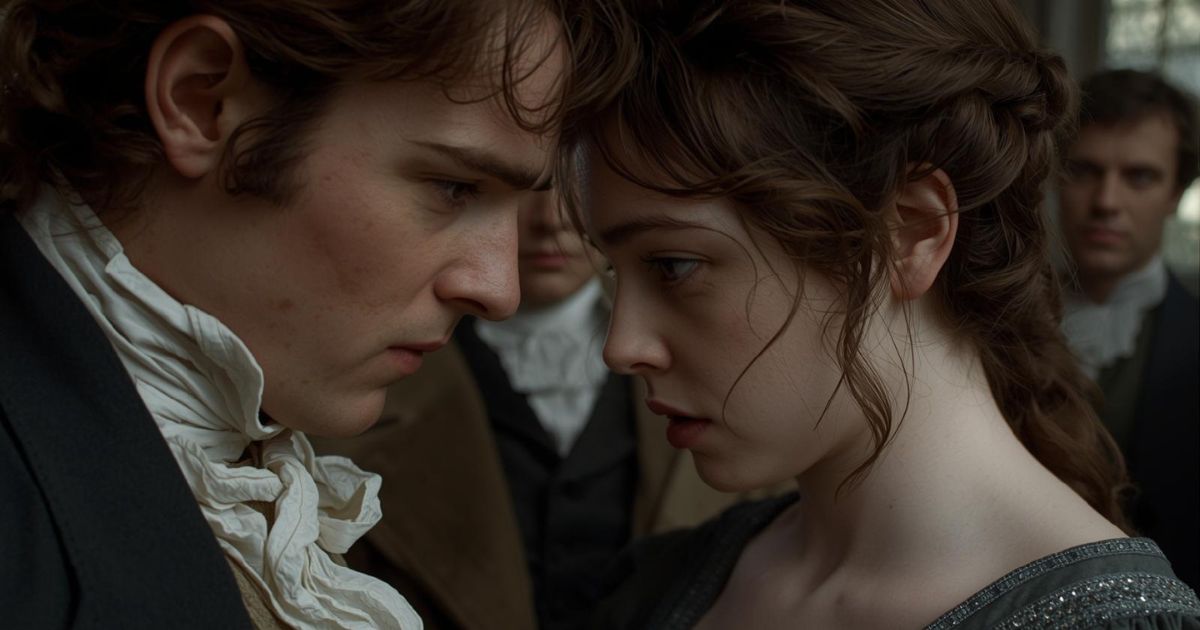
An excerpt from the original text.(complete · 1535 words)
[llustration]
After a week spent in professions of love and schemes of felicity, Mr.
Collins was called from his amiable Charlotte by the arrival of
Saturday. The pain of separation, however, might be alleviated on his
side by preparations for the reception of his bride, as he had reason to
hope, that shortly after his next return into Hertfordshire, the day
would be fixed that was to make him the happiest of men. He took leave
of his relations at Longbourn with as much solemnity as before; wished
his fair cousins health and happiness again, and promised their father
another letter of thanks.
On the following Monday, Mrs. Bennet had the pleasure of receiving her
brother and his wife, who came, as usual, to spend the Christmas at
Longbourn. Mr. Gardiner was a sensible, gentlemanlike man, greatly
superior to his sister, as well by nature as education. The Netherfield
ladies would have had difficulty in believing that a man who lived by
trade, and within view of his own warehouses, could have been so
well-bred and agreeable. Mrs. Gardiner, who was several years younger
than Mrs. Bennet and Mrs. Philips, was an amiable, intelligent, elegant
woman, and a great favourite with her Longbourn nieces. Between the two
eldest and herself especially, there subsisted a very particular regard.
They had frequently been staying with her in town.
The first part of Mrs. Gardiner’s business, on her arrival, was to
distribute her presents and describe the newest fashions. When this was
done, she had a less active part to play. It became her turn to listen.
Mrs. Bennet had many grievances to relate, and much to complain of. They
had all been very ill-used since she last saw her sister. Two of her
girls had been on the point of marriage, and after all there was nothing
in it.
“I do not blame Jane,” she continued, “for Jane would have got Mr.
Bingley if she could. But, Lizzy! Oh, sister! it is very hard to think
that she might have been Mr. Collins’s wife by this time, had not it
been for her own perverseness. He made her an offer in this very room,
and she refused him. The consequence of it is, that Lady Lucas will have
a daughter married before I have, and that Longbourn estate is just as
much entailed as ever. The Lucases are very artful people, indeed,
sister. They are all for what they can get. I am sorry to say it of
them, but so it is. It makes me very nervous and poorly, to be thwarted
so in my own family, and to have neighbours who think of themselves
before anybody else. However, your coming just at this time is the
greatest of comforts, and I am very glad to hear what you tell us of
long sleeves.”
Mrs. Gardiner, to whom the chief of this news had been given before, in
the course of Jane and Elizabeth’s correspondence with her, made her
sister a slight answer, and, in compassion to her nieces, turned the
conversation.
When alone with Elizabeth afterwards, she spoke more on the subject.
“It seems likely to have been a desirable match for Jane,” said she. “I
am sorry it went off. But these things happen so often! A young man,
such as you describe Mr. Bingley, so easily falls in love with a pretty
girl for a few weeks, and, when accident separates them, so easily
forgets her, that these sort of inconstancies are very frequent.”
[Illustration:
“Offended two or three young ladies”
[Copyright 1894 by George Allen.]]
“An excellent consolation in its way,” said Elizabeth; “but it will not
do for us. We do not suffer by accident. It does not often happen
that the interference of friends will persuade a young man of
independent fortune to think no more of a girl whom he was violently in
love with only a few days before.”
“But that expression of ‘violently in love’ is so hackneyed, so
doubtful, so indefinite, that it gives me very little idea. It is as
often applied to feelings which arise only from a half hour’s
acquaintance, as to a real, strong attachment. Pray, how violent was
Mr. Bingley’s love?”
“I never saw a more promising inclination; he was growing quite
inattentive to other people, and wholly engrossed by her. Every time
they met, it was more decided and remarkable. At his own ball he
offended two or three young ladies by not asking them to dance; and I
spoke to him twice myself without receiving an answer. Could there be
finer symptoms? Is not general incivility the very essence of love?”
“Oh, yes! of that kind of love which I suppose him to have felt. Poor
Jane! I am sorry for her, because, with her disposition, she may not get
over it immediately. It had better have happened to you, Lizzy; you
would have laughed yourself out of it sooner. But do you think she would
be prevailed on to go back with us? Change of scene might be of
service--and perhaps a little relief from home may be as useful as
anything.”
Elizabeth was exceedingly pleased with this proposal, and felt persuaded
of her sister’s ready acquiescence.
“I hope,” added Mrs. Gardiner, “that no consideration with regard to
this young man will influence her. We live in so different a part of
town, all our connections are so different, and, as you well know, we go
out so little, that it is very improbable they should meet at all,
unless he really comes to see her.”
“And that is quite impossible; for he is now in the custody of his
friend, and Mr. Darcy would no more suffer him to call on Jane in such a
part of London! My dear aunt, how could you think of it? Mr. Darcy may,
perhaps, have heard of such a place as Gracechurch Street, but he
would hardly think a month’s ablution enough to cleanse him from its
impurities, were he once to enter it; and, depend upon it, Mr. Bingley
never stirs without him.”
“So much the better. I hope they will not meet at all. But does not Jane
correspond with his sister? She will not be able to help calling.”
“She will drop the acquaintance entirely.”
But, in spite of the certainty in which Elizabeth affected to place this
point, as well as the still more interesting one of Bingley’s being
withheld from seeing Jane, she felt a solicitude on the subject which
convinced her, on examination, that she did not consider it entirely
hopeless. It was possible, and sometimes she thought it probable, that
his affection might be re-animated, and the influence of his friends
successfully combated by the more natural influence of Jane’s
attractions.
Miss Bennet accepted her aunt’s invitation with pleasure; and the
Bingleys were no otherwise in her thoughts at the same time than as she
hoped, by Caroline’s not living in the same house with her brother, she
might occasionally spend a morning with her, without any danger of
seeing him.
The Gardiners stayed a week at Longbourn; and what with the Philipses,
the Lucases, and the officers, there was not a day without its
engagement. Mrs. Bennet had so carefully provided for the entertainment
of her brother and sister, that they did not once sit down to a family
dinner. When the engagement was for home, some of the officers always
made part of it, of which officers Mr. Wickham was sure to be one; and
on these occasions Mrs. Gardiner, rendered suspicious by Elizabeth’s
warm commendation of him, narrowly observed them both. Without supposing
them, from what she saw, to be very seriously in love, their preference
of each other was plain enough to make her a little uneasy; and she
resolved to speak to Elizabeth on the subject before she left
Hertfordshire, and represent to her the imprudence of encouraging such
an attachment.
To Mrs. Gardiner, Wickham had one means of affording pleasure,
unconnected with his general powers. About ten or a dozen years ago,
before her marriage, she had spent a considerable time in that very part
of Derbyshire to which he belonged. They had, therefore, many
acquaintance in common; and, though Wickham had been little there since
the death of Darcy’s father, five years before, it was yet in his power
to give her fresher intelligence of her former friends than she had been
in the way of procuring.
Mrs. Gardiner had seen Pemberley, and known the late Mr. Darcy by
character perfectly well. Here, consequently, was an inexhaustible
subject of discourse. In comparing her recollection of Pemberley with
the minute description which Wickham could give, and in bestowing her
tribute of praise on the character of its late possessor, she was
delighting both him and herself. On being made acquainted with the
present Mr. Darcy’s treatment of him, she tried to remember something of
that gentleman’s reputed disposition, when quite a lad, which might
agree with it; and was confident, at last, that she recollected having
heard Mr. Fitzwilliam Darcy formerly spoken of as a very proud,
ill-natured boy.
[Illustration:
“Will you come and see me?”
]
Master this chapter. Complete your experience
Purchase the complete book to access all chapters and support classic literature
As an Amazon Associate, we earn a small commission from qualifying purchases at no additional cost to you.
Available in paperback, hardcover, and e-book formats
Let's Analyse the Pattern
Why This Matters
Connect literature to life
This chapter teaches how to recognize when your confidence in reading people might be your biggest blind spot.
Now let's explore the literary elements.
Key Quotes & Analysis
"How despicably have I acted! I, who have prided myself on my discernment!"
Context: Elizabeth's reaction after reading Darcy's letter and realizing her misjudgments
This moment of self-awareness marks Elizabeth's crucial character development. She recognizes that her pride in being a good judge of character was actually her greatest weakness, leading her to trust Wickham and dismiss Darcy.
"Till this moment, I never knew myself."
Context: Elizabeth's devastating realization about her own character flaws
This represents the novel's central theme about self-knowledge. Elizabeth discovers that true understanding requires honest self-examination, not just judgment of others. It's a painful but necessary step toward maturity.
"I have no wish of denying that I did everything in my power to separate my friend from your sister."
Context: Darcy's honest admission in his letter about interfering with Jane and Bingley
Darcy's directness shows his integrity - he doesn't make excuses but explains his reasoning. This honesty contrasts sharply with Wickham's manipulative charm and begins to show Elizabeth Darcy's true character.
Thematic Threads
Prejudice
In This Chapter
Elizabeth confronts how her prejudice against Darcy made her believe Wickham's lies and dismiss Darcy's true character
Development
Evolves from social prejudice to personal bias - now it's about Elizabeth's flawed judgment, not just class differences
In Your Life:
When have you let your first impressions of someone blind you to evidence that contradicted your initial judgment?
Self-Knowledge
In This Chapter
Elizabeth experiences painful self-reflection, realizing she's been wrong about her ability to judge character accurately
Development
Major breakthrough - Elizabeth moves from confident in her perceptions to questioning everything she thought she knew
In Your Life:
Can you think of a time when you discovered you were completely wrong about something you felt certain about - how did that shake your confidence?
Truth vs Appearance
In This Chapter
Darcy's letter reveals the gap between how things appeared and what actually happened with both Wickham and Jane/Bingley
Development
Deepens from social appearances to personal deceptions - the stakes become more intimate and damaging
In Your Life:
Have you ever found out that a situation you thought you understood completely was actually very different from what it appeared to be?
Communication
In This Chapter
Darcy's written letter succeeds where his spoken words failed, allowing Elizabeth to process difficult truths privately
Development
Shows how the medium of communication affects the message - writing allows for reflection that conversation didn't
In Your Life:
When has writing out your thoughts (or receiving a written message) helped you process something difficult that face-to-face conversation couldn't accomplish?
Pride
In This Chapter
Elizabeth's pride in her own judgment prevented her from seeing the truth about both men until forced to confront facts
Development
Shifts from Darcy's social pride to Elizabeth's intellectual pride - both forms blind us to reality
In Your Life:
What's an example of when your confidence in your own abilities or judgment actually prevented you from seeing an important truth?
You now have the context. Time to form your own thoughts.
Discussion Questions
- 1
What specific information in Darcy's letter completely changed Elizabeth's understanding of both him and Wickham?
- 2
How did Elizabeth's first impressions create a mental filter that made her miss obvious red flags about Wickham's character?
- 3
Think about someone you initially misjudged - what made you finally see them differently, and how long did it take?
- 4
When you realize you've been wrong about someone important, what's your strategy for rebuilding that relationship or protecting yourself?
- 5
Why do we humans cling so tightly to our first impressions even when new evidence suggests we're wrong?
Critical Thinking Exercise
The Evidence Audit
Think of someone you have a strong opinion about - positive or negative. Write down three specific pieces of 'evidence' that support your view of them. Now challenge each piece: What other explanations could there be for their behavior? What contradictory evidence have you been ignoring or explaining away? Finally, identify one concrete action you could take to test whether your impression might be incomplete.
Consider:
- •Look for patterns where you've had to create increasingly complex explanations for someone's actions to maintain your original impression
- •Pay attention to information you've been unconsciously filtering out because it doesn't fit your narrative about this person
- •Consider how your own emotional state or circumstances when you first met this person might have colored your judgment
Coming Up Next...
Chapter 26
Elizabeth struggles to process everything Darcy has revealed, questioning everything she thought she knew about the people around her. Her entire understanding of recent events begins to crumble as she faces some hard truths about herself.