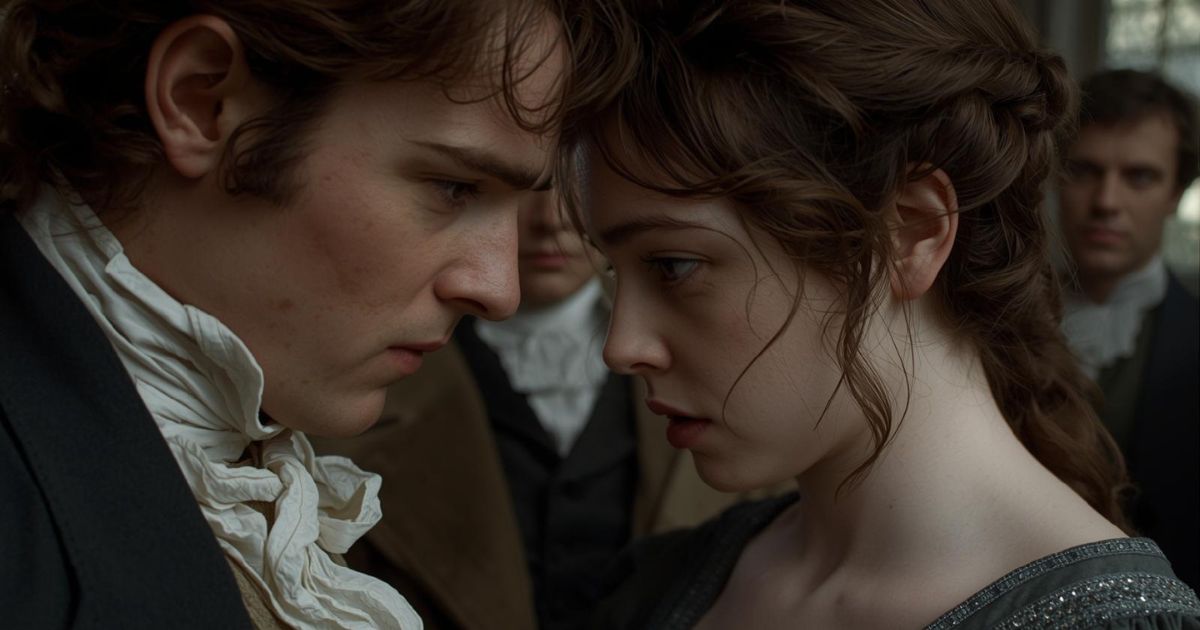
An excerpt from the original text.(complete · 1260 words)
[llustration]
With no greater events than these in the Longbourn family, and otherwise
diversified by little beyond the walks to Meryton, sometimes dirty and
sometimes cold, did January and February pass away. March was to take
Elizabeth to Hunsford. She had not at first thought very seriously of
going thither; but Charlotte, she soon found, was depending on the
plan, and she gradually learned to consider it herself with greater
pleasure as well as greater certainty. Absence had increased her desire
of seeing Charlotte again, and weakened her disgust of Mr. Collins.
There was novelty in the scheme; and as, with such a mother and such
uncompanionable sisters, home could not be faultless, a little change
was not unwelcome for its own sake. The journey would, moreover, give
her a peep at Jane; and, in short, as the time drew near, she would have
been very sorry for any delay. Everything, however, went on smoothly,
and was finally settled according to Charlotte’s first sketch. She was
to accompany Sir William and his second daughter. The improvement of
spending a night in London was added in time, and the plan became as
perfect as plan could be.
The only pain was in leaving her father, who would certainly miss her,
and who, when it came to the point, so little liked her going, that he
told her to write to him, and almost promised to answer her letter.
The farewell between herself and Mr. Wickham was perfectly friendly; on
his side even more. His present pursuit could not make him forget that
Elizabeth had been the first to excite and to deserve his attention, the
first to listen and to pity, the first to be admired; and in his manner
of bidding her adieu, wishing her every enjoyment, reminding her of what
she was to expect in Lady Catherine de Bourgh, and trusting their
opinion of her--their opinion of everybody--would always coincide, there
was a solicitude, an interest, which she felt must ever attach her to
him with a most sincere regard; and she parted from him convinced, that,
whether married or single, he must always be her model of the amiable
and pleasing.
Her fellow-travellers the next day were not of a kind to make her think
him less agreeable. Sir William Lucas, and his daughter Maria, a
good-humoured girl, but as empty-headed as himself, had nothing to say
that could be worth hearing, and were listened to with about as much
delight as the rattle of the chaise. Elizabeth loved absurdities, but
she had known Sir William’s too long. He could tell her nothing new of
the wonders of his presentation and knighthood; and his civilities were
worn out, like his information.
It was a journey of only twenty-four miles, and they began it so early
as to be in Gracechurch Street by noon. As they drove to Mr. Gardiner’s
door, Jane was at a drawing-room window watching their arrival: when
they entered the passage, she was there to welcome them, and Elizabeth,
looking earnestly in her face, was pleased to see it healthful and
lovely as ever. On the stairs were a troop of little boys and girls,
whose eagerness for their cousin’s appearance would not allow them to
wait in the drawing-room, and whose shyness, as they had not seen her
for a twelvemonth, prevented their coming lower. All was joy and
kindness. The day passed most pleasantly away; the morning in bustle and
shopping, and the evening at one of the theatres.
Elizabeth then contrived to sit by her aunt. Their first subject was her
sister; and she was more grieved than astonished to hear, in reply to
her minute inquiries, that though Jane always struggled to support her
spirits, there were periods of dejection. It was reasonable, however, to
hope that they would not continue long. Mrs. Gardiner gave her the
particulars also of Miss Bingley’s visit in Gracechurch Street, and
repeated conversations occurring at different times between Jane and
herself, which proved that the former had, from her heart, given up the
acquaintance.
Mrs. Gardiner then rallied her niece on Wickham’s desertion, and
complimented her on bearing it so well.
“But, my dear Elizabeth,” she added, “what sort of girl is Miss King? I
should be sorry to think our friend mercenary.”
“Pray, my dear aunt, what is the difference in matrimonial affairs,
between the mercenary and the prudent motive? Where does discretion end,
and avarice begin? Last Christmas you were afraid of his marrying me,
because it would be imprudent; and now, because he is trying to get a
girl with only ten thousand pounds, you want to find out that he is
mercenary.”
“If you will only tell me what sort of girl Miss King is, I shall know
what to think.”
“She is a very good kind of girl, I believe. I know no harm of her.”
“But he paid her not the smallest attention till her grandfather’s death
made her mistress of this fortune?”
“No--why should he? If it were not allowable for him to gain my
affections, because I had no money, what occasion could there be for
making love to a girl whom he did not care about, and who was equally
poor?”
“But there seems indelicacy in directing his attentions towards her so
soon after this event.”
“A man in distressed circumstances has not time for all those elegant
decorums which other people may observe. If she does not object to it,
why should we?”
“Her not objecting does not justify him. It only shows her being
deficient in something herself--sense or feeling.”
“Well,” cried Elizabeth, “have it as you choose. He shall be
mercenary, and she shall be foolish.”
“No, Lizzy, that is what I do not choose. I should be sorry, you know,
to think ill of a young man who has lived so long in Derbyshire.”
“Oh, if that is all, I have a very poor opinion of young men who live in
Derbyshire; and their intimate friends who live in Hertfordshire are not
much better. I am sick of them all. Thank heaven! I am going to-morrow
where I shall find a man who has not one agreeable quality, who has
neither manners nor sense to recommend him. Stupid men are the only ones
worth knowing, after all.”
“Take care, Lizzy; that speech savours strongly of disappointment.”
Before they were separated by the conclusion of the play, she had the
unexpected happiness of an invitation to accompany her uncle and aunt in
a tour of pleasure which they proposed taking in the summer.
“We have not quite determined how far it shall carry us,” said Mrs.
Gardiner; “but perhaps, to the Lakes.”
No scheme could have been more agreeable to Elizabeth, and her
acceptance of the invitation was most ready and grateful. “My dear, dear
aunt,” she rapturously cried, “what delight! what felicity! You give me
fresh life and vigour. Adieu to disappointment and spleen. What are men
to rocks and mountains? Oh, what hours of transport we shall spend! And
when we do return, it shall not be like other travellers, without
being able to give one accurate idea of anything. We will know where
we have gone--we will recollect what we have seen. Lakes, mountains,
and rivers, shall not be jumbled together in our imaginations; nor, when
we attempt to describe any particular scene, will we begin quarrelling
about its relative situation. Let our first effusions be less
insupportable than those of the generality of travellers.”
[Illustration:
“At the door”
]
Master this chapter. Complete your experience
Purchase the complete book to access all chapters and support classic literature
As an Amazon Associate, we earn a small commission from qualifying purchases at no additional cost to you.
Available in paperback, hardcover, and e-book formats
Let's Analyse the Pattern
Why This Matters
Connect literature to life
This chapter teaches how to recognize when wounded feelings are filtering information to protect ego rather than reveal truth.
Now let's explore the literary elements.
Key Quotes & Analysis
"How despicably have I acted! I, who have prided myself on my discernment!"
Context: Elizabeth's reaction after reading Darcy's letter and realizing how wrong she's been
This moment captures Elizabeth's painful but necessary self-recognition. She's built her identity on being a good judge of character, but now must face that her pride made her blind to the truth.
"Till this moment, I never knew myself."
Context: Elizabeth's realization about her own prejudices after reading the letter
This is the turning point of Elizabeth's character development. True wisdom begins with honest self-knowledge, and she's finally seeing her own flaws clearly for the first time.
"I have been a selfish being all my life, in practice, though not in principle."
Context: From his letter, explaining how he was raised to think only of his own family's interests
Darcy shows remarkable self-awareness and humility. He admits his faults while explaining that his actions, though appearing selfish, came from a sense of duty to protect those he cares about.
Thematic Threads
Prejudice
In This Chapter
Elizabeth realizes her judgment of both men was completely wrong, based on first impressions and wounded pride rather than evidence
Development
Reaches critical turning point - Elizabeth finally sees how her prejudices blinded her to truth
In Your Life:
When have you realized that your initial judgment of someone was completely wrong because you let a bad first impression cloud your ability to see who they really were?
Pride
In This Chapter
Elizabeth's wounded pride from Darcy's rejection made her eager to believe the worst about him and dismiss his good qualities
Development
Evolves from defensive pride to painful self-recognition - the hardest kind of growth
In Your Life:
Can you think of a time when feeling hurt or rejected made you stubbornly refuse to see anything good about the person who wounded you?
Deception
In This Chapter
Wickham's lies are fully exposed - he's a fortune hunter who tried to seduce a fifteen-year-old for money
Development
Culmination of Wickham's manipulative behavior - the charming mask finally comes off completely
In Your Life:
Have you ever been completely fooled by someone who seemed charming and trustworthy but turned out to be manipulating you for their own gain?
Personal Growth
In This Chapter
Elizabeth faces the uncomfortable truth about her own flawed judgment and admits she was completely wrong
Development
Major breakthrough - Elizabeth moves from thinking she's always right to genuine self-awareness
In Your Life:
What's the most difficult truth you've had to accept about yourself when you realized you were wrong about something you felt certain about?
Protection
In This Chapter
Darcy's actions were about protecting his sister and friends from real harm, not arrogance
Development
Reframes Darcy's earlier behavior - what looked like snobbery was actually responsibility
In Your Life:
Have you ever misinterpreted someone's protective actions as controlling or judgmental because you didn't understand their true motivations?
You now have the context. Time to form your own thoughts.
Discussion Questions
- 1
What two major revelations does Darcy share in his letter, and how does each one contradict what Elizabeth previously believed?
- 2
Why was Elizabeth so quick to believe Wickham's story about Darcy, and so slow to question it even when details didn't add up?
- 3
Think about your workplace, family, or community - where do you see people choosing to believe information that confirms what they already want to think?
- 4
When someone you dislike gives you information that challenges your assumptions, what steps could you take to evaluate it fairly instead of dismissing it?
- 5
What does Elizabeth's reaction to the letter reveal about the difference between being smart and being wise?
Critical Thinking Exercise
Track Your Bias Blind Spots
Think of someone you currently have negative feelings toward - maybe a coworker, family member, or public figure. Write down three specific things you believe about this person's character or motivations. Now, for each belief, identify what evidence you have and what evidence you might be ignoring or explaining away. Finally, consider what you might be invested in believing about this person.
Consider:
- •Notice if your 'evidence' is mostly other people's opinions or your own interpretations of their actions
- •Pay attention to whether you feel resistant to considering positive information about this person
- •Ask yourself what it would cost you emotionally to admit you might be wrong about them
Coming Up Next...
Chapter 28
Elizabeth must face the aftermath of these revelations, grappling with shame over her misjudgments while trying to process her completely changed feelings about Darcy. Meanwhile, she still has to return home and face her family—including Wickham—with this explosive new knowledge.