
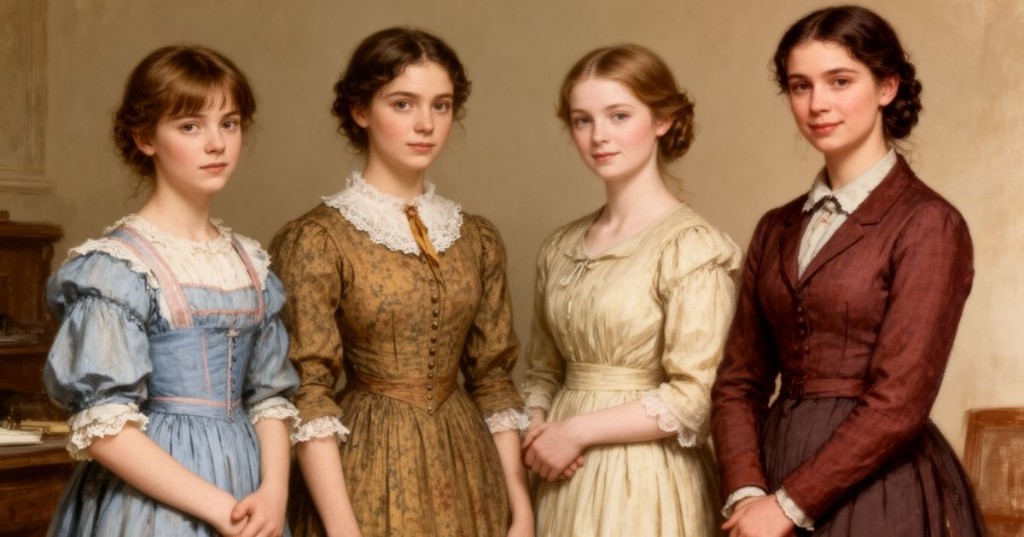
An excerpt from the original text.(complete · 2203 words)
CHAPTER FORTY-FIVE DAISY AND DEMI
I cannot feel that I have done my duty as humble historian of the March
family, without devoting at least one chapter to the two most precious
and important members of it. Daisy and Demi had now arrived at years of
discretion, for in this fast age babies of three or four assert their
rights, and get them, too, which is more than many of their elders do.
If there ever were a pair of twins in danger of being utterly spoiled
by adoration, it was these prattling Brookes. Of course they were the
most remarkable children ever born, as will be shown when I mention
that they walked at eight months, talked fluently at twelve months, and
at two years they took their places at table, and behaved with a
propriety which charmed all beholders. At three, Daisy demanded a
‘needler’, and actually made a bag with four stitches in it. She
likewise set up housekeeping in the sideboard, and managed a
microscopic cooking stove with a skill that brought tears of pride to
Hannah’s eyes, while Demi learned his letters with his grandfather, who
invented a new mode of teaching the alphabet by forming letters with
his arms and legs, thus uniting gymnastics for head and heels. The boy
early developed a mechanical genius which delighted his father and
distracted his mother, for he tried to imitate every machine he saw,
and kept the nursery in a chaotic condition, with his ‘sewinsheen’, a
mysterious structure of string, chairs, clothespins, and spools, for
wheels to go ‘wound and wound’. Also a basket hung over the back of a
chair, in which he vainly tried to hoist his too confiding sister, who,
with feminine devotion, allowed her little head to be bumped till
rescued, when the young inventor indignantly remarked, “Why, Marmar,
dat’s my lellywaiter, and me’s trying to pull her up.”
Though utterly unlike in character, the twins got on remarkably well
together, and seldom quarreled more than thrice a day. Of course, Demi
tyrannized over Daisy, and gallantly defended her from every other
aggressor, while Daisy made a galley slave of herself, and adored her
brother as the one perfect being in the world. A rosy, chubby, sunshiny
little soul was Daisy, who found her way to everybody’s heart, and
nestled there. One of the captivating children, who seem made to be
kissed and cuddled, adorned and adored like little goddesses, and
produced for general approval on all festive occasions. Her small
virtues were so sweet that she would have been quite angelic if a few
small naughtinesses had not kept her delightfully human. It was all
fair weather in her world, and every morning she scrambled up to the
window in her little nightgown to look out, and say, no matter whether
it rained or shone, “Oh, pitty day, oh, pitty day!” Everyone was a
friend, and she offered kisses to a stranger so confidingly that the
most inveterate bachelor relented, and baby-lovers became faithful
worshipers.
“Me loves evvybody,” she once said, opening her arms, with her spoon in
one hand, and her mug in the other, as if eager to embrace and nourish
the whole world.
As she grew, her mother began to feel that the Dovecote would be
blessed by the presence of an inmate as serene and loving as that which
had helped to make the old house home, and to pray that she might be
spared a loss like that which had lately taught them how long they had
entertained an angel unawares. Her grandfather often called her ‘Beth’,
and her grandmother watched over her with untiring devotion, as if
trying to atone for some past mistake, which no eye but her own could
see.
Demi, like a true Yankee, was of an inquiring turn, wanting to know
everything, and often getting much disturbed because he could not get
satisfactory answers to his perpetual “What for?”
He also possessed a philosophic bent, to the great delight of his
grandfather, who used to hold Socratic conversations with him, in which
the precocious pupil occasionally posed his teacher, to the undisguised
satisfaction of the womenfolk.
“What makes my legs go, Dranpa?” asked the young philosopher, surveying
those active portions of his frame with a meditative air, while resting
after a go-to-bed frolic one night.
“It’s your little mind, Demi,” replied the sage, stroking the yellow
head respectfully.
“What is a little mine?”
“It is something which makes your body move, as the spring made the
wheels go in my watch when I showed it to you.”
“Open me. I want to see it go wound.”
“I can’t do that any more than you could open the watch. God winds you
up, and you go till He stops you.”
“Does I?” and Demi’s brown eyes grew big and bright as he took in the
new thought. “Is I wounded up like the watch?”
“Yes, but I can’t show you how, for it is done when we don’t see.”
Demi felt his back, as if expecting to find it like that of the watch,
and then gravely remarked, “I dess Dod does it when I’s asleep.”
A careful explanation followed, to which he listened so attentively
that his anxious grandmother said, “My dear, do you think it wise to
talk about such things to that baby? He’s getting great bumps over his
eyes, and learning to ask the most unanswerable questions.”
“If he is old enough to ask the question he is old enough to receive
true answers. I am not putting the thoughts into his head, but helping
him unfold those already there. These children are wiser than we are,
and I have no doubt the boy understands every word I have said to him.
Now, Demi, tell me where you keep your mind.”
If the boy had replied like Alcibiades, “By the gods, Socrates, I
cannot tell,” his grandfather would not have been surprised, but when,
after standing a moment on one leg, like a meditative young stork, he
answered, in a tone of calm conviction, “In my little belly,” the old
gentleman could only join in Grandma’s laugh, and dismiss the class in
metaphysics.
There might have been cause for maternal anxiety, if Demi had not given
convincing proofs that he was a true boy, as well as a budding
philosopher, for often, after a discussion which caused Hannah to
prophesy, with ominous nods, “That child ain’t long for this world,” he
would turn about and set her fears at rest by some of the pranks with
which dear, dirty, naughty little rascals distract and delight their
parent’s souls.
Meg made many moral rules, and tried to keep them, but what mother was
ever proof against the winning wiles, the ingenious evasions, or the
tranquil audacity of the miniature men and women who so early show
themselves accomplished Artful Dodgers?
“No more raisins, Demi. They’ll make you sick,” says Mamma to the young
person who offers his services in the kitchen with unfailing regularity
on plum-pudding day.
“Me likes to be sick.”
“I don’t want to have you, so run away and help Daisy make patty
cakes.”
He reluctantly departs, but his wrongs weigh upon his spirit, and
by-and-by when an opportunity comes to redress them, he outwits Mamma
by a shrewd bargain.
“Now you have been good children, and I’ll play anything you like,”
says Meg, as she leads her assistant cooks upstairs, when the pudding
is safely bouncing in the pot.
“Truly, Marmar?” asks Demi, with a brilliant idea in his well-powdered
head.
“Yes, truly. Anything you say,” replies the shortsighted parent,
preparing herself to sing, “The Three Little Kittens” half a dozen
times over, or to take her family to “Buy a penny bun,” regardless of
wind or limb. But Demi corners her by the cool reply...
“Then we’ll go and eat up all the raisins.”
Aunt Dodo was chief playmate and confidante of both children, and the
trio turned the little house topsy-turvy. Aunt Amy was as yet only a
name to them, Aunt Beth soon faded into a pleasantly vague memory, but
Aunt Dodo was a living reality, and they made the most of her, for
which compliment she was deeply grateful. But when Mr. Bhaer came, Jo
neglected her playfellows, and dismay and desolation fell upon their
little souls. Daisy, who was fond of going about peddling kisses, lost
her best customer and became bankrupt. Demi, with infantile
penetration, soon discovered that Dodo like to play with ‘the bear-man’
better than she did him, but though hurt, he concealed his anguish, for
he hadn’t the heart to insult a rival who kept a mine of chocolate
drops in his waistcoat pocket, and a watch that could be taken out of
its case and freely shaken by ardent admirers.
Some persons might have considered these pleasing liberties as bribes,
but Demi didn’t see it in that light, and continued to patronize the
‘the bear-man’ with pensive affability, while Daisy bestowed her small
affections upon him at the third call, and considered his shoulder her
throne, his arm her refuge, his gifts treasures surpassing worth.
Gentlemen are sometimes seized with sudden fits of admiration for the
young relatives of ladies whom they honor with their regard, but this
counterfeit philoprogenitiveness sits uneasily upon them, and does not
deceive anybody a particle. Mr. Bhaer’s devotion was sincere, however
likewise effective—for honesty is the best policy in love as in law. He
was one of the men who are at home with children, and looked
particularly well when little faces made a pleasant contrast with his
manly one. His business, whatever it was, detained him from day to day,
but evening seldom failed to bring him out to see—well, he always asked
for Mr. March, so I suppose he was the attraction. The excellent papa
labored under the delusion that he was, and reveled in long discussions
with the kindred spirit, till a chance remark of his more observing
grandson suddenly enlightened him.
Mr. Bhaer came in one evening to pause on the threshold of the study,
astonished by the spectacle that met his eye. Prone upon the floor lay
Mr. March, with his respectable legs in the air, and beside him,
likewise prone, was Demi, trying to imitate the attitude with his own
short, scarlet-stockinged legs, both grovelers so seriously absorbed
that they were unconscious of spectators, till Mr. Bhaer laughed his
sonorous laugh, and Jo cried out, with a scandalized face...
“Father, Father, here’s the Professor!”
Down went the black legs and up came the gray head, as the preceptor
said, with undisturbed dignity, “Good evening, Mr. Bhaer. Excuse me for
a moment. We are just finishing our lesson. Now, Demi, make the letter
and tell its name.”
“I knows him!” and, after a few convulsive efforts, the red legs took
the shape of a pair of compasses, and the intelligent pupil
triumphantly shouted, “It’s a We, Dranpa, it’s a We!”
“He’s a born Weller,” laughed Jo, as her parent gathered himself up,
and her nephew tried to stand on his head, as the only mode of
expressing his satisfaction that school was over.
“What have you been at today, bubchen?” asked Mr. Bhaer, picking up the
gymnast.
“Me went to see little Mary.”
“And what did you there?”
“I kissed her,” began Demi, with artless frankness.
“Prut! Thou beginnest early. What did the little Mary say to that?”
asked Mr. Bhaer, continuing to confess the young sinner, who stood upon
the knee, exploring the waistcoat pocket.
“Oh, she liked it, and she kissed me, and I liked it. Don’t little boys
like little girls?” asked Demi, with his mouth full, and an air of
bland satisfaction.
“You precocious chick! Who put that into your head?” said Jo, enjoying
the innocent revelation as much as the Professor.
“’Tisn’t in mine head, it’s in mine mouf,” answered literal Demi,
putting out his tongue, with a chocolate drop on it, thinking she
alluded to confectionery, not ideas.
“Thou shouldst save some for the little friend. Sweets to the sweet,
mannling,” and Mr. Bhaer offered Jo some, with a look that made her
wonder if chocolate was not the nectar drunk by the gods. Demi also saw
the smile, was impressed by it, and artlessy inquired. ..
“Do great boys like great girls, to, ’Fessor?”
Like young Washington, Mr. Bhaer ‘couldn’t tell a lie’, so he gave the
somewhat vague reply that he believed they did sometimes, in a tone
that made Mr. March put down his clothesbrush, glance at Jo’s retiring
face, and then sink into his chair, looking as if the ‘precocious
chick’ had put an idea into his head that was both sweet and sour.
Why Dodo, when she caught him in the china closet half an hour
afterward, nearly squeezed the breath out of his little body with a
tender embrace, instead of shaking him for being there, and why she
followed up this novel performance by the unexpected gift of a big
slice of bread and jelly, remained one of the problems over which Demi
puzzled his small wits, and was forced to leave unsolved forever.
Master this chapter. Complete your experience
Purchase the complete book to access all chapters and support classic literature
As an Amazon Associate, we earn a small commission from qualifying purchases at no additional cost to you.
Available in paperback, hardcover, and e-book formats
Let's Analyse the Pattern
The Mirror of Innocence - When Children Reveal Adult Truth
Children and vulnerable beings instinctively respond to authentic character, serving as truth detectors that cut through adult pretense.
Why This Matters
Connect literature to life
This chapter teaches how to distinguish between genuine care and performed kindness by observing how people treat those who can't benefit them.
Practice This Today
This week, notice how potential partners, friends, or colleagues interact with service workers, elderly people, or children—their unguarded behavior reveals their true character.
Now let's explore the literary elements.
Key Quotes & Analysis
"If there ever were a pair of twins in danger of being utterly spoiled by adoration, it was these prattling Brookes."
Context: Opening description of how the entire family dotes on the twins
This sets up the central tension of the chapter - how children can be loved so much it might harm them. Yet it also shows the joy these children bring to a family that has known loss and hardship.
In Today's Words:
These kids were so adorable that everyone was ready to spoil them rotten.
"Do great boys like great girls?"
Context: An innocent question that forces uncomfortable truths about Jo and Mr. Bhaer's relationship into the open
Children's directness often cuts through adult pretense and denial. This simple question reveals what everyone can see but no one will say - that Jo and the Professor have feelings for each other.
In Today's Words:
Do grown-up guys like grown-up girls the same way?
"The boy early developed a mechanical genius which delighted his father and distracted his mother."
Context: Describing Demi's constant need to build and take things apart
This captures the different ways parents react to the same child behavior - what thrills one parent can stress out the other. It shows how children's natural talents can create both pride and chaos.
In Today's Words:
The kid was always building stuff, which his dad loved but drove his mom crazy.
Thematic Threads
Authenticity
In This Chapter
Mr. Bhaer's natural ease with the twins contrasts with others' awkward performances around children
Development
Building from Jo's journey toward authentic self-expression
In Your Life:
You might notice how children or vulnerable patients respond differently to you when you're genuinely present versus going through motions.
Truth
In This Chapter
Demi's innocent question about whether 'great boys like great girls' forces hidden feelings into the open
Development
Continues the theme of truth emerging through unexpected channels
In Your Life:
You might find that honest questions from children or naive colleagues reveal truths others are avoiding.
Growth
In This Chapter
Jo's changing priorities as she neglects the twins for the Professor show her maturing focus
Development
Part of Jo's ongoing evolution from girl to woman
In Your Life:
You might recognize when your attention shifts signal deeper changes in your values and priorities.
Family
In This Chapter
The twins represent continuity and hope as the next generation of the March family legacy
Development
Evolution from the original four sisters to the expanding family circle
In Your Life:
You might see how children in your family carry forward values and traits from previous generations.
Wisdom
In This Chapter
Demi's philosophical conversations with his grandfather show how children possess unclouded insight
Development
Introduced here as a new perspective on intelligence and understanding
In Your Life:
You might notice how children ask the questions adults are afraid to voice, cutting straight to core issues.
You now have the context. Time to form your own thoughts.
Discussion Questions
- 1
How do Daisy and Demi react differently to Mr. Bhaer compared to other adults who visit the March family?
analysis • surface - 2
Why do you think children like Daisy and Demi can immediately sense who genuinely cares about them versus who is just being polite?
analysis • medium - 3
Think about your workplace or community - where have you seen children or vulnerable people gravitate toward certain adults while avoiding others who seem equally 'nice'?
application • medium - 4
When Demi asks if 'great boys like great girls,' he forces adults to confront hidden truths. How can you use children's honest questions to better understand situations in your own life?
application • deep - 5
What does this chapter reveal about the difference between performing care and genuinely feeling it, and why does this distinction matter in relationships?
reflection • deep
Critical Thinking Exercise
Test Your Authenticity Detector
Think of three people in your life who interact with children, elderly relatives, or new employees. Write down how these vulnerable groups respond to each person. Look for patterns - do children light up around one person but seem cautious with another? Do new coworkers immediately trust one supervisor but keep their guard up with someone else? Use these observations to identify who possesses genuine care versus who performs it.
Consider:
- •Children and vulnerable people haven't learned to ignore their instincts yet
- •Pay attention to body language and energy, not just words
- •Someone can say all the right things but still make others uncomfortable
Journaling Prompt
Write about a time when you initially trusted someone because they seemed nice, but children or animals around them acted differently. What did you learn from that experience about reading people's true character?
Coming Up Next...
Chapter 46: Love Under the Umbrella
The romantic tension that Demi innocently exposed reaches a crescendo as Jo and Professor Bhaer find themselves alone under an umbrella. Sometimes the most important conversations happen when you're caught in the rain with nowhere to hide.



