
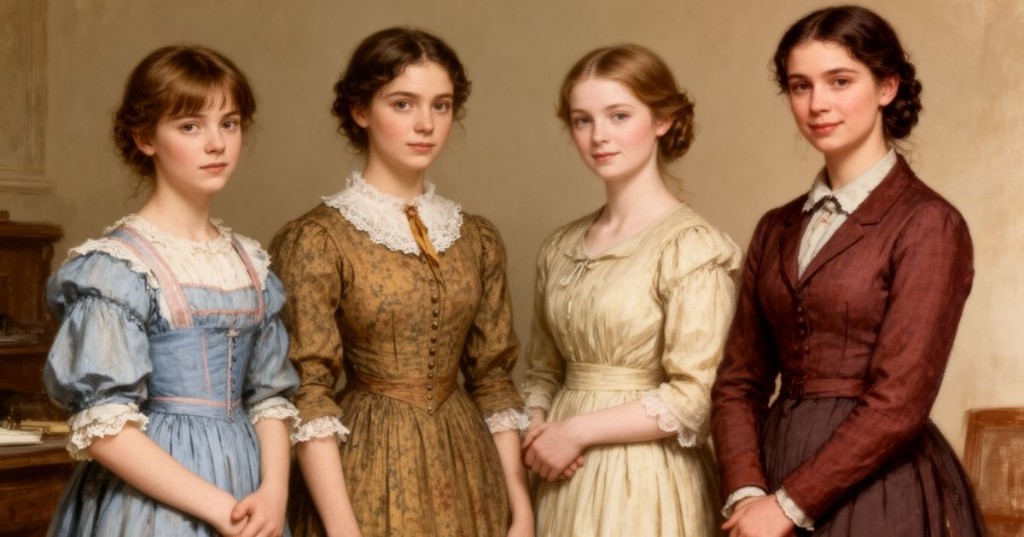
An excerpt from the original text.(complete · 1921 words)
CHAPTER FORTY-FOUR MY LORD AND LADY
“Please, Madam Mother, could you lend me my wife for half an hour? The
luggage has come, and I’ve been making hay of Amy’s Paris finery,
trying to find some things I want,” said Laurie, coming in the next day
to find Mrs. Laurence sitting in her mother’s lap, as if being made
‘the baby’ again.
“Certainly. Go, dear, I forgot that you have any home but this,” and
Mrs. March pressed the white hand that wore the wedding ring, as if
asking pardon for her maternal covetousness.
“I shouldn’t have come over if I could have helped it, but I can’t get
on without my little woman any more than a...”
“Weathercock can without the wind,” suggested Jo, as he paused for a
simile. Jo had grown quite her own saucy self again since Teddy came
home.
“Exactly, for Amy keeps me pointing due west most of the time, with
only an occasional whiffle round to the south, and I haven’t had an
easterly spell since I was married. Don’t know anything about the
north, but am altogether salubrious and balmy, hey, my lady?”
“Lovely weather so far. I don’t know how long it will last, but I’m not
afraid of storms, for I’m learning how to sail my ship. Come home,
dear, and I’ll find your bootjack. I suppose that’s what you are
rummaging after among my things. Men are so helpless, Mother,” said
Amy, with a matronly air, which delighted her husband.
“What are you going to do with yourselves after you get settled?” asked
Jo, buttoning Amy’s cloak as she used to button her pinafores.
“We have our plans. We don’t mean to say much about them yet, because
we are such very new brooms, but we don’t intend to be idle. I’m going
into business with a devotion that shall delight Grandfather, and prove
to him that I’m not spoiled. I need something of the sort to keep me
steady. I’m tired of dawdling, and mean to work like a man.”
“And Amy, what is she going to do?” asked Mrs. March, well pleased at
Laurie’s decision and the energy with which he spoke.
“After doing the civil all round, and airing our best bonnet, we shall
astonish you by the elegant hospitalities of our mansion, the brilliant
society we shall draw about us, and the beneficial influence we shall
exert over the world at large. That’s about it, isn’t it, Madame
Recamier?” asked Laurie with a quizzical look at Amy.
“Time will show. Come away, Impertinence, and don’t shock my family by
calling me names before their faces,” answered Amy, resolving that
there should be a home with a good wife in it before she set up a salon
as a queen of society.
“How happy those children seem together!” observed Mr. March, finding
it difficult to become absorbed in his Aristotle after the young couple
had gone.
“Yes, and I think it will last,” added Mrs. March, with the restful
expression of a pilot who has brought a ship safely into port.
“I know it will. Happy Amy!” and Jo sighed, then smiled brightly as
Professor Bhaer opened the gate with an impatient push.
Later in the evening, when his mind had been set at rest about the
bootjack, Laurie said suddenly to his wife, “Mrs. Laurence.”
“My Lord!”
“That man intends to marry our Jo!”
“I hope so, don’t you, dear?”
“Well, my love, I consider him a trump, in the fullest sense of that
expressive word, but I do wish he was a little younger and a good deal
richer.”
“Now, Laurie, don’t be too fastidious and worldly-minded. If they love
one another it doesn’t matter a particle how old they are nor how poor.
Women never should marry for money...” Amy caught herself up short as
the words escaped her, and looked at her husband, who replied, with
malicious gravity...
“Certainly not, though you do hear charming girls say that they intend
to do it sometimes. If my memory serves me, you once thought it your
duty to make a rich match. That accounts, perhaps, for your marrying a
good-for-nothing like me.”
“Oh, my dearest boy, don’t, don’t say that! I forgot you were rich when
I said ‘Yes’. I’d have married you if you hadn’t a penny, and I
sometimes wish you were poor that I might show how much I love you.”
And Amy, who was very dignified in public and very fond in private,
gave convincing proofs of the truth of her words.
“You don’t really think I am such a mercenary creature as I tried to be
once, do you? It would break my heart if you didn’t believe that I’d
gladly pull in the same boat with you, even if you had to get your
living by rowing on the lake.”
“Am I an idiot and a brute? How could I think so, when you refused a
richer man for me, and won’t let me give you half I want to now, when I
have the right? Girls do it every day, poor things, and are taught to
think it is their only salvation, but you had better lessons, and
though I trembled for you at one time, I was not disappointed, for the
daughter was true to the mother’s teaching. I told Mamma so yesterday,
and she looked as glad and grateful as if I’d given her a check for a
million, to be spent in charity. You are not listening to my moral
remarks, Mrs. Laurence,” and Laurie paused, for Amy’s eyes had an
absent look, though fixed upon his face.
“Yes, I am, and admiring the mole in your chin at the same time. I
don’t wish to make you vain, but I must confess that I’m prouder of my
handsome husband than of all his money. Don’t laugh, but your nose is
such a comfort to me,” and Amy softly caressed the well-cut feature
with artistic satisfaction.
Laurie had received many compliments in his life, but never one that
suited him better, as he plainly showed though he did laugh at his
wife’s peculiar taste, while she said slowly, “May I ask you a
question, dear?”
“Of course, you may.”
“Shall you care if Jo does marry Mr. Bhaer?”
“Oh, that’s the trouble is it? I thought there was something in the
dimple that didn’t quite suit you. Not being a dog in the manger, but
the happiest fellow alive, I assure you I can dance at Jo’s wedding
with a heart as light as my heels. Do you doubt it, my darling?”
Amy looked up at him, and was satisfied. Her little jealous fear
vanished forever, and she thanked him, with a face full of love and
confidence.
“I wish we could do something for that capital old Professor. Couldn’t
we invent a rich relation, who shall obligingly die out there in
Germany, and leave him a tidy little fortune?” said Laurie, when they
began to pace up and down the long drawing room, arm in arm, as they
were fond of doing, in memory of the chateau garden.
“Jo would find us out, and spoil it all. She is very proud of him, just
as he is, and said yesterday that she thought poverty was a beautiful
thing.”
“Bless her dear heart! She won’t think so when she has a literary
husband, and a dozen little professors and professorins to support. We
won’t interfere now, but watch our chance, and do them a good turn in
spite of themselves. I owe Jo for a part of my education, and she
believes in people’s paying their honest debts, so I’ll get round her
in that way.”
“How delightful it is to be able to help others, isn’t it? That was
always one of my dreams, to have the power of giving freely, and thanks
to you, the dream has come true.”
“Ah, we’ll do quantities of good, won’t we? There’s one sort of poverty
that I particularly like to help. Out-and-out beggars get taken care
of, but poor gentle folks fare badly, because they won’t ask, and
people don’t dare to offer charity. Yet there are a thousand ways of
helping them, if one only knows how to do it so delicately that it does
not offend. I must say, I like to serve a decayed gentleman better than
a blarnerying beggar. I suppose it’s wrong, but I do, though it is
harder.”
“Because it takes a gentleman to do it,” added the other member of the
domestic admiration society.
“Thank you, I’m afraid I don’t deserve that pretty compliment. But I
was going to say that while I was dawdling about abroad, I saw a good
many talented young fellows making all sorts of sacrifices, and
enduring real hardships, that they might realize their dreams. Splendid
fellows, some of them, working like heros, poor and friendless, but so
full of courage, patience, and ambition that I was ashamed of myself,
and longed to give them a right good lift. Those are people whom it’s a
satisfaction to help, for if they’ve got genius, it’s an honor to be
allowed to serve them, and not let it be lost or delayed for want of
fuel to keep the pot boiling. If they haven’t, it’s a pleasure to
comfort the poor souls, and keep them from despair when they find it
out.”
“Yes, indeed, and there’s another class who can’t ask, and who suffer
in silence. I know something of it, for I belonged to it before you
made a princess of me, as the king does the beggarmaid in the old
story. Ambitious girls have a hard time, Laurie, and often have to see
youth, health, and precious opportunities go by, just for want of a
little help at the right minute. People have been very kind to me, and
whenever I see girls struggling along, as we used to do, I want to put
out my hand and help them, as I was helped.”
“And so you shall, like an angel as you are!” cried Laurie, resolving,
with a glow of philanthropic zeal, to found and endow an institution
for the express benefit of young women with artistic tendencies. “Rich
people have no right to sit down and enjoy themselves, or let their
money accumulate for others to waste. It’s not half so sensible to
leave legacies when one dies as it is to use the money wisely while
alive, and enjoy making one’s fellow creatures happy with it. We’ll
have a good time ourselves, and add an extra relish to our own pleasure
by giving other people a generous taste. Will you be a little Dorcas,
going about emptying a big basket of comforts, and filling it up with
good deeds?”
“With all my heart, if you will be a brave St. Martin, stopping as you
ride gallantly through the world to share your cloak with the beggar.”
“It’s a bargain, and we shall get the best of it!”
So the young pair shook hands upon it, and then paced happily on again,
feeling that their pleasant home was more homelike because they hoped
to brighten other homes, believing that their own feet would walk more
uprightly along the flowery path before them, if they smoothed rough
ways for other feet, and feeling that their hearts were more closely
knit together by a love which could tenderly remember those less blest
than they.
Master this chapter. Complete your experience
Purchase the complete book to access all chapters and support classic literature
As an Amazon Associate, we earn a small commission from qualifying purchases at no additional cost to you.
Available in paperback, hardcover, and e-book formats
Let's Analyse the Pattern
When genuine partnership moves beyond individual benefit to create shared purpose that serves others.
Why This Matters
Connect literature to life
This chapter teaches how to identify relationships that transform individual privilege or success into shared purpose rather than just personal comfort.
Practice This Today
This week, notice when couples or partnerships focus their conversations on 'what can we build together' rather than 'what can we get for ourselves'—these are the relationships that create lasting fulfillment.
Now let's explore the literary elements.
Key Quotes & Analysis
"I'm learning how to sail my ship"
Context: When Laurie compares himself to a weathervane following Amy's direction
Amy shows she's not just following Laurie's lead but actively learning to navigate marriage as an equal partner. She's taking responsibility for steering their relationship.
In Today's Words:
I'm figuring out how to handle this marriage thing and be a real partner
"We'll be a sort of bank for those who can't get help any other way"
Context: Discussing how to use their wealth to help struggling artists and proud families
Amy recognizes that some people need help but won't ask for charity directly. She's creating a system that preserves dignity while providing support.
In Today's Words:
We'll help people who are too proud to ask for handouts by finding ways that don't make them feel like charity cases
"I may not be a great artist, but I can help those who are better than I"
Context: Reflecting on her own artistic limitations while planning to support others
Shows remarkable self-awareness and maturity. Amy has accepted her limitations without bitterness and found meaning in enabling others' success.
In Today's Words:
I'll never be the star, but I can use what I have to help people with real talent make it
Thematic Threads
Personal Growth
In This Chapter
Amy and Laurie have matured from spoiled young people into thoughtful partners with genuine concern for others
Development
Culmination of both characters' growth arcs—Amy from vanity to depth, Laurie from aimlessness to purpose
In Your Life:
You might notice how your own relationships either keep you stuck in old patterns or push you to become better.
Class
In This Chapter
The couple grapples with using their wealth responsibly, wanting to help 'poor gentle folks' without condescension
Development
Evolved from earlier class tensions to mature understanding of privilege and responsibility
In Your Life:
You might recognize the awkwardness of having advantages others don't, and wanting to help without seeming superior.
Human Relationships
In This Chapter
Their marriage has healed old wounds and jealousies, particularly Laurie's past feelings for Jo
Development
Resolution of the complex romantic dynamics that drove much of the earlier plot
In Your Life:
You might see how healthy relationships can actually heal pain from previous relationships or rejections.
Social Expectations
In This Chapter
They're choosing to use their position for service rather than just enjoying their privileged status
Development
Subversion of typical wealthy couple expectations—they're rejecting pure leisure for meaningful work
In Your Life:
You might feel pressure to use any success you achieve just for personal comfort rather than helping others.
Identity
In This Chapter
Both have found their true selves through partnership—Amy as supporter of artists, Laurie as serious businessman
Development
Final crystallization of who they're meant to be, discovered through love rather than individual searching
In Your Life:
You might notice how the right relationships help you discover parts of yourself you didn't know existed.
You now have the context. Time to form your own thoughts.
Discussion Questions
- 1
How have Amy and Laurie changed from the people they were before their marriage?
analysis • surface - 2
Why does their wealth feel like a responsibility to them now rather than just a privilege?
analysis • medium - 3
Where do you see couples today who use their combined strengths to help others rather than just themselves?
application • medium - 4
If you had more resources than you needed, how would you decide who to help and how?
application • deep - 5
What does this chapter suggest about how real love changes people's priorities?
reflection • deep
Critical Thinking Exercise
Design Your Partnership Mission
Think about a meaningful relationship in your life - romantic, friendship, or work partnership. Write down what each person brings to the table, then brainstorm three small ways you could combine your strengths to help someone else. This isn't about grand gestures - it's about recognizing how partnership can amplify impact.
Consider:
- •Consider what you've learned from your own struggles that others might benefit from
- •Think about resources you take for granted that others might desperately need
- •Focus on sustainable help that builds people up rather than creates dependence
Journaling Prompt
Write about a time when someone helped you in a way that felt respectful rather than pitying. What made their approach work? How could you offer that same kind of support to others?
Coming Up Next...
Chapter 45: The Next Generation's Wisdom
The focus shifts to the next generation as we meet Daisy and Demi, Meg's twins, whose personalities and antics reveal how the March family legacy continues through the children.



