
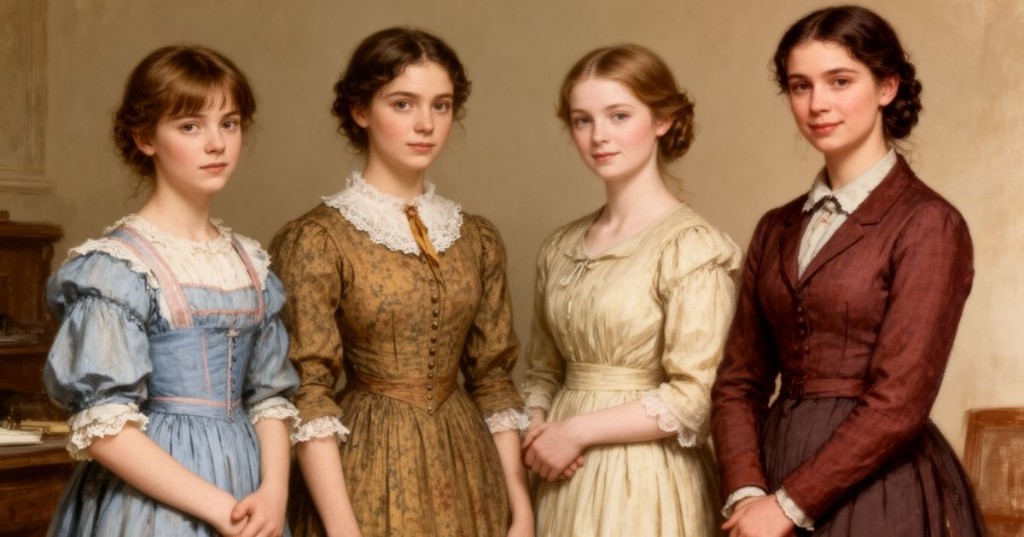
An excerpt from the original text.(complete · 6188 words)
CHAPTER FORTY-THREE SURPRISES
Jo was alone in the twilight, lying on the old sofa, looking at the
fire, and thinking. It was her favorite way of spending the hour of
dusk. No one disturbed her, and she used to lie there on Beth’s little
red pillow, planning stories, dreaming dreams, or thinking tender
thoughts of the sister who never seemed far away. Her face looked
tired, grave, and rather sad, for tomorrow was her birthday, and she
was thinking how fast the years went by, how old she was getting, and
how little she seemed to have accomplished. Almost twenty-five, and
nothing to show for it. Jo was mistaken in that. There was a good deal
to show, and by-and-by she saw, and was grateful for it.
“An old maid, that’s what I’m to be. A literary spinster, with a pen
for a spouse, a family of stories for children, and twenty years hence
a morsel of fame, perhaps, when, like poor Johnson, I’m old and can’t
enjoy it, solitary, and can’t share it, independent, and don’t need it.
Well, I needn’t be a sour saint nor a selfish sinner, and, I dare say,
old maids are very comfortable when they get used to it, but...” and
there Jo sighed, as if the prospect was not inviting.
It seldom is, at first, and thirty seems the end of all things to
five-and-twenty. But it’s not as bad as it looks, and one can get on
quite happily if one has something in one’s self to fall back upon. At
twenty-five, girls begin to talk about being old maids, but secretly
resolve that they never will be. At thirty they say nothing about it,
but quietly accept the fact, and if sensible, console themselves by
remembering that they have twenty more useful, happy years, in which
they may be learning to grow old gracefully. Don’t laugh at the
spinsters, dear girls, for often very tender, tragic romances are
hidden away in the hearts that beat so quietly under the sober gowns,
and many silent sacrifices of youth, health, ambition, love itself,
make the faded faces beautiful in God’s sight. Even the sad, sour
sisters should be kindly dealt with, because they have missed the
sweetest part of life, if for no other reason. And looking at them with
compassion, not contempt, girls in their bloom should remember that
they too may miss the blossom time. That rosy cheeks don’t last
forever, that silver threads will come in the bonnie brown hair, and
that, by-and-by, kindness and respect will be as sweet as love and
admiration now.
Gentlemen, which means boys, be courteous to the old maids, no matter
how poor and plain and prim, for the only chivalry worth having is that
which is the readiest to pay deference to the old, protect the feeble,
and serve womankind, regardless of rank, age, or color. Just recollect
the good aunts who have not only lectured and fussed, but nursed and
petted, too often without thanks, the scrapes they have helped you out
of, the tips they have given you from their small store, the stitches
the patient old fingers have set for you, the steps the willing old
feet have taken, and gratefully pay the dear old ladies the little
attentions that women love to receive as long as they live. The
bright-eyed girls are quick to see such traits, and will like you all
the better for them, and if death, almost the only power that can part
mother and son, should rob you of yours, you will be sure to find a
tender welcome and maternal cherishing from some Aunt Priscilla, who
has kept the warmest corner of her lonely old heart for ‘the best nevvy
in the world’.
Jo must have fallen asleep (as I dare say my reader has during this
little homily), for suddenly Laurie’s ghost seemed to stand before her,
a substantial, lifelike ghost, leaning over her with the very look he
used to wear when he felt a good deal and didn’t like to show it. But,
like Jenny in the ballad...
“She could not think it he,”
and lay staring up at him in startled silence, till he stooped and
kissed her. Then she knew him, and flew up, crying joyfully...
“Oh my Teddy! Oh my Teddy!”
“Dear Jo, you are glad to see me, then?”
“Glad! My blessed boy, words can’t express my gladness. Where’s Amy?”
“Your mother has got her down at Meg’s. We stopped there by the way,
and there was no getting my wife out of their clutches.”
“Your what?” cried Jo, for Laurie uttered those two words with an
unconscious pride and satisfaction which betrayed him.
“Oh, the dickens! Now I’ve done it,” and he looked so guilty that Jo
was down on him like a flash.
“You’ve gone and got married!”
“Yes, please, but I never will again,” and he went down upon his knees,
with a penitent clasping of hands, and a face full of mischief, mirth,
and triumph.
“Actually married?”
“Very much so, thank you.”
“Mercy on us. What dreadful thing will you do next?” and Jo fell into
her seat with a gasp.
“A characteristic, but not exactly complimentary, congratulation,”
returned Laurie, still in an abject attitude, but beaming with
satisfaction.
“What can you expect, when you take one’s breath away, creeping in like
a burglar, and letting cats out of bags like that? Get up, you
ridiculous boy, and tell me all about it.”
“Not a word, unless you let me come in my old place, and promise not to
barricade.”
Jo laughed at that as she had not done for many a long day, and patted
the sofa invitingly, as she said in a cordial tone, “The old pillow is
up garret, and we don’t need it now. So, come and ’fess, Teddy.”
“How good it sounds to hear you say ‘Teddy’! No one ever calls me that
but you,” and Laurie sat down with an air of great content.
“What does Amy call you?”
“My lord.”
“That’s like her. Well, you look it,” and Jo’s eye plainly betrayed
that she found her boy comelier than ever.
The pillow was gone, but there was a barricade, nevertheless, a natural
one, raised by time, absence, and change of heart. Both felt it, and
for a minute looked at one another as if that invisible barrier cast a
little shadow over them. It was gone directly however, for Laurie said,
with a vain attempt at dignity...
“Don’t I look like a married man and the head of a family?”
“Not a bit, and you never will. You’ve grown bigger and bonnier, but
you are the same scapegrace as ever.”
“Now really, Jo, you ought to treat me with more respect,” began
Laurie, who enjoyed it all immensely.
“How can I, when the mere idea of you, married and settled, is so
irresistibly funny that I can’t keep sober!” answered Jo, smiling all
over her face, so infectiously that they had another laugh, and then
settled down for a good talk, quite in the pleasant old fashion.
“It’s no use your going out in the cold to get Amy, for they are all
coming up presently. I couldn’t wait. I wanted to be the one to tell
you the grand surprise, and have ‘first skim’ as we used to say when we
squabbled about the cream.”
“Of course you did, and spoiled your story by beginning at the wrong
end. Now, start right, and tell me how it all happened. I’m pining to
know.”
“Well, I did it to please Amy,” began Laurie, with a twinkle that made
Jo exclaim...
“Fib number one. Amy did it to please you. Go on, and tell the truth,
if you can, sir.”
“Now she’s beginning to marm it. Isn’t it jolly to hear her?” said
Laurie to the fire, and the fire glowed and sparkled as if it quite
agreed. “It’s all the same, you know, she and I being one. We planned
to come home with the Carrols, a month or more ago, but they suddenly
changed their minds, and decided to pass another winter in Paris. But
Grandpa wanted to come home. He went to please me, and I couldn’t let
him go alone, neither could I leave Amy, and Mrs. Carrol had got
English notions about chaperons and such nonsense, and wouldn’t let Amy
come with us. So I just settled the difficulty by saying, ‘Let’s be
married, and then we can do as we like’.”
“Of course you did. You always have things to suit you.”
“Not always,” and something in Laurie’s voice made Jo say hastily...
“How did you ever get Aunt to agree?”
“It was hard work, but between us, we talked her over, for we had heaps
of good reasons on our side. There wasn’t time to write and ask leave,
but you all liked it, had consented to it by-and-by, and it was only
‘taking time by the fetlock’, as my wife says.”
“Aren’t we proud of those two words, and don’t we like to say them?”
interrupted Jo, addressing the fire in her turn, and watching with
delight the happy light it seemed to kindle in the eyes that had been
so tragically gloomy when she saw them last.
“A trifle, perhaps, she’s such a captivating little woman I can’t help
being proud of her. Well, then Uncle and Aunt were there to play
propriety. We were so absorbed in one another we were of no mortal use
apart, and that charming arrangement would make everything easy all
round, so we did it.”
“When, where, how?” asked Jo, in a fever of feminine interest and
curiosity, for she could not realize it a particle.
“Six weeks ago, at the American consul’s, in Paris, a very quiet
wedding of course, for even in our happiness we didn’t forget dear
little Beth.”
Jo put her hand in his as he said that, and Laurie gently smoothed the
little red pillow, which he remembered well.
“Why didn’t you let us know afterward?” asked Jo, in a quieter tone,
when they had sat quite still a minute.
“We wanted to surprise you. We thought we were coming directly home, at
first, but the dear old gentleman, as soon as we were married, found he
couldn’t be ready under a month, at least, and sent us off to spend our
honeymoon wherever we liked. Amy had once called Valrosa a regular
honeymoon home, so we went there, and were as happy as people are but
once in their lives. My faith! Wasn’t it love among the roses!”
Laurie seemed to forget Jo for a minute, and Jo was glad of it, for the
fact that he told her these things so freely and so naturally assured
her that he had quite forgiven and forgotten. She tried to draw away
her hand, but as if he guessed the thought that prompted the
half-involuntary impulse, Laurie held it fast, and said, with a manly
gravity she had never seen in him before...
“Jo, dear, I want to say one thing, and then we’ll put it by forever.
As I told you in my letter when I wrote that Amy had been so kind to
me, I never shall stop loving you, but the love is altered, and I have
learned to see that it is better as it is. Amy and you changed places
in my heart, that’s all. I think it was meant to be so, and would have
come about naturally, if I had waited, as you tried to make me, but I
never could be patient, and so I got a heartache. I was a boy then,
headstrong and violent, and it took a hard lesson to show me my
mistake. For it was one, Jo, as you said, and I found it out, after
making a fool of myself. Upon my word, I was so tumbled up in my mind,
at one time, that I didn’t know which I loved best, you or Amy, and
tried to love you both alike. But I couldn’t, and when I saw her in
Switzerland, everything seemed to clear up all at once. You both got
into your right places, and I felt sure that it was well off with the
old love before it was on with the new, that I could honestly share my
heart between sister Jo and wife Amy, and love them dearly. Will you
believe it, and go back to the happy old times when we first knew one
another?”
“I’ll believe it, with all my heart, but, Teddy, we never can be boy
and girl again. The happy old times can’t come back, and we mustn’t
expect it. We are man and woman now, with sober work to do, for
playtime is over, and we must give up frolicking. I’m sure you feel
this. I see the change in you, and you’ll find it in me. I shall miss
my boy, but I shall love the man as much, and admire him more, because
he means to be what I hoped he would. We can’t be little playmates any
longer, but we will be brother and sister, to love and help one another
all our lives, won’t we, Laurie?”
He did not say a word, but took the hand she offered him, and laid his
face down on it for a minute, feeling that out of the grave of a boyish
passion, there had risen a beautiful, strong friendship to bless them
both. Presently Jo said cheerfully, for she didn’t want the coming home
to be a sad one, “I can’t make it true that you children are really
married and going to set up housekeeping. Why, it seems only yesterday
that I was buttoning Amy’s pinafore, and pulling your hair when you
teased. Mercy me, how time does fly!”
“As one of the children is older than yourself, you needn’t talk so
like a grandma. I flatter myself I’m a ‘gentleman growed’ as Peggotty
said of David, and when you see Amy, you’ll find her rather a
precocious infant,” said Laurie, looking amused at her maternal air.
“You may be a little older in years, but I’m ever so much older in
feeling, Teddy. Women always are, and this last year has been such a
hard one that I feel forty.”
“Poor Jo! We left you to bear it alone, while we went pleasuring. You
are older. Here’s a line, and there’s another. Unless you smile, your
eyes look sad, and when I touched the cushion, just now, I found a tear
on it. You’ve had a great deal to bear, and had to bear it all alone.
What a selfish beast I’ve been!” and Laurie pulled his own hair, with a
remorseful look.
But Jo only turned over the traitorous pillow, and answered, in a tone
which she tried to make more cheerful, “No, I had Father and Mother to
help me, and the dear babies to comfort me, and the thought that you
and Amy were safe and happy, to make the troubles here easier to bear.
I am lonely, sometimes, but I dare say it’s good for me, and...”
“You never shall be again,” broke in Laurie, putting his arm about her,
as if to fence out every human ill. “Amy and I can’t get on without
you, so you must come and teach ‘the children’ to keep house, and go
halves in everything, just as we used to do, and let us pet you, and
all be blissfully happy and friendly together.”
“If I shouldn’t be in the way, it would be very pleasant. I begin to
feel quite young already, for somehow all my troubles seemed to fly
away when you came. You always were a comfort, Teddy,” and Jo leaned
her head on his shoulder, just as she did years ago, when Beth lay ill
and Laurie told her to hold on to him.
He looked down at her, wondering if she remembered the time, but Jo was
smiling to herself, as if in truth her troubles had all vanished at his
coming.
“You are the same Jo still, dropping tears about one minute, and
laughing the next. You look a little wicked now. What is it, Grandma?”
“I was wondering how you and Amy get on together.”
“Like angels!”
“Yes, of course, but which rules?”
“I don’t mind telling you that she does now, at least I let her think
so, it pleases her, you know. By-and-by we shall take turns, for
marriage, they say, halves one’s rights and doubles one’s duties.”
“You’ll go on as you begin, and Amy will rule you all the days of your
life.”
“Well, she does it so imperceptibly that I don’t think I shall mind
much. She is the sort of woman who knows how to rule well. In fact, I
rather like it, for she winds one round her finger as softly and
prettily as a skein of silk, and makes you feel as if she was doing you
a favor all the while.”
“That ever I should live to see you a henpecked husband and enjoying
it!” cried Jo, with uplifted hands.
It was good to see Laurie square his shoulders, and smile with
masculine scorn at that insinuation, as he replied, with his “high and
mighty” air, “Amy is too well-bred for that, and I am not the sort of
man to submit to it. My wife and I respect ourselves and one another
too much ever to tyrannize or quarrel.”
Jo liked that, and thought the new dignity very becoming, but the boy
seemed changing very fast into the man, and regret mingled with her
pleasure.
“I am sure of that. Amy and you never did quarrel as we used to. She is
the sun and I the wind, in the fable, and the sun managed the man best,
you remember.”
“She can blow him up as well as shine on him,” laughed Laurie. “Such a
lecture as I got at Nice! I give you my word it was a deal worse than
any of your scoldings, a regular rouser. I’ll tell you all about it
sometime, she never will, because after telling me that she despised
and was ashamed of me, she lost her heart to the despicable party and
married the good-for-nothing.”
“What baseness! Well, if she abuses you, come to me, and I’ll defend
you.”
“I look as if I needed it, don’t I?” said Laurie, getting up and
striking an attitude which suddenly changed from the imposing to the
rapturous, as Amy’s voice was heard calling, “Where is she? Where’s my
dear old Jo?”
In trooped the whole family, and everyone was hugged and kissed all
over again, and after several vain attempts, the three wanderers were
set down to be looked at and exulted over. Mr. Laurence, hale and
hearty as ever, was quite as much improved as the others by his foreign
tour, for the crustiness seemed to be nearly gone, and the
old-fashioned courtliness had received a polish which made it kindlier
than ever. It was good to see him beam at ‘my children’, as he called
the young pair. It was better still to see Amy pay him the daughterly
duty and affection which completely won his old heart, and best of all,
to watch Laurie revolve about the two, as if never tired of enjoying
the pretty picture they made.
The minute she put her eyes upon Amy, Meg became conscious that her own
dress hadn’t a Parisian air, that young Mrs. Moffat would be entirely
eclipsed by young Mrs. Laurence, and that ‘her ladyship’ was altogether
a most elegant and graceful woman. Jo thought, as she watched the pair,
“How well they look together! I was right, and Laurie has found the
beautiful, accomplished girl who will become his home better than
clumsy old Jo, and be a pride, not a torment to him.” Mrs. March and
her husband smiled and nodded at each other with happy faces, for they
saw that their youngest had done well, not only in worldly things, but
the better wealth of love, confidence, and happiness.
For Amy’s face was full of the soft brightness which betokens a
peaceful heart, her voice had a new tenderness in it, and the cool,
prim carriage was changed to a gentle dignity, both womanly and
winning. No little affectations marred it, and the cordial sweetness of
her manner was more charming than the new beauty or the old grace, for
it stamped her at once with the unmistakable sign of the true
gentlewoman she had hoped to become.
“Love has done much for our little girl,” said her mother softly.
“She has had a good example before her all her life, my dear,” Mr.
March whispered back, with a loving look at the worn face and gray head
beside him.
Daisy found it impossible to keep her eyes off her ‘pitty aunty’, but
attached herself like a lap dog to the wonderful chatelaine full of
delightful charms. Demi paused to consider the new relationship before
he compromised himself by the rash acceptance of a bribe, which took
the tempting form of a family of wooden bears from Berne. A flank
movement produced an unconditional surrender, however, for Laurie knew
where to have him.
“Young man, when I first had the honor of making your acquaintance you
hit me in the face. Now I demand the satisfaction of a gentleman,” and
with that the tall uncle proceeded to toss and tousle the small nephew
in a way that damaged his philosophical dignity as much as it delighted
his boyish soul.
“Blest if she ain’t in silk from head to foot; ain’t it a relishin’
sight to see her settin’ there as fine as a fiddle, and hear folks
calling little Amy ‘Mis. Laurence!’” muttered old Hannah, who could not
resist frequent “peeks” through the slide as she set the table in a
most decidedly promiscuous manner.
Mercy on us, how they did talk! first one, then the other, then all
burst out together—trying to tell the history of three years in half an
hour. It was fortunate that tea was at hand, to produce a lull and
provide refreshment—for they would have been hoarse and faint if they
had gone on much longer. Such a happy procession as filed away into the
little dining room! Mr. March proudly escorted Mrs. Laurence. Mrs.
March as proudly leaned on the arm of ‘my son’. The old gentleman took
Jo, with a whispered, “You must be my girl now,” and a glance at the
empty corner by the fire, that made Jo whisper back, “I’ll try to fill
her place, sir.”
The twins pranced behind, feeling that the millennium was at hand, for
everyone was so busy with the newcomers that they were left to revel at
their own sweet will, and you may be sure they made the most of the
opportunity. Didn’t they steal sips of tea, stuff gingerbread ad
libitum, get a hot biscuit apiece, and as a crowning trespass, didn’t
they each whisk a captivating little tart into their tiny pockets,
there to stick and crumble treacherously, teaching them that both human
nature and a pastry are frail? Burdened with the guilty consciousness
of the sequestered tarts, and fearing that Dodo’s sharp eyes would
pierce the thin disguise of cambric and merino which hid their booty,
the little sinners attached themselves to ‘Dranpa’, who hadn’t his
spectacles on. Amy, who was handed about like refreshments, returned to
the parlor on Father Laurence’s arm. The others paired off as before,
and this arrangement left Jo companionless. She did not mind it at the
minute, for she lingered to answer Hannah’s eager inquiry.
“Will Miss Amy ride in her coop (coupe), and use all them lovely silver
dishes that’s stored away over yander?”
“Shouldn’t wonder if she drove six white horses, ate off gold plate,
and wore diamonds and point lace every day. Teddy thinks nothing too
good for her,” returned Jo with infinite satisfaction.
“No more there is! Will you have hash or fishballs for breakfast?”
asked Hannah, who wisely mingled poetry and prose.
“I don’t care,” and Jo shut the door, feeling that food was an
uncongenial topic just then. She stood a minute looking at the party
vanishing above, and as Demi’s short plaid legs toiled up the last
stair, a sudden sense of loneliness came over her so strongly that she
looked about her with dim eyes, as if to find something to lean upon,
for even Teddy had deserted her. If she had known what birthday gift
was coming every minute nearer and nearer, she would not have said to
herself, “I’ll weep a little weep when I go to bed. It won’t do to be
dismal now.” Then she drew her hand over her eyes, for one of her
boyish habits was never to know where her handkerchief was, and had
just managed to call up a smile when there came a knock at the porch
door.
She opened with hospitable haste, and started as if another ghost had
come to surprise her, for there stood a tall bearded gentleman, beaming
on her from the darkness like a midnight sun.
“Oh, Mr. Bhaer, I am so glad to see you!” cried Jo, with a clutch, as
if she feared the night would swallow him up before she could get him
in.
“And I to see Miss Marsch, but no, you haf a party,” and the Professor
paused as the sound of voices and the tap of dancing feet came down to
them.
“No, we haven’t, only the family. My sister and friends have just come
home, and we are all very happy. Come in, and make one of us.”
Though a very social man, I think Mr. Bhaer would have gone decorously
away, and come again another day, but how could he, when Jo shut the
door behind him, and bereft him of his hat? Perhaps her face had
something to do with it, for she forgot to hide her joy at seeing him,
and showed it with a frankness that proved irresistible to the solitary
man, whose welcome far exceeded his boldest hopes.
“If I shall not be Monsieur de Trop, I will so gladly see them all. You
haf been ill, my friend?”
He put the question abruptly, for, as Jo hung up his coat, the light
fell on her face, and he saw a change in it.
“Not ill, but tired and sorrowful. We have had trouble since I saw you
last.”
“Ah, yes, I know. My heart was sore for you when I heard that,” and he
shook hands again, with such a sympathetic face that Jo felt as if no
comfort could equal the look of the kind eyes, the grasp of the big,
warm hand.
“Father, Mother, this is my friend, Professor Bhaer,” she said, with a
face and tone of such irrepressible pride and pleasure that she might
as well have blown a trumpet and opened the door with a flourish.
If the stranger had any doubts about his reception, they were set at
rest in a minute by the cordial welcome he received. Everyone greeted
him kindly, for Jo’s sake at first, but very soon they liked him for
his own. They could not help it, for he carried the talisman that opens
all hearts, and these simple people warmed to him at once, feeling even
the more friendly because he was poor. For poverty enriches those who
live above it, and is a sure passport to truly hospitable spirits. Mr.
Bhaer sat looking about him with the air of a traveler who knocks at a
strange door, and when it opens, finds himself at home. The children
went to him like bees to a honeypot, and establishing themselves on
each knee, proceeded to captivate him by rifling his pockets, pulling
his beard, and investigating his watch, with juvenile audacity. The
women telegraphed their approval to one another, and Mr. March, feeling
that he had got a kindred spirit, opened his choicest stores for his
guest’s benefit, while silent John listened and enjoyed the talk, but
said not a word, and Mr. Laurence found it impossible to go to sleep.
If Jo had not been otherwise engaged, Laurie’s behavior would have
amused her, for a faint twinge, not of jealousy, but something like
suspicion, caused that gentleman to stand aloof at first, and observe
the newcomer with brotherly circumspection. But it did not last long.
He got interested in spite of himself, and before he knew it, was drawn
into the circle. For Mr. Bhaer talked well in this genial atmosphere,
and did himself justice. He seldom spoke to Laurie, but he looked at
him often, and a shadow would pass across his face, as if regretting
his own lost youth, as he watched the young man in his prime. Then his
eyes would turn to Jo so wistfully that she would have surely answered
the mute inquiry if she had seen it. But Jo had her own eyes to take
care of, and feeling that they could not be trusted, she prudently kept
them on the little sock she was knitting, like a model maiden aunt.
A stealthy glance now and then refreshed her like sips of fresh water
after a dusty walk, for the sidelong peeps showed her several
propitious omens. Mr. Bhaer’s face had lost the absent-minded
expression, and looked all alive with interest in the present moment,
actually young and handsome, she thought, forgetting to compare him
with Laurie, as she usually did strange men, to their great detriment.
Then he seemed quite inspired, though the burial customs of the
ancients, to which the conversation had strayed, might not be
considered an exhilarating topic. Jo quite glowed with triumph when
Teddy got quenched in an argument, and thought to herself, as she
watched her father’s absorbed face, “How he would enjoy having such a
man as my Professor to talk with every day!” Lastly, Mr. Bhaer was
dressed in a new suit of black, which made him look more like a
gentleman than ever. His bushy hair had been cut and smoothly brushed,
but didn’t stay in order long, for in exciting moments, he rumpled it
up in the droll way he used to do, and Jo liked it rampantly erect
better than flat, because she thought it gave his fine forehead a
Jove-like aspect. Poor Jo, how she did glorify that plain man, as she
sat knitting away so quietly, yet letting nothing escape her, not even
the fact that Mr. Bhaer actually had gold sleeve-buttons in his
immaculate wristbands.
“Dear old fellow! He couldn’t have got himself up with more care if
he’d been going a-wooing,” said Jo to herself, and then a sudden
thought born of the words made her blush so dreadfully that she had to
drop her ball, and go down after it to hide her face.
The maneuver did not succeed as well as she expected, however, for
though just in the act of setting fire to a funeral pyre, the Professor
dropped his torch, metaphorically speaking, and made a dive after the
little blue ball. Of course they bumped their heads smartly together,
saw stars, and both came up flushed and laughing, without the ball, to
resume their seats, wishing they had not left them.
Nobody knew where the evening went to, for Hannah skillfully abstracted
the babies at an early hour, nodding like two rosy poppies, and Mr.
Laurence went home to rest. The others sat round the fire, talking
away, utterly regardless of the lapse of time, till Meg, whose maternal
mind was impressed with a firm conviction that Daisy had tumbled out of
bed, and Demi set his nightgown afire studying the structure of
matches, made a move to go.
“We must have our sing, in the good old way, for we are all together
again once more,” said Jo, feeling that a good shout would be a safe
and pleasant vent for the jubilant emotions of her soul.
They were not all there. But no one found the words thoughtless or
untrue, for Beth still seemed among them, a peaceful presence,
invisible, but dearer than ever, since death could not break the
household league that love made dissoluble. The little chair stood in
its old place. The tidy basket, with the bit of work she left
unfinished when the needle grew ‘so heavy’, was still on its accustomed
shelf. The beloved instrument, seldom touched now had not been moved,
and above it Beth’s face, serene and smiling, as in the early days,
looked down upon them, seeming to say, “Be happy. I am here.”
“Play something, Amy. Let them hear how much you have improved,” said
Laurie, with pardonable pride in his promising pupil.
But Amy whispered, with full eyes, as she twirled the faded stool, “Not
tonight, dear. I can’t show off tonight.”
But she did show something better than brilliancy or skill, for she
sang Beth’s songs with a tender music in her voice which the best
master could not have taught, and touched the listener’s hearts with a
sweeter power than any other inspiration could have given her. The room
was very still, when the clear voice failed suddenly at the last line
of Beth’s favorite hymn. It was hard to say...
Earth hath no sorrow that heaven cannot heal;
and Amy leaned against her husband, who stood behind her, feeling that
her welcome home was not quite perfect without Beth’s kiss.
“Now, we must finish with Mignon’s song, for Mr. Bhaer sings that,”
said Jo, before the pause grew painful. And Mr. Bhaer cleared his
throat with a gratified “Hem!” as he stepped into the corner where Jo
stood, saying...
“You will sing with me? We go excellently well together.”
A pleasing fiction, by the way, for Jo had no more idea of music than a
grasshopper. But she would have consented if he had proposed to sing a
whole opera, and warbled away, blissfully regardless of time and tune.
It didn’t much matter, for Mr. Bhaer sang like a true German, heartily
and well, and Jo soon subsided into a subdued hum, that she might
listen to the mellow voice that seemed to sing for her alone.
Know’st thou the land where the citron blooms,
used to be the Professor’s favorite line, for ‘das land’ meant Germany
to him, but now he seemed to dwell, with peculiar warmth and melody,
upon the words...
There, oh there, might I with thee,
O, my beloved, go
and one listener was so thrilled by the tender invitation that she
longed to say she did know the land, and would joyfully depart thither
whenever he liked.
The song was considered a great success, and the singer retired covered
with laurels. But a few minutes afterward, he forgot his manners
entirely, and stared at Amy putting on her bonnet, for she had been
introduced simply as ‘my sister’, and no one had called her by her new
name since he came. He forgot himself still further when Laurie said,
in his most gracious manner, at parting...
“My wife and I are very glad to meet you, sir. Please remember that
there is always a welcome waiting for you over the way.”
Then the Professor thanked him so heartily, and looked so suddenly
illuminated with satisfaction, that Laurie thought him the most
delightfully demonstrative old fellow he ever met.
“I too shall go, but I shall gladly come again, if you will gif me
leave, dear madame, for a little business in the city will keep me here
some days.”
He spoke to Mrs. March, but he looked at Jo, and the mother’s voice
gave as cordial an assent as did the daughter’s eyes, for Mrs. March
was not so blind to her children’s interest as Mrs. Moffat supposed.
“I suspect that is a wise man,” remarked Mr. March, with placid
satisfaction, from the hearthrug, after the last guest had gone.
“I know he is a good one,” added Mrs. March, with decided approval, as
she wound up the clock.
“I thought you’d like him,” was all Jo said, as she slipped away to her
bed.
She wondered what the business was that brought Mr. Bhaer to the city,
and finally decided that he had been appointed to some great honor,
somewhere, but had been too modest to mention the fact. If she had seen
his face when, safe in his own room, he looked at the picture of a
severe and rigid young lady, with a good deal of hair, who appeared to
be gazing darkly into futurity, it might have thrown some light upon
the subject, especially when he turned off the gas, and kissed the
picture in the dark.
Master this chapter. Complete your experience
Purchase the complete book to access all chapters and support classic literature
As an Amazon Associate, we earn a small commission from qualifying purchases at no additional cost to you.
Available in paperback, hardcover, and e-book formats
Let's Analyse the Pattern
The ability to navigate major relationship changes with acceptance rather than resistance, allowing connections to evolve rather than die.
Why This Matters
Connect literature to life
This chapter teaches how to handle major relationship shifts with grace rather than bitterness, preserving connection while allowing evolution.
Practice This Today
This week, notice when you resist changes in important relationships—practice asking 'What is this becoming?' instead of fighting what it was.
Now let's explore the literary elements.
Key Quotes & Analysis
"An old maid, that's what I'm to be. A literary spinster, with a pen for a spouse, a family of stories for children, and twenty years hence a morsel of fame, perhaps."
Context: Jo is alone on her birthday eve, contemplating her future
This quote captures Jo's internal struggle between accepting her unconventional path and mourning what she's given up. She's trying to convince herself that independence and career fulfillment will be enough, but her tone reveals doubt.
In Today's Words:
I guess I'll be the career woman who never got married - successful but alone.
"I think you are right to choose happiness, Jo. There's something sweet and comfortable in the thought that we never can be old maids now."
Context: Laurie is explaining his marriage to Amy and their new relationship dynamic
Laurie shows remarkable emotional intelligence here, validating Jo's choices while also acknowledging that their bond has evolved. He's offering her a different kind of security - not romantic, but familial.
In Today's Words:
You made the right call for yourself, and hey, at least we'll always have each other as family now.
"Girls write to ask who the little women marry, as if that was the only end and aim of a woman's life."
Context: Jo is discussing her writing and readers' expectations
This meta-commentary shows Alcott's awareness of societal expectations through Jo's voice. It's both a critique of how women's stories are viewed and a defense of Jo's more complex journey toward fulfillment.
In Today's Words:
Everyone always wants to know who ends up with who, like that's all women care about.
Thematic Threads
Emotional Maturity
In This Chapter
Jo responds to Laurie's marriage news with grace instead of jealousy or bitterness
Development
Evolved from Jo's earlier impulsive, dramatic reactions to life's challenges
In Your Life:
You might see this when handling news of an ex's engagement or a friend's success that triggers comparison
Identity
In This Chapter
Jo questions her worth as a 'literary spinster' but doesn't let others' choices define her value
Development
Continues Jo's struggle with societal expectations versus personal fulfillment
In Your Life:
You might recognize this when measuring your life against others' milestones like marriage or career success
Human Relationships
In This Chapter
Multiple relationships evolve simultaneously—Jo and Laurie's friendship deepens while romantic possibility emerges with Bhaer
Development
Shows the complex web of changing relationships as characters mature
In Your Life:
You might experience this during life transitions when multiple relationships shift at once
Personal Growth
In This Chapter
Jo demonstrates wisdom by accepting change rather than fighting it, staying open to new possibilities
Development
Represents Jo's evolution from a reactive teenager to a thoughtful adult
In Your Life:
You might apply this when facing unexpected life changes that initially feel like setbacks
Social Expectations
In This Chapter
Jo confronts the 'spinster' label society places on unmarried women while maintaining her independence
Development
Ongoing tension between societal pressures and personal choice throughout the novel
In Your Life:
You might feel this pressure around life milestones society expects by certain ages
You now have the context. Time to form your own thoughts.
Discussion Questions
- 1
How does Jo handle the shocking news that Laurie married Amy? What specific actions and words show her emotional maturity?
analysis • surface - 2
Why is Laurie able to explain his shift from loving Jo to loving Amy without it destroying their friendship? What makes this conversation work instead of explode?
analysis • medium - 3
Where do you see this pattern of graceful relationship transitions in your own life or workplace? When have you seen someone handle major relationship changes well or poorly?
application • medium - 4
If you were Jo, facing both Laurie's marriage news and Professor Bhaer's arrival on the same night, how would you manage your emotions and responses? What would be hardest for you?
application • deep - 5
What does this chapter reveal about the difference between love that clings and love that releases? How does this apply beyond romantic relationships?
reflection • deep
Critical Thinking Exercise
Navigate Your Own Relationship Transition
Think of a relationship in your life that has changed or needs to change - a friendship that's evolved, a work dynamic that shifted, or a family relationship that's different now. Map out Jo's strategy: acknowledge what you're losing, separate your worth from their choices, and identify what might be emerging. Write down what 'graceful transition' would look like in your specific situation.
Consider:
- •What are you trying to hold onto that might need to change?
- •How might your resistance be blocking new possibilities?
- •What would accepting this change allow to grow?
Journaling Prompt
Write about a time when someone else's happiness initially felt like your loss. How did you handle it, and what would you do differently now using Jo's approach?
Coming Up Next...
Chapter 44: Marriage as Partnership and Purpose
With Laurie and Amy settled into married life, all eyes turn to Jo's future. But will she recognize the Professor's intentions, and more importantly, will she be brave enough to embrace the possibility of her own happy ending?



