
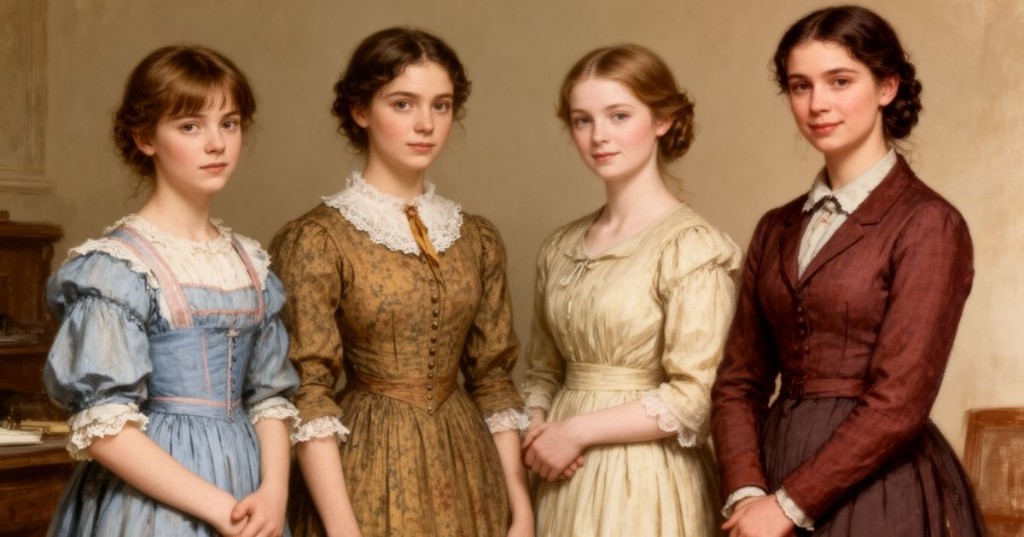
An excerpt from the original text.(complete · 5082 words)
CHAPTER THIRTY-NINE LAZY LAURENCE
Laurie went to Nice intending to stay a week, and remained a month. He
was tired of wandering about alone, and Amy’s familiar presence seemed
to give a homelike charm to the foreign scenes in which she bore a
part. He rather missed the ‘petting’ he used to receive, and enjoyed a
taste of it again, for no attentions, however flattering, from
strangers, were half so pleasant as the sisterly adoration of the girls
at home. Amy never would pet him like the others, but she was very glad
to see him now, and quite clung to him, feeling that he was the
representative of the dear family for whom she longed more than she
would confess. They naturally took comfort in each other’s society and
were much together, riding, walking, dancing, or dawdling, for at Nice
no one can be very industrious during the gay season. But, while
apparently amusing themselves in the most careless fashion, they were
half-consciously making discoveries and forming opinions about each
other. Amy rose daily in the estimation of her friend, but he sank in
hers, and each felt the truth before a word was spoken. Amy tried to
please, and succeeded, for she was grateful for the many pleasures he
gave her, and repaid him with the little services to which womanly
women know how to lend an indescribable charm. Laurie made no effort of
any kind, but just let himself drift along as comfortably as possible,
trying to forget, and feeling that all women owed him a kind word
because one had been cold to him. It cost him no effort to be generous,
and he would have given Amy all the trinkets in Nice if she would have
taken them, but at the same time he felt that he could not change the
opinion she was forming of him, and he rather dreaded the keen blue
eyes that seemed to watch him with such half-sorrowful, half-scornful
surprise.
“All the rest have gone to Monaco for the day. I preferred to stay at
home and write letters. They are done now, and I am going to Valrosa to
sketch, will you come?” said Amy, as she joined Laurie one lovely day
when he lounged in as usual, about noon.
“Well, yes, but isn’t it rather warm for such a long walk?” he answered
slowly, for the shaded salon looked inviting after the glare without.
“I’m going to have the little carriage, and Baptiste can drive, so
you’ll have nothing to do but hold your umbrella, and keep your gloves
nice,” returned Amy, with a sarcastic glance at the immaculate kids,
which were a weak point with Laurie.
“Then I’ll go with pleasure.” and he put out his hand for her
sketchbook. But she tucked it under her arm with a sharp...
“Don’t trouble yourself. It’s no exertion to me, but you don’t look
equal to it.”
Laurie lifted his eyebrows and followed at a leisurely pace as she ran
downstairs, but when they got into the carriage he took the reins
himself, and left little Baptiste nothing to do but fold his arms and
fall asleep on his perch.
The two never quarreled. Amy was too well-bred, and just now Laurie was
too lazy, so in a minute he peeped under her hatbrim with an inquiring
air. She answered him with a smile, and they went on together in the
most amicable manner.
It was a lovely drive, along winding roads rich in the picturesque
scenes that delight beauty-loving eyes. Here an ancient monastery,
whence the solemn chanting of the monks came down to them. There a
bare-legged shepherd, in wooden shoes, pointed hat, and rough jacket
over one shoulder, sat piping on a stone while his goats skipped among
the rocks or lay at his feet. Meek, mouse-colored donkeys, laden with
panniers of freshly cut grass passed by, with a pretty girl in a
capaline sitting between the green piles, or an old woman spinning with
a distaff as she went. Brown, soft-eyed children ran out from the
quaint stone hovels to offer nosegays, or bunches of oranges still on
the bough. Gnarled olive trees covered the hills with their dusky
foliage, fruit hung golden in the orchard, and great scarlet anemones
fringed the roadside, while beyond green slopes and craggy heights, the
Maritime Alps rose sharp and white against the blue Italian sky.
Valrosa well deserved its name, for in that climate of perpetual summer
roses blossomed everywhere. They overhung the archway, thrust
themselves between the bars of the great gate with a sweet welcome to
passers-by, and lined the avenue, winding through lemon trees and
feathery palms up to the villa on the hill. Every shadowy nook, where
seats invited one to stop and rest, was a mass of bloom, every cool
grotto had its marble nymph smiling from a veil of flowers and every
fountain reflected crimson, white, or pale pink roses, leaning down to
smile at their own beauty. Roses covered the walls of the house, draped
the cornices, climbed the pillars, and ran riot over the balustrade of
the wide terrace, whence one looked down on the sunny Mediterranean,
and the white-walled city on its shore.
“This is a regular honeymoon paradise, isn’t it? Did you ever see such
roses?” asked Amy, pausing on the terrace to enjoy the view, and a
luxurious whiff of perfume that came wandering by.
“No, nor felt such thorns,” returned Laurie, with his thumb in his
mouth, after a vain attempt to capture a solitary scarlet flower that
grew just beyond his reach.
“Try lower down, and pick those that have no thorns,” said Amy,
gathering three of the tiny cream-colored ones that starred the wall
behind her. She put them in his buttonhole as a peace offering, and he
stood a minute looking down at them with a curious expression, for in
the Italian part of his nature there was a touch of superstition, and
he was just then in that state of half-sweet, half-bitter melancholy,
when imaginative young men find significance in trifles and food for
romance everywhere. He had thought of Jo in reaching after the thorny
red rose, for vivid flowers became her, and she had often worn ones
like that from the greenhouse at home. The pale roses Amy gave him were
the sort that the Italians lay in dead hands, never in bridal wreaths,
and for a moment he wondered if the omen was for Jo or for himself, but
the next instant his American common sense got the better of
sentimentality, and he laughed a heartier laugh than Amy had heard
since he came.
“It’s good advice, you’d better take it and save your fingers,” she
said, thinking her speech amused him.
“Thank you, I will,” he answered in jest, and a few months later he did
it in earnest.
“Laurie, when are you going to your grandfather?” she asked presently,
as she settled herself on a rustic seat.
“Very soon.”
“You have said that a dozen times within the last three weeks.”
“I dare say, short answers save trouble.”
“He expects you, and you really ought to go.”
“Hospitable creature! I know it.”
“Then why don’t you do it?”
“Natural depravity, I suppose.”
“Natural indolence, you mean. It’s really dreadful!” and Amy looked
severe.
“Not so bad as it seems, for I should only plague him if I went, so I
might as well stay and plague you a little longer, you can bear it
better, in fact I think it agrees with you excellently,” and Laurie
composed himself for a lounge on the broad ledge of the balustrade.
Amy shook her head and opened her sketchbook with an air of
resignation, but she had made up her mind to lecture ‘that boy’ and in
a minute she began again.
“What are you doing just now?”
“Watching lizards.”
“No, no. I mean what do you intend and wish to do?”
“Smoke a cigarette, if you’ll allow me.”
“How provoking you are! I don’t approve of cigars and I will only allow
it on condition that you let me put you into my sketch. I need a
figure.”
“With all the pleasure in life. How will you have me, full length or
three-quarters, on my head or my heels? I should respectfully suggest a
recumbent posture, then put yourself in also and call it ‘Dolce far
niente’.”
“Stay as you are, and go to sleep if you like. I intend to work hard,”
said Amy in her most energetic tone.
“What delightful enthusiasm!” and he leaned against a tall urn with an
air of entire satisfaction.
“What would Jo say if she saw you now?” asked Amy impatiently, hoping
to stir him up by the mention of her still more energetic sister’s
name.
“As usual, ‘Go away, Teddy. I’m busy!’” He laughed as he spoke, but the
laugh was not natural, and a shade passed over his face, for the
utterance of the familiar name touched the wound that was not healed
yet. Both tone and shadow struck Amy, for she had seen and heard them
before, and now she looked up in time to catch a new expression on
Laurie’s face—a hard bitter look, full of pain, dissatisfaction, and
regret. It was gone before she could study it and the listless
expression back again. She watched him for a moment with artistic
pleasure, thinking how like an Italian he looked, as he lay basking in
the sun with uncovered head and eyes full of southern dreaminess, for
he seemed to have forgotten her and fallen into a reverie.
“You look like the effigy of a young knight asleep on his tomb,” she
said, carefully tracing the well-cut profile defined against the dark
stone.
“Wish I was!”
“That’s a foolish wish, unless you have spoiled your life. You are so
changed, I sometimes think—” there Amy stopped, with a half-timid,
half-wistful look, more significant than her unfinished speech.
Laurie saw and understood the affectionate anxiety which she hesitated
to express, and looking straight into her eyes, said, just as he used
to say it to her mother, “It’s all right, ma’am.”
That satisfied her and set at rest the doubts that had begun to worry
her lately. It also touched her, and she showed that it did, by the
cordial tone in which she said...
“I’m glad of that! I didn’t think you’d been a very bad boy, but I
fancied you might have wasted money at that wicked Baden-Baden, lost
your heart to some charming Frenchwoman with a husband, or got into
some of the scrapes that young men seem to consider a necessary part of
a foreign tour. Don’t stay out there in the sun, come and lie on the
grass here and ‘let us be friendly’, as Jo used to say when we got in
the sofa corner and told secrets.”
Laurie obediently threw himself down on the turf, and began to amuse
himself by sticking daisies into the ribbons of Amy’s hat, that lay
there.
“I’m all ready for the secrets.” and he glanced up with a decided
expression of interest in his eyes.
“I’ve none to tell. You may begin.”
“Haven’t one to bless myself with. I thought perhaps you’d had some
news from home..”
“You have heard all that has come lately. Don’t you hear often? I
fancied Jo would send you volumes.”
“She’s very busy. I’m roving about so, it’s impossible to be regular,
you know. When do you begin your great work of art, Raphaella?” he
asked, changing the subject abruptly after another pause, in which he
had been wondering if Amy knew his secret and wanted to talk about it.
“Never,” she answered, with a despondent but decided air. “Rome took
all the vanity out of me, for after seeing the wonders there, I felt
too insignificant to live and gave up all my foolish hopes in despair.”
“Why should you, with so much energy and talent?”
“That’s just why, because talent isn’t genius, and no amount of energy
can make it so. I want to be great, or nothing. I won’t be a
common-place dauber, so I don’t intend to try any more.”
“And what are you going to do with yourself now, if I may ask?”
“Polish up my other talents, and be an ornament to society, if I get
the chance.”
It was a characteristic speech, and sounded daring, but audacity
becomes young people, and Amy’s ambition had a good foundation. Laurie
smiled, but he liked the spirit with which she took up a new purpose
when a long-cherished one died, and spent no time lamenting.
“Good! And here is where Fred Vaughn comes in, I fancy.”
Amy preserved a discreet silence, but there was a conscious look in her
downcast face that made Laurie sit up and say gravely, “Now I’m going
to play brother, and ask questions. May I?”
“I don’t promise to answer.”
“Your face will, if your tongue won’t. You aren’t woman of the world
enough yet to hide your feelings, my dear. I heard rumors about Fred
and you last year, and it’s my private opinion that if he had not been
called home so suddenly and detained so long, something would have come
of it, hey?”
“That’s not for me to say,” was Amy’s grim reply, but her lips would
smile, and there was a traitorous sparkle of the eye which betrayed
that she knew her power and enjoyed the knowledge.
“You are not engaged, I hope?” and Laurie looked very elder-brotherly
and grave all of a sudden.
“No.”
“But you will be, if he comes back and goes properly down on his knees,
won’t you?”
“Very likely.”
“Then you are fond of old Fred?”
“I could be, if I tried.”
“But you don’t intend to try till the proper moment? Bless my soul,
what unearthly prudence! He’s a good fellow, Amy, but not the man I
fancied you’d like.”
“He is rich, a gentleman, and has delightful manners,” began Amy,
trying to be quite cool and dignified, but feeling a little ashamed of
herself, in spite of the sincerity of her intentions.
“I understand. Queens of society can’t get on without money, so you
mean to make a good match, and start in that way? Quite right and
proper, as the world goes, but it sounds odd from the lips of one of
your mother’s girls.”
“True, nevertheless.”
A short speech, but the quiet decision with which it was uttered
contrasted curiously with the young speaker. Laurie felt this
instinctively and laid himself down again, with a sense of
disappointment which he could not explain. His look and silence, as
well as a certain inward self-disapproval, ruffled Amy, and made her
resolve to deliver her lecture without delay.
“I wish you’d do me the favor to rouse yourself a little,” she said
sharply.
“Do it for me, there’s a dear girl.”
“I could, if I tried.” and she looked as if she would like doing it in
the most summary style.
“Try, then. I give you leave,” returned Laurie, who enjoyed having
someone to tease, after his long abstinence from his favorite pastime.
“You’d be angry in five minutes.”
“I’m never angry with you. It takes two flints to make a fire. You are
as cool and soft as snow.”
“You don’t know what I can do. Snow produces a glow and a tingle, if
applied rightly. Your indifference is half affectation, and a good
stirring up would prove it.”
“Stir away, it won’t hurt me and it may amuse you, as the big man said
when his little wife beat him. Regard me in the light of a husband or a
carpet, and beat till you are tired, if that sort of exercise agrees
with you.”
Being decidedly nettled herself, and longing to see him shake off the
apathy that so altered him, Amy sharpened both tongue and pencil, and
began.
“Flo and I have got a new name for you. It’s Lazy Laurence. How do you
like it?”
She thought it would annoy him, but he only folded his arms under his
head, with an imperturbable, “That’s not bad. Thank you, ladies.”
“Do you want to know what I honestly think of you?”
“Pining to be told.”
“Well, I despise you.”
If she had even said ‘I hate you’ in a petulant or coquettish tone, he
would have laughed and rather liked it, but the grave, almost sad,
accent in her voice made him open his eyes, and ask quickly...
“Why, if you please?”
“Because, with every chance for being good, useful, and happy, you are
faulty, lazy, and miserable.”
“Strong language, mademoiselle.”
“If you like it, I’ll go on.”
“Pray do, it’s quite interesting.”
“I thought you’d find it so. Selfish people always like to talk about
themselves.”
“Am I selfish?” the question slipped out involuntarily and in a tone of
surprise, for the one virtue on which he prided himself was generosity.
“Yes, very selfish,” continued Amy, in a calm, cool voice, twice as
effective just then as an angry one. “I’ll show you how, for I’ve
studied you while we were frolicking, and I’m not at all satisfied with
you. Here you have been abroad nearly six months, and done nothing but
waste time and money and disappoint your friends.”
“Isn’t a fellow to have any pleasure after a four-year grind?”
“You don’t look as if you’d had much. At any rate, you are none the
better for it, as far as I can see. I said when we first met that you
had improved. Now I take it all back, for I don’t think you half so
nice as when I left you at home. You have grown abominably lazy, you
like gossip, and waste time on frivolous things, you are contented to
be petted and admired by silly people, instead of being loved and
respected by wise ones. With money, talent, position, health, and
beauty, ah you like that old Vanity! But it’s the truth, so I can’t
help saying it, with all these splendid things to use and enjoy, you
can find nothing to do but dawdle, and instead of being the man you
ought to be, you are only...” there she stopped, with a look that had
both pain and pity in it.
“Saint Laurence on a gridiron,” added Laurie, blandly finishing the
sentence. But the lecture began to take effect, for there was a
wide-awake sparkle in his eyes now and a half-angry, half-injured
expression replaced the former indifference.
“I supposed you’d take it so. You men tell us we are angels, and say we
can make you what we will, but the instant we honestly try to do you
good, you laugh at us and won’t listen, which proves how much your
flattery is worth.” Amy spoke bitterly, and turned her back on the
exasperating martyr at her feet.
In a minute a hand came down over the page, so that she could not draw,
and Laurie’s voice said, with a droll imitation of a penitent child, “I
will be good, oh, I will be good!”
But Amy did not laugh, for she was in earnest, and tapping on the
outspread hand with her pencil, said soberly, “Aren’t you ashamed of a
hand like that? It’s as soft and white as a woman’s, and looks as if it
never did anything but wear Jouvin’s best gloves and pick flowers for
ladies. You are not a dandy, thank Heaven, so I’m glad to see there are
no diamonds or big seal rings on it, only the little old one Jo gave
you so long ago. Dear soul, I wish she was here to help me!”
“So do I!”
The hand vanished as suddenly as it came, and there was energy enough
in the echo of her wish to suit even Amy. She glanced down at him with
a new thought in her mind, but he was lying with his hat half over his
face, as if for shade, and his mustache hid his mouth. She only saw his
chest rise and fall, with a long breath that might have been a sigh,
and the hand that wore the ring nestled down into the grass, as if to
hide something too precious or too tender to be spoken of. All in a
minute various hints and trifles assumed shape and significance in
Amy’s mind, and told her what her sister never had confided to her. She
remembered that Laurie never spoke voluntarily of Jo, she recalled the
shadow on his face just now, the change in his character, and the
wearing of the little old ring which was no ornament to a handsome
hand. Girls are quick to read such signs and feel their eloquence. Amy
had fancied that perhaps a love trouble was at the bottom of the
alteration, and now she was sure of it. Her keen eyes filled, and when
she spoke again, it was in a voice that could be beautifully soft and
kind when she chose to make it so.
“I know I have no right to talk so to you, Laurie, and if you weren’t
the sweetest-tempered fellow in the world, you’d be very angry with me.
But we are all so fond and proud of you, I couldn’t bear to think they
should be disappointed in you at home as I have been, though, perhaps
they would understand the change better than I do.”
“I think they would,” came from under the hat, in a grim tone, quite as
touching as a broken one.
“They ought to have told me, and not let me go blundering and scolding,
when I should have been more kind and patient than ever. I never did
like that Miss Randal and now I hate her!” said artful Amy, wishing to
be sure of her facts this time.
“Hang Miss Randal!” and Laurie knocked the hat off his face with a look
that left no doubt of his sentiments toward that young lady.
“I beg pardon, I thought...” and there she paused diplomatically.
“No, you didn’t, you knew perfectly well I never cared for anyone but
Jo,” Laurie said that in his old, impetuous tone, and turned his face
away as he spoke.
“I did think so, but as they never said anything about it, and you came
away, I supposed I was mistaken. And Jo wouldn’t be kind to you? Why, I
was sure she loved you dearly.”
“She was kind, but not in the right way, and it’s lucky for her she
didn’t love me, if I’m the good-for-nothing fellow you think me. It’s
her fault though, and you may tell her so.”
The hard, bitter look came back again as he said that, and it troubled
Amy, for she did not know what balm to apply.
“I was wrong, I didn’t know. I’m very sorry I was so cross, but I can’t
help wishing you’d bear it better, Teddy, dear.”
“Don’t, that’s her name for me!” and Laurie put up his hand with a
quick gesture to stop the words spoken in Jo’s half-kind,
half-reproachful tone. “Wait till you’ve tried it yourself,” he added
in a low voice, as he pulled up the grass by the handful.
“I’d take it manfully, and be respected if I couldn’t be loved,” said
Amy, with the decision of one who knew nothing about it.
Now, Laurie flattered himself that he had borne it remarkably well,
making no moan, asking no sympathy, and taking his trouble away to live
it down alone. Amy’s lecture put the matter in a new light, and for the
first time it did look weak and selfish to lose heart at the first
failure, and shut himself up in moody indifference. He felt as if
suddenly shaken out of a pensive dream and found it impossible to go to
sleep again. Presently he sat up and asked slowly, “Do you think Jo
would despise me as you do?”
“Yes, if she saw you now. She hates lazy people. Why don’t you do
something splendid, and make her love you?”
“I did my best, but it was no use.”
“Graduating well, you mean? That was no more than you ought to have
done, for your grandfather’s sake. It would have been shameful to fail
after spending so much time and money, when everyone knew that you
could do well.”
“I did fail, say what you will, for Jo wouldn’t love me,” began Laurie,
leaning his head on his hand in a despondent attitude.
“No, you didn’t, and you’ll say so in the end, for it did you good, and
proved that you could do something if you tried. If you’d only set
about another task of some sort, you’d soon be your hearty, happy self
again, and forget your trouble.”
“That’s impossible.”
“Try it and see. You needn’t shrug your shoulders, and think, ‘Much she
knows about such things’. I don’t pretend to be wise, but I am
observing, and I see a great deal more than you’d imagine. I’m
interested in other people’s experiences and inconsistencies, and
though I can’t explain, I remember and use them for my own benefit.
Love Jo all your days, if you choose, but don’t let it spoil you, for
it’s wicked to throw away so many good gifts because you can’t have the
one you want. There, I won’t lecture any more, for I know you’ll wake
up and be a man in spite of that hardhearted girl.”
Neither spoke for several minutes. Laurie sat turning the little ring
on his finger, and Amy put the last touches to the hasty sketch she had
been working at while she talked. Presently she put it on his knee,
merely saying, “How do you like that?”
He looked and then he smiled, as he could not well help doing, for it
was capitally done, the long, lazy figure on the grass, with listless
face, half-shut eyes, and one hand holding a cigar, from which came the
little wreath of smoke that encircled the dreamer’s head.
“How well you draw!” he said, with a genuine surprise and pleasure at
her skill, adding, with a half-laugh, “Yes, that’s me.”
“As you are. This is as you were.” and Amy laid another sketch beside
the one he held.
It was not nearly so well done, but there was a life and spirit in it
which atoned for many faults, and it recalled the past so vividly that
a sudden change swept over the young man’s face as he looked. Only a
rough sketch of Laurie taming a horse. Hat and coat were off, and every
line of the active figure, resolute face, and commanding attitude was
full of energy and meaning. The handsome brute, just subdued, stood
arching his neck under the tightly drawn rein, with one foot
impatiently pawing the ground, and ears pricked up as if listening for
the voice that had mastered him. In the ruffled mane, the rider’s
breezy hair and erect attitude, there was a suggestion of suddenly
arrested motion, of strength, courage, and youthful buoyancy that
contrasted sharply with the supine grace of the ‘Dolce far Niente’
sketch. Laurie said nothing but as his eye went from one to the other,
Amy saw him flush up and fold his lips together as if he read and
accepted the little lesson she had given him. That satisfied her, and
without waiting for him to speak, she said, in her sprightly way...
“Don’t you remember the day you played Rarey with Puck, and we all
looked on? Meg and Beth were frightened, but Jo clapped and pranced,
and I sat on the fence and drew you. I found that sketch in my
portfolio the other day, touched it up, and kept it to show you.”
“Much obliged. You’ve improved immensely since then, and I congratulate
you. May I venture to suggest in ‘a honeymoon paradise’ that five
o’clock is the dinner hour at your hotel?”
Laurie rose as he spoke, returned the pictures with a smile and a bow
and looked at his watch, as if to remind her that even moral lectures
should have an end. He tried to resume his former easy, indifferent
air, but it was an affectation now, for the rousing had been more
effacious than he would confess. Amy felt the shade of coldness in his
manner, and said to herself...
“Now, I’ve offended him. Well, if it does him good, I’m glad, if it
makes him hate me, I’m sorry, but it’s true, and I can’t take back a
word of it.”
They laughed and chatted all the way home, and little Baptiste, up
behind, thought that monsieur and madamoiselle were in charming
spirits. But both felt ill at ease. The friendly frankness was
disturbed, the sunshine had a shadow over it, and despite their
apparent gaiety, there was a secret discontent in the heart of each.
“Shall we see you this evening, mon frere?” asked Amy, as they parted
at her aunt’s door.
“Unfortunately I have an engagement. Au revoir, madamoiselle,” and
Laurie bent as if to kiss her hand, in the foreign fashion, which
became him better than many men. Something in his face made Amy say
quickly and warmly...
“No, be yourself with me, Laurie, and part in the good old way. I’d
rather have a hearty English handshake than all the sentimental
salutations in France.”
“Goodbye, dear,” and with these words, uttered in the tone she liked,
Laurie left her, after a handshake almost painful in its heartiness.
Next morning, instead of the usual call, Amy received a note which made
her smile at the beginning and sigh at the end.
My Dear Mentor, Please make my adieux to your aunt, and exult within
yourself, for ‘Lazy Laurence’ has gone to his grandpa, like the best of
boys. A pleasant winter to you, and may the gods grant you a blissful
honeymoon at Valrosa! I think Fred would be benefited by a rouser. Tell
him so, with my congratulations.
Yours gratefully, Telemachus
“Good boy! I’m glad he’s gone,” said Amy, with an approving smile. The
next minute her face fell as she glanced about the empty room, adding,
with an involuntary sigh, “Yes, I am glad, but how I shall miss him.”
Master this chapter. Complete your experience
Purchase the complete book to access all chapters and support classic literature
As an Amazon Associate, we earn a small commission from qualifying purchases at no additional cost to you.
Available in paperback, hardcover, and e-book formats
Let's Analyse the Pattern
When emotional pain becomes an excuse for lowered standards and stagnation disguised as self-care.
Why This Matters
Connect literature to life
This chapter teaches how to recognize when legitimate pain becomes an excuse for avoiding growth and responsibility.
Practice This Today
This week, notice when you or others use past hurts to justify present inaction—then ask whether this is healing or hiding from the next step forward.
Now let's explore the literary elements.
Key Quotes & Analysis
"You are getting to be rather conceited, my dear, and it's quite time you set about correcting it. You have a good many little gifts and virtues, but there is no need of parading them, for conceit spoils the finest genius."
Context: Amy is beginning her systematic takedown of Laurie's behavior during their carriage ride
Amy identifies that Laurie's problem isn't lack of talent but his attitude about his talents. She's calling out how his self-pity has turned into arrogance and waste of potential.
In Today's Words:
You're getting a big head and wasting your gifts because you think the world owes you something.
"I despise you for being so lazy and self-indulgent when you have every reason to be happy and useful."
Context: Amy delivers her harshest criticism, refusing to coddle Laurie's feelings
This is the core of Amy's tough love - she's not attacking his character but his choices. She sees his potential and is frustrated by his waste of advantages others would kill for.
In Today's Words:
I'm disgusted that you're throwing your life away when you have everything going for you.
"You have been spoiled, and I'm afraid it has done you harm. You are not half so nice as when I knew you first."
Context: Amy explains why Laurie has changed for the worse since his heartbreak
Amy pinpoints how being constantly petted and excused has made Laurie worse, not better. She's comparing his current self to his better past self to show him what he's lost.
In Today's Words:
Everyone babying you has made you worse, not better - you used to be so much more than this.
Thematic Threads
Tough Love
In This Chapter
Amy delivers brutal honesty about Laurie's decline when gentle sympathy has failed
Development
Builds on Jo's earlier directness, showing how real care sometimes requires uncomfortable truth
In Your Life:
Sometimes the people who truly love you are the ones willing to tell you what you don't want to hear.
Wasted Potential
In This Chapter
Laurie has natural talents and advantages but chooses lazy indulgence over meaningful effort
Development
Contrasts with earlier chapters showing his capabilities and promise
In Your Life:
Your gifts don't automatically fulfill themselves—they require deliberate cultivation and effort.
Self-Deception
In This Chapter
Laurie convinces himself his aimless lifestyle is justified by his heartbreak over Jo
Development
Shows how rationalization can become a comfortable substitute for growth
In Your Life:
We're remarkably good at creating stories that excuse our avoidance of difficult but necessary changes.
Social Mirrors
In This Chapter
Amy uses sketches to show Laurie who he was versus who he's become
Development
Continues the theme of how others can see us more clearly than we see ourselves
In Your Life:
Sometimes you need an outside perspective to recognize how far you've drifted from your better self.
Catalyst Moments
In This Chapter
Amy's confrontation becomes the wake-up call that finally motivates Laurie to leave
Development
Shows how change often requires a specific moment of clarity or confrontation
In Your Life:
Real change usually happens not gradually but in response to a moment when the truth becomes undeniable.
You now have the context. Time to form your own thoughts.
Discussion Questions
- 1
What specific behaviors does Amy criticize in Laurie, and how does she use the two sketches to make her point?
analysis • surface - 2
Why does Amy's harsh criticism succeed where sympathy from others failed to motivate Laurie?
analysis • medium - 3
Where do you see people today using past hurt as an excuse to avoid growth or effort?
application • medium - 4
How would you distinguish between someone who needs compassionate support versus someone who needs tough love like Amy gave Laurie?
application • deep - 5
What does this chapter reveal about the difference between healing from disappointment and hiding behind it?
reflection • deep
Critical Thinking Exercise
The Comfort Trap Audit
Think of an area in your life where you might be settling for comfort instead of growth. Write down three specific behaviors that show you're 'dawdling' like Laurie, then identify one small action you could take this week to break the pattern. Be honest about whether you're using past disappointments as an excuse to avoid trying.
Consider:
- •Look for areas where you do the minimum instead of your best
- •Notice if you're surrounding yourself with people who only tell you what you want to hear
- •Consider whether you're wearing your own version of Jo's ring - holding onto something that keeps you stuck
Journaling Prompt
Write about a time when someone gave you tough love that you didn't want to hear but needed. How did it feel in the moment versus how you view it now?
Coming Up Next...
Chapter 40: Grace in the Valley of Shadows
As Laurie begins his journey toward redemption, the March family faces their greatest trial yet. Beth's fragile health takes a dangerous turn, and the family must confront the possibility of loss that will test every bond they've built.



