
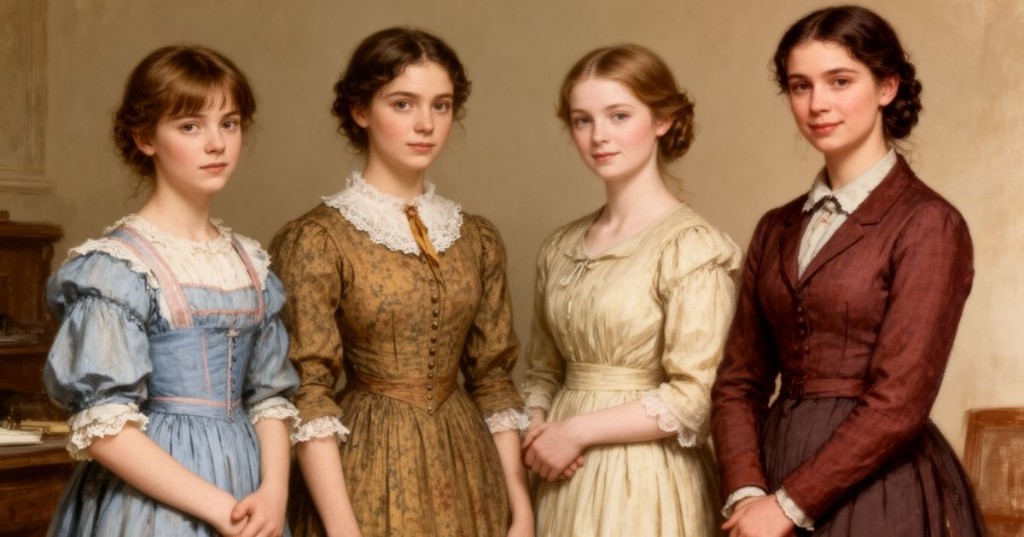
An excerpt from the original text.(complete · 2073 words)
CHAPTER FORTY THE VALLEY OF THE SHADOW
When the first bitterness was over, the family accepted the inevitable,
and tried to bear it cheerfully, helping one another by the increased
affection which comes to bind households tenderly together in times of
trouble. They put away their grief, and each did his or her part toward
making that last year a happy one.
The pleasantest room in the house was set apart for Beth, and in it was
gathered everything that she most loved, flowers, pictures, her piano,
the little worktable, and the beloved pussies. Father’s best books
found their way there, Mother’s easy chair, Jo’s desk, Amy’s finest
sketches, and every day Meg brought her babies on a loving pilgrimage,
to make sunshine for Aunty Beth. John quietly set apart a little sum,
that he might enjoy the pleasure of keeping the invalid supplied with
the fruit she loved and longed for. Old Hannah never wearied of
concocting dainty dishes to tempt a capricious appetite, dropping tears
as she worked, and from across the sea came little gifts and cheerful
letters, seeming to bring breaths of warmth and fragrance from lands
that know no winter.
Here, cherished like a household saint in its shrine, sat Beth,
tranquil and busy as ever, for nothing could change the sweet,
unselfish nature, and even while preparing to leave life, she tried to
make it happier for those who should remain behind. The feeble fingers
were never idle, and one of her pleasures was to make little things for
the school children daily passing to and fro, to drop a pair of mittens
from her window for a pair of purple hands, a needlebook for some small
mother of many dolls, penwipers for young penmen toiling through
forests of pothooks, scrapbooks for picture-loving eyes, and all manner
of pleasant devices, till the reluctant climbers of the ladder of
learning found their way strewn with flowers, as it were, and came to
regard the gentle giver as a sort of fairy godmother, who sat above
there, and showered down gifts miraculously suited to their tastes and
needs. If Beth had wanted any reward, she found it in the bright little
faces always turned up to her window, with nods and smiles, and the
droll little letters which came to her, full of blots and gratitude.
The first few months were very happy ones, and Beth often used to look
round, and say “How beautiful this is!” as they all sat together in her
sunny room, the babies kicking and crowing on the floor, mother and
sisters working near, and father reading, in his pleasant voice, from
the wise old books which seemed rich in good and comfortable words, as
applicable now as when written centuries ago, a little chapel, where a
paternal priest taught his flock the hard lessons all must learn,
trying to show them that hope can comfort love, and faith make
resignation possible. Simple sermons, that went straight to the souls
of those who listened, for the father’s heart was in the minister’s
religion, and the frequent falter in the voice gave a double eloquence
to the words he spoke or read.
It was well for all that this peaceful time was given them as
preparation for the sad hours to come, for by-and-by, Beth said the
needle was ‘so heavy’, and put it down forever. Talking wearied her,
faces troubled her, pain claimed her for its own, and her tranquil
spirit was sorrowfully perturbed by the ills that vexed her feeble
flesh. Ah me! Such heavy days, such long, long nights, such aching
hearts and imploring prayers, when those who loved her best were forced
to see the thin hands stretched out to them beseechingly, to hear the
bitter cry, “Help me, help me!” and to feel that there was no help. A
sad eclipse of the serene soul, a sharp struggle of the young life with
death, but both were mercifully brief, and then the natural rebellion
over, the old peace returned more beautiful than ever. With the wreck
of her frail body, Beth’s soul grew strong, and though she said little,
those about her felt that she was ready, saw that the first pilgrim
called was likewise the fittest, and waited with her on the shore,
trying to see the Shining Ones coming to receive her when she crossed
the river.
Jo never left her for an hour since Beth had said “I feel stronger when
you are here.” She slept on a couch in the room, waking often to renew
the fire, to feed, lift, or wait upon the patient creature who seldom
asked for anything, and ‘tried not to be a trouble’. All day she
haunted the room, jealous of any other nurse, and prouder of being
chosen then than of any honor her life ever brought her. Precious and
helpful hours to Jo, for now her heart received the teaching that it
needed. Lessons in patience were so sweetly taught her that she could
not fail to learn them, charity for all, the lovely spirit that can
forgive and truly forget unkindness, the loyalty to duty that makes the
hardest easy, and the sincere faith that fears nothing, but trusts
undoubtingly.
Often when she woke Jo found Beth reading in her well-worn little book,
heard her singing softly, to beguile the sleepless night, or saw her
lean her face upon her hands, while slow tears dropped through the
transparent fingers, and Jo would lie watching her with thoughts too
deep for tears, feeling that Beth, in her simple, unselfish way, was
trying to wean herself from the dear old life, and fit herself for the
life to come, by sacred words of comfort, quiet prayers, and the music
she loved so well.
Seeing this did more for Jo than the wisest sermons, the saintliest
hymns, the most fervent prayers that any voice could utter. For with
eyes made clear by many tears, and a heart softened by the tenderest
sorrow, she recognized the beauty of her sister’s life—uneventful,
unambitious, yet full of the genuine virtues which ‘smell sweet, and
blossom in the dust’, the self-forgetfulness that makes the humblest on
earth remembered soonest in heaven, the true success which is possible
to all.
One night when Beth looked among the books upon her table, to find
something to make her forget the mortal weariness that was almost as
hard to bear as pain, as she turned the leaves of her old favorite,
Pilgrims’s Progress, she found a little paper, scribbled over in Jo’s
hand. The name caught her eye and the blurred look of the lines made
her sure that tears had fallen on it.
“Poor Jo! She’s fast asleep, so I won’t wake her to ask leave. She
shows me all her things, and I don’t think she’ll mind if I look at
this”, thought Beth, with a glance at her sister, who lay on the rug,
with the tongs beside her, ready to wake up the minute the log fell
apart.
MY BETH
Sitting patient in the shadow
Till the blessed light shall come,
A serene and saintly presence
Sanctifies our troubled home.
Earthly joys and hopes and sorrows
Break like ripples on the strand
Of the deep and solemn river
Where her willing feet now stand.
O my sister, passing from me,
Out of human care and strife,
Leave me, as a gift, those virtues
Which have beautified your life.
Dear, bequeath me that great patience
Which has power to sustain
A cheerful, uncomplaining spirit
In its prison-house of pain.
Give me, for I need it sorely,
Of that courage, wise and sweet,
Which has made the path of duty
Green beneath your willing feet.
Give me that unselfish nature,
That with charity divine
Can pardon wrong for love’s dear sake—
Meek heart, forgive me mine!
Thus our parting daily loseth
Something of its bitter pain,
And while learning this hard lesson,
My great loss becomes my gain.
For the touch of grief will render
My wild nature more serene,
Give to life new aspirations,
A new trust in the unseen.
Henceforth, safe across the river,
I shall see forever more
A beloved, household spirit
Waiting for me on the shore.
Hope and faith, born of my sorrow,
Guardian angels shall become,
And the sister gone before me
By their hands shall lead me home.
Blurred and blotted, faulty and feeble as the lines were, they brought
a look of inexpressible comfort to Beth’s face, for her one regret had
been that she had done so little, and this seemed to assure her that
her life had not been useless, that her death would not bring the
despair she feared. As she sat with the paper folded between her hands,
the charred log fell asunder. Jo started up, revived the blaze, and
crept to the bedside, hoping Beth slept.
“Not asleep, but so happy, dear. See, I found this and read it. I knew
you wouldn’t care. Have I been all that to you, Jo?” she asked, with
wistful, humble earnestness.
“Oh, Beth, so much, so much!” and Jo’s head went down upon the pillow
beside her sister’s.
“Then I don’t feel as if I’d wasted my life. I’m not so good as you
make me, but I have tried to do right. And now, when it’s too late to
begin even to do better, it’s such a comfort to know that someone loves
me so much, and feels as if I’d helped them.”
“More than any one in the world, Beth. I used to think I couldn’t let
you go, but I’m learning to feel that I don’t lose you, that you’ll be
more to me than ever, and death can’t part us, though it seems to.”
“I know it cannot, and I don’t fear it any longer, for I’m sure I shall
be your Beth still, to love and help you more than ever. You must take
my place, Jo, and be everything to Father and Mother when I’m gone.
They will turn to you, don’t fail them, and if it’s hard to work alone,
remember that I don’t forget you, and that you’ll be happier in doing
that than writing splendid books or seeing all the world, for love is
the only thing that we can carry with us when we go, and it makes the
end so easy.”
“I’ll try, Beth.” and then and there Jo renounced her old ambition,
pledged herself to a new and better one, acknowledging the poverty of
other desires, and feeling the blessed solace of a belief in the
immortality of love.
So the spring days came and went, the sky grew clearer, the earth
greener, the flowers were up fairly early, and the birds came back in
time to say goodbye to Beth, who, like a tired but trustful child,
clung to the hands that had led her all her life, as Father and Mother
guided her tenderly through the Valley of the Shadow, and gave her up
to God.
Seldom except in books do the dying utter memorable words, see visions,
or depart with beatified countenances, and those who have sped many
parting souls know that to most the end comes as naturally and simply
as sleep. As Beth had hoped, the ‘tide went out easily’, and in the
dark hour before dawn, on the bosom where she had drawn her first
breath, she quietly drew her last, with no farewell but one loving
look, one little sigh.
With tears and prayers and tender hands, Mother and sisters made her
ready for the long sleep that pain would never mar again, seeing with
grateful eyes the beautiful serenity that soon replaced the pathetic
patience that had wrung their hearts so long, and feeling with reverent
joy that to their darling death was a benignant angel, not a phantom
full of dread.
When morning came, for the first time in many months the fire was out,
Jo’s place was empty, and the room was very still. But a bird sang
blithely on a budding bough, close by, the snowdrops blossomed freshly
at the window, and the spring sunshine streamed in like a benediction
over the placid face upon the pillow, a face so full of painless peace
that those who loved it best smiled through their tears, and thanked
God that Beth was well at last.
Master this chapter. Complete your experience
Purchase the complete book to access all chapters and support classic literature
As an Amazon Associate, we earn a small commission from qualifying purchases at no additional cost to you.
Available in paperback, hardcover, and e-book formats
Let's Analyse the Pattern
The Grace Under Fire Protocol
When facing inevitable loss or powerlessness, channeling remaining energy into service and meaning rather than fighting the unchangeable creates extraordinary grace and transforms suffering into purpose.
Why This Matters
Connect literature to life
This chapter teaches how to distinguish between the strength that fights what can't be changed and the strength that transforms unavoidable circumstances into meaningful action.
Practice This Today
This week, notice when you're wasting energy fighting unchangeable situations—then ask what you can still contribute or create within those constraints.
Now let's explore the literary elements.
Key Quotes & Analysis
"Nothing could change the sweet, unselfish nature, and even while preparing to leave life, she tried to make it happier for those who should remain behind."
Context: Describing how Beth continues caring for others even as she's dying
This shows that true character doesn't change under pressure - Beth remains herself until the end. It suggests that the most meaningful lives are measured by how much we give, not what we achieve.
In Today's Words:
Even when she was dying, Beth was still more worried about everyone else than herself.
"Love alone is a beautiful thing, Jo, and the only thing we can carry with us when we go, and make our lives here happier with."
Context: Beth comforting Jo about the value of a life spent loving others
Beth articulates the book's central message that love, not fame or success, gives life meaning. This wisdom comes from someone who lived quietly but deeply, making her words especially powerful.
In Today's Words:
The only thing that really matters is how much we love people - that's what makes life worth living and what lasts after we're gone.
"Jo never left her for an hour since Beth had said, 'I feel stronger when you are here.'"
Context: Describing Jo's constant presence during Beth's final days
This shows how caregiving becomes a form of love in action. Jo learns that being present for someone's pain is one of the most important things we can do, even when we can't fix the situation.
In Today's Words:
Jo stayed by Beth's side 24/7 because Beth told her it helped just having her there.
Thematic Threads
Service
In This Chapter
Beth continues making mittens for children and gifts for others even as she weakens, finding purpose in giving
Development
Evolved from Beth's early household duties to this final expression of selfless love through service
In Your Life:
You might recognize this when you find meaning in helping others during your own difficult times.
Sacrifice
In This Chapter
Jo abandons her literary ambitions to care for Beth, discovering that love's immortality surpasses fame
Development
Transformed from Jo's earlier selfish artistic dreams to this willing sacrifice for family
In Your Life:
You might see this when choosing family needs over personal goals reveals deeper fulfillment.
Identity
In This Chapter
Beth finally understands her quiet life mattered deeply when she reads Jo's poem about her worth
Development
Culmination of Beth's journey from self-doubt about her simple life to recognition of her true value
In Your Life:
You might experience this when someone helps you see the importance of your seemingly ordinary contributions.
Growth
In This Chapter
Jo learns that patient caregiving and unconditional love require more strength than writing novels
Development
Completes Jo's arc from ambitious self-focus to mature understanding of real achievement
In Your Life:
You might recognize this when caring for others teaches you more about yourself than any personal pursuit.
Human Relationships
In This Chapter
The family creates a sanctuary of love around Beth, showing how relationships can transform suffering into peace
Development
Represents the ultimate expression of the March family's bond, tested by life's greatest challenge
In Your Life:
You might see this when crisis brings your family closer together rather than driving you apart.
You now have the context. Time to form your own thoughts.
Discussion Questions
- 1
How does Beth transform her final months from a time of loss into a time of giving?
analysis • surface - 2
Why does Jo's devotion to Beth teach her more about success than her writing ambitions ever did?
analysis • medium - 3
Where do you see people today channeling difficult circumstances into service to others?
application • medium - 4
When facing your own inevitable losses or endings, how would you apply Beth's approach of focusing on what you can still give rather than what you're losing?
application • deep - 5
What does Beth's peaceful death teach us about how ordinary people can achieve extraordinary grace?
reflection • deep
Critical Thinking Exercise
Design Your Grace Under Fire Protocol
Think of a current challenge or inevitable change you're facing (job uncertainty, aging parent, relationship transition, health concern). Create your personal action plan using Beth's model: What can't you control that you need to accept? What CAN you still contribute or influence? How might you transform this difficulty into service or meaning for others?
Consider:
- •Focus on actions within your control rather than outcomes you can't guarantee
- •Consider how accepting help gracefully might actually strengthen relationships
- •Think about what legacy or positive impact you want this experience to create
Journaling Prompt
Write about a time when you or someone you know transformed a powerless situation into purposeful action. What made the difference between despair and grace?
Coming Up Next...
Chapter 41: Learning to Forget
With Beth gone, the March family must learn to navigate their new reality. Jo faces the challenge of keeping her promise to fill the void Beth left behind, while each family member struggles to find their way forward without their beloved peacemaker.



