
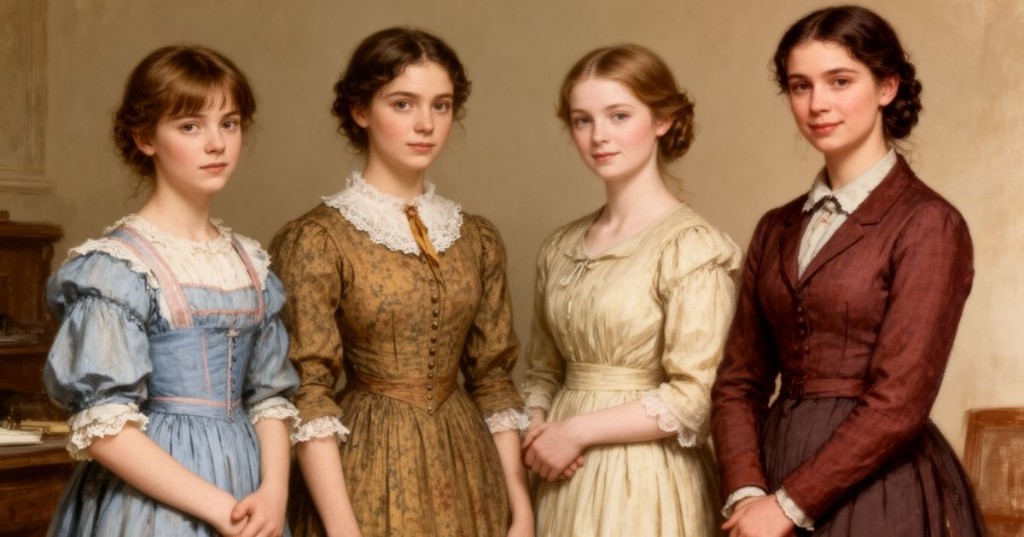
An excerpt from the original text.(complete · 4024 words)
CHAPTER THIRTY-FIVE HEARTACHE
Whatever his motive might have been, Laurie studied to some purpose
that year, for he graduated with honor, and gave the Latin oration with
the grace of a Phillips and the eloquence of a Demosthenes, so his
friends said. They were all there, his grandfather—oh, so proud—Mr. and
Mrs. March, John and Meg, Jo and Beth, and all exulted over him with
the sincere admiration which boys make light of at the time, but fail
to win from the world by any after-triumphs.
“I’ve got to stay for this confounded supper, but I shall be home early
tomorrow. You’ll come and meet me as usual, girls?” Laurie said, as he
put the sisters into the carriage after the joys of the day were over.
He said ‘girls’, but he meant Jo, for she was the only one who kept up
the old custom. She had not the heart to refuse her splendid,
successful boy anything, and answered warmly...
“I’ll come, Teddy, rain or shine, and march before you, playing ‘Hail
the conquering hero comes’ on a jew’s-harp.”
Laurie thanked her with a look that made her think in a sudden panic,
“Oh, deary me! I know he’ll say something, and then what shall I do?”
Evening meditation and morning work somewhat allayed her fears, and
having decided that she wouldn’t be vain enough to think people were
going to propose when she had given them every reason to know what her
answer would be, she set forth at the appointed time, hoping Teddy
wouldn’t do anything to make her hurt his poor feelings. A call at
Meg’s, and a refreshing sniff and sip at the Daisy and Demijohn, still
further fortified her for the tete-a-tete, but when she saw a stalwart
figure looming in the distance, she had a strong desire to turn about
and run away.
“Where’s the jew’s-harp, Jo?” cried Laurie, as soon as he was within
speaking distance.
“I forgot it.” And Jo took heart again, for that salutation could not
be called lover-like.
She always used to take his arm on these occasions, now she did not,
and he made no complaint, which was a bad sign, but talked on rapidly
about all sorts of faraway subjects, till they turned from the road
into the little path that led homeward through the grove. Then he
walked more slowly, suddenly lost his fine flow of language, and now
and then a dreadful pause occurred. To rescue the conversation from one
of the wells of silence into which it kept falling, Jo said hastily,
“Now you must have a good long holiday!”
“I intend to.”
Something in his resolute tone made Jo look up quickly to find him
looking down at her with an expression that assured her the dreaded
moment had come, and made her put out her hand with an imploring, “No,
Teddy. Please don’t!”
“I will, and you must hear me. It’s no use, Jo, we’ve got to have it
out, and the sooner the better for both of us,” he answered, getting
flushed and excited all at once.
“Say what you like then. I’ll listen,” said Jo, with a desperate sort
of patience.
Laurie was a young lover, but he was in earnest, and meant to ‘have it
out’, if he died in the attempt, so he plunged into the subject with
characteristic impetuousity, saying in a voice that would get choky now
and then, in spite of manful efforts to keep it steady...
“I’ve loved you ever since I’ve known you, Jo, couldn’t help it, you’ve
been so good to me. I’ve tried to show it, but you wouldn’t let me. Now
I’m going to make you hear, and give me an answer, for I can’t go on so
any longer.”
“I wanted to save you this. I thought you’d understand...” began Jo,
finding it a great deal harder than she expected.
“I know you did, but the girls are so queer you never know what they
mean. They say no when they mean yes, and drive a man out of his wits
just for the fun of it,” returned Laurie, entrenching himself behind an
undeniable fact.
“I don’t. I never wanted to make you care for me so, and I went away to
keep you from it if I could.”
“I thought so. It was like you, but it was no use. I only loved you all
the more, and I worked hard to please you, and I gave up billiards and
everything you didn’t like, and waited and never complained, for I
hoped you’d love me, though I’m not half good enough...” Here there was
a choke that couldn’t be controlled, so he decapitated buttercups while
he cleared his ‘confounded throat’.
“You, you are, you’re a great deal too good for me, and I’m so grateful
to you, and so proud and fond of you, I don’t know why I can’t love you
as you want me to. I’ve tried, but I can’t change the feeling, and it
would be a lie to say I do when I don’t.”
“Really, truly, Jo?”
He stopped short, and caught both her hands as he put his question with
a look that she did not soon forget.
“Really, truly, dear.”
They were in the grove now, close by the stile, and when the last words
fell reluctantly from Jo’s lips, Laurie dropped her hands and turned as
if to go on, but for once in his life the fence was too much for him.
So he just laid his head down on the mossy post, and stood so still
that Jo was frightened.
“Oh, Teddy, I’m sorry, so desperately sorry, I could kill myself if it
would do any good! I wish you wouldn’t take it so hard, I can’t help
it. You know it’s impossible for people to make themselves love other
people if they don’t,” cried Jo inelegantly but remorsefully, as she
softly patted his shoulder, remembering the time when he had comforted
her so long ago.
“They do sometimes,” said a muffled voice from the post. “I don’t
believe it’s the right sort of love, and I’d rather not try it,” was
the decided answer.
There was a long pause, while a blackbird sung blithely on the willow
by the river, and the tall grass rustled in the wind. Presently Jo said
very soberly, as she sat down on the step of the stile, “Laurie, I want
to tell you something.”
He started as if he had been shot, threw up his head, and cried out in
a fierce tone, “Don’t tell me that, Jo, I can’t bear it now!”
“Tell what?” she asked, wondering at his violence.
“That you love that old man.”
“What old man?” demanded Jo, thinking he must mean his grandfather.
“That devilish Professor you were always writing about. If you say you
love him, I know I shall do something desperate;” and he looked as if
he would keep his word, as he clenched his hands with a wrathful spark
in his eyes.
Jo wanted to laugh, but restrained herself and said warmly, for she
too, was getting excited with all this, “Don’t swear, Teddy! He isn’t
old, nor anything bad, but good and kind, and the best friend I’ve got,
next to you. Pray, don’t fly into a passion. I want to be kind, but I
know I shall get angry if you abuse my Professor. I haven’t the least
idea of loving him or anybody else.”
“But you will after a while, and then what will become of me?”
“You’ll love someone else too, like a sensible boy, and forget all this
trouble.”
“I can’t love anyone else, and I’ll never forget you, Jo, Never!
Never!” with a stamp to emphasize his passionate words.
“What shall I do with him?” sighed Jo, finding that emotions were more
unmanagable than she expected. “You haven’t heard what I wanted to tell
you. Sit down and listen, for indeed I want to do right and make you
happy,” she said, hoping to soothe him with a little reason, which
proved that she knew nothing about love.
Seeing a ray of hope in that last speech, Laurie threw himself down on
the grass at her feet, leaned his arm on the lower step of the stile,
and looked up at her with an expectant face. Now that arrangement was
not conducive to calm speech or clear thought on Jo’s part, for how
could she say hard things to her boy while he watched her with eyes
full of love and longing, and lashes still wet with the bitter drop or
two her hardness of heart had wrung from him? She gently turned his
head away, saying, as she stroked the wavy hair which had been allowed
to grow for her sake—how touching that was, to be sure! “I agree with
Mother that you and I are not suited to each other, because our quick
tempers and strong wills would probably make us very miserable, if we
were so foolish as to...” Jo paused a little over the last word, but
Laurie uttered it with a rapturous expression.
“Marry—no we shouldn’t! If you loved me, Jo, I should be a perfect
saint, for you could make me anything you like.”
“No, I can’t. I’ve tried and failed, and I won’t risk our happiness by
such a serious experiment. We don’t agree and we never shall, so we’ll
be good friends all our lives, but we won’t go and do anything rash.”
“Yes, we will if we get the chance,” muttered Laurie rebelliously.
“Now do be reasonable, and take a sensible view of the case,” implored
Jo, almost at her wit’s end.
“I won’t be reasonable. I don’t want to take what you call ‘a sensible
view’. It won’t help me, and it only makes it harder. I don’t believe
you’ve got any heart.”
“I wish I hadn’t.”
There was a little quiver in Jo’s voice, and thinking it a good omen,
Laurie turned round, bringing all his persuasive powers to bear as he
said, in the wheedlesome tone that had never been so dangerously
wheedlesome before, “Don’t disappoint us, dear! Everyone expects it.
Grandpa has set his heart upon it, your people like it, and I can’t get
on without you. Say you will, and let’s be happy. Do, do!”
Not until months afterward did Jo understand how she had the strength
of mind to hold fast to the resolution she had made when she decided
that she did not love her boy, and never could. It was very hard to do,
but she did it, knowing that delay was both useless and cruel.
“I can’t say ‘yes’ truly, so I won’t say it at all. You’ll see that I’m
right, by-and-by, and thank me for it...” she began solemnly.
“I’ll be hanged if I do!” and Laurie bounced up off the grass, burning
with indignation at the very idea.
“Yes, you will!” persisted Jo. “You’ll get over this after a while, and
find some lovely accomplished girl, who will adore you, and make a fine
mistress for your fine house. I shouldn’t. I’m homely and awkward and
odd and old, and you’d be ashamed of me, and we should quarrel—we can’t
help it even now, you see—and I shouldn’t like elegant society and you
would, and you’d hate my scribbling, and I couldn’t get on without it,
and we should be unhappy, and wish we hadn’t done it, and everything
would be horrid!”
“Anything more?” asked Laurie, finding it hard to listen patiently to
this prophetic burst.
“Nothing more, except that I don’t believe I shall ever marry. I’m
happy as I am, and love my liberty too well to be in a hurry to give it
up for any mortal man.”
“I know better!” broke in Laurie. “You think so now, but there’ll come
a time when you will care for somebody, and you’ll love him
tremendously, and live and die for him. I know you will, it’s your way,
and I shall have to stand by and see it,” and the despairing lover cast
his hat upon the ground with a gesture that would have seemed comical,
if his face had not been so tragic.
“Yes, I will live and die for him, if he ever comes and makes me love
him in spite of myself, and you must do the best you can!” cried Jo,
losing patience with poor Teddy. “I’ve done my best, but you won’t be
reasonable, and it’s selfish of you to keep teasing for what I can’t
give. I shall always be fond of you, very fond indeed, as a friend, but
I’ll never marry you, and the sooner you believe it the better for both
of us—so now!”
That speech was like gunpowder. Laurie looked at her a minute as if he
did not quite know what to do with himself, then turned sharply away,
saying in a desperate sort of tone, “You’ll be sorry some day, Jo.”
“Oh, where are you going?” she cried, for his face frightened her.
“To the devil!” was the consoling answer.
For a minute Jo’s heart stood still, as he swung himself down the bank
toward the river, but it takes much folly, sin or misery to send a
young man to a violent death, and Laurie was not one of the weak sort
who are conquered by a single failure. He had no thought of a
melodramatic plunge, but some blind instinct led him to fling hat and
coat into his boat, and row away with all his might, making better time
up the river than he had done in any race. Jo drew a long breath and
unclasped her hands as she watched the poor fellow trying to outstrip
the trouble which he carried in his heart.
“That will do him good, and he’ll come home in such a tender, penitent
state of mind, that I shan’t dare to see him,” she said, adding, as she
went slowly home, feeling as if she had murdered some innocent thing,
and buried it under the leaves. “Now I must go and prepare Mr. Laurence
to be very kind to my poor boy. I wish he’d love Beth, perhaps he may
in time, but I begin to think I was mistaken about her. Oh dear! How
can girls like to have lovers and refuse them? I think it’s dreadful.”
Being sure that no one could do it so well as herself, she went
straight to Mr. Laurence, told the hard story bravely through, and then
broke down, crying so dismally over her own insensibility that the kind
old gentleman, though sorely disappointed, did not utter a reproach. He
found it difficult to understand how any girl could help loving Laurie,
and hoped she would change her mind, but he knew even better than Jo
that love cannot be forced, so he shook his head sadly and resolved to
carry his boy out of harm’s way, for Young Impetuosity’s parting words
to Jo disturbed him more than he would confess.
When Laurie came home, dead tired but quite composed, his grandfather
met him as if he knew nothing, and kept up the delusion very
successfully for an hour or two. But when they sat together in the
twilight, the time they used to enjoy so much, it was hard work for the
old man to ramble on as usual, and harder still for the young one to
listen to praises of the last year’s success, which to him now seemed
like love’s labor lost. He bore it as long as he could, then went to
his piano and began to play. The windows were open, and Jo, walking in
the garden with Beth, for once understood music better than her sister,
for he played the ‘Sonata Pathetique’, and played it as he never did
before.
“That’s very fine, I dare say, but it’s sad enough to make one cry.
Give us something gayer, lad,” said Mr. Laurence, whose kind old heart
was full of sympathy, which he longed to show but knew not how.
Laurie dashed into a livelier strain, played stormily for several
minutes, and would have got through bravely, if in a momentary lull
Mrs. March’s voice had not been heard calling, “Jo, dear, come in. I
want you.”
Just what Laurie longed to say, with a different meaning! As he
listened, he lost his place, the music ended with a broken chord, and
the musician sat silent in the dark.
“I can’t stand this,” muttered the old gentleman. Up he got, groped his
way to the piano, laid a kind hand on either of the broad shoulders,
and said, as gently as a woman, “I know, my boy, I know.”
No answer for an instant, then Laurie asked sharply, “Who told you?”
“Jo herself.”
“Then there’s an end of it!” And he shook off his grandfather’s hands
with an impatient motion, for though grateful for the sympathy, his
man’s pride could not bear a man’s pity.
“Not quite. I want to say one thing, and then there shall be an end of
it,” returned Mr. Laurence with unusual mildness. “You won’t care to
stay at home now, perhaps?”
“I don’t intend to run away from a girl. Jo can’t prevent my seeing
her, and I shall stay and do it as long as I like,” interrupted Laurie
in a defiant tone.
“Not if you are the gentleman I think you. I’m disappointed, but the
girl can’t help it, and the only thing left for you to do is to go away
for a time. Where will you go?”
“Anywhere. I don’t care what becomes of me,” and Laurie got up with a
reckless laugh that grated on his grandfather’s ear.
“Take it like a man, and don’t do anything rash, for God’s sake. Why
not go abroad, as you planned, and forget it?”
“I can’t.”
“But you’ve been wild to go, and I promised you should when you got
through college.”
“Ah, but I didn’t mean to go alone!” and Laurie walked fast through the
room with an expression which it was well his grandfather did not see.
“I don’t ask you to go alone. There’s someone ready and glad to go with
you, anywhere in the world.”
“Who, Sir?” stopping to listen.
“Myself.”
Laurie came back as quickly as he went, and put out his hand, saying
huskily, “I’m a selfish brute, but—you know—Grandfather—”
“Lord help me, yes, I do know, for I’ve been through it all before,
once in my own young days, and then with your father. Now, my dear boy,
just sit quietly down and hear my plan. It’s all settled, and can be
carried out at once,” said Mr. Laurence, keeping hold of the young man,
as if fearful that he would break away as his father had done before
him.
“Well, sir, what is it?” and Laurie sat down, without a sign of
interest in face or voice.
“There is business in London that needs looking after. I meant you
should attend to it, but I can do it better myself, and things here
will get on very well with Brooke to manage them. My partners do almost
everything, I’m merely holding on until you take my place, and can be
off at any time.”
“But you hate traveling, Sir. I can’t ask it of you at your age,” began
Laurie, who was grateful for the sacrifice, but much preferred to go
alone, if he went at all.
The old gentleman knew that perfectly well, and particularly desired to
prevent it, for the mood in which he found his grandson assured him
that it would not be wise to leave him to his own devices. So, stifling
a natural regret at the thought of the home comforts he would leave
behind him, he said stoutly, “Bless your soul, I’m not superannuated
yet. I quite enjoy the idea. It will do me good, and my old bones won’t
suffer, for traveling nowadays is almost as easy as sitting in a
chair.”
A restless movement from Laurie suggested that his chair was not easy,
or that he did not like the plan, and made the old man add hastily, “I
don’t mean to be a marplot or a burden. I go because I think you’d feel
happier than if I was left behind. I don’t intend to gad about with
you, but leave you free to go where you like, while I amuse myself in
my own way. I’ve friends in London and Paris, and should like to visit
them. Meantime you can go to Italy, Germany, Switzerland, where you
will, and enjoy pictures, music, scenery, and adventures to your
heart’s content.”
Now, Laurie felt just then that his heart was entirely broken and the
world a howling wilderness, but at the sound of certain words which the
old gentleman artfully introduced into his closing sentence, the broken
heart gave an unexpected leap, and a green oasis or two suddenly
appeared in the howling wilderness. He sighed, and then said, in a
spiritless tone, “Just as you like, Sir. It doesn’t matter where I go
or what I do.”
“It does to me, remember that, my lad. I give you entire liberty, but I
trust you to make an honest use of it. Promise me that, Laurie.”
“Anything you like, Sir.”
“Good,” thought the old gentleman. “You don’t care now, but there’ll
come a time when that promise will keep you out of mischief, or I’m
much mistaken.”
Being an energetic individual, Mr. Laurence struck while the iron was
hot, and before the blighted being recovered spirit enough to rebel,
they were off. During the time necessary for preparation, Laurie bore
himself as young gentleman usually do in such cases. He was moody,
irritable, and pensive by turns, lost his appetite, neglected his dress
and devoted much time to playing tempestuously on his piano, avoided
Jo, but consoled himself by staring at her from his window, with a
tragic face that haunted her dreams by night and oppressed her with a
heavy sense of guilt by day. Unlike some sufferers, he never spoke of
his unrequited passion, and would allow no one, not even Mrs. March, to
attempt consolation or offer sympathy. On some accounts, this was a
relief to his friends, but the weeks before his departure were very
uncomfortable, and everyone rejoiced that the ‘poor, dear fellow was
going away to forget his trouble, and come home happy’. Of course, he
smiled darkly at their delusion, but passed it by with the sad
superiority of one who knew that his fidelity like his love was
unalterable.
When the parting came he affected high spirits, to conceal certain
inconvenient emotions which seemed inclined to assert themselves. This
gaiety did not impose upon anybody, but they tried to look as if it did
for his sake, and he got on very well till Mrs. March kissed him, with
a whisper full of motherly solicitude. Then feeling that he was going
very fast, he hastily embraced them all round, not forgetting the
afflicted Hannah, and ran downstairs as if for his life. Jo followed a
minute after to wave her hand to him if he looked round. He did look
round, came back, put his arms about her as she stood on the step above
him, and looked up at her with a face that made his short appeal
eloquent and pathetic.
“Oh, Jo, can’t you?”
“Teddy, dear, I wish I could!”
That was all, except a little pause. Then Laurie straightened himself
up, said, “It’s all right, never mind,” and went away without another
word. Ah, but it wasn’t all right, and Jo did mind, for while the curly
head lay on her arm a minute after her hard answer, she felt as if she
had stabbed her dearest friend, and when he left her without a look
behind him, she knew that the boy Laurie never would come again.
Master this chapter. Complete your experience
Purchase the complete book to access all chapters and support classic literature
As an Amazon Associate, we earn a small commission from qualifying purchases at no additional cost to you.
Available in paperback, hardcover, and e-book formats
Let's Analyse the Pattern
The most loving response to unwanted affection or unrealistic expectations is immediate, kind honesty rather than prolonged false hope.
Why This Matters
Connect literature to life
This chapter teaches how to recognize when avoiding difficult conversations actually causes more harm than having them.
Practice This Today
This week, notice when you're giving vague responses to avoid someone's disappointment—practice delivering clear, kind truth instead of comfortable ambiguity.
Now let's explore the literary elements.
Key Quotes & Analysis
"Oh, deary me! I know he'll say something, and then what shall I do?"
Context: Jo realizes Laurie is about to confess his feelings during their walk
This shows Jo has seen the signs but has been dreading this moment. She knows she'll have to hurt someone she loves, which terrifies her more than any other challenge she's faced.
In Today's Words:
Oh no, he's going to tell me he likes me and I'm going to have to break his heart.
"I can't love you as you want me to, and it would be a lie to say I do when I don't."
Context: Jo's honest response to Laurie's marriage proposal
Jo chooses painful honesty over comfortable lies. She refuses to pretend romantic feelings she doesn't have, even though it would be easier to go along with everyone's expectations.
In Today's Words:
I don't have those feelings for you, and I won't fake it just to make this easier.
"Teddy, dear, I wish I could!"
Context: Jo's final words to Laurie as he makes one last desperate appeal
This captures the heartbreak of the situation - Jo genuinely wishes she could love him the way he wants, but feelings can't be forced. It shows her pain at causing his pain.
In Today's Words:
I wish I felt the same way, but I just don't.
Thematic Threads
Honest Communication
In This Chapter
Jo chooses painful truth over comfortable lies when rejecting Laurie's proposal
Development
Builds on Jo's earlier direct communication style, now applied to the most difficult conversation possible
In Your Life:
You might recognize this when avoiding difficult conversations with family members or coworkers about unrealistic expectations
Self-Knowledge
In This Chapter
Jo clearly understands her own feelings and refuses to pretend otherwise
Development
Culminates Jo's journey of understanding who she is versus who others want her to be
In Your Life:
You see this when you know what you want but feel pressure to want something else to please others
Social Expectations
In This Chapter
Everyone expects Jo to marry Laurie, but she defies this universal assumption
Development
Extends the ongoing theme of characters choosing personal truth over social convenience
In Your Life:
You experience this when family or friends assume you want something you've never actually said you wanted
Protective Love
In This Chapter
Mr. Laurence immediately arranges European travel to help Laurie heal
Development
Shows mature love responding to crisis with practical action rather than empty comfort
In Your Life:
You might need this when someone you care about is devastated and needs space to process rather than advice
Emotional Courage
In This Chapter
Jo stays present for Laurie's pain and anger rather than running away
Development
Demonstrates the bravery required for authentic relationships established throughout the novel
In Your Life:
You face this when you've had to deliver bad news and resist the urge to disappear afterward
You now have the context. Time to form your own thoughts.
Discussion Questions
- 1
Why does Jo reject Laurie even though she cares about him deeply?
analysis • surface - 2
What does Jo mean when she says they're 'too similar in temperament' to make a good match?
analysis • medium - 3
Think about times when someone wanted something from you that you couldn't give. How did you handle it?
application • medium - 4
Jo could have said 'maybe someday' or 'I need time to think.' Why does she choose immediate honesty instead?
analysis • deep - 5
When is it more loving to break someone's heart than to spare their feelings?
reflection • deep
Critical Thinking Exercise
The Honest Conversation Simulator
Think of a situation in your life where you've been avoiding a difficult but necessary conversation. Write out three versions: the comfortable lie you might tell, the harsh truth without kindness, and Jo's approach—honest but compassionate. Notice how each version would affect the other person differently.
Consider:
- •Consider whether you're protecting them or protecting yourself from their reaction
- •Think about what support systems the person might need after hearing the truth
- •Remember that confusion often creates more pain than clarity
Journaling Prompt
Write about a time when someone told you a hard truth with kindness. How did their honesty help you in the long run, even if it hurt at first?
Coming Up Next...
Chapter 36: When Love Faces Loss
While Laurie nurses his broken heart abroad, another March sister harbors a secret that will soon demand attention. Beth's quiet strength has always been her defining trait, but some burdens are too heavy to carry alone.



