
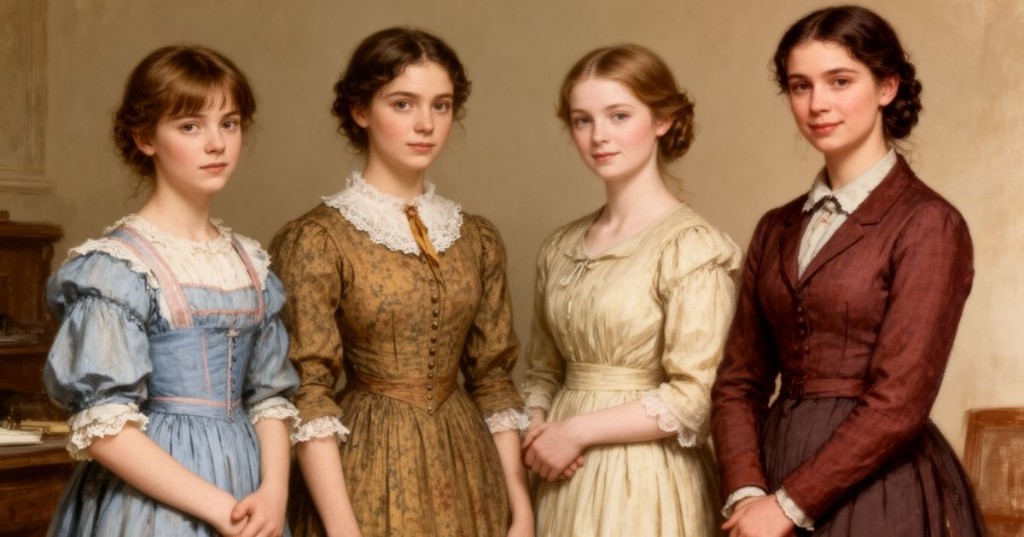
An excerpt from the original text.(complete · 2221 words)
CHAPTER THIRTY-SIX
BETH’S SECRET
When Jo came home that spring, she had been struck with the change in
Beth. No one spoke of it or seemed aware of it, for it had come too
gradually to startle those who saw her daily, but to eyes sharpened by
absence, it was very plain and a heavy weight fell on Jo’s heart as she
saw her sister’s face. It was no paler and but littler thinner than in
the autumn, yet there was a strange, transparent look about it, as if
the mortal was being slowly refined away, and the immortal shining
through the frail flesh with an indescribably pathetic beauty. Jo saw
and felt it, but said nothing at the time, and soon the first
impression lost much of its power, for Beth seemed happy, no one
appeared to doubt that she was better, and presently in other cares Jo
for a time forgot her fear.
But when Laurie was gone, and peace prevailed again, the vague anxiety
returned and haunted her. She had confessed her sins and been forgiven,
but when she showed her savings and proposed a mountain trip, Beth had
thanked her heartily, but begged not to go so far away from home.
Another little visit to the seashore would suit her better, and as
Grandma could not be prevailed upon to leave the babies, Jo took Beth
down to the quiet place, where she could live much in the open air, and
let the fresh sea breezes blow a little color into her pale cheeks.
It was not a fashionable place, but even among the pleasant people
there, the girls made few friends, preferring to live for one another.
Beth was too shy to enjoy society, and Jo too wrapped up in her to care
for anyone else. So they were all in all to each other, and came and
went, quite unconscious of the interest they excited in those about
them, who watched with sympathetic eyes the strong sister and the
feeble one, always together, as if they felt instinctively that a long
separation was not far away.
They did feel it, yet neither spoke of it, for often between ourselves
and those nearest and dearest to us there exists a reserve which it is
very hard to overcome. Jo felt as if a veil had fallen between her
heart and Beth’s, but when she put out her hand to lift it up, there
seemed something sacred in the silence, and she waited for Beth to
speak. She wondered, and was thankful also, that her parents did not
seem to see what she saw, and during the quiet weeks when the shadows
grew so plain to her, she said nothing of it to those at home,
believing that it would tell itself when Beth came back no better. She
wondered still more if her sister really guessed the hard truth, and
what thoughts were passing through her mind during the long hours when
she lay on the warm rocks with her head in Jo’s lap, while the winds
blew healthfully over her and the sea made music at her feet.
One day Beth told her. Jo thought she was asleep, she lay so still, and
putting down her book, sat looking at her with wistful eyes, trying to
see signs of hope in the faint color on Beth’s cheeks. But she could
not find enough to satisfy her, for the cheeks were very thin, and the
hands seemed too feeble to hold even the rosy little shells they had
been collecting. It came to her then more bitterly than ever that Beth
was slowly drifting away from her, and her arms instinctively tightened
their hold upon the dearest treasure she possessed. For a minute her
eyes were too dim for seeing, and when they cleared, Beth was looking
up at her so tenderly that there was hardly any need for her to say,
“Jo, dear, I’m glad you know it. I’ve tried to tell you, but I
couldn’t.”
There was no answer except her sister’s cheek against her own, not even
tears, for when most deeply moved, Jo did not cry. She was the weaker
then, and Beth tried to comfort and sustain her, with her arms about
her and the soothing words she whispered in her ear.
“I’ve known it for a good while, dear, and now I’m used to it, it isn’t
hard to think of or to bear. Try to see it so and don’t be troubled
about me, because it’s best, indeed it is.”
“Is this what made you so unhappy in the autumn, Beth? You did not feel
it then, and keep it to yourself so long, did you?” asked Jo, refusing
to see or say that it was best, but glad to know that Laurie had no
part in Beth’s trouble.
“Yes, I gave up hoping then, but I didn’t like to own it. I tried to
think it was a sick fancy, and would not let it trouble anyone. But
when I saw you all so well and strong and full of happy plans, it was
hard to feel that I could never be like you, and then I was miserable,
Jo.”
“Oh, Beth, and you didn’t tell me, didn’t let me comfort and help you?
How could you shut me out, bear it all alone?”
Jo’s voice was full of tender reproach, and her heart ached to think of
the solitary struggle that must have gone on while Beth learned to say
goodbye to health, love, and life, and take up her cross so cheerfully.
“Perhaps it was wrong, but I tried to do right. I wasn’t sure, no one
said anything, and I hoped I was mistaken. It would have been selfish
to frighten you all when Marmee was so anxious about Meg, and Amy away,
and you so happy with Laurie—at least I thought so then.”
“And I thought you loved him, Beth, and I went away because I
couldn’t,” cried Jo, glad to say all the truth.
Beth looked so amazed at the idea that Jo smiled in spite of her pain,
and added softly, “Then you didn’t, dearie? I was afraid it was so, and
imagined your poor little heart full of lovelornity all that while.”
“Why, Jo, how could I, when he was so fond of you?” asked Beth, as
innocently as a child. “I do love him dearly. He is so good to me, how
can I help It? But he could never be anything to me but my brother. I
hope he truly will be, sometime.”
“Not through me,” said Jo decidedly. “Amy is left for him, and they
would suit excellently, but I have no heart for such things, now. I
don’t care what becomes of anybody but you, Beth. You must get well.”
“I want to, oh, so much! I try, but every day I lose a little, and feel
more sure that I shall never gain it back. It’s like the tide, Jo, when
it turns, it goes slowly, but it can’t be stopped.”
“It shall be stopped, your tide must not turn so soon, nineteen is too
young, Beth. I can’t let you go. I’ll work and pray and fight against
it. I’ll keep you in spite of everything. There must be ways, it can’t
be too late. God won’t be so cruel as to take you from me,” cried poor
Jo rebelliously, for her spirit was far less piously submissive than
Beth’s.
Simple, sincere people seldom speak much of their piety. It shows
itself in acts rather than in words, and has more influence than
homilies or protestations. Beth could not reason upon or explain the
faith that gave her courage and patience to give up life, and
cheerfully wait for death. Like a confiding child, she asked no
questions, but left everything to God and nature, Father and Mother of
us all, feeling sure that they, and they only, could teach and
strengthen heart and spirit for this life and the life to come. She did
not rebuke Jo with saintly speeches, only loved her better for her
passionate affection, and clung more closely to the dear human love,
from which our Father never means us to be weaned, but through which He
draws us closer to Himself. She could not say, “I’m glad to go,” for
life was very sweet for her. She could only sob out, “I try to be
willing,” while she held fast to Jo, as the first bitter wave of this
great sorrow broke over them together.
By and by Beth said, with recovered serenity, “You’ll tell them this
when we go home?”
“I think they will see it without words,” sighed Jo, for now it seemed
to her that Beth changed every day.
“Perhaps not. I’ve heard that the people who love best are often
blindest to such things. If they don’t see it, you will tell them for
me. I don’t want any secrets, and it’s kinder to prepare them. Meg has
John and the babies to comfort her, but you must stand by Father and
Mother, won’t you Jo?”
“If I can. But, Beth, I don’t give up yet. I’m going to believe that it
is a sick fancy, and not let you think it’s true.” said Jo, trying to
speak cheerfully.
Beth lay a minute thinking, and then said in her quiet way, “I don’t
know how to express myself, and shouldn’t try to anyone but you,
because I can’t speak out except to my Jo. I only mean to say that I
have a feeling that it never was intended I should live long. I’m not
like the rest of you. I never made any plans about what I’d do when I
grew up. I never thought of being married, as you all did. I couldn’t
seem to imagine myself anything but stupid little Beth, trotting about
at home, of no use anywhere but there. I never wanted to go away, and
the hard part now is the leaving you all. I’m not afraid, but it seems
as if I should be homesick for you even in heaven.”
Jo could not speak, and for several minutes there was no sound but the
sigh of the wind and the lapping of the tide. A white-winged gull flew
by, with the flash of sunshine on its silvery breast. Beth watched it
till it vanished, and her eyes were full of sadness. A little
gray-coated sand bird came tripping over the beach ‘peeping’ softly to
itself, as if enjoying the sun and sea. It came quite close to Beth,
and looked at her with a friendly eye and sat upon a warm stone,
dressing its wet feathers, quite at home. Beth smiled and felt
comforted, for the tiny thing seemed to offer its small friendship and
remind her that a pleasant world was still to be enjoyed.
“Dear little bird! See, Jo, how tame it is. I like peeps better than
the gulls. They are not so wild and handsome, but they seem happy,
confiding little things. I used to call them my birds last summer, and
Mother said they reminded her of me—busy, quaker-colored creatures,
always near the shore, and always chirping that contented little song
of theirs. You are the gull, Jo, strong and wild, fond of the storm and
the wind, flying far out to sea, and happy all alone. Meg is the
turtledove, and Amy is like the lark she writes about, trying to get up
among the clouds, but always dropping down into its nest again. Dear
little girl! She’s so ambitious, but her heart is good and tender, and
no matter how high she flies, she never will forget home. I hope I
shall see her again, but she seems so far away.”
“She is coming in the spring, and I mean that you shall be all ready to
see and enjoy her. I’m going to have you well and rosy by that time,”
began Jo, feeling that of all the changes in Beth, the talking change
was the greatest, for it seemed to cost no effort now, and she thought
aloud in a way quite unlike bashful Beth.
“Jo, dear, don’t hope any more. It won’t do any good. I’m sure of that.
We won’t be miserable, but enjoy being together while we wait. We’ll
have happy times, for I don’t suffer much, and I think the tide will go
out easily, if you help me.”
Jo leaned down to kiss the tranquil face, and with that silent kiss,
she dedicated herself soul and body to Beth.
She was right. There was no need of any words when they got home, for
Father and Mother saw plainly now what they had prayed to be saved from
seeing. Tired with her short journey, Beth went at once to bed, saying
how glad she was to be home, and when Jo went down, she found that she
would be spared the hard task of telling Beth’s secret. Her father
stood leaning his head on the mantelpiece and did not turn as she came
in, but her mother stretched out her arms as if for help, and Jo went
to comfort her without a word.
Master this chapter. Complete your experience
Purchase the complete book to access all chapters and support classic literature
As an Amazon Associate, we earn a small commission from qualifying purchases at no additional cost to you.
Available in paperback, hardcover, and e-book formats
Let's Analyse the Pattern
When love motivates keeping painful secrets to shield others, but the silence ultimately increases suffering for everyone involved.
Why This Matters
Connect literature to life
This chapter teaches how to identify when someone is hiding pain to 'protect' others, creating isolation instead of intimacy.
Practice This Today
This week, notice when conversations feel artificially light during stressful times—ask 'Is there something you're not telling me because you think I can't handle it?'
Now let's explore the literary elements.
Key Quotes & Analysis
"There was a strange, transparent look about it, as if the mortal was being slowly refined away, and the immortal shining through the frail flesh."
Context: Jo observing Beth's changed appearance after being away
This poetic description captures how terminal illness can make someone appear otherworldly. It shows Jo's artistic way of processing what she's seeing while avoiding the harsh reality.
In Today's Words:
Beth looked fragile and ethereal, like she was already halfway to another world.
"I never made any plans about what I'd do when I grew up. I never thought of being married, as you all did. I couldn't seem to imagine myself anything but stupid little Beth, trotting about at home, of no use anywhere but there."
Context: Beth explaining to Jo why she's not afraid to die
This reveals Beth's limited self-concept and how she never envisioned a future beyond her current role. It's both heartbreaking and shows how some people define themselves too narrowly.
In Today's Words:
I never really saw myself having a big life or career like you guys - I was just the homebody who helped out around here.
"I'm not afraid, but it seems as if I should be homesick for you even in heaven."
Context: Beth expressing her only sadness about dying
This shows Beth's deep love for her family while maintaining her acceptance of death. It's a touching way to express that love transcends death while acknowledging the pain of separation.
In Today's Words:
I'm okay with dying, but I'll miss you guys so much, even if I'm in a better place.
Thematic Threads
Mortality
In This Chapter
Beth faces death with acceptance while Jo fights against the inevitable, showing different ways people process terminal situations
Development
Introduced here as the central crisis that will define the family's final chapters
In Your Life:
You might recognize this when facing any irreversible loss—job, relationship, or health—where acceptance and fighting both have their place.
Family Roles
In This Chapter
Beth sees herself only as 'little Beth at home,' unable to imagine a future beyond her prescribed family role
Development
Builds on earlier themes of how family positions can become identity prisons
In Your Life:
You might feel trapped in being the 'responsible one' or 'the problem' in your family, unable to grow beyond that role.
Protective Love
In This Chapter
Beth hides her condition to shield her family, while they unconsciously avoid seeing the truth to protect themselves
Development
Evolves from earlier protective behaviors into life-and-death consequences
In Your Life:
You might keep financial struggles or health problems secret, thinking you're protecting loved ones from worry.
Truth and Denial
In This Chapter
The family collectively avoids acknowledging what they can see, until the sisters' conversation forces honesty
Development
Builds on patterns of avoiding difficult conversations seen throughout the book
In Your Life:
You might recognize this in relationships where everyone knows something is wrong but no one wants to say it first.
Individual Response to Crisis
In This Chapter
Jo responds with fierce denial and determination to fight, while Beth chooses acceptance and faith
Development
Shows how the sisters' different personalities shape their approach to the ultimate crisis
In Your Life:
You might see this in how you and family members handle crisis differently—some fight, some accept, some withdraw.
You now have the context. Time to form your own thoughts.
Discussion Questions
- 1
Why does Beth keep her dying a secret from her family for months, and how does this decision affect everyone involved?
analysis • surface - 2
What drives people to hide painful truths from the people they love most, even when keeping secrets causes more suffering?
analysis • medium - 3
Where do you see this pattern of 'protective silence' playing out in families, workplaces, or relationships today?
application • medium - 4
How would you create an environment where people feel safe sharing difficult truths instead of carrying burdens alone?
application • deep - 5
What does Beth and Jo's conversation reveal about the different ways people find meaning when facing life's hardest challenges?
reflection • deep
Critical Thinking Exercise
Break the Protective Silence Pattern
Think of a situation in your life where someone might be keeping a difficult truth to 'protect' others, or where you're avoiding a hard conversation. Write down three specific ways you could create a safe space for that truth to be shared. Then practice the exact words you would use to invite honest communication without forcing it.
Consider:
- •People often hide struggles because they fear being a burden or causing worry
- •Creating safety means showing you can handle difficult information without falling apart
- •Sometimes the fear of the conversation is worse than the actual conversation
Journaling Prompt
Write about a time when someone kept something difficult from you 'for your own good.' How did you feel when you found out? What would have helped you handle the truth better from the beginning?
Coming Up Next...
Chapter 37: New Impressions and Old Feelings
As the March family adjusts to their new reality, life continues around them with its own rhythms and changes. New faces and fresh perspectives will soon enter their world, bringing unexpected complications and possibilities.



