
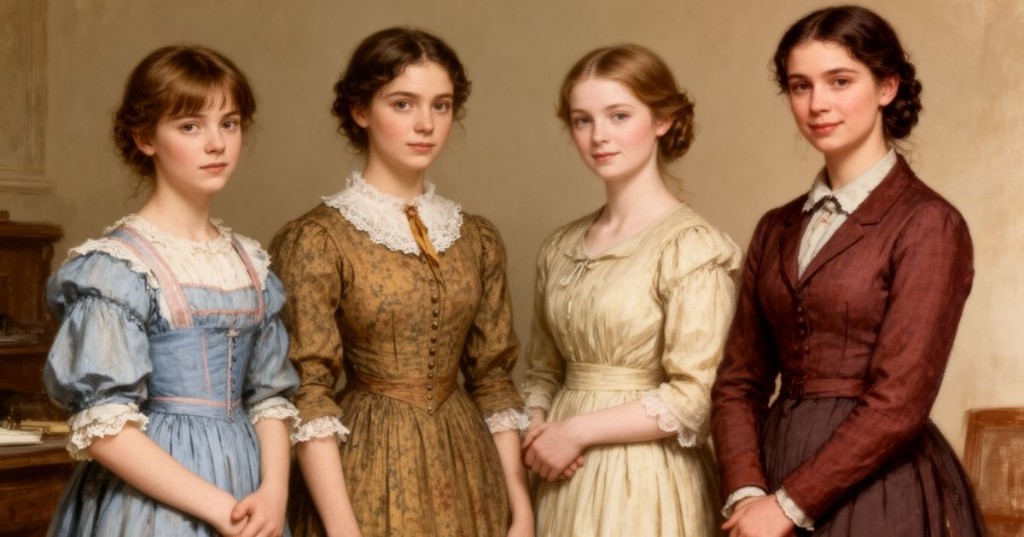
An excerpt from the original text.(complete · 5917 words)
CHAPTER THIRTY-FOUR FRIEND
Though very happy in the social atmosphere about her, and very busy
with the daily work that earned her bread and made it sweeter for the
effort, Jo still found time for literary labors. The purpose which now
took possession of her was a natural one to a poor and ambitious girl,
but the means she took to gain her end were not the best. She saw that
money conferred power, money and power, therefore, she resolved to
have, not to be used for herself alone, but for those whom she loved
more than life. The dream of filling home with comforts, giving Beth
everything she wanted, from strawberries in winter to an organ in her
bedroom, going abroad herself, and always having more than enough, so
that she might indulge in the luxury of charity, had been for years
Jo’s most cherished castle in the air.
The prize-story experience had seemed to open a way which might, after
long traveling and much uphill work, lead to this delightful chateau en
Espagne. But the novel disaster quenched her courage for a time, for
public opinion is a giant which has frightened stouter-hearted Jacks on
bigger beanstalks than hers. Like that immortal hero, she reposed
awhile after the first attempt, which resulted in a tumble and the
least lovely of the giant’s treasures, if I remember rightly. But the
‘up again and take another’ spirit was as strong in Jo as in Jack, so
she scrambled up on the shady side this time and got more booty, but
nearly left behind her what was far more precious than the moneybags.
She took to writing sensation stories, for in those dark ages, even
all-perfect America read rubbish. She told no one, but concocted a
‘thrilling tale’, and boldly carried it herself to Mr. Dashwood, editor
of the Weekly Volcano. She had never read Sartor Resartus, but she had
a womanly instinct that clothes possess an influence more powerful over
many than the worth of character or the magic of manners. So she
dressed herself in her best, and trying to persuade herself that she
was neither excited nor nervous, bravely climbed two pairs of dark and
dirty stairs to find herself in a disorderly room, a cloud of cigar
smoke, and the presence of three gentlemen, sitting with their heels
rather higher than their hats, which articles of dress none of them
took the trouble to remove on her appearance. Somewhat daunted by this
reception, Jo hesitated on the threshold, murmuring in much
embarrassment...
“Excuse me, I was looking for the Weekly Volcano office. I wished to
see Mr. Dashwood.”
Down went the highest pair of heels, up rose the smokiest gentleman,
and carefully cherishing his cigar between his fingers, he advanced
with a nod and a countenance expressive of nothing but sleep. Feeling
that she must get through the matter somehow, Jo produced her
manuscript and, blushing redder and redder with each sentence,
blundered out fragments of the little speech carefully prepared for the
occasion.
“A friend of mine desired me to offer—a story—just as an
experiment—would like your opinion—be glad to write more if this
suits.”
While she blushed and blundered, Mr. Dashwood had taken the manuscript,
and was turning over the leaves with a pair of rather dirty fingers,
and casting critical glances up and down the neat pages.
“Not a first attempt, I take it?” observing that the pages were
numbered, covered only on one side, and not tied up with a ribbon—sure
sign of a novice.
“No, sir. She has had some experience, and got a prize for a tale in
the Blarneystone Banner.”
“Oh, did she?” and Mr. Dashwood gave Jo a quick look, which seemed to
take note of everything she had on, from the bow in her bonnet to the
buttons on her boots. “Well, you can leave it, if you like. We’ve more
of this sort of thing on hand than we know what to do with at present,
but I’ll run my eye over it, and give you an answer next week.”
Now, Jo did not like to leave it, for Mr. Dashwood didn’t suit her at
all, but, under the circumstances, there was nothing for her to do but
bow and walk away, looking particularly tall and dignified, as she was
apt to do when nettled or abashed. Just then she was both, for it was
perfectly evident from the knowing glances exchanged among the
gentlemen that her little fiction of ‘my friend’ was considered a good
joke, and a laugh, produced by some inaudible remark of the editor, as
he closed the door, completed her discomfiture. Half resolving never to
return, she went home, and worked off her irritation by stitching
pinafores vigorously, and in an hour or two was cool enough to laugh
over the scene and long for next week.
When she went again, Mr. Dashwood was alone, whereat she rejoiced. Mr.
Dashwood was much wider awake than before, which was agreeable, and Mr.
Dashwood was not too deeply absorbed in a cigar to remember his
manners, so the second interview was much more comfortable than the
first.
“We’ll take this (editors never say I), if you don’t object to a few
alterations. It’s too long, but omitting the passages I’ve marked will
make it just the right length,” he said, in a businesslike tone.
Jo hardly knew her own MS. again, so crumpled and underscored were its
pages and paragraphs, but feeling as a tender parent might on being
asked to cut off her baby’s legs in order that it might fit into a new
cradle, she looked at the marked passages and was surprised to find
that all the moral reflections—which she had carefully put in as
ballast for much romance—had been stricken out.
“But, Sir, I thought every story should have some sort of a moral, so I
took care to have a few of my sinners repent.”
Mr. Dashwoods’s editorial gravity relaxed into a smile, for Jo had
forgotten her ‘friend’, and spoken as only an author could.
“People want to be amused, not preached at, you know. Morals don’t sell
nowadays.” Which was not quite a correct statement, by the way.
“You think it would do with these alterations, then?”
“Yes, it’s a new plot, and pretty well worked up—language good, and so
on,” was Mr. Dashwood’s affable reply.
“What do you—that is, what compensation—” began Jo, not exactly knowing
how to express herself.
“Oh, yes, well, we give from twenty-five to thirty for things of this
sort. Pay when it comes out,” returned Mr. Dashwood, as if that point
had escaped him. Such trifles do escape the editorial mind, it is said.
“Very well, you can have it,” said Jo, handing back the story with a
satisfied air, for after the dollar-a-column work, even twenty-five
seemed good pay.
“Shall I tell my friend you will take another if she has one better
than this?” asked Jo, unconscious of her little slip of the tongue, and
emboldened by her success.
“Well, we’ll look at it. Can’t promise to take it. Tell her to make it
short and spicy, and never mind the moral. What name would your friend
like to put on it?” in a careless tone.
“None at all, if you please, she doesn’t wish her name to appear and
has no nom de plume,” said Jo, blushing in spite of herself.
“Just as she likes, of course. The tale will be out next week. Will you
call for the money, or shall I send it?” asked Mr. Dashwood, who felt a
natural desire to know who his new contributor might be.
“I’ll call. Good morning, Sir.”
As she departed, Mr. Dashwood put up his feet, with the graceful
remark, “Poor and proud, as usual, but she’ll do.”
Following Mr. Dashwood’s directions, and making Mrs. Northbury her
model, Jo rashly took a plunge into the frothy sea of sensational
literature, but thanks to the life preserver thrown her by a friend,
she came up again not much the worse for her ducking.
Like most young scribblers, she went abroad for her characters and
scenery, and banditti, counts, gypsies, nuns, and duchesses appeared
upon her stage, and played their parts with as much accuracy and spirit
as could be expected. Her readers were not particular about such
trifles as grammar, punctuation, and probability, and Mr. Dashwood
graciously permitted her to fill his columns at the lowest prices, not
thinking it necessary to tell her that the real cause of his
hospitality was the fact that one of his hacks, on being offered higher
wages, had basely left him in the lurch.
She soon became interested in her work, for her emaciated purse grew
stout, and the little hoard she was making to take Beth to the
mountains next summer grew slowly but surely as the weeks passed. One
thing disturbed her satisfaction, and that was that she did not tell
them at home. She had a feeling that Father and Mother would not
approve, and preferred to have her own way first, and beg pardon
afterward. It was easy to keep her secret, for no name appeared with
her stories. Mr. Dashwood had of course found it out very soon, but
promised to be dumb, and for a wonder kept his word.
She thought it would do her no harm, for she sincerely meant to write
nothing of which she would be ashamed, and quieted all pricks of
conscience by anticipations of the happy minute when she should show
her earnings and laugh over her well-kept secret.
But Mr. Dashwood rejected any but thrilling tales, and as thrills could
not be produced except by harrowing up the souls of the readers,
history and romance, land and sea, science and art, police records and
lunatic asylums, had to be ransacked for the purpose. Jo soon found
that her innocent experience had given her but few glimpses of the
tragic world which underlies society, so regarding it in a business
light, she set about supplying her deficiencies with characteristic
energy. Eager to find material for stories, and bent on making them
original in plot, if not masterly in execution, she searched newspapers
for accidents, incidents, and crimes. She excited the suspicions of
public librarians by asking for works on poisons. She studied faces in
the street, and characters, good, bad, and indifferent, all about her.
She delved in the dust of ancient times for facts or fictions so old
that they were as good as new, and introduced herself to folly, sin,
and misery, as well as her limited opportunities allowed. She thought
she was prospering finely, but unconsciously she was beginning to
desecrate some of the womanliest attributes of a woman’s character. She
was living in bad society, and imaginary though it was, its influence
affected her, for she was feeding heart and fancy on dangerous and
unsubstantial food, and was fast brushing the innocent bloom from her
nature by a premature acquaintance with the darker side of life, which
comes soon enough to all of us.
She was beginning to feel rather than see this, for much describing of
other people’s passions and feelings set her to studying and
speculating about her own, a morbid amusement in which healthy young
minds do not voluntarily indulge. Wrongdoing always brings its own
punishment, and when Jo most needed hers, she got it.
I don’t know whether the study of Shakespeare helped her to read
character, or the natural instinct of a woman for what was honest,
brave, and strong, but while endowing her imaginary heroes with every
perfection under the sun, Jo was discovering a live hero, who
interested her in spite of many human imperfections. Mr. Bhaer, in one
of their conversations, had advised her to study simple, true, and
lovely characters, wherever she found them, as good training for a
writer. Jo took him at his word, for she coolly turned round and
studied him—a proceeding which would have much surprised him, had he
known it, for the worthy Professor was very humble in his own conceit.
Why everybody liked him was what puzzled Jo, at first. He was neither
rich nor great, young nor handsome, in no respect what is called
fascinating, imposing, or brilliant, and yet he was as attractive as a
genial fire, and people seemed to gather about him as naturally as
about a warm hearth. He was poor, yet always appeared to be giving
something away; a stranger, yet everyone was his friend; no longer
young, but as happy-hearted as a boy; plain and peculiar, yet his face
looked beautiful to many, and his oddities were freely forgiven for his
sake. Jo often watched him, trying to discover the charm, and at last
decided that it was benevolence which worked the miracle. If he had any
sorrow, ‘it sat with its head under its wing’, and he turned only his
sunny side to the world. There were lines upon his forehead, but Time
seemed to have touched him gently, remembering how kind he was to
others. The pleasant curves about his mouth were the memorials of many
friendly words and cheery laughs, his eyes were never cold or hard, and
his big hand had a warm, strong grasp that was more expressive than
words.
His very clothes seemed to partake of the hospitable nature of the
wearer. They looked as if they were at ease, and liked to make him
comfortable. His capacious waistcoat was suggestive of a large heart
underneath. His rusty coat had a social air, and the baggy pockets
plainly proved that little hands often went in empty and came out full.
His very boots were benevolent, and his collars never stiff and raspy
like other people’s.
“That’s it!” said Jo to herself, when she at length discovered that
genuine good will toward one’s fellow men could beautify and dignify
even a stout German teacher, who shoveled in his dinner, darned his own
socks, and was burdened with the name of Bhaer.
Jo valued goodness highly, but she also possessed a most feminine
respect for intellect, and a little discovery which she made about the
Professor added much to her regard for him. He never spoke of himself,
and no one ever knew that in his native city he had been a man much
honored and esteemed for learning and integrity, till a countryman came
to see him. He never spoke of himself, and in a conversation with Miss
Norton divulged the pleasing fact. From her Jo learned it, and liked it
all the better because Mr. Bhaer had never told it. She felt proud to
know that he was an honored Professor in Berlin, though only a poor
language-master in America, and his homely, hard-working life was much
beautified by the spice of romance which this discovery gave it.
Another and a better gift than intellect was shown her in a most
unexpected manner. Miss Norton had the entree into most society, which
Jo would have had no chance of seeing but for her. The solitary woman
felt an interest in the ambitious girl, and kindly conferred many
favors of this sort both on Jo and the Professor. She took them with
her one night to a select symposium, held in honor of several
celebrities.
Jo went prepared to bow down and adore the mighty ones whom she had
worshiped with youthful enthusiasm afar off. But her reverence for
genius received a severe shock that night, and it took her some time to
recover from the discovery that the great creatures were only men and
women after all. Imagine her dismay, on stealing a glance of timid
admiration at the poet whose lines suggested an ethereal being fed on
‘spirit, fire, and dew’, to behold him devouring his supper with an
ardor which flushed his intellectual countenance. Turning as from a
fallen idol, she made other discoveries which rapidly dispelled her
romantic illusions. The great novelist vibrated between two decanters
with the regularity of a pendulum; the famous divine flirted openly
with one of the Madame de Staels of the age, who looked daggers at
another Corinne, who was amiably satirizing her, after outmaneuvering
her in efforts to absorb the profound philosopher, who imbibed tea
Johnsonianly and appeared to slumber, the loquacity of the lady
rendering speech impossible. The scientific celebrities, forgetting
their mollusks and glacial periods, gossiped about art, while devoting
themselves to oysters and ices with characteristic energy; the young
musician, who was charming the city like a second Orpheus, talked
horses; and the specimen of the British nobility present happened to be
the most ordinary man of the party.
Before the evening was half over, Jo felt so completely disillusioned,
that she sat down in a corner to recover herself. Mr. Bhaer soon joined
her, looking rather out of his element, and presently several of the
philosophers, each mounted on his hobby, came ambling up to hold an
intellectual tournament in the recess. The conversations were miles
beyond Jo’s comprehension, but she enjoyed it, though Kant and Hegel
were unknown gods, the Subjective and Objective unintelligible terms,
and the only thing ‘evolved from her inner consciousness’ was a bad
headache after it was all over. It dawned upon her gradually that the
world was being picked to pieces, and put together on new and,
according to the talkers, on infinitely better principles than before,
that religion was in a fair way to be reasoned into nothingness, and
intellect was to be the only God. Jo knew nothing about philosophy or
metaphysics of any sort, but a curious excitement, half pleasurable,
half painful, came over her as she listened with a sense of being
turned adrift into time and space, like a young balloon out on a
holiday.
She looked round to see how the Professor liked it, and found him
looking at her with the grimmest expression she had ever seen him wear.
He shook his head and beckoned her to come away, but she was fascinated
just then by the freedom of Speculative Philosophy, and kept her seat,
trying to find out what the wise gentlemen intended to rely upon after
they had annihilated all the old beliefs.
Now, Mr. Bhaer was a diffident man and slow to offer his own opinions,
not because they were unsettled, but too sincere and earnest to be
lightly spoken. As he glanced from Jo to several other young people,
attracted by the brilliancy of the philosophic pyrotechnics, he knit
his brows and longed to speak, fearing that some inflammable young soul
would be led astray by the rockets, to find when the display was over
that they had only an empty stick or a scorched hand.
He bore it as long as he could, but when he was appealed to for an
opinion, he blazed up with honest indignation and defended religion
with all the eloquence of truth—an eloquence which made his broken
English musical and his plain face beautiful. He had a hard fight, for
the wise men argued well, but he didn’t know when he was beaten and
stood to his colors like a man. Somehow, as he talked, the world got
right again to Jo. The old beliefs, that had lasted so long, seemed
better than the new. God was not a blind force, and immortality was not
a pretty fable, but a blessed fact. She felt as if she had solid ground
under her feet again, and when Mr. Bhaer paused, outtalked but not one
whit convinced, Jo wanted to clap her hands and thank him.
She did neither, but she remembered the scene, and gave the Professor
her heartiest respect, for she knew it cost him an effort to speak out
then and there, because his conscience would not let him be silent. She
began to see that character is a better possession than money, rank,
intellect, or beauty, and to feel that if greatness is what a wise man
has defined it to be, ‘truth, reverence, and good will’, then her
friend Friedrich Bhaer was not only good, but great.
This belief strengthened daily. She valued his esteem, she coveted his
respect, she wanted to be worthy of his friendship, and just when the
wish was sincerest, she came near to losing everything. It all grew out
of a cocked hat, for one evening the Professor came in to give Jo her
lesson with a paper soldier cap on his head, which Tina had put there
and he had forgotten to take off.
“It’s evident he doesn’t look in his glass before coming down,” thought
Jo, with a smile, as he said “Goot efening,” and sat soberly down,
quite unconscious of the ludicrous contrast between his subject and his
headgear, for he was going to read her the Death of Wallenstein.
She said nothing at first, for she liked to hear him laugh out his big,
hearty laugh when anything funny happened, so she left him to discover
it for himself, and presently forgot all about it, for to hear a German
read Schiller is rather an absorbing occupation. After the reading came
the lesson, which was a lively one, for Jo was in a gay mood that
night, and the cocked hat kept her eyes dancing with merriment. The
Professor didn’t know what to make of her, and stopped at last to ask
with an air of mild surprise that was irresistible. . .
“Mees Marsch, for what do you laugh in your master’s face? Haf you no
respect for me, that you go on so bad?”
“How can I be respectful, Sir, when you forget to take your hat off?”
said Jo.
Lifting his hand to his head, the absent-minded Professor gravely felt
and removed the little cocked hat, looked at it a minute, and then
threw back his head and laughed like a merry bass viol.
“Ah! I see him now, it is that imp Tina who makes me a fool with my
cap. Well, it is nothing, but see you, if this lesson goes not well,
you too shall wear him.”
But the lesson did not go at all for a few minutes because Mr. Bhaer
caught sight of a picture on the hat, and unfolding it, said with great
disgust, “I wish these papers did not come in the house. They are not
for children to see, nor young people to read. It is not well, and I
haf no patience with those who make this harm.”
Jo glanced at the sheet and saw a pleasing illustration composed of a
lunatic, a corpse, a villain, and a viper. She did not like it, but the
impulse that made her turn it over was not one of displeasure but fear,
because for a minute she fancied the paper was the Volcano. It was not,
however, and her panic subsided as she remembered that even if it had
been and one of her own tales in it, there would have been no name to
betray her. She had betrayed herself, however, by a look and a blush,
for though an absent man, the Professor saw a good deal more than
people fancied. He knew that Jo wrote, and had met her down among the
newspaper offices more than once, but as she never spoke of it, he
asked no questions in spite of a strong desire to see her work. Now it
occurred to him that she was doing what she was ashamed to own, and it
troubled him. He did not say to himself, “It is none of my business.
I’ve no right to say anything,” as many people would have done. He only
remembered that she was young and poor, a girl far away from mother’s
love and father’s care, and he was moved to help her with an impulse as
quick and natural as that which would prompt him to put out his hand to
save a baby from a puddle. All this flashed through his mind in a
minute, but not a trace of it appeared in his face, and by the time the
paper was turned, and Jo’s needle threaded, he was ready to say quite
naturally, but very gravely...
“Yes, you are right to put it from you. I do not think that good young
girls should see such things. They are made pleasant to some, but I
would more rather give my boys gunpowder to play with than this bad
trash.”
“All may not be bad, only silly, you know, and if there is a demand for
it, I don’t see any harm in supplying it. Many very respectable people
make an honest living out of what are called sensation stories,” said
Jo, scratching gathers so energetically that a row of little slits
followed her pin.
“There is a demand for whisky, but I think you and I do not care to
sell it. If the respectable people knew what harm they did, they would
not feel that the living was honest. They haf no right to put poison in
the sugarplum, and let the small ones eat it. No, they should think a
little, and sweep mud in the street before they do this thing.”
Mr. Bhaer spoke warmly, and walked to the fire, crumpling the paper in
his hands. Jo sat still, looking as if the fire had come to her, for
her cheeks burned long after the cocked hat had turned to smoke and
gone harmlessly up the chimney.
“I should like much to send all the rest after him,” muttered the
Professor, coming back with a relieved air.
Jo thought what a blaze her pile of papers upstairs would make, and her
hard-earned money lay rather heavily on her conscience at that minute.
Then she thought consolingly to herself, “Mine are not like that, they
are only silly, never bad, so I won’t be worried,” and taking up her
book, she said, with a studious face, “Shall we go on, Sir? I’ll be
very good and proper now.”
“I shall hope so,” was all he said, but he meant more than she
imagined, and the grave, kind look he gave her made her feel as if the
words Weekly Volcano were printed in large type on her forehead.
As soon as she went to her room, she got out her papers, and carefully
reread every one of her stories. Being a little shortsighted, Mr. Bhaer
sometimes used eye glasses, and Jo had tried them once, smiling to see
how they magnified the fine print of her book. Now she seemed to have
on the Professor’s mental or moral spectacles also, for the faults of
these poor stories glared at her dreadfully and filled her with dismay.
“They are trash, and will soon be worse trash if I go on, for each is
more sensational than the last. I’ve gone blindly on, hurting myself
and other people, for the sake of money. I know it’s so, for I can’t
read this stuff in sober earnest without being horribly ashamed of it,
and what should I do if they were seen at home or Mr. Bhaer got hold of
them?”
Jo turned hot at the bare idea, and stuffed the whole bundle into her
stove, nearly setting the chimney afire with the blaze.
“Yes, that’s the best place for such inflammable nonsense. I’d better
burn the house down, I suppose, than let other people blow themselves
up with my gunpowder,” she thought as she watched the Demon of the Jura
whisk away, a little black cinder with fiery eyes.
But when nothing remained of all her three month’s work except a heap
of ashes and the money in her lap, Jo looked sober, as she sat on the
floor, wondering what she ought to do about her wages.
“I think I haven’t done much harm yet, and may keep this to pay for my
time,” she said, after a long meditation, adding impatiently, “I almost
wish I hadn’t any conscience, it’s so inconvenient. If I didn’t care
about doing right, and didn’t feel uncomfortable when doing wrong, I
should get on capitally. I can’t help wishing sometimes, that Mother
and Father hadn’t been so particular about such things.”
Ah, Jo, instead of wishing that, thank God that ‘Father and Mother were
particular’, and pity from your heart those who have no such guardians
to hedge them round with principles which may seem like prison walls to
impatient youth, but which will prove sure foundations to build
character upon in womanhood.
Jo wrote no more sensational stories, deciding that the money did not
pay for her share of the sensation, but going to the other extreme, as
is the way with people of her stamp, she took a course of Mrs.
Sherwood, Miss Edgeworth, and Hannah More, and then produced a tale
which might have been more properly called an essay or a sermon, so
intensely moral was it. She had her doubts about it from the beginning,
for her lively fancy and girlish romance felt as ill at ease in the new
style as she would have done masquerading in the stiff and cumbrous
costume of the last century. She sent this didactic gem to several
markets, but it found no purchaser, and she was inclined to agree with
Mr. Dashwood that morals didn’t sell.
Then she tried a child’s story, which she could easily have disposed of
if she had not been mercenary enough to demand filthy lucre for it. The
only person who offered enough to make it worth her while to try
juvenile literature was a worthy gentleman who felt it his mission to
convert all the world to his particular belief. But much as she liked
to write for children, Jo could not consent to depict all her naughty
boys as being eaten by bears or tossed by mad bulls because they did
not go to a particular Sabbath school, nor all the good infants who did
go as rewarded by every kind of bliss, from gilded gingerbread to
escorts of angels when they departed this life with psalms or sermons
on their lisping tongues. So nothing came of these trials, and Jo
corked up her inkstand, and said in a fit of very wholesome humility...
“I don’t know anything. I’ll wait until I do before I try again, and
meantime, ‘sweep mud in the street’ if I can’t do better, that’s
honest, at least.” Which decision proved that her second tumble down
the beanstalk had done her some good.
While these internal revolutions were going on, her external life had
been as busy and uneventful as usual, and if she sometimes looked
serious or a little sad no one observed it but Professor Bhaer. He did
it so quietly that Jo never knew he was watching to see if she would
accept and profit by his reproof, but she stood the test, and he was
satisfied, for though no words passed between them, he knew that she
had given up writing. Not only did he guess it by the fact that the
second finger of her right hand was no longer inky, but she spent her
evenings downstairs now, was met no more among newspaper offices, and
studied with a dogged patience, which assured him that she was bent on
occupying her mind with something useful, if not pleasant.
He helped her in many ways, proving himself a true friend, and Jo was
happy, for while her pen lay idle, she was learning other lessons
besides German, and laying a foundation for the sensation story of her
own life.
It was a pleasant winter and a long one, for she did not leave Mrs.
Kirke till June. Everyone seemed sorry when the time came. The children
were inconsolable, and Mr. Bhaer’s hair stuck straight up all over his
head, for he always rumpled it wildly when disturbed in mind.
“Going home? Ah, you are happy that you haf a home to go in,” he said,
when she told him, and sat silently pulling his beard in the corner,
while she held a little levee on that last evening.
She was going early, so she bade them all goodbye overnight, and when
his turn came, she said warmly, “Now, Sir, you won’t forget to come and
see us, if you ever travel our way, will you? I’ll never forgive you if
you do, for I want them all to know my friend.”
“Do you? Shall I come?” he asked, looking down at her with an eager
expression which she did not see.
“Yes, come next month. Laurie graduates then, and you’d enjoy
commencement as something new.”
“That is your best friend, of whom you speak?” he said in an altered
tone.
“Yes, my boy Teddy. I’m very proud of him and should like you to see
him.”
Jo looked up then, quite unconscious of anything but her own pleasure
in the prospect of showing them to one another. Something in Mr.
Bhaer’s face suddenly recalled the fact that she might find Laurie more
than a ‘best friend’, and simply because she particularly wished not to
look as if anything was the matter, she involuntarily began to blush,
and the more she tried not to, the redder she grew. If it had not been
for Tina on her knee. She didn’t know what would have become of her.
Fortunately the child was moved to hug her, so she managed to hide her
face an instant, hoping the Professor did not see it. But he did, and
his own changed again from that momentary anxiety to its usual
expression, as he said cordially...
“I fear I shall not make the time for that, but I wish the friend much
success, and you all happiness. Gott bless you!” And with that, he
shook hands warmly, shouldered Tina, and went away.
But after the boys were abed, he sat long before his fire with the
tired look on his face and the ‘heimweh’, or homesickness, lying heavy
at his heart. Once, when he remembered Jo as she sat with the little
child in her lap and that new softness in her face, he leaned his head
on his hands a minute, and then roamed about the room, as if in search
of something that he could not find.
“It is not for me, I must not hope it now,” he said to himself, with a
sigh that was almost a groan. Then, as if reproaching himself for the
longing that he could not repress, he went and kissed the two tousled
heads upon the pillow, took down his seldom-used meerschaum, and opened
his Plato.
He did his best and did it manfully, but I don’t think he found that a
pair of rampant boys, a pipe, or even the divine Plato, were very
satisfactory substitutes for wife and child at home.
Early as it was, he was at the station next morning to see Jo off, and
thanks to him, she began her solitary journey with the pleasant memory
of a familiar face smiling its farewell, a bunch of violets to keep her
company, and best of all, the happy thought, “Well, the winter’s gone,
and I’ve written no books, earned no fortune, but I’ve made a friend
worth having and I’ll try to keep him all my life.”
Master this chapter. Complete your experience
Purchase the complete book to access all chapters and support classic literature
As an Amazon Associate, we earn a small commission from qualifying purchases at no additional cost to you.
Available in paperback, hardcover, and e-book formats
Let's Analyse the Pattern
Financial pressure creates a cycle where we gradually abandon our values while telling ourselves each compromise serves a higher purpose.
Why This Matters
Connect literature to life
This chapter teaches how to recognize when small compromises create a slippery slope toward larger betrayals of your values.
Practice This Today
This week, notice when you tell yourself 'just this once' or 'it's not that bad'—these phrases often signal the beginning of incremental boundary-crossing.
Now let's explore the literary elements.
Key Quotes & Analysis
"She saw that money conferred power, money and power, therefore, she resolved to have."
Context: Describing Jo's mindset as she enters the world of sensational writing
This shows how financial desperation can corrupt our thinking, making us see money as the solution to all problems. Jo's noble intentions don't protect her from the moral dangers of pursuing money at any cost.
In Today's Words:
She figured money equals power, so she was going to get some no matter what.
"Morals don't sell, my dear."
Context: The editor explaining why he removes all moral content from Jo's stories
This cynical wisdom represents how commercial pressures can strip meaning from creative work. It's the voice that tells artists to abandon their values because virtue doesn't pay the bills.
In Today's Words:
Nobody wants to hear about doing the right thing - they want drama and scandal.
"I think you are right to put the boys before the books."
Context: Jo praising Professor Bhaer for prioritizing his students over literary fame
This moment shows Jo recognizing true worth in character over celebrity. She's learning to value integrity and service above fame and money, marking her moral growth.
In Today's Words:
You're smart to care more about the people you help than getting famous for your work.
Thematic Threads
Moral Compromise
In This Chapter
Jo writes sensational stories that strip away morals for money, gradually losing her ethical center
Development
Introduced here as Jo faces new financial pressures and moral challenges
In Your Life:
You might find yourself cutting ethical corners at work when bills pile up or family needs money
Class
In This Chapter
Jo's desperation to earn money forces her into work she knows is beneath her values
Development
Evolving from earlier themes about poverty's constraints to show how it can corrupt character
In Your Life:
Financial stress might push you toward jobs or choices that conflict with your principles
Identity
In This Chapter
Jo struggles between her identity as a moral writer and her role as family breadwinner
Development
Building on Jo's earlier writing ambitions, now complicated by financial reality
In Your Life:
You might feel torn between who you want to be and what circumstances force you to become
Mentorship
In This Chapter
Professor Bhaer serves as Jo's moral compass, helping her see her work clearly without judgment
Development
Introduced here as a new form of guidance different from family influence
In Your Life:
You need people in your life whose values you respect enough to reconsider your choices
Recognition
In This Chapter
Jo realizes her corruption only when she sees her work through someone else's moral lens
Development
Introduced here as the mechanism for moral awakening
In Your Life:
Sometimes you need an outside perspective to see how far you've drifted from your values
You now have the context. Time to form your own thoughts.
Discussion Questions
- 1
What specific steps led Jo from writing innocent stories to creating what Professor Bhaer calls 'poison'?
analysis • surface - 2
Why does Jo convince herself that writing sensational stories is acceptable when she knows her family would disapprove?
analysis • medium - 3
Where do you see people today making similar compromises - telling themselves they're doing something questionable 'for good reasons'?
application • medium - 4
How can someone recognize when financial pressure is pushing them toward choices that conflict with their values?
application • deep - 5
What does Jo's story reveal about the difference between quick money and sustainable success?
reflection • deep
Critical Thinking Exercise
Map Your Moral Shortcuts
Think of a time when financial pressure or urgent need tempted you to compromise something you normally value. Write down the justifications you used - what did you tell yourself to make it feel okay? Then identify what your 'Professor Bhaer' (someone whose opinion you deeply respect) would say about those choices.
Consider:
- •Notice how we rebrand compromises as noble sacrifices
- •Consider whether the 'emergency' was as urgent as it felt at the time
- •Think about what alternative solutions you might have missed while focused on the quick fix
Journaling Prompt
Write about someone in your life whose respect means more to you than immediate gain. How do you think they would advise you when facing your current pressures or temptations?
Coming Up Next...
Chapter 35: When Love Isn't Enough
As Jo prepares to leave New York and return home, unspoken feelings between her and Professor Bhaer create tension. A misunderstanding about Laurie threatens to change everything between them just as Jo begins to understand what she might be leaving behind.



