
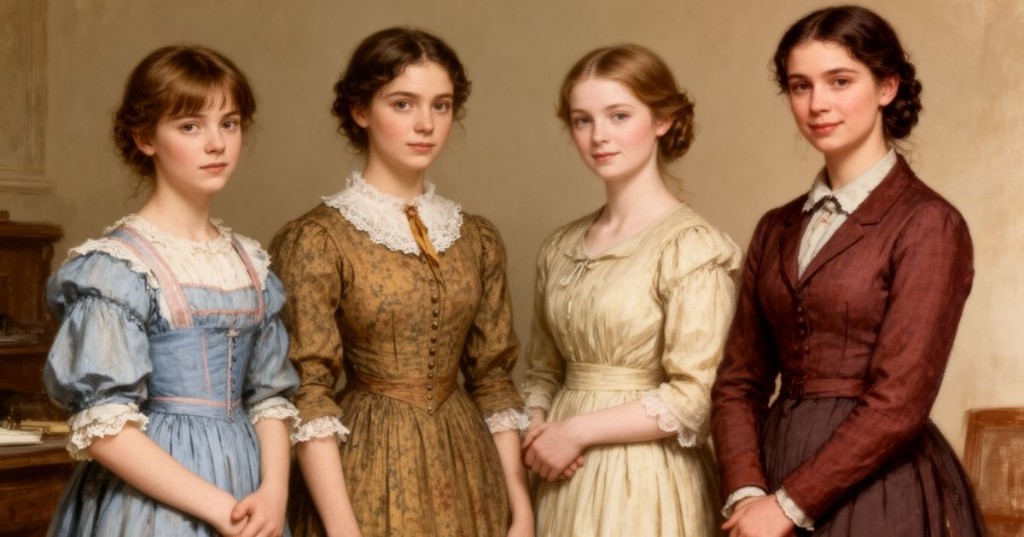
An excerpt from the original text.(complete · 3918 words)
CHAPTER THIRTY-ONE OUR FOREIGN CORRESPONDENT
London
Dearest People, Here I really sit at a front window of the Bath Hotel,
Piccadilly. It’s not a fashionable place, but Uncle stopped here years
ago, and won’t go anywhere else. However, we don’t mean to stay long,
so it’s no great matter. Oh, I can’t begin to tell you how I enjoy it
all! I never can, so I’ll only give you bits out of my notebook, for
I’ve done nothing but sketch and scribble since I started.
I sent a line from Halifax, when I felt pretty miserable, but after
that I got on delightfully, seldom ill, on deck all day, with plenty of
pleasant people to amuse me. Everyone was very kind to me, especially
the officers. Don’t laugh, Jo, gentlemen really are very necessary
aboard ship, to hold on to, or to wait upon one, and as they have
nothing to do, it’s a mercy to make them useful, otherwise they would
smoke themselves to death, I’m afraid.
Aunt and Flo were poorly all the way, and liked to be let alone, so
when I had done what I could for them, I went and enjoyed myself. Such
walks on deck, such sunsets, such splendid air and waves! It was almost
as exciting as riding a fast horse, when we went rushing on so grandly.
I wish Beth could have come, it would have done her so much good. As
for Jo, she would have gone up and sat on the maintop jib, or whatever
the high thing is called, made friends with the engineers, and tooted
on the captain’s speaking trumpet, she’d have been in such a state of
rapture.
It was all heavenly, but I was glad to see the Irish coast, and found
it very lovely, so green and sunny, with brown cabins here and there,
ruins on some of the hills, and gentlemen’s countryseats in the
valleys, with deer feeding in the parks. It was early in the morning,
but I didn’t regret getting up to see it, for the bay was full of
little boats, the shore so picturesque, and a rosy sky overhead. I
never shall forget it.
At Queenstown one of my new acquaintances left us, Mr. Lennox, and when
I said something about the Lakes of Killarney, he sighed, and sung,
with a look at me...
“Oh, have you e’er heard of Kate Kearney?
She lives on the banks of Killarney;
From the glance of her eye,
Shun danger and fly,
For fatal’s the glance of Kate Kearney.”
Wasn’t that nonsensical?
We only stopped at Liverpool a few hours. It’s a dirty, noisy place,
and I was glad to leave it. Uncle rushed out and bought a pair of
dogskin gloves, some ugly, thick shoes, and an umbrella, and got shaved
à la mutton chop, the first thing. Then he flattered himself that he
looked like a true Briton, but the first time he had the mud cleaned
off his shoes, the little bootblack knew that an American stood in
them, and said, with a grin, “There yer har, sir. I’ve given ’em the
latest Yankee shine.” It amused Uncle immensely. Oh, I must tell you
what that absurd Lennox did! He got his friend Ward, who came on with
us, to order a bouquet for me, and the first thing I saw in my room was
a lovely one, with “Robert Lennox’s compliments,” on the card. Wasn’t
that fun, girls? I like traveling.
I never shall get to London if I don’t hurry. The trip was like riding
through a long picture gallery, full of lovely landscapes. The
farmhouses were my delight, with thatched roofs, ivy up to the eaves,
latticed windows, and stout women with rosy children at the doors. The
very cattle looked more tranquil than ours, as they stood knee-deep in
clover, and the hens had a contented cluck, as if they never got
nervous like Yankee biddies. Such perfect color I never saw, the grass
so green, sky so blue, grain so yellow, woods so dark, I was in a
rapture all the way. So was Flo, and we kept bouncing from one side to
the other, trying to see everything while we were whisking along at the
rate of sixty miles an hour. Aunt was tired and went to sleep, but
Uncle read his guidebook, and wouldn’t be astonished at anything. This
is the way we went on. Amy, flying up—“Oh, that must be Kenilworth,
that gray place among the trees!” Flo, darting to my window—“How sweet!
We must go there sometime, won’t we Papa?” Uncle, calmly admiring his
boots—“No, my dear, not unless you want beer, that’s a brewery.”
A pause—then Flo cried out, “Bless me, there’s a gallows and a man
going up.” “Where, where?” shrieks Amy, staring out at two tall posts
with a crossbeam and some dangling chains. “A colliery,” remarks Uncle,
with a twinkle of the eye. “Here’s a lovely flock of lambs all lying
down,” says Amy. “See, Papa, aren’t they pretty?” added Flo
sentimentally. “Geese, young ladies,” returns Uncle, in a tone that
keeps us quiet till Flo settles down to enjoy the Flirtations of
Captain Cavendish, and I have the scenery all to myself.
Of course it rained when we got to London, and there was nothing to be
seen but fog and umbrellas. We rested, unpacked, and shopped a little
between the showers. Aunt Mary got me some new things, for I came off
in such a hurry I wasn’t half ready. A white hat and blue feather, a
muslin dress to match, and the loveliest mantle you ever saw. Shopping
in Regent Street is perfectly splendid. Things seem so cheap, nice
ribbons only sixpence a yard. I laid in a stock, but shall get my
gloves in Paris. Doesn’t that sound sort of elegant and rich?
Flo and I, for the fun of it, ordered a hansom cab, while Aunt and
Uncle were out, and went for a drive, though we learned afterward that
it wasn’t the thing for young ladies to ride in them alone. It was so
droll! For when we were shut in by the wooden apron, the man drove so
fast that Flo was frightened, and told me to stop him, but he was up
outside behind somewhere, and I couldn’t get at him. He didn’t hear me
call, nor see me flap my parasol in front, and there we were, quite
helpless, rattling away, and whirling around corners at a breakneck
pace. At last, in my despair, I saw a little door in the roof, and on
poking it open, a red eye appeared, and a beery voice said...
“Now, then, mum?”
I gave my order as soberly as I could, and slamming down the door, with
an “Aye, aye, mum,” the man made his horse walk, as if going to a
funeral. I poked again and said, “A little faster,” then off he went,
helter-skelter as before, and we resigned ourselves to our fate.
Today was fair, and we went to Hyde Park, close by, for we are more
aristocratic than we look. The Duke of Devonshire lives near. I often
see his footmen lounging at the back gate, and the Duke of Wellington’s
house is not far off. Such sights as I saw, my dear! It was as good as
Punch, for there were fat dowagers rolling about in their red and
yellow coaches, with gorgeous Jeameses in silk stockings and velvet
coats, up behind, and powdered coachmen in front. Smart maids, with the
rosiest children I ever saw, handsome girls, looking half asleep,
dandies in queer English hats and lavender kids lounging about, and
tall soldiers, in short red jackets and muffin caps stuck on one side,
looking so funny I longed to sketch them.
Rotten Row means ‘Route de Roi’, or the king’s way, but now it’s more
like a riding school than anything else. The horses are splendid, and
the men, especially the grooms, ride well, but the women are stiff, and
bounce, which isn’t according to our rules. I longed to show them a
tearing American gallop, for they trotted solemnly up and down, in
their scant habits and high hats, looking like the women in a toy
Noah’s Ark. Everyone rides—old men, stout ladies, little children—and
the young folks do a deal of flirting here, I saw a pair exchange rose
buds, for it’s the thing to wear one in the button-hole, and I thought
it rather a nice little idea.
In the P.M. to Westminster Abbey, but don’t expect me to describe it,
that’s impossible, so I’ll only say it was sublime! This evening we are
going to see Fechter, which will be an appropriate end to the happiest
day of my life.
It’s very late, but I can’t let my letter go in the morning without
telling you what happened last evening. Who do you think came in, as we
were at tea? Laurie’s English friends, Fred and Frank Vaughn! I was so
surprised, for I shouldn’t have known them but for the cards. Both are
tall fellows with whiskers, Fred handsome in the English style, and
Frank much better, for he only limps slightly, and uses no crutches.
They had heard from Laurie where we were to be, and came to ask us to
their house, but Uncle won’t go, so we shall return the call, and see
them as we can. They went to the theater with us, and we did have such
a good time, for Frank devoted himself to Flo, and Fred and I talked
over past, present, and future fun as if we had known each other all
our days. Tell Beth Frank asked for her, and was sorry to hear of her
ill health. Fred laughed when I spoke of Jo, and sent his ‘respectful
compliments to the big hat’. Neither of them had forgotten Camp
Laurence, or the fun we had there. What ages ago it seems, doesn’t it?
Aunt is tapping on the wall for the third time, so I must stop. I
really feel like a dissipated London fine lady, writing here so late,
with my room full of pretty things, and my head a jumble of parks,
theaters, new gowns, and gallant creatures who say “Ah!” and twirl
their blond mustaches with the true English lordliness. I long to see
you all, and in spite of my nonsense am, as ever, your loving...
AMY
PARIS
Dear girls,
In my last I told you about our London visit, how kind the Vaughns
were, and what pleasant parties they made for us. I enjoyed the trips
to Hampton Court and the Kensington Museum more than anything else, for
at Hampton I saw Raphael’s cartoons, and at the Museum, rooms full of
pictures by Turner, Lawrence, Reynolds, Hogarth, and the other great
creatures. The day in Richmond Park was charming, for we had a regular
English picnic, and I had more splendid oaks and groups of deer than I
could copy, also heard a nightingale, and saw larks go up. We ‘did’
London to our heart’s content, thanks to Fred and Frank, and were sorry
to go away, for though English people are slow to take you in, when
they once make up their minds to do it they cannot be outdone in
hospitality, I think. The Vaughns hope to meet us in Rome next winter,
and I shall be dreadfully disappointed if they don’t, for Grace and I
are great friends, and the boys very nice fellows, especially Fred.
Well, we were hardly settled here, when he turned up again, saying he
had come for a holiday, and was going to Switzerland. Aunt looked sober
at first, but he was so cool about it she couldn’t say a word. And now
we get on nicely, and are very glad he came, for he speaks French like
a native, and I don’t know what we should do without him. Uncle doesn’t
know ten words, and insists on talking English very loud, as if it
would make people understand him. Aunt’s pronunciation is
old-fashioned, and Flo and I, though we flattered ourselves that we
knew a good deal, find we don’t, and are very grateful to have Fred do
the ‘parley vooing’, as Uncle calls it.
Such delightful times as we are having! Sight-seeing from morning till
night, stopping for nice lunches in the gay cafes, and meeting with
all sorts of droll adventures. Rainy days I spend in the Louvre,
revelling in pictures. Jo would turn up her naughty nose at some of the
finest, because she has no soul for art, but I have, and I’m
cultivating eye and taste as fast as I can. She would like the relics
of great people better, for I’ve seen her Napoleon’s cocked hat and
gray coat, his baby’s cradle and his old toothbrush, also Marie
Antoinette’s little shoe, the ring of Saint Denis, Charlemagne’s sword,
and many other interesting things. I’ll talk for hours about them when
I come, but haven’t time to write.
The Palais Royale is a heavenly place, so full of bijouterie and
lovely things that I’m nearly distracted because I can’t buy them. Fred
wanted to get me some, but of course I didn’t allow it. Then the Bois
and Champs Elysees are tres magnifique. I’ve seen the imperial family
several times, the emperor an ugly, hard-looking man, the empress pale
and pretty, but dressed in bad taste, I thought—purple dress, green
hat, and yellow gloves. Little Nap is a handsome boy, who sits chatting
to his tutor, and kisses his hand to the people as he passes in his
four-horse barouche, with postilions in red satin jackets and a mounted
guard before and behind.
We often walk in the Tuileries Gardens, for they are lovely, though the
antique Luxembourg Gardens suit me better. Pere la Chaise is very
curious, for many of the tombs are like small rooms, and looking in,
one sees a table, with images or pictures of the dead, and chairs for
the mourners to sit in when they come to lament. That is so Frenchy.
Our rooms are on the Rue de Rivoli, and sitting on the balcony, we look
up and down the long, brilliant street. It is so pleasant that we spend
our evenings talking there when too tired with our day’s work to go
out. Fred is very entertaining, and is altogether the most agreeable
young man I ever knew—except Laurie, whose manners are more charming. I
wish Fred was dark, for I don’t fancy light men, however, the Vaughns
are very rich and come of an excellent family, so I won’t find fault
with their yellow hair, as my own is yellower.
Next week we are off to Germany and Switzerland, and as we shall travel
fast, I shall only be able to give you hasty letters. I keep my diary,
and try to ‘remember correctly and describe clearly all that I see and
admire’, as Father advised. It is good practice for me, and with my
sketchbook will give you a better idea of my tour than these scribbles.
Adieu, I embrace you tenderly. “Votre Amie.”
HEIDELBERG
My dear Mamma,
Having a quiet hour before we leave for Berne, I’ll try to tell you
what has happened, for some of it is very important, as you will see.
The sail up the Rhine was perfect, and I just sat and enjoyed it with
all my might. Get Father’s old guidebooks and read about it. I haven’t
words beautiful enough to describe it. At Coblentz we had a lovely
time, for some students from Bonn, with whom Fred got acquainted on the
boat, gave us a serenade. It was a moonlight night, and about one
o’clock Flo and I were waked by the most delicious music under our
windows. We flew up, and hid behind the curtains, but sly peeps showed
us Fred and the students singing away down below. It was the most
romantic thing I ever saw—the river, the bridge of boats, the great
fortress opposite, moonlight everywhere, and music fit to melt a heart
of stone.
When they were done we threw down some flowers, and saw them scramble
for them, kiss their hands to the invisible ladies, and go laughing
away, to smoke and drink beer, I suppose. Next morning Fred showed me
one of the crumpled flowers in his vest pocket, and looked very
sentimental. I laughed at him, and said I didn’t throw it, but Flo,
which seemed to disgust him, for he tossed it out of the window, and
turned sensible again. I’m afraid I’m going to have trouble with that
boy, it begins to look like it.
The baths at Nassau were very gay, so was Baden-Baden, where Fred lost
some money, and I scolded him. He needs someone to look after him when
Frank is not with him. Kate said once she hoped he’d marry soon, and I
quite agree with her that it would be well for him. Frankfurt was
delightful. I saw Goethe’s house, Schiller’s statue, and Dannecker’s
famous ‘Ariadne.’ It was very lovely, but I should have enjoyed it more
if I had known the story better. I didn’t like to ask, as everyone knew
it or pretended they did. I wish Jo would tell me all about it. I ought
to have read more, for I find I don’t know anything, and it mortifies
me.
Now comes the serious part, for it happened here, and Fred has just
gone. He has been so kind and jolly that we all got quite fond of him.
I never thought of anything but a traveling friendship till the
serenade night. Since then I’ve begun to feel that the moonlight walks,
balcony talks, and daily adventures were something more to him than
fun. I haven’t flirted, Mother, truly, but remembered what you said to
me, and have done my very best. I can’t help it if people like me. I
don’t try to make them, and it worries me if I don’t care for them,
though Jo says I haven’t got any heart. Now I know Mother will shake
her head, and the girls say, “Oh, the mercenary little wretch!”, but
I’ve made up my mind, and if Fred asks me, I shall accept him, though
I’m not madly in love. I like him, and we get on comfortably together.
He is handsome, young, clever enough, and very rich—ever so much richer
than the Laurences. I don’t think his family would object, and I should
be very happy, for they are all kind, well-bred, generous people, and
they like me. Fred, as the eldest twin, will have the estate, I
suppose, and such a splendid one it is! A city house in a fashionable
street, not so showy as our big houses, but twice as comfortable and
full of solid luxury, such as English people believe in. I like it, for
it’s genuine. I’ve seen the plate, the family jewels, the old servants,
and pictures of the country place, with its park, great house, lovely
grounds, and fine horses. Oh, it would be all I should ask! And I’d
rather have it than any title such as girls snap up so readily, and
find nothing behind. I may be mercenary, but I hate poverty, and don’t
mean to bear it a minute longer than I can help. One of us must marry
well. Meg didn’t, Jo won’t, Beth can’t yet, so I shall, and make
everything okay all round. I wouldn’t marry a man I hated or despised.
You may be sure of that, and though Fred is not my model hero, he does
very well, and in time I should get fond enough of him if he was very
fond of me, and let me do just as I liked. So I’ve been turning the
matter over in my mind the last week, for it was impossible to help
seeing that Fred liked me. He said nothing, but little things showed
it. He never goes with Flo, always gets on my side of the carriage,
table, or promenade, looks sentimental when we are alone, and frowns at
anyone else who ventures to speak to me. Yesterday at dinner, when an
Austrian officer stared at us and then said something to his friend, a
rakish-looking baron, about ‘ein wonderschones Blondchen’, Fred
looked as fierce as a lion, and cut his meat so savagely it nearly flew
off his plate. He isn’t one of the cool, stiff Englishmen, but is
rather peppery, for he has Scotch blood in him, as one might guess from
his bonnie blue eyes.
Well, last evening we went up to the castle about sunset, at least all
of us but Fred, who was to meet us there after going to the Post
Restante for letters. We had a charming time poking about the ruins,
the vaults where the monster tun is, and the beautiful gardens made by
the elector long ago for his English wife. I liked the great terrace
best, for the view was divine, so while the rest went to see the rooms
inside, I sat there trying to sketch the gray stone lion’s head on the
wall, with scarlet woodbine sprays hanging round it. I felt as if I’d
got into a romance, sitting there, watching the Neckar rolling through
the valley, listening to the music of the Austrian band below, and
waiting for my lover, like a real storybook girl. I had a feeling that
something was going to happen and I was ready for it. I didn’t feel
blushy or quakey, but quite cool and only a little excited.
By-and-by I heard Fred’s voice, and then he came hurrying through the
great arch to find me. He looked so troubled that I forgot all about
myself, and asked what the matter was. He said he’d just got a letter
begging him to come home, for Frank was very ill. So he was going at
once on the night train and only had time to say good-by. I was very
sorry for him, and disappointed for myself, but only for a minute
because he said, as he shook hands, and said it in a way that I could
not mistake, “I shall soon come back, you won’t forget me, Amy?”
I didn’t promise, but I looked at him, and he seemed satisfied, and
there was no time for anything but messages and good-byes, for he was
off in an hour, and we all miss him very much. I know he wanted to
speak, but I think, from something he once hinted, that he had promised
his father not to do anything of the sort yet a while, for he is a rash
boy, and the old gentleman dreads a foreign daughter-in-law. We shall
soon meet in Rome, and then, if I don’t change my mind, I’ll say “Yes,
thank you,” when he says “Will you, please?”
Of course this is all very private, but I wished you to know what was
going on. Don’t be anxious about me, remember I am your ‘prudent Amy’,
and be sure I will do nothing rashly. Send me as much advice as you
like. I’ll use it if I can. I wish I could see you for a good talk,
Marmee. Love and trust me.
Ever your AMY
Master this chapter. Complete your experience
Purchase the complete book to access all chapters and support classic literature
As an Amazon Associate, we earn a small commission from qualifying purchases at no additional cost to you.
Available in paperback, hardcover, and e-book formats
Let's Analyse the Pattern
The Calculated Heart - When Logic Overrides Love
Making major life decisions based primarily on practical benefits while minimizing or ignoring emotional and authentic compatibility.
Why This Matters
Connect literature to life
This chapter teaches how to identify when you're making major life decisions based primarily on practical benefits rather than authentic connection or passion.
Practice This Today
This week, notice when you catch yourself listing someone's or something's practical benefits without mentioning how it makes you feel—that's your signal to dig deeper into your real motivations.
Now let's explore the literary elements.
Key Quotes & Analysis
"Someone must marry well in this family, and since Meg didn't, Jo won't, and Beth can't, it falls to me to save us all from ruin."
Context: Amy justifies her practical approach to marriage in a letter home
This quote reveals Amy's clear-eyed assessment of her family's situation and her willingness to sacrifice romantic love for financial security. It shows her growth from a selfish child to someone who feels responsible for her family's welfare, even if her methods are calculating.
In Today's Words:
Someone in this family needs to marry money, and since my sisters won't do it, I guess it's up to me to save us all.
"I'm not madly in love with Fred, but I do like him very much, and he's everything a sensible girl should want in a husband."
Context: Amy honestly evaluates her feelings about Fred Vaughn
Amy's brutal honesty about her lack of passionate love shows her maturity and pragmatism. She's not deluding herself about romance but making a calculated decision based on compatibility and security. This reflects the limited options available to women of her era.
In Today's Words:
I'm not head-over-heels for Fred, but I really like him and he's got everything a smart woman should want in a husband.
"The galleries and museums here are beyond description. I feel like I'm drinking in beauty and knowledge with every breath."
Context: Amy describes her cultural experiences in Europe
This quote shows Amy's genuine love of art and culture, revealing that her trip isn't just about husband-hunting. Her artistic soul is being nourished even as she makes practical calculations about her future. It demonstrates the conflict between her dreams and her pragmatic choices.
In Today's Words:
The art museums here are incredible - I feel like I'm soaking up culture and learning everywhere I go.
Thematic Threads
Class
In This Chapter
Amy openly acknowledges that someone in the family must marry up to escape genteel poverty, and she's willing to be that person
Development
Evolved from earlier chapters where class was background anxiety to now being Amy's primary decision-making factor
In Your Life:
You might find yourself choosing opportunities or relationships based on what looks good to others rather than what feels right to you.
Identity
In This Chapter
Amy struggles between her artistic soul awakened by European culture and her practical nature focused on security
Development
Building on her earlier vanity, now showing deeper self-awareness about her competing desires and motivations
In Your Life:
You might recognize the tension between who you're becoming and who you think you should be for practical reasons.
Social Expectations
In This Chapter
Amy feels obligated to fulfill the family role of marrying well since her sisters haven't or won't
Development
New pressure showing how family expectations can override personal desires
In Your Life:
You might feel pressure to make choices that serve your family's needs rather than your own authentic path.
Personal Growth
In This Chapter
Amy's brutal honesty about her motivations shows maturity, even if her conclusions are questionable
Development
Significant evolution from the vain child to a young woman capable of clear self-analysis
In Your Life:
You might find that growing up sometimes means making harder, more complex choices that don't have clear right answers.
Human Relationships
In This Chapter
Amy's approach to Fred is transactional rather than emotional, viewing marriage as a practical arrangement
Development
Contrasts sharply with the passionate, authentic relationships shown in earlier chapters
In Your Life:
You might catch yourself evaluating relationships based on what someone can provide rather than genuine connection and compatibility.
You now have the context. Time to form your own thoughts.
Discussion Questions
- 1
What reasons does Amy give for considering marriage to Fred Vaughn, and how does she justify her feelings about him?
analysis • surface - 2
Why does Amy believe it's her responsibility to 'marry well' for the family, and what does this reveal about the pressures she feels?
analysis • medium - 3
Where do you see people today making major life decisions based primarily on practical considerations rather than genuine feelings?
application • medium - 4
How would you help someone distinguish between being realistically practical and settling for less than they deserve in relationships?
application • deep - 5
What does Amy's internal struggle teach us about the tension between security and authenticity in major life choices?
reflection • deep
Critical Thinking Exercise
The Decision Matrix Reality Check
Create two columns: 'Head Reasons' and 'Heart Reasons' for a major decision you're facing or have faced (job, relationship, living situation). List Amy's reasons for considering Fred in the appropriate columns, then do the same for your situation. Notice the balance between practical and emotional factors.
Consider:
- •Are your 'head reasons' actually fears disguised as wisdom?
- •What would happen if you weighted heart reasons more heavily?
- •How much of your decision comes from what others expect versus what you truly want?
Journaling Prompt
Write about a time when you chose the 'safe' option over what your heart wanted. What did you learn from that choice, and how might you handle a similar situation differently now?
Coming Up Next...
Chapter 32: Love's Tender Troubles
While Amy contemplates a strategic marriage abroad, back home in Concord, deeper emotional currents are stirring as the March family faces new challenges that will test their bonds in unexpected ways.



