
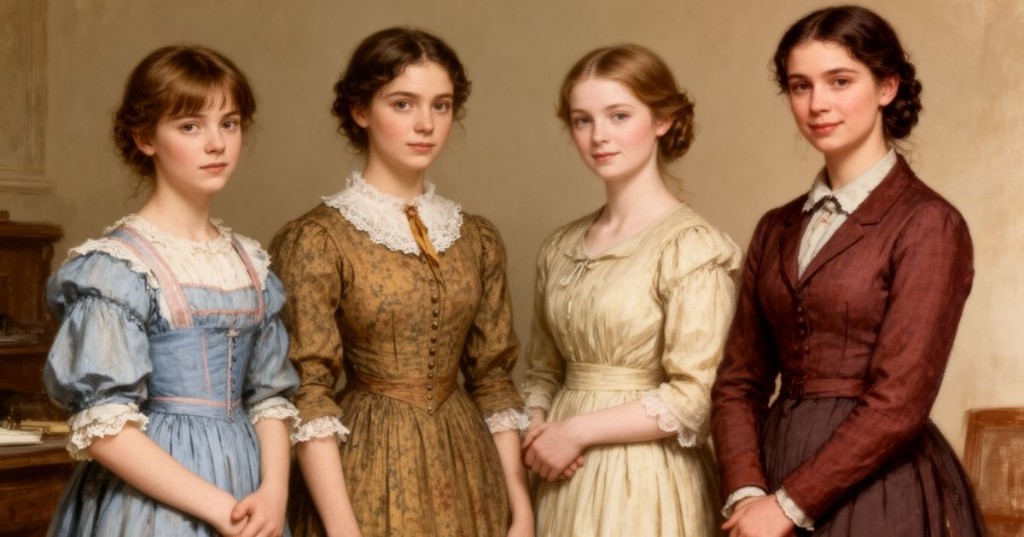
An excerpt from the original text.(complete · 4422 words)
CHAPTER THIRTY CONSEQUENCES
Mrs. Chester’s fair was so very elegant and select that it was
considered a great honor by the young ladies of the neighborhood to be
invited to take a table, and everyone was much interested in the
matter. Amy was asked, but Jo was not, which was fortunate for all
parties, as her elbows were decidedly akimbo at this period of her
life, and it took a good many hard knocks to teach her how to get on
easily. The ‘haughty, uninteresting creature’ was let severely alone,
but Amy’s talent and taste were duly complimented by the offer of the
art table, and she exerted herself to prepare and secure appropriate
and valuable contributions to it.
Everything went on smoothly till the day before the fair opened, then
there occurred one of the little skirmishes which it is almost
impossible to avoid, when some five-and-twenty women, old and young,
with all their private piques and prejudices, try to work together.
May Chester was rather jealous of Amy because the latter was a greater
favorite than herself, and just at this time several trifling
circumstances occurred to increase the feeling. Amy’s dainty
pen-and-ink work entirely eclipsed May’s painted vases—that was one
thorn. Then the all conquering Tudor had danced four times with Amy at
a late party and only once with May—that was thorn number two. But the
chief grievance that rankled in her soul, and gave an excuse for her
unfriendly conduct, was a rumor which some obliging gossip had
whispered to her, that the March girls had made fun of her at the
Lambs’. All the blame of this should have fallen upon Jo, for her
naughty imitation had been too lifelike to escape detection, and the
frolicsome Lambs had permitted the joke to escape. No hint of this had
reached the culprits, however, and Amy’s dismay can be imagined, when,
the very evening before the fair, as she was putting the last touches
to her pretty table, Mrs. Chester, who, of course, resented the
supposed ridicule of her daughter, said, in a bland tone, but with a
cold look...
“I find, dear, that there is some feeling among the young ladies about
my giving this table to anyone but my girls. As this is the most
prominent, and some say the most attractive table of all, and they are
the chief getters-up of the fair, it is thought best for them to take
this place. I’m sorry, but I know you are too sincerely interested in
the cause to mind a little personal disappointment, and you shall have
another table if you like.”
Mrs. Chester fancied beforehand that it would be easy to deliver this
little speech, but when the time came, she found it rather difficult to
utter it naturally, with Amy’s unsuspicious eyes looking straight at
her full of surprise and trouble.
Amy felt that there was something behind this, but could not guess
what, and said quietly, feeling hurt, and showing that she did,
“Perhaps you had rather I took no table at all?”
“Now, my dear, don’t have any ill feeling, I beg. It’s merely a matter
of expediency, you see, my girls will naturally take the lead, and this
table is considered their proper place. I think it very appropriate to
you, and feel very grateful for your efforts to make it so pretty, but
we must give up our private wishes, of course, and I will see that you
have a good place elsewhere. Wouldn’t you like the flower table? The
little girls undertook it, but they are discouraged. You could make a
charming thing of it, and the flower table is always attractive you
know.”
“Especially to gentlemen,” added May, with a look which enlightened Amy
as to one cause of her sudden fall from favor. She colored angrily, but
took no other notice of that girlish sarcasm, and answered with
unexpected amiability...
“It shall be as you please, Mrs. Chester. I’ll give up my place here at
once, and attend to the flowers, if you like.”
“You can put your own things on your own table, if you prefer,” began
May, feeling a little conscience-stricken, as she looked at the pretty
racks, the painted shells, and quaint illuminations Amy had so
carefully made and so gracefully arranged. She meant it kindly, but Amy
mistook her meaning, and said quickly...
“Oh, certainly, if they are in your way,” and sweeping her
contributions into her apron, pell-mell, she walked off, feeling that
herself and her works of art had been insulted past forgiveness.
“Now she’s mad. Oh, dear, I wish I hadn’t asked you to speak, Mama,”
said May, looking disconsolately at the empty spaces on her table.
“Girls’ quarrels are soon over,” returned her mother, feeling a trifle
ashamed of her own part in this one, as well she might.
The little girls hailed Amy and her treasures with delight, which
cordial reception somewhat soothed her perturbed spirit, and she fell
to work, determined to succeed florally, if she could not artistically.
But everything seemed against her. It was late, and she was tired.
Everyone was too busy with their own affairs to help her, and the
little girls were only hindrances, for the dears fussed and chattered
like so many magpies, making a great deal of confusion in their artless
efforts to preserve the most perfect order. The evergreen arch wouldn’t
stay firm after she got it up, but wiggled and threatened to tumble
down on her head when the hanging baskets were filled. Her best tile
got a splash of water, which left a sepia tear on the Cupid’s cheek.
She bruised her hands with hammering, and got cold working in a draft,
which last affliction filled her with apprehensions for the morrow. Any
girl reader who has suffered like afflictions will sympathize with poor
Amy and wish her well through her task.
There was great indignation at home when she told her story that
evening. Her mother said it was a shame, but told her she had done
right. Beth declared she wouldn’t go to the fair at all, and Jo
demanded why she didn’t take all her pretty things and leave those mean
people to get on without her.
“Because they are mean is no reason why I should be. I hate such
things, and though I think I’ve a right to be hurt, I don’t intend to
show it. They will feel that more than angry speeches or huffy actions,
won’t they, Marmee?”
“That’s the right spirit, my dear. A kiss for a blow is always best,
though it’s not very easy to give it sometimes,” said her mother, with
the air of one who had learned the difference between preaching and
practicing.
In spite of various very natural temptations to resent and retaliate,
Amy adhered to her resolution all the next day, bent on conquering her
enemy by kindness. She began well, thanks to a silent reminder that
came to her unexpectedly, but most opportunely. As she arranged her
table that morning, while the little girls were in the anteroom filling
the baskets, she took up her pet production, a little book, the antique
cover of which her father had found among his treasures, and in which
on leaves of vellum she had beautifully illuminated different texts. As
she turned the pages rich in dainty devices with very pardonable pride,
her eye fell upon one verse that made her stop and think. Framed in a
brilliant scrollwork of scarlet, blue and gold, with little spirits of
good will helping one another up and down among the thorns and flowers,
were the words, “Thou shalt love thy neighbor as thyself.”
“I ought, but I don’t,” thought Amy, as her eye went from the bright
page to May’s discontented face behind the big vases, that could not
hide the vacancies her pretty work had once filled. Amy stood a minute,
turning the leaves in her hand, reading on each some sweet rebuke for
all heartburnings and uncharitableness of spirit. Many wise and true
sermons are preached us every day by unconscious ministers in street,
school, office, or home. Even a fair table may become a pulpit, if it
can offer the good and helpful words which are never out of season.
Amy’s conscience preached her a little sermon from that text, then and
there, and she did what many of us do not always do, took the sermon to
heart, and straightway put it in practice.
A group of girls were standing about May’s table, admiring the pretty
things, and talking over the change of saleswomen. They dropped their
voices, but Amy knew they were speaking of her, hearing one side of the
story and judging accordingly. It was not pleasant, but a better spirit
had come over her, and presently a chance offered for proving it. She
heard May say sorrowfully...
“It’s too bad, for there is no time to make other things, and I don’t
want to fill up with odds and ends. The table was just complete then.
Now it’s spoiled.”
“I dare say she’d put them back if you asked her,” suggested someone.
“How could I after all the fuss?” began May, but she did not finish,
for Amy’s voice came across the hall, saying pleasantly...
“You may have them, and welcome, without asking, if you want them. I
was just thinking I’d offer to put them back, for they belong to your
table rather than mine. Here they are, please take them, and forgive me
if I was hasty in carrying them away last night.”
As she spoke, Amy returned her contribution, with a nod and a smile,
and hurried away again, feeling that it was easier to do a friendly
thing than it was to stay and be thanked for it.
“Now, I call that lovely of her, don’t you?” cried one girl.
May’s answer was inaudible, but another young lady, whose temper was
evidently a little soured by making lemonade, added, with a
disagreeable laugh, “Very lovely, for she knew she wouldn’t sell them
at her own table.”
Now, that was hard. When we make little sacrifices we like to have them
appreciated, at least, and for a minute Amy was sorry she had done it,
feeling that virtue was not always its own reward. But it is, as she
presently discovered, for her spirits began to rise, and her table to
blossom under her skillful hands, the girls were very kind, and that
one little act seemed to have cleared the atmosphere amazingly.
It was a very long day and a hard one for Amy, as she sat behind her
table, often quite alone, for the little girls deserted very soon. Few
cared to buy flowers in summer, and her bouquets began to droop long
before night.
The art table was the most attractive in the room. There was a crowd
about it all day long, and the tenders were constantly flying to and
fro with important faces and rattling money boxes. Amy often looked
wistfully across, longing to be there, where she felt at home and
happy, instead of in a corner with nothing to do. It might seem no
hardship to some of us, but to a pretty, blithe young girl, it was not
only tedious, but very trying, and the thought of Laurie and his
friends made it a real martyrdom.
She did not go home till night, and then she looked so pale and quiet
that they knew the day had been a hard one, though she made no
complaint, and did not even tell what she had done. Her mother gave her
an extra cordial cup of tea. Beth helped her dress, and made a charming
little wreath for her hair, while Jo astonished her family by getting
herself up with unusual care, and hinting darkly that the tables were
about to be turned.
“Don’t do anything rude, pray Jo; I won’t have any fuss made, so let it
all pass and behave yourself,” begged Amy, as she departed early,
hoping to find a reinforcement of flowers to refresh her poor little
table.
“I merely intend to make myself entrancingly agreeable to every one I
know, and to keep them in your corner as long as possible. Teddy and
his boys will lend a hand, and we’ll have a good time yet.” returned
Jo, leaning over the gate to watch for Laurie. Presently the familiar
tramp was heard in the dusk, and she ran out to meet him.
“Is that my boy?”
“As sure as this is my girl!” and Laurie tucked her hand under his arm
with the air of a man whose every wish was gratified.
“Oh, Teddy, such doings!” and Jo told Amy’s wrongs with sisterly zeal.
“A flock of our fellows are going to drive over by-and-by, and I’ll be
hanged if I don’t make them buy every flower she’s got, and camp down
before her table afterward,” said Laurie, espousing her cause with
warmth.
“The flowers are not at all nice, Amy says, and the fresh ones may not
arrive in time. I don’t wish to be unjust or suspicious, but I
shouldn’t wonder if they never came at all. When people do one mean
thing they are very likely to do another,” observed Jo in a disgusted
tone.
“Didn’t Hayes give you the best out of our gardens? I told him to.”
“I didn’t know that, he forgot, I suppose, and, as your grandpa was
poorly, I didn’t like to worry him by asking, though I did want some.”
“Now, Jo, how could you think there was any need of asking? They are
just as much yours as mine. Don’t we always go halves in everything?”
began Laurie, in the tone that always made Jo turn thorny.
“Gracious, I hope not! Half of some of your things wouldn’t suit me at
all. But we mustn’t stand philandering here. I’ve got to help Amy, so
you go and make yourself splendid, and if you’ll be so very kind as to
let Hayes take a few nice flowers up to the Hall, I’ll bless you
forever.”
“Couldn’t you do it now?” asked Laurie, so suggestively that Jo shut
the gate in his face with inhospitable haste, and called through the
bars, “Go away, Teddy, I’m busy.”
Thanks to the conspirators, the tables were turned that night, for
Hayes sent up a wilderness of flowers, with a lovely basket arranged in
his best manner for a centerpiece. Then the March family turned out en
masse, and Jo exerted herself to some purpose, for people not only
came, but stayed, laughing at her nonsense, admiring Amy’s taste, and
apparently enjoying themselves very much. Laurie and his friends
gallantly threw themselves into the breach, bought up the bouquets,
encamped before the table, and made that corner the liveliest spot in
the room. Amy was in her element now, and out of gratitude, if nothing
more, was as spritely and gracious as possible, coming to the
conclusion, about that time, that virtue was its own reward, after all.
Jo behaved herself with exemplary propriety, and when Amy was happily
surrounded by her guard of honor, Jo circulated about the Hall, picking
up various bits of gossip, which enlightened her upon the subject of
the Chester change of base. She reproached herself for her share of the
ill feeling and resolved to exonerate Amy as soon as possible. She also
discovered what Amy had done about the things in the morning, and
considered her a model of magnanimity. As she passed the art table, she
glanced over it for her sister’s things, but saw no sign of them.
“Tucked away out of sight, I dare say,” thought Jo, who could forgive
her own wrongs, but hotly resented any insult offered her family.
“Good evening, Miss Jo. How does Amy get on?” asked May with a
conciliatory air, for she wanted to show that she also could be
generous.
“She has sold everything she had that was worth selling, and now she is
enjoying herself. The flower table is always attractive, you know,
‘especially to gentlemen’.” Jo couldn’t resist giving that little slap,
but May took it so meekly she regretted it a minute after, and fell to
praising the great vases, which still remained unsold.
“Is Amy’s illumination anywhere about? I took a fancy to buy that for
Father,” said Jo, very anxious to learn the fate of her sister’s work.
“Everything of Amy’s sold long ago. I took care that the right people
saw them, and they made a nice little sum of money for us,” returned
May, who had overcome sundry small temptations, as well as Amy had,
that day.
Much gratified, Jo rushed back to tell the good news, and Amy looked
both touched and surprised by the report of May’s word and manner.
“Now, gentlemen, I want you to go and do your duty by the other tables
as generously as you have by mine, especially the art table,” she said,
ordering out ‘Teddy’s own’, as the girls called the college friends.
“‘Charge, Chester, charge!’ is the motto for that table, but do your
duty like men, and you’ll get your money’s worth of art in every sense
of the word,” said the irrepressible Jo, as the devoted phalanx
prepared to take the field.
“To hear is to obey, but March is fairer far than May,” said little
Parker, making a frantic effort to be both witty and tender, and
getting promptly quenched by Laurie, who said...
“Very well, my son, for a small boy!” and walked him off, with a
paternal pat on the head.
“Buy the vases,” whispered Amy to Laurie, as a final heaping of coals
of fire on her enemy’s head.
To May’s great delight, Mr. Laurence not only bought the vases, but
pervaded the hall with one under each arm. The other gentlemen
speculated with equal rashness in all sorts of frail trifles, and
wandered helplessly about afterward, burdened with wax flowers, painted
fans, filigree portfolios, and other useful and appropriate purchases.
Aunt Carrol was there, heard the story, looked pleased, and said
something to Mrs. March in a corner, which made the latter lady beam
with satisfaction, and watch Amy with a face full of mingled pride and
anxiety, though she did not betray the cause of her pleasure till
several days later.
The fair was pronounced a success, and when May bade Amy goodnight, she
did not gush as usual, but gave her an affectionate kiss, and a look
which said ‘forgive and forget’. That satisfied Amy, and when she got
home she found the vases paraded on the parlor chimney piece with a
great bouquet in each. “The reward of merit for a magnanimous March,”
as Laurie announced with a flourish.
“You’ve a deal more principle and generosity and nobleness of character
than I ever gave you credit for, Amy. You’ve behaved sweetly, and I
respect you with all my heart,” said Jo warmly, as they brushed their
hair together late that night.
“Yes, we all do, and love her for being so ready to forgive. It must
have been dreadfully hard, after working so long and setting your heart
on selling your own pretty things. I don’t believe I could have done it
as kindly as you did,” added Beth from her pillow.
“Why, girls, you needn’t praise me so. I only did as I’d be done by.
You laugh at me when I say I want to be a lady, but I mean a true
gentlewoman in mind and manners, and I try to do it as far as I know
how. I can’t explain exactly, but I want to be above the little
meannesses and follies and faults that spoil so many women. I’m far
from it now, but I do my best, and hope in time to be what Mother is.”
Amy spoke earnestly, and Jo said, with a cordial hug, “I understand now
what you mean, and I’ll never laugh at you again. You are getting on
faster than you think, and I’ll take lessons of you in true politeness,
for you’ve learned the secret, I believe. Try away, deary, you’ll get
your reward some day, and no one will be more delighted than I shall.”
A week later Amy did get her reward, and poor Jo found it hard to be
delighted. A letter came from Aunt Carrol, and Mrs. March’s face was
illuminated to such a degree when she read it that Jo and Beth, who
were with her, demanded what the glad tidings were.
“Aunt Carrol is going abroad next month, and wants...”
“Me to go with her!” burst in Jo, flying out of her chair in an
uncontrollable rapture.
“No, dear, not you. It’s Amy.”
“Oh, Mother! She’s too young, it’s my turn first. I’ve wanted it so
long. It would do me so much good, and be so altogether splendid. I
must go!”
“I’m afraid it’s impossible, Jo. Aunt says Amy, decidedly, and it is
not for us to dictate when she offers such a favor.”
“It’s always so. Amy has all the fun and I have all the work. It isn’t
fair, oh, it isn’t fair!” cried Jo passionately.
“I’m afraid it’s partly your own fault, dear. When Aunt spoke to me the
other day, she regretted your blunt manners and too independent spirit,
and here she writes, as if quoting something you had said—‘I planned at
first to ask Jo, but as ‘favors burden her’, and she ‘hates French’, I
think I won’t venture to invite her. Amy is more docile, will make a
good companion for Flo, and receive gratefully any help the trip may
give her.”
“Oh, my tongue, my abominable tongue! Why can’t I learn to keep it
quiet?” groaned Jo, remembering words which had been her undoing. When
she had heard the explanation of the quoted phrases, Mrs. March said
sorrowfully...
“I wish you could have gone, but there is no hope of it this time, so
try to bear it cheerfully, and don’t sadden Amy’s pleasure by
reproaches or regrets.”
“I’ll try,” said Jo, winking hard as she knelt down to pick up the
basket she had joyfully upset. “I’ll take a leaf out of her book, and
try not only to seem glad, but to be so, and not grudge her one minute
of happiness. But it won’t be easy, for it is a dreadful
disappointment,” and poor Jo bedewed the little fat pincushion she held
with several very bitter tears.
“Jo, dear, I’m very selfish, but I couldn’t spare you, and I’m glad you
are not going quite yet,” whispered Beth, embracing her, basket and
all, with such a clinging touch and loving face that Jo felt comforted
in spite of the sharp regret that made her want to box her own ears,
and humbly beg Aunt Carrol to burden her with this favor, and see how
gratefully she would bear it.
By the time Amy came in, Jo was able to take her part in the family
jubilation, not quite as heartily as usual, perhaps, but without
repinings at Amy’s good fortune. The young lady herself received the
news as tidings of great joy, went about in a solemn sort of rapture,
and began to sort her colors and pack her pencils that evening, leaving
such trifles as clothes, money, and passports to those less absorbed in
visions of art than herself.
“It isn’t a mere pleasure trip to me, girls,” she said impressively, as
she scraped her best palette. “It will decide my career, for if I have
any genius, I shall find it out in Rome, and will do something to prove
it.”
“Suppose you haven’t?” said Jo, sewing away, with red eyes, at the new
collars which were to be handed over to Amy.
“Then I shall come home and teach drawing for my living,” replied the
aspirant for fame, with philosophic composure. But she made a wry face
at the prospect, and scratched away at her palette as if bent on
vigorous measures before she gave up her hopes.
“No, you won’t. You hate hard work, and you’ll marry some rich man, and
come home to sit in the lap of luxury all your days,” said Jo.
“Your predictions sometimes come to pass, but I don’t believe that one
will. I’m sure I wish it would, for if I can’t be an artist myself, I
should like to be able to help those who are,” said Amy, smiling, as if
the part of Lady Bountiful would suit her better than that of a poor
drawing teacher.
“Hum!” said Jo, with a sigh. “If you wish it you’ll have it, for your
wishes are always granted—mine never.”
“Would you like to go?” asked Amy, thoughtfully patting her nose with
her knife.
“Rather!”
“Well, in a year or two I’ll send for you, and we’ll dig in the Forum
for relics, and carry out all the plans we’ve made so many times.”
“Thank you. I’ll remind you of your promise when that joyful day comes,
if it ever does,” returned Jo, accepting the vague but magnificent
offer as gratefully as she could.
There was not much time for preparation, and the house was in a ferment
till Amy was off. Jo bore up very well till the last flutter of blue
ribbon vanished, when she retired to her refuge, the garret, and cried
till she couldn’t cry any more. Amy likewise bore up stoutly till the
steamer sailed. Then just as the gangway was about to be withdrawn, it
suddenly came over her that a whole ocean was soon to roll between her
and those who loved her best, and she clung to Laurie, the last
lingerer, saying with a sob...
“Oh, take care of them for me, and if anything should happen...”
“I will, dear, I will, and if anything happens, I’ll come and comfort
you,” whispered Laurie, little dreaming that he would be called upon to
keep his word.
So Amy sailed away to find the Old World, which is always new and
beautiful to young eyes, while her father and friend watched her from
the shore, fervently hoping that none but gentle fortunes would befall
the happy-hearted girl, who waved her hand to them till they could see
nothing but the summer sunshine dazzling on the sea.
Master this chapter. Complete your experience
Purchase the complete book to access all chapters and support classic literature
As an Amazon Associate, we earn a small commission from qualifying purchases at no additional cost to you.
Available in paperback, hardcover, and e-book formats
Let's Analyse the Pattern
Responding to unfairness with grace instead of retaliation creates unexpected opportunities and allies while preserving long-term prospects.
Why This Matters
Connect literature to life
This chapter teaches how to recognize when you're being tested by people who hold real power, not just the person directly wronging you.
Practice This Today
This week, notice when conflicts have hidden audiences—your response is often being evaluated by people you don't realize are watching.
Now let's explore the literary elements.
Key Quotes & Analysis
"It is not the thing, I know, but I can't help wishing for it"
Context: Amy admits she wants recognition and nice things, despite knowing she should be more selfless
Shows Amy's honest self-awareness about her desires for status and beauty. She's not pretending to be above wanting nice things, which makes her more relatable and human.
In Today's Words:
I know I shouldn't care so much about having nice things, but I can't help wanting them
"You can't order a man's heart about"
Context: Defending his right to choose his own romantic feelings when pressured about Amy
Establishes the theme that love cannot be forced or manufactured through social expectations. Foreshadows the complex romantic dynamics that will develop.
In Today's Words:
You can't make someone fall in love just because you think they should
"I'll try to be what he loves to call me, 'a little woman,' and not be rough and wild"
Context: Amy's resolution to improve her behavior and become more refined
Shows Amy's genuine desire for self-improvement and her understanding that becoming a 'little woman' means developing character, not just following rules.
In Today's Words:
I want to become the kind of person he'd be proud of - more mature and less dramatic
Thematic Threads
Class
In This Chapter
Amy learns that true class isn't about money or position—it's about how you handle yourself when things go wrong
Development
Evolved from earlier focus on material class markers to understanding behavioral class distinctions
In Your Life:
You might discover that your reputation for handling difficult situations gracefully becomes more valuable than any title or salary
Identity
In This Chapter
Amy chooses to define herself by her response to adversity rather than by what happens to her
Development
Built on previous chapters showing each sister discovering who she wants to become
In Your Life:
You might realize that your identity is shaped more by how you handle setbacks than by your successes
Social Expectations
In This Chapter
Amy exceeds social expectations by returning kindness for cruelty, surprising everyone including herself
Development
Continued exploration of how breaking social rules can sometimes lead to better outcomes
In Your Life:
You might find that doing more than expected in difficult situations sets you apart from everyone else who just does the minimum
Personal Growth
In This Chapter
Amy's maturity is tested and proven through her gracious handling of public humiliation
Development
Shows concrete evidence of the character development hinted at in earlier chapters
In Your Life:
You might recognize that your biggest growth moments come when you're tempted to react badly but choose better
Human Relationships
In This Chapter
Amy transforms potential enemies into allies through unexpected generosity and grace
Development
Demonstrates how relationships can shift dramatically based on individual choices
In Your Life:
You might discover that your worst professional or personal conflicts can become your strongest relationships if you handle them with wisdom
You now have the context. Time to form your own thoughts.
Discussion Questions
- 1
What exactly happened to Amy at the charity fair, and how did she respond?
analysis • surface - 2
Why do you think Aunt Carroll chose Amy over Jo for the Europe trip, even though Jo wanted it more?
analysis • medium - 3
Can you think of a time when someone's graceful response to unfairness actually worked out better for them than fighting back would have?
application • medium - 4
If you were in Amy's position at the fair, what would be the hardest part about choosing grace over getting even?
application • deep - 5
What does this chapter suggest about how our character under pressure affects our future opportunities?
reflection • deep
Critical Thinking Exercise
Map Your Response Strategy
Think of a recent situation where you felt publicly embarrassed or unfairly treated. Write down three possible responses you could have had: the immediate emotional reaction, the 'get even' response, and the graceful response. For each response, trace out the likely consequences 24 hours later, one week later, and one month later.
Consider:
- •Who else might be watching your response besides the person who wronged you?
- •What opportunities might open or close based on how you handle conflict?
- •How does your reputation in small situations affect bigger opportunities later?
Journaling Prompt
Write about a time when someone's response to unfairness surprised you - either positively or negatively. How did their choice affect how you viewed them? What did you learn about character from watching their reaction?
Coming Up Next...
Chapter 31: Amy's Grand Tour and Growing Ambitions
Amy sets sail for Europe, leaving behind everything familiar for the artistic adventure of her dreams. But as the ocean stretches between her and home, she'll discover that seeing the world means more than just visiting famous galleries and ancient ruins.



