
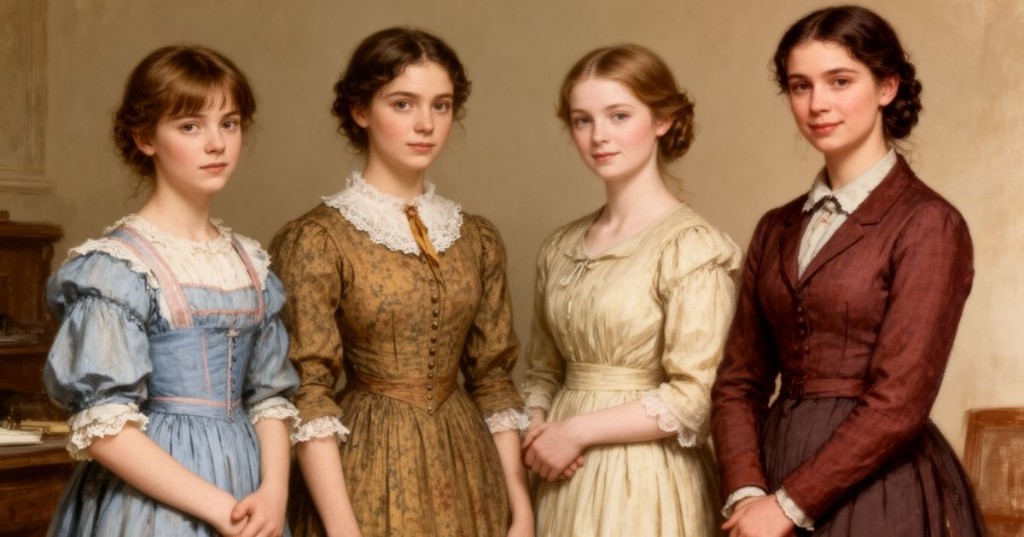
An excerpt from the original text.(complete · 4864 words)
CHAPTER TWENTY-NINE CALLS
“Come, Jo, it’s time.”
“For what?”
“You don’t mean to say you have forgotten that you promised to make
half a dozen calls with me today?”
“I’ve done a good many rash and foolish things in my life, but I don’t
think I ever was mad enough to say I’d make six calls in one day, when
a single one upsets me for a week.”
“Yes, you did, it was a bargain between us. I was to finish the crayon
of Beth for you, and you were to go properly with me, and return our
neighbors’ visits.”
“If it was fair, that was in the bond, and I stand to the letter of my
bond, Shylock. There is a pile of clouds in the east, it’s not fair,
and I don’t go.”
“Now, that’s shirking. It’s a lovely day, no prospect of rain, and you
pride yourself on keeping promises, so be honorable, come and do your
duty, and then be at peace for another six months.”
At that minute Jo was particularly absorbed in dressmaking, for she was
mantua-maker general to the family, and took especial credit to herself
because she could use a needle as well as a pen. It was very provoking
to be arrested in the act of a first trying-on, and ordered out to make
calls in her best array on a warm July day. She hated calls of the
formal sort, and never made any till Amy compelled her with a bargain,
bribe, or promise. In the present instance there was no escape, and
having clashed her scissors rebelliously, while protesting that she
smelled thunder, she gave in, put away her work, and taking up her hat
and gloves with an air of resignation, told Amy the victim was ready.
“Jo March, you are perverse enough to provoke a saint! You don’t intend
to make calls in that state, I hope,” cried Amy, surveying her with
amazement.
“Why not? I’m neat and cool and comfortable, quite proper for a dusty
walk on a warm day. If people care more for my clothes than they do for
me, I don’t wish to see them. You can dress for both, and be as elegant
as you please. It pays for you to be fine. It doesn’t for me, and
furbelows only worry me.”
“Oh, dear!” sighed Amy, “now she’s in a contrary fit, and will drive me
distracted before I can get her properly ready. I’m sure it’s no
pleasure to me to go today, but it’s a debt we owe society, and there’s
no one to pay it but you and me. I’ll do anything for you, Jo, if
you’ll only dress yourself nicely, and come and help me do the civil.
You can talk so well, look so aristocratic in your best things, and
behave so beautifully, if you try, that I’m proud of you. I’m afraid to
go alone, do come and take care of me.”
“You’re an artful little puss to flatter and wheedle your cross old
sister in that way. The idea of my being aristocratic and well-bred,
and your being afraid to go anywhere alone! I don’t know which is the
most absurd. Well, I’ll go if I must, and do my best. You shall be
commander of the expedition, and I’ll obey blindly, will that satisfy
you?” said Jo, with a sudden change from perversity to lamblike
submission.
“You’re a perfect cherub! Now put on all your best things, and I’ll
tell you how to behave at each place, so that you will make a good
impression. I want people to like you, and they would if you’d only try
to be a little more agreeable. Do your hair the pretty way, and put the
pink rose in your bonnet. It’s becoming, and you look too sober in your
plain suit. Take your light gloves and the embroidered handkerchief.
We’ll stop at Meg’s, and borrow her white sunshade, and then you can
have my dove-colored one.”
While Amy dressed, she issued her orders, and Jo obeyed them, not
without entering her protest, however, for she sighed as she rustled
into her new organdie, frowned darkly at herself as she tied her bonnet
strings in an irreproachable bow, wrestled viciously with pins as she
put on her collar, wrinkled up her features generally as she shook out
the handkerchief, whose embroidery was as irritating to her nose as the
present mission was to her feelings, and when she had squeezed her
hands into tight gloves with three buttons and a tassel, as the last
touch of elegance, she turned to Amy with an imbecile expression of
countenance, saying meekly...
“I’m perfectly miserable, but if you consider me presentable, I die
happy.”
“You’re highly satisfactory. Turn slowly round, and let me get a
careful view.” Jo revolved, and Amy gave a touch here and there, then
fell back, with her head on one side, observing graciously, “Yes,
you’ll do. Your head is all I could ask, for that white bonnet with the
rose is quite ravishing. Hold back your shoulders, and carry your hands
easily, no matter if your gloves do pinch. There’s one thing you can do
well, Jo, that is, wear a shawl. I can’t, but it’s very nice to see
you, and I’m so glad Aunt March gave you that lovely one. It’s simple,
but handsome, and those folds over the arm are really artistic. Is the
point of my mantle in the middle, and have I looped my dress evenly? I
like to show my boots, for my feet are pretty, though my nose isn’t.”
“You are a thing of beauty and a joy forever,” said Jo, looking through
her hand with the air of a connoisseur at the blue feather against the
golden hair. “Am I to drag my best dress through the dust, or loop it
up, please, ma’am?”
“Hold it up when you walk, but drop it in the house. The sweeping style
suits you best, and you must learn to trail your skirts gracefully. You
haven’t half buttoned one cuff, do it at once. You’ll never look
finished if you are not careful about the little details, for they make
up the pleasing whole.”
Jo sighed, and proceeded to burst the buttons off her glove, in doing
up her cuff, but at last both were ready, and sailed away, looking as
‘pretty as picters’, Hannah said, as she hung out of the upper window
to watch them.
“Now, Jo dear, the Chesters consider themselves very elegant people, so
I want you to put on your best deportment. Don’t make any of your
abrupt remarks, or do anything odd, will you? Just be calm, cool, and
quiet, that’s safe and ladylike, and you can easily do it for fifteen
minutes,” said Amy, as they approached the first place, having borrowed
the white parasol and been inspected by Meg, with a baby on each arm.
“Let me see. ‘Calm, cool, and quiet’, yes, I think I can promise that.
I’ve played the part of a prim young lady on the stage, and I’ll try it
off. My powers are great, as you shall see, so be easy in your mind, my
child.”
Amy looked relieved, but naughty Jo took her at her word, for during
the first call she sat with every limb gracefully composed, every fold
correctly draped, calm as a summer sea, cool as a snowbank, and as
silent as the sphinx. In vain Mrs. Chester alluded to her ‘charming
novel’, and the Misses Chester introduced parties, picnics, the opera,
and the fashions. Each and all were answered by a smile, a bow, and a
demure “Yes” or “No” with the chill on. In vain Amy telegraphed the
word ‘talk’, tried to draw her out, and administered covert pokes with
her foot. Jo sat as if blandly unconscious of it all, with deportment
like Maud’s face, ‘icily regular, splendidly null’.
“What a haughty, uninteresting creature that oldest Miss March is!” was
the unfortunately audible remark of one of the ladies, as the door
closed upon their guests. Jo laughed noiselessly all through the hall,
but Amy looked disgusted at the failure of her instructions, and very
naturally laid the blame upon Jo.
“How could you mistake me so? I merely meant you to be properly
dignified and composed, and you made yourself a perfect stock and
stone. Try to be sociable at the Lambs’. Gossip as other girls do, and
be interested in dress and flirtations and whatever nonsense comes up.
They move in the best society, are valuable persons for us to know, and
I wouldn’t fail to make a good impression there for anything.”
“I’ll be agreeable. I’ll gossip and giggle, and have horrors and
raptures over any trifle you like. I rather enjoy this, and now I’ll
imitate what is called ‘a charming girl’. I can do it, for I have May
Chester as a model, and I’ll improve upon her. See if the Lambs don’t
say, ‘What a lively, nice creature that Jo March is!”
Amy felt anxious, as well she might, for when Jo turned freakish there
was no knowing where she would stop. Amy’s face was a study when she
saw her sister skim into the next drawing room, kiss all the young
ladies with effusion, beam graciously upon the young gentlemen, and
join in the chat with a spirit which amazed the beholder. Amy was taken
possession of by Mrs. Lamb, with whom she was a favorite, and forced to
hear a long account of Lucretia’s last attack, while three delightful
young gentlemen hovered near, waiting for a pause when they might rush
in and rescue her. So situated, she was powerless to check Jo, who
seemed possessed by a spirit of mischief, and talked away as volubly as
the lady. A knot of heads gathered about her, and Amy strained her ears
to hear what was going on, for broken sentences filled her with
curiosity, and frequent peals of laughter made her wild to share the
fun. One may imagine her suffering on overhearing fragments of this
sort of conversation.
“She rides splendidly. Who taught her?”
“No one. She used to practice mounting, holding the reins, and sitting
straight on an old saddle in a tree. Now she rides anything, for she
doesn’t know what fear is, and the stableman lets her have horses cheap
because she trains them to carry ladies so well. She has such a passion
for it, I often tell her if everything else fails, she can be a
horsebreaker, and get her living so.”
At this awful speech Amy contained herself with difficulty, for the
impression was being given that she was rather a fast young lady, which
was her especial aversion. But what could she do? For the old lady was
in the middle of her story, and long before it was done, Jo was off
again, making more droll revelations and committing still more fearful
blunders.
“Yes, Amy was in despair that day, for all the good beasts were gone,
and of three left, one was lame, one blind, and the other so balky that
you had to put dirt in his mouth before he would start. Nice animal for
a pleasure party, wasn’t it?”
“Which did she choose?” asked one of the laughing gentlemen, who
enjoyed the subject.
“None of them. She heard of a young horse at the farm house over the
river, and though a lady had never ridden him, she resolved to try,
because he was handsome and spirited. Her struggles were really
pathetic. There was no one to bring the horse to the saddle, so she
took the saddle to the horse. My dear creature, she actually rowed it
over the river, put it on her head, and marched up to the barn to the
utter amazement of the old man!”
“Did she ride the horse?”
“Of course she did, and had a capital time. I expected to see her
brought home in fragments, but she managed him perfectly, and was the
life of the party.”
“Well, I call that plucky!” and young Mr. Lamb turned an approving
glance upon Amy, wondering what his mother could be saying to make the
girl look so red and uncomfortable.
She was still redder and more uncomfortable a moment after, when a
sudden turn in the conversation introduced the subject of dress. One of
the young ladies asked Jo where she got the pretty drab hat she wore to
the picnic and stupid Jo, instead of mentioning the place where it was
bought two years ago, must needs answer with unnecessary frankness,
“Oh, Amy painted it. You can’t buy those soft shades, so we paint ours
any color we like. It’s a great comfort to have an artistic sister.”
“Isn’t that an original idea?” cried Miss Lamb, who found Jo great fun.
“That’s nothing compared to some of her brilliant performances. There’s
nothing the child can’t do. Why, she wanted a pair of blue boots for
Sallie’s party, so she just painted her soiled white ones the loveliest
shade of sky blue you ever saw, and they looked exactly like satin,”
added Jo, with an air of pride in her sister’s accomplishments that
exasperated Amy till she felt that it would be a relief to throw her
cardcase at her.
“We read a story of yours the other day, and enjoyed it very much,”
observed the elder Miss Lamb, wishing to compliment the literary lady,
who did not look the character just then, it must be confessed.
Any mention of her ‘works’ always had a bad effect upon Jo, who either
grew rigid and looked offended, or changed the subject with a brusque
remark, as now. “Sorry you could find nothing better to read. I write
that rubbish because it sells, and ordinary people like it. Are you
going to New York this winter?”
As Miss Lamb had ‘enjoyed’ the story, this speech was not exactly
grateful or complimentary. The minute it was made Jo saw her mistake,
but fearing to make the matter worse, suddenly remembered that it was
for her to make the first move toward departure, and did so with an
abruptness that left three people with half-finished sentences in their
mouths.
“Amy, we must go. Good-by, dear, do come and see us. We are pining for
a visit. I don’t dare to ask you, Mr. Lamb, but if you should come, I
don’t think I shall have the heart to send you away.”
Jo said this with such a droll imitation of May Chester’s gushing style
that Amy got out of the room as rapidly as possible, feeling a strong
desire to laugh and cry at the same time.
“Didn’t I do well?” asked Jo, with a satisfied air as they walked away.
“Nothing could have been worse,” was Amy’s crushing reply. “What
possessed you to tell those stories about my saddle, and the hats and
boots, and all the rest of it?”
“Why, it’s funny, and amuses people. They know we are poor, so it’s no
use pretending that we have grooms, buy three or four hats a season,
and have things as easy and fine as they do.”
“You needn’t go and tell them all our little shifts, and expose our
poverty in that perfectly unnecessary way. You haven’t a bit of proper
pride, and never will learn when to hold your tongue and when to
speak,” said Amy despairingly.
Poor Jo looked abashed, and silently chafed the end of her nose with
the stiff handkerchief, as if performing a penance for her
misdemeanors.
“How shall I behave here?” she asked, as they approached the third
mansion.
“Just as you please. I wash my hands of you,” was Amy’s short answer.
“Then I’ll enjoy myself. The boys are at home, and we’ll have a
comfortable time. Goodness knows I need a little change, for elegance
has a bad effect upon my constitution,” returned Jo gruffly, being
disturbed by her failure to suit.
An enthusiastic welcome from three big boys and several pretty children
speedily soothed her ruffled feelings, and leaving Amy to entertain the
hostess and Mr. Tudor, who happened to be calling likewise, Jo devoted
herself to the young folks and found the change refreshing. She
listened to college stories with deep interest, caressed pointers and
poodles without a murmur, agreed heartily that “Tom Brown was a brick,”
regardless of the improper form of praise, and when one lad proposed a
visit to his turtle tank, she went with an alacrity which caused Mamma
to smile upon her, as that motherly lady settled the cap which was left
in a ruinous condition by filial hugs, bearlike but affectionate, and
dearer to her than the most faultless coiffure from the hands of an
inspired Frenchwoman.
Leaving her sister to her own devices, Amy proceeded to enjoy herself
to her heart’s content. Mr. Tudor’s uncle had married an English lady
who was third cousin to a living lord, and Amy regarded the whole
family with great respect, for in spite of her American birth and
breeding, she possessed that reverence for titles which haunts the best
of us—that unacknowledged loyalty to the early faith in kings which set
the most democratic nation under the sun in ferment at the coming of a
royal yellow-haired laddie, some years ago, and which still has
something to do with the love the young country bears the old, like
that of a big son for an imperious little mother, who held him while
she could, and let him go with a farewell scolding when he rebelled.
But even the satisfaction of talking with a distant connection of the
British nobility did not render Amy forgetful of time, and when the
proper number of minutes had passed, she reluctantly tore herself from
this aristocratic society, and looked about for Jo, fervently hoping
that her incorrigible sister would not be found in any position which
should bring disgrace upon the name of March.
It might have been worse, but Amy considered it bad. For Jo sat on the
grass, with an encampment of boys about her, and a dirty-footed dog
reposing on the skirt of her state and festival dress, as she related
one of Laurie’s pranks to her admiring audience. One small child was
poking turtles with Amy’s cherished parasol, a second was eating
gingerbread over Jo’s best bonnet, and a third playing ball with her
gloves, but all were enjoying themselves, and when Jo collected her
damaged property to go, her escort accompanied her, begging her to come
again, “It was such fun to hear about Laurie’s larks.”
“Capital boys, aren’t they? I feel quite young and brisk again after
that.” said Jo, strolling along with her hands behind her, partly from
habit, partly to conceal the bespattered parasol.
“Why do you always avoid Mr. Tudor?” asked Amy, wisely refraining from
any comment upon Jo’s dilapidated appearance.
“Don’t like him, he puts on airs, snubs his sisters, worries his
father, and doesn’t speak respectfully of his mother. Laurie says he is
fast, and I don’t consider him a desirable acquaintance, so I let him
alone.”
“You might treat him civilly, at least. You gave him a cool nod, and
just now you bowed and smiled in the politest way to Tommy Chamberlain,
whose father keeps a grocery store. If you had just reversed the nod
and the bow, it would have been right,” said Amy reprovingly.
“No, it wouldn’t,” returned Jo, “I neither like, respect, nor admire
Tudor, though his grandfather’s uncle’s nephew’s niece was a third
cousin to a lord. Tommy is poor and bashful and good and very clever. I
think well of him, and like to show that I do, for he is a gentleman in
spite of the brown paper parcels.”
“It’s no use trying to argue with you,” began Amy.
“Not the least, my dear,” interrupted Jo, “so let us look amiable, and
drop a card here, as the Kings are evidently out, for which I’m deeply
grateful.”
The family cardcase having done its duty the girls walked on, and Jo
uttered another thanksgiving on reaching the fifth house, and being
told that the young ladies were engaged.
“Now let us go home, and never mind Aunt March today. We can run down
there any time, and it’s really a pity to trail through the dust in our
best bibs and tuckers, when we are tired and cross.”
“Speak for yourself, if you please. Aunt March likes to have us pay her
the compliment of coming in style, and making a formal call. It’s a
little thing to do, but it gives her pleasure, and I don’t believe it
will hurt your things half so much as letting dirty dogs and clumping
boys spoil them. Stoop down, and let me take the crumbs off of your
bonnet.”
“What a good girl you are, Amy!” said Jo, with a repentant glance from
her own damaged costume to that of her sister, which was fresh and
spotless still. “I wish it was as easy for me to do little things to
please people as it is for you. I think of them, but it takes too much
time to do them, so I wait for a chance to confer a great favor, and
let the small ones slip, but they tell best in the end, I fancy.”
Amy smiled and was mollified at once, saying with a maternal air,
“Women should learn to be agreeable, particularly poor ones, for they
have no other way of repaying the kindnesses they receive. If you’d
remember that, and practice it, you’d be better liked than I am,
because there is more of you.”
“I’m a crotchety old thing, and always shall be, but I’m willing to own
that you are right, only it’s easier for me to risk my life for a
person than to be pleasant to him when I don’t feel like it. It’s a
great misfortune to have such strong likes and dislikes, isn’t it?”
“It’s a greater not to be able to hide them. I don’t mind saying that I
don’t approve of Tudor any more than you do, but I’m not called upon to
tell him so. Neither are you, and there is no use in making yourself
disagreeable because he is.”
“But I think girls ought to show when they disapprove of young men, and
how can they do it except by their manners? Preaching does not do any
good, as I know to my sorrow, since I’ve had Teddie to manage. But
there are many little ways in which I can influence him without a word,
and I say we ought to do it to others if we can.”
“Teddy is a remarkable boy, and can’t be taken as a sample of other
boys,” said Amy, in a tone of solemn conviction, which would have
convulsed the ‘remarkable boy’ if he had heard it. “If we were belles,
or women of wealth and position, we might do something, perhaps, but
for us to frown at one set of young gentlemen because we don’t approve
of them, and smile upon another set because we do, wouldn’t have a
particle of effect, and we should only be considered odd and
puritanical.”
“So we are to countenance things and people which we detest, merely
because we are not belles and millionaires, are we? That’s a nice sort
of morality.”
“I can’t argue about it, I only know that it’s the way of the world,
and people who set themselves against it only get laughed at for their
pains. I don’t like reformers, and I hope you never try to be one.”
“I do like them, and I shall be one if I can, for in spite of the
laughing the world would never get on without them. We can’t agree
about that, for you belong to the old set, and I to the new. You will
get on the best, but I shall have the liveliest time of it. I should
rather enjoy the brickbats and hooting, I think.”
“Well, compose yourself now, and don’t worry Aunt with your new ideas.”
“I’ll try not to, but I’m always possessed to burst out with some
particularly blunt speech or revolutionary sentiment before her. It’s
my doom, and I can’t help it.”
They found Aunt Carrol with the old lady, both absorbed in some very
interesting subject, but they dropped it as the girls came in, with a
conscious look which betrayed that they had been talking about their
nieces. Jo was not in a good humor, and the perverse fit returned, but
Amy, who had virtuously done her duty, kept her temper and pleased
everybody, was in a most angelic frame of mind. This amiable spirit was
felt at once, and both aunts ‘my deared’ her affectionately, looking
what they afterward said emphatically, “That child improves every day.”
“Are you going to help about the fair, dear?” asked Mrs. Carrol, as Amy
sat down beside her with the confiding air elderly people like so well
in the young.
“Yes, Aunt. Mrs. Chester asked me if I would, and I offered to tend a
table, as I have nothing but my time to give.”
“I’m not,” put in Jo decidedly. “I hate to be patronized, and the
Chesters think it’s a great favor to allow us to help with their highly
connected fair. I wonder you consented, Amy, they only want you to
work.”
“I am willing to work. It’s for the freedmen as well as the Chesters,
and I think it very kind of them to let me share the labor and the fun.
Patronage does not trouble me when it is well meant.”
“Quite right and proper. I like your grateful spirit, my dear. It’s a
pleasure to help people who appreciate our efforts. Some do not, and
that is trying,” observed Aunt March, looking over her spectacles at
Jo, who sat apart, rocking herself, with a somewhat morose expression.
If Jo had only known what a great happiness was wavering in the balance
for one of them, she would have turned dove-like in a minute, but
unfortunately, we don’t have windows in our breasts, and cannot see
what goes on in the minds of our friends. Better for us that we cannot
as a general thing, but now and then it would be such a comfort, such a
saving of time and temper. By her next speech, Jo deprived herself of
several years of pleasure, and received a timely lesson in the art of
holding her tongue.
“I don’t like favors, they oppress and make me feel like a slave. I’d
rather do everything for myself, and be perfectly independent.”
“Ahem!” coughed Aunt Carrol softly, with a look at Aunt March.
“I told you so,” said Aunt March, with a decided nod to Aunt Carrol.
Mercifully unconscious of what she had done, Jo sat with her nose in
the air, and a revolutionary aspect which was anything but inviting.
“Do you speak French, dear?” asked Mrs. Carrol, laying a hand on Amy’s.
“Pretty well, thanks to Aunt March, who lets Esther talk to me as often
as I like,” replied Amy, with a grateful look, which caused the old
lady to smile affably.
“How are you about languages?” asked Mrs. Carrol of Jo.
“Don’t know a word. I’m very stupid about studying anything, can’t bear
French, it’s such a slippery, silly sort of language,” was the brusque
reply.
Another look passed between the ladies, and Aunt March said to Amy,
“You are quite strong and well now, dear, I believe? Eyes don’t trouble
you any more, do they?”
“Not at all, thank you, ma’am. I’m very well, and mean to do great
things next winter, so that I may be ready for Rome, whenever that
joyful time arrives.”
“Good girl! You deserve to go, and I’m sure you will some day,” said
Aunt March, with an approving pat on the head, as Amy picked up her
ball for her.
Crosspatch, draw the latch,
Sit by the fire and spin,
squalled Polly, bending down from his perch on the back of her chair to
peep into Jo’s face, with such a comical air of impertinent inquiry
that it was impossible to help laughing.
“Most observing bird,” said the old lady.
“Come and take a walk, my dear?” cried Polly, hopping toward the china
closet, with a look suggestive of a lump of sugar.
“Thank you, I will. Come Amy.” and Jo brought the visit to an end,
feeling more strongly than ever that calls did have a bad effect upon
her constitution. She shook hands in a gentlemanly manner, but Amy
kissed both the aunts, and the girls departed, leaving behind them the
impression of shadow and sunshine, which impression caused Aunt March
to say, as they vanished...
“You’d better do it, Mary. I’ll supply the money.” and Aunt Carrol to
reply decidedly, “I certainly will, if her father and mother consent.”
Master this chapter. Complete your experience
Purchase the complete book to access all chapters and support classic literature
As an Amazon Associate, we earn a small commission from qualifying purchases at no additional cost to you.
Available in paperback, hardcover, and e-book formats
Let's Analyse the Pattern
When insisting on unchanging 'authenticity' becomes a form of self-sabotage that limits opportunities and relationships.
Why This Matters
Connect literature to life
This chapter teaches how to recognize when different situations require different communication approaches without compromising your core values.
Practice This Today
This week, notice when you're in different social contexts—talking to your boss versus your coworker, speaking with a doctor versus a friend—and observe how successful people adjust their tone and approach while staying genuine.
Now let's explore the literary elements.
Key Quotes & Analysis
"I've done a good many rash and foolish things in my life, but I don't think I ever was mad enough to say I'd make six calls in one day, when a single one upsets me for a week."
Context: Jo trying to get out of the social calls she promised to make with Amy
This reveals Jo's deep anxiety about social performance and her tendency to avoid rather than learn to navigate uncomfortable situations. Her dramatic language shows she sees these calls as genuine torture rather than necessary social maintenance.
In Today's Words:
I've made some bad decisions, but I'm not crazy enough to agree to six networking events in one day when just one stresses me out for a week.
"Now I'll be agreeable. I'll gossip and giggle, and have horrors and raptures over any trifle you like."
Context: Jo overcorrecting after being criticized for being too quiet at their first visit
Jo's sarcastic response shows she sees feminine social behavior as fake and ridiculous rather than a skill to master. Her all-or-nothing approach prevents her from finding a middle ground.
In Today's Words:
Fine, I'll be fake and bubbly and act excited about stupid stuff if that's what you want.
"You can go through the world with your elbows out and your nose in the air, and call it independence, if you like. That's not my way."
Context: Amy confronting Jo about her attitude during social calls
Amy recognizes that Jo's 'authenticity' often comes across as rudeness or superiority. She understands that true independence might require playing by social rules to gain the power to change them later.
In Today's Words:
You can act stuck-up and call it being authentic, but that's not how I'm going to succeed.
Thematic Threads
Class Navigation
In This Chapter
Jo's inability to code-switch between social situations costs her opportunities, while Amy's adaptability opens doors
Development
Builds on earlier themes of poverty's impact, now showing how class mobility requires social skills, not just merit
In Your Life:
Your ability to adjust your communication style for different audiences directly affects your opportunities.
Pride vs Pragmatism
In This Chapter
Jo's pride in her 'authentic' behavior blinds her to the practical consequences of social inflexibility
Development
Evolved from Jo's earlier pride in her writing—now showing how pride can limit growth in all areas
In Your Life:
Sometimes what you call 'staying true to yourself' is actually pride preventing you from learning new skills.
Social Intelligence
In This Chapter
Amy demonstrates that reading social cues and adapting behavior isn't fake—it's a learnable skill that creates opportunities
Development
Introduced here as a counterpoint to Jo's rigid approach
In Your Life:
Your ability to read the room and adjust accordingly is a professional and personal asset worth developing.
Opportunity Recognition
In This Chapter
The aunts' mysterious approval of Amy suggests opportunities that Jo's behavior has closed off for herself
Development
Builds on earlier themes about how small choices compound into life-changing consequences
In Your Life:
Opportunities often come disguised as social situations you might be tempted to dismiss or handle poorly.
Communication Styles
In This Chapter
Jo swings between silence and oversharing, missing the middle ground of appropriate social engagement
Development
Introduced here, showing how communication is a skill that can be learned and refined
In Your Life:
Learning to match your communication style to your audience isn't being fake—it's being effective.
You now have the context. Time to form your own thoughts.
Discussion Questions
- 1
Why does Jo struggle so much with the social calls while Amy seems to navigate them naturally?
analysis • surface - 2
What does Jo's swing between complete silence and oversharing reveal about her understanding of social situations?
analysis • medium - 3
Where do you see people today using 'being authentic' as a reason to avoid adapting their communication style?
application • medium - 4
How can someone stay true to their values while still adjusting their approach for different situations?
application • deep - 5
What's the difference between being fake and being socially intelligent?
reflection • deep
Critical Thinking Exercise
Map Your Communication Styles
Think of three different people you interact with regularly - maybe your boss, your teenager, and your elderly neighbor. Write down how you naturally adjust your communication style with each one. What changes about your tone, word choice, or topics? Then identify one relationship where you might be too rigid in your approach.
Consider:
- •Notice that adjusting your style doesn't mean lying or being fake
- •Consider whether your 'authenticity' sometimes creates barriers instead of bridges
- •Think about times when someone successfully communicated with you by meeting you where you were
Journaling Prompt
Write about a time when someone's refusal to adapt their communication style damaged a relationship or missed an opportunity. What could they have done differently while still staying true to their core message?
Coming Up Next...
Chapter 30: Grace Under Fire
The mysterious conversation between the aunts bears fruit, but the consequences of this social visit will reshape the March sisters' futures in unexpected ways. Someone is about to receive a life-changing opportunity.



