
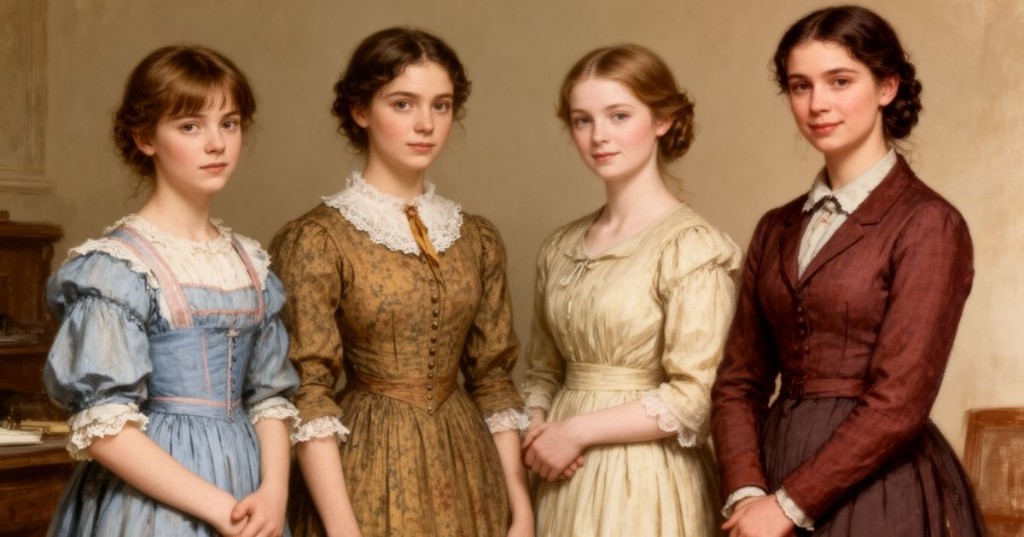
An excerpt from the original text.(complete · 5747 words)
CHAPTER TWENTY-EIGHT DOMESTIC EXPERIENCES
Like most other young matrons, Meg began her married life with the
determination to be a model housekeeper. John should find home a
paradise, he should always see a smiling face, should fare sumptuously
every day, and never know the loss of a button. She brought so much
love, energy, and cheerfulness to the work that she could not but
succeed, in spite of some obstacles. Her paradise was not a tranquil
one, for the little woman fussed, was over-anxious to please, and
bustled about like a true Martha, cumbered with many cares. She was too
tired, sometimes, even to smile, John grew dyspeptic after a course of
dainty dishes and ungratefully demanded plain fare. As for buttons, she
soon learned to wonder where they went, to shake her head over the
carelessness of men, and to threaten to make him sew them on himself,
and see if his work would stand impatient and clumsy fingers any better
than hers.
They were very happy, even after they discovered that they couldn’t
live on love alone. John did not find Meg’s beauty diminished, though
she beamed at him from behind the familiar coffee pot. Nor did Meg miss
any of the romance from the daily parting, when her husband followed up
his kiss with the tender inquiry, “Shall I send some veal or mutton for
dinner, darling?” The little house ceased to be a glorified bower, but
it became a home, and the young couple soon felt that it was a change
for the better. At first they played keep-house, and frolicked over it
like children. Then John took steadily to business, feeling the cares
of the head of a family upon his shoulders, and Meg laid by her cambric
wrappers, put on a big apron, and fell to work, as before said, with
more energy than discretion.
While the cooking mania lasted she went through Mrs. Cornelius’s
Receipt Book as if it were a mathematical exercise, working out the
problems with patience and care. Sometimes her family were invited in
to help eat up a too bounteous feast of successes, or Lotty would be
privately dispatched with a batch of failures, which were to be
concealed from all eyes in the convenient stomachs of the little
Hummels. An evening with John over the account books usually produced a
temporary lull in the culinary enthusiasm, and a frugal fit would
ensue, during which the poor man was put through a course of bread
pudding, hash, and warmed-over coffee, which tried his soul, although
he bore it with praiseworthy fortitude. Before the golden mean was
found, however, Meg added to her domestic possessions what young
couples seldom get on long without, a family jar.
Fired with a housewifely wish to see her storeroom stocked with
homemade preserves, she undertook to put up her own currant jelly. John
was requested to order home a dozen or so of little pots and an extra
quantity of sugar, for their own currants were ripe and were to be
attended to at once. As John firmly believed that ‘my wife’ was equal
to anything, and took a natural pride in her skill, he resolved that
she should be gratified, and their only crop of fruit laid by in a most
pleasing form for winter use. Home came four dozen delightful little
pots, half a barrel of sugar, and a small boy to pick the currants for
her. With her pretty hair tucked into a little cap, arms bared to the
elbow, and a checked apron which had a coquettish look in spite of the
bib, the young housewife fell to work, feeling no doubts about her
success, for hadn’t she seen Hannah do it hundreds of times? The array
of pots rather amazed her at first, but John was so fond of jelly, and
the nice little jars would look so well on the top shelf, that Meg
resolved to fill them all, and spent a long day picking, boiling,
straining, and fussing over her jelly. She did her best, she asked
advice of Mrs. Cornelius, she racked her brain to remember what Hannah
did that she left undone, she reboiled, resugared, and restrained, but
that dreadful stuff wouldn’t ‘jell’.
She longed to run home, bib and all, and ask Mother to lend her a hand,
but John and she had agreed that they would never annoy anyone with
their private worries, experiments, or quarrels. They had laughed over
that last word as if the idea it suggested was a most preposterous one,
but they had held to their resolve, and whenever they could get on
without help they did so, and no one interfered, for Mrs. March had
advised the plan. So Meg wrestled alone with the refractory sweetmeats
all that hot summer day, and at five o’clock sat down in her
topsy-turvey kitchen, wrung her bedaubed hands, lifted up her voice and
wept.
Now, in the first flush of the new life, she had often said, “My
husband shall always feel free to bring a friend home whenever he
likes. I shall always be prepared. There shall be no flurry, no
scolding, no discomfort, but a neat house, a cheerful wife, and a good
dinner. John, dear, never stop to ask my leave, invite whom you please,
and be sure of a welcome from me.”
How charming that was, to be sure! John quite glowed with pride to hear
her say it, and felt what a blessed thing it was to have a superior
wife. But, although they had had company from time to time, it never
happened to be unexpected, and Meg had never had an opportunity to
distinguish herself till now. It always happens so in this vale of
tears, there is an inevitability about such things which we can only
wonder at, deplore, and bear as we best can.
If John had not forgotten all about the jelly, it really would have
been unpardonable in him to choose that day, of all the days in the
year, to bring a friend home to dinner unexpectedly. Congratulating
himself that a handsome repast had been ordered that morning, feeling
sure that it would be ready to the minute, and indulging in pleasant
anticipations of the charming effect it would produce, when his pretty
wife came running out to meet him, he escorted his friend to his
mansion, with the irrepressible satisfaction of a young host and
husband.
It is a world of disappointments, as John discovered when he reached
the Dovecote. The front door usually stood hospitably open. Now it was
not only shut, but locked, and yesterday’s mud still adorned the steps.
The parlor windows were closed and curtained, no picture of the pretty
wife sewing on the piazza, in white, with a distracting little bow in
her hair, or a bright-eyed hostess, smiling a shy welcome as she
greeted her guest. Nothing of the sort, for not a soul appeared but a
sanginary-looking boy asleep under the current bushes.
“I’m afraid something has happened. Step into the garden, Scott, while
I look up Mrs. Brooke,” said John, alarmed at the silence and solitude.
Round the house he hurried, led by a pungent smell of burned sugar, and
Mr. Scott strolled after him, with a queer look on his face. He paused
discreetly at a distance when Brooke disappeared, but he could both see
and hear, and being a bachelor, enjoyed the prospect mightily.
In the kitchen reigned confusion and despair. One edition of jelly was
trickled from pot to pot, another lay upon the floor, and a third was
burning gaily on the stove. Lotty, with Teutonic phlegm, was calmly
eating bread and currant wine, for the jelly was still in a hopelessly
liquid state, while Mrs. Brooke, with her apron over her head, sat
sobbing dismally.
“My dearest girl, what is the matter?” cried John, rushing in, with
awful visions of scalded hands, sudden news of affliction, and secret
consternation at the thought of the guest in the garden.
“Oh, John, I am so tired and hot and cross and worried! I’ve been at it
till I’m all worn out. Do come and help me or I shall die!” and the
exhausted housewife cast herself upon his breast, giving him a sweet
welcome in every sense of the word, for her pinafore had been baptized
at the same time as the floor.
“What worries you dear? Has anything dreadful happened?” asked the
anxious John, tenderly kissing the crown of the little cap, which was
all askew.
“Yes,” sobbed Meg despairingly.
“Tell me quick, then. Don’t cry. I can bear anything better than that.
Out with it, love.”
“The... The jelly won’t jell and I don’t know what to do!”
John Brooke laughed then as he never dared to laugh afterward, and the
derisive Scott smiled involuntarily as he heard the hearty peal, which
put the finishing stroke to poor Meg’s woe.
“Is that all? Fling it out of the window, and don’t bother any more
about it. I’ll buy you quarts if you want it, but for heaven’s sake
don’t have hysterics, for I’ve brought Jack Scott home to dinner,
and...”
John got no further, for Meg cast him off, and clasped her hands with a
tragic gesture as she fell into a chair, exclaiming in a tone of
mingled indignation, reproach, and dismay...
“A man to dinner, and everything in a mess! John Brooke, how could you
do such a thing?”
“Hush, he’s in the garden! I forgot the confounded jelly, but it can’t
be helped now,” said John, surveying the prospect with an anxious eye.
“You ought to have sent word, or told me this morning, and you ought to
have remembered how busy I was,” continued Meg petulantly, for even
turtledoves will peck when ruffled.
“I didn’t know it this morning, and there was no time to send word, for
I met him on the way out. I never thought of asking leave, when you
have always told me to do as I liked. I never tried it before, and hang
me if I ever do again!” added John, with an aggrieved air.
“I should hope not! Take him away at once. I can’t see him, and there
isn’t any dinner.”
“Well, I like that! Where’s the beef and vegetables I sent home, and
the pudding you promised?” cried John, rushing to the larder.
“I hadn’t time to cook anything. I meant to dine at Mother’s. I’m
sorry, but I was so busy,” and Meg’s tears began again.
John was a mild man, but he was human, and after a long day’s work to
come home tired, hungry, and hopeful, to find a chaotic house, an empty
table, and a cross wife was not exactly conducive to repose of mind or
manner. He restrained himself however, and the little squall would have
blown over, but for one unlucky word.
“It’s a scrape, I acknowledge, but if you will lend a hand, we’ll pull
through and have a good time yet. Don’t cry, dear, but just exert
yourself a bit, and fix us up something to eat. We’re both as hungry as
hunters, so we shan’t mind what it is. Give us the cold meat, and bread
and cheese. We won’t ask for jelly.”
He meant it to be a good-natured joke, but that one word sealed his
fate. Meg thought it was too cruel to hint about her sad failure, and
the last atom of patience vanished as he spoke.
“You must get yourself out of the scrape as you can. I’m too used up to
‘exert’ myself for anyone. It’s like a man to propose a bone and vulgar
bread and cheese for company. I won’t have anything of the sort in my
house. Take that Scott up to Mother’s, and tell him I’m away, sick,
dead, anything. I won’t see him, and you two can laugh at me and my
jelly as much as you like. You won’t have anything else here.” and
having delivered her defiance all on one breath, Meg cast away her
pinafore and precipitately left the field to bemoan herself in her own
room.
What those two creatures did in her absence, she never knew, but Mr.
Scott was not taken ‘up to Mother’s’, and when Meg descended, after
they had strolled away together, she found traces of a promiscuous
lunch which filled her with horror. Lotty reported that they had eaten
“a much, and greatly laughed, and the master bid her throw away all the
sweet stuff, and hide the pots.”
Meg longed to go and tell Mother, but a sense of shame at her own
short-comings, of loyalty to John, “who might be cruel, but nobody
should know it,” restrained her, and after a summary cleaning up, she
dressed herself prettily, and sat down to wait for John to come and be
forgiven.
Unfortunately, John didn’t come, not seeing the matter in that light.
He had carried it off as a good joke with Scott, excused his little
wife as well as he could, and played the host so hospitably that his
friend enjoyed the impromptu dinner, and promised to come again, but
John was angry, though he did not show it, he felt that Meg had
deserted him in his hour of need. “It wasn’t fair to tell a man to
bring folks home any time, with perfect freedom, and when he took you
at your word, to flame up and blame him, and leave him in the lurch, to
be laughed at or pitied. No, by George, it wasn’t! And Meg must know
it.”
He had fumed inwardly during the feast, but when the flurry was over
and he strolled home after seeing Scott off, a milder mood came over
him. “Poor little thing! It was hard upon her when she tried so
heartily to please me. She was wrong, of course, but then she was
young. I must be patient and teach her.” He hoped she had not gone
home—he hated gossip and interference. For a minute he was ruffled
again at the mere thought of it, and then the fear that Meg would cry
herself sick softened his heart, and sent him on at a quicker pace,
resolving to be calm and kind, but firm, quite firm, and show her where
she had failed in her duty to her spouse.
Meg likewise resolved to be ‘calm and kind, but firm’, and show him his
duty. She longed to run to meet him, and beg pardon, and be kissed and
comforted, as she was sure of being, but, of course, she did nothing of
the sort, and when she saw John coming, began to hum quite naturally,
as she rocked and sewed, like a lady of leisure in her best parlor.
John was a little disappointed not to find a tender Niobe, but feeling
that his dignity demanded the first apology, he made none, only came
leisurely in and laid himself upon the sofa with the singularly
relevant remark, “We are going to have a new moon, my dear.”
“I’ve no objection,” was Meg’s equally soothing remark. A few other
topics of general interest were introduced by Mr. Brooke and
wet-blanketed by Mrs. Brooke, and conversation languished. John went to
one window, unfolded his paper, and wrapped himself in it, figuratively
speaking. Meg went to the other window, and sewed as if new rosettes
for slippers were among the necessaries of life. Neither spoke. Both
looked quite ‘calm and firm’, and both felt desperately uncomfortable.
“Oh, dear,” thought Meg, “married life is very trying, and does need
infinite patience as well as love, as Mother says.” The word ‘Mother’
suggested other maternal counsels given long ago, and received with
unbelieving protests.
“John is a good man, but he has his faults, and you must learn to see
and bear with them, remembering your own. He is very decided, but never
will be obstinate, if you reason kindly, not oppose impatiently. He is
very accurate, and particular about the truth—a good trait, though you
call him ‘fussy’. Never deceive him by look or word, Meg, and he will
give you the confidence you deserve, the support you need. He has a
temper, not like ours—one flash and then all over—but the white, still
anger that is seldom stirred, but once kindled is hard to quench. Be
careful, be very careful, not to wake his anger against yourself, for
peace and happiness depend on keeping his respect. Watch yourself, be
the first to ask pardon if you both err, and guard against the little
piques, misunderstandings, and hasty words that often pave the way for
bitter sorrow and regret.”
These words came back to Meg, as she sat sewing in the sunset,
especially the last. This was the first serious disagreement, her own
hasty speeches sounded both silly and unkind, as she recalled them, her
own anger looked childish now, and thoughts of poor John coming home to
such a scene quite melted her heart. She glanced at him with tears in
her eyes, but he did not see them. She put down her work and got up,
thinking, “I will be the first to say, ‘Forgive me’”, but he did not
seem to hear her. She went very slowly across the room, for pride was
hard to swallow, and stood by him, but he did not turn his head. For a
minute she felt as if she really couldn’t do it, then came the thought,
“This is the beginning. I’ll do my part, and have nothing to reproach
myself with,” and stooping down, she softly kissed her husband on the
forehead. Of course that settled it. The penitent kiss was better than
a world of words, and John had her on his knee in a minute, saying
tenderly...
“It was too bad to laugh at the poor little jelly pots. Forgive me,
dear. I never will again!”
But he did, oh bless you, yes, hundreds of times, and so did Meg, both
declaring that it was the sweetest jelly they ever made, for family
peace was preserved in that little family jar.
After this, Meg had Mr. Scott to dinner by special invitation, and
served him up a pleasant feast without a cooked wife for the first
course, on which occasion she was so gay and gracious, and made
everything go off so charmingly, that Mr. Scott told John he was a
lucky fellow, and shook his head over the hardships of bachelorhood all
the way home.
In the autumn, new trials and experiences came to Meg. Sallie Moffat
renewed her friendship, was always running out for a dish of gossip at
the little house, or inviting ‘that poor dear’ to come in and spend the
day at the big house. It was pleasant, for in dull weather Meg often
felt lonely. All were busy at home, John absent till night, and nothing
to do but sew, or read, or potter about. So it naturally fell out that
Meg got into the way of gadding and gossiping with her friend. Seeing
Sallie’s pretty things made her long for such, and pity herself because
she had not got them. Sallie was very kind, and often offered her the
coveted trifles, but Meg declined them, knowing that John wouldn’t like
it, and then this foolish little woman went and did what John disliked
even worse.
She knew her husband’s income, and she loved to feel that he trusted
her, not only with his happiness, but what some men seem to value
more—his money. She knew where it was, was free to take what she liked,
and all he asked was that she should keep account of every penny, pay
bills once a month, and remember that she was a poor man’s wife. Till
now she had done well, been prudent and exact, kept her little account
books neatly, and showed them to him monthly without fear. But that
autumn the serpent got into Meg’s paradise, and tempted her like many a
modern Eve, not with apples, but with dress. Meg didn’t like to be
pitied and made to feel poor. It irritated her, but she was ashamed to
confess it, and now and then she tried to console herself by buying
something pretty, so that Sallie needn’t think she had to economize.
She always felt wicked after it, for the pretty things were seldom
necessaries, but then they cost so little, it wasn’t worth worrying
about, so the trifles increased unconsciously, and in the shopping
excursions she was no longer a passive looker-on.
But the trifles cost more than one would imagine, and when she cast up
her accounts at the end of the month the sum total rather scared her.
John was busy that month and left the bills to her, the next month he
was absent, but the third he had a grand quarterly settling up, and Meg
never forgot it. A few days before she had done a dreadful thing, and
it weighed upon her conscience. Sallie had been buying silks, and Meg
longed for a new one, just a handsome light one for parties, her black
silk was so common, and thin things for evening wear were only proper
for girls. Aunt March usually gave the sisters a present of twenty-five
dollars apiece at New Year’s. That was only a month to wait, and here
was a lovely violet silk going at a bargain, and she had the money, if
she only dared to take it. John always said what was his was hers, but
would he think it right to spend not only the prospective
five-and-twenty, but another five-and-twenty out of the household fund?
That was the question. Sallie had urged her to do it, had offered to
lend the money, and with the best intentions in life had tempted Meg
beyond her strength. In an evil moment the shopman held up the lovely,
shimmering folds, and said, “A bargain, I assure, you, ma’am.” She
answered, “I’ll take it,” and it was cut off and paid for, and Sallie
had exulted, and she had laughed as if it were a thing of no
consequence, and driven away, feeling as if she had stolen something,
and the police were after her.
When she got home, she tried to assuage the pangs of remorse by
spreading forth the lovely silk, but it looked less silvery now, didn’t
become her, after all, and the words ‘fifty dollars’ seemed stamped
like a pattern down each breadth. She put it away, but it haunted her,
not delightfully as a new dress should, but dreadfully like the ghost
of a folly that was not easily laid. When John got out his books that
night, Meg’s heart sank, and for the first time in her married life,
she was afraid of her husband. The kind, brown eyes looked as if they
could be stern, and though he was unusually merry, she fancied he had
found her out, but didn’t mean to let her know it. The house bills were
all paid, the books all in order. John had praised her, and was undoing
the old pocketbook which they called the ‘bank’, when Meg, knowing that
it was quite empty, stopped his hand, saying nervously...
“You haven’t seen my private expense book yet.”
John never asked to see it, but she always insisted on his doing so,
and used to enjoy his masculine amazement at the queer things women
wanted, and made him guess what piping was, demand fiercely the meaning
of a hug-me-tight, or wonder how a little thing composed of three
rosebuds, a bit of velvet, and a pair of strings, could possibly be a
bonnet, and cost six dollars. That night he looked as if he would like
the fun of quizzing her figures and pretending to be horrified at her
extravagance, as he often did, being particularly proud of his prudent
wife.
The little book was brought slowly out and laid down before him. Meg
got behind his chair under pretense of smoothing the wrinkles out of
his tired forehead, and standing there, she said, with her panic
increasing with every word...
“John, dear, I’m ashamed to show you my book, for I’ve really been
dreadfully extravagant lately. I go about so much I must have things,
you know, and Sallie advised my getting it, so I did, and my New Year’s
money will partly pay for it, but I was sorry after I had done it, for
I knew you’d think it wrong in me.”
John laughed, and drew her round beside him, saying goodhumoredly,
“Don’t go and hide. I won’t beat you if you have got a pair of killing
boots. I’m rather proud of my wife’s feet, and don’t mind if she does
pay eight or nine dollars for her boots, if they are good ones.”
That had been one of her last ‘trifles’, and John’s eye had fallen on
it as he spoke. “Oh, what will he say when he comes to that awful fifty
dollars!” thought Meg, with a shiver.
“It’s worse than boots, it’s a silk dress,” she said, with the calmness
of desperation, for she wanted the worst over.
“Well, dear, what is the ‘dem’d total’, as Mr. Mantalini says?”
That didn’t sound like John, and she knew he was looking up at her with
the straightforward look that she had always been ready to meet and
answer with one as frank till now. She turned the page and her head at
the same time, pointing to the sum which would have been bad enough
without the fifty, but which was appalling to her with that added. For
a minute the room was very still, then John said slowly—but she could
feel it cost him an effort to express no displeasure—. . .
“Well, I don’t know that fifty is much for a dress, with all the
furbelows and notions you have to have to finish it off these days.”
“It isn’t made or trimmed,” sighed Meg, faintly, for a sudden
recollection of the cost still to be incurred quite overwhelmed her.
“Twenty-five yards of silk seems a good deal to cover one small woman,
but I’ve no doubt my wife will look as fine as Ned Moffat’s when she
gets it on,” said John dryly.
“I know you are angry, John, but I can’t help it. I don’t mean to waste
your money, and I didn’t think those little things would count up so. I
can’t resist them when I see Sallie buying all she wants, and pitying
me because I don’t. I try to be contented, but it is hard, and I’m
tired of being poor.”
The last words were spoken so low she thought he did not hear them, but
he did, and they wounded him deeply, for he had denied himself many
pleasures for Meg’s sake. She could have bitten her tongue out the
minute she had said it, for John pushed the books away and got up,
saying with a little quiver in his voice, “I was afraid of this. I do
my best, Meg.” If he had scolded her, or even shaken her, it would not
have broken her heart like those few words. She ran to him and held him
close, crying, with repentant tears, “Oh, John, my dear, kind,
hard-working boy. I didn’t mean it! It was so wicked, so untrue and
ungrateful, how could I say it! Oh, how could I say it!”
He was very kind, forgave her readily, and did not utter one reproach,
but Meg knew that she had done and said a thing which would not be
forgotten soon, although he might never allude to it again. She had
promised to love him for better or worse, and then she, his wife, had
reproached him with his poverty, after spending his earnings
recklessly. It was dreadful, and the worst of it was John went on so
quietly afterward, just as if nothing had happened, except that he
stayed in town later, and worked at night when she had gone to cry
herself to sleep. A week of remorse nearly made Meg sick, and the
discovery that John had countermanded the order for his new greatcoat
reduced her to a state of despair which was pathetic to behold. He had
simply said, in answer to her surprised inquiries as to the change, “I
can’t afford it, my dear.”
Meg said no more, but a few minutes after he found her in the hall with
her face buried in the old greatcoat, crying as if her heart would
break.
They had a long talk that night, and Meg learned to love her husband
better for his poverty, because it seemed to have made a man of him,
given him the strength and courage to fight his own way, and taught him
a tender patience with which to bear and comfort the natural longings
and failures of those he loved.
Next day she put her pride in her pocket, went to Sallie, told the
truth, and asked her to buy the silk as a favor. The good-natured Mrs.
Moffat willingly did so, and had the delicacy not to make her a present
of it immediately afterward. Then Meg ordered home the greatcoat, and
when John arrived, she put it on, and asked him how he liked her new
silk gown. One can imagine what answer he made, how he received his
present, and what a blissful state of things ensued. John came home
early, Meg gadded no more, and that greatcoat was put on in the morning
by a very happy husband, and taken off at night by a most devoted
little wife. So the year rolled round, and at midsummer there came to
Meg a new experience, the deepest and tenderest of a woman’s life.
Laurie came sneaking into the kitchen of the Dovecote one Saturday,
with an excited face, and was received with the clash of cymbals, for
Hannah clapped her hands with a saucepan in one and the cover in the
other.
“How’s the little mamma? Where is everybody? Why didn’t you tell me
before I came home?” began Laurie in a loud whisper.
“Happy as a queen, the dear! Every soul of ’em is upstairs a
worshipin’. We didn’t want no hurrycanes round. Now you go into the
parlor, and I’ll send ’em down to you,” with which somewhat involved
reply Hannah vanished, chuckling ecstatically.
Presently Jo appeared, proudly bearing a flannel bundle laid forth upon
a large pillow. Jo’s face was very sober, but her eyes twinkled, and
there was an odd sound in her voice of repressed emotion of some sort.
“Shut your eyes and hold out your arms,” she said invitingly.
Laurie backed precipitately into a corner, and put his hands behind him
with an imploring gesture. “No, thank you. I’d rather not. I shall drop
it or smash it, as sure as fate.”
“Then you shan’t see your nevvy,” said Jo decidedly, turning as if to
go.
“I will, I will! Only you must be responsible for damages.” and obeying
orders, Laurie heroically shut his eyes while something was put into
his arms. A peal of laughter from Jo, Amy, Mrs. March, Hannah, and John
caused him to open them the next minute, to find himself invested with
two babies instead of one.
No wonder they laughed, for the expression of his face was droll enough
to convulse a Quaker, as he stood and stared wildly from the
unconscious innocents to the hilarious spectators with such dismay that
Jo sat down on the floor and screamed.
“Twins, by Jupiter!” was all he said for a minute, then turning to the
women with an appealing look that was comically piteous, he added,
“Take ’em quick, somebody! I’m going to laugh, and I shall drop ’em.”
Jo rescued his babies, and marched up and down, with one on each arm,
as if already initiated into the mysteries of babytending, while Laurie
laughed till the tears ran down his cheeks.
“It’s the best joke of the season, isn’t it? I wouldn’t have told you,
for I set my heart on surprising you, and I flatter myself I’ve done
it,” said Jo, when she got her breath.
“I never was more staggered in my life. Isn’t it fun? Are they boys?
What are you going to name them? Let’s have another look. Hold me up,
Jo, for upon my life it’s one too many for me,” returned Laurie,
regarding the infants with the air of a big, benevolent Newfoundland
looking at a pair of infantile kittens.
“Boy and girl. Aren’t they beauties?” said the proud papa, beaming upon
the little red squirmers as if they were unfledged angels.
“Most remarkable children I ever saw. Which is which?” and Laurie bent
like a well-sweep to examine the prodigies.
“Amy put a blue ribbon on the boy and a pink on the girl, French
fashion, so you can always tell. Besides, one has blue eyes and one
brown. Kiss them, Uncle Teddy,” said wicked Jo.
“I’m afraid they mightn’t like it,” began Laurie, with unusual timidity
in such matters.
“Of course they will, they are used to it now. Do it this minute, sir!”
commanded Jo, fearing he might propose a proxy.
Laurie screwed up his face and obeyed with a gingerly peck at each
little cheek that produced another laugh, and made the babies squeal.
“There, I knew they didn’t like it! That’s the boy, see him kick, he
hits out with his fists like a good one. Now then, young Brooke, pitch
into a man of your own size, will you?” cried Laurie, delighted with a
poke in the face from a tiny fist, flapping aimlessly about.
“He’s to be named John Laurence, and the girl Margaret, after mother
and grandmother. We shall call her Daisey, so as not to have two Megs,
and I suppose the mannie will be Jack, unless we find a better name,”
said Amy, with aunt-like interest.
“Name him Demijohn, and call him Demi for short,” said Laurie.
“Daisy and Demi, just the thing! I knew Teddy would do it,” cried Jo
clapping her hands.
Teddy certainly had done it that time, for the babies were ‘Daisy’ and
‘Demi’ to the end of the chapter.
Master this chapter. Complete your experience
Purchase the complete book to access all chapters and support classic literature
As an Amazon Associate, we earn a small commission from qualifying purchases at no additional cost to you.
Available in paperback, hardcover, and e-book formats
Let's Analyse the Pattern
Exposure to others' advantages transforms existing contentment into artificial dissatisfaction, leading to choices that damage what you actually value.
Why This Matters
Connect literature to life
This chapter teaches how to recognize when exposure to others' lives creates artificial dissatisfaction in your own.
Practice This Today
This week, notice when you feel suddenly inadequate after social media, conversations, or visiting someone's home—ask yourself if you were unhappy about that area of your life before the comparison moment.
Now let's explore the literary elements.
Key Quotes & Analysis
"They were very happy, even after they discovered that they couldn't live on love alone."
Context: After describing Meg's early struggles with housekeeping and John's digestive problems from her cooking
This captures the universal truth that romantic love must evolve into practical partnership. The phrase 'even after' suggests this discovery could have destroyed them, but instead it deepened their bond by making it more realistic.
In Today's Words:
They stayed happy even when they realized feelings alone don't pay the bills or solve problems.
"I'm tired of being poor!"
Context: During their fight about her secret purchase of an expensive silk dress
This outburst reveals how social pressure and comparison have poisoned Meg's contentment. The word 'tired' suggests she sees their modest lifestyle as something to endure rather than appreciate, which wounds John deeply.
In Today's Words:
I'm sick of not having money like everyone else!
"Shall I send some veal or mutton for dinner, darling?"
Context: His daily parting question as he leaves for work, showing how romance adapts to practical needs
This tender inquiry shows how real love expresses itself through daily care rather than grand gestures. The contrast between 'darling' and 'veal or mutton' captures how marriage blends romance with mundane necessities.
In Today's Words:
What do you want me to pick up for dinner tonight, babe?
Thematic Threads
Class
In This Chapter
Meg's friendship with wealthy Sallie creates pressure to live beyond her means, showing how class differences strain relationships
Development
Evolved from earlier chapters about March family's genteel poverty to show how class anxiety affects marriage
In Your Life:
You might feel inadequate about your lifestyle when interacting with wealthier friends or colleagues
Expectations
In This Chapter
Meg's perfectionist homemaking attempts backfire spectacularly, revealing the gap between idealized roles and reality
Development
Built on earlier themes of social expectations for women, now showing marriage-specific pressures
In Your Life:
You might exhaust yourself trying to meet impossible standards for parenting, work performance, or relationships
Communication
In This Chapter
John and Meg's fight escalates because both hide their true feelings—he suffers silently, she acts deceptively
Development
Continues the book's emphasis on honest communication as essential for healthy relationships
In Your Life:
You might avoid difficult conversations with your partner, letting resentment build until it explodes
Growth
In This Chapter
Both characters learn from their mistakes and emerge stronger, with twins symbolizing new beginnings
Development
Reinforces the book's core message that personal development comes through facing challenges honestly
In Your Life:
You might discover that working through conflicts with loved ones actually strengthens your relationships
You now have the context. Time to form your own thoughts.
Discussion Questions
- 1
What specific events triggered Meg's transformation from a contented newlywed to someone who felt 'tired of being poor'?
analysis • surface - 2
Why did Meg's exposure to Sallie's wealthy lifestyle have such a powerful effect on her happiness, even though her own circumstances hadn't actually changed?
analysis • medium - 3
Where do you see this same pattern of comparison poisoning in modern life—people becoming dissatisfied after seeing others' lifestyles on social media, at work, or in their community?
application • medium - 4
If you were John's friend, what advice would you give him about handling Meg's spending and her comment about being tired of poverty?
application • deep - 5
What does Meg and John's conflict reveal about how comparison to others can damage not just our contentment, but our most important relationships?
reflection • deep
Critical Thinking Exercise
Track Your Comparison Triggers
For the next three days, notice when you feel dissatisfied with something you were previously content with. Write down what triggered the feeling—was it social media, a conversation, visiting someone's home, or seeing someone's purchase? Track the pattern from contentment to comparison to wanting something you didn't need before. This exercise helps you recognize comparison poisoning in real-time.
Consider:
- •Pay attention to the exact moment your mood shifts from satisfied to wanting
- •Notice whether the trigger involves seeing someone else's highlight reel versus their daily reality
- •Consider whether you were actually unhappy before the comparison moment
Journaling Prompt
Write about a time when comparison to others led you to make a decision you later regretted. What would you do differently now that you can name this pattern?
Coming Up Next...
Chapter 29: The Art of Social Navigation
As Meg adjusts to motherhood with twins, the March family faces new social pressures. Amy's artistic ambitions and romantic prospects begin to shift the family dynamics in unexpected ways.



