
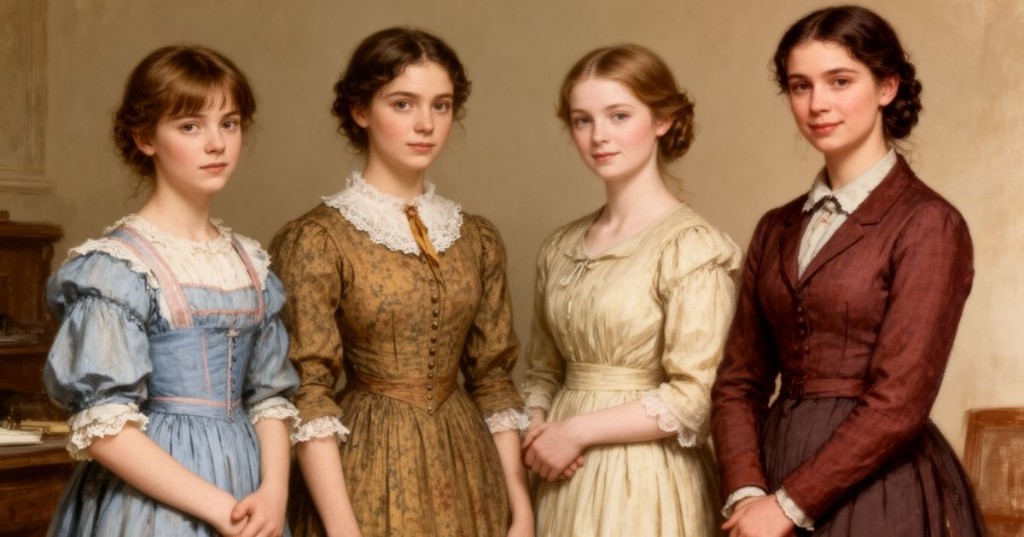
An excerpt from the original text.(complete · 2882 words)
CHAPTER TWENTY-SEVEN LITERARY LESSONS
Fortune suddenly smiled upon Jo, and dropped a good luck penny in her
path. Not a golden penny, exactly, but I doubt if half a million would
have given more real happiness then did the little sum that came to her
in this wise.
Every few weeks she would shut herself up in her room, put on her
scribbling suit, and ‘fall into a vortex’, as she expressed it, writing
away at her novel with all her heart and soul, for till that was
finished she could find no peace. Her ‘scribbling suit’ consisted of a
black woolen pinafore on which she could wipe her pen at will, and a
cap of the same material, adorned with a cheerful red bow, into which
she bundled her hair when the decks were cleared for action. This cap
was a beacon to the inquiring eyes of her family, who during these
periods kept their distance, merely popping in their heads
semi-occasionally to ask, with interest, “Does genius burn, Jo?” They
did not always venture even to ask this question, but took an
observation of the cap, and judged accordingly. If this expressive
article of dress was drawn low upon the forehead, it was a sign that
hard work was going on, in exciting moments it was pushed rakishly
askew, and when despair seized the author it was plucked wholly off,
and cast upon the floor. At such times the intruder silently withdrew,
and not until the red bow was seen gaily erect upon the gifted brow,
did anyone dare address Jo.
She did not think herself a genius by any means, but when the writing
fit came on, she gave herself up to it with entire abandon, and led a
blissful life, unconscious of want, care, or bad weather, while she sat
safe and happy in an imaginary world, full of friends almost as real
and dear to her as any in the flesh. Sleep forsook her eyes, meals
stood untasted, day and night were all too short to enjoy the happiness
which blessed her only at such times, and made these hours worth
living, even if they bore no other fruit. The divine afflatus usually
lasted a week or two, and then she emerged from her ‘vortex’, hungry,
sleepy, cross, or despondent.
She was just recovering from one of these attacks when she was
prevailed upon to escort Miss Crocker to a lecture, and in return for
her virtue was rewarded with a new idea. It was a People’s Course, the
lecture on the Pyramids, and Jo rather wondered at the choice of such a
subject for such an audience, but took it for granted that some great
social evil would be remedied or some great want supplied by unfolding
the glories of the Pharaohs to an audience whose thoughts were busy
with the price of coal and flour, and whose lives were spent in trying
to solve harder riddles than that of the Sphinx.
They were early, and while Miss Crocker set the heel of her stocking,
Jo amused herself by examining the faces of the people who occupied the
seat with them. On her left were two matrons, with massive foreheads
and bonnets to match, discussing Women’s Rights and making tatting.
Beyond sat a pair of humble lovers, artlessly holding each other by the
hand, a somber spinster eating peppermints out of a paper bag, and an
old gentleman taking his preparatory nap behind a yellow bandanna. On
her right, her only neighbor was a studious looking lad absorbed in a
newspaper.
It was a pictorial sheet, and Jo examined the work of art nearest her,
idly wondering what fortuitous concatenation of circumstances needed
the melodramatic illustration of an Indian in full war costume,
tumbling over a precipice with a wolf at his throat, while two
infuriated young gentlemen, with unnaturally small feet and big eyes,
were stabbing each other close by, and a disheveled female was flying
away in the background with her mouth wide open. Pausing to turn a
page, the lad saw her looking and, with boyish good nature offered half
his paper, saying bluntly, “want to read it? That’s a first-rate
story.”
Jo accepted it with a smile, for she had never outgrown her liking for
lads, and soon found herself involved in the usual labyrinth of love,
mystery, and murder, for the story belonged to that class of light
literature in which the passions have a holiday, and when the author’s
invention fails, a grand catastrophe clears the stage of one half the
dramatis personae, leaving the other half to exult over their downfall.
“Prime, isn’t it?” asked the boy, as her eye went down the last
paragraph of her portion.
“I think you and I could do as well as that if we tried,” returned Jo,
amused at his admiration of the trash.
“I should think I was a pretty lucky chap if I could. She makes a good
living out of such stories, they say.” and he pointed to the name of
Mrs. S.L.A.N.G. Northbury, under the title of the tale.
“Do you know her?” asked Jo, with sudden interest.
“No, but I read all her pieces, and I know a fellow who works in the
office where this paper is printed.”
“Do you say she makes a good living out of stories like this?” and Jo
looked more respectfully at the agitated group and thickly sprinkled
exclamation points that adorned the page.
“Guess she does! She knows just what folks like, and gets paid well for
writing it.”
Here the lecture began, but Jo heard very little of it, for while
Professor Sands was prosing away about Belzoni, Cheops, scarabei, and
hieroglyphics, she was covertly taking down the address of the paper,
and boldly resolving to try for the hundred-dollar prize offered in its
columns for a sensational story. By the time the lecture ended and the
audience awoke, she had built up a splendid fortune for herself (not
the first founded on paper), and was already deep in the concoction of
her story, being unable to decide whether the duel should come before
the elopement or after the murder.
She said nothing of her plan at home, but fell to work next day, much
to the disquiet of her mother, who always looked a little anxious when
‘genius took to burning’. Jo had never tried this style before,
contenting herself with very mild romances for The Spread Eagle. Her
experience and miscellaneous reading were of service now, for they gave
her some idea of dramatic effect, and supplied plot, language, and
costumes. Her story was as full of desperation and despair as her
limited acquaintance with those uncomfortable emotions enabled her to
make it, and having located it in Lisbon, she wound up with an
earthquake, as a striking and appropriate denouement. The manuscript
was privately dispatched, accompanied by a note, modestly saying that
if the tale didn’t get the prize, which the writer hardly dared expect,
she would be very glad to receive any sum it might be considered worth.
Six weeks is a long time to wait, and a still longer time for a girl to
keep a secret, but Jo did both, and was just beginning to give up all
hope of ever seeing her manuscript again, when a letter arrived which
almost took her breath away, for on opening it, a check for a hundred
dollars fell into her lap. For a minute she stared at it as if it had
been a snake, then she read her letter and began to cry. If the amiable
gentleman who wrote that kindly note could have known what intense
happiness he was giving a fellow creature, I think he would devote his
leisure hours, if he has any, to that amusement, for Jo valued the
letter more than the money, because it was encouraging, and after years
of effort it was so pleasant to find that she had learned to do
something, though it was only to write a sensation story.
A prouder young woman was seldom seen than she, when, having composed
herself, she electrified the family by appearing before them with the
letter in one hand, the check in the other, announcing that she had won
the prize. Of course there was a great jubilee, and when the story came
everyone read and praised it, though after her father had told her that
the language was good, the romance fresh and hearty, and the tragedy
quite thrilling, he shook his head, and said in his unworldly way...
“You can do better than this, Jo. Aim at the highest, and never mind
the money.”
“I think the money is the best part of it. What will you do with such a
fortune?” asked Amy, regarding the magic slip of paper with a
reverential eye.
“Send Beth and Mother to the seaside for a month or two,” answered Jo
promptly.
To the seaside they went, after much discussion, and though Beth didn’t
come home as plump and rosy as could be desired, she was much better,
while Mrs. March declared she felt ten years younger. So Jo was
satisfied with the investment of her prize money, and fell to work with
a cheery spirit, bent on earning more of those delightful checks. She
did earn several that year, and began to feel herself a power in the
house, for by the magic of a pen, her ‘rubbish’ turned into comforts
for them all. The Duke’s Daughter paid the butcher’s bill, A Phantom
Hand put down a new carpet, and the Curse of the Coventrys proved the
blessing of the Marches in the way of groceries and gowns.
Wealth is certainly a most desirable thing, but poverty has its sunny
side, and one of the sweet uses of adversity is the genuine
satisfaction which comes from hearty work of head or hand, and to the
inspiration of necessity, we owe half the wise, beautiful, and useful
blessings of the world. Jo enjoyed a taste of this satisfaction, and
ceased to envy richer girls, taking great comfort in the knowledge that
she could supply her own wants, and need ask no one for a penny.
Little notice was taken of her stories, but they found a market, and
encouraged by this fact, she resolved to make a bold stroke for fame
and fortune. Having copied her novel for the fourth time, read it to
all her confidential friends, and submitted it with fear and trembling
to three publishers, she at last disposed of it, on condition that she
would cut it down one third, and omit all the parts which she
particularly admired.
“Now I must either bundle it back in to my tin kitchen to mold, pay for
printing it myself, or chop it up to suit purchasers and get what I can
for it. Fame is a very good thing to have in the house, but cash is
more convenient, so I wish to take the sense of the meeting on this
important subject,” said Jo, calling a family council.
“Don’t spoil your book, my girl, for there is more in it than you know,
and the idea is well worked out. Let it wait and ripen,” was her
father’s advice, and he practiced what he preached, having waited
patiently thirty years for fruit of his own to ripen, and being in no
haste to gather it even now when it was sweet and mellow.
“It seems to me that Jo will profit more by taking the trial than by
waiting,” said Mrs. March. “Criticism is the best test of such work,
for it will show her both unsuspected merits and faults, and help her
to do better next time. We are too partial, but the praise and blame of
outsiders will prove useful, even if she gets but little money.”
“Yes,” said Jo, knitting her brows, “that’s just it. I’ve been fussing
over the thing so long, I really don’t know whether it’s good, bad, or
indifferent. It will be a great help to have cool, impartial persons
take a look at it, and tell me what they think of it.”
“I wouldn’t leave a word out of it. You’ll spoil it if you do, for the
interest of the story is more in the minds than in the actions of the
people, and it will be all a muddle if you don’t explain as you go on,”
said Meg, who firmly believed that this book was the most remarkable
novel ever written.
“But Mr. Allen says, ‘Leave out the explanations, make it brief and
dramatic, and let the characters tell the story’,” interrupted Jo,
turning to the publisher’s note.
“Do as he tells you. He knows what will sell, and we don’t. Make a
good, popular book, and get as much money as you can. By-and-by, when
you’ve got a name, you can afford to digress, and have philosophical
and metaphysical people in your novels,” said Amy, who took a strictly
practical view of the subject.
“Well,” said Jo, laughing, “if my people are ‘philosophical and
metaphysical’, it isn’t my fault, for I know nothing about such things,
except what I hear father say, sometimes. If I’ve got some of his wise
ideas jumbled up with my romance, so much the better for me. Now, Beth,
what do you say?”
“I should so like to see it printed soon,” was all Beth said, and
smiled in saying it. But there was an unconscious emphasis on the last
word, and a wistful look in the eyes that never lost their childlike
candor, which chilled Jo’s heart for a minute with a forboding fear,
and decided her to make her little venture ‘soon’.
So, with Spartan firmness, the young authoress laid her first-born on
her table, and chopped it up as ruthlessly as any ogre. In the hope of
pleasing everyone, she took everyone’s advice, and like the old man and
his donkey in the fable suited nobody.
Her father liked the metaphysical streak which had unconsciously got
into it, so that was allowed to remain though she had her doubts about
it. Her mother thought that there was a trifle too much description.
Out, therefore it came, and with it many necessary links in the story.
Meg admired the tragedy, so Jo piled up the agony to suit her, while
Amy objected to the fun, and, with the best intentions in life, Jo
quenched the spritly scenes which relieved the somber character of the
story. Then, to complicate the ruin, she cut it down one third, and
confidingly sent the poor little romance, like a picked robin, out into
the big, busy world to try its fate.
Well, it was printed, and she got three hundred dollars for it,
likewise plenty of praise and blame, both so much greater than she
expected that she was thrown into a state of bewilderment from which it
took her some time to recover.
“You said, Mother, that criticism would help me. But how can it, when
it’s so contradictory that I don’t know whether I’ve written a
promising book or broken all the ten commandments?” cried poor Jo,
turning over a heap of notices, the perusal of which filled her with
pride and joy one minute, wrath and dismay the next. “This man says,
‘An exquisite book, full of truth, beauty, and earnestness.’ ‘All is
sweet, pure, and healthy.’” continued the perplexed authoress. “The
next, ‘The theory of the book is bad, full of morbid fancies,
spiritualistic ideas, and unnatural characters.’ Now, as I had no
theory of any kind, don’t believe in Spiritualism, and copied my
characters from life, I don’t see how this critic can be right. Another
says, ‘It’s one of the best American novels which has appeared for
years.’ (I know better than that), and the next asserts that ‘Though it
is original, and written with great force and feeling, it is a
dangerous book.’ ’Tisn’t! Some make fun of it, some overpraise, and
nearly all insist that I had a deep theory to expound, when I only
wrote it for the pleasure and the money. I wish I’d printed the whole
or not at all, for I do hate to be so misjudged.”
Her family and friends administered comfort and commendation liberally.
Yet it was a hard time for sensitive, high-spirited Jo, who meant so
well and had apparently done so ill. But it did her good, for those
whose opinion had real value gave her the criticism which is an
author’s best education, and when the first soreness was over, she
could laugh at her poor little book, yet believe in it still, and feel
herself the wiser and stronger for the buffeting she had received.
“Not being a genius, like Keats, it won’t kill me,” she said stoutly,
“and I’ve got the joke on my side, after all, for the parts that were
taken straight out of real life are denounced as impossible and absurd,
and the scenes that I made up out of my own silly head are pronounced
‘charmingly natural, tender, and true’. So I’ll comfort myself with
that, and when I’m ready, I’ll up again and take another.”
Master this chapter. Complete your experience
Purchase the complete book to access all chapters and support classic literature
As an Amazon Associate, we earn a small commission from qualifying purchases at no additional cost to you.
Available in paperback, hardcover, and e-book formats
Let's Analyse the Pattern
Financial pressure forces incremental compromises of personal vision until the original purpose becomes unrecognizable.
Why This Matters
Connect literature to life
This chapter teaches how to identify when financial pressure is systematically eroding your standards and long-term goals.
Practice This Today
This week, notice when you justify decisions purely by immediate financial need—track what you're trading away and whether it's sustainable long-term.
Now let's explore the literary elements.
Key Quotes & Analysis
"Does genius burn, Jo?"
Context: They ask this when checking on Jo during her intense writing sessions, judging her mood by how she wears her writing cap.
This shows how Jo's family respects her creative process and gives her space to work. The playful tone suggests they take her writing seriously while maintaining humor about her dramatic work habits.
In Today's Words:
Are you in the zone right now?
"She had taken to writing sensation stories, for in those dark ages, even all-perfect America read rubbish, and was content to be fed on trash."
Context: Describing Jo's shift to writing melodramatic stories for money rather than her preferred literary style.
The narrator's sarcastic tone about 'all-perfect America' reveals criticism of popular taste while acknowledging that writers must give audiences what they want to survive financially.
In Today's Words:
She started writing trashy stories because that's what people actually read and bought.
"Jo's literary harvest was a success, for her rubbish turned into comforts for them all."
Context: After Jo starts regularly selling sensational stories to support her household expenses.
This quote captures the practical value of commercial writing - even if Jo considers her stories 'rubbish,' they provide real material benefits for her family's daily needs.
In Today's Words:
Her trashy writing actually paid the bills and made life better for everyone.
Thematic Threads
Class
In This Chapter
Jo's writing career is driven by financial necessity—she writes 'rubbish' because it pays, not because it fulfills her artistic vision
Development
Evolved from earlier genteel poverty to active income generation through compromise
In Your Life:
You might recognize this when you take work that pays the bills but slowly erodes what you actually care about
Identity
In This Chapter
Jo struggles between her identity as a serious writer and her role as family provider, ultimately choosing financial responsibility over artistic integrity
Development
Deepened from earlier chapters where Jo's writing was purely personal expression
In Your Life:
You might face this tension between who you want to be professionally and what circumstances force you to become
Personal Growth
In This Chapter
Jo learns painful lessons about criticism and public reception—that success doesn't equal understanding and that financial reward can come at the cost of artistic soul
Development
Continued growth through harsh experience rather than gentle guidance
In Your Life:
You might discover that achieving what you thought you wanted brings unexpected complications and hollow victories
Social Expectations
In This Chapter
Publishers, critics, and readers all have different expectations for Jo's work, forcing her to navigate conflicting demands that ultimately please no one
Development
Expanded from family expectations to public and professional pressures
In Your Life:
You might find yourself trying to satisfy multiple stakeholders with incompatible demands, satisfying none completely
You now have the context. Time to form your own thoughts.
Discussion Questions
- 1
What financial pressures drove Jo to start writing sensational stories, and how did her success change her approach to writing?
analysis • surface - 2
Why did Jo choose to accept the publisher's demands to cut her novel by a third, despite her father's advice to wait for a better offer?
analysis • medium - 3
Where do you see people today making similar compromises between their values and financial necessity? What patterns do you notice?
application • medium - 4
If you were Jo's friend, how would you help her set boundaries between creative integrity and financial survival without being judgmental?
application • deep - 5
What does Jo's experience with contradictory reviews teach us about how external validation can mislead us about our own work and decisions?
reflection • deep
Critical Thinking Exercise
Map Your Compromise Points
Think about an area of your life where financial pressure or practical necessity conflicts with your values or vision. Draw a simple line with 'My Ideal Vision' on one end and 'Survival Mode' on the other. Mark where you currently operate and identify three specific compromise points along that line. For each point, write what you gain and what you lose.
Consider:
- •Which compromises feel temporary versus permanent?
- •What would need to change for you to move closer to your ideal vision?
- •How do you recognize when you've compromised too much?
Journaling Prompt
Write about a time when financial pressure led you to make a choice that conflicted with your values. What did you learn from that experience, and how would you handle a similar situation now?
Coming Up Next...
Chapter 28: The Reality of Marriage
While Jo navigates the literary world, Meg embarks on her own new adventure as she adjusts to married life and discovers that domestic happiness requires different skills than she expected.



