
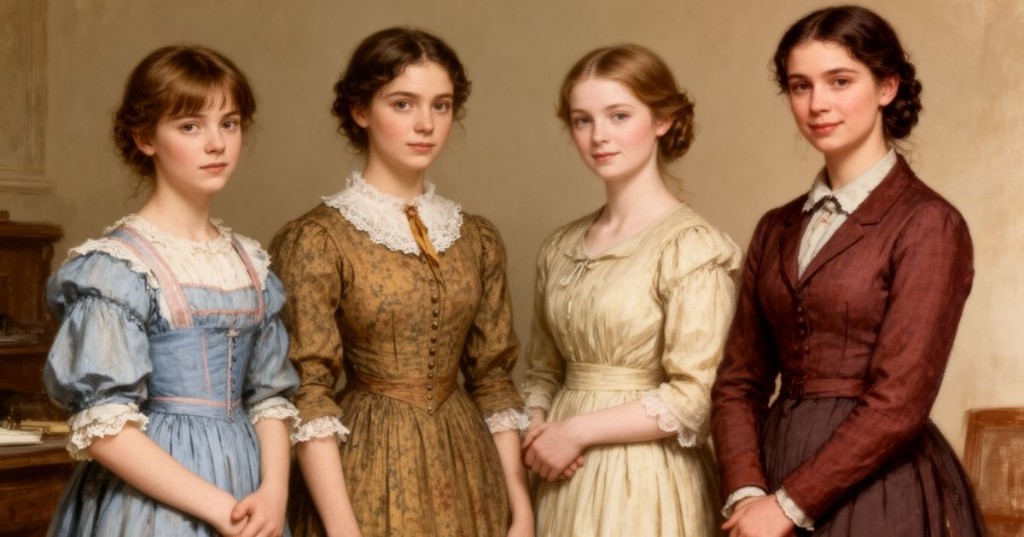
An excerpt from the original text.(complete · 3891 words)
CHAPTER TWENTY-SIX ARTISTIC ATTEMPTS
It takes people a long time to learn the difference between talent and
genius, especially ambitious young men and women. Amy was learning this
distinction through much tribulation, for mistaking enthusiasm for
inspiration, she attempted every branch of art with youthful audacity.
For a long time there was a lull in the ‘mud-pie’ business, and she
devoted herself to the finest pen-and-ink drawing, in which she showed
such taste and skill that her graceful handiwork proved both pleasant
and profitable. But over-strained eyes caused pen and ink to be laid
aside for a bold attempt at poker-sketching. While this attack lasted,
the family lived in constant fear of a conflagration, for the odor of
burning wood pervaded the house at all hours, smoke issued from attic
and shed with alarming frequency, red-hot pokers lay about
promiscuously, and Hannah never went to bed without a pail of water and
the dinner bell at her door in case of fire. Raphael’s face was found
boldly executed on the underside of the moulding board, and Bacchus on
the head of a beer barrel. A chanting cherub adorned the cover of the
sugar bucket, and attempts to portray Romeo and Juliet supplied
kindling for some time.
From fire to oil was a natural transition for burned fingers, and Amy
fell to painting with undiminished ardor. An artist friend fitted her
out with his castoff palettes, brushes, and colors, and she daubed
away, producing pastoral and marine views such as were never seen on
land or sea. Her monstrosities in the way of cattle would have taken
prizes at an agricultural fair, and the perilous pitching of her
vessels would have produced seasickness in the most nautical observer,
if the utter disregard to all known rules of shipbuilding and rigging
had not convulsed him with laughter at the first glance. Swarthy boys
and dark-eyed Madonnas, staring at you from one corner of the studio,
suggested Murillo; oily brown shadows of faces with a lurid streak in
the wrong place, meant Rembrandt; buxom ladies and dropiscal infants,
Rubens; and Turner appeared in tempests of blue thunder, orange
lightning, brown rain, and purple clouds, with a tomato-colored splash
in the middle, which might be the sun or a bouy, a sailor’s shirt or a
king’s robe, as the spectator pleased.
Charcoal portraits came next, and the entire family hung in a row,
looking as wild and crocky as if just evoked from a coalbin. Softened
into crayon sketches, they did better, for the likenesses were good,
and Amy’s hair, Jo’s nose, Meg’s mouth, and Laurie’s eyes were
pronounced ‘wonderfully fine’. A return to clay and plaster followed,
and ghostly casts of her acquaintances haunted corners of the house, or
tumbled off closet shelves onto people’s heads. Children were enticed
in as models, till their incoherent accounts of her mysterious doings
caused Miss Amy to be regarded in the light of a young ogress. Her
efforts in this line, however, were brought to an abrupt close by an
untoward accident, which quenched her ardor. Other models failing her
for a time, she undertook to cast her own pretty foot, and the family
were one day alarmed by an unearthly bumping and screaming and running
to the rescue, found the young enthusiast hopping wildly about the shed
with her foot held fast in a pan full of plaster, which had hardened
with unexpected rapidity. With much difficulty and some danger she was
dug out, for Jo was so overcome with laughter while she excavated that
her knife went too far, cut the poor foot, and left a lasting memorial
of one artistic attempt, at least.
After this Amy subsided, till a mania for sketching from nature set her
to haunting river, field, and wood, for picturesque studies, and
sighing for ruins to copy. She caught endless colds sitting on damp
grass to book ‘a delicious bit’, composed of a stone, a stump, one
mushroom, and a broken mullein stalk, or ‘a heavenly mass of clouds’,
that looked like a choice display of featherbeds when done. She
sacrificed her complexion floating on the river in the midsummer sun to
study light and shade, and got a wrinkle over her nose trying after
‘points of sight’, or whatever the squint-and-string performance is
called.
If ‘genius is eternal patience’, as Michelangelo affirms, Amy had some
claim to the divine attribute, for she persevered in spite of all
obstacles, failures, and discouragements, firmly believing that in time
she should do something worthy to be called ‘high art’.
She was learning, doing, and enjoying other things, meanwhile, for she
had resolved to be an attractive and accomplished woman, even if she
never became a great artist. Here she succeeded better, for she was one
of those happily created beings who please without effort, make friends
everywhere, and take life so gracefully and easily that less fortunate
souls are tempted to believe that such are born under a lucky star.
Everybody liked her, for among her good gifts was tact. She had an
instinctive sense of what was pleasing and proper, always said the
right thing to the right person, did just what suited the time and
place, and was so self-possessed that her sisters used to say, “If Amy
went to court without any rehearsal beforehand, she’d know exactly what
to do.”
One of her weaknesses was a desire to move in ‘our best society’,
without being quite sure what the best really was. Money, position,
fashionable accomplishments, and elegant manners were most desirable
things in her eyes, and she liked to associate with those who possessed
them, often mistaking the false for the true, and admiring what was not
admirable. Never forgetting that by birth she was a gentlewoman, she
cultivated her aristocratic tastes and feelings, so that when the
opportunity came she might be ready to take the place from which
poverty now excluded her.
“My lady,” as her friends called her, sincerely desired to be a genuine
lady, and was so at heart, but had yet to learn that money cannot buy
refinement of nature, that rank does not always confer nobility, and
that true breeding makes itself felt in spite of external drawbacks.
“I want to ask a favor of you, Mamma,” Amy said, coming in with an
important air one day.
“Well, little girl, what is it?” replied her mother, in whose eyes the
stately young lady still remained ‘the baby’.
“Our drawing class breaks up next week, and before the girls separate
for the summer, I want to ask them out here for a day. They are wild to
see the river, sketch the broken bridge, and copy some of the things
they admire in my book. They have been very kind to me in many ways,
and I am grateful, for they are all rich and I know I am poor, yet they
never made any difference.”
“Why should they?” and Mrs. March put the question with what the girls
called her ‘Maria Theresa air’.
“You know as well as I that it does make a difference with nearly
everyone, so don’t ruffle up like a dear, motherly hen, when your
chickens get pecked by smarter birds. The ugly duckling turned out a
swan, you know.” and Amy smiled without bitterness, for she possessed a
happy temper and hopeful spirit.
Mrs. March laughed, and smoothed down her maternal pride as she asked,
“Well, my swan, what is your plan?”
“I should like to ask the girls out to lunch next week, to take them
for a drive to the places they want to see, a row on the river,
perhaps, and make a little artistic fete for them.”
“That looks feasible. What do you want for lunch? Cake, sandwiches,
fruit, and coffee will be all that is necessary, I suppose?”
“Oh, dear, no! We must have cold tongue and chicken, French chocolate
and ice cream, besides. The girls are used to such things, and I want
my lunch to be proper and elegant, though I do work for my living.”
“How many young ladies are there?” asked her mother, beginning to look
sober.
“Twelve or fourteen in the class, but I dare say they won’t all come.”
“Bless me, child, you will have to charter an omnibus to carry them
about.”
“Why, Mother, how can you think of such a thing? Not more than six or
eight will probably come, so I shall hire a beach wagon and borrow Mr.
Laurence’s cherry-bounce.” (Hannah’s pronunciation of char-a-banc.)
“All of this will be expensive, Amy.”
“Not very. I’ve calculated the cost, and I’ll pay for it myself.”
“Don’t you think, dear, that as these girls are used to such things,
and the best we can do will be nothing new, that some simpler plan
would be pleasanter to them, as a change if nothing more, and much
better for us than buying or borrowing what we don’t need, and
attempting a style not in keeping with our circumstances?”
“If I can’t have it as I like, I don’t care to have it at all. I know
that I can carry it out perfectly well, if you and the girls will help
a little, and I don’t see why I can’t if I’m willing to pay for it,”
said Amy, with the decision which opposition was apt to change into
obstinacy.
Mrs. March knew that experience was an excellent teacher, and when it
was possible she left her children to learn alone the lessons which she
would gladly have made easier, if they had not objected to taking
advice as much as they did salts and senna.
“Very well, Amy, if your heart is set upon it, and you see your way
through without too great an outlay of money, time, and temper, I’ll
say no more. Talk it over with the girls, and whichever way you decide,
I’ll do my best to help you.”
“Thanks, Mother, you are always so kind.” and away went Amy to lay her
plan before her sisters.
Meg agreed at once, and promised her aid, gladly offering anything she
possessed, from her little house itself to her very best saltspoons.
But Jo frowned upon the whole project and would have nothing to do with
it at first.
“Why in the world should you spend your money, worry your family, and
turn the house upside down for a parcel of girls who don’t care a
sixpence for you? I thought you had too much pride and sense to truckle
to any mortal woman just because she wears French boots and rides in a
coupe,” said Jo, who, being called from the tragic climax of her novel,
was not in the best mood for social enterprises.
“I don’t truckle, and I hate being patronized as much as you do!”
returned Amy indignantly, for the two still jangled when such questions
arose. “The girls do care for me, and I for them, and there’s a great
deal of kindness and sense and talent among them, in spite of what you
call fashionable nonsense. You don’t care to make people like you, to
go into good society, and cultivate your manners and tastes. I do, and
I mean to make the most of every chance that comes. You can go through
the world with your elbows out and your nose in the air, and call it
independence, if you like. That’s not my way.”
When Amy had whetted her tongue and freed her mind she usually got the
best of it, for she seldom failed to have common sense on her side,
while Jo carried her love of liberty and hate of conventionalities to
such an unlimited extent that she naturally found herself worsted in an
argument. Amy’s definition of Jo’s idea of independence was such a good
hit that both burst out laughing, and the discussion took a more
amiable turn. Much against her will, Jo at length consented to
sacrifice a day to Mrs. Grundy, and help her sister through what she
regarded as ‘a nonsensical business’.
The invitations were sent, nearly all accepted, and the following
Monday was set apart for the grand event. Hannah was out of humor
because her week’s work was deranged, and prophesied that “ef the
washin’ and ironin’ warn’t done reg’lar, nothin’ would go well
anywheres”. This hitch in the mainspring of the domestic machinery had
a bad effect upon the whole concern, but Amy’s motto was ‘Nil
desperandum’, and having made up her mind what to do, she proceeded to
do it in spite of all obstacles. To begin with, Hannah’s cooking didn’t
turn out well. The chicken was tough, the tongue too salty, and the
chocolate wouldn’t froth properly. Then the cake and ice cost more than
Amy expected, so did the wagon, and various other expenses, which
seemed trifling at the outset, counted up rather alarmingly afterward.
Beth got a cold and took to her bed. Meg had an unusual number of
callers to keep her at home, and Jo was in such a divided state of mind
that her breakages, accidents, and mistakes were uncommonly numerous,
serious, and trying.
If it was not fair on Monday, the young ladies were to come on Tuesday,
an arrangement which aggravated Jo and Hannah to the last degree. On
Monday morning the weather was in that undecided state which is more
exasperating than a steady pour. It drizzled a little, shone a little,
blew a little, and didn’t make up its mind till it was too late for
anyone else to make up theirs. Amy was up at dawn, hustling people out
of their beds and through their breakfasts, that the house might be got
in order. The parlor struck her as looking uncommonly shabby, but
without stopping to sigh for what she had not, she skillfully made the
best of what she had, arranging chairs over the worn places in the
carpet, covering stains on the walls with homemade statuary, which gave
an artistic air to the room, as did the lovely vases of flowers Jo
scattered about.
The lunch looked charming, and as she surveyed it, she sincerely hoped
it would taste well, and that the borrowed glass, china, and silver
would get safely home again. The carriages were promised, Meg and
Mother were all ready to do the honors, Beth was able to help Hannah
behind the scenes, Jo had engaged to be as lively and amiable as an
absent mind, and aching head, and a very decided disapproval of
everybody and everything would allow, and as she wearily dressed, Amy
cheered herself with anticipations of the happy moment when, lunch
safely over, she should drive away with her friends for an afternoon of
artistic delights, for the ‘cherry bounce’ and the broken bridge were
her strong points.
Then came the hours of suspense, during which she vibrated from parlor
to porch, while public opinion varied like the weathercock. A smart
shower at eleven had evidently quenched the enthusiasm of the young
ladies who were to arrive at twelve, for nobody came, and at two the
exhausted family sat down in a blaze of sunshine to consume the
perishable portions of the feast, that nothing might be lost.
“No doubt about the weather today, they will certainly come, so we must
fly round and be ready for them,” said Amy, as the sun woke her next
morning. She spoke briskly, but in her secret soul she wished she had
said nothing about Tuesday, for her interest like her cake was getting
a little stale.
“I can’t get any lobsters, so you will have to do without salad today,”
said Mr. March, coming in half an hour later, with an expression of
placid despair.
“Use the chicken then, the toughness won’t matter in a salad,” advised
his wife.
“Hannah left it on the kitchen table a minute, and the kittens got at
it. I’m very sorry, Amy,” added Beth, who was still a patroness of
cats.
“Then I must have a lobster, for tongue alone won’t do,” said Amy
decidedly.
“Shall I rush into town and demand one?” asked Jo, with the magnanimity
of a martyr.
“You’d come bringing it home under your arm without any paper, just to
try me. I’ll go myself,” answered Amy, whose temper was beginning to
fail.
Shrouded in a thick veil and armed with a genteel traveling basket, she
departed, feeling that a cool drive would soothe her ruffled spirit and
fit her for the labors of the day. After some delay, the object of her
desire was procured, likewise a bottle of dressing to prevent further
loss of time at home, and off she drove again, well pleased with her
own forethought.
As the omnibus contained only one other passenger, a sleepy old lady,
Amy pocketed her veil and beguiled the tedium of the way by trying to
find out where all her money had gone to. So busy was she with her card
full of refractory figures that she did not observe a newcomer, who
entered without stopping the vehicle, till a masculine voice said,
“Good morning, Miss March,” and, looking up, she beheld one of Laurie’s
most elegant college friends. Fervently hoping that he would get out
before she did, Amy utterly ignored the basket at her feet, and
congratulating herself that she had on her new traveling dress,
returned the young man’s greeting with her usual suavity and spirit.
They got on excellently, for Amy’s chief care was soon set at rest by
learning that the gentleman would leave first, and she was chatting
away in a peculiarly lofty strain, when the old lady got out. In
stumbling to the door, she upset the basket, and—oh horror!—the
lobster, in all its vulgar size and brilliancy, was revealed to the
highborn eyes of a Tudor!
“By Jove, she’s forgotten her dinner!” cried the unconscious youth,
poking the scarlet monster into its place with his cane, and preparing
to hand out the basket after the old lady.
“Please don’t—it’s—it’s mine,” murmured Amy, with a face nearly as red
as her fish.
“Oh, really, I beg pardon. It’s an uncommonly fine one, isn’t it?” said
Tudor, with great presence of mind, and an air of sober interest that
did credit to his breeding.
Amy recovered herself in a breath, set her basket boldly on the seat,
and said, laughing, “Don’t you wish you were to have some of the salad
he’s going to make, and to see the charming young ladies who are to eat
it?”
Now that was tact, for two of the ruling foibles of the masculine mind
were touched. The lobster was instantly surrounded by a halo of
pleasing reminiscences, and curiosity about ‘the charming young ladies’
diverted his mind from the comical mishap.
“I suppose he’ll laugh and joke over it with Laurie, but I shan’t see
them, that’s a comfort,” thought Amy, as Tudor bowed and departed.
She did not mention this meeting at home (though she discovered that,
thanks to the upset, her new dress was much damaged by the rivulets of
dressing that meandered down the skirt), but went through with the
preparations which now seemed more irksome than before, and at twelve
o’clock all was ready again. Feeling that the neighbors were interested
in her movements, she wished to efface the memory of yesterday’s
failure by a grand success today, so she ordered the ‘cherry bounce’,
and drove away in state to meet and escort her guests to the banquet.
“There’s the rumble, they’re coming! I’ll go onto the porch and meet
them. It looks hospitable, and I want the poor child to have a good
time after all her trouble,” said Mrs. March, suiting the action to the
word. But after one glance, she retired, with an indescribable
expression, for looking quite lost in the big carriage, sat Amy and one
young lady.
“Run, Beth, and help Hannah clear half the things off the table. It
will be too absurd to put a luncheon for twelve before a single girl,”
cried Jo, hurrying away to the lower regions, too excited to stop even
for a laugh.
In came Amy, quite calm and delightfully cordial to the one guest who
had kept her promise. The rest of the family, being of a dramatic turn,
played their parts equally well, and Miss Eliott found them a most
hilarious set, for it was impossible to control entirely the merriment
which possessed them. The remodeled lunch being gaily partaken of, the
studio and garden visited, and art discussed with enthusiasm, Amy
ordered a buggy (alas for the elegant cherry-bounce), and drove her
friend quietly about the neighborhood till sunset, when ‘the party went
out’.
As she came walking in, looking very tired but as composed as ever, she
observed that every vestige of the unfortunate fete had disappeared,
except a suspicious pucker about the corners of Jo’s mouth.
“You’ve had a loverly afternoon for your drive, dear,” said her mother,
as respectfully as if the whole twelve had come.
“Miss Eliott is a very sweet girl, and seemed to enjoy herself, I
thought,” observed Beth, with unusual warmth.
“Could you spare me some of your cake? I really need some, I have so
much company, and I can’t make such delicious stuff as yours,” asked
Meg soberly.
“Take it all. I’m the only one here who likes sweet things, and it will
mold before I can dispose of it,” answered Amy, thinking with a sigh of
the generous store she had laid in for such an end as this.
“It’s a pity Laurie isn’t here to help us,” began Jo, as they sat down
to ice cream and salad for the second time in two days.
A warning look from her mother checked any further remarks, and the
whole family ate in heroic silence, till Mr. March mildly observed,
“salad was one of the favorite dishes of the ancients, and Evelyn...”
Here a general explosion of laughter cut short the ‘history of salads’,
to the great surprise of the learned gentleman.
“Bundle everything into a basket and send it to the Hummels. Germans
like messes. I’m sick of the sight of this, and there’s no reason you
should all die of a surfeit because I’ve been a fool,” cried Amy,
wiping her eyes.
“I thought I should have died when I saw you two girls rattling about
in the what-you-call-it, like two little kernels in a very big
nutshell, and Mother waiting in state to receive the throng,” sighed
Jo, quite spent with laughter.
“I’m very sorry you were disappointed, dear, but we all did our best to
satisfy you,” said Mrs. March, in a tone full of motherly regret.
“I am satisfied. I’ve done what I undertook, and it’s not my fault that
it failed. I comfort myself with that,” said Amy with a little quiver
in her voice. “I thank you all very much for helping me, and I’ll thank
you still more if you won’t allude to it for a month, at least.”
No one did for several months, but the word ‘fete’ always produced a
general smile, and Laurie’s birthday gift to Amy was a tiny coral
lobster in the shape of a charm for her watch guard.
Master this chapter. Complete your experience
Purchase the complete book to access all chapters and support classic literature
As an Amazon Associate, we earn a small commission from qualifying purchases at no additional cost to you.
Available in paperback, hardcover, and e-book formats
Let's Analyse the Pattern
The mistaken belief that you can buy your way into acceptance by imitating the external markers of those you want to join.
Why This Matters
Connect literature to life
This chapter teaches how to distinguish between genuine confidence and borrowed authority—both in yourself and others.
Practice This Today
This week, notice when someone uses excessive jargon or name-drops credentials in casual conversation—they might be performing expertise rather than demonstrating it.
Now let's explore the literary elements.
Key Quotes & Analysis
"It takes people a long time to learn the difference between talent and genius, especially ambitious young men and women."
Context: Opening the chapter about Amy's artistic struggles
This sets up the entire chapter's theme about the painful gap between dreams and abilities. It's specifically about young people because they haven't had enough experience to calibrate their expectations with reality.
In Today's Words:
Young people often think they're naturally gifted when they're really just enthusiastic beginners.
"Hannah never went to bed without a pail of water and the dinner bell at her door in case of fire."
Context: Describing the household's fear during Amy's poker-sketching phase
Shows how Amy's artistic pursuits create real consequences for everyone around her. Hannah's practical preparation contrasts with Amy's romantic notions about art.
In Today's Words:
The responsible adult had to baby-proof the house because of Amy's dangerous new hobby.
"She was learning, doing, and enjoying much, her ardor unquenched by failure, and her ambition unsubdued by disappointment."
Context: Describing Amy's persistence despite her artistic failures
This captures both Amy's admirable determination and her dangerous inability to learn from mistakes. Her 'unquenched ardor' sounds positive but leads to bigger problems.
In Today's Words:
She kept trying new things even though she kept failing, which was both inspiring and kind of concerning.
Thematic Threads
Class Anxiety
In This Chapter
Amy desperately tries to match her wealthy classmates' lifestyle despite her family's modest means
Development
Building from earlier subtle class consciousness into active social climbing
In Your Life:
You might recognize this when you feel pressure to spend money you don't have to 'keep up' with coworkers or friends
Authentic Identity
In This Chapter
Amy's artistic failures and social pretensions both stem from not accepting who she actually is
Development
Contrasts with Jo's earlier authentic self-expression through writing
In Your Life:
You see this when you catch yourself pretending to be someone you're not to gain approval
Family Support
In This Chapter
The March family gently warns Amy but supports her through her failures without judgment
Development
Continues the pattern of unconditional love despite individual mistakes
In Your Life:
This shows up when people who truly care about you help you recover from bad decisions without saying 'I told you so'
Social Performance
In This Chapter
Amy's elaborate lunch party becomes a stage where she performs wealth and sophistication
Development
Introduced here as a new dimension of the March family's social navigation
In Your Life:
You experience this whenever you feel like you're 'performing' a version of yourself rather than being genuine
Failure as Teacher
In This Chapter
Both Amy's artistic disasters and social humiliation become opportunities for growth
Development
Builds on earlier theme that setbacks can lead to self-knowledge
In Your Life:
This appears when your embarrassing mistakes actually teach you something valuable about yourself
You now have the context. Time to form your own thoughts.
Discussion Questions
- 1
Amy tries multiple art forms and plans an elaborate party, but both efforts fail spectacularly. What specific mistakes does she make in each situation?
analysis • surface - 2
Why does Amy feel she needs to match her wealthy classmates' lifestyle to earn their friendship? What does this reveal about how she views relationships?
analysis • medium - 3
Where do you see people today trying to 'buy belonging' through expensive purchases, fake expertise, or borrowed status symbols? What usually happens?
application • medium - 4
If you were Amy's friend, how would you help her recognize the difference between wanting to improve herself and trying to become someone else entirely?
application • deep - 5
Amy's family supports her through both disasters without saying 'I told you so.' What does this teach us about how to help someone learn from failure without crushing their spirit?
reflection • deep
Critical Thinking Exercise
Spot the Borrowed Identity
Think about a time when you felt pressure to fit into a group or situation. List three things you considered changing about yourself (appearance, interests, way of speaking, etc.) to gain acceptance. For each item, write whether it represented genuine growth or borrowed identity. Then identify one authentic strength you could have offered instead.
Consider:
- •Borrowed identity feels exhausting to maintain, while authentic growth feels energizing
- •Notice the difference between improving skills and pretending to have skills you don't possess
- •Real belonging comes from spaces that value what you actually bring to the table
Journaling Prompt
Write about a time when you tried to be someone you weren't to gain acceptance. What did you learn from that experience, and how would you handle a similar situation now?
Coming Up Next...
Chapter 27: Jo's First Publishing Success
While Amy learns hard lessons about art and society, Jo faces her own creative struggles. Her writing ambitions will soon collide with the harsh realities of the literary world, testing whether her talent is real or just another March sister's wishful thinking.



