
An excerpt from the original text.(complete · 2482 words)
CHAPTER TWENTY-FIVE THE FIRST WEDDING
The June roses over the porch were awake bright and early on that
morning, rejoicing with all their hearts in the cloudless sunshine,
like friendly little neighbors, as they were. Quite flushed with
excitement were their ruddy faces, as they swung in the wind,
whispering to one another what they had seen, for some peeped in at the
dining room windows where the feast was spread, some climbed up to nod
and smile at the sisters as they dressed the bride, others waved a
welcome to those who came and went on various errands in garden, porch,
and hall, and all, from the rosiest full-blown flower to the palest
baby bud, offered their tribute of beauty and fragrance to the gentle
mistress who had loved and tended them so long.
Meg looked very like a rose herself, for all that was best and sweetest
in heart and soul seemed to bloom into her face that day, making it
fair and tender, with a charm more beautiful than beauty. Neither silk,
lace, nor orange flowers would she have. “I don’t want a fashionable
wedding, but only those about me whom I love, and to them I wish to
look and be my familiar self.”
So she made her wedding gown herself, sewing into it the tender hopes
and innocent romances of a girlish heart. Her sisters braided up her
pretty hair, and the only ornaments she wore were the lilies of the
valley, which ‘her John’ liked best of all the flowers that grew.
“You do look just like our own dear Meg, only so very sweet and lovely
that I should hug you if it wouldn’t crumple your dress,” cried Amy,
surveying her with delight when all was done.
“Then I am satisfied. But please hug and kiss me, everyone, and don’t
mind my dress. I want a great many crumples of this sort put into it
today,” and Meg opened her arms to her sisters, who clung about her
with April faces for a minute, feeling that the new love had not
changed the old.
“Now I’m going to tie John’s cravat for him, and then to stay a few
minutes with Father quietly in the study,” and Meg ran down to perform
these little ceremonies, and then to follow her mother wherever she
went, conscious that in spite of the smiles on the motherly face, there
was a secret sorrow hid in the motherly heart at the flight of the
first bird from the nest.
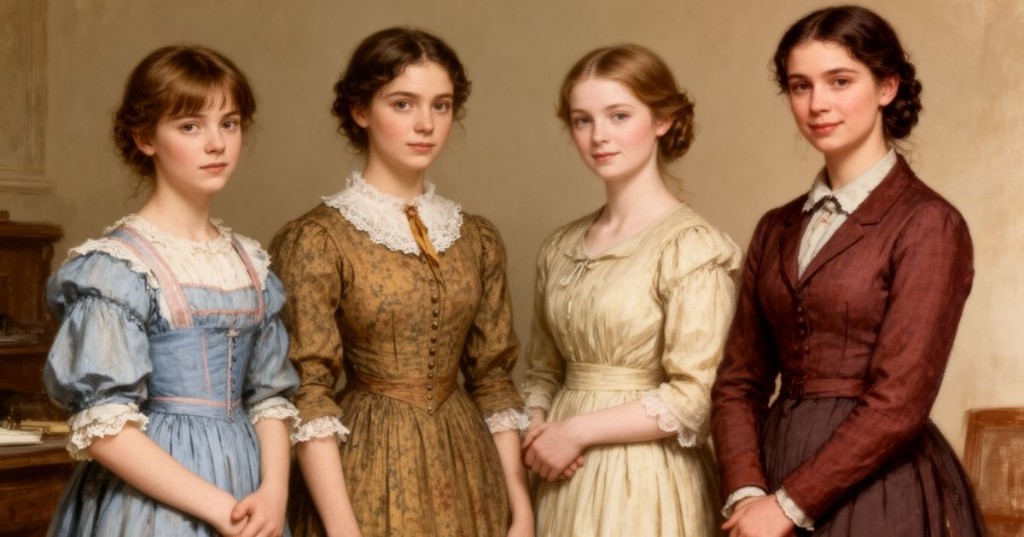
As the younger girls stand together, giving the last touches to their
simple toilet, it may be a good time to tell of a few changes which
three years have wrought in their appearance, for all are looking their
best just now.
Jo’s angles are much softened, she has learned to carry herself with
ease, if not grace. The curly crop has lengthened into a thick coil,
more becoming to the small head atop of the tall figure. There is a
fresh color in her brown cheeks, a soft shine in her eyes, and only
gentle words fall from her sharp tongue today.
Beth has grown slender, pale, and more quiet than ever. The beautiful,
kind eyes are larger, and in them lies an expression that saddens one,
although it is not sad itself. It is the shadow of pain which touches
the young face with such pathetic patience, but Beth seldom complains
and always speaks hopefully of ‘being better soon’.
Amy is with truth considered ‘the flower of the family’, for at sixteen
she has the air and bearing of a full-grown woman, not beautiful, but
possessed of that indescribable charm called grace. One saw it in the
lines of her figure, the make and motion of her hands, the flow of her
dress, the droop of her hair, unconscious yet harmonious, and as
attractive to many as beauty itself. Amy’s nose still afflicted her,
for it never would grow Grecian, so did her mouth, being too wide, and
having a decided chin. These offending features gave character to her
whole face, but she never could see it, and consoled herself with her
wonderfully fair complexion, keen blue eyes, and curls more golden and
abundant than ever.
All three wore suits of thin silver gray (their best gowns for the
summer), with blush roses in hair and bosom, and all three looked just
what they were, fresh-faced, happy-hearted girls, pausing a moment in
their busy lives to read with wistful eyes the sweetest chapter in the
romance of womanhood.
There were to be no ceremonious performances, everything was to be as
natural and homelike as possible, so when Aunt March arrived, she was
scandalized to see the bride come running to welcome and lead her in,
to find the bridegroom fastening up a garland that had fallen down, and
to catch a glimpse of the paternal minister marching upstairs with a
grave countenance and a wine bottle under each arm.
“Upon my word, here’s a state of things!” cried the old lady, taking
the seat of honor prepared for her, and settling the folds of her
lavender moire with a great rustle. “You oughtn’t to be seen till the
last minute, child.”
“I’m not a show, Aunty, and no one is coming to stare at me, to
criticize my dress, or count the cost of my luncheon. I’m too happy to
care what anyone says or thinks, and I’m going to have my little
wedding just as I like it. John, dear, here’s your hammer.” And away
went Meg to help ‘that man’ in his highly improper employment.
Mr. Brooke didn’t even say, “Thank you,” but as he stooped for the
unromantic tool, he kissed his little bride behind the folding door,
with a look that made Aunt March whisk out her pocket handkerchief with
a sudden dew in her sharp old eyes.
A crash, a cry, and a laugh from Laurie, accompanied by the indecorous
exclamation, “Jupiter Ammon! Jo’s upset the cake again!” caused a
momentary flurry, which was hardly over when a flock of cousins
arrived, and ‘the party came in’, as Beth used to say when a child.
“Don’t let that young giant come near me, he worries me worse than
mosquitoes,” whispered the old lady to Amy, as the rooms filled and
Laurie’s black head towered above the rest.
“He has promised to be very good today, and he can be perfectly elegant
if he likes,” returned Amy, and gliding away to warn Hercules to beware
of the dragon, which warning caused him to haunt the old lady with a
devotion that nearly distracted her.
There was no bridal procession, but a sudden silence fell upon the room
as Mr. March and the young couple took their places under the green
arch. Mother and sisters gathered close, as if loath to give Meg up.
The fatherly voice broke more than once, which only seemed to make the
service more beautiful and solemn. The bridegroom’s hand trembled
visibly, and no one heard his replies. But Meg looked straight up in
her husband’s eyes, and said, “I will!” with such tender trust in her
own face and voice that her mother’s heart rejoiced and Aunt March
sniffed audibly.
Jo did not cry, though she was very near it once, and was only saved
from a demonstration by the consciousness that Laurie was staring
fixedly at her, with a comical mixture of merriment and emotion in his
wicked black eyes. Beth kept her face hidden on her mother’s shoulder,
but Amy stood like a graceful statue, with a most becoming ray of
sunshine touching her white forehead and the flower in her hair.
It wasn’t at all the thing, I’m afraid, but the minute she was fairly
married, Meg cried, “The first kiss for Marmee!” and turning, gave it
with her heart on her lips. During the next fifteen minutes she looked
more like a rose than ever, for everyone availed themselves of their
privileges to the fullest extent, from Mr. Laurence to old Hannah, who,
adorned with a headdress fearfully and wonderfully made, fell upon her
in the hall, crying with a sob and a chuckle, “Bless you, deary, a
hundred times! The cake ain’t hurt a mite, and everything looks
lovely.”
Everybody cleared up after that, and said something brilliant, or tried
to, which did just as well, for laughter is ready when hearts are
light. There was no display of gifts, for they were already in the
little house, nor was there an elaborate breakfast, but a plentiful
lunch of cake and fruit, dressed with flowers. Mr. Laurence and Aunt
March shrugged and smiled at one another when water, lemonade, and
coffee were found to be to only sorts of nectar which the three Hebes
carried round. No one said anything, till Laurie, who insisted on
serving the bride, appeared before her, with a loaded salver in his
hand and a puzzled expression on his face.
“Has Jo smashed all the bottles by accident?” he whispered, “or am I
merely laboring under a delusion that I saw some lying about loose this
morning?”
“No, your grandfather kindly offered us his best, and Aunt March
actually sent some, but Father put away a little for Beth, and
dispatched the rest to the Soldier’s Home. You know he thinks that wine
should be used only in illness, and Mother says that neither she nor
her daughters will ever offer it to any young man under her roof.”
Meg spoke seriously and expected to see Laurie frown or laugh, but he
did neither, for after a quick look at her, he said, in his impetuous
way, “I like that! For I’ve seen enough harm done to wish other women
would think as you do.”
“You are not made wise by experience, I hope?” and there was an anxious
accent in Meg’s voice.
“No. I give you my word for it. Don’t think too well of me, either,
this is not one of my temptations. Being brought up where wine is as
common as water and almost as harmless, I don’t care for it, but when a
pretty girl offers it, one doesn’t like to refuse, you see.”
“But you will, for the sake of others, if not for your own. Come,
Laurie, promise, and give me one more reason to call this the happiest
day of my life.”
A demand so sudden and so serious made the young man hesitate a moment,
for ridicule is often harder to bear than self-denial. Meg knew that if
he gave the promise he would keep it at all costs, and feeling her
power, used it as a woman may for her friend’s good. She did not speak,
but she looked up at him with a face made very eloquent by happiness,
and a smile which said, “No one can refuse me anything today.”
Laurie certainly could not, and with an answering smile, he gave her
his hand, saying heartily, “I promise, Mrs. Brooke!”
“I thank you, very, very much.”
“And I drink ‘long life to your resolution’, Teddy,” cried Jo,
baptizing him with a splash of lemonade, as she waved her glass and
beamed approvingly upon him.
So the toast was drunk, the pledge made and loyally kept in spite of
many temptations, for with instinctive wisdom, the girls seized a happy
moment to do their friend a service, for which he thanked them all his
life.
After lunch, people strolled about, by twos and threes, through the
house and garden, enjoying the sunshine without and within. Meg and
John happened to be standing together in the middle of the grass plot,
when Laurie was seized with an inspiration which put the finishing
touch to this unfashionable wedding.
“All the married people take hands and dance round the new-made husband
and wife, as the Germans do, while we bachelors and spinsters prance in
couples outside!” cried Laurie, promenading down the path with Amy,
with such infectious spirit and skill that everyone else followed their
example without a murmur. Mr. and Mrs. March, Aunt and Uncle Carrol
began it, others rapidly joined in, even Sallie Moffat, after a
moment’s hesitation, threw her train over her arm and whisked Ned into
the ring. But the crowning joke was Mr. Laurence and Aunt March, for
when the stately old gentleman chasseed solemnly up to the old lady,
she just tucked her cane under her arm, and hopped briskly away to join
hands with the rest and dance about the bridal pair, while the young
folks pervaded the garden like butterflies on a midsummer day.
Want of breath brought the impromptu ball to a close, and then people
began to go.
“I wish you well, my dear, I heartily wish you well, but I think you’ll
be sorry for it,” said Aunt March to Meg, adding to the bridegroom, as
he led her to the carriage, “You’ve got a treasure, young man, see that
you deserve it.”
“That is the prettiest wedding I’ve been to for an age, Ned, and I
don’t see why, for there wasn’t a bit of style about it,” observed Mrs.
Moffat to her husband, as they drove away.
“Laurie, my lad, if you ever want to indulge in this sort of thing, get
one of those little girls to help you, and I shall be perfectly
satisfied,” said Mr. Laurence, settling himself in his easy chair to
rest after the excitement of the morning.
“I’ll do my best to gratify you, Sir,” was Laurie’s unusually dutiful
reply, as he carefully unpinned the posy Jo had put in his buttonhole.
The little house was not far away, and the only bridal journey Meg had
was the quiet walk with John from the old home to the new. When she
came down, looking like a pretty Quakeress in her dove-colored suit and
straw bonnet tied with white, they all gathered about her to say
‘good-by’, as tenderly as if she had been going to make the grand tour.
“Don’t feel that I am separated from you, Marmee dear, or that I love
you any the less for loving John so much,” she said, clinging to her
mother, with full eyes for a moment. “I shall come every day, Father,
and expect to keep my old place in all your hearts, though I am
married. Beth is going to be with me a great deal, and the other girls
will drop in now and then to laugh at my housekeeping struggles. Thank
you all for my happy wedding day. Good-by, good-by!”
They stood watching her, with faces full of love and hope and tender
pride as she walked away, leaning on her husband’s arm, with her hands
full of flowers and the June sunshine brightening her happy face—and so
Meg’s married life began.
Master this chapter. Complete your experience
Purchase the complete book to access all chapters and support classic literature
As an Amazon Associate, we earn a small commission from qualifying purchases at no additional cost to you.
Available in paperback, hardcover, and e-book formats
Let's Analyse the Pattern
Choosing what genuinely reflects your values over what's expected creates deeper satisfaction and stronger connections than performing for others' approval.
Why This Matters
Connect literature to life
This chapter teaches how to recognize when you're performing for others versus acting from your genuine values and desires.
Practice This Today
This week, notice when you feel pressure to do something 'the right way'—ask yourself whose approval you're seeking and whether it aligns with what you actually want.
Now let's explore the literary elements.
Key Quotes & Analysis
"I don't want a fashionable wedding, but only those about me whom I love, and to them I wish to look and be my familiar self."
Context: When explaining why she won't have orange blossoms or expensive decorations
This quote captures the chapter's central theme about choosing authenticity over social expectations. Meg prioritizes genuine relationships and being true to herself over impressing others.
In Today's Words:
I want to be myself around people who matter, not put on a show for strangers.
"Promise me, for my sake, that you will refuse when ladies offer you wine."
Context: Meg asking Laurie to take a temperance pledge on her wedding day
Shows how women used their influence to protect men from social pressures. Meg uses her happiness and special day to secure a commitment that could save Laurie's future.
In Today's Words:
Promise me you'll say no when people pressure you to drink - do it because you care about me.
"So she made her wedding gown herself, sewing into it the tender hopes and innocent romances of a girlish heart."
Context: Describing how Meg created her own simple wedding dress
The physical act of making her dress becomes symbolic of creating her own path. Her labor and dreams are more valuable than expensive fabric or professional tailoring.
In Today's Words:
She put her heart and dreams into making something meaningful with her own hands.
Thematic Threads
Class
In This Chapter
Meg rejects expensive wedding conventions, choosing simplicity that reflects her family's actual means and values
Development
Evolution from earlier struggles with wanting more—now she actively chooses less for deeper reasons
In Your Life:
You might face pressure to spend beyond your means for appearances when your authentic choice would be simpler and more meaningful.
Identity
In This Chapter
Meg wants to 'look and be my familiar self' rather than transform into someone else for her wedding day
Development
Culmination of her journey from wanting to be fashionable to embracing her authentic self
In Your Life:
You might struggle with staying true to yourself when major life events create pressure to be someone you're not.
Social Expectations
In This Chapter
The family creates their own celebration style, ignoring Aunt March's scandalized disapproval of their unconventional choices
Development
Growing confidence in defying social pressure that's been building throughout the book
In Your Life:
You might face criticism from relatives or community when your choices don't match their expectations for how things 'should' be done.
Personal Growth
In This Chapter
Each sister shows three years of development—Jo softened, Beth more fragile, Amy more graceful—revealing how people evolve
Development
First major time jump showing concrete evidence of character development
In Your Life:
You might not notice your own growth day-to-day, but significant time reveals how you've changed and matured.
Human Relationships
In This Chapter
Meg uses her wedding day joy to secure Laurie's promise about alcohol, showing how love motivates protective action
Development
Demonstrates how the March family's caring extends beyond blood relations to chosen family
In Your Life:
You might find moments of happiness give you courage to address concerns about people you care about.
You now have the context. Time to form your own thoughts.
Discussion Questions
- 1
Why does Meg choose to make her own simple wedding dress instead of buying an expensive one, and how do her guests react to her unconventional choices?
analysis • surface - 2
What does Meg's decision reveal about the difference between what society expects and what actually creates meaningful experiences?
analysis • medium - 3
Where do you see people today choosing authenticity over expensive performances - in weddings, parties, social media, or career moves?
application • medium - 4
Think of a time when you felt pressure to 'perform' rather than be yourself. How would you handle that situation differently now, using Meg's approach?
application • deep - 5
Why does choosing authenticity over performance often create deeper satisfaction, even when some people disapprove of your choices?
reflection • deep
Critical Thinking Exercise
Design Your Authentic Celebration
Think of an upcoming event in your life - a birthday, promotion, anniversary, or achievement. List what society or others might expect you to do, then design how you would celebrate authentically based on your actual values and preferences. Compare the two approaches and identify which would create more genuine satisfaction.
Consider:
- •What pressures do you feel to celebrate in certain 'expected' ways?
- •What would you actually enjoy most, regardless of others' opinions?
- •How might your authentic choice inspire others to be more genuine?
Journaling Prompt
Write about a time when you chose to do something your own way despite social pressure. What did you learn about yourself, and how did others actually respond to your authenticity?
Coming Up Next...
Chapter 26: When Ambition Meets Reality
As Meg settles into married life, Amy decides to pursue her artistic ambitions more seriously. But her grand plans for becoming a great artist will face some humbling realities about talent, effort, and finding your true calling.



