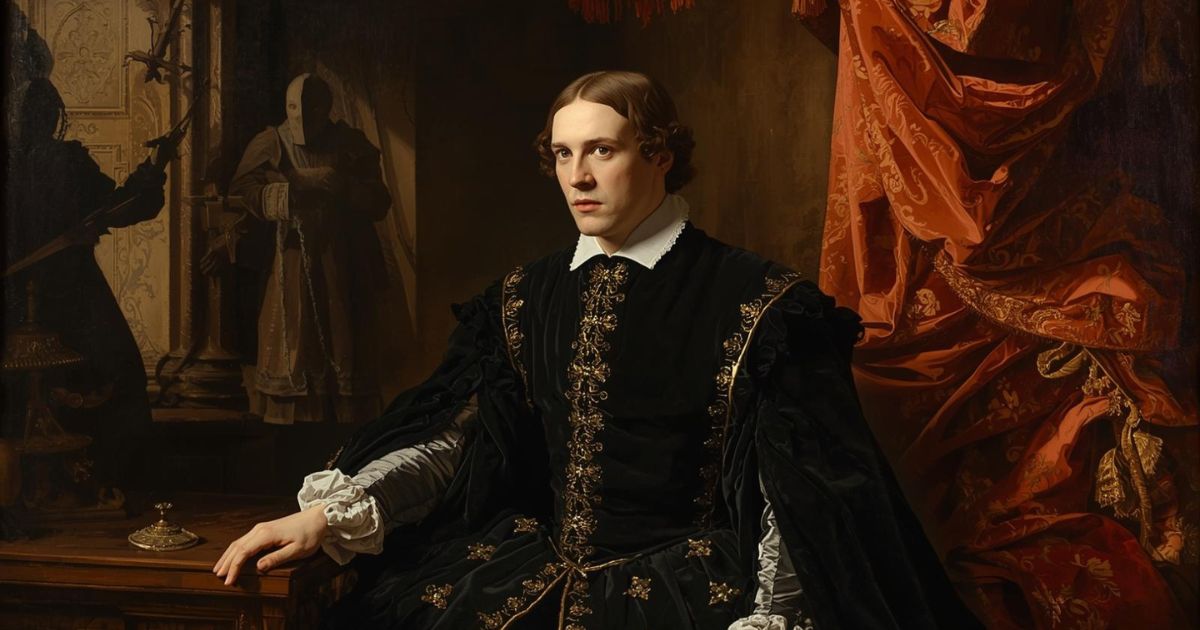
An excerpt from the original text.(complete · 1640 words)
CENE VII. Another room in the Castle.
Enter King and Laertes.
KING.
Now must your conscience my acquittance seal,
And you must put me in your heart for friend,
Sith you have heard, and with a knowing ear,
That he which hath your noble father slain
Pursu’d my life.
LAERTES.
It well appears. But tell me
Why you proceeded not against these feats,
So crimeful and so capital in nature,
As by your safety, wisdom, all things else,
You mainly were stirr’d up.
KING.
O, for two special reasons,
Which may to you, perhaps, seem much unsinew’d,
But yet to me they are strong. The Queen his mother
Lives almost by his looks; and for myself,—
My virtue or my plague, be it either which,—
She’s so conjunctive to my life and soul,
That, as the star moves not but in his sphere,
I could not but by her. The other motive,
Why to a public count I might not go,
Is the great love the general gender bear him,
Who, dipping all his faults in their affection,
Would like the spring that turneth wood to stone,
Convert his gyves to graces; so that my arrows,
Too slightly timber’d for so loud a wind,
Would have reverted to my bow again,
And not where I had aim’d them.
LAERTES.
And so have I a noble father lost,
A sister driven into desperate terms,
Whose worth, if praises may go back again,
Stood challenger on mount of all the age
For her perfections. But my revenge will come.
KING.
Break not your sleeps for that. You must not think
That we are made of stuff so flat and dull
That we can let our beard be shook with danger,
And think it pastime. You shortly shall hear more.
I lov’d your father, and we love ourself,
And that, I hope, will teach you to imagine—
Enter a Messenger.
How now? What news?
MESSENGER.
Letters, my lord, from Hamlet.
This to your Majesty; this to the Queen.
KING.
From Hamlet! Who brought them?
MESSENGER.
Sailors, my lord, they say; I saw them not.
They were given me by Claudio. He receiv’d them
Of him that brought them.
KING.
Laertes, you shall hear them.
Leave us.
[Exit Messenger.]
[Reads.] ‘High and mighty, you shall know I am set naked on your
kingdom. Tomorrow shall I beg leave to see your kingly eyes. When I
shall, first asking your pardon thereunto, recount the occasions of my
sudden and more strange return.
HAMLET.’
What should this mean? Are all the rest come back?
Or is it some abuse, and no such thing?
LAERTES.
Know you the hand?
KING.
’Tis Hamlet’s character. ‘Naked!’
And in a postscript here he says ‘alone.’
Can you advise me?
LAERTES.
I am lost in it, my lord. But let him come,
It warms the very sickness in my heart
That I shall live and tell him to his teeth,
‘Thus diest thou.’
KING.
If it be so, Laertes,—
As how should it be so? How otherwise?—
Will you be rul’d by me?
LAERTES.
Ay, my lord;
So you will not o’errule me to a peace.
KING.
To thine own peace. If he be now return’d,
As checking at his voyage, and that he means
No more to undertake it, I will work him
To an exploit, now ripe in my device,
Under the which he shall not choose but fall;
And for his death no wind shall breathe,
But even his mother shall uncharge the practice
And call it accident.
LAERTES.
My lord, I will be rul’d;
The rather if you could devise it so
That I might be the organ.
KING.
It falls right.
You have been talk’d of since your travel much,
And that in Hamlet’s hearing, for a quality
Wherein they say you shine. Your sum of parts
Did not together pluck such envy from him
As did that one, and that, in my regard,
Of the unworthiest siege.
LAERTES.
What part is that, my lord?
KING.
A very riband in the cap of youth,
Yet needful too, for youth no less becomes
The light and careless livery that it wears
Than settled age his sables and his weeds,
Importing health and graveness. Two months since
Here was a gentleman of Normandy,—
I’ve seen myself, and serv’d against, the French,
And they can well on horseback, but this gallant
Had witchcraft in’t. He grew unto his seat,
And to such wondrous doing brought his horse,
As had he been incorps’d and demi-natur’d
With the brave beast. So far he topp’d my thought
That I in forgery of shapes and tricks,
Come short of what he did.
LAERTES.
A Norman was’t?
KING.
A Norman.
LAERTES.
Upon my life, Lamord.
KING.
The very same.
LAERTES.
I know him well. He is the brooch indeed
And gem of all the nation.
KING.
He made confession of you,
And gave you such a masterly report
For art and exercise in your defence,
And for your rapier most especially,
That he cried out ’twould be a sight indeed
If one could match you. The scrimers of their nation
He swore had neither motion, guard, nor eye,
If you oppos’d them. Sir, this report of his
Did Hamlet so envenom with his envy
That he could nothing do but wish and beg
Your sudden coming o’er to play with him.
Now, out of this,—
LAERTES.
What out of this, my lord?
KING.
Laertes, was your father dear to you?
Or are you like the painting of a sorrow,
A face without a heart?
LAERTES.
Why ask you this?
KING.
Not that I think you did not love your father,
But that I know love is begun by time,
And that I see, in passages of proof,
Time qualifies the spark and fire of it.
There lives within the very flame of love
A kind of wick or snuff that will abate it;
And nothing is at a like goodness still,
For goodness, growing to a pleurisy,
Dies in his own too much. That we would do,
We should do when we would; for this ‘would’ changes,
And hath abatements and delays as many
As there are tongues, are hands, are accidents;
And then this ‘should’ is like a spendthrift sigh
That hurts by easing. But to the quick o’ th’ulcer:
Hamlet comes back: what would you undertake
To show yourself your father’s son in deed,
More than in words?
LAERTES.
To cut his throat i’ th’ church.
KING.
No place, indeed, should murder sanctuarize;
Revenge should have no bounds. But good Laertes,
Will you do this, keep close within your chamber.
Hamlet return’d shall know you are come home:
We’ll put on those shall praise your excellence,
And set a double varnish on the fame
The Frenchman gave you, bring you in fine together
And wager on your heads. He, being remiss,
Most generous, and free from all contriving,
Will not peruse the foils; so that with ease,
Or with a little shuffling, you may choose
A sword unbated, and in a pass of practice,
Requite him for your father.
LAERTES.
I will do’t.
And for that purpose I’ll anoint my sword.
I bought an unction of a mountebank
So mortal that, but dip a knife in it,
Where it draws blood no cataplasm so rare,
Collected from all simples that have virtue
Under the moon, can save the thing from death
This is but scratch’d withal. I’ll touch my point
With this contagion, that if I gall him slightly,
It may be death.
KING.
Let’s further think of this,
Weigh what convenience both of time and means
May fit us to our shape. If this should fail,
And that our drift look through our bad performance.
’Twere better not assay’d. Therefore this project
Should have a back or second, that might hold
If this did blast in proof. Soft, let me see.
We’ll make a solemn wager on your cunnings,—
I ha’t! When in your motion you are hot and dry,
As make your bouts more violent to that end,
And that he calls for drink, I’ll have prepar’d him
A chalice for the nonce; whereon but sipping,
If he by chance escape your venom’d stuck,
Our purpose may hold there.
Enter Queen.
How now, sweet Queen?
QUEEN.
One woe doth tread upon another’s heel,
So fast they follow. Your sister’s drown’d, Laertes.
LAERTES.
Drown’d! O, where?
QUEEN.
There is a willow grows aslant a brook,
That shows his hoary leaves in the glassy stream.
There with fantastic garlands did she make
Of crow-flowers, nettles, daisies, and long purples,
That liberal shepherds give a grosser name,
But our cold maids do dead men’s fingers call them.
There on the pendant boughs her coronet weeds
Clamb’ring to hang, an envious sliver broke,
When down her weedy trophies and herself
Fell in the weeping brook. Her clothes spread wide,
And mermaid-like, awhile they bore her up,
Which time she chaunted snatches of old tunes,
As one incapable of her own distress,
Or like a creature native and indued
Unto that element. But long it could not be
Till that her garments, heavy with their drink,
Pull’d the poor wretch from her melodious lay
To muddy death.
LAERTES.
Alas, then she is drown’d?
QUEEN.
Drown’d, drown’d.
LAERTES.
Too much of water hast thou, poor Ophelia,
And therefore I forbid my tears. But yet
It is our trick; nature her custom holds,
Let shame say what it will. When these are gone,
The woman will be out. Adieu, my lord,
I have a speech of fire, that fain would blaze,
But that this folly douts it.
[Exit.]
KING.
Let’s follow, Gertrude;
How much I had to do to calm his rage!
Now fear I this will give it start again;
Therefore let’s follow.
[Exeunt.]
ACT V
Master this chapter. Complete your experience
Purchase the complete book to access all chapters and support classic literature
As an Amazon Associate, we earn a small commission from qualifying purchases at no additional cost to you.
Available in paperback, hardcover, and e-book formats
Let's Analyse the Pattern
When manipulators transform someone's legitimate pain into a weapon for their own purposes by validating the hurt then redirecting the anger.
Why This Matters
Connect literature to life
This chapter teaches how to recognize when someone validates your pain only to redirect your anger toward their chosen target.
Practice This Today
This week, notice when someone 'understands your frustration' then immediately suggests who's really to blame—pause and ask what they gain from your anger.
Now let's explore the literary elements.
Key Quotes & Analysis
"The Queen his mother lives almost by his looks"
Context: Explaining to Laertes why he can't openly punish Hamlet
Reveals how Claudius understands family dynamics and uses them strategically. He knows Gertrude's love for Hamlet protects him politically.
In Today's Words:
His mom is so attached to him that going after him would destroy her
"The great love the general gender bear him"
Context: Continuing his explanation about why Hamlet is untouchable
Shows Claudius's political savvy - he knows public opinion matters more than justice. He can't risk making Hamlet a martyr.
In Today's Words:
Everyone loves this guy, so if I come for him, they'll turn on me
"There, on the pendent boughs her coronet weeds clambering to hang, an envious sliver broke"
Context: Describing how Ophelia fell into the water and drowned
The poetic language shows how people sometimes beautify tragedy to make it bearable. Gertrude can't face the harsh reality of suicide.
In Today's Words:
She was trying to hang flowers on a branch when it broke and she fell in
Thematic Threads
Manipulation
In This Chapter
Claudius masterfully converts Laertes' grief into murderous loyalty through validation, flattery, and providing a target
Development
Evolved from earlier subtle manipulation to now showing the complete playbook of emotional weaponization
In Your Life:
You might see this when someone validates your workplace frustrations then steers you toward specific targets for blame.
Betrayal
In This Chapter
Claudius plans to betray the rules of 'friendly' competition with poisoned weapons and backup murder plots
Development
Built from Claudius's original betrayal of his brother to now orchestrating elaborate deceptions
In Your Life:
You might encounter this when someone proposes 'fair' competitions or discussions while secretly stacking the deck.
Power Dynamics
In This Chapter
Claudius explains why he couldn't openly punish Hamlet—the queen's love and people's adoration limit his power
Development
Continues exploring how even kings must navigate political realities and public opinion
In Your Life:
You might recognize this when authority figures explain why they 'can't' take direct action against someone popular.
Grief
In This Chapter
Both Laertes' raw anger over his father and Ophelia's tragic drowning show grief's devastating power
Development
Introduced here as a central force that can be exploited and weaponized by others
In Your Life:
You might experience this when your own losses make you vulnerable to others' agendas and manipulation.
Innocence Lost
In This Chapter
Ophelia's death represents the ultimate cost of the adults' schemes—an innocent destroyed by forces beyond her control
Development
Culmination of Ophelia's descent from pure love to madness to death, showing collateral damage of corruption
In Your Life:
You might witness this when workplace or family conflicts harm bystanders who never chose to be involved.
You now have the context. Time to form your own thoughts.
Discussion Questions
- 1
What specific techniques does Claudius use to turn Laertes from a grieving son into a willing assassin?
analysis • surface - 2
Why does Claudius create multiple backup plans (poisoned sword AND poisoned wine) instead of relying on just one method?
analysis • medium - 3
Where have you seen someone use another person's pain or anger to advance their own agenda?
application • medium - 4
How can you tell the difference between someone genuinely supporting you through grief and someone exploiting your vulnerability?
application • deep - 5
What does Ophelia's death reveal about the cost of being caught in other people's power games?
reflection • deep
Critical Thinking Exercise
Spot the Manipulation Playbook
Think of a time someone tried to influence your feelings about another person. Write down exactly what they said and did, step by step. Then identify which of Claudius's techniques they used: validating your feelings, building your ego, offering you a target, or providing a concrete plan for action.
Consider:
- •Notice if they immediately offered solutions rather than just listening
- •Pay attention to whether they kept bringing the topic back to your anger
- •Consider what they gained if you stayed upset with that person
Journaling Prompt
Write about a time when you realized someone was using your emotions to serve their own purposes. How did you recognize it, and what did you do about it?
Coming Up Next...
Chapter 20: Graves, Skulls, and Final Confrontations
The final act begins in a graveyard, where Hamlet will confront mortality in the most direct way possible. A chance encounter will force him to grapple with death, legacy, and what it truly means to exist.