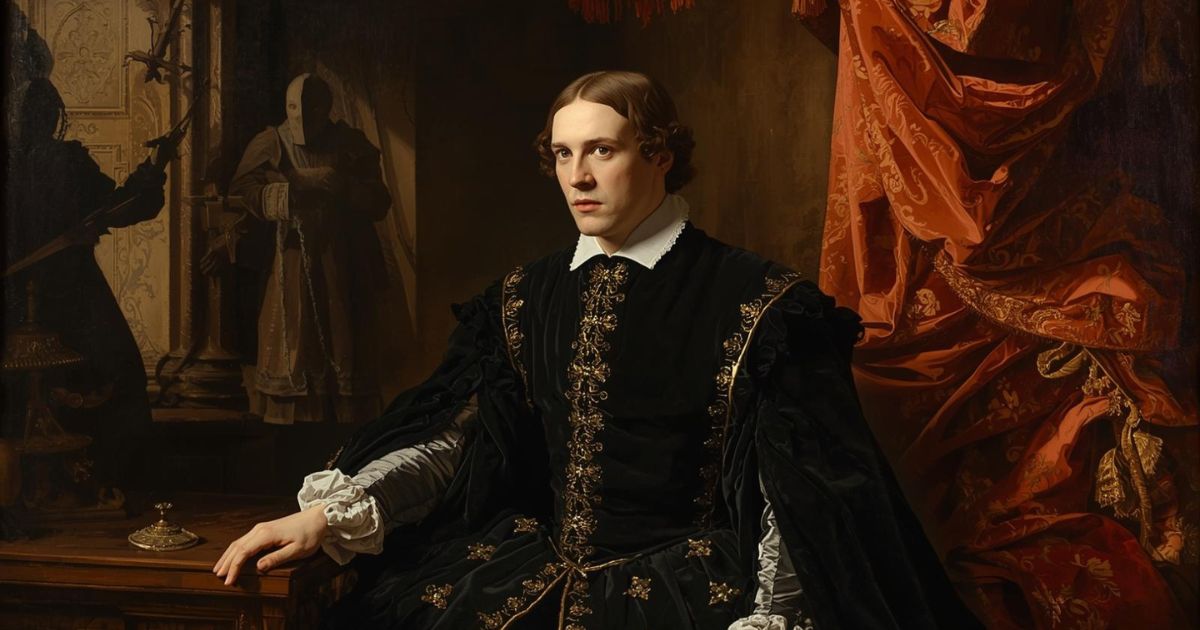
An excerpt from the original text.(complete · 390 words)
CENE I. A room in the Castle.
Enter King, Queen, Rosencrantz and Guildenstern.
KING.
There’s matter in these sighs. These profound heaves
You must translate; ’tis fit we understand them.
Where is your son?
QUEEN.
Bestow this place on us a little while.
[To Rosencrantz and Guildenstern, who go out.]
Ah, my good lord, what have I seen tonight!
KING.
What, Gertrude? How does Hamlet?
QUEEN.
Mad as the sea and wind, when both contend
Which is the mightier. In his lawless fit
Behind the arras hearing something stir,
Whips out his rapier, cries ‘A rat, a rat!’
And in this brainish apprehension kills
The unseen good old man.
KING.
O heavy deed!
It had been so with us, had we been there.
His liberty is full of threats to all;
To you yourself, to us, to everyone.
Alas, how shall this bloody deed be answer’d?
It will be laid to us, whose providence
Should have kept short, restrain’d, and out of haunt
This mad young man. But so much was our love
We would not understand what was most fit,
But like the owner of a foul disease,
To keep it from divulging, let it feed
Even on the pith of life. Where is he gone?
QUEEN.
To draw apart the body he hath kill’d,
O’er whom his very madness, like some ore
Among a mineral of metals base,
Shows itself pure. He weeps for what is done.
KING.
O Gertrude, come away!
The sun no sooner shall the mountains touch
But we will ship him hence, and this vile deed
We must with all our majesty and skill
Both countenance and excuse.—Ho, Guildenstern!
Re-enter Rosencrantz and Guildenstern.
Friends both, go join you with some further aid:
Hamlet in madness hath Polonius slain,
And from his mother’s closet hath he dragg’d him.
Go seek him out, speak fair, and bring the body
Into the chapel. I pray you haste in this.
[Exeunt Rosencrantz and Guildenstern.]
Come, Gertrude, we’ll call up our wisest friends,
And let them know both what we mean to do
And what’s untimely done, so haply slander,
Whose whisper o’er the world’s diameter,
As level as the cannon to his blank,
Transports his poison’d shot, may miss our name,
And hit the woundless air. O, come away!
My soul is full of discord and dismay.
[Exeunt.]
Master this chapter. Complete your experience
Purchase the complete book to access all chapters and support classic literature
As an Amazon Associate, we earn a small commission from qualifying purchases at no additional cost to you.
Available in paperback, hardcover, and e-book formats
Let's Analyse the Pattern
The tendency to prioritize image control and damage limitation over addressing root causes when problems emerge.
Why This Matters
Connect literature to life
This chapter teaches you to distinguish between leaders who solve problems and those who manage appearances when disaster strikes.
Practice This Today
This week, notice when someone in authority faces a problem - do they ask 'How do we fix this?' or 'How do we spin this?'
Now let's explore the literary elements.
Key Quotes & Analysis
"But so much was our love, We would not understand what was most fit"
Context: Claudius admits he should have dealt with Hamlet's problems earlier but was too protective
This reveals how Claudius tries to frame his political calculation as love and protection. He's really saying he ignored warning signs because addressing them would have been inconvenient.
In Today's Words:
We loved him so much we ignored the red flags
"Mad as the sea and wind, when both contend Which is the mightier"
Context: Gertrude describes Hamlet's mental state to Claudius
This powerful image captures the violent, unpredictable nature of Hamlet's condition. Gertrude sees her son as caught between equally destructive forces.
In Today's Words:
He's completely out of control, like he's being torn apart by forces he can't handle
"It will be laid to us, whose providence Should have kept short, restrain'd, and out of haunt This mad young man"
Context: Claudius realizes the public will blame him for not controlling Hamlet
Claudius immediately thinks about public perception and political fallout. He's more worried about being blamed than about the actual tragedy that occurred.
In Today's Words:
Everyone's going to say this is our fault for not getting him help sooner
Thematic Threads
Power Dynamics
In This Chapter
Claudius immediately shifts into self-preservation mode, using his authority to control the narrative around Polonius's death
Development
Evolved from earlier displays of political maneuvering to desperate damage control
In Your Life:
You might see this when supervisors blame employees for systemic failures rather than fixing broken processes
Moral Corruption
In This Chapter
Claudius prioritizes reputation over justice, planning to 'excuse' murder rather than seek accountability
Development
Deepened from his original crime to now covering up consequences of his actions
In Your Life:
You might recognize this when institutions you trust choose legal protection over doing what's right
Betrayal
In This Chapter
Claudius betrays his duty as king by focusing on political survival rather than protecting his subjects
Development
Extended from personal betrayals to betraying the responsibilities of leadership
In Your Life:
You might experience this when leaders abandon their stated values the moment those values become inconvenient
Family Loyalty
In This Chapter
Gertrude shows misplaced loyalty by making excuses for Hamlet's violence while Claudius calculates political costs
Development
Contrasted with earlier protective instincts, now showing how loyalty can enable harmful behavior
In Your Life:
You might struggle with this when family members expect you to cover for their destructive choices
You now have the context. Time to form your own thoughts.
Discussion Questions
- 1
What is Claudius's immediate reaction when he learns Hamlet has killed Polonius, and what does this tell us about his priorities?
analysis • surface - 2
Why does Claudius admit he should have dealt with Hamlet's behavior earlier, and what does his comparison to hiding a disease reveal about leadership?
analysis • medium - 3
Where have you seen this 'crisis management over leadership' pattern in your workplace, family, or community when something goes wrong?
application • medium - 4
If you were in Claudius's position, how would you balance protecting your reputation with doing the right thing, and what would guide your decision?
application • deep - 5
What does this chapter reveal about how fear changes the way people in power make decisions, and how can you recognize when someone is in 'survival mode' versus 'problem-solving mode'?
reflection • deep
Critical Thinking Exercise
Crisis Response Audit
Think of a recent crisis in your workplace, family, or community. Write down what the person in charge actually did versus what they could have done to address the root problem. Then identify whether their response was focused on managing optics or solving the underlying issue. This exercise helps you recognize the pattern and respond better when you're in charge.
Consider:
- •Look for language that focuses on 'how this looks' versus 'how to prevent this again'
- •Notice whether the first actions were about controlling information or gathering facts
- •Consider whether the response addressed symptoms or root causes
Journaling Prompt
Write about a time when you had to choose between protecting your reputation and doing the right thing. What did you learn about yourself from that choice, and how would you handle it differently now?
Coming Up Next...
Chapter 14: The Sponge Speech
Hamlet faces the consequences of his actions as the king's men come looking for him. His responses will reveal whether his madness is real or calculated.