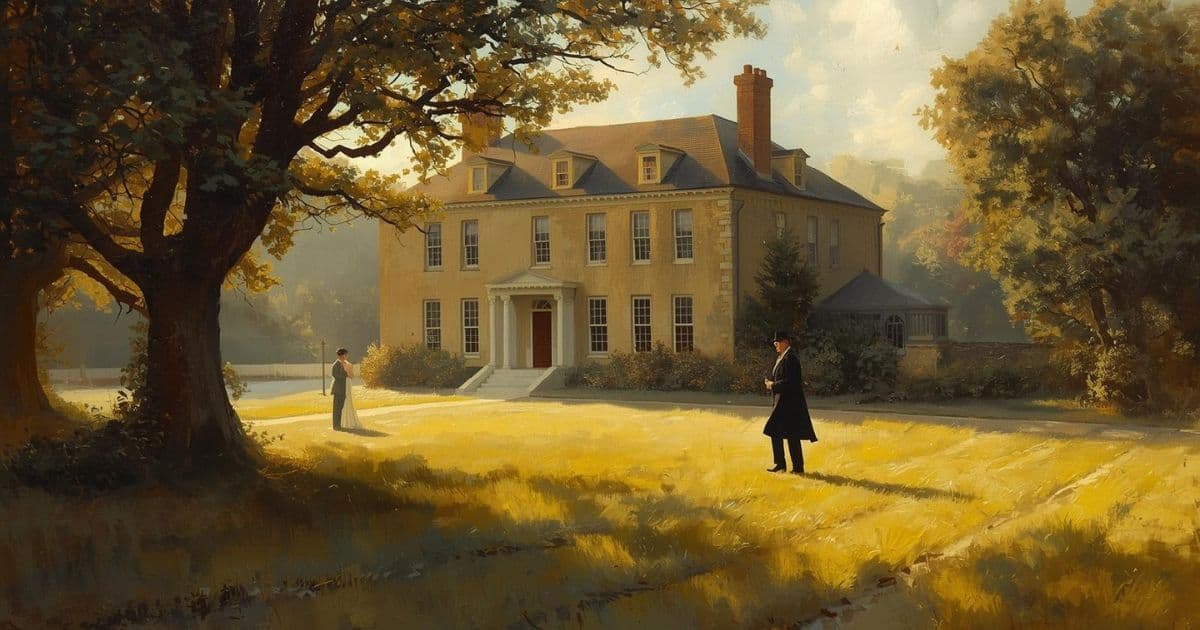
An excerpt from the original text.(complete · 5014 words)
was in the fourth year of my apprenticeship to Joe, and it was a
Saturday night. There was a group assembled round the fire at the Three
Jolly Bargemen, attentive to Mr. Wopsle as he read the newspaper aloud.
Of that group I was one.
A highly popular murder had been committed, and Mr. Wopsle was imbrued
in blood to the eyebrows. He gloated over every abhorrent adjective in
the description, and identified himself with every witness at the
Inquest. He faintly moaned, “I am done for,” as the victim, and he
barbarously bellowed, “I’ll serve you out,” as the murderer. He gave
the medical testimony, in pointed imitation of our local practitioner;
and he piped and shook, as the aged turnpike-keeper who had heard
blows, to an extent so very paralytic as to suggest a doubt regarding
the mental competency of that witness. The coroner, in Mr. Wopsle’s
hands, became Timon of Athens; the beadle, Coriolanus. He enjoyed
himself thoroughly, and we all enjoyed ourselves, and were delightfully
comfortable. In this cosey state of mind we came to the verdict Wilful
Murder.
Then, and not sooner, I became aware of a strange gentleman leaning
over the back of the settle opposite me, looking on. There was an
expression of contempt on his face, and he bit the side of a great
forefinger as he watched the group of faces.
“Well!” said the stranger to Mr. Wopsle, when the reading was done,
“you have settled it all to your own satisfaction, I have no doubt?”
Everybody started and looked up, as if it were the murderer. He looked
at everybody coldly and sarcastically.
“Guilty, of course?” said he. “Out with it. Come!”
“Sir,” returned Mr. Wopsle, “without having the honour of your
acquaintance, I do say Guilty.” Upon this we all took courage to unite
in a confirmatory murmur.
“I know you do,” said the stranger; “I knew you would. I told you so.
But now I’ll ask you a question. Do you know, or do you not know, that
the law of England supposes every man to be innocent, until he is
proved—proved—to be guilty?”
“Sir,” Mr. Wopsle began to reply, “as an Englishman myself, I—”
“Come!” said the stranger, biting his forefinger at him. “Don’t evade
the question. Either you know it, or you don’t know it. Which is it to
be?”
He stood with his head on one side and himself on one side, in a
bullying, interrogative manner, and he threw his forefinger at Mr.
Wopsle,—as it were to mark him out—before biting it again.
“Now!” said he. “Do you know it, or don’t you know it?”
“Certainly I know it,” replied Mr. Wopsle.
“Certainly you know it. Then why didn’t you say so at first? Now, I’ll
ask you another question,”—taking possession of Mr. Wopsle, as if he
had a right to him,—“do you know that none of these witnesses have
yet been cross-examined?”
Mr. Wopsle was beginning, “I can only say—” when the stranger stopped
him.
“What? You won’t answer the question, yes or no? Now, I’ll try you
again.” Throwing his finger at him again. “Attend to me. Are you aware,
or are you not aware, that none of these witnesses have yet been
cross-examined? Come, I only want one word from you. Yes, or no?”
Mr. Wopsle hesitated, and we all began to conceive rather a poor
opinion of him.
“Come!” said the stranger, “I’ll help you. You don’t deserve help, but
I’ll help you. Look at that paper you hold in your hand. What is it?”
“What is it?” repeated Mr. Wopsle, eyeing it, much at a loss.
“Is it,” pursued the stranger in his most sarcastic and suspicious
manner, “the printed paper you have just been reading from?”
“Undoubtedly.”
“Undoubtedly. Now, turn to that paper, and tell me whether it
distinctly states that the prisoner expressly said that his legal
advisers instructed him altogether to reserve his defence?”
“I read that just now,” Mr. Wopsle pleaded.
“Never mind what you read just now, sir; I don’t ask you what you read
just now. You may read the Lord’s Prayer backwards, if you like,—and,
perhaps, have done it before to-day. Turn to the paper. No, no, no my
friend; not to the top of the column; you know better than that; to the
bottom, to the bottom.” (We all began to think Mr. Wopsle full of
subterfuge.) “Well? Have you found it?”
“Here it is,” said Mr. Wopsle.
“Now, follow that passage with your eye, and tell me whether it
distinctly states that the prisoner expressly said that he was
instructed by his legal advisers wholly to reserve his defence? Come!
Do you make that of it?”
Mr. Wopsle answered, “Those are not the exact words.”
“Not the exact words!” repeated the gentleman bitterly. “Is that the
exact substance?”
“Yes,” said Mr. Wopsle.
“Yes,” repeated the stranger, looking round at the rest of the company
with his right hand extended towards the witness, Wopsle. “And now I
ask you what you say to the conscience of that man who, with that
passage before his eyes, can lay his head upon his pillow after having
pronounced a fellow-creature guilty, unheard?”
We all began to suspect that Mr. Wopsle was not the man we had thought
him, and that he was beginning to be found out.
“And that same man, remember,” pursued the gentleman, throwing his
finger at Mr. Wopsle heavily,—“that same man might be summoned as a
juryman upon this very trial, and, having thus deeply committed
himself, might return to the bosom of his family and lay his head upon
his pillow, after deliberately swearing that he would well and truly
try the issue joined between Our Sovereign Lord the King and the
prisoner at the bar, and would a true verdict give according to the
evidence, so help him God!”
We were all deeply persuaded that the unfortunate Wopsle had gone too
far, and had better stop in his reckless career while there was yet
time.
The strange gentleman, with an air of authority not to be disputed, and
with a manner expressive of knowing something secret about every one of
us that would effectually do for each individual if he chose to
disclose it, left the back of the settle, and came into the space
between the two settles, in front of the fire, where he remained
standing, his left hand in his pocket, and he biting the forefinger of
his right.
“From information I have received,” said he, looking round at us as we
all quailed before him, “I have reason to believe there is a blacksmith
among you, by name Joseph—or Joe—Gargery. Which is the man?”
“Here is the man,” said Joe.
The strange gentleman beckoned him out of his place, and Joe went.
“You have an apprentice,” pursued the stranger, “commonly known as Pip?
Is he here?”
“I am here!” I cried.
The stranger did not recognise me, but I recognised him as the
gentleman I had met on the stairs, on the occasion of my second visit
to Miss Havisham. I had known him the moment I saw him looking over the
settle, and now that I stood confronting him with his hand upon my
shoulder, I checked off again in detail his large head, his dark
complexion, his deep-set eyes, his bushy black eyebrows, his large
watch-chain, his strong black dots of beard and whisker, and even the
smell of scented soap on his great hand.
“I wish to have a private conference with you two,” said he, when he
had surveyed me at his leisure. “It will take a little time. Perhaps we
had better go to your place of residence. I prefer not to anticipate my
communication here; you will impart as much or as little of it as you
please to your friends afterwards; I have nothing to do with that.”
Amidst a wondering silence, we three walked out of the Jolly Bargemen,
and in a wondering silence walked home. While going along, the strange
gentleman occasionally looked at me, and occasionally bit the side of
his finger. As we neared home, Joe vaguely acknowledging the occasion
as an impressive and ceremonious one, went on ahead to open the front
door. Our conference was held in the state parlour, which was feebly
lighted by one candle.
It began with the strange gentleman’s sitting down at the table,
drawing the candle to him, and looking over some entries in his
pocket-book. He then put up the pocket-book and set the candle a little
aside, after peering round it into the darkness at Joe and me, to
ascertain which was which.
“My name,” he said, “is Jaggers, and I am a lawyer in London. I am
pretty well known. I have unusual business to transact with you, and I
commence by explaining that it is not of my originating. If my advice
had been asked, I should not have been here. It was not asked, and you
see me here. What I have to do as the confidential agent of another, I
do. No less, no more.”
Finding that he could not see us very well from where he sat, he got
up, and threw one leg over the back of a chair and leaned upon it; thus
having one foot on the seat of the chair, and one foot on the ground.
“Now, Joseph Gargery, I am the bearer of an offer to relieve you of
this young fellow your apprentice. You would not object to cancel his
indentures at his request and for his good? You would want nothing for
so doing?”
“Lord forbid that I should want anything for not standing in Pip’s
way,” said Joe, staring.
“Lord forbidding is pious, but not to the purpose,” returned Mr.
Jaggers. “The question is, Would you want anything? Do you want
anything?”
“The answer is,” returned Joe, sternly, “No.”
I thought Mr. Jaggers glanced at Joe, as if he considered him a fool
for his disinterestedness. But I was too much bewildered between
breathless curiosity and surprise, to be sure of it.
“Very well,” said Mr. Jaggers. “Recollect the admission you have made,
and don’t try to go from it presently.”
“Who’s a-going to try?” retorted Joe.
“I don’t say anybody is. Do you keep a dog?”
“Yes, I do keep a dog.”
“Bear in mind then, that Brag is a good dog, but Holdfast is a better.
Bear that in mind, will you?” repeated Mr. Jaggers, shutting his eyes
and nodding his head at Joe, as if he were forgiving him something.
“Now, I return to this young fellow. And the communication I have got
to make is, that he has great expectations.”
Joe and I gasped, and looked at one another.
“I am instructed to communicate to him,” said Mr. Jaggers, throwing his
finger at me sideways, “that he will come into a handsome property.
Further, that it is the desire of the present possessor of that
property, that he be immediately removed from his present sphere of
life and from this place, and be brought up as a gentleman,—in a word,
as a young fellow of great expectations.”
My dream was out; my wild fancy was surpassed by sober reality; Miss
Havisham was going to make my fortune on a grand scale.
“Now, Mr. Pip,” pursued the lawyer, “I address the rest of what I have
to say, to you. You are to understand, first, that it is the request of
the person from whom I take my instructions that you always bear the
name of Pip. You will have no objection, I dare say, to your great
expectations being encumbered with that easy condition. But if you have
any objection, this is the time to mention it.”
My heart was beating so fast, and there was such a singing in my ears,
that I could scarcely stammer I had no objection.
“I should think not! Now you are to understand, secondly, Mr. Pip, that
the name of the person who is your liberal benefactor remains a
profound secret, until the person chooses to reveal it. I am empowered
to mention that it is the intention of the person to reveal it at first
hand by word of mouth to yourself. When or where that intention may be
carried out, I cannot say; no one can say. It may be years hence. Now,
you are distinctly to understand that you are most positively
prohibited from making any inquiry on this head, or any allusion or
reference, however distant, to any individual whomsoever as the
individual, in all the communications you may have with me. If you have
a suspicion in your own breast, keep that suspicion in your own breast.
It is not the least to the purpose what the reasons of this prohibition
are; they may be the strongest and gravest reasons, or they may be mere
whim. This is not for you to inquire into. The condition is laid down.
Your acceptance of it, and your observance of it as binding, is the
only remaining condition that I am charged with, by the person from
whom I take my instructions, and for whom I am not otherwise
responsible. That person is the person from whom you derive your
expectations, and the secret is solely held by that person and by me.
Again, not a very difficult condition with which to encumber such a
rise in fortune; but if you have any objection to it, this is the time
to mention it. Speak out.”
Once more, I stammered with difficulty that I had no objection.
“I should think not! Now, Mr. Pip, I have done with stipulations.”
Though he called me Mr. Pip, and began rather to make up to me, he
still could not get rid of a certain air of bullying suspicion; and
even now he occasionally shut his eyes and threw his finger at me while
he spoke, as much as to express that he knew all kinds of things to my
disparagement, if he only chose to mention them. “We come next, to mere
details of arrangement. You must know that, although I have used the
term ‘expectations’ more than once, you are not endowed with
expectations only. There is already lodged in my hands a sum of money
amply sufficient for your suitable education and maintenance. You will
please consider me your guardian. Oh!” for I was going to thank him, “I
tell you at once, I am paid for my services, or I shouldn’t render
them. It is considered that you must be better educated, in accordance
with your altered position, and that you will be alive to the
importance and necessity of at once entering on that advantage.”
I said I had always longed for it.
“Never mind what you have always longed for, Mr. Pip,” he retorted;
“keep to the record. If you long for it now, that’s enough. Am I
answered that you are ready to be placed at once under some proper
tutor? Is that it?”
I stammered yes, that was it.
“Good. Now, your inclinations are to be consulted. I don’t think that
wise, mind, but it’s my trust. Have you ever heard of any tutor whom
you would prefer to another?”
I had never heard of any tutor but Biddy and Mr. Wopsle’s great-aunt;
so, I replied in the negative.
“There is a certain tutor, of whom I have some knowledge, who I think
might suit the purpose,” said Mr. Jaggers. “I don’t recommend him,
observe; because I never recommend anybody. The gentleman I speak of is
one Mr. Matthew Pocket.”
Ah! I caught at the name directly. Miss Havisham’s relation. The
Matthew whom Mr. and Mrs. Camilla had spoken of. The Matthew whose
place was to be at Miss Havisham’s head, when she lay dead, in her
bride’s dress on the bride’s table.
“You know the name?” said Mr. Jaggers, looking shrewdly at me, and then
shutting up his eyes while he waited for my answer.
My answer was, that I had heard of the name.
“Oh!” said he. “You have heard of the name. But the question is, what
do you say of it?”
I said, or tried to say, that I was much obliged to him for his
recommendation—
“No, my young friend!” he interrupted, shaking his great head very
slowly. “Recollect yourself!”
Not recollecting myself, I began again that I was much obliged to him
for his recommendation—
“No, my young friend,” he interrupted, shaking his head and frowning
and smiling both at once,—“no, no, no; it’s very well done, but it
won’t do; you are too young to fix me with it. Recommendation is not
the word, Mr. Pip. Try another.”
Correcting myself, I said that I was much obliged to him for his
mention of Mr. Matthew Pocket—
“That’s more like it!” cried Mr. Jaggers.—And (I added), I would
gladly try that gentleman.
“Good. You had better try him in his own house. The way shall be
prepared for you, and you can see his son first, who is in London. When
will you come to London?”
I said (glancing at Joe, who stood looking on, motionless), that I
supposed I could come directly.
“First,” said Mr. Jaggers, “you should have some new clothes to come
in, and they should not be working-clothes. Say this day week. You’ll
want some money. Shall I leave you twenty guineas?”
He produced a long purse, with the greatest coolness, and counted them
out on the table and pushed them over to me. This was the first time he
had taken his leg from the chair. He sat astride of the chair when he
had pushed the money over, and sat swinging his purse and eyeing Joe.
“Well, Joseph Gargery? You look dumbfoundered?”
“I am!” said Joe, in a very decided manner.
“It was understood that you wanted nothing for yourself, remember?”
“It were understood,” said Joe. “And it are understood. And it ever
will be similar according.”
“But what,” said Mr. Jaggers, swinging his purse,—“what if it was in my
instructions to make you a present, as compensation?”
“As compensation what for?” Joe demanded.
“For the loss of his services.”
Joe laid his hand upon my shoulder with the touch of a woman. I have
often thought him since, like the steam-hammer that can crush a man or
pat an egg-shell, in his combination of strength with gentleness. “Pip
is that hearty welcome,” said Joe, “to go free with his services, to
honour and fortun’, as no words can tell him. But if you think as Money
can make compensation to me for the loss of the little child—what come
to the forge—and ever the best of friends!—”
O dear good Joe, whom I was so ready to leave and so unthankful to, I
see you again, with your muscular blacksmith’s arm before your eyes,
and your broad chest heaving, and your voice dying away. O dear good
faithful tender Joe, I feel the loving tremble of your hand upon my
arm, as solemnly this day as if it had been the rustle of an angel’s
wing!
But I encouraged Joe at the time. I was lost in the mazes of my future
fortunes, and could not retrace the by-paths we had trodden together. I
begged Joe to be comforted, for (as he said) we had ever been the best
of friends, and (as I said) we ever would be so. Joe scooped his eyes
with his disengaged wrist, as if he were bent on gouging himself, but
said not another word.
Mr. Jaggers had looked on at this, as one who recognised in Joe the
village idiot, and in me his keeper. When it was over, he said,
weighing in his hand the purse he had ceased to swing:—
“Now, Joseph Gargery, I warn you this is your last chance. No half
measures with me. If you mean to take a present that I have it in
charge to make you, speak out, and you shall have it. If on the
contrary you mean to say—” Here, to his great amazement, he was stopped
by Joe’s suddenly working round him with every demonstration of a fell
pugilistic purpose.
“Which I meantersay,” cried Joe, “that if you come into my place
bull-baiting and badgering me, come out! Which I meantersay as sech if
you’re a man, come on! Which I meantersay that what I say, I meantersay
and stand or fall by!”
I drew Joe away, and he immediately became placable; merely stating to
me, in an obliging manner and as a polite expostulatory notice to any
one whom it might happen to concern, that he were not a-going to be
bull-baited and badgered in his own place. Mr. Jaggers had risen when
Joe demonstrated, and had backed near the door. Without evincing any
inclination to come in again, he there delivered his valedictory
remarks. They were these.
“Well, Mr. Pip, I think the sooner you leave here—as you are to be a
gentleman—the better. Let it stand for this day week, and you shall
receive my printed address in the meantime. You can take a
hackney-coach at the stage-coach office in London, and come straight to
me. Understand, that I express no opinion, one way or other, on the
trust I undertake. I am paid for undertaking it, and I do so. Now,
understand that, finally. Understand that!”
He was throwing his finger at both of us, and I think would have gone
on, but for his seeming to think Joe dangerous, and going off.
Something came into my head which induced me to run after him, as he
was going down to the Jolly Bargemen, where he had left a hired
carriage.
“I beg your pardon, Mr. Jaggers.”
“Halloa!” said he, facing round, “what’s the matter?”
“I wish to be quite right, Mr. Jaggers, and to keep to your directions;
so I thought I had better ask. Would there be any objection to my
taking leave of any one I know, about here, before I go away?”
“No,” said he, looking as if he hardly understood me.
“I don’t mean in the village only, but up town?”
“No,” said he. “No objection.”
I thanked him and ran home again, and there I found that Joe had
already locked the front door and vacated the state parlour, and was
seated by the kitchen fire with a hand on each knee, gazing intently at
the burning coals. I too sat down before the fire and gazed at the
coals, and nothing was said for a long time.
My sister was in her cushioned chair in her corner, and Biddy sat at
her needle-work before the fire, and Joe sat next Biddy, and I sat next
Joe in the corner opposite my sister. The more I looked into the
glowing coals, the more incapable I became of looking at Joe; the
longer the silence lasted, the more unable I felt to speak.
At length I got out, “Joe, have you told Biddy?”
“No, Pip,” returned Joe, still looking at the fire, and holding his
knees tight, as if he had private information that they intended to
make off somewhere, “which I left it to yourself, Pip.”
“I would rather you told, Joe.”
“Pip’s a gentleman of fortun’ then,” said Joe, “and God bless him in
it!”
Biddy dropped her work, and looked at me. Joe held his knees and looked
at me. I looked at both of them. After a pause, they both heartily
congratulated me; but there was a certain touch of sadness in their
congratulations that I rather resented.
I took it upon myself to impress Biddy (and through Biddy, Joe) with
the grave obligation I considered my friends under, to know nothing and
say nothing about the maker of my fortune. It would all come out in
good time, I observed, and in the meanwhile nothing was to be said,
save that I had come into great expectations from a mysterious patron.
Biddy nodded her head thoughtfully at the fire as she took up her work
again, and said she would be very particular; and Joe, still detaining
his knees, said, “Ay, ay, I’ll be ekervally partickler, Pip;” and then
they congratulated me again, and went on to express so much wonder at
the notion of my being a gentleman that I didn’t half like it.
Infinite pains were then taken by Biddy to convey to my sister some
idea of what had happened. To the best of my belief, those efforts
entirely failed. She laughed and nodded her head a great many times,
and even repeated after Biddy, the words “Pip” and “Property.” But I
doubt if they had more meaning in them than an election cry, and I
cannot suggest a darker picture of her state of mind.
I never could have believed it without experience, but as Joe and Biddy
became more at their cheerful ease again, I became quite gloomy.
Dissatisfied with my fortune, of course I could not be; but it is
possible that I may have been, without quite knowing it, dissatisfied
with myself.
Anyhow, I sat with my elbow on my knee and my face upon my hand,
looking into the fire, as those two talked about my going away, and
about what they should do without me, and all that. And whenever I
caught one of them looking at me, though never so pleasantly (and they
often looked at me,—particularly Biddy), I felt offended: as if they
were expressing some mistrust of me. Though Heaven knows they never did
by word or sign.
At those times I would get up and look out at the door; for our kitchen
door opened at once upon the night, and stood open on summer evenings
to air the room. The very stars to which I then raised my eyes, I am
afraid I took to be but poor and humble stars for glittering on the
rustic objects among which I had passed my life.
“Saturday night,” said I, when we sat at our supper of bread and cheese
and beer. “Five more days, and then the day before the day! They’ll
soon go.”
“Yes, Pip,” observed Joe, whose voice sounded hollow in his beer-mug.
“They’ll soon go.”
“Soon, soon go,” said Biddy.
“I have been thinking, Joe, that when I go down town on Monday, and
order my new clothes, I shall tell the tailor that I’ll come and put
them on there, or that I’ll have them sent to Mr. Pumblechook’s. It
would be very disagreeable to be stared at by all the people here.”
“Mr. and Mrs. Hubble might like to see you in your new gen-teel figure
too, Pip,” said Joe, industriously cutting his bread, with his cheese
on it, in the palm of his left hand, and glancing at my untasted supper
as if he thought of the time when we used to compare slices. “So might
Wopsle. And the Jolly Bargemen might take it as a compliment.”
“That’s just what I don’t want, Joe. They would make such a business of
it,—such a coarse and common business,—that I couldn’t bear myself.”
“Ah, that indeed, Pip!” said Joe. “If you couldn’t abear yourself—”
Biddy asked me here, as she sat holding my sister’s plate, “Have you
thought about when you’ll show yourself to Mr. Gargery, and your sister
and me? You will show yourself to us; won’t you?”
“Biddy,” I returned with some resentment, “you are so exceedingly quick
that it’s difficult to keep up with you.”
(“She always were quick,” observed Joe.)
“If you had waited another moment, Biddy, you would have heard me say
that I shall bring my clothes here in a bundle one evening,—most likely
on the evening before I go away.”
Biddy said no more. Handsomely forgiving her, I soon exchanged an
affectionate good night with her and Joe, and went up to bed. When I
got into my little room, I sat down and took a long look at it, as a
mean little room that I should soon be parted from and raised above,
for ever. It was furnished with fresh young remembrances too, and even
at the same moment I fell into much the same confused division of mind
between it and the better rooms to which I was going, as I had been in
so often between the forge and Miss Havisham’s, and Biddy and Estella.
The sun had been shining brightly all day on the roof of my attic, and
the room was warm. As I put the window open and stood looking out, I
saw Joe come slowly forth at the dark door, below, and take a turn or
two in the air; and then I saw Biddy come, and bring him a pipe and
light it for him. He never smoked so late, and it seemed to hint to me
that he wanted comforting, for some reason or other.
He presently stood at the door immediately beneath me, smoking his
pipe, and Biddy stood there too, quietly talking to him, and I knew
that they talked of me, for I heard my name mentioned in an endearing
tone by both of them more than once. I would not have listened for
more, if I could have heard more; so I drew away from the window, and
sat down in my one chair by the bedside, feeling it very sorrowful and
strange that this first night of my bright fortunes should be the
loneliest I had ever known.
Looking towards the open window, I saw light wreaths from Joe’s pipe
floating there, and I fancied it was like a blessing from Joe,—not
obtruded on me or paraded before me, but pervading the air we shared
together. I put my light out, and crept into bed; and it was an uneasy
bed now, and I never slept the old sound sleep in it any more.
Master this chapter. Complete your experience
Purchase the complete book to access all chapters and support classic literature
As an Amazon Associate, we earn a small commission from qualifying purchases at no additional cost to you.
Available in paperback, hardcover, and e-book formats
Let's Analyse the Pattern
The tendency to emotionally distance ourselves from people who genuinely care about us when our circumstances improve, mistaking social mobility for personal superiority.
Why This Matters
Connect literature to life
This chapter teaches how to identify when achievement creates artificial embarrassment about your origins.
Practice This Today
This week, notice when good news makes you want to hide your background - that's the warning signal to lean into gratitude instead.
Now let's explore the literary elements.
Key Quotes & Analysis
"I am instructed to communicate to him that he will come into a handsome property."
Context: Jaggers formally announces Pip's inheritance to the stunned tavern crowd
This moment changes everything for Pip. The formal, legal language emphasizes how serious and binding this offer is. The word 'handsome' suggests not just money but respectability and status.
In Today's Words:
You're about to inherit some serious money.
"The name of the person who is your liberal benefactor remains a profound secret."
Context: Explaining the conditions of Pip's inheritance
The mystery benefactor is crucial to the plot and to Pip's psychology. Not knowing who's helping him means he can't properly thank them or understand their motives, creating uncertainty beneath his good fortune.
In Today's Words:
The person giving you this money wants to stay anonymous.
"If you can take it, I'll put it at once into Biddy's hands."
Context: Refusing Jaggers' offer of compensation for losing Pip as an apprentice
Joe's refusal shows his integrity and genuine love for Pip. He won't profit from Pip's good fortune, and mentioning Biddy shows he's already thinking about helping others rather than himself.
In Today's Words:
I don't want your money, but if you insist, give it to someone who needs it.
Thematic Threads
Class Mobility
In This Chapter
Pip's instant transformation from blacksmith's apprentice to gentleman creates immediate psychological distance from his origins
Development
Builds on earlier class consciousness - now Pip has actual mobility, making the tensions concrete
In Your Life:
You might feel this when you get promoted, move to a better neighborhood, or achieve education your family didn't have
Authentic Love
In This Chapter
Joe's refusal to accept payment and emotional response to losing Pip demonstrates unconditional care
Development
Contrasts with Pip's earlier focus on impressing Estella - Joe's love requires nothing in return
In Your Life:
You see this in people who support your dreams even when your success means leaving them behind
Identity Confusion
In This Chapter
Pip must keep his name but everything else about his identity is changing, creating internal conflict
Development
Extends from his earlier shame about his background - now he's officially becoming someone else
In Your Life:
You experience this when rapid life changes make you question who you really are underneath the new circumstances
Secrecy's Power
In This Chapter
The mysterious benefactor's anonymity gives them complete control over Pip's life and choices
Development
Introduced here - the unknown patron creates dependency and obligation
In Your Life:
You encounter this when accepting help or opportunities with unclear strings attached
Isolation
In This Chapter
Pip's final night at home is restless and lonely despite achieving his greatest wish
Development
Foreshadows the loneliness that accompanies his earlier desires for social advancement
In Your Life:
You feel this when major life changes leave you between worlds, no longer fitting your old life but not yet comfortable in your new one
You now have the context. Time to form your own thoughts.
Discussion Questions
- 1
What specific changes happen to Pip the moment he learns about his inheritance, and how does he start treating the people around him differently?
analysis • surface - 2
Why does Pip immediately feel embarrassed about Joe and his humble background, even though nothing about Joe has actually changed?
analysis • medium - 3
Where do you see this pattern today - people pulling away from family or old friends when their circumstances improve?
application • medium - 4
If you suddenly came into money or got a big promotion, how would you maintain your relationships with people who supported you before your success?
application • deep - 5
What does Joe's reaction to losing Pip reveal about the difference between conditional and unconditional love?
reflection • deep
Critical Thinking Exercise
Map Your Support Network
Draw a simple map of the people who have supported you in your life - family, friends, mentors, coworkers. Mark which relationships might change if your circumstances suddenly improved (new job, more money, education). Then identify three specific actions you could take to maintain those authentic connections even if success creates distance.
Consider:
- •Think about people who loved you before you had anything to offer them
- •Consider how your own attitudes might shift, not just how others treat you
- •Remember that maintaining relationships requires intentional effort when circumstances change
Journaling Prompt
Write about a time when success or good fortune created distance in one of your relationships. What would you do differently now?
Coming Up Next...
Chapter 19: The Price of Rising Above
Pip prepares for his departure to London, but the six days of waiting feel endless. His anxiety grows that something might happen to destroy his good fortune before he can claim it, while the reality of leaving his old life behind becomes increasingly complex.