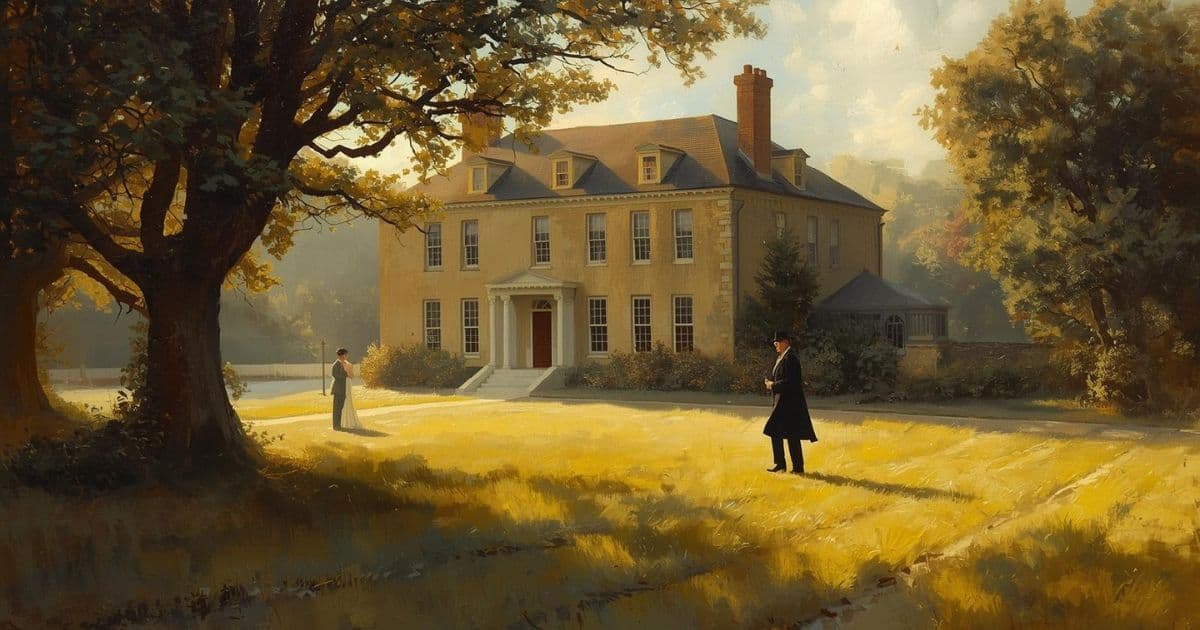
An excerpt from the original text.(complete · 3341 words)
ow fell into a regular routine of apprenticeship life, which was
varied beyond the limits of the village and the marshes, by no more
remarkable circumstance than the arrival of my birthday and my paying
another visit to Miss Havisham. I found Miss Sarah Pocket still on duty
at the gate; I found Miss Havisham just as I had left her, and she
spoke of Estella in the very same way, if not in the very same words.
The interview lasted but a few minutes, and she gave me a guinea when I
was going, and told me to come again on my next birthday. I may mention
at once that this became an annual custom. I tried to decline taking
the guinea on the first occasion, but with no better effect than
causing her to ask me very angrily, if I expected more? Then, and after
that, I took it.
So unchanging was the dull old house, the yellow light in the darkened
room, the faded spectre in the chair by the dressing-table glass, that
I felt as if the stopping of the clocks had stopped Time in that
mysterious place, and, while I and everything else outside it grew
older, it stood still. Daylight never entered the house as to my
thoughts and remembrances of it, any more than as to the actual fact.
It bewildered me, and under its influence I continued at heart to hate
my trade and to be ashamed of home.
Imperceptibly I became conscious of a change in Biddy, however. Her
shoes came up at the heel, her hair grew bright and neat, her hands
were always clean. She was not beautiful,—she was common, and could not
be like Estella,—but she was pleasant and wholesome and sweet-tempered.
She had not been with us more than a year (I remember her being newly
out of mourning at the time it struck me), when I observed to myself
one evening that she had curiously thoughtful and attentive eyes; eyes
that were very pretty and very good.
It came of my lifting up my own eyes from a task I was poring
at—writing some passages from a book, to improve myself in two ways at
once by a sort of stratagem—and seeing Biddy observant of what I was
about. I laid down my pen, and Biddy stopped in her needlework without
laying it down.
“Biddy,” said I, “how do you manage it? Either I am very stupid, or you
are very clever.”
“What is it that I manage? I don’t know,” returned Biddy, smiling.
She managed our whole domestic life, and wonderfully too; but I did not
mean that, though that made what I did mean more surprising.
“How do you manage, Biddy,” said I, “to learn everything that I learn,
and always to keep up with me?” I was beginning to be rather vain of my
knowledge, for I spent my birthday guineas on it, and set aside the
greater part of my pocket-money for similar investment; though I have
no doubt, now, that the little I knew was extremely dear at the price.
“I might as well ask you,” said Biddy, “how you manage?”
“No; because when I come in from the forge of a night, any one can see
me turning to at it. But you never turn to at it, Biddy.”
“I suppose I must catch it like a cough,” said Biddy, quietly; and went
on with her sewing.
Pursuing my idea as I leaned back in my wooden chair, and looked at
Biddy sewing away with her head on one side, I began to think her
rather an extraordinary girl. For I called to mind now, that she was
equally accomplished in the terms of our trade, and the names of our
different sorts of work, and our various tools. In short, whatever I
knew, Biddy knew. Theoretically, she was already as good a blacksmith
as I, or better.
“You are one of those, Biddy,” said I, “who make the most of every
chance. You never had a chance before you came here, and see how
improved you are!”
Biddy looked at me for an instant, and went on with her sewing. “I was
your first teacher though; wasn’t I?” said she, as she sewed.
“Biddy!” I exclaimed, in amazement. “Why, you are crying!”
“No I am not,” said Biddy, looking up and laughing. “What put that in
your head?”
What could have put it in my head but the glistening of a tear as it
dropped on her work? I sat silent, recalling what a drudge she had been
until Mr. Wopsle’s great-aunt successfully overcame that bad habit of
living, so highly desirable to be got rid of by some people. I recalled
the hopeless circumstances by which she had been surrounded in the
miserable little shop and the miserable little noisy evening school,
with that miserable old bundle of incompetence always to be dragged and
shouldered. I reflected that even in those untoward times there must
have been latent in Biddy what was now developing, for, in my first
uneasiness and discontent I had turned to her for help, as a matter of
course. Biddy sat quietly sewing, shedding no more tears, and while I
looked at her and thought about it all, it occurred to me that perhaps
I had not been sufficiently grateful to Biddy. I might have been too
reserved, and should have patronised her more (though I did not use
that precise word in my meditations) with my confidence.
“Yes, Biddy,” I observed, when I had done turning it over, “you were my
first teacher, and that at a time when we little thought of ever being
together like this, in this kitchen.”
“Ah, poor thing!” replied Biddy. It was like her self-forgetfulness to
transfer the remark to my sister, and to get up and be busy about her,
making her more comfortable; “that’s sadly true!”
“Well!” said I, “we must talk together a little more, as we used to do.
And I must consult you a little more, as I used to do. Let us have a
quiet walk on the marshes next Sunday, Biddy, and a long chat.”
My sister was never left alone now; but Joe more than readily undertook
the care of her on that Sunday afternoon, and Biddy and I went out
together. It was summer-time, and lovely weather. When we had passed
the village and the church and the churchyard, and were out on the
marshes and began to see the sails of the ships as they sailed on, I
began to combine Miss Havisham and Estella with the prospect, in my
usual way. When we came to the river-side and sat down on the bank,
with the water rippling at our feet, making it all more quiet than it
would have been without that sound, I resolved that it was a good time
and place for the admission of Biddy into my inner confidence.
“Biddy,” said I, after binding her to secrecy, “I want to be a
gentleman.”
“O, I wouldn’t, if I was you!” she returned. “I don’t think it would
answer.”
“Biddy,” said I, with some severity, “I have particular reasons for
wanting to be a gentleman.”
“You know best, Pip; but don’t you think you are happier as you are?”
“Biddy,” I exclaimed, impatiently, “I am not at all happy as I am. I am
disgusted with my calling and with my life. I have never taken to
either, since I was bound. Don’t be absurd.”
“Was I absurd?” said Biddy, quietly raising her eyebrows; “I am sorry
for that; I didn’t mean to be. I only want you to do well, and to be
comfortable.”
“Well, then, understand once for all that I never shall or can be
comfortable—or anything but miserable—there, Biddy!—unless I can lead a
very different sort of life from the life I lead now.”
“That’s a pity!” said Biddy, shaking her head with a sorrowful air.
Now, I too had so often thought it a pity, that, in the singular kind
of quarrel with myself which I was always carrying on, I was half
inclined to shed tears of vexation and distress when Biddy gave
utterance to her sentiment and my own. I told her she was right, and I
knew it was much to be regretted, but still it was not to be helped.
“If I could have settled down,” I said to Biddy, plucking up the short
grass within reach, much as I had once upon a time pulled my feelings
out of my hair and kicked them into the brewery wall,—“if I could have
settled down and been but half as fond of the forge as I was when I was
little, I know it would have been much better for me. You and I and Joe
would have wanted nothing then, and Joe and I would perhaps have gone
partners when I was out of my time, and I might even have grown up to
keep company with you, and we might have sat on this very bank on a
fine Sunday, quite different people. I should have been good enough for
you; shouldn’t I, Biddy?”
Biddy sighed as she looked at the ships sailing on, and returned for
answer, “Yes; I am not over-particular.” It scarcely sounded
flattering, but I knew she meant well.
“Instead of that,” said I, plucking up more grass and chewing a blade
or two, “see how I am going on. Dissatisfied, and uncomfortable,
and—what would it signify to me, being coarse and common, if nobody had
told me so!”
Biddy turned her face suddenly towards mine, and looked far more
attentively at me than she had looked at the sailing ships.
“It was neither a very true nor a very polite thing to say,” she
remarked, directing her eyes to the ships again. “Who said it?”
I was disconcerted, for I had broken away without quite seeing where I
was going to. It was not to be shuffled off now, however, and I
answered, “The beautiful young lady at Miss Havisham’s, and she’s more
beautiful than anybody ever was, and I admire her dreadfully, and I
want to be a gentleman on her account.” Having made this lunatic
confession, I began to throw my torn-up grass into the river, as if I
had some thoughts of following it.
“Do you want to be a gentleman, to spite her or to gain her over?”
Biddy quietly asked me, after a pause.
“I don’t know,” I moodily answered.
“Because, if it is to spite her,” Biddy pursued, “I should think—but
you know best—that might be better and more independently done by
caring nothing for her words. And if it is to gain her over, I should
think—but you know best—she was not worth gaining over.”
Exactly what I myself had thought, many times. Exactly what was
perfectly manifest to me at the moment. But how could I, a poor dazed
village lad, avoid that wonderful inconsistency into which the best and
wisest of men fall every day?
“It may be all quite true,” said I to Biddy, “but I admire her
dreadfully.”
In short, I turned over on my face when I came to that, and got a good
grasp on the hair on each side of my head, and wrenched it well. All
the while knowing the madness of my heart to be so very mad and
misplaced, that I was quite conscious it would have served my face
right, if I had lifted it up by my hair, and knocked it against the
pebbles as a punishment for belonging to such an idiot.
Biddy was the wisest of girls, and she tried to reason no more with me.
She put her hand, which was a comfortable hand though roughened by
work, upon my hands, one after another, and gently took them out of my
hair. Then she softly patted my shoulder in a soothing way, while with
my face upon my sleeve I cried a little,—exactly as I had done in the
brewery yard,—and felt vaguely convinced that I was very much ill-used
by somebody, or by everybody; I can’t say which.
“I am glad of one thing,” said Biddy, “and that is, that you have felt
you could give me your confidence, Pip. And I am glad of another thing,
and that is, that of course you know you may depend upon my keeping it
and always so far deserving it. If your first teacher (dear! such a
poor one, and so much in need of being taught herself!) had been your
teacher at the present time, she thinks she knows what lesson she would
set. But it would be a hard one to learn, and you have got beyond her,
and it’s of no use now.” So, with a quiet sigh for me, Biddy rose from
the bank, and said, with a fresh and pleasant change of voice, “Shall
we walk a little farther, or go home?”
“Biddy,” I cried, getting up, putting my arm round her neck, and giving
her a kiss, “I shall always tell you everything.”
“Till you’re a gentleman,” said Biddy.
“You know I never shall be, so that’s always. Not that I have any
occasion to tell you anything, for you know everything I know,—as I
told you at home the other night.”
“Ah!” said Biddy, quite in a whisper, as she looked away at the ships.
And then repeated, with her former pleasant change, “shall we walk a
little farther, or go home?”
I said to Biddy we would walk a little farther, and we did so, and the
summer afternoon toned down into the summer evening, and it was very
beautiful. I began to consider whether I was not more naturally and
wholesomely situated, after all, in these circumstances, than playing
beggar my neighbour by candle-light in the room with the stopped
clocks, and being despised by Estella. I thought it would be very good
for me if I could get her out of my head, with all the rest of those
remembrances and fancies, and could go to work determined to relish
what I had to do, and stick to it, and make the best of it. I asked
myself the question whether I did not surely know that if Estella were
beside me at that moment instead of Biddy, she would make me miserable?
I was obliged to admit that I did know it for a certainty, and I said
to myself, “Pip, what a fool you are!”
We talked a good deal as we walked, and all that Biddy said seemed
right. Biddy was never insulting, or capricious, or Biddy to-day and
somebody else to-morrow; she would have derived only pain, and no
pleasure, from giving me pain; she would far rather have wounded her
own breast than mine. How could it be, then, that I did not like her
much the better of the two?
“Biddy,” said I, when we were walking homeward, “I wish you could put
me right.”
“I wish I could!” said Biddy.
“If I could only get myself to fall in love with you,—you don’t mind my
speaking so openly to such an old acquaintance?”
“Oh dear, not at all!” said Biddy. “Don’t mind me.”
“If I could only get myself to do it, that would be the thing for
me.”
“But you never will, you see,” said Biddy.
It did not appear quite so unlikely to me that evening, as it would
have done if we had discussed it a few hours before. I therefore
observed I was not quite sure of that. But Biddy said she was, and
she said it decisively. In my heart I believed her to be right; and yet
I took it rather ill, too, that she should be so positive on the point.
When we came near the churchyard, we had to cross an embankment, and
get over a stile near a sluice-gate. There started up, from the gate,
or from the rushes, or from the ooze (which was quite in his stagnant
way), Old Orlick.
“Halloa!” he growled, “where are you two going?”
“Where should we be going, but home?”
“Well, then,” said he, “I’m jiggered if I don’t see you home!”
This penalty of being jiggered was a favourite supposititious case of
his. He attached no definite meaning to the word that I am aware of,
but used it, like his own pretended Christian name, to affront mankind,
and convey an idea of something savagely damaging. When I was younger,
I had had a general belief that if he had jiggered me personally, he
would have done it with a sharp and twisted hook.
Biddy was much against his going with us, and said to me in a whisper,
“Don’t let him come; I don’t like him.” As I did not like him either, I
took the liberty of saying that we thanked him, but we didn’t want
seeing home. He received that piece of information with a yell of
laughter, and dropped back, but came slouching after us at a little
distance.
Curious to know whether Biddy suspected him of having had a hand in
that murderous attack of which my sister had never been able to give
any account, I asked her why she did not like him.
“Oh!” she replied, glancing over her shoulder as he slouched after us,
“because I—I am afraid he likes me.”
“Did he ever tell you he liked you?” I asked indignantly.
“No,” said Biddy, glancing over her shoulder again, “he never told me
so; but he dances at me, whenever he can catch my eye.”
However novel and peculiar this testimony of attachment, I did not
doubt the accuracy of the interpretation. I was very hot indeed upon
Old Orlick’s daring to admire her; as hot as if it were an outrage on
myself.
“But it makes no difference to you, you know,” said Biddy, calmly.
“No, Biddy, it makes no difference to me; only I don’t like it; I don’t
approve of it.”
“Nor I neither,” said Biddy. “Though that makes no difference to
you.”
“Exactly,” said I; “but I must tell you I should have no opinion of
you, Biddy, if he danced at you with your own consent.”
I kept an eye on Orlick after that night, and, whenever circumstances
were favourable to his dancing at Biddy, got before him to obscure that
demonstration. He had struck root in Joe’s establishment, by reason of
my sister’s sudden fancy for him, or I should have tried to get him
dismissed. He quite understood and reciprocated my good intentions, as
I had reason to know thereafter.
And now, because my mind was not confused enough before, I complicated
its confusion fifty thousand-fold, by having states and seasons when I
was clear that Biddy was immeasurably better than Estella, and that the
plain honest working life to which I was born had nothing in it to be
ashamed of, but offered me sufficient means of self-respect and
happiness. At those times, I would decide conclusively that my
disaffection to dear old Joe and the forge was gone, and that I was
growing up in a fair way to be partners with Joe and to keep company
with Biddy,—when all in a moment some confounding remembrance of the
Havisham days would fall upon me like a destructive missile, and
scatter my wits again. Scattered wits take a long time picking up; and
often before I had got them well together, they would be dispersed in
all directions by one stray thought, that perhaps after all Miss
Havisham was going to make my fortune when my time was out.
If my time had run out, it would have left me still at the height of my
perplexities, I dare say. It never did run out, however, but was
brought to a premature end, as I proceed to relate.
Master this chapter. Complete your experience
Purchase the complete book to access all chapters and support classic literature
As an Amazon Associate, we earn a small commission from qualifying purchases at no additional cost to you.
Available in paperback, hardcover, and e-book formats
Let's Analyse the Pattern
We assign higher value to what's difficult to obtain while devaluing what's readily available, even when the available option is objectively better for us.
Why This Matters
Connect literature to life
This chapter teaches how to identify when we're pursuing something because it's difficult rather than because it's good for us.
Practice This Today
This week, notice when you're working harder for someone's approval who's consistently dismissive while taking for granted people who already support you.
Now let's explore the literary elements.
Key Quotes & Analysis
"I felt as if the stopping of the clocks had stopped Time in that mysterious place, and, while I and everything else outside it grew older, it stood still."
Context: Pip describes the unchanging atmosphere of Miss Havisham's house during his annual visits
This shows how Miss Havisham's refusal to move forward with her life creates an unnatural, haunting environment. The stopped time represents emotional stagnation and the danger of living in the past instead of growing and changing.
In Today's Words:
That place felt frozen in time - like nothing ever changed while the rest of the world moved on.
"Under its influence I continued at heart to hate my trade and to be ashamed of home."
Context: Pip explains how Miss Havisham's house affects his feelings about his working-class life
This reveals how exposure to wealth and status can poison your appreciation for what you have. Pip's visits make him reject his honest work and loving home, showing how comparison breeds misery.
In Today's Words:
Being around all that wealth made me hate my job and feel embarrassed about where I came from.
"If you can't get to be oncommon through going straight, you'll never get to do it through going crooked."
Context: Biddy warns Pip about his motivations for wanting to become a gentleman
Biddy's wisdom cuts to the heart of Pip's problem - he wants to change himself for the wrong reasons. Real self-improvement comes from honest effort, not from trying to impress someone or spite them.
In Today's Words:
If you can't succeed by being genuine, you definitely won't succeed by being fake or doing it for the wrong reasons.
Thematic Threads
Self-Sabotage
In This Chapter
Pip recognizes Biddy is better for him than Estella but can't make himself love her
Development
Introduced here - shows how shame creates destructive romantic choices
In Your Life:
You might find yourself drawn to people or situations that validate your insecurities rather than heal them.
Class Shame
In This Chapter
Miss Havisham's house continues to make Pip ashamed of his working-class life and trade
Development
Deepening from earlier exposure - now affecting his romantic choices
In Your Life:
You might feel embarrassed about your background when around people you perceive as 'better' than you.
Hidden Wisdom
In This Chapter
Biddy quietly keeps pace with all of Pip's learning and offers gentle but profound insights about his motivations
Development
Expanding from her earlier supportive role - revealing her intelligence
In Your Life:
You might overlook the wisdom of people who don't make a show of their knowledge or credentials.
Obsession
In This Chapter
Pip's fixation on Estella makes him miserable but he can't let it go
Development
Intensifying from his first encounter with her - now driving major life decisions
In Your Life:
You might stay stuck pursuing something that consistently makes you unhappy because letting go feels like failure.
Emotional Intelligence
In This Chapter
Biddy asks probing questions about whether Pip wants to spite Estella or win her, exposing his confused motivations
Development
Introduced here - showing Biddy's ability to see through surface desires
In Your Life:
You might benefit from friends who ask uncomfortable questions about your real motivations.
You now have the context. Time to form your own thoughts.
Discussion Questions
- 1
Why does Pip continue visiting Miss Havisham even though her house makes him miserable and ashamed of his life?
analysis • surface - 2
What does Biddy mean when she says she 'catches' learning 'like a cough'? Why might Pip find this both impressive and frustrating?
analysis • medium - 3
Pip recognizes that Biddy is kinder and better for him than Estella, yet he can't make himself love her. Where do you see this pattern of wanting what hurts us in modern life?
application • medium - 4
If you were Pip's friend, how would you help him see the trap he's creating for himself without being preachy or judgmental?
application • deep - 5
What does this chapter reveal about why we sometimes reject what would heal us and chase what damages us?
reflection • deep
Critical Thinking Exercise
The Availability Audit
Make two lists: people or opportunities you're chasing that seem just out of reach, and people or opportunities that are readily available to you. For each item on the 'chasing' list, write why it feels valuable. For each item on the 'available' list, write one genuine positive quality you might be overlooking.
Consider:
- •Notice if difficulty or scarcity makes something seem more valuable than it actually is
- •Consider whether you're taking available support or opportunities for granted
- •Ask yourself what you might be missing by focusing only on what's hard to get
Journaling Prompt
Write about a time when you realized you were chasing something that wasn't good for you while overlooking something that was. What helped you recognize the pattern, and what did you do about it?
Coming Up Next...
Chapter 18: Great Expectations Arrive
Four years into his apprenticeship, Pip finds himself at the Three Jolly Bargemen on a Saturday night, listening to Mr. Wopsle read the newspaper aloud. This seemingly ordinary evening is about to change everything - his apprenticeship will come to an unexpected and premature end.