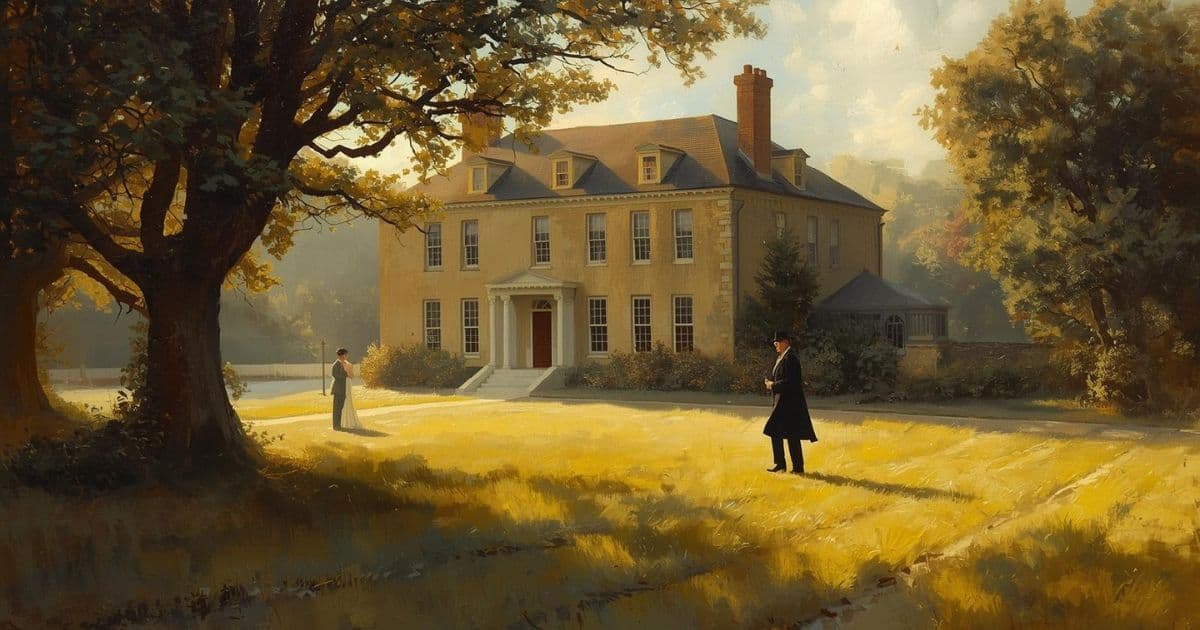
An excerpt from the original text.(complete · 5698 words)
orning made a considerable difference in my general prospect of Life,
and brightened it so much that it scarcely seemed the same. What lay
heaviest on my mind was, the consideration that six days intervened
between me and the day of departure; for I could not divest myself of a
misgiving that something might happen to London in the meanwhile, and
that, when I got there, it would be either greatly deteriorated or
clean gone.
Joe and Biddy were very sympathetic and pleasant when I spoke of our
approaching separation; but they only referred to it when I did. After
breakfast, Joe brought out my indentures from the press in the best
parlour, and we put them in the fire, and I felt that I was free. With
all the novelty of my emancipation on me, I went to church with Joe,
and thought perhaps the clergyman wouldn’t have read that about the
rich man and the kingdom of Heaven, if he had known all.
After our early dinner, I strolled out alone, purposing to finish off
the marshes at once, and get them done with. As I passed the church, I
felt (as I had felt during service in the morning) a sublime compassion
for the poor creatures who were destined to go there, Sunday after
Sunday, all their lives through, and to lie obscurely at last among the
low green mounds. I promised myself that I would do something for them
one of these days, and formed a plan in outline for bestowing a dinner
of roast-beef and plum-pudding, a pint of ale, and a gallon of
condescension, upon everybody in the village.
If I had often thought before, with something allied to shame, of my
companionship with the fugitive whom I had once seen limping among
those graves, what were my thoughts on this Sunday, when the place
recalled the wretch, ragged and shivering, with his felon iron and
badge! My comfort was, that it happened a long time ago, and that he
had doubtless been transported a long way off, and that he was dead to
me, and might be veritably dead into the bargain.
No more low, wet grounds, no more dikes and sluices, no more of these
grazing cattle,—though they seemed, in their dull manner, to wear a
more respectful air now, and to face round, in order that they might
stare as long as possible at the possessor of such great
expectations,—farewell, monotonous acquaintances of my childhood,
henceforth I was for London and greatness; not for smith’s work in
general, and for you! I made my exultant way to the old Battery, and,
lying down there to consider the question whether Miss Havisham
intended me for Estella, fell asleep.
When I awoke, I was much surprised to find Joe sitting beside me,
smoking his pipe. He greeted me with a cheerful smile on my opening my
eyes, and said,—
“As being the last time, Pip, I thought I’d foller.”
“And Joe, I am very glad you did so.”
“Thankee, Pip.”
“You may be sure, dear Joe,” I went on, after we had shaken hands,
“that I shall never forget you.”
“No, no, Pip!” said Joe, in a comfortable tone, “I’m sure of that.
Ay, ay, old chap! Bless you, it were only necessary to get it well
round in a man’s mind, to be certain on it. But it took a bit of time
to get it well round, the change come so oncommon plump; didn’t it?”
Somehow, I was not best pleased with Joe’s being so mightily secure of
me. I should have liked him to have betrayed emotion, or to have said,
“It does you credit, Pip,” or something of that sort. Therefore, I made
no remark on Joe’s first head; merely saying as to his second, that the
tidings had indeed come suddenly, but that I had always wanted to be a
gentleman, and had often and often speculated on what I would do, if I
were one.
“Have you though?” said Joe. “Astonishing!”
“It’s a pity now, Joe,” said I, “that you did not get on a little more,
when we had our lessons here; isn’t it?”
“Well, I don’t know,” returned Joe. “I’m so awful dull. I’m only master
of my own trade. It were always a pity as I was so awful dull; but it’s
no more of a pity now, than it was—this day twelvemonth—don’t you see?”
What I had meant was, that when I came into my property and was able to
do something for Joe, it would have been much more agreeable if he had
been better qualified for a rise in station. He was so perfectly
innocent of my meaning, however, that I thought I would mention it to
Biddy in preference.
So, when we had walked home and had had tea, I took Biddy into our
little garden by the side of the lane, and, after throwing out in a
general way for the elevation of her spirits, that I should never
forget her, said I had a favour to ask of her.
“And it is, Biddy,” said I, “that you will not omit any opportunity of
helping Joe on, a little.”
“How helping him on?” asked Biddy, with a steady sort of glance.
“Well! Joe is a dear good fellow,—in fact, I think he is the dearest
fellow that ever lived,—but he is rather backward in some things. For
instance, Biddy, in his learning and his manners.”
Although I was looking at Biddy as I spoke, and although she opened her
eyes very wide when I had spoken, she did not look at me.
“O, his manners! won’t his manners do then?” asked Biddy, plucking a
black-currant leaf.
“My dear Biddy, they do very well here—”
“O! they do very well here?” interrupted Biddy, looking closely at
the leaf in her hand.
“Hear me out,—but if I were to remove Joe into a higher sphere, as I
shall hope to remove him when I fully come into my property, they would
hardly do him justice.”
“And don’t you think he knows that?” asked Biddy.
It was such a very provoking question (for it had never in the most
distant manner occurred to me), that I said, snappishly,—
“Biddy, what do you mean?”
Biddy, having rubbed the leaf to pieces between her hands,—and the
smell of a black-currant bush has ever since recalled to me that
evening in the little garden by the side of the lane,—said, “Have you
never considered that he may be proud?”
“Proud?” I repeated, with disdainful emphasis.
“O! there are many kinds of pride,” said Biddy, looking full at me and
shaking her head; “pride is not all of one kind—”
“Well? What are you stopping for?” said I.
“Not all of one kind,” resumed Biddy. “He may be too proud to let any
one take him out of a place that he is competent to fill, and fills
well and with respect. To tell you the truth, I think he is; though it
sounds bold in me to say so, for you must know him far better than I
do.”
“Now, Biddy,” said I, “I am very sorry to see this in you. I did not
expect to see this in you. You are envious, Biddy, and grudging. You
are dissatisfied on account of my rise in fortune, and you can’t help
showing it.”
“If you have the heart to think so,” returned Biddy, “say so. Say so
over and over again, if you have the heart to think so.”
“If you have the heart to be so, you mean, Biddy,” said I, in a
virtuous and superior tone; “don’t put it off upon me. I am very sorry
to see it, and it’s a—it’s a bad side of human nature. I did intend to
ask you to use any little opportunities you might have after I was
gone, of improving dear Joe. But after this I ask you nothing. I am
extremely sorry to see this in you, Biddy,” I repeated. “It’s a—it’s a
bad side of human nature.”
“Whether you scold me or approve of me,” returned poor Biddy, “you may
equally depend upon my trying to do all that lies in my power, here, at
all times. And whatever opinion you take away of me, shall make no
difference in my remembrance of you. Yet a gentleman should not be
unjust neither,” said Biddy, turning away her head.
I again warmly repeated that it was a bad side of human nature (in
which sentiment, waiving its application, I have since seen reason to
think I was right), and I walked down the little path away from Biddy,
and Biddy went into the house, and I went out at the garden gate and
took a dejected stroll until supper-time; again feeling it very
sorrowful and strange that this, the second night of my bright
fortunes, should be as lonely and unsatisfactory as the first.
But, morning once more brightened my view, and I extended my clemency
to Biddy, and we dropped the subject. Putting on the best clothes I
had, I went into town as early as I could hope to find the shops open,
and presented myself before Mr. Trabb, the tailor, who was having his
breakfast in the parlour behind his shop, and who did not think it
worth his while to come out to me, but called me in to him.
“Well!” said Mr. Trabb, in a hail-fellow-well-met kind of way. “How are
you, and what can I do for you?”
Mr. Trabb had sliced his hot roll into three feather-beds, and was
slipping butter in between the blankets, and covering it up. He was a
prosperous old bachelor, and his open window looked into a prosperous
little garden and orchard, and there was a prosperous iron safe let
into the wall at the side of his fireplace, and I did not doubt that
heaps of his prosperity were put away in it in bags.
“Mr. Trabb,” said I, “it’s an unpleasant thing to have to mention,
because it looks like boasting; but I have come into a handsome
property.”
A change passed over Mr. Trabb. He forgot the butter in bed, got up
from the bedside, and wiped his fingers on the tablecloth, exclaiming,
“Lord bless my soul!”
“I am going up to my guardian in London,” said I, casually drawing some
guineas out of my pocket and looking at them; “and I want a fashionable
suit of clothes to go in. I wish to pay for them,” I added—otherwise I
thought he might only pretend to make them, “with ready money.”
“My dear sir,” said Mr. Trabb, as he respectfully bent his body, opened
his arms, and took the liberty of touching me on the outside of each
elbow, “don’t hurt me by mentioning that. May I venture to congratulate
you? Would you do me the favour of stepping into the shop?”
Mr. Trabb’s boy was the most audacious boy in all that country-side.
When I had entered he was sweeping the shop, and he had sweetened his
labours by sweeping over me. He was still sweeping when I came out into
the shop with Mr. Trabb, and he knocked the broom against all possible
corners and obstacles, to express (as I understood it) equality with
any blacksmith, alive or dead.
“Hold that noise,” said Mr. Trabb, with the greatest sternness, “or
I’ll knock your head off!—Do me the favour to be seated, sir. Now,
this,” said Mr. Trabb, taking down a roll of cloth, and tiding it out
in a flowing manner over the counter, preparatory to getting his hand
under it to show the gloss, “is a very sweet article. I can recommend
it for your purpose, sir, because it really is extra super. But you
shall see some others. Give me Number Four, you!” (To the boy, and with
a dreadfully severe stare; foreseeing the danger of that miscreant’s
brushing me with it, or making some other sign of familiarity.)
Mr. Trabb never removed his stern eye from the boy until he had
deposited number four on the counter and was at a safe distance again.
Then he commanded him to bring number five, and number eight. “And let
me have none of your tricks here,” said Mr. Trabb, “or you shall repent
it, you young scoundrel, the longest day you have to live.”
Mr. Trabb then bent over number four, and in a sort of deferential
confidence recommended it to me as a light article for summer wear, an
article much in vogue among the nobility and gentry, an article that it
would ever be an honour to him to reflect upon a distinguished
fellow-townsman’s (if he might claim me for a fellow-townsman) having
worn. “Are you bringing numbers five and eight, you vagabond,” said Mr.
Trabb to the boy after that, “or shall I kick you out of the shop and
bring them myself?”
I selected the materials for a suit, with the assistance of Mr. Trabb’s
judgment, and re-entered the parlour to be measured. For although Mr.
Trabb had my measure already, and had previously been quite contented
with it, he said apologetically that it “wouldn’t do under existing
circumstances, sir,—wouldn’t do at all.” So, Mr. Trabb measured and
calculated me in the parlour, as if I were an estate and he the finest
species of surveyor, and gave himself such a world of trouble that I
felt that no suit of clothes could possibly remunerate him for his
pains. When he had at last done and had appointed to send the articles
to Mr. Pumblechook’s on the Thursday evening, he said, with his hand
upon the parlour lock, “I know, sir, that London gentlemen cannot be
expected to patronise local work, as a rule; but if you would give me a
turn now and then in the quality of a townsman, I should greatly esteem
it. Good-morning, sir, much obliged.—Door!”
The last word was flung at the boy, who had not the least notion what
it meant. But I saw him collapse as his master rubbed me out with his
hands, and my first decided experience of the stupendous power of money
was, that it had morally laid upon his back Trabb’s boy.
After this memorable event, I went to the hatter’s, and the
bootmaker’s, and the hosier’s, and felt rather like Mother Hubbard’s
dog whose outfit required the services of so many trades. I also went
to the coach-office and took my place for seven o’clock on Saturday
morning. It was not necessary to explain everywhere that I had come
into a handsome property; but whenever I said anything to that effect,
it followed that the officiating tradesman ceased to have his attention
diverted through the window by the High Street, and concentrated his
mind upon me. When I had ordered everything I wanted, I directed my
steps towards Pumblechook’s, and, as I approached that gentleman’s
place of business, I saw him standing at his door.
He was waiting for me with great impatience. He had been out early with
the chaise-cart, and had called at the forge and heard the news. He had
prepared a collation for me in the Barnwell parlour, and he too ordered
his shopman to “come out of the gangway” as my sacred person passed.
“My dear friend,” said Mr. Pumblechook, taking me by both hands, when
he and I and the collation were alone, “I give you joy of your good
fortune. Well deserved, well deserved!”
This was coming to the point, and I thought it a sensible way of
expressing himself.
“To think,” said Mr. Pumblechook, after snorting admiration at me for
some moments, “that I should have been the humble instrument of leading
up to this, is a proud reward.”
I begged Mr. Pumblechook to remember that nothing was to be ever said
or hinted, on that point.
“My dear young friend,” said Mr. Pumblechook; “if you will allow me to
call you so—”
I murmured “Certainly,” and Mr. Pumblechook took me by both hands
again, and communicated a movement to his waistcoat, which had an
emotional appearance, though it was rather low down, “My dear young
friend, rely upon my doing my little all in your absence, by keeping
the fact before the mind of Joseph.—Joseph!” said Mr. Pumblechook, in
the way of a compassionate adjuration. “Joseph!! Joseph!!!” Thereupon
he shook his head and tapped it, expressing his sense of deficiency in
Joseph.
“But my dear young friend,” said Mr. Pumblechook, “you must be hungry,
you must be exhausted. Be seated. Here is a chicken had round from the
Boar, here is a tongue had round from the Boar, here’s one or two
little things had round from the Boar, that I hope you may not despise.
But do I,” said Mr. Pumblechook, getting up again the moment after he
had sat down, “see afore me, him as I ever sported with in his times of
happy infancy? And may I—may I—?”
This May I, meant might he shake hands? I consented, and he was
fervent, and then sat down again.
“Here is wine,” said Mr. Pumblechook. “Let us drink, Thanks to Fortune,
and may she ever pick out her favourites with equal judgment! And yet I
cannot,” said Mr. Pumblechook, getting up again, “see afore me One—and
likewise drink to One—without again expressing—May I—may I—?”
I said he might, and he shook hands with me again, and emptied his
glass and turned it upside down. I did the same; and if I had turned
myself upside down before drinking, the wine could not have gone more
direct to my head.
Mr. Pumblechook helped me to the liver wing, and to the best slice of
tongue (none of those out-of-the-way No Thoroughfares of Pork now), and
took, comparatively speaking, no care of himself at all. “Ah! poultry,
poultry! You little thought,” said Mr. Pumblechook, apostrophising the
fowl in the dish, “when you was a young fledgling, what was in store
for you. You little thought you was to be refreshment beneath this
humble roof for one as—Call it a weakness, if you will,” said Mr.
Pumblechook, getting up again, “but may I? may I—?”
It began to be unnecessary to repeat the form of saying he might, so he
did it at once. How he ever did it so often without wounding himself
with my knife, I don’t know.
“And your sister,” he resumed, after a little steady eating, “which had
the honour of bringing you up by hand! It’s a sad picter, to reflect
that she’s no longer equal to fully understanding the honour. May—”
I saw he was about to come at me again, and I stopped him.
“We’ll drink her health,” said I.
“Ah!” cried Mr. Pumblechook, leaning back in his chair, quite flaccid
with admiration, “that’s the way you know ’em, sir!” (I don’t know who
Sir was, but he certainly was not I, and there was no third person
present); “that’s the way you know the noble-minded, sir! Ever
forgiving and ever affable. It might,” said the servile Pumblechook,
putting down his untasted glass in a hurry and getting up again, “to a
common person, have the appearance of repeating—but may I—?”
When he had done it, he resumed his seat and drank to my sister. “Let
us never be blind,” said Mr. Pumblechook, “to her faults of temper, but
it is to be hoped she meant well.”
At about this time, I began to observe that he was getting flushed in
the face; as to myself, I felt all face, steeped in wine and smarting.
I mentioned to Mr. Pumblechook that I wished to have my new clothes
sent to his house, and he was ecstatic on my so distinguishing him. I
mentioned my reason for desiring to avoid observation in the village,
and he lauded it to the skies. There was nobody but himself, he
intimated, worthy of my confidence, and—in short, might he? Then he
asked me tenderly if I remembered our boyish games at sums, and how we
had gone together to have me bound apprentice, and, in effect, how he
had ever been my favourite fancy and my chosen friend? If I had taken
ten times as many glasses of wine as I had, I should have known that he
never had stood in that relation towards me, and should in my heart of
hearts have repudiated the idea. Yet for all that, I remember feeling
convinced that I had been much mistaken in him, and that he was a
sensible, practical, good-hearted prime fellow.
By degrees he fell to reposing such great confidence in me, as to ask
my advice in reference to his own affairs. He mentioned that there was
an opportunity for a great amalgamation and monopoly of the corn and
seed trade on those premises, if enlarged, such as had never occurred
before in that or any other neighbourhood. What alone was wanting to
the realisation of a vast fortune, he considered to be More Capital.
Those were the two little words, more capital. Now it appeared to him
(Pumblechook) that if that capital were got into the business, through
a sleeping partner, sir,—which sleeping partner would have nothing to
do but walk in, by self or deputy, whenever he pleased, and examine the
books,—and walk in twice a year and take his profits away in his
pocket, to the tune of fifty per cent,—it appeared to him that that
might be an opening for a young gentleman of spirit combined with
property, which would be worthy of his attention. But what did I think?
He had great confidence in my opinion, and what did I think? I gave it
as my opinion. “Wait a bit!” The united vastness and distinctness of
this view so struck him, that he no longer asked if he might shake
hands with me, but said he really must,—and did.
We drank all the wine, and Mr. Pumblechook pledged himself over and
over again to keep Joseph up to the mark (I don’t know what mark), and
to render me efficient and constant service (I don’t know what
service). He also made known to me for the first time in my life, and
certainly after having kept his secret wonderfully well, that he had
always said of me, “That boy is no common boy, and mark me, his fortun’
will be no common fortun’.” He said with a tearful smile that it was a
singular thing to think of now, and I said so too. Finally, I went out
into the air, with a dim perception that there was something unwonted
in the conduct of the sunshine, and found that I had slumberously got
to the turnpike without having taken any account of the road.
There, I was roused by Mr. Pumblechook’s hailing me. He was a long way
down the sunny street, and was making expressive gestures for me to
stop. I stopped, and he came up breathless.
“No, my dear friend,” said he, when he had recovered wind for speech.
“Not if I can help it. This occasion shall not entirely pass without
that affability on your part.—May I, as an old friend and well-wisher?
May I?”
We shook hands for the hundredth time at least, and he ordered a young
carter out of my way with the greatest indignation. Then, he blessed me
and stood waving his hand to me until I had passed the crook in the
road; and then I turned into a field and had a long nap under a hedge
before I pursued my way home.
I had scant luggage to take with me to London, for little of the little
I possessed was adapted to my new station. But I began packing that
same afternoon, and wildly packed up things that I knew I should want
next morning, in a fiction that there was not a moment to be lost.
So, Tuesday, Wednesday, and Thursday, passed; and on Friday morning I
went to Mr. Pumblechook’s, to put on my new clothes and pay my visit to
Miss Havisham. Mr. Pumblechook’s own room was given up to me to dress
in, and was decorated with clean towels expressly for the event. My
clothes were rather a disappointment, of course. Probably every new and
eagerly expected garment ever put on since clothes came in, fell a
trifle short of the wearer’s expectation. But after I had had my new
suit on some half an hour, and had gone through an immensity of
posturing with Mr. Pumblechook’s very limited dressing-glass, in the
futile endeavour to see my legs, it seemed to fit me better. It being
market morning at a neighbouring town some ten miles off, Mr.
Pumblechook was not at home. I had not told him exactly when I meant to
leave, and was not likely to shake hands with him again before
departing. This was all as it should be, and I went out in my new
array, fearfully ashamed of having to pass the shopman, and suspicious
after all that I was at a personal disadvantage, something like Joe’s
in his Sunday suit.
I went circuitously to Miss Havisham’s by all the back ways, and rang
at the bell constrainedly, on account of the stiff long fingers of my
gloves. Sarah Pocket came to the gate, and positively reeled back when
she saw me so changed; her walnut-shell countenance likewise turned
from brown to green and yellow.
“You?” said she. “You? Good gracious! What do you want?”
“I am going to London, Miss Pocket,” said I, “and want to say good-bye
to Miss Havisham.”
I was not expected, for she left me locked in the yard, while she went
to ask if I were to be admitted. After a very short delay, she returned
and took me up, staring at me all the way.
Miss Havisham was taking exercise in the room with the long spread
table, leaning on her crutch stick. The room was lighted as of yore,
and at the sound of our entrance, she stopped and turned. She was then
just abreast of the rotted bride-cake.
“Don’t go, Sarah,” she said. “Well, Pip?”
“I start for London, Miss Havisham, to-morrow,” I was exceedingly
careful what I said, “and I thought you would kindly not mind my taking
leave of you.”
“This is a gay figure, Pip,” said she, making her crutch stick play
round me, as if she, the fairy godmother who had changed me, were
bestowing the finishing gift.
“I have come into such good fortune since I saw you last, Miss
Havisham,” I murmured. “And I am so grateful for it, Miss Havisham!”
“Ay, ay!” said she, looking at the discomfited and envious Sarah, with
delight. “I have seen Mr. Jaggers. I have heard about it, Pip. So you
go to-morrow?”
“Yes, Miss Havisham.”
“And you are adopted by a rich person?”
“Yes, Miss Havisham.”
“Not named?”
“No, Miss Havisham.”
“And Mr. Jaggers is made your guardian?”
“Yes, Miss Havisham.”
She quite gloated on these questions and answers, so keen was her
enjoyment of Sarah Pocket’s jealous dismay. “Well!” she went on; “you
have a promising career before you. Be good—deserve it—and abide by Mr.
Jaggers’s instructions.” She looked at me, and looked at Sarah, and
Sarah’s countenance wrung out of her watchful face a cruel smile.
“Good-bye, Pip!—you will always keep the name of Pip, you know.”
“Yes, Miss Havisham.”
“Good-bye, Pip!”
She stretched out her hand, and I went down on my knee and put it to my
lips. I had not considered how I should take leave of her; it came
naturally to me at the moment to do this. She looked at Sarah Pocket
with triumph in her weird eyes, and so I left my fairy godmother, with
both her hands on her crutch stick, standing in the midst of the dimly
lighted room beside the rotten bride-cake that was hidden in cobwebs.
Sarah Pocket conducted me down, as if I were a ghost who must be seen
out. She could not get over my appearance, and was in the last degree
confounded. I said “Good-bye, Miss Pocket;” but she merely stared, and
did not seem collected enough to know that I had spoken. Clear of the
house, I made the best of my way back to Pumblechook’s, took off my new
clothes, made them into a bundle, and went back home in my older dress,
carrying it—to speak the truth—much more at my ease too, though I had
the bundle to carry.
And now, those six days which were to have run out so slowly, had run
out fast and were gone, and to-morrow looked me in the face more
steadily than I could look at it. As the six evenings had dwindled
away, to five, to four, to three, to two, I had become more and more
appreciative of the society of Joe and Biddy. On this last evening, I
dressed myself out in my new clothes for their delight, and sat in my
splendour until bedtime. We had a hot supper on the occasion,
graced by the inevitable roast fowl, and we had some flip to finish
with. We were all very low, and none the higher for pretending to be in
spirits.
I was to leave our village at five in the morning, carrying my little
hand-portmanteau, and I had told Joe that I wished to walk away all
alone. I am afraid—sore afraid—that this purpose originated in my sense
of the contrast there would be between me and Joe, if we went to the
coach together. I had pretended with myself that there was nothing of
this taint in the arrangement; but when I went up to my little room on
this last night, I felt compelled to admit that it might be so, and had
an impulse upon me to go down again and entreat Joe to walk with me in
the morning. I did not.
All night there were coaches in my broken sleep, going to wrong places
instead of to London, and having in the traces, now dogs, now cats, now
pigs, now men,—never horses. Fantastic failures of journeys occupied me
until the day dawned and the birds were singing. Then, I got up and
partly dressed, and sat at the window to take a last look out, and in
taking it fell asleep.
Biddy was astir so early to get my breakfast, that, although I did not
sleep at the window an hour, I smelt the smoke of the kitchen fire when
I started up with a terrible idea that it must be late in the
afternoon. But long after that, and long after I had heard the clinking
of the teacups and was quite ready, I wanted the resolution to go
downstairs. After all, I remained up there, repeatedly unlocking and
unstrapping my small portmanteau and locking and strapping it up again,
until Biddy called to me that I was late.
It was a hurried breakfast with no taste in it. I got up from the meal,
saying with a sort of briskness, as if it had only just occurred to me,
“Well! I suppose I must be off!” and then I kissed my sister who was
laughing and nodding and shaking in her usual chair, and kissed Biddy,
and threw my arms around Joe’s neck. Then I took up my little
portmanteau and walked out. The last I saw of them was, when I
presently heard a scuffle behind me, and looking back, saw Joe throwing
an old shoe after me and Biddy throwing another old shoe. I stopped
then, to wave my hat, and dear old Joe waved his strong right arm above
his head, crying huskily “Hooroar!” and Biddy put her apron to her
face.
I walked away at a good pace, thinking it was easier to go than I had
supposed it would be, and reflecting that it would never have done to
have had an old shoe thrown after the coach, in sight of all the High
Street. I whistled and made nothing of going. But the village was very
peaceful and quiet, and the light mists were solemnly rising, as if to
show me the world, and I had been so innocent and little there, and all
beyond was so unknown and great, that in a moment with a strong heave
and sob I broke into tears. It was by the finger-post at the end of the
village, and I laid my hand upon it, and said, “Good-bye, O my dear,
dear friend!”
Heaven knows we need never be ashamed of our tears, for they are rain
upon the blinding dust of earth, overlying our hard hearts. I was
better after I had cried than before,—more sorry, more aware of my own
ingratitude, more gentle. If I had cried before, I should have had Joe
with me then.
So subdued I was by those tears, and by their breaking out again in the
course of the quiet walk, that when I was on the coach, and it was
clear of the town, I deliberated with an aching heart whether I would
not get down when we changed horses and walk back, and have another
evening at home, and a better parting. We changed, and I had not made
up my mind, and still reflected for my comfort that it would be quite
practicable to get down and walk back, when we changed again. And while
I was occupied with these deliberations, I would fancy an exact
resemblance to Joe in some man coming along the road towards us, and my
heart would beat high.—As if he could possibly be there!
We changed again, and yet again, and it was now too late and too far to
go back, and I went on. And the mists had all solemnly risen now, and
the world lay spread before me.
THIS IS THE END OF THE FIRST STAGE OF PIP’S EXPECTATIONS.
Master this chapter. Complete your experience
Purchase the complete book to access all chapters and support classic literature
As an Amazon Associate, we earn a small commission from qualifying purchases at no additional cost to you.
Available in paperback, hardcover, and e-book formats
Let's Analyse the Pattern
The tendency to devalue our origins and past relationships when we gain status, believing we must distance ourselves from where we came from to justify where we're going.
Why This Matters
Connect literature to life
This chapter teaches how sudden elevation creates a distortion field that makes us unable to see our own arrogance.
Practice This Today
This week, notice when you catch yourself explaining things others didn't ask about, or feeling embarrassed by people you used to be comfortable with.
Now let's explore the literary elements.
Key Quotes & Analysis
"I felt that I was free."
Context: After burning his apprentice papers with Joe
This moment of 'freedom' is deeply ironic. While Pip thinks he's freeing himself from his humble past, he's actually becoming enslaved to social expectations and his own pride.
In Today's Words:
I thought I was finally breaking free from my old life.
"If you could give him a little more polish, it would be a kindness."
Context: Condescendingly suggesting Biddy should 'improve' Joe
This reveals how completely Pip's values have shifted. He now sees Joe's honest simplicity as something shameful that needs fixing, showing his growing moral blindness.
In Today's Words:
Maybe you could help him seem more sophisticated and classy.
"Whether you scold me or approve of me, you cannot help yourself."
Context: Responding to Pip's accusation that she's jealous
Biddy's wisdom cuts through Pip's self-deception. She understands that his success has made him unable to hear criticism or see his own faults clearly.
In Today's Words:
No matter what I say, you're going to think what you want to think.
"My dear Handel, I fear I shall soon have to leave you."
Context: Pip's formal, affected way of speaking to Joe
Even his language has become artificial and distant. He can't speak naturally to the man who raised him, showing how his pursuit of gentility is making him less genuine.
In Today's Words:
Joe, I'm afraid I'll have to be going soon.
Thematic Threads
Social Mobility
In This Chapter
Pip literally burns his working-class identity and immediately begins critiquing those he's leaving behind
Development
Evolution from earlier gratitude to active rejection of his origins
In Your Life:
Notice when getting ahead makes you judge where you came from instead of appreciating the journey.
Pride
In This Chapter
Pip dismisses Biddy's wisdom as jealousy, unable to see his own condescension
Development
Pride has grown from simple embarrassment to active blindness to his own behavior
In Your Life:
When someone challenges your new attitude, resist the urge to dismiss them as jealous or bitter.
Isolation
In This Chapter
Pip walks alone to avoid being seen with Joe and Biddy, choosing image over connection
Development
Introduced here as the cost of his social climbing
In Your Life:
Success that requires hiding your relationships isn't success—it's trading love for status.
Manipulation
In This Chapter
Pumblechook rewrites history to claim credit for Pip's fortune while the tailor becomes obsequious
Development
Shows how Pip's wealth reveals others' true characters
In Your Life:
Your good fortune will expose who genuinely cared about you versus who sees opportunity.
Self-Deception
In This Chapter
Pip believes he's helping by suggesting Joe needs improvement, blind to his own arrogance
Development
His capacity for self-deception has grown more sophisticated
In Your Life:
The most dangerous judgments are the ones we convince ourselves are for other people's good.
You now have the context. Time to form your own thoughts.
Discussion Questions
- 1
What does Pip do with his apprentice papers, and how does he treat Joe and Biddy differently now that he has expectations?
analysis • surface - 2
Why does Pip believe he's helping when he suggests Biddy should 'improve' Joe, and what does Biddy's response reveal about his blind spots?
analysis • medium - 3
Where have you seen people change how they treat others after getting a promotion, winning money, or gaining status? What patterns do you notice?
application • medium - 4
If you found yourself in Pip's position - suddenly elevated above your background - how would you maintain relationships without condescending or cutting ties?
application • deep - 5
What does this chapter teach us about the real cost of 'moving up' in the world, and why do people often become what they once disliked?
reflection • deep
Critical Thinking Exercise
The Status Shift Audit
Think of a time when you gained something - a new job, skill, knowledge, or even a small win. Write down how you treated people before and after. Did you catch yourself thinking others needed to 'catch up' to you? Did you avoid certain people or places? Now flip it: recall when someone else's rise made you feel left behind.
Consider:
- •Notice the subtle ways success changes our language and assumptions
- •Pay attention to who you started avoiding and why
- •Consider how others' reactions to your success affected your relationships
Journaling Prompt
Write about a relationship that changed when either you or the other person 'moved up.' What would you do differently now to preserve the connection while still growing?
Coming Up Next...
Chapter 20: First Glimpse of London's Dark Heart
Pip arrives in London, expecting grandeur befitting his great expectations. Instead, he discovers the harsh realities of city life and meets his mysterious benefactor's representative, beginning to understand that his new world may not be the paradise he imagined.