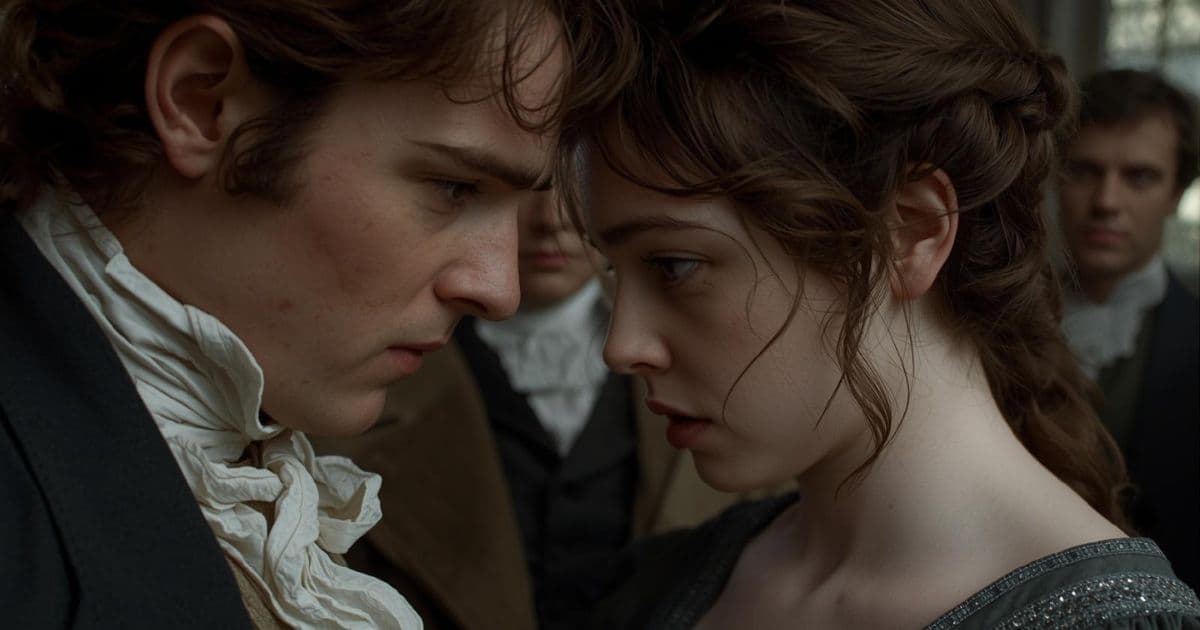
An excerpt from the original text.(complete · 3078 words)
rs. Weston’s friends were all made happy by her safety; and if the
satisfaction of her well-doing could be increased to Emma, it was by
knowing her to be the mother of a little girl. She had been decided in
wishing for a Miss Weston. She would not acknowledge that it was with
any view of making a match for her, hereafter, with either of
Isabella’s sons; but she was convinced that a daughter would suit both
father and mother best. It would be a great comfort to Mr. Weston, as
he grew older—and even Mr. Weston might be growing older ten years
hence—to have his fireside enlivened by the sports and the nonsense,
the freaks and the fancies of a child never banished from home; and
Mrs. Weston—no one could doubt that a daughter would be most to her;
and it would be quite a pity that any one who so well knew how to
teach, should not have their powers in exercise again.
“She has had the advantage, you know, of practising on me,” she
continued—“like La Baronne d’Almane on La Comtesse d’Ostalis, in Madame
de Genlis’ Adelaide and Theodore, and we shall now see her own little
Adelaide educated on a more perfect plan.”
“That is,” replied Mr. Knightley, “she will indulge her even more than
she did you, and believe that she does not indulge her at all. It will
be the only difference.”
“Poor child!” cried Emma; “at that rate, what will become of her?”
“Nothing very bad.—The fate of thousands. She will be disagreeable in
infancy, and correct herself as she grows older. I am losing all my
bitterness against spoilt children, my dearest Emma. I, who am owing
all my happiness to you, would not it be horrible ingratitude in me
to be severe on them?”
Emma laughed, and replied: “But I had the assistance of all your
endeavours to counteract the indulgence of other people. I doubt
whether my own sense would have corrected me without it.”
“Do you?—I have no doubt. Nature gave you understanding:—Miss Taylor
gave you principles. You must have done well. My interference was quite
as likely to do harm as good. It was very natural for you to say, what
right has he to lecture me?—and I am afraid very natural for you to
feel that it was done in a disagreeable manner. I do not believe I did
you any good. The good was all to myself, by making you an object of
the tenderest affection to me. I could not think about you so much
without doating on you, faults and all; and by dint of fancying so many
errors, have been in love with you ever since you were thirteen at
least.”
“I am sure you were of use to me,” cried Emma. “I was very often
influenced rightly by you—oftener than I would own at the time. I am
very sure you did me good. And if poor little Anna Weston is to be
spoiled, it will be the greatest humanity in you to do as much for her
as you have done for me, except falling in love with her when she is
thirteen.”
“How often, when you were a girl, have you said to me, with one of your
saucy looks—‘Mr. Knightley, I am going to do so-and-so; papa says I
may, or I have Miss Taylor’s leave’—something which, you knew, I did
not approve. In such cases my interference was giving you two bad
feelings instead of one.”
“What an amiable creature I was!—No wonder you should hold my speeches
in such affectionate remembrance.”
“‘Mr. Knightley.’—You always called me, ‘Mr. Knightley;’ and, from
habit, it has not so very formal a sound.—And yet it is formal. I want
you to call me something else, but I do not know what.”
“I remember once calling you ‘George,’ in one of my amiable fits, about
ten years ago. I did it because I thought it would offend you; but, as
you made no objection, I never did it again.”
“And cannot you call me ‘George’ now?”
“Impossible!—I never can call you any thing but ‘Mr. Knightley.’ I will
not promise even to equal the elegant terseness of Mrs. Elton, by
calling you Mr. K.—But I will promise,” she added presently, laughing
and blushing—“I will promise to call you once by your Christian name. I
do not say when, but perhaps you may guess where;—in the building in
which N. takes M. for better, for worse.”
Emma grieved that she could not be more openly just to one important
service which his better sense would have rendered her, to the advice
which would have saved her from the worst of all her womanly
follies—her wilful intimacy with Harriet Smith; but it was too tender a
subject.—She could not enter on it.—Harriet was very seldom mentioned
between them. This, on his side, might merely proceed from her not
being thought of; but Emma was rather inclined to attribute it to
delicacy, and a suspicion, from some appearances, that their friendship
were declining. She was aware herself, that, parting under any other
circumstances, they certainly should have corresponded more, and that
her intelligence would not have rested, as it now almost wholly did, on
Isabella’s letters. He might observe that it was so. The pain of being
obliged to practise concealment towards him, was very little inferior
to the pain of having made Harriet unhappy.
Isabella sent quite as good an account of her visitor as could be
expected; on her first arrival she had thought her out of spirits,
which appeared perfectly natural, as there was a dentist to be
consulted; but, since that business had been over, she did not appear
to find Harriet different from what she had known her before.—Isabella,
to be sure, was no very quick observer; yet if Harriet had not been
equal to playing with the children, it would not have escaped her.
Emma’s comforts and hopes were most agreeably carried on, by Harriet’s
being to stay longer; her fortnight was likely to be a month at least.
Mr. and Mrs. John Knightley were to come down in August, and she was
invited to remain till they could bring her back.
“John does not even mention your friend,” said Mr. Knightley. “Here is
his answer, if you like to see it.”
It was the answer to the communication of his intended marriage. Emma
accepted it with a very eager hand, with an impatience all alive to
know what he would say about it, and not at all checked by hearing that
her friend was unmentioned.
“John enters like a brother into my happiness,” continued Mr.
Knightley, “but he is no complimenter; and though I well know him to
have, likewise, a most brotherly affection for you, he is so far from
making flourishes, that any other young woman might think him rather
cool in her praise. But I am not afraid of your seeing what he writes.”
“He writes like a sensible man,” replied Emma, when she had read the
letter. “I honour his sincerity. It is very plain that he considers the
good fortune of the engagement as all on my side, but that he is not
without hope of my growing, in time, as worthy of your affection, as
you think me already. Had he said any thing to bear a different
construction, I should not have believed him.”
“My Emma, he means no such thing. He only means—”
“He and I should differ very little in our estimation of the two,”
interrupted she, with a sort of serious smile—“much less, perhaps, than
he is aware of, if we could enter without ceremony or reserve on the
subject.”
“Emma, my dear Emma—”
“Oh!” she cried with more thorough gaiety, “if you fancy your brother
does not do me justice, only wait till my dear father is in the secret,
and hear his opinion. Depend upon it, he will be much farther from
doing you justice. He will think all the happiness, all the
advantage, on your side of the question; all the merit on mine. I wish
I may not sink into ‘poor Emma’ with him at once.—His tender compassion
towards oppressed worth can go no farther.”
“Ah!” he cried, “I wish your father might be half as easily convinced
as John will be, of our having every right that equal worth can give,
to be happy together. I am amused by one part of John’s letter—did you
notice it?—where he says, that my information did not take him wholly
by surprize, that he was rather in expectation of hearing something of
the kind.”
“If I understand your brother, he only means so far as your having some
thoughts of marrying. He had no idea of me. He seems perfectly
unprepared for that.”
“Yes, yes—but I am amused that he should have seen so far into my
feelings. What has he been judging by?—I am not conscious of any
difference in my spirits or conversation that could prepare him at this
time for my marrying any more than at another.—But it was so, I
suppose. I dare say there was a difference when I was staying with them
the other day. I believe I did not play with the children quite so much
as usual. I remember one evening the poor boys saying, ‘Uncle seems
always tired now.’”
The time was coming when the news must spread farther, and other
persons’ reception of it tried. As soon as Mrs. Weston was sufficiently
recovered to admit Mr. Woodhouse’s visits, Emma having it in view that
her gentle reasonings should be employed in the cause, resolved first
to announce it at home, and then at Randalls.—But how to break it to
her father at last!—She had bound herself to do it, in such an hour of
Mr. Knightley’s absence, or when it came to the point her heart would
have failed her, and she must have put it off; but Mr. Knightley was to
come at such a time, and follow up the beginning she was to make.—She
was forced to speak, and to speak cheerfully too. She must not make it
a more decided subject of misery to him, by a melancholy tone herself.
She must not appear to think it a misfortune.—With all the spirits she
could command, she prepared him first for something strange, and then,
in a few words, said, that if his consent and approbation could be
obtained—which, she trusted, would be attended with no difficulty,
since it was a plan to promote the happiness of all—she and Mr.
Knightley meant to marry; by which means Hartfield would receive the
constant addition of that person’s company whom she knew he loved, next
to his daughters and Mrs. Weston, best in the world.
Poor man!—it was at first a considerable shock to him, and he tried
earnestly to dissuade her from it. She was reminded, more than once, of
having always said she would never marry, and assured that it would be
a great deal better for her to remain single; and told of poor
Isabella, and poor Miss Taylor.—But it would not do. Emma hung about
him affectionately, and smiled, and said it must be so; and that he
must not class her with Isabella and Mrs. Weston, whose marriages
taking them from Hartfield, had, indeed, made a melancholy change: but
she was not going from Hartfield; she should be always there; she was
introducing no change in their numbers or their comforts but for the
better; and she was very sure that he would be a great deal the happier
for having Mr. Knightley always at hand, when he were once got used to
the idea.—Did he not love Mr. Knightley very much?—He would not deny
that he did, she was sure.—Whom did he ever want to consult on business
but Mr. Knightley?—Who was so useful to him, who so ready to write his
letters, who so glad to assist him?—Who so cheerful, so attentive, so
attached to him?—Would not he like to have him always on the spot?—Yes.
That was all very true. Mr. Knightley could not be there too often; he
should be glad to see him every day;—but they did see him every day as
it was.—Why could not they go on as they had done?
Mr. Woodhouse could not be soon reconciled; but the worst was overcome,
the idea was given; time and continual repetition must do the rest.—To
Emma’s entreaties and assurances succeeded Mr. Knightley’s, whose fond
praise of her gave the subject even a kind of welcome; and he was soon
used to be talked to by each, on every fair occasion.—They had all the
assistance which Isabella could give, by letters of the strongest
approbation; and Mrs. Weston was ready, on the first meeting, to
consider the subject in the most serviceable light—first, as a settled,
and, secondly, as a good one—well aware of the nearly equal importance
of the two recommendations to Mr. Woodhouse’s mind.—It was agreed upon,
as what was to be; and every body by whom he was used to be guided
assuring him that it would be for his happiness; and having some
feelings himself which almost admitted it, he began to think that some
time or other—in another year or two, perhaps—it might not be so very
bad if the marriage did take place.
Mrs. Weston was acting no part, feigning no feelings in all that she
said to him in favour of the event.—She had been extremely surprized,
never more so, than when Emma first opened the affair to her; but she
saw in it only increase of happiness to all, and had no scruple in
urging him to the utmost.—She had such a regard for Mr. Knightley, as
to think he deserved even her dearest Emma; and it was in every respect
so proper, suitable, and unexceptionable a connexion, and in one
respect, one point of the highest importance, so peculiarly eligible,
so singularly fortunate, that now it seemed as if Emma could not safely
have attached herself to any other creature, and that she had herself
been the stupidest of beings in not having thought of it, and wished it
long ago.—How very few of those men in a rank of life to address Emma
would have renounced their own home for Hartfield! And who but Mr.
Knightley could know and bear with Mr. Woodhouse, so as to make such an
arrangement desirable!—The difficulty of disposing of poor Mr.
Woodhouse had been always felt in her husband’s plans and her own, for
a marriage between Frank and Emma. How to settle the claims of Enscombe
and Hartfield had been a continual impediment—less acknowledged by Mr.
Weston than by herself—but even he had never been able to finish the
subject better than by saying—“Those matters will take care of
themselves; the young people will find a way.” But here there was
nothing to be shifted off in a wild speculation on the future. It was
all right, all open, all equal. No sacrifice on any side worth the
name. It was a union of the highest promise of felicity in itself, and
without one real, rational difficulty to oppose or delay it.
Mrs. Weston, with her baby on her knee, indulging in such reflections
as these, was one of the happiest women in the world. If any thing
could increase her delight, it was perceiving that the baby would soon
have outgrown its first set of caps.
The news was universally a surprize wherever it spread; and Mr. Weston
had his five minutes share of it; but five minutes were enough to
familiarise the idea to his quickness of mind.—He saw the advantages of
the match, and rejoiced in them with all the constancy of his wife; but
the wonder of it was very soon nothing; and by the end of an hour he
was not far from believing that he had always foreseen it.
“It is to be a secret, I conclude,” said he. “These matters are always
a secret, till it is found out that every body knows them. Only let me
be told when I may speak out.—I wonder whether Jane has any suspicion.”
He went to Highbury the next morning, and satisfied himself on that
point. He told her the news. Was not she like a daughter, his eldest
daughter?—he must tell her; and Miss Bates being present, it passed, of
course, to Mrs. Cole, Mrs. Perry, and Mrs. Elton, immediately
afterwards. It was no more than the principals were prepared for; they
had calculated from the time of its being known at Randalls, how soon
it would be over Highbury; and were thinking of themselves, as the
evening wonder in many a family circle, with great sagacity.
In general, it was a very well approved match. Some might think him,
and others might think her, the most in luck. One set might recommend
their all removing to Donwell, and leaving Hartfield for the John
Knightleys; and another might predict disagreements among their
servants; but yet, upon the whole, there was no serious objection
raised, except in one habitation, the Vicarage.—There, the surprize was
not softened by any satisfaction. Mr. Elton cared little about it,
compared with his wife; he only hoped “the young lady’s pride would now
be contented;” and supposed “she had always meant to catch Knightley if
she could;” and, on the point of living at Hartfield, could daringly
exclaim, “Rather he than I!”—But Mrs. Elton was very much discomposed
indeed.—“Poor Knightley! poor fellow!—sad business for him.”—She was
extremely concerned; for, though very eccentric, he had a thousand good
qualities.—How could he be so taken in?—Did not think him at all in
love—not in the least.—Poor Knightley!—There would be an end of all
pleasant intercourse with him.—How happy he had been to come and dine
with them whenever they asked him! But that would be all over now.—Poor
fellow!—No more exploring parties to Donwell made for her. Oh! no;
there would be a Mrs. Knightley to throw cold water on every
thing.—Extremely disagreeable! But she was not at all sorry that she
had abused the housekeeper the other day.—Shocking plan, living
together. It would never do. She knew a family near Maple Grove who had
tried it, and been obliged to separate before the end of the first
quarter.
Master this chapter. Complete your experience
Purchase the complete book to access all chapters and support classic literature
As an Amazon Associate, we earn a small commission from qualifying purchases at no additional cost to you.
Available in paperback, hardcover, and e-book formats
Let's Analyse the Pattern
Major life changes must be presented strategically, addressing each person's specific fears rather than demanding universal celebration.
Why This Matters
Connect literature to life
This chapter teaches how to predict and navigate other people's resistance to your life changes by understanding their underlying fears.
Practice This Today
This week, notice when someone reacts negatively to good news - ask yourself what security or status they fear losing, then address that specific concern in future conversations.
Now let's explore the literary elements.
Key Quotes & Analysis
"She will indulge her even more than she did you, and believe that she does not indulge her at all. It will be the only difference."
Context: Speaking to Emma about how Mrs. Weston will raise her new daughter
This shows Knightley's understanding of human nature and his gentle way of pointing out patterns. He's noting how people often repeat their parenting mistakes while thinking they're improving, revealing his insight into self-deception.
In Today's Words:
She'll spoil her daughter even more than she spoiled you, but she'll convince herself she's being strict.
"I cannot make speeches, Emma. If I loved you less, I might be able to talk about it more."
Context: When Emma teases him about not being romantic enough in his declarations
This perfectly captures how genuine deep feeling often struggles with expression. Knightley's honesty about his limitations makes his love more believable than flowery speeches would.
In Today's Words:
I'm not good with romantic words - my feelings are too real for fancy speeches.
"What will become of poor Emma when she is married? She will be quite as much a prisoner as I am."
Context: Worrying about Emma's future happiness after marriage
This reveals Mr. Woodhouse's projection of his own fears onto Emma's situation. He can't imagine happiness outside his narrow comfort zone, showing how anxiety distorts our perception of others' choices.
In Today's Words:
Emma's going to be trapped and miserable just like me when she gets married.
Thematic Threads
Communication Strategy
In This Chapter
Emma carefully frames her engagement to address her father's abandonment fears rather than just sharing her happiness
Development
Evolution from Emma's earlier blunt honesty to sophisticated understanding of how to present difficult truths
In Your Life:
You might need this when announcing job changes, relationships, or major decisions to family members who resist change
Family Dynamics
In This Chapter
Mr. Woodhouse's anxiety about losing Emma requires patient, strategic management rather than dismissal
Development
Continuation of the ongoing theme of managing an anxious, dependent parent while pursuing adult independence
In Your Life:
You might recognize this in dealing with parents who struggle to accept your growing independence or major life choices
Social Status
In This Chapter
Mrs. Elton's bitter reaction stems from losing her position as the most prominent married woman in Highbury
Development
Culmination of Mrs. Elton's status anxiety and competitive nature throughout the novel
In Your Life:
You might see this when your success threatens someone else's sense of their own position or importance
Community Response
In This Chapter
Highbury's varied reactions to the engagement reveal how personal character shapes response to others' happiness
Development
Final demonstration of how the community's social dynamics and individual personalities influence their reactions
In Your Life:
You might notice this pattern when your good news brings out both the generous and petty sides of people in your circle
Personal Growth
In This Chapter
Emma demonstrates maturity in how she handles her father's concerns and manages the announcement process
Development
Culmination of Emma's journey from impulsive to thoughtful, from self-centered to considerate
In Your Life:
You might recognize this growth in learning to consider how your decisions affect others while still pursuing your own happiness
You now have the context. Time to form your own thoughts.
Discussion Questions
- 1
What different strategies does Emma use to get her father to accept her engagement to Mr. Knightley?
analysis • surface - 2
Why does Emma reframe the marriage as 'Knightley coming to Hartfield' rather than 'Emma leaving home'? What does this reveal about managing resistance to change?
analysis • medium - 3
Think about a time when you had big news to share - a job change, relationship, move, or major decision. How did different people in your life react, and what drove those reactions?
application • medium - 4
Mrs. Elton responds with jealousy and spite to Emma's engagement news. When you encounter someone who reacts negatively to your good news, how do you distinguish between their legitimate concerns and their personal issues?
application • deep - 5
What does this chapter teach us about the difference between announcing decisions and selling decisions? When do you need to do each?
reflection • deep
Critical Thinking Exercise
Map Your Announcement Strategy
Think of a major decision you need to announce or have recently announced (job change, relationship status, living situation, health choice, etc.). List the key people who need to know, then identify what each person's main concern or fear might be about your news. Finally, write how you would frame the announcement to address each person's specific worry.
Consider:
- •Some people's resistance comes from fear of losing you or losing status themselves
- •Your timing and setting can be as important as your words
- •You might need different versions of the same news for different audiences
Journaling Prompt
Write about a time when someone announced news that initially made you uncomfortable or resistant. Looking back, what were you really afraid of losing or changing? How might they have presented it differently to ease your concerns?
Coming Up Next...
Chapter 54: Harriet's Happy Resolution
With the engagement announced and family concerns addressed, Emma and Knightley must now navigate the final preparations and any remaining obstacles before their wedding can take place.