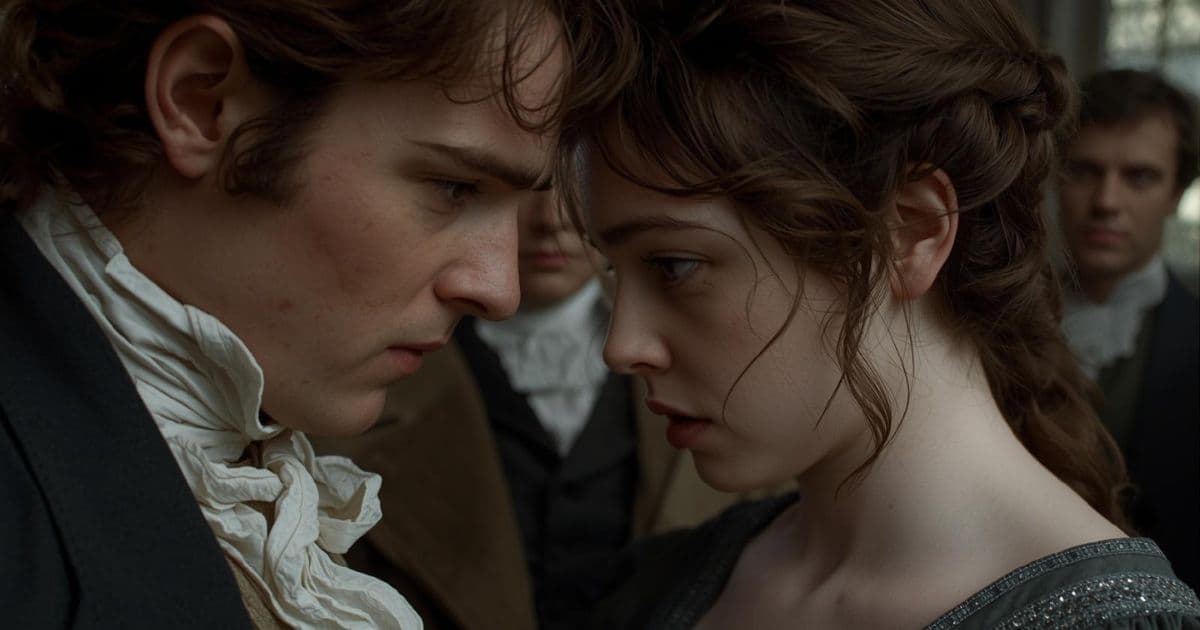
An excerpt from the original text.(complete · 3196 words)
t was a very great relief to Emma to find Harriet as desirous as
herself to avoid a meeting. Their intercourse was painful enough by
letter. How much worse, had they been obliged to meet!
Harriet expressed herself very much as might be supposed, without
reproaches, or apparent sense of ill-usage; and yet Emma fancied there
was a something of resentment, a something bordering on it in her
style, which increased the desirableness of their being separate.—It
might be only her own consciousness; but it seemed as if an angel only
could have been quite without resentment under such a stroke.
She had no difficulty in procuring Isabella’s invitation; and she was
fortunate in having a sufficient reason for asking it, without
resorting to invention.—There was a tooth amiss. Harriet really wished,
and had wished some time, to consult a dentist. Mrs. John Knightley was
delighted to be of use; any thing of ill health was a recommendation to
her—and though not so fond of a dentist as of a Mr. Wingfield, she was
quite eager to have Harriet under her care.—When it was thus settled on
her sister’s side, Emma proposed it to her friend, and found her very
persuadable.—Harriet was to go; she was invited for at least a
fortnight; she was to be conveyed in Mr. Woodhouse’s carriage.—It was
all arranged, it was all completed, and Harriet was safe in Brunswick
Square.
Now Emma could, indeed, enjoy Mr. Knightley’s visits; now she could
talk, and she could listen with true happiness, unchecked by that sense
of injustice, of guilt, of something most painful, which had haunted
her when remembering how disappointed a heart was near her, how much
might at that moment, and at a little distance, be enduring by the
feelings which she had led astray herself.
The difference of Harriet at Mrs. Goddard’s, or in London, made perhaps
an unreasonable difference in Emma’s sensations; but she could not
think of her in London without objects of curiosity and employment,
which must be averting the past, and carrying her out of herself.
She would not allow any other anxiety to succeed directly to the place
in her mind which Harriet had occupied. There was a communication
before her, one which she only could be competent to make—the
confession of her engagement to her father; but she would have nothing
to do with it at present.—She had resolved to defer the disclosure till
Mrs. Weston were safe and well. No additional agitation should be
thrown at this period among those she loved—and the evil should not act
on herself by anticipation before the appointed time.—A fortnight, at
least, of leisure and peace of mind, to crown every warmer, but more
agitating, delight, should be hers.
She soon resolved, equally as a duty and a pleasure, to employ half an
hour of this holiday of spirits in calling on Miss Fairfax.—She ought
to go—and she was longing to see her; the resemblance of their present
situations increasing every other motive of goodwill. It would be a
secret satisfaction; but the consciousness of a similarity of
prospect would certainly add to the interest with which she should
attend to any thing Jane might communicate.
She went—she had driven once unsuccessfully to the door, but had not
been into the house since the morning after Box Hill, when poor Jane
had been in such distress as had filled her with compassion, though all
the worst of her sufferings had been unsuspected.—The fear of being
still unwelcome, determined her, though assured of their being at home,
to wait in the passage, and send up her name.—She heard Patty
announcing it; but no such bustle succeeded as poor Miss Bates had
before made so happily intelligible.—No; she heard nothing but the
instant reply of, “Beg her to walk up;”—and a moment afterwards she was
met on the stairs by Jane herself, coming eagerly forward, as if no
other reception of her were felt sufficient.—Emma had never seen her
look so well, so lovely, so engaging. There was consciousness,
animation, and warmth; there was every thing which her countenance or
manner could ever have wanted.— She came forward with an offered hand;
and said, in a low, but very feeling tone,
“This is most kind, indeed!—Miss Woodhouse, it is impossible for me to
express—I hope you will believe—Excuse me for being so entirely without
words.”
Emma was gratified, and would soon have shewn no want of words, if the
sound of Mrs. Elton’s voice from the sitting-room had not checked her,
and made it expedient to compress all her friendly and all her
congratulatory sensations into a very, very earnest shake of the hand.
Mrs. Bates and Mrs. Elton were together. Miss Bates was out, which
accounted for the previous tranquillity. Emma could have wished Mrs.
Elton elsewhere; but she was in a humour to have patience with every
body; and as Mrs. Elton met her with unusual graciousness, she hoped
the rencontre would do them no harm.
She soon believed herself to penetrate Mrs. Elton’s thoughts, and
understand why she was, like herself, in happy spirits; it was being in
Miss Fairfax’s confidence, and fancying herself acquainted with what
was still a secret to other people. Emma saw symptoms of it immediately
in the expression of her face; and while paying her own compliments to
Mrs. Bates, and appearing to attend to the good old lady’s replies, she
saw her with a sort of anxious parade of mystery fold up a letter which
she had apparently been reading aloud to Miss Fairfax, and return it
into the purple and gold reticule by her side, saying, with significant
nods,
“We can finish this some other time, you know. You and I shall not want
opportunities. And, in fact, you have heard all the essential already.
I only wanted to prove to you that Mrs. S. admits our apology, and is
not offended. You see how delightfully she writes. Oh! she is a sweet
creature! You would have doated on her, had you gone.—But not a word
more. Let us be discreet—quite on our good behaviour.—Hush!—You
remember those lines—I forget the poem at this moment:
“For when a lady’s in the case,
“You know all other things give place.”
Now I say, my dear, in our case, for lady, read——mum! a word to the
wise.—I am in a fine flow of spirits, an’t I? But I want to set your
heart at ease as to Mrs. S.—My representation, you see, has quite
appeased her.”
And again, on Emma’s merely turning her head to look at Mrs. Bates’s
knitting, she added, in a half whisper,
“I mentioned no names, you will observe.—Oh! no; cautious as a
minister of state. I managed it extremely well.”
Emma could not doubt. It was a palpable display, repeated on every
possible occasion. When they had all talked a little while in harmony
of the weather and Mrs. Weston, she found herself abruptly addressed
with,
“Do not you think, Miss Woodhouse, our saucy little friend here is
charmingly recovered?—Do not you think her cure does Perry the highest
credit?—(here was a side-glance of great meaning at Jane.) Upon my
word, Perry has restored her in a wonderful short time!—Oh! if you had
seen her, as I did, when she was at the worst!”—And when Mrs. Bates was
saying something to Emma, whispered farther, “We do not say a word of
any assistance that Perry might have; not a word of a certain young
physician from Windsor.—Oh! no; Perry shall have all the credit.”
“I have scarce had the pleasure of seeing you, Miss Woodhouse,” she
shortly afterwards began, “since the party to Box Hill. Very pleasant
party. But yet I think there was something wanting. Things did not
seem—that is, there seemed a little cloud upon the spirits of some.—So
it appeared to me at least, but I might be mistaken. However, I think
it answered so far as to tempt one to go again. What say you both to
our collecting the same party, and exploring to Box Hill again, while
the fine weather lasts?—It must be the same party, you know, quite the
same party, not one exception.”
Soon after this Miss Bates came in, and Emma could not help being
diverted by the perplexity of her first answer to herself, resulting,
she supposed, from doubt of what might be said, and impatience to say
every thing.
“Thank you, dear Miss Woodhouse, you are all kindness.—It is impossible
to say—Yes, indeed, I quite understand—dearest Jane’s prospects—that
is, I do not mean.—But she is charmingly recovered.—How is Mr.
Woodhouse?—I am so glad.—Quite out of my power.—Such a happy little
circle as you find us here.—Yes, indeed.—Charming young man!—that is—so
very friendly; I mean good Mr. Perry!—such attention to Jane!”—And from
her great, her more than commonly thankful delight towards Mrs. Elton
for being there, Emma guessed that there had been a little show of
resentment towards Jane, from the vicarage quarter, which was now
graciously overcome.—After a few whispers, indeed, which placed it
beyond a guess, Mrs. Elton, speaking louder, said,
“Yes, here I am, my good friend; and here I have been so long, that
anywhere else I should think it necessary to apologise; but, the truth
is, that I am waiting for my lord and master. He promised to join me
here, and pay his respects to you.”
“What! are we to have the pleasure of a call from Mr. Elton?—That will
be a favour indeed! for I know gentlemen do not like morning visits,
and Mr. Elton’s time is so engaged.”
“Upon my word it is, Miss Bates.—He really is engaged from morning to
night.—There is no end of people’s coming to him, on some pretence or
other.—The magistrates, and overseers, and churchwardens, are always
wanting his opinion. They seem not able to do any thing without
him.—‘Upon my word, Mr. E.,’ I often say, ‘rather you than I.—I do not
know what would become of my crayons and my instrument, if I had half
so many applicants.’—Bad enough as it is, for I absolutely neglect them
both to an unpardonable degree.—I believe I have not played a bar this
fortnight.—However, he is coming, I assure you: yes, indeed, on purpose
to wait on you all.” And putting up her hand to screen her words from
Emma—“A congratulatory visit, you know.—Oh! yes, quite indispensable.”
Miss Bates looked about her, so happily—!
“He promised to come to me as soon as he could disengage himself from
Knightley; but he and Knightley are shut up together in deep
consultation.—Mr. E. is Knightley’s right hand.”
Emma would not have smiled for the world, and only said, “Is Mr. Elton
gone on foot to Donwell?—He will have a hot walk.”
“Oh! no, it is a meeting at the Crown, a regular meeting. Weston and
Cole will be there too; but one is apt to speak only of those who
lead.—I fancy Mr. E. and Knightley have every thing their own way.”
“Have not you mistaken the day?” said Emma. “I am almost certain that
the meeting at the Crown is not till to-morrow.—Mr. Knightley was at
Hartfield yesterday, and spoke of it as for Saturday.”
“Oh! no, the meeting is certainly to-day,” was the abrupt answer, which
denoted the impossibility of any blunder on Mrs. Elton’s side.—“I do
believe,” she continued, “this is the most troublesome parish that ever
was. We never heard of such things at Maple Grove.”
“Your parish there was small,” said Jane.
“Upon my word, my dear, I do not know, for I never heard the subject
talked of.”
“But it is proved by the smallness of the school, which I have heard
you speak of, as under the patronage of your sister and Mrs. Bragge;
the only school, and not more than five-and-twenty children.”
“Ah! you clever creature, that’s very true. What a thinking brain you
have! I say, Jane, what a perfect character you and I should make, if
we could be shaken together. My liveliness and your solidity would
produce perfection.—Not that I presume to insinuate, however, that
some people may not think you perfection already.—But hush!—not a
word, if you please.”
It seemed an unnecessary caution; Jane was wanting to give her words,
not to Mrs. Elton, but to Miss Woodhouse, as the latter plainly saw.
The wish of distinguishing her, as far as civility permitted, was very
evident, though it could not often proceed beyond a look.
Mr. Elton made his appearance. His lady greeted him with some of her
sparkling vivacity.
“Very pretty, sir, upon my word; to send me on here, to be an
encumbrance to my friends, so long before you vouchsafe to come!—But
you knew what a dutiful creature you had to deal with. You knew I
should not stir till my lord and master appeared.—Here have I been
sitting this hour, giving these young ladies a sample of true conjugal
obedience—for who can say, you know, how soon it may be wanted?”
Mr. Elton was so hot and tired, that all this wit seemed thrown away.
His civilities to the other ladies must be paid; but his subsequent
object was to lament over himself for the heat he was suffering, and
the walk he had had for nothing.
“When I got to Donwell,” said he, “Knightley could not be found. Very
odd! very unaccountable! after the note I sent him this morning, and
the message he returned, that he should certainly be at home till one.”
“Donwell!” cried his wife.—“My dear Mr. E., you have not been to
Donwell!—You mean the Crown; you come from the meeting at the Crown.”
“No, no, that’s to-morrow; and I particularly wanted to see Knightley
to-day on that very account.—Such a dreadful broiling morning!—I went
over the fields too—(speaking in a tone of great ill-usage,) which made
it so much the worse. And then not to find him at home! I assure you I
am not at all pleased. And no apology left, no message for me. The
housekeeper declared she knew nothing of my being expected.—Very
extraordinary!—And nobody knew at all which way he was gone. Perhaps to
Hartfield, perhaps to the Abbey Mill, perhaps into his woods.—Miss
Woodhouse, this is not like our friend Knightley!—Can you explain it?”
Emma amused herself by protesting that it was very extraordinary,
indeed, and that she had not a syllable to say for him.
“I cannot imagine,” said Mrs. Elton, (feeling the indignity as a wife
ought to do,) “I cannot imagine how he could do such a thing by you, of
all people in the world! The very last person whom one should expect to
be forgotten!—My dear Mr. E., he must have left a message for you, I am
sure he must.—Not even Knightley could be so very eccentric;—and his
servants forgot it. Depend upon it, that was the case: and very likely
to happen with the Donwell servants, who are all, I have often
observed, extremely awkward and remiss.—I am sure I would not have such
a creature as his Harry stand at our sideboard for any consideration.
And as for Mrs. Hodges, Wright holds her very cheap indeed.—She
promised Wright a receipt, and never sent it.”
“I met William Larkins,” continued Mr. Elton, “as I got near the house,
and he told me I should not find his master at home, but I did not
believe him.—William seemed rather out of humour. He did not know what
was come to his master lately, he said, but he could hardly ever get
the speech of him. I have nothing to do with William’s wants, but it
really is of very great importance that I should see Knightley
to-day; and it becomes a matter, therefore, of very serious
inconvenience that I should have had this hot walk to no purpose.”
Emma felt that she could not do better than go home directly. In all
probability she was at this very time waited for there; and Mr.
Knightley might be preserved from sinking deeper in aggression towards
Mr. Elton, if not towards William Larkins.
She was pleased, on taking leave, to find Miss Fairfax determined to
attend her out of the room, to go with her even downstairs; it gave her
an opportunity which she immediately made use of, to say,
“It is as well, perhaps, that I have not had the possibility. Had you
not been surrounded by other friends, I might have been tempted to
introduce a subject, to ask questions, to speak more openly than might
have been strictly correct.—I feel that I should certainly have been
impertinent.”
“Oh!” cried Jane, with a blush and an hesitation which Emma thought
infinitely more becoming to her than all the elegance of all her usual
composure—“there would have been no danger. The danger would have been
of my wearying you. You could not have gratified me more than by
expressing an interest—. Indeed, Miss Woodhouse, (speaking more
collectedly,) with the consciousness which I have of misconduct, very
great misconduct, it is particularly consoling to me to know that those
of my friends, whose good opinion is most worth preserving, are not
disgusted to such a degree as to—I have not time for half that I could
wish to say. I long to make apologies, excuses, to urge something for
myself. I feel it so very due. But, unfortunately—in short, if your
compassion does not stand my friend—”
“Oh! you are too scrupulous, indeed you are,” cried Emma warmly, and
taking her hand. “You owe me no apologies; and every body to whom you
might be supposed to owe them, is so perfectly satisfied, so delighted
even—”
“You are very kind, but I know what my manners were to you.—So cold and
artificial!—I had always a part to act.—It was a life of deceit!—I know
that I must have disgusted you.”
“Pray say no more. I feel that all the apologies should be on my side.
Let us forgive each other at once. We must do whatever is to be done
quickest, and I think our feelings will lose no time there. I hope you
have pleasant accounts from Windsor?”
“Very.”
“And the next news, I suppose, will be, that we are to lose you—just as
I begin to know you.”
“Oh! as to all that, of course nothing can be thought of yet. I am here
till claimed by Colonel and Mrs. Campbell.”
“Nothing can be actually settled yet, perhaps,” replied Emma,
smiling—“but, excuse me, it must be thought of.”
The smile was returned as Jane answered,
“You are very right; it has been thought of. And I will own to you, (I
am sure it will be safe), that so far as our living with Mr. Churchill
at Enscombe, it is settled. There must be three months, at least, of
deep mourning; but when they are over, I imagine there will be nothing
more to wait for.”
“Thank you, thank you.—This is just what I wanted to be assured of.—Oh!
if you knew how much I love every thing that is decided and
open!—Good-bye, good-bye.”
Master this chapter. Complete your experience
Purchase the complete book to access all chapters and support classic literature
As an Amazon Associate, we earn a small commission from qualifying purchases at no additional cost to you.
Available in paperback, hardcover, and e-book formats
Let's Analyse the Pattern
The Relief Reset - How Removing Guilt Sources Unlocks Growth
Unresolved guilt creates an emotional filter that blocks authentic connection and sabotages future relationships.
Why This Matters
Connect literature to life
This chapter teaches how to recognize when unresolved guilt is sabotaging current relationships and preventing authentic connection.
Practice This Today
This week, notice when shame about past actions makes you defensive or distant in conversations, then practice creating one guilt-free interaction where you focus entirely on the present moment.
Now let's explore the literary elements.
Key Quotes & Analysis
"Now Emma could, indeed, enjoy Mr. Knightley's visits; now she could talk, and she could listen with true happiness."
Context: After Harriet leaves for London, removing the source of Emma's guilt
This shows how unresolved guilt can poison even our best relationships. Emma couldn't fully connect with Mr. Knightley while carrying the weight of what she'd done to Harriet.
In Today's Words:
Finally, I can actually enjoy spending time with him without feeling terrible about myself.
"If a woman doubts as to whether she should accept a man or not, she certainly ought to refuse him."
Context: During her conversation with Jane about relationships and decisions
Emma has learned that uncertainty in relationships usually means the answer is no. This wisdom comes from her painful experience with her own romantic confusion.
In Today's Words:
If you're not sure about someone, that's probably your answer right there.
"One has not great hopes from Birmingham. I always say there is something direful in the sound."
Context: Making snobby comments about industrial cities while hinting about Jane's situation
Mrs. Elton's classist attitudes reveal her need to feel superior to others. She uses geography and social status as weapons to put people down.
In Today's Words:
Ugh, that place sounds so trashy - you know nothing good comes from there.
Thematic Threads
Personal Growth
In This Chapter
Emma demonstrates mature self-awareness by recognizing what she needs (distance from Harriet) and taking action to create healthier conditions for herself
Development
Evolved from Emma's earlier impulsive meddling to thoughtful self-management
In Your Life:
You might need to temporarily distance yourself from situations that trigger your worst behaviors until you develop better coping strategies.
Communication
In This Chapter
Emma and Jane have their first honest conversation, with both women apologizing and explaining their past behavior
Development
Contrasts sharply with earlier chapters full of misunderstandings and hidden meanings
In Your Life:
You might discover that direct, honest conversations can resolve conflicts you thought were permanent.
Class
In This Chapter
Mrs. Elton's barely concealed hints about Jane's secret show how insider knowledge becomes social currency among the privileged
Development
Continues the theme of how information and secrets function as power in social hierarchies
In Your Life:
You might notice how some people use private information to establish their importance in social or work situations.
Identity
In This Chapter
Jane reveals her true personality once she no longer needs to maintain a deceptive facade, showing how circumstances can force us to hide our authentic selves
Development
Builds on earlier themes about the masks people wear in society
In Your Life:
You might recognize times when external pressures forced you to act in ways that didn't reflect who you really are.
Relationships
In This Chapter
Emma learns the value of stepping back from situations rather than trying to control or fix everything
Development
Represents a major shift from her earlier pattern of constant interference
In Your Life:
You might need to practice recognizing when your involvement in a situation is making things worse rather than better.
You now have the context. Time to form your own thoughts.
Discussion Questions
- 1
What changes in Emma's mood and behavior once Harriet leaves for London, and why does this shift happen?
analysis • surface - 2
How does guilt function as a barrier in Emma's relationships, and what happens when that barrier is removed?
analysis • medium - 3
Where do you see people in your life carrying guilt that prevents them from connecting authentically with others?
application • medium - 4
If you were advising someone who felt too guilty about past mistakes to enjoy present relationships, what practical steps would you suggest?
application • deep - 5
What does Emma and Jane's reconciliation reveal about the power of honest communication to heal damaged relationships?
reflection • deep
Critical Thinking Exercise
Identify Your Guilt Triggers
Think about a current relationship where you feel tense or defensive. Map out what guilt or shame might be creating that tension. Write down the specific incident or pattern you feel bad about, then identify how that guilt shows up in your interactions with that person. Finally, brainstorm one concrete action you could take to address the underlying issue.
Consider:
- •Guilt often disguises itself as other emotions like anger, withdrawal, or over-explaining
- •The person may have no idea you're carrying this burden - the barrier might exist only in your mind
- •Sometimes the solution is a simple conversation, sometimes it's internal forgiveness work
Journaling Prompt
Write about a time when addressing guilt or shame directly improved one of your relationships. What did you learn about the difference between carrying guilt and taking responsibility?
Coming Up Next...
Chapter 53: Breaking the News to Family
With Harriet safely away and Jane's friendship restored, Emma must now face the challenge she's been avoiding - telling her father about her engagement to Mr. Knightley. How will she break news that could shatter his comfortable world?