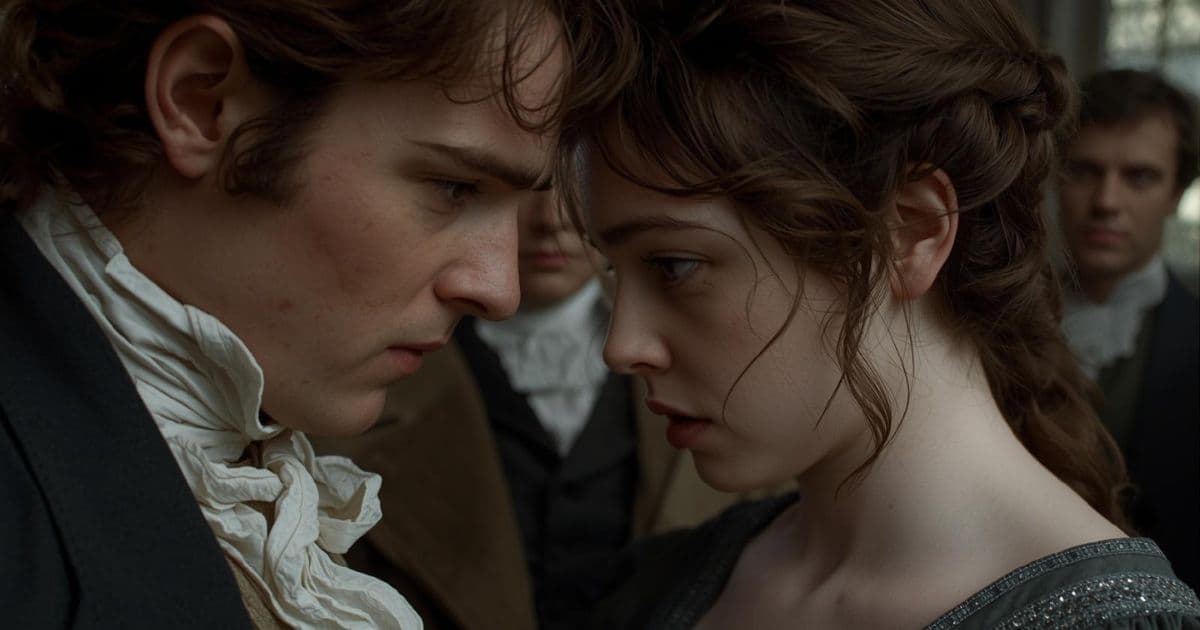
An excerpt from the original text.(complete · 3610 words)
ime passed on. A few more to-morrows, and the party from London would
be arriving. It was an alarming change; and Emma was thinking of it one
morning, as what must bring a great deal to agitate and grieve her,
when Mr. Knightley came in, and distressing thoughts were put by. After
the first chat of pleasure he was silent; and then, in a graver tone,
began with,
“I have something to tell you, Emma; some news.”
“Good or bad?” said she, quickly, looking up in his face.
“I do not know which it ought to be called.”
“Oh! good I am sure.—I see it in your countenance. You are trying not
to smile.”
“I am afraid,” said he, composing his features, “I am very much afraid,
my dear Emma, that you will not smile when you hear it.”
“Indeed! but why so?—I can hardly imagine that any thing which pleases
or amuses you, should not please and amuse me too.”
“There is one subject,” he replied, “I hope but one, on which we do not
think alike.” He paused a moment, again smiling, with his eyes fixed on
her face. “Does nothing occur to you?—Do not you recollect?—Harriet
Smith.”
Her cheeks flushed at the name, and she felt afraid of something,
though she knew not what.
“Have you heard from her yourself this morning?” cried he. “You have, I
believe, and know the whole.”
“No, I have not; I know nothing; pray tell me.”
“You are prepared for the worst, I see—and very bad it is. Harriet
Smith marries Robert Martin.”
Emma gave a start, which did not seem like being prepared—and her eyes,
in eager gaze, said, “No, this is impossible!” but her lips were
closed.
“It is so, indeed,” continued Mr. Knightley; “I have it from Robert
Martin himself. He left me not half an hour ago.”
She was still looking at him with the most speaking amazement.
“You like it, my Emma, as little as I feared.—I wish our opinions were
the same. But in time they will. Time, you may be sure, will make one
or the other of us think differently; and, in the meanwhile, we need
not talk much on the subject.”
“You mistake me, you quite mistake me,” she replied, exerting herself.
“It is not that such a circumstance would now make me unhappy, but I
cannot believe it. It seems an impossibility!—You cannot mean to say,
that Harriet Smith has accepted Robert Martin. You cannot mean that he
has even proposed to her again—yet. You only mean, that he intends it.”
“I mean that he has done it,” answered Mr. Knightley, with smiling but
determined decision, “and been accepted.”
“Good God!” she cried.—“Well!”—Then having recourse to her workbasket,
in excuse for leaning down her face, and concealing all the exquisite
feelings of delight and entertainment which she knew she must be
expressing, she added, “Well, now tell me every thing; make this
intelligible to me. How, where, when?—Let me know it all. I never was
more surprized—but it does not make me unhappy, I assure you.—How—how
has it been possible?”
“It is a very simple story. He went to town on business three days ago,
and I got him to take charge of some papers which I was wanting to send
to John.—He delivered these papers to John, at his chambers, and was
asked by him to join their party the same evening to Astley’s. They
were going to take the two eldest boys to Astley’s. The party was to be
our brother and sister, Henry, John—and Miss Smith. My friend Robert
could not resist. They called for him in their way; were all extremely
amused; and my brother asked him to dine with them the next day—which
he did—and in the course of that visit (as I understand) he found an
opportunity of speaking to Harriet; and certainly did not speak in
vain.—She made him, by her acceptance, as happy even as he is
deserving. He came down by yesterday’s coach, and was with me this
morning immediately after breakfast, to report his proceedings, first
on my affairs, and then on his own. This is all that I can relate of
the how, where, and when. Your friend Harriet will make a much longer
history when you see her.—She will give you all the minute particulars,
which only woman’s language can make interesting.—In our communications
we deal only in the great.—However, I must say, that Robert Martin’s
heart seemed for him, and to me, very overflowing; and that he did
mention, without its being much to the purpose, that on quitting their
box at Astley’s, my brother took charge of Mrs. John Knightley and
little John, and he followed with Miss Smith and Henry; and that at one
time they were in such a crowd, as to make Miss Smith rather uneasy.”
He stopped.—Emma dared not attempt any immediate reply. To speak, she
was sure would be to betray a most unreasonable degree of happiness.
She must wait a moment, or he would think her mad. Her silence
disturbed him; and after observing her a little while, he added,
“Emma, my love, you said that this circumstance would not now make you
unhappy; but I am afraid it gives you more pain than you expected. His
situation is an evil—but you must consider it as what satisfies your
friend; and I will answer for your thinking better and better of him as
you know him more. His good sense and good principles would delight
you.—As far as the man is concerned, you could not wish your friend in
better hands. His rank in society I would alter if I could, which is
saying a great deal I assure you, Emma.—You laugh at me about William
Larkins; but I could quite as ill spare Robert Martin.”
He wanted her to look up and smile; and having now brought herself not
to smile too broadly—she did—cheerfully answering,
“You need not be at any pains to reconcile me to the match. I think
Harriet is doing extremely well. Her connexions may be worse than
his. In respectability of character, there can be no doubt that they
are. I have been silent from surprize merely, excessive surprize. You
cannot imagine how suddenly it has come on me! how peculiarly
unprepared I was!—for I had reason to believe her very lately more
determined against him, much more, than she was before.”
“You ought to know your friend best,” replied Mr. Knightley; “but I
should say she was a good-tempered, soft-hearted girl, not likely to be
very, very determined against any young man who told her he loved her.”
Emma could not help laughing as she answered, “Upon my word, I believe
you know her quite as well as I do.—But, Mr. Knightley, are you
perfectly sure that she has absolutely and downright accepted him. I
could suppose she might in time—but can she already?—Did not you
misunderstand him?—You were both talking of other things; of business,
shows of cattle, or new drills—and might not you, in the confusion of
so many subjects, mistake him?—It was not Harriet’s hand that he was
certain of—it was the dimensions of some famous ox.”
The contrast between the countenance and air of Mr. Knightley and
Robert Martin was, at this moment, so strong to Emma’s feelings, and so
strong was the recollection of all that had so recently passed on
Harriet’s side, so fresh the sound of those words, spoken with such
emphasis, “No, I hope I know better than to think of Robert Martin,”
that she was really expecting the intelligence to prove, in some
measure, premature. It could not be otherwise.
“Do you dare say this?” cried Mr. Knightley. “Do you dare to suppose me
so great a blockhead, as not to know what a man is talking of?—What do
you deserve?”
“Oh! I always deserve the best treatment, because I never put up with
any other; and, therefore, you must give me a plain, direct answer. Are
you quite sure that you understand the terms on which Mr. Martin and
Harriet now are?”
“I am quite sure,” he replied, speaking very distinctly, “that he told
me she had accepted him; and that there was no obscurity, nothing
doubtful, in the words he used; and I think I can give you a proof that
it must be so. He asked my opinion as to what he was now to do. He knew
of no one but Mrs. Goddard to whom he could apply for information of
her relations or friends. Could I mention any thing more fit to be
done, than to go to Mrs. Goddard? I assured him that I could not. Then,
he said, he would endeavour to see her in the course of this day.”
“I am perfectly satisfied,” replied Emma, with the brightest smiles,
“and most sincerely wish them happy.”
“You are materially changed since we talked on this subject before.”
“I hope so—for at that time I was a fool.”
“And I am changed also; for I am now very willing to grant you all
Harriet’s good qualities. I have taken some pains for your sake, and
for Robert Martin’s sake, (whom I have always had reason to believe as
much in love with her as ever,) to get acquainted with her. I have
often talked to her a good deal. You must have seen that I did.
Sometimes, indeed, I have thought you were half suspecting me of
pleading poor Martin’s cause, which was never the case; but, from all
my observations, I am convinced of her being an artless, amiable girl,
with very good notions, very seriously good principles, and placing her
happiness in the affections and utility of domestic life.—Much of this,
I have no doubt, she may thank you for.”
“Me!” cried Emma, shaking her head.—“Ah! poor Harriet!”
She checked herself, however, and submitted quietly to a little more
praise than she deserved.
Their conversation was soon afterwards closed by the entrance of her
father. She was not sorry. She wanted to be alone. Her mind was in a
state of flutter and wonder, which made it impossible for her to be
collected. She was in dancing, singing, exclaiming spirits; and till
she had moved about, and talked to herself, and laughed and reflected,
she could be fit for nothing rational.
Her father’s business was to announce James’s being gone out to put the
horses to, preparatory to their now daily drive to Randalls; and she
had, therefore, an immediate excuse for disappearing.
The joy, the gratitude, the exquisite delight of her sensations may be
imagined. The sole grievance and alloy thus removed in the prospect of
Harriet’s welfare, she was really in danger of becoming too happy for
security.—What had she to wish for? Nothing, but to grow more worthy of
him, whose intentions and judgment had been ever so superior to her
own. Nothing, but that the lessons of her past folly might teach her
humility and circumspection in future.
Serious she was, very serious in her thankfulness, and in her
resolutions; and yet there was no preventing a laugh, sometimes in the
very midst of them. She must laugh at such a close! Such an end of the
doleful disappointment of five weeks back! Such a heart—such a Harriet!
Now there would be pleasure in her returning—Every thing would be a
pleasure. It would be a great pleasure to know Robert Martin.
High in the rank of her most serious and heartfelt felicities, was the
reflection that all necessity of concealment from Mr. Knightley would
soon be over. The disguise, equivocation, mystery, so hateful to her to
practise, might soon be over. She could now look forward to giving him
that full and perfect confidence which her disposition was most ready
to welcome as a duty.
In the gayest and happiest spirits she set forward with her father; not
always listening, but always agreeing to what he said; and, whether in
speech or silence, conniving at the comfortable persuasion of his being
obliged to go to Randalls every day, or poor Mrs. Weston would be
disappointed.
They arrived.—Mrs. Weston was alone in the drawing-room:—but hardly had
they been told of the baby, and Mr. Woodhouse received the thanks for
coming, which he asked for, when a glimpse was caught through the
blind, of two figures passing near the window.
“It is Frank and Miss Fairfax,” said Mrs. Weston. “I was just going to
tell you of our agreeable surprize in seeing him arrive this morning.
He stays till to-morrow, and Miss Fairfax has been persuaded to spend
the day with us.—They are coming in, I hope.”
In half a minute they were in the room. Emma was extremely glad to see
him—but there was a degree of confusion—a number of embarrassing
recollections on each side. They met readily and smiling, but with a
consciousness which at first allowed little to be said; and having all
sat down again, there was for some time such a blank in the circle,
that Emma began to doubt whether the wish now indulged, which she had
long felt, of seeing Frank Churchill once more, and of seeing him with
Jane, would yield its proportion of pleasure. When Mr. Weston joined
the party, however, and when the baby was fetched, there was no longer
a want of subject or animation—or of courage and opportunity for Frank
Churchill to draw near her and say,
“I have to thank you, Miss Woodhouse, for a very kind forgiving message
in one of Mrs. Weston’s letters. I hope time has not made you less
willing to pardon. I hope you do not retract what you then said.”
“No, indeed,” cried Emma, most happy to begin, “not in the least. I am
particularly glad to see and shake hands with you—and to give you joy
in person.”
He thanked her with all his heart, and continued some time to speak
with serious feeling of his gratitude and happiness.
“Is not she looking well?” said he, turning his eyes towards Jane.
“Better than she ever used to do?—You see how my father and Mrs. Weston
doat upon her.”
But his spirits were soon rising again, and with laughing eyes, after
mentioning the expected return of the Campbells, he named the name of
Dixon.—Emma blushed, and forbade its being pronounced in her hearing.
“I can never think of it,” she cried, “without extreme shame.”
“The shame,” he answered, “is all mine, or ought to be. But is it
possible that you had no suspicion?—I mean of late. Early, I know, you
had none.”
“I never had the smallest, I assure you.”
“That appears quite wonderful. I was once very near—and I wish I had—it
would have been better. But though I was always doing wrong things,
they were very bad wrong things, and such as did me no service.—It
would have been a much better transgression had I broken the bond of
secrecy and told you every thing.”
“It is not now worth a regret,” said Emma.
“I have some hope,” resumed he, “of my uncle’s being persuaded to pay a
visit at Randalls; he wants to be introduced to her. When the Campbells
are returned, we shall meet them in London, and continue there, I
trust, till we may carry her northward.—But now, I am at such a
distance from her—is not it hard, Miss Woodhouse?—Till this morning, we
have not once met since the day of reconciliation. Do not you pity me?”
Emma spoke her pity so very kindly, that with a sudden accession of gay
thought, he cried,
“Ah! by the bye,” then sinking his voice, and looking demure for the
moment—“I hope Mr. Knightley is well?” He paused.—She coloured and
laughed.—“I know you saw my letter, and think you may remember my wish
in your favour. Let me return your congratulations.—I assure you that I
have heard the news with the warmest interest and satisfaction.—He is a
man whom I cannot presume to praise.”
Emma was delighted, and only wanted him to go on in the same style; but
his mind was the next moment in his own concerns and with his own Jane,
and his next words were,
“Did you ever see such a skin?—such smoothness! such delicacy!—and yet
without being actually fair.—One cannot call her fair. It is a most
uncommon complexion, with her dark eye-lashes and hair—a most
distinguishing complexion! So peculiarly the lady in it.—Just colour
enough for beauty.”
“I have always admired her complexion,” replied Emma, archly; “but do
not I remember the time when you found fault with her for being so
pale?—When we first began to talk of her.—Have you quite forgotten?”
“Oh! no—what an impudent dog I was!—How could I dare—”
But he laughed so heartily at the recollection, that Emma could not
help saying,
“I do suspect that in the midst of your perplexities at that time, you
had very great amusement in tricking us all.—I am sure you had.—I am
sure it was a consolation to you.”
“Oh! no, no, no—how can you suspect me of such a thing? I was the most
miserable wretch!”
“Not quite so miserable as to be insensible to mirth. I am sure it was
a source of high entertainment to you, to feel that you were taking us
all in.—Perhaps I am the readier to suspect, because, to tell you the
truth, I think it might have been some amusement to myself in the same
situation. I think there is a little likeness between us.”
He bowed.
“If not in our dispositions,” she presently added, with a look of true
sensibility, “there is a likeness in our destiny; the destiny which
bids fair to connect us with two characters so much superior to our
own.”
“True, true,” he answered, warmly. “No, not true on your side. You can
have no superior, but most true on mine.—She is a complete angel. Look
at her. Is not she an angel in every gesture? Observe the turn of her
throat. Observe her eyes, as she is looking up at my father.—You will
be glad to hear (inclining his head, and whispering seriously) that my
uncle means to give her all my aunt’s jewels. They are to be new set. I
am resolved to have some in an ornament for the head. Will not it be
beautiful in her dark hair?”
“Very beautiful, indeed,” replied Emma; and she spoke so kindly, that
he gratefully burst out,
“How delighted I am to see you again! and to see you in such excellent
looks!—I would not have missed this meeting for the world. I should
certainly have called at Hartfield, had you failed to come.”
The others had been talking of the child, Mrs. Weston giving an account
of a little alarm she had been under, the evening before, from the
infant’s appearing not quite well. She believed she had been foolish,
but it had alarmed her, and she had been within half a minute of
sending for Mr. Perry. Perhaps she ought to be ashamed, but Mr. Weston
had been almost as uneasy as herself.—In ten minutes, however, the
child had been perfectly well again. This was her history; and
particularly interesting it was to Mr. Woodhouse, who commended her
very much for thinking of sending for Perry, and only regretted that
she had not done it. “She should always send for Perry, if the child
appeared in the slightest degree disordered, were it only for a moment.
She could not be too soon alarmed, nor send for Perry too often. It was
a pity, perhaps, that he had not come last night; for, though the child
seemed well now, very well considering, it would probably have been
better if Perry had seen it.”
Frank Churchill caught the name.
“Perry!” said he to Emma, and trying, as he spoke, to catch Miss
Fairfax’s eye. “My friend Mr. Perry! What are they saying about Mr.
Perry?—Has he been here this morning?—And how does he travel now?—Has
he set up his carriage?”
Emma soon recollected, and understood him; and while she joined in the
laugh, it was evident from Jane’s countenance that she too was really
hearing him, though trying to seem deaf.
“Such an extraordinary dream of mine!” he cried. “I can never think of
it without laughing.—She hears us, she hears us, Miss Woodhouse. I see
it in her cheek, her smile, her vain attempt to frown. Look at her. Do
not you see that, at this instant, the very passage of her own letter,
which sent me the report, is passing under her eye—that the whole
blunder is spread before her—that she can attend to nothing else,
though pretending to listen to the others?”
Jane was forced to smile completely, for a moment; and the smile partly
remained as she turned towards him, and said in a conscious, low, yet
steady voice,
“How you can bear such recollections, is astonishing to me!—They will
sometimes obtrude—but how you can court them!”
He had a great deal to say in return, and very entertainingly; but
Emma’s feelings were chiefly with Jane, in the argument; and on leaving
Randalls, and falling naturally into a comparison of the two men, she
felt, that pleased as she had been to see Frank Churchill, and really
regarding him as she did with friendship, she had never been more
sensible of Mr. Knightley’s high superiority of character. The
happiness of this most happy day, received its completion, in the
animated contemplation of his worth which this comparison produced.
Master this chapter. Complete your experience
Purchase the complete book to access all chapters and support classic literature
As an Amazon Associate, we earn a small commission from qualifying purchases at no additional cost to you.
Available in paperback, hardcover, and e-book formats
Let's Analyse the Pattern
Emotionally secure people can admit mistakes and celebrate being corrected because their self-worth isn't tied to always being right.
Why This Matters
Connect literature to life
This chapter teaches how emotionally secure people respond to being corrected—with relief and celebration rather than defensiveness.
Practice This Today
This week, notice when someone corrects you and practice the Emma response: immediate acknowledgment, focus on the better outcome, and genuine appreciation for being set straight.
Now let's explore the literary elements.
Key Quotes & Analysis
"I am very much afraid, my dear Emma, that you will not smile when you hear it."
Context: Knightley is preparing to tell Emma about Harriet's engagement to Robert Martin
This shows Knightley's deep understanding of Emma's psychology. He knows she initially opposed this match and expects her to feel disappointed or embarrassed. His gentle approach demonstrates his care for her feelings.
In Today's Words:
I'm worried you're not going to like what I'm about to tell you.
"I was a fool. I was wrong."
Context: Emma's response upon learning of Harriet's engagement to Robert Martin
This simple admission represents Emma's complete character transformation. She can now acknowledge her mistakes without defensiveness and genuinely celebrate outcomes that prove her wrong. It shows real emotional maturity.
In Today's Words:
I was totally wrong about this, and I can admit it.
"This is a connection which offers nothing but good."
Context: Emma reflecting on Harriet's match with Robert Martin
Emma now sees the match as Knightley always did - as genuinely beneficial for both parties. Her ability to recognize 'good' in what she once opposed shows her growth in judgment and her freedom from selfish motivations.
In Today's Words:
This relationship is actually perfect for both of them.
Thematic Threads
Personal Growth
In This Chapter
Emma admits she was 'a fool' about the Martin-Harriet match and genuinely celebrates the outcome
Development
Culmination of Emma's journey from meddling to wisdom throughout the novel
In Your Life:
You might recognize this when you can finally admit a family member was right about something you stubbornly opposed.
Class
In This Chapter
Emma now sees that Robert Martin was always the appropriate match for Harriet, regardless of social climbing
Development
Complete reversal from her early class-based objections to the match
In Your Life:
You might see this when you realize someone's character matters more than their job title or background.
Social Expectations
In This Chapter
The awkward but warm meeting between Emma and Frank shows how social situations can be navigated with maturity
Development
Evolved from earlier scenes of social manipulation to genuine courtesy
In Your Life:
You might experience this when running into an ex or former friend and choosing kindness over awkwardness.
Human Relationships
In This Chapter
Both couples have found their 'appropriate matches' - Emma/Knightley and Frank/Jane represent different but valid relationship styles
Development
Resolution of the novel's central relationship conflicts
In Your Life:
You might recognize this when you stop comparing your relationship to others and appreciate what works for you.
Identity
In This Chapter
Emma's relief at being freed from guilt allows her to fully embrace her own happiness
Development
Final step in Emma's identity transformation from meddler to mature woman
In Your Life:
You might feel this when you finally forgive yourself for past mistakes and allow yourself to be truly happy.
You now have the context. Time to form your own thoughts.
Discussion Questions
- 1
What news does Mr. Knightley bring Emma about Harriet, and how does Emma react?
analysis • surface - 2
Why is Emma able to admit she was 'a fool' about Harriet and Robert Martin's match instead of defending her previous interference?
analysis • medium - 3
Think about your workplace or family - when have you seen someone gracefully admit they were wrong versus someone who doubled down on a mistake?
application • medium - 4
When you're proven wrong about something important, what's your first instinct - to defend your position or celebrate the better outcome? How could you practice the Emma response?
application • deep - 5
What does Emma's reaction reveal about the connection between feeling secure in relationships and being able to handle being wrong?
reflection • deep
Critical Thinking Exercise
Practice the Secure Response
Think of a recent situation where you were wrong about something - a prediction, advice you gave, or a judgment you made. Write down how you actually responded versus how Emma would have responded. Then practice rewriting your response using Emma's pattern: immediate acknowledgment, genuine celebration of the better outcome, and focus on what's best for everyone involved.
Consider:
- •Notice whether your first instinct was to defend your position or find the best outcome
- •Consider how your relationship security affects your ability to admit mistakes
- •Think about how admitting you're wrong can actually strengthen relationships rather than weaken them
Journaling Prompt
Write about a time when someone close to you admitted they were wrong about something important. How did their graceful acknowledgment affect your relationship and your respect for them?
Coming Up Next...
Chapter 55: Happily Ever After for Everyone
With all romantic entanglements resolved and happiness secured, Emma prepares for her wedding day and reflects on the lessons learned from her journey of self-discovery.