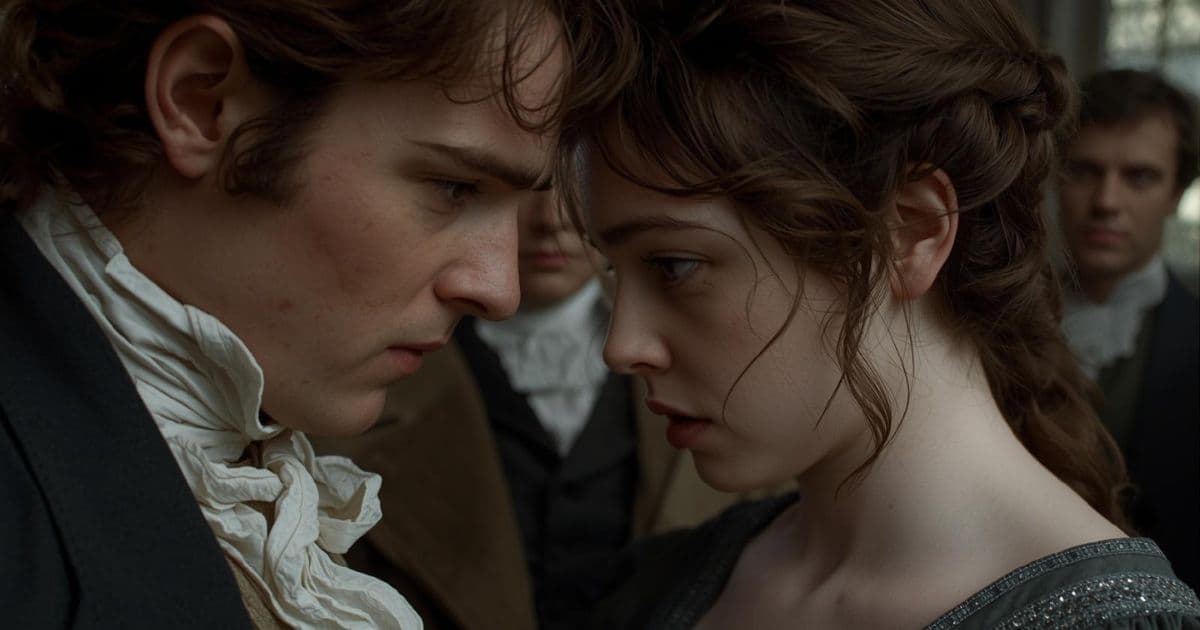
An excerpt from the original text.(complete · 5010 words)
fter being long fed with hopes of a speedy visit from Mr. and Mrs.
Suckling, the Highbury world were obliged to endure the mortification
of hearing that they could not possibly come till the autumn. No such
importation of novelties could enrich their intellectual stores at
present. In the daily interchange of news, they must be again
restricted to the other topics with which for a while the Sucklings’
coming had been united, such as the last accounts of Mrs. Churchill,
whose health seemed every day to supply a different report, and the
situation of Mrs. Weston, whose happiness it was to be hoped might
eventually be as much increased by the arrival of a child, as that of
all her neighbours was by the approach of it.
Mrs. Elton was very much disappointed. It was the delay of a great deal
of pleasure and parade. Her introductions and recommendations must all
wait, and every projected party be still only talked of. So she thought
at first;—but a little consideration convinced her that every thing
need not be put off. Why should not they explore to Box Hill though the
Sucklings did not come? They could go there again with them in the
autumn. It was settled that they should go to Box Hill. That there was
to be such a party had been long generally known: it had even given the
idea of another. Emma had never been to Box Hill; she wished to see
what every body found so well worth seeing, and she and Mr. Weston had
agreed to chuse some fine morning and drive thither. Two or three more
of the chosen only were to be admitted to join them, and it was to be
done in a quiet, unpretending, elegant way, infinitely superior to the
bustle and preparation, the regular eating and drinking, and picnic
parade of the Eltons and the Sucklings.
This was so very well understood between them, that Emma could not but
feel some surprise, and a little displeasure, on hearing from Mr.
Weston that he had been proposing to Mrs. Elton, as her brother and
sister had failed her, that the two parties should unite, and go
together; and that as Mrs. Elton had very readily acceded to it, so it
was to be, if she had no objection. Now, as her objection was nothing
but her very great dislike of Mrs. Elton, of which Mr. Weston must
already be perfectly aware, it was not worth bringing forward again:—it
could not be done without a reproof to him, which would be giving pain
to his wife; and she found herself therefore obliged to consent to an
arrangement which she would have done a great deal to avoid; an
arrangement which would probably expose her even to the degradation of
being said to be of Mrs. Elton’s party! Every feeling was offended; and
the forbearance of her outward submission left a heavy arrear due of
secret severity in her reflections on the unmanageable goodwill of Mr.
Weston’s temper.
“I am glad you approve of what I have done,” said he very comfortably.
“But I thought you would. Such schemes as these are nothing without
numbers. One cannot have too large a party. A large party secures its
own amusement. And she is a good-natured woman after all. One could not
leave her out.”
Emma denied none of it aloud, and agreed to none of it in private.
It was now the middle of June, and the weather fine; and Mrs. Elton was
growing impatient to name the day, and settle with Mr. Weston as to
pigeon-pies and cold lamb, when a lame carriage-horse threw every thing
into sad uncertainty. It might be weeks, it might be only a few days,
before the horse were useable; but no preparations could be ventured
on, and it was all melancholy stagnation. Mrs. Elton’s resources were
inadequate to such an attack.
“Is not this most vexatious, Knightley?” she cried.—“And such weather
for exploring!—These delays and disappointments are quite odious. What
are we to do?—The year will wear away at this rate, and nothing done.
Before this time last year I assure you we had had a delightful
exploring party from Maple Grove to Kings Weston.”
“You had better explore to Donwell,” replied Mr. Knightley. “That may
be done without horses. Come, and eat my strawberries. They are
ripening fast.”
If Mr. Knightley did not begin seriously, he was obliged to proceed so,
for his proposal was caught at with delight; and the “Oh! I should like
it of all things,” was not plainer in words than manner. Donwell was
famous for its strawberry-beds, which seemed a plea for the invitation:
but no plea was necessary; cabbage-beds would have been enough to tempt
the lady, who only wanted to be going somewhere. She promised him again
and again to come—much oftener than he doubted—and was extremely
gratified by such a proof of intimacy, such a distinguishing compliment
as she chose to consider it.
“You may depend upon me,” said she. “I certainly will come. Name your
day, and I will come. You will allow me to bring Jane Fairfax?”
“I cannot name a day,” said he, “till I have spoken to some others whom
I would wish to meet you.”
“Oh! leave all that to me. Only give me a carte-blanche.—I am Lady
Patroness, you know. It is my party. I will bring friends with me.”
“I hope you will bring Elton,” said he: “but I will not trouble you to
give any other invitations.”
“Oh! now you are looking very sly. But consider—you need not be afraid
of delegating power to me. I am no young lady on her preferment.
Married women, you know, may be safely authorised. It is my party.
Leave it all to me. I will invite your guests.”
“No,”—he calmly replied,—“there is but one married woman in the world
whom I can ever allow to invite what guests she pleases to Donwell, and
that one is—”
“—Mrs. Weston, I suppose,” interrupted Mrs. Elton, rather mortified.
“No—Mrs. Knightley;—and till she is in being, I will manage such
matters myself.”
“Ah! you are an odd creature!” she cried, satisfied to have no one
preferred to herself.—“You are a humourist, and may say what you like.
Quite a humourist. Well, I shall bring Jane with me—Jane and her
aunt.—The rest I leave to you. I have no objections at all to meeting
the Hartfield family. Don’t scruple. I know you are attached to them.”
“You certainly will meet them if I can prevail; and I shall call on
Miss Bates in my way home.”
“That’s quite unnecessary; I see Jane every day:—but as you like. It is
to be a morning scheme, you know, Knightley; quite a simple thing. I
shall wear a large bonnet, and bring one of my little baskets hanging
on my arm. Here,—probably this basket with pink ribbon. Nothing can be
more simple, you see. And Jane will have such another. There is to be
no form or parade—a sort of gipsy party. We are to walk about your
gardens, and gather the strawberries ourselves, and sit under
trees;—and whatever else you may like to provide, it is to be all out
of doors—a table spread in the shade, you know. Every thing as natural
and simple as possible. Is not that your idea?”
“Not quite. My idea of the simple and the natural will be to have the
table spread in the dining-room. The nature and the simplicity of
gentlemen and ladies, with their servants and furniture, I think is
best observed by meals within doors. When you are tired of eating
strawberries in the garden, there shall be cold meat in the house.”
“Well—as you please; only don’t have a great set out. And, by the bye,
can I or my housekeeper be of any use to you with our opinion?—Pray be
sincere, Knightley. If you wish me to talk to Mrs. Hodges, or to
inspect anything—”
“I have not the least wish for it, I thank you.”
“Well—but if any difficulties should arise, my housekeeper is extremely
clever.”
“I will answer for it, that mine thinks herself full as clever, and
would spurn any body’s assistance.”
“I wish we had a donkey. The thing would be for us all to come on
donkeys, Jane, Miss Bates, and me—and my caro sposo walking by. I
really must talk to him about purchasing a donkey. In a country life I
conceive it to be a sort of necessary; for, let a woman have ever so
many resources, it is not possible for her to be always shut up at
home;—and very long walks, you know—in summer there is dust, and in
winter there is dirt.”
“You will not find either, between Donwell and Highbury. Donwell Lane
is never dusty, and now it is perfectly dry. Come on a donkey, however,
if you prefer it. You can borrow Mrs. Cole’s. I would wish every thing
to be as much to your taste as possible.”
“That I am sure you would. Indeed I do you justice, my good friend.
Under that peculiar sort of dry, blunt manner, I know you have the
warmest heart. As I tell Mr. E., you are a thorough humourist.—Yes,
believe me, Knightley, I am fully sensible of your attention to me in
the whole of this scheme. You have hit upon the very thing to please
me.”
Mr. Knightley had another reason for avoiding a table in the shade. He
wished to persuade Mr. Woodhouse, as well as Emma, to join the party;
and he knew that to have any of them sitting down out of doors to eat
would inevitably make him ill. Mr. Woodhouse must not, under the
specious pretence of a morning drive, and an hour or two spent at
Donwell, be tempted away to his misery.
He was invited on good faith. No lurking horrors were to upbraid him
for his easy credulity. He did consent. He had not been at Donwell for
two years. “Some very fine morning, he, and Emma, and Harriet, could go
very well; and he could sit still with Mrs. Weston, while the dear
girls walked about the gardens. He did not suppose they could be damp
now, in the middle of the day. He should like to see the old house
again exceedingly, and should be very happy to meet Mr. and Mrs. Elton,
and any other of his neighbours.—He could not see any objection at all
to his, and Emma’s, and Harriet’s going there some very fine morning.
He thought it very well done of Mr. Knightley to invite them—very kind
and sensible—much cleverer than dining out.—He was not fond of dining
out.”
Mr. Knightley was fortunate in every body’s most ready concurrence. The
invitation was everywhere so well received, that it seemed as if, like
Mrs. Elton, they were all taking the scheme as a particular compliment
to themselves.—Emma and Harriet professed very high expectations of
pleasure from it; and Mr. Weston, unasked, promised to get Frank over
to join them, if possible; a proof of approbation and gratitude which
could have been dispensed with.—Mr. Knightley was then obliged to say
that he should be glad to see him; and Mr. Weston engaged to lose no
time in writing, and spare no arguments to induce him to come.
In the meanwhile the lame horse recovered so fast, that the party to
Box Hill was again under happy consideration; and at last Donwell was
settled for one day, and Box Hill for the next,—the weather appearing
exactly right.
Under a bright mid-day sun, at almost Midsummer, Mr. Woodhouse was
safely conveyed in his carriage, with one window down, to partake of
this al-fresco party; and in one of the most comfortable rooms in the
Abbey, especially prepared for him by a fire all the morning, he was
happily placed, quite at his ease, ready to talk with pleasure of what
had been achieved, and advise every body to come and sit down, and not
to heat themselves.—Mrs. Weston, who seemed to have walked there on
purpose to be tired, and sit all the time with him, remained, when all
the others were invited or persuaded out, his patient listener and
sympathiser.
It was so long since Emma had been at the Abbey, that as soon as she
was satisfied of her father’s comfort, she was glad to leave him, and
look around her; eager to refresh and correct her memory with more
particular observation, more exact understanding of a house and grounds
which must ever be so interesting to her and all her family.
She felt all the honest pride and complacency which her alliance with
the present and future proprietor could fairly warrant, as she viewed
the respectable size and style of the building, its suitable, becoming,
characteristic situation, low and sheltered—its ample gardens
stretching down to meadows washed by a stream, of which the Abbey, with
all the old neglect of prospect, had scarcely a sight—and its abundance
of timber in rows and avenues, which neither fashion nor extravagance
had rooted up.—The house was larger than Hartfield, and totally unlike
it, covering a good deal of ground, rambling and irregular, with many
comfortable, and one or two handsome rooms.—It was just what it ought
to be, and it looked what it was—and Emma felt an increasing respect
for it, as the residence of a family of such true gentility, untainted
in blood and understanding.—Some faults of temper John Knightley had;
but Isabella had connected herself unexceptionably. She had given them
neither men, nor names, nor places, that could raise a blush. These
were pleasant feelings, and she walked about and indulged them till it
was necessary to do as the others did, and collect round the
strawberry-beds.—The whole party were assembled, excepting Frank
Churchill, who was expected every moment from Richmond; and Mrs. Elton,
in all her apparatus of happiness, her large bonnet and her basket, was
very ready to lead the way in gathering, accepting, or
talking—strawberries, and only strawberries, could now be thought or
spoken of.—“The best fruit in England—every body’s favourite—always
wholesome.—These the finest beds and finest sorts.—Delightful to gather
for one’s self—the only way of really enjoying them.—Morning decidedly
the best time—never tired—every sort good—hautboy infinitely
superior—no comparison—the others hardly eatable—hautboys very
scarce—Chili preferred—white wood finest flavour of all—price of
strawberries in London—abundance about Bristol—Maple
Grove—cultivation—beds when to be renewed—gardeners thinking exactly
different—no general rule—gardeners never to be put out of their
way—delicious fruit—only too rich to be eaten much of—inferior to
cherries—currants more refreshing—only objection to gathering
strawberries the stooping—glaring sun—tired to death—could bear it no
longer—must go and sit in the shade.”
Such, for half an hour, was the conversation—interrupted only once by
Mrs. Weston, who came out, in her solicitude after her son-in-law, to
inquire if he were come—and she was a little uneasy.—She had some fears
of his horse.
Seats tolerably in the shade were found; and now Emma was obliged to
overhear what Mrs. Elton and Jane Fairfax were talking of.—A situation,
a most desirable situation, was in question. Mrs. Elton had received
notice of it that morning, and was in raptures. It was not with Mrs.
Suckling, it was not with Mrs. Bragge, but in felicity and splendour it
fell short only of them: it was with a cousin of Mrs. Bragge, an
acquaintance of Mrs. Suckling, a lady known at Maple Grove. Delightful,
charming, superior, first circles, spheres, lines, ranks, every
thing—and Mrs. Elton was wild to have the offer closed with
immediately.—On her side, all was warmth, energy, and triumph—and she
positively refused to take her friend’s negative, though Miss Fairfax
continued to assure her that she would not at present engage in any
thing, repeating the same motives which she had been heard to urge
before.—Still Mrs. Elton insisted on being authorised to write an
acquiescence by the morrow’s post.—How Jane could bear it at all, was
astonishing to Emma.—She did look vexed, she did speak pointedly—and at
last, with a decision of action unusual to her, proposed a
removal.—“Should not they walk? Would not Mr. Knightley shew them the
gardens—all the gardens?—She wished to see the whole extent.”—The
pertinacity of her friend seemed more than she could bear.
It was hot; and after walking some time over the gardens in a
scattered, dispersed way, scarcely any three together, they insensibly
followed one another to the delicious shade of a broad short avenue of
limes, which stretching beyond the garden at an equal distance from the
river, seemed the finish of the pleasure grounds.—It led to nothing;
nothing but a view at the end over a low stone wall with high pillars,
which seemed intended, in their erection, to give the appearance of an
approach to the house, which never had been there. Disputable, however,
as might be the taste of such a termination, it was in itself a
charming walk, and the view which closed it extremely pretty.—The
considerable slope, at nearly the foot of which the Abbey stood,
gradually acquired a steeper form beyond its grounds; and at half a
mile distant was a bank of considerable abruptness and grandeur, well
clothed with wood;—and at the bottom of this bank, favourably placed
and sheltered, rose the Abbey Mill Farm, with meadows in front, and the
river making a close and handsome curve around it.
It was a sweet view—sweet to the eye and the mind. English verdure,
English culture, English comfort, seen under a sun bright, without
being oppressive.
In this walk Emma and Mr. Weston found all the others assembled; and
towards this view she immediately perceived Mr. Knightley and Harriet
distinct from the rest, quietly leading the way. Mr. Knightley and
Harriet!—It was an odd tête-à-tête; but she was glad to see it.—There
had been a time when he would have scorned her as a companion, and
turned from her with little ceremony. Now they seemed in pleasant
conversation. There had been a time also when Emma would have been
sorry to see Harriet in a spot so favourable for the Abbey Mill Farm;
but now she feared it not. It might be safely viewed with all its
appendages of prosperity and beauty, its rich pastures, spreading
flocks, orchard in blossom, and light column of smoke ascending.—She
joined them at the wall, and found them more engaged in talking than in
looking around. He was giving Harriet information as to modes of
agriculture, etc. and Emma received a smile which seemed to say, “These
are my own concerns. I have a right to talk on such subjects, without
being suspected of introducing Robert Martin.”—She did not suspect him.
It was too old a story.—Robert Martin had probably ceased to think of
Harriet.—They took a few turns together along the walk.—The shade was
most refreshing, and Emma found it the pleasantest part of the day.
The next remove was to the house; they must all go in and eat;—and they
were all seated and busy, and still Frank Churchill did not come. Mrs.
Weston looked, and looked in vain. His father would not own himself
uneasy, and laughed at her fears; but she could not be cured of wishing
that he would part with his black mare. He had expressed himself as to
coming, with more than common certainty. “His aunt was so much better,
that he had not a doubt of getting over to them.”—Mrs. Churchill’s
state, however, as many were ready to remind her, was liable to such
sudden variation as might disappoint her nephew in the most reasonable
dependence—and Mrs. Weston was at last persuaded to believe, or to say,
that it must be by some attack of Mrs. Churchill that he was prevented
coming.—Emma looked at Harriet while the point was under consideration;
she behaved very well, and betrayed no emotion.
The cold repast was over, and the party were to go out once more to see
what had not yet been seen, the old Abbey fish-ponds; perhaps get as
far as the clover, which was to be begun cutting on the morrow, or, at
any rate, have the pleasure of being hot, and growing cool again.—Mr.
Woodhouse, who had already taken his little round in the highest part
of the gardens, where no damps from the river were imagined even by
him, stirred no more; and his daughter resolved to remain with him,
that Mrs. Weston might be persuaded away by her husband to the exercise
and variety which her spirits seemed to need.
Mr. Knightley had done all in his power for Mr. Woodhouse’s
entertainment. Books of engravings, drawers of medals, cameos, corals,
shells, and every other family collection within his cabinets, had been
prepared for his old friend, to while away the morning; and the
kindness had perfectly answered. Mr. Woodhouse had been exceedingly
well amused. Mrs. Weston had been shewing them all to him, and now he
would shew them all to Emma;—fortunate in having no other resemblance
to a child, than in a total want of taste for what he saw, for he was
slow, constant, and methodical.—Before this second looking over was
begun, however, Emma walked into the hall for the sake of a few
moments’ free observation of the entrance and ground-plot of the
house—and was hardly there, when Jane Fairfax appeared, coming quickly
in from the garden, and with a look of escape.—Little expecting to meet
Miss Woodhouse so soon, there was a start at first; but Miss Woodhouse
was the very person she was in quest of.
“Will you be so kind,” said she, “when I am missed, as to say that I am
gone home?—I am going this moment.—My aunt is not aware how late it is,
nor how long we have been absent—but I am sure we shall be wanted, and
I am determined to go directly.—I have said nothing about it to any
body. It would only be giving trouble and distress. Some are gone to
the ponds, and some to the lime walk. Till they all come in I shall not
be missed; and when they do, will you have the goodness to say that I
am gone?”
“Certainly, if you wish it;—but you are not going to walk to Highbury
alone?”
“Yes—what should hurt me?—I walk fast. I shall be at home in twenty
minutes.”
“But it is too far, indeed it is, to be walking quite alone. Let my
father’s servant go with you.—Let me order the carriage. It can be
round in five minutes.”
“Thank you, thank you—but on no account.—I would rather walk.—And for
me to be afraid of walking alone!—I, who may so soon have to guard
others!”
She spoke with great agitation; and Emma very feelingly replied, “That
can be no reason for your being exposed to danger now. I must order the
carriage. The heat even would be danger.—You are fatigued already.”
“I am,”—she answered—“I am fatigued; but it is not the sort of
fatigue—quick walking will refresh me.—Miss Woodhouse, we all know at
times what it is to be wearied in spirits. Mine, I confess, are
exhausted. The greatest kindness you can shew me, will be to let me
have my own way, and only say that I am gone when it is necessary.”
Emma had not another word to oppose. She saw it all; and entering into
her feelings, promoted her quitting the house immediately, and watched
her safely off with the zeal of a friend. Her parting look was
grateful—and her parting words, “Oh! Miss Woodhouse, the comfort of
being sometimes alone!”—seemed to burst from an overcharged heart, and
to describe somewhat of the continual endurance to be practised by her,
even towards some of those who loved her best.
“Such a home, indeed! such an aunt!” said Emma, as she turned back into
the hall again. “I do pity you. And the more sensibility you betray of
their just horrors, the more I shall like you.”
Jane had not been gone a quarter of an hour, and they had only
accomplished some views of St. Mark’s Place, Venice, when Frank
Churchill entered the room. Emma had not been thinking of him, she had
forgotten to think of him—but she was very glad to see him. Mrs. Weston
would be at ease. The black mare was blameless; they were right who
had named Mrs. Churchill as the cause. He had been detained by a
temporary increase of illness in her; a nervous seizure, which had
lasted some hours—and he had quite given up every thought of coming,
till very late;—and had he known how hot a ride he should have, and how
late, with all his hurry, he must be, he believed he should not have
come at all. The heat was excessive; he had never suffered any thing
like it—almost wished he had staid at home—nothing killed him like
heat—he could bear any degree of cold, etc., but heat was
intolerable—and he sat down, at the greatest possible distance from the
slight remains of Mr. Woodhouse’s fire, looking very deplorable.
“You will soon be cooler, if you sit still,” said Emma.
“As soon as I am cooler I shall go back again. I could very ill be
spared—but such a point had been made of my coming! You will all be
going soon I suppose; the whole party breaking up. I met one as I
came—Madness in such weather!—absolute madness!”
Emma listened, and looked, and soon perceived that Frank Churchill’s
state might be best defined by the expressive phrase of being out of
humour. Some people were always cross when they were hot. Such might be
his constitution; and as she knew that eating and drinking were often
the cure of such incidental complaints, she recommended his taking some
refreshment; he would find abundance of every thing in the
dining-room—and she humanely pointed out the door.
“No—he should not eat. He was not hungry; it would only make him
hotter.” In two minutes, however, he relented in his own favour; and
muttering something about spruce-beer, walked off. Emma returned all
her attention to her father, saying in secret—
“I am glad I have done being in love with him. I should not like a man
who is so soon discomposed by a hot morning. Harriet’s sweet easy
temper will not mind it.”
He was gone long enough to have had a very comfortable meal, and came
back all the better—grown quite cool—and, with good manners, like
himself—able to draw a chair close to them, take an interest in their
employment; and regret, in a reasonable way, that he should be so late.
He was not in his best spirits, but seemed trying to improve them; and,
at last, made himself talk nonsense very agreeably. They were looking
over views in Swisserland.
“As soon as my aunt gets well, I shall go abroad,” said he. “I shall
never be easy till I have seen some of these places. You will have my
sketches, some time or other, to look at—or my tour to read—or my poem.
I shall do something to expose myself.”
“That may be—but not by sketches in Swisserland. You will never go to
Swisserland. Your uncle and aunt will never allow you to leave
England.”
“They may be induced to go too. A warm climate may be prescribed for
her. I have more than half an expectation of our all going abroad. I
assure you I have. I feel a strong persuasion, this morning, that I
shall soon be abroad. I ought to travel. I am tired of doing nothing. I
want a change. I am serious, Miss Woodhouse, whatever your penetrating
eyes may fancy—I am sick of England—and would leave it to-morrow, if I
could.”
“You are sick of prosperity and indulgence. Cannot you invent a few
hardships for yourself, and be contented to stay?”
“I sick of prosperity and indulgence! You are quite mistaken. I do
not look upon myself as either prosperous or indulged. I am thwarted in
every thing material. I do not consider myself at all a fortunate
person.”
“You are not quite so miserable, though, as when you first came. Go and
eat and drink a little more, and you will do very well. Another slice
of cold meat, another draught of Madeira and water, will make you
nearly on a par with the rest of us.”
“No—I shall not stir. I shall sit by you. You are my best cure.”
“We are going to Box Hill to-morrow;—you will join us. It is not
Swisserland, but it will be something for a young man so much in want
of a change. You will stay, and go with us?”
“No, certainly not; I shall go home in the cool of the evening.”
“But you may come again in the cool of to-morrow morning.”
“No—It will not be worth while. If I come, I shall be cross.”
“Then pray stay at Richmond.”
“But if I do, I shall be crosser still. I can never bear to think of
you all there without me.”
“These are difficulties which you must settle for yourself. Chuse your
own degree of crossness. I shall press you no more.”
The rest of the party were now returning, and all were soon collected.
With some there was great joy at the sight of Frank Churchill; others
took it very composedly; but there was a very general distress and
disturbance on Miss Fairfax’s disappearance being explained. That it
was time for every body to go, concluded the subject; and with a short
final arrangement for the next day’s scheme, they parted. Frank
Churchill’s little inclination to exclude himself increased so much,
that his last words to Emma were,
“Well;—if you wish me to stay and join the party, I will.”
She smiled her acceptance; and nothing less than a summons from
Richmond was to take him back before the following evening.
Master this chapter. Complete your experience
Purchase the complete book to access all chapters and support classic literature
As an Amazon Associate, we earn a small commission from qualifying purchases at no additional cost to you.
Available in paperback, hardcover, and e-book formats
Let's Analyse the Pattern
When multiple people try to control the same situation, the loudest or most powerful usually wins while the most vulnerable suffers in silence.
Why This Matters
Connect literature to life
This chapter teaches how to identify when multiple people are trying to control the same situation and recognize who has the least power to protect themselves.
Practice This Today
This week, notice when someone in your group keeps getting talked over or when their needs get ignored while louder voices dominate - then speak up for them or create space for their voice.
Now let's explore the literary elements.
Key Quotes & Analysis
"It was settled that they should go to Box Hill."
Context: After the Sucklings cancel their visit, Mrs. Elton decides the Box Hill trip should proceed anyway.
This simple statement sets up the social complications to come. The passive voice shows how Emma gets swept along with plans she didn't really want.
In Today's Words:
So it was decided they'd all go together, whether Emma liked it or not.
"Mrs. Elton was very much disappointed. It was the delay of a great deal of pleasure and parade."
Context: When the Sucklings postpone their visit, Mrs. Elton loses her chance to show off her connections.
This reveals that Mrs. Elton cares more about showing off than actual friendship. The word 'parade' suggests she treats social events like performances.
In Today's Words:
Mrs. Elton was bummed because she couldn't show off her important friends.
"I shall wear a large bonnet, and bring one of my little baskets hanging on my arm."
Context: She's planning her outfit for the strawberry picking at Donwell Abbey.
Even at someone else's estate, Mrs. Elton focuses on her appearance and tries to control the aesthetic. She treats it like a costume party rather than a genuine social gathering.
In Today's Words:
I'll dress the part perfectly and bring the cutest accessories.
Thematic Threads
Social Control
In This Chapter
Mrs. Elton tries to take over Mr. Knightley's strawberry gathering arrangements despite being a guest
Development
Evolved from her earlier attempts to dominate Emma's social circle
In Your Life:
You might see this when a coworker tries to take credit for your project or a relative hijacks your family event planning.
Boundaries
In This Chapter
Mr. Knightley politely but firmly maintains control of his own estate and guest arrangements
Development
Consistent with his character's steady moral compass throughout the novel
In Your Life:
You might need this skill when pushy people try to override your decisions about your own home, work, or family.
Hidden Suffering
In This Chapter
Jane Fairfax endures Mrs. Elton's pressure about governess positions until she finally escapes, claiming exhaustion
Development
Building tension from previous chapters where Jane appears increasingly strained
In Your Life:
You might recognize this when you're smiling through situations that are actually wearing you down emotionally.
Class Pressure
In This Chapter
Emma must accept Mrs. Elton's involvement to avoid hurting Mr. Weston, showing how social obligations override personal preferences
Development
Continues the theme of how social expectations constrain individual choice
In Your Life:
You might face this when workplace politics force you to collaborate with difficult people to maintain professional relationships.
True Character
In This Chapter
Frank Churchill's irritability and bad mood reveal less attractive aspects of his personality when he's uncomfortable
Development
First major crack in his charming facade, contrasting with earlier chapters
In Your Life:
You might notice this when someone's behavior changes dramatically under stress, showing their real personality.
You now have the context. Time to form your own thoughts.
Discussion Questions
- 1
What happens when Mr. Weston tries to combine Emma's intimate Box Hill plan with Mrs. Elton's larger party? How does each person react?
analysis • surface - 2
Why does Jane Fairfax suddenly leave the strawberry picking at Donwell Abbey? What pressures is she facing that the others don't see?
analysis • medium - 3
Think about a recent group situation where everyone had different ideas about how things should go. What competing agendas were at play?
application • medium - 4
How does Mr. Knightley handle Mrs. Elton's attempts to take over his party plans? What can we learn from his approach to setting boundaries?
application • deep - 5
Why do social gatherings often become invisible battlefields? What does this reveal about how people try to get their needs met?
reflection • deep
Critical Thinking Exercise
Map the Competing Agendas
Think of a recent situation where multiple people wanted different outcomes from the same event - a family gathering, work meeting, or group project. Create a simple chart listing each person and what they really wanted (not what they said they wanted). Then identify who had the most power to get their way and who got hurt in the process.
Consider:
- •Look for the difference between what people say they want and what they actually need
- •Notice who speaks loudest versus who has real authority to make decisions
- •Pay attention to who stays quiet - they might be suffering the most
Journaling Prompt
Write about a time when you were caught between competing agendas like Emma was. How did you handle it, and what would you do differently now that you can see the pattern?
Coming Up Next...
Chapter 43: The Cruel Jest at Box Hill
The much-anticipated Box Hill expedition finally takes place, but what should be a pleasant day out becomes something far more complicated. Social tensions that have been simmering beneath the surface are about to boil over in ways that will change relationships forever.