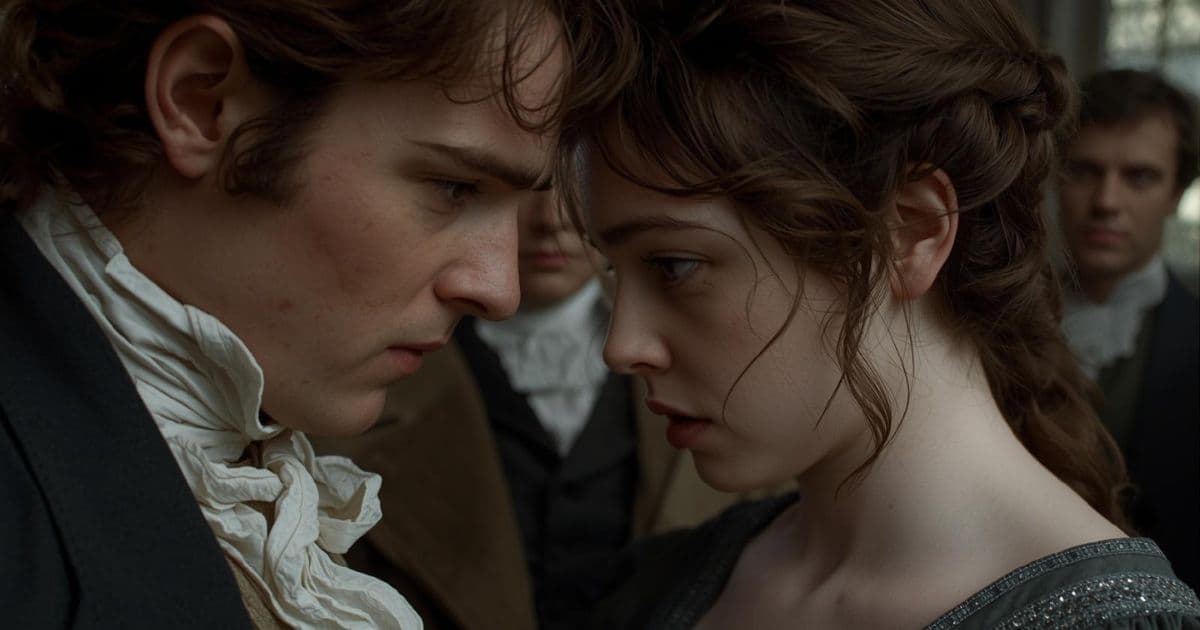
An excerpt from the original text.(complete · 3265 words)
hey had a very fine day for Box Hill; and all the other outward
circumstances of arrangement, accommodation, and punctuality, were in
favour of a pleasant party. Mr. Weston directed the whole, officiating
safely between Hartfield and the Vicarage, and every body was in good
time. Emma and Harriet went together; Miss Bates and her niece, with
the Eltons; the gentlemen on horseback. Mrs. Weston remained with Mr.
Woodhouse. Nothing was wanting but to be happy when they got there.
Seven miles were travelled in expectation of enjoyment, and every body
had a burst of admiration on first arriving; but in the general amount
of the day there was deficiency. There was a languor, a want of
spirits, a want of union, which could not be got over. They separated
too much into parties. The Eltons walked together; Mr. Knightley took
charge of Miss Bates and Jane; and Emma and Harriet belonged to Frank
Churchill. And Mr. Weston tried, in vain, to make them harmonise
better. It seemed at first an accidental division, but it never
materially varied. Mr. and Mrs. Elton, indeed, shewed no unwillingness
to mix, and be as agreeable as they could; but during the two whole
hours that were spent on the hill, there seemed a principle of
separation, between the other parties, too strong for any fine
prospects, or any cold collation, or any cheerful Mr. Weston, to
remove.
At first it was downright dulness to Emma. She had never seen Frank
Churchill so silent and stupid. He said nothing worth hearing—looked
without seeing—admired without intelligence—listened without knowing
what she said. While he was so dull, it was no wonder that Harriet
should be dull likewise; and they were both insufferable.
When they all sat down it was better; to her taste a great deal better,
for Frank Churchill grew talkative and gay, making her his first
object. Every distinguishing attention that could be paid, was paid to
her. To amuse her, and be agreeable in her eyes, seemed all that he
cared for—and Emma, glad to be enlivened, not sorry to be flattered,
was gay and easy too, and gave him all the friendly encouragement, the
admission to be gallant, which she had ever given in the first and most
animating period of their acquaintance; but which now, in her own
estimation, meant nothing, though in the judgment of most people
looking on it must have had such an appearance as no English word but
flirtation could very well describe. “Mr. Frank Churchill and Miss
Woodhouse flirted together excessively.” They were laying themselves
open to that very phrase—and to having it sent off in a letter to Maple
Grove by one lady, to Ireland by another. Not that Emma was gay and
thoughtless from any real felicity; it was rather because she felt less
happy than she had expected. She laughed because she was disappointed;
and though she liked him for his attentions, and thought them all,
whether in friendship, admiration, or playfulness, extremely judicious,
they were not winning back her heart. She still intended him for her
friend.
“How much I am obliged to you,” said he, “for telling me to come
to-day!—If it had not been for you, I should certainly have lost all
the happiness of this party. I had quite determined to go away again.”
“Yes, you were very cross; and I do not know what about, except that
you were too late for the best strawberries. I was a kinder friend than
you deserved. But you were humble. You begged hard to be commanded to
come.”
“Don’t say I was cross. I was fatigued. The heat overcame me.”
“It is hotter to-day.”
“Not to my feelings. I am perfectly comfortable to-day.”
“You are comfortable because you are under command.”
“Your command?—Yes.”
“Perhaps I intended you to say so, but I meant self-command. You had,
somehow or other, broken bounds yesterday, and run away from your own
management; but to-day you are got back again—and as I cannot be always
with you, it is best to believe your temper under your own command
rather than mine.”
“It comes to the same thing. I can have no self-command without a
motive. You order me, whether you speak or not. And you can be always
with me. You are always with me.”
“Dating from three o’clock yesterday. My perpetual influence could not
begin earlier, or you would not have been so much out of humour
before.”
“Three o’clock yesterday! That is your date. I thought I had seen you
first in February.”
“Your gallantry is really unanswerable. But (lowering her voice)—nobody
speaks except ourselves, and it is rather too much to be talking
nonsense for the entertainment of seven silent people.”
“I say nothing of which I am ashamed,” replied he, with lively
impudence. “I saw you first in February. Let every body on the Hill
hear me if they can. Let my accents swell to Mickleham on one side, and
Dorking on the other. I saw you first in February.” And then
whispering—“Our companions are excessively stupid. What shall we do to
rouse them? Any nonsense will serve. They shall talk. Ladies and
gentlemen, I am ordered by Miss Woodhouse (who, wherever she is,
presides) to say, that she desires to know what you are all thinking
of?”
Some laughed, and answered good-humouredly. Miss Bates said a great
deal; Mrs. Elton swelled at the idea of Miss Woodhouse’s presiding; Mr.
Knightley’s answer was the most distinct.
“Is Miss Woodhouse sure that she would like to hear what we are all
thinking of?”
“Oh! no, no”—cried Emma, laughing as carelessly as she could—“Upon no
account in the world. It is the very last thing I would stand the brunt
of just now. Let me hear any thing rather than what you are all
thinking of. I will not say quite all. There are one or two, perhaps,
(glancing at Mr. Weston and Harriet,) whose thoughts I might not be
afraid of knowing.”
“It is a sort of thing,” cried Mrs. Elton emphatically, “which I
should not have thought myself privileged to inquire into. Though,
perhaps, as the Chaperon of the party—I never was in any
circle—exploring parties—young ladies—married women—”
Her mutterings were chiefly to her husband; and he murmured, in reply,
“Very true, my love, very true. Exactly so, indeed—quite unheard of—but
some ladies say any thing. Better pass it off as a joke. Every body
knows what is due to you.”
“It will not do,” whispered Frank to Emma; “they are most of them
affronted. I will attack them with more address. Ladies and gentlemen—I
am ordered by Miss Woodhouse to say, that she waives her right of
knowing exactly what you may all be thinking of, and only requires
something very entertaining from each of you, in a general way. Here
are seven of you, besides myself, (who, she is pleased to say, am very
entertaining already,) and she only demands from each of you either one
thing very clever, be it prose or verse, original or repeated—or two
things moderately clever—or three things very dull indeed, and she
engages to laugh heartily at them all.”
“Oh! very well,” exclaimed Miss Bates, “then I need not be uneasy.
‘Three things very dull indeed.’ That will just do for me, you know. I
shall be sure to say three dull things as soon as ever I open my mouth,
shan’t I? (looking round with the most good-humoured dependence on
every body’s assent)—Do not you all think I shall?”
Emma could not resist.
“Ah! ma’am, but there may be a difficulty. Pardon me—but you will be
limited as to number—only three at once.”
Miss Bates, deceived by the mock ceremony of her manner, did not
immediately catch her meaning; but, when it burst on her, it could not
anger, though a slight blush shewed that it could pain her.
“Ah!—well—to be sure. Yes, I see what she means, (turning to Mr.
Knightley,) and I will try to hold my tongue. I must make myself very
disagreeable, or she would not have said such a thing to an old
friend.”
“I like your plan,” cried Mr. Weston. “Agreed, agreed. I will do my
best. I am making a conundrum. How will a conundrum reckon?”
“Low, I am afraid, sir, very low,” answered his son;—“but we shall be
indulgent—especially to any one who leads the way.”
“No, no,” said Emma, “it will not reckon low. A conundrum of Mr.
Weston’s shall clear him and his next neighbour. Come, sir, pray let me
hear it.”
“I doubt its being very clever myself,” said Mr. Weston. “It is too
much a matter of fact, but here it is.—What two letters of the alphabet
are there, that express perfection?”
“What two letters!—express perfection! I am sure I do not know.”
“Ah! you will never guess. You, (to Emma), I am certain, will never
guess.—I will tell you.—M. and A.—Em-ma.—Do you understand?”
Understanding and gratification came together. It might be a very
indifferent piece of wit, but Emma found a great deal to laugh at and
enjoy in it—and so did Frank and Harriet.—It did not seem to touch the
rest of the party equally; some looked very stupid about it, and Mr.
Knightley gravely said,
“This explains the sort of clever thing that is wanted, and Mr. Weston
has done very well for himself; but he must have knocked up every body
else. Perfection should not have come quite so soon.”
“Oh! for myself, I protest I must be excused,” said Mrs. Elton; “I
really cannot attempt—I am not at all fond of the sort of thing. I had
an acrostic once sent to me upon my own name, which I was not at all
pleased with. I knew who it came from. An abominable puppy!—You know
who I mean (nodding to her husband). These kind of things are very well
at Christmas, when one is sitting round the fire; but quite out of
place, in my opinion, when one is exploring about the country in
summer. Miss Woodhouse must excuse me. I am not one of those who have
witty things at every body’s service. I do not pretend to be a wit. I
have a great deal of vivacity in my own way, but I really must be
allowed to judge when to speak and when to hold my tongue. Pass us, if
you please, Mr. Churchill. Pass Mr. E., Knightley, Jane, and myself. We
have nothing clever to say—not one of us.
“Yes, yes, pray pass me,” added her husband, with a sort of sneering
consciousness; “I have nothing to say that can entertain Miss
Woodhouse, or any other young lady. An old married man—quite good for
nothing. Shall we walk, Augusta?”
“With all my heart. I am really tired of exploring so long on one spot.
Come, Jane, take my other arm.”
Jane declined it, however, and the husband and wife walked off. “Happy
couple!” said Frank Churchill, as soon as they were out of
hearing:—“How well they suit one another!—Very lucky—marrying as they
did, upon an acquaintance formed only in a public place!—They only knew
each other, I think, a few weeks in Bath! Peculiarly lucky!—for as to
any real knowledge of a person’s disposition that Bath, or any public
place, can give—it is all nothing; there can be no knowledge. It is
only by seeing women in their own homes, among their own set, just as
they always are, that you can form any just judgment. Short of that, it
is all guess and luck—and will generally be ill-luck. How many a man
has committed himself on a short acquaintance, and rued it all the rest
of his life!”
Miss Fairfax, who had seldom spoken before, except among her own
confederates, spoke now.
“Such things do occur, undoubtedly.”—She was stopped by a cough. Frank
Churchill turned towards her to listen.
“You were speaking,” said he, gravely. She recovered her voice.
“I was only going to observe, that though such unfortunate
circumstances do sometimes occur both to men and women, I cannot
imagine them to be very frequent. A hasty and imprudent attachment may
arise—but there is generally time to recover from it afterwards. I
would be understood to mean, that it can be only weak, irresolute
characters, (whose happiness must be always at the mercy of chance,)
who will suffer an unfortunate acquaintance to be an inconvenience, an
oppression for ever.”
He made no answer; merely looked, and bowed in submission; and soon
afterwards said, in a lively tone,
“Well, I have so little confidence in my own judgment, that whenever I
marry, I hope some body will chuse my wife for me. Will you? (turning
to Emma.) Will you chuse a wife for me?—I am sure I should like any
body fixed on by you. You provide for the family, you know, (with a
smile at his father). Find some body for me. I am in no hurry. Adopt
her, educate her.”
“And make her like myself.”
“By all means, if you can.”
“Very well. I undertake the commission. You shall have a charming
wife.”
“She must be very lively, and have hazle eyes. I care for nothing else.
I shall go abroad for a couple of years—and when I return, I shall come
to you for my wife. Remember.”
Emma was in no danger of forgetting. It was a commission to touch every
favourite feeling. Would not Harriet be the very creature described?
Hazle eyes excepted, two years more might make her all that he wished.
He might even have Harriet in his thoughts at the moment; who could
say? Referring the education to her seemed to imply it.
“Now, ma’am,” said Jane to her aunt, “shall we join Mrs. Elton?”
“If you please, my dear. With all my heart. I am quite ready. I was
ready to have gone with her, but this will do just as well. We shall
soon overtake her. There she is—no, that’s somebody else. That’s one of
the ladies in the Irish car party, not at all like her.—Well, I
declare—”
They walked off, followed in half a minute by Mr. Knightley. Mr.
Weston, his son, Emma, and Harriet, only remained; and the young man’s
spirits now rose to a pitch almost unpleasant. Even Emma grew tired at
last of flattery and merriment, and wished herself rather walking
quietly about with any of the others, or sitting almost alone, and
quite unattended to, in tranquil observation of the beautiful views
beneath her. The appearance of the servants looking out for them to
give notice of the carriages was a joyful sight; and even the bustle of
collecting and preparing to depart, and the solicitude of Mrs. Elton to
have her carriage first, were gladly endured, in the prospect of the
quiet drive home which was to close the very questionable enjoyments of
this day of pleasure. Such another scheme, composed of so many
ill-assorted people, she hoped never to be betrayed into again.
While waiting for the carriage, she found Mr. Knightley by her side. He
looked around, as if to see that no one were near, and then said,
“Emma, I must once more speak to you as I have been used to do: a
privilege rather endured than allowed, perhaps, but I must still use
it. I cannot see you acting wrong, without a remonstrance. How could
you be so unfeeling to Miss Bates? How could you be so insolent in your
wit to a woman of her character, age, and situation?—Emma, I had not
thought it possible.”
Emma recollected, blushed, was sorry, but tried to laugh it off.
“Nay, how could I help saying what I did?—Nobody could have helped it.
It was not so very bad. I dare say she did not understand me.”
“I assure you she did. She felt your full meaning. She has talked of it
since. I wish you could have heard how she talked of it—with what
candour and generosity. I wish you could have heard her honouring your
forbearance, in being able to pay her such attentions, as she was for
ever receiving from yourself and your father, when her society must be
so irksome.”
“Oh!” cried Emma, “I know there is not a better creature in the world:
but you must allow, that what is good and what is ridiculous are most
unfortunately blended in her.”
“They are blended,” said he, “I acknowledge; and, were she prosperous,
I could allow much for the occasional prevalence of the ridiculous over
the good. Were she a woman of fortune, I would leave every harmless
absurdity to take its chance, I would not quarrel with you for any
liberties of manner. Were she your equal in situation—but, Emma,
consider how far this is from being the case. She is poor; she has sunk
from the comforts she was born to; and, if she live to old age, must
probably sink more. Her situation should secure your compassion. It was
badly done, indeed! You, whom she had known from an infant, whom she
had seen grow up from a period when her notice was an honour, to have
you now, in thoughtless spirits, and the pride of the moment, laugh at
her, humble her—and before her niece, too—and before others, many of
whom (certainly some,) would be entirely guided by your treatment
of her.—This is not pleasant to you, Emma—and it is very far from
pleasant to me; but I must, I will,—I will tell you truths while I can;
satisfied with proving myself your friend by very faithful counsel, and
trusting that you will some time or other do me greater justice than
you can do now.”
While they talked, they were advancing towards the carriage; it was
ready; and, before she could speak again, he had handed her in. He had
misinterpreted the feelings which had kept her face averted, and her
tongue motionless. They were combined only of anger against herself,
mortification, and deep concern. She had not been able to speak; and,
on entering the carriage, sunk back for a moment overcome—then
reproaching herself for having taken no leave, making no
acknowledgment, parting in apparent sullenness, she looked out with
voice and hand eager to shew a difference; but it was just too late. He
had turned away, and the horses were in motion. She continued to look
back, but in vain; and soon, with what appeared unusual speed, they
were half way down the hill, and every thing left far behind. She was
vexed beyond what could have been expressed—almost beyond what she
could conceal. Never had she felt so agitated, mortified, grieved, at
any circumstance in her life. She was most forcibly struck. The truth
of this representation there was no denying. She felt it at her heart.
How could she have been so brutal, so cruel to Miss Bates! How could
she have exposed herself to such ill opinion in any one she valued! And
how suffer him to leave her without saying one word of gratitude, of
concurrence, of common kindness!
Time did not compose her. As she reflected more, she seemed but to feel
it more. She never had been so depressed. Happily it was not necessary
to speak. There was only Harriet, who seemed not in spirits herself,
fagged, and very willing to be silent; and Emma felt the tears running
down her cheeks almost all the way home, without being at any trouble
to check them, extraordinary as they were.
Master this chapter. Complete your experience
Purchase the complete book to access all chapters and support classic literature
As an Amazon Associate, we earn a small commission from qualifying purchases at no additional cost to you.
Available in paperback, hardcover, and e-book formats
Let's Analyse the Pattern
When frustrated or powerless, we justify being cruel to those who can't fight back by convincing ourselves they deserve it.
Why This Matters
Connect literature to life
This chapter teaches how to identify when we're taking out our real frustrations on safe, vulnerable targets instead of addressing the actual source.
Practice This Today
This week, notice when you feel the urge to be cutting or critical—pause and ask yourself what you're really frustrated about and whether you're picking on someone who can't fight back.
Now let's explore the literary elements.
Key Quotes & Analysis
"Oh! very well, exclaimed Miss Bates, then I need not be uneasy. Three things very dull indeed. That will just do for me, you know. I shall be sure to say three dull things as soon as ever I open my mouth, shan't I?"
Context: Her response to Emma's cruel suggestion that she limit herself to three dull comments
This shows Miss Bates understands exactly what Emma meant - that she's boring and talks too much. Her attempt to laugh it off makes it even more heartbreaking because we see her dignity in the face of public humiliation.
In Today's Words:
Oh, got it - I'm boring and should shut up. Thanks for letting me know in front of everyone.
"Emma, I must once more speak to you as I have been used to do: a privilege rather endured than allowed, perhaps, but I must still use it."
Context: Beginning his confrontation with Emma about her behavior toward Miss Bates
Knightley knows Emma might not want to hear this, but he's going to say it anyway because he truly cares about her character. Real friends don't let you become a worse person.
In Today's Words:
I know you probably don't want to hear this, but I'm going to tell you the truth because I care about you.
"How could you be so unfeeling to Miss Bates? How could you be so insolent in your wit to a woman of her character, age, and situation?"
Context: His direct confrontation about Emma's cruelty
Knightley doesn't sugarcoat it - he calls Emma's behavior exactly what it was. He points out that Miss Bates's vulnerability should have protected her, not made her a target.
In Today's Words:
How could you be so cruel to someone who's already struggling and has always been kind to you?
"The tears ran down her cheeks almost all the way home, without any endeavour to check them, extraordinary as they were."
Context: Emma's reaction after Knightley's rebuke during the ride home
Emma rarely cries, so these tears show genuine remorse and self-recognition. She's not crying because she got caught - she's crying because she finally sees what she's become.
In Today's Words:
She cried the whole way home because she finally realized how awful she'd been.
Thematic Threads
Class
In This Chapter
Emma's social position gives her the power to humiliate Miss Bates publicly without consequences
Development
Evolved from subtle class awareness to active abuse of social privilege
In Your Life:
You might use your position—as supervisor, parent, or insider—to put down someone with less power
Identity
In This Chapter
Emma's self-image as clever and witty blinds her to her capacity for cruelty
Development
Progressed from self-satisfaction to self-deception about her true nature
In Your Life:
You might tell yourself you're 'just being honest' when you're actually being mean
Personal Growth
In This Chapter
Knightley's harsh but loving rebuke forces Emma to confront her ugly behavior
Development
First major moment of genuine self-reflection and remorse in the novel
In Your Life:
You need people who will call out your worst behavior, even when it hurts to hear
Social Expectations
In This Chapter
The pressure to be entertaining at the picnic leads Emma to sacrifice kindness for wit
Development
Shows how social performance can corrupt basic human decency
In Your Life:
You might prioritize looking good to others over treating people well
Human Relationships
In This Chapter
Emma's cruelty damages not just Miss Bates but her own character and relationships
Development
Demonstrates how our treatment of the vulnerable reveals our true nature
In Your Life:
How you treat people who can't help you shows who you really are
You now have the context. Time to form your own thoughts.
Discussion Questions
- 1
What exactly did Emma say to Miss Bates, and how did Miss Bates react?
analysis • surface - 2
Why do you think Emma chose Miss Bates as her target for the cruel joke, rather than someone else in the group?
analysis • medium - 3
Where do you see this pattern today—people taking out their frustrations on someone who can't fight back?
application • medium - 4
When you're feeling frustrated or disappointed, how do you usually handle those feelings? Do you ever find yourself being sharper with certain people?
application • deep - 5
What does Emma's immediate regret after Knightley's rebuke tell us about the difference between momentary cruelty and true character?
reflection • deep
Critical Thinking Exercise
Map Your Frustration Flow
Think of a recent time when you felt frustrated, stressed, or disappointed. Draw or write out what happened: What was the real source of your frustration? Who did you interact with afterward? Were you shorter, snappier, or less patient with anyone? Map the flow from your original frustration to how you treated others.
Consider:
- •Notice if you were gentler with people who had power over you and harsher with those who didn't
- •Consider whether the people who got your displaced frustration deserved that treatment
- •Think about safer ways you could have processed those difficult feelings
Journaling Prompt
Write about a time when someone took their bad mood out on you. How did it feel? What would you have wanted them to do differently? Now apply that same standard to your own behavior.
Coming Up Next...
Chapter 44: The Weight of True Remorse
Emma's shame deepens as she reflects on her behavior, but will her remorse lead to meaningful change? The aftermath of Box Hill forces her to examine not just this one cruel moment, but the pattern of privilege and thoughtlessness that enabled it.