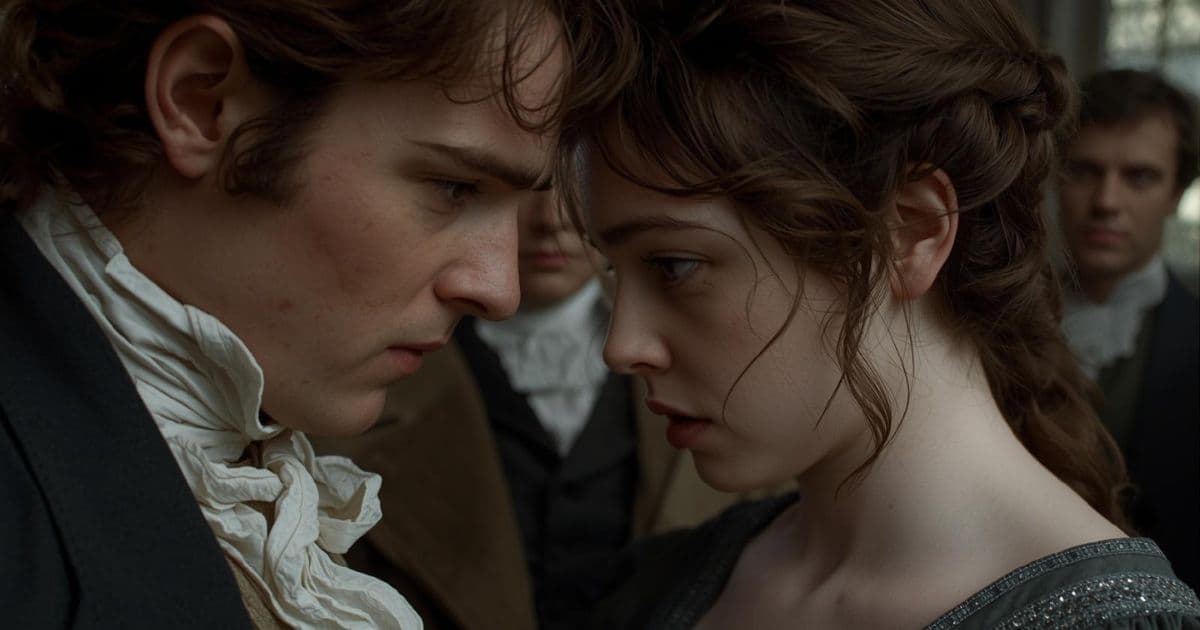
An excerpt from the original text.(complete · 2923 words)
n this state of schemes, and hopes, and connivance, June opened upon
Hartfield. To Highbury in general it brought no material change. The
Eltons were still talking of a visit from the Sucklings, and of the use
to be made of their barouche-landau; and Jane Fairfax was still at her
grandmother’s; and as the return of the Campbells from Ireland was
again delayed, and August, instead of Midsummer, fixed for it, she was
likely to remain there full two months longer, provided at least she
were able to defeat Mrs. Elton’s activity in her service, and save
herself from being hurried into a delightful situation against her
will.
Mr. Knightley, who, for some reason best known to himself, had
certainly taken an early dislike to Frank Churchill, was only growing
to dislike him more. He began to suspect him of some double dealing in
his pursuit of Emma. That Emma was his object appeared indisputable.
Every thing declared it; his own attentions, his father’s hints, his
mother-in-law’s guarded silence; it was all in unison; words, conduct,
discretion, and indiscretion, told the same story. But while so many
were devoting him to Emma, and Emma herself making him over to Harriet,
Mr. Knightley began to suspect him of some inclination to trifle with
Jane Fairfax. He could not understand it; but there were symptoms of
intelligence between them—he thought so at least—symptoms of admiration
on his side, which, having once observed, he could not persuade himself
to think entirely void of meaning, however he might wish to escape any
of Emma’s errors of imagination. She was not present when the
suspicion first arose. He was dining with the Randalls family, and
Jane, at the Eltons’; and he had seen a look, more than a single look,
at Miss Fairfax, which, from the admirer of Miss Woodhouse, seemed
somewhat out of place. When he was again in their company, he could not
help remembering what he had seen; nor could he avoid observations
which, unless it were like Cowper and his fire at twilight,
“Myself creating what I saw,”
brought him yet stronger suspicion of there being a something of
private liking, of private understanding even, between Frank Churchill
and Jane.
He had walked up one day after dinner, as he very often did, to spend
his evening at Hartfield. Emma and Harriet were going to walk; he
joined them; and, on returning, they fell in with a larger party, who,
like themselves, judged it wisest to take their exercise early, as the
weather threatened rain; Mr. and Mrs. Weston and their son, Miss Bates
and her niece, who had accidentally met. They all united; and, on
reaching Hartfield gates, Emma, who knew it was exactly the sort of
visiting that would be welcome to her father, pressed them all to go in
and drink tea with him. The Randalls party agreed to it immediately;
and after a pretty long speech from Miss Bates, which few persons
listened to, she also found it possible to accept dear Miss Woodhouse’s
most obliging invitation.
As they were turning into the grounds, Mr. Perry passed by on
horseback. The gentlemen spoke of his horse.
“By the bye,” said Frank Churchill to Mrs. Weston presently, “what
became of Mr. Perry’s plan of setting up his carriage?”
Mrs. Weston looked surprized, and said, “I did not know that he ever
had any such plan.”
“Nay, I had it from you. You wrote me word of it three months ago.”
“Me! impossible!”
“Indeed you did. I remember it perfectly. You mentioned it as what was
certainly to be very soon. Mrs. Perry had told somebody, and was
extremely happy about it. It was owing to her persuasion, as she
thought his being out in bad weather did him a great deal of harm. You
must remember it now?”
“Upon my word I never heard of it till this moment.”
“Never! really, never!—Bless me! how could it be?—Then I must have
dreamt it—but I was completely persuaded—Miss Smith, you walk as if you
were tired. You will not be sorry to find yourself at home.”
“What is this?—What is this?” cried Mr. Weston, “about Perry and a
carriage? Is Perry going to set up his carriage, Frank? I am glad he
can afford it. You had it from himself, had you?”
“No, sir,” replied his son, laughing, “I seem to have had it from
nobody.—Very odd!—I really was persuaded of Mrs. Weston’s having
mentioned it in one of her letters to Enscombe, many weeks ago, with
all these particulars—but as she declares she never heard a syllable of
it before, of course it must have been a dream. I am a great dreamer. I
dream of every body at Highbury when I am away—and when I have gone
through my particular friends, then I begin dreaming of Mr. and Mrs.
Perry.”
“It is odd though,” observed his father, “that you should have had such
a regular connected dream about people whom it was not very likely you
should be thinking of at Enscombe. Perry’s setting up his carriage! and
his wife’s persuading him to it, out of care for his health—just what
will happen, I have no doubt, some time or other; only a little
premature. What an air of probability sometimes runs through a dream!
And at others, what a heap of absurdities it is! Well, Frank, your
dream certainly shews that Highbury is in your thoughts when you are
absent. Emma, you are a great dreamer, I think?”
Emma was out of hearing. She had hurried on before her guests to
prepare her father for their appearance, and was beyond the reach of
Mr. Weston’s hint.
“Why, to own the truth,” cried Miss Bates, who had been trying in vain
to be heard the last two minutes, “if I must speak on this subject,
there is no denying that Mr. Frank Churchill might have—I do not mean
to say that he did not dream it—I am sure I have sometimes the oddest
dreams in the world—but if I am questioned about it, I must acknowledge
that there was such an idea last spring; for Mrs. Perry herself
mentioned it to my mother, and the Coles knew of it as well as
ourselves—but it was quite a secret, known to nobody else, and only
thought of about three days. Mrs. Perry was very anxious that he should
have a carriage, and came to my mother in great spirits one morning
because she thought she had prevailed. Jane, don’t you remember
grandmama’s telling us of it when we got home? I forget where we had
been walking to—very likely to Randalls; yes, I think it was to
Randalls. Mrs. Perry was always particularly fond of my mother—indeed I
do not know who is not—and she had mentioned it to her in confidence;
she had no objection to her telling us, of course, but it was not to go
beyond: and, from that day to this, I never mentioned it to a soul that
I know of. At the same time, I will not positively answer for my having
never dropt a hint, because I know I do sometimes pop out a thing
before I am aware. I am a talker, you know; I am rather a talker; and
now and then I have let a thing escape me which I should not. I am not
like Jane; I wish I were. I will answer for it she never betrayed the
least thing in the world. Where is she?—Oh! just behind. Perfectly
remember Mrs. Perry’s coming.—Extraordinary dream, indeed!”
They were entering the hall. Mr. Knightley’s eyes had preceded Miss
Bates’s in a glance at Jane. From Frank Churchill’s face, where he
thought he saw confusion suppressed or laughed away, he had
involuntarily turned to hers; but she was indeed behind, and too busy
with her shawl. Mr. Weston had walked in. The two other gentlemen
waited at the door to let her pass. Mr. Knightley suspected in Frank
Churchill the determination of catching her eye—he seemed watching her
intently—in vain, however, if it were so—Jane passed between them into
the hall, and looked at neither.
There was no time for farther remark or explanation. The dream must be
borne with, and Mr. Knightley must take his seat with the rest round
the large modern circular table which Emma had introduced at Hartfield,
and which none but Emma could have had power to place there and
persuade her father to use, instead of the small-sized Pembroke, on
which two of his daily meals had, for forty years been crowded. Tea
passed pleasantly, and nobody seemed in a hurry to move.
“Miss Woodhouse,” said Frank Churchill, after examining a table behind
him, which he could reach as he sat, “have your nephews taken away
their alphabets—their box of letters? It used to stand here. Where is
it? This is a sort of dull-looking evening, that ought to be treated
rather as winter than summer. We had great amusement with those letters
one morning. I want to puzzle you again.”
Emma was pleased with the thought; and producing the box, the table was
quickly scattered over with alphabets, which no one seemed so much
disposed to employ as their two selves. They were rapidly forming words
for each other, or for any body else who would be puzzled. The
quietness of the game made it particularly eligible for Mr. Woodhouse,
who had often been distressed by the more animated sort, which Mr.
Weston had occasionally introduced, and who now sat happily occupied in
lamenting, with tender melancholy, over the departure of the “poor
little boys,” or in fondly pointing out, as he took up any stray letter
near him, how beautifully Emma had written it.
Frank Churchill placed a word before Miss Fairfax. She gave a slight
glance round the table, and applied herself to it. Frank was next to
Emma, Jane opposite to them—and Mr. Knightley so placed as to see them
all; and it was his object to see as much as he could, with as little
apparent observation. The word was discovered, and with a faint smile
pushed away. If meant to be immediately mixed with the others, and
buried from sight, she should have looked on the table instead of
looking just across, for it was not mixed; and Harriet, eager after
every fresh word, and finding out none, directly took it up, and fell
to work. She was sitting by Mr. Knightley, and turned to him for help.
The word was blunder; and as Harriet exultingly proclaimed it, there
was a blush on Jane’s cheek which gave it a meaning not otherwise
ostensible. Mr. Knightley connected it with the dream; but how it could
all be, was beyond his comprehension. How the delicacy, the discretion
of his favourite could have been so lain asleep! He feared there must
be some decided involvement. Disingenuousness and double dealing seemed
to meet him at every turn. These letters were but the vehicle for
gallantry and trick. It was a child’s play, chosen to conceal a deeper
game on Frank Churchill’s part.
With great indignation did he continue to observe him; with great alarm
and distrust, to observe also his two blinded companions. He saw a
short word prepared for Emma, and given to her with a look sly and
demure. He saw that Emma had soon made it out, and found it highly
entertaining, though it was something which she judged it proper to
appear to censure; for she said, “Nonsense! for shame!” He heard Frank
Churchill next say, with a glance towards Jane, “I will give it to
her—shall I?”—and as clearly heard Emma opposing it with eager laughing
warmth. “No, no, you must not; you shall not, indeed.”
It was done however. This gallant young man, who seemed to love without
feeling, and to recommend himself without complaisance, directly handed
over the word to Miss Fairfax, and with a particular degree of sedate
civility entreated her to study it. Mr. Knightley’s excessive curiosity
to know what this word might be, made him seize every possible moment
for darting his eye towards it, and it was not long before he saw it to
be Dixon. Jane Fairfax’s perception seemed to accompany his; her
comprehension was certainly more equal to the covert meaning, the
superior intelligence, of those five letters so arranged. She was
evidently displeased; looked up, and seeing herself watched, blushed
more deeply than he had ever perceived her, and saying only, “I did not
know that proper names were allowed,” pushed away the letters with even
an angry spirit, and looked resolved to be engaged by no other word
that could be offered. Her face was averted from those who had made the
attack, and turned towards her aunt.
“Aye, very true, my dear,” cried the latter, though Jane had not spoken
a word—“I was just going to say the same thing. It is time for us to be
going indeed. The evening is closing in, and grandmama will be looking
for us. My dear sir, you are too obliging. We really must wish you good
night.”
Jane’s alertness in moving, proved her as ready as her aunt had
preconceived. She was immediately up, and wanting to quit the table;
but so many were also moving, that she could not get away; and Mr.
Knightley thought he saw another collection of letters anxiously pushed
towards her, and resolutely swept away by her unexamined. She was
afterwards looking for her shawl—Frank Churchill was looking also—it
was growing dusk, and the room was in confusion; and how they parted,
Mr. Knightley could not tell.
He remained at Hartfield after all the rest, his thoughts full of what
he had seen; so full, that when the candles came to assist his
observations, he must—yes, he certainly must, as a friend—an anxious
friend—give Emma some hint, ask her some question. He could not see her
in a situation of such danger, without trying to preserve her. It was
his duty.
“Pray, Emma,” said he, “may I ask in what lay the great amusement, the
poignant sting of the last word given to you and Miss Fairfax? I saw
the word, and am curious to know how it could be so very entertaining
to the one, and so very distressing to the other.”
Emma was extremely confused. She could not endure to give him the true
explanation; for though her suspicions were by no means removed, she
was really ashamed of having ever imparted them.
“Oh!” she cried in evident embarrassment, “it all meant nothing; a mere
joke among ourselves.”
“The joke,” he replied gravely, “seemed confined to you and Mr.
Churchill.”
He had hoped she would speak again, but she did not. She would rather
busy herself about any thing than speak. He sat a little while in
doubt. A variety of evils crossed his mind. Interference—fruitless
interference. Emma’s confusion, and the acknowledged intimacy, seemed
to declare her affection engaged. Yet he would speak. He owed it to
her, to risk any thing that might be involved in an unwelcome
interference, rather than her welfare; to encounter any thing, rather
than the remembrance of neglect in such a cause.
“My dear Emma,” said he at last, with earnest kindness, “do you think
you perfectly understand the degree of acquaintance between the
gentleman and lady we have been speaking of?”
“Between Mr. Frank Churchill and Miss Fairfax? Oh! yes, perfectly.—Why
do you make a doubt of it?”
“Have you never at any time had reason to think that he admired her, or
that she admired him?”
“Never, never!” she cried with a most open eagerness—“Never, for the
twentieth part of a moment, did such an idea occur to me. And how could
it possibly come into your head?”
“I have lately imagined that I saw symptoms of attachment between
them—certain expressive looks, which I did not believe meant to be
public.”
“Oh! you amuse me excessively. I am delighted to find that you can
vouchsafe to let your imagination wander—but it will not do—very sorry
to check you in your first essay—but indeed it will not do. There is no
admiration between them, I do assure you; and the appearances which
have caught you, have arisen from some peculiar circumstances—feelings
rather of a totally different nature—it is impossible exactly to
explain:—there is a good deal of nonsense in it—but the part which is
capable of being communicated, which is sense, is, that they are as far
from any attachment or admiration for one another, as any two beings in
the world can be. That is, I presume it to be so on her side, and I
can answer for its being so on his. I will answer for the gentleman’s
indifference.”
She spoke with a confidence which staggered, with a satisfaction which
silenced, Mr. Knightley. She was in gay spirits, and would have
prolonged the conversation, wanting to hear the particulars of his
suspicions, every look described, and all the wheres and hows of a
circumstance which highly entertained her: but his gaiety did not meet
hers. He found he could not be useful, and his feelings were too much
irritated for talking. That he might not be irritated into an absolute
fever, by the fire which Mr. Woodhouse’s tender habits required almost
every evening throughout the year, he soon afterwards took a hasty
leave, and walked home to the coolness and solitude of Donwell Abbey.
Master this chapter. Complete your experience
Purchase the complete book to access all chapters and support classic literature
As an Amazon Associate, we earn a small commission from qualifying purchases at no additional cost to you.
Available in paperback, hardcover, and e-book formats
Let's Analyse the Pattern
Ignoring obvious warning signs because facing them would disrupt our preferred narrative or emotional investment.
Why This Matters
Connect literature to life
This chapter teaches how to recognize when someone is using coded communication to intimidate or control another person.
Practice This Today
This week, notice when someone consistently makes comments that upset the same person—even if those comments seem innocent on the surface.
Now let's explore the literary elements.
Key Quotes & Analysis
"He began to suspect him of some double dealing in his pursuit of Emma."
Context: Describing Mr. Knightley's growing distrust of Frank Churchill's motives
This reveals Knightley's sharp instincts about people and his protective feelings toward Emma. The phrase 'double dealing' suggests Frank is being dishonest with multiple people simultaneously, which proves to be exactly right.
In Today's Words:
He started thinking Frank was playing games and not being straight with Emma.
"These letters were but the vehicle for gallantry and trick."
Context: Describing how Frank uses the word game to send coded messages
This shows how Frank weaponizes seemingly innocent entertainment to manipulate and communicate secretly. The word 'trick' emphasizes the deceptive nature of his actions, turning a parlor game into emotional manipulation.
In Today's Words:
He was using the letter game to flirt and mess with people's heads.
"The word was blunder; and as Harriet exultingly proclaimed it, there was a blush on Jane's cheek which gave it a meaning not otherwise ostensible."
Context: During the word game when Frank deliberately creates provocative words for Jane
Jane's physical reaction reveals she understands Frank is referencing her secret situation. The word 'blunder' likely refers to mistakes in their secret relationship, and her blush shows she's being emotionally manipulated in public.
In Today's Words:
When they called out the word 'blunder,' Jane turned red because she knew exactly what he was really saying to her.
Thematic Threads
Deception
In This Chapter
Frank uses word games to communicate secretly with Jane while appearing innocent to others
Development
Evolved from simple flirtation to deliberate manipulation and coded communication
In Your Life:
You might see this when someone uses jokes or 'harmless' comments to send messages they can't say directly
Class
In This Chapter
Secret information about Mr. Perry's carriage reveals how gossip flows differently through social levels
Development
Continues showing how information and access vary by social position
In Your Life:
You experience this when certain workplace information only reaches certain levels or social circles
Personal Growth
In This Chapter
Emma's inability to read social cues shows her lack of emotional intelligence development
Development
Her blindness to manipulation has grown more dangerous as stakes increase
In Your Life:
You might recognize this in your own moments of missing obvious social signals because you're focused on your own narrative
Human Relationships
In This Chapter
Mr. Knightley tries to warn Emma but she dismisses his concerns about Frank
Development
Their dynamic shifts as he becomes more protective and she becomes more resistant
In Your Life:
You see this when friends try to warn you about someone but you're not ready to hear it
Identity
In This Chapter
Jane's angry reaction to the word game reveals her struggle between public composure and private feelings
Development
Her mask is slipping as the pressure of maintaining her secret intensifies
In Your Life:
You experience this when maintaining a professional or social facade becomes exhausting under stress
You now have the context. Time to form your own thoughts.
Discussion Questions
- 1
What specific clues does Mr. Knightley notice that suggest Frank Churchill and Jane Fairfax have a secret connection?
analysis • surface - 2
Why does Emma dismiss Mr. Knightley's concerns about Frank, even when presented with evidence?
analysis • medium - 3
Where do you see this pattern of willful blindness in modern workplaces, families, or relationships?
application • medium - 4
How would you handle a situation where you suspect someone close to you is ignoring obvious warning signs?
application • deep - 5
What does this chapter reveal about how our emotional investments can cloud our judgment?
reflection • deep
Critical Thinking Exercise
Map Your Blind Spots
Think of a current situation where you might be experiencing willful blindness—ignoring warning signs because facing them would disrupt something you want to believe. Write down what you're invested in believing, what evidence you might be dismissing, and what an objective observer might see. Then identify one person in your life who could serve as your 'Mr. Knightley'—someone with no emotional stake who might see clearly.
Consider:
- •Consider areas where you have strong emotional investment: relationships, career decisions, family dynamics
- •Look for patterns where you've dismissed concerns from trusted friends or advisors
- •Think about situations where you've said 'I should have seen that coming' in hindsight
Journaling Prompt
Write about a time when you ignored obvious warning signs because acknowledging them would have meant giving up something you wanted. What did you learn from that experience, and how do you create space for objective feedback now?
Coming Up Next...
Chapter 42: Party Planning and Social Maneuvering
Mr. Knightley's concerns about Frank Churchill's true intentions reach a breaking point. With Emma still blind to the deception around her, someone will finally have to speak the truth—no matter the consequences.