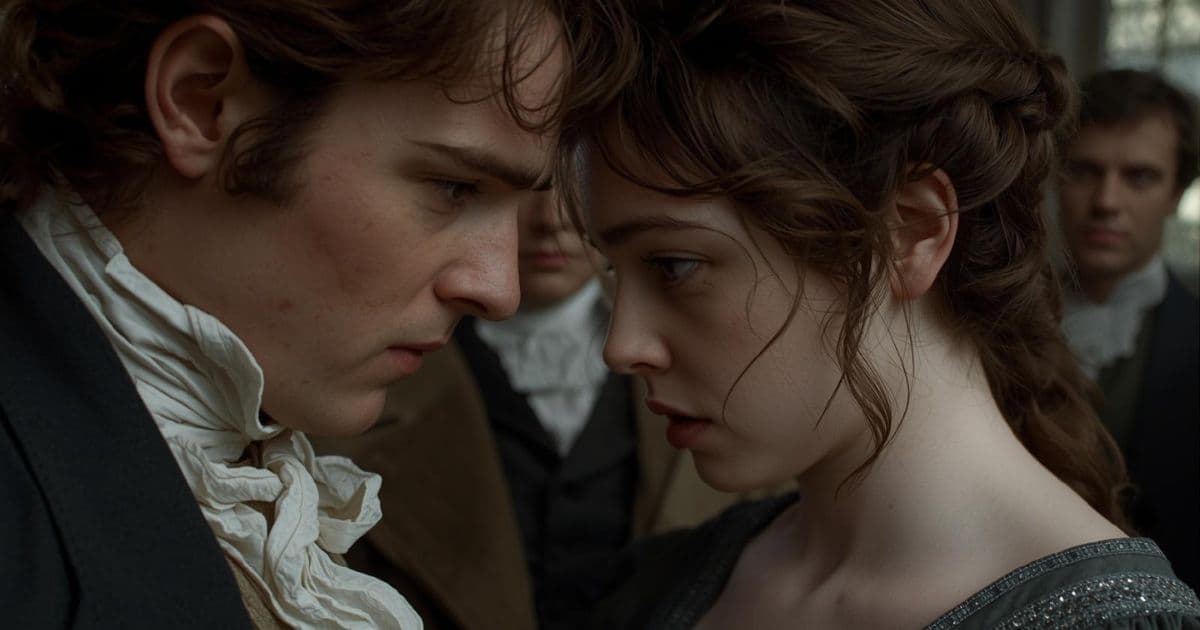
An excerpt from the original text.(complete · 2033 words)
very few days had passed after this adventure, when Harriet came one
morning to Emma with a small parcel in her hand, and after sitting down
and hesitating, thus began:
“Miss Woodhouse—if you are at leisure—I have something that I should
like to tell you—a sort of confession to make—and then, you know, it
will be over.”
Emma was a good deal surprized; but begged her to speak. There was a
seriousness in Harriet’s manner which prepared her, quite as much as
her words, for something more than ordinary.
“It is my duty, and I am sure it is my wish,” she continued, “to have
no reserves with you on this subject. As I am happily quite an altered
creature in one respect, it is very fit that you should have the
satisfaction of knowing it. I do not want to say more than is
necessary—I am too much ashamed of having given way as I have done, and
I dare say you understand me.”
“Yes,” said Emma, “I hope I do.”
“How I could so long a time be fancying myself!...” cried Harriet,
warmly. “It seems like madness! I can see nothing at all extraordinary
in him now.—I do not care whether I meet him or not—except that of the
two I had rather not see him—and indeed I would go any distance round
to avoid him—but I do not envy his wife in the least; I neither admire
her nor envy her, as I have done: she is very charming, I dare say, and
all that, but I think her very ill-tempered and disagreeable—I shall
never forget her look the other night!—However, I assure you, Miss
Woodhouse, I wish her no evil.—No, let them be ever so happy together,
it will not give me another moment’s pang: and to convince you that I
have been speaking truth, I am now going to destroy—what I ought to
have destroyed long ago—what I ought never to have kept—I know that
very well (blushing as she spoke).—However, now I will destroy it
all—and it is my particular wish to do it in your presence, that you
may see how rational I am grown. Cannot you guess what this parcel
holds?” said she, with a conscious look.
“Not the least in the world.—Did he ever give you any thing?”
“No—I cannot call them gifts; but they are things that I have valued
very much.”
She held the parcel towards her, and Emma read the words Most
precious treasures on the top. Her curiosity was greatly excited.
Harriet unfolded the parcel, and she looked on with impatience. Within
abundance of silver paper was a pretty little Tunbridge-ware box, which
Harriet opened: it was well lined with the softest cotton; but,
excepting the cotton, Emma saw only a small piece of court-plaister.
“Now,” said Harriet, “you must recollect.”
“No, indeed I do not.”
“Dear me! I should not have thought it possible you could forget what
passed in this very room about court-plaister, one of the very last
times we ever met in it!—It was but a very few days before I had my
sore throat—just before Mr. and Mrs. John Knightley came—I think the
very evening.—Do not you remember his cutting his finger with your new
penknife, and your recommending court-plaister?—But, as you had none
about you, and knew I had, you desired me to supply him; and so I took
mine out and cut him a piece; but it was a great deal too large, and he
cut it smaller, and kept playing some time with what was left, before
he gave it back to me. And so then, in my nonsense, I could not help
making a treasure of it—so I put it by never to be used, and looked at
it now and then as a great treat.”
“My dearest Harriet!” cried Emma, putting her hand before her face, and
jumping up, “you make me more ashamed of myself than I can bear.
Remember it? Aye, I remember it all now; all, except your saving this
relic—I knew nothing of that till this moment—but the cutting the
finger, and my recommending court-plaister, and saying I had none about
me!—Oh! my sins, my sins!—And I had plenty all the while in my
pocket!—One of my senseless tricks!—I deserve to be under a continual
blush all the rest of my life.—Well—(sitting down again)—go on—what
else?”
“And had you really some at hand yourself? I am sure I never suspected
it, you did it so naturally.”
“And so you actually put this piece of court-plaister by for his sake!”
said Emma, recovering from her state of shame and feeling divided
between wonder and amusement. And secretly she added to herself, “Lord
bless me! when should I ever have thought of putting by in cotton a
piece of court-plaister that Frank Churchill had been pulling about! I
never was equal to this.”
“Here,” resumed Harriet, turning to her box again, “here is something
still more valuable, I mean that has been more valuable, because
this is what did really once belong to him, which the court-plaister
never did.”
Emma was quite eager to see this superior treasure. It was the end of
an old pencil,—the part without any lead.
“This was really his,” said Harriet.—“Do not you remember one
morning?—no, I dare say you do not. But one morning—I forget exactly
the day—but perhaps it was the Tuesday or Wednesday before that
evening, he wanted to make a memorandum in his pocket-book; it was
about spruce-beer. Mr. Knightley had been telling him something about
brewing spruce-beer, and he wanted to put it down; but when he took out
his pencil, there was so little lead that he soon cut it all away, and
it would not do, so you lent him another, and this was left upon the
table as good for nothing. But I kept my eye on it; and, as soon as I
dared, caught it up, and never parted with it again from that moment.”
“I do remember it,” cried Emma; “I perfectly remember it.—Talking about
spruce-beer.—Oh! yes—Mr. Knightley and I both saying we liked it, and
Mr. Elton’s seeming resolved to learn to like it too. I perfectly
remember it.—Stop; Mr. Knightley was standing just here, was not he? I
have an idea he was standing just here.”
“Ah! I do not know. I cannot recollect.—It is very odd, but I cannot
recollect.—Mr. Elton was sitting here, I remember, much about where I
am now.”—
“Well, go on.”
“Oh! that’s all. I have nothing more to shew you, or to say—except that
I am now going to throw them both behind the fire, and I wish you to
see me do it.”
“My poor dear Harriet! and have you actually found happiness in
treasuring up these things?”
“Yes, simpleton as I was!—but I am quite ashamed of it now, and wish I
could forget as easily as I can burn them. It was very wrong of me, you
know, to keep any remembrances, after he was married. I knew it was—but
had not resolution enough to part with them.”
“But, Harriet, is it necessary to burn the court-plaister?—I have not a
word to say for the bit of old pencil, but the court-plaister might be
useful.”
“I shall be happier to burn it,” replied Harriet. “It has a
disagreeable look to me. I must get rid of every thing.—There it goes,
and there is an end, thank Heaven! of Mr. Elton.”
“And when,” thought Emma, “will there be a beginning of Mr. Churchill?”
She had soon afterwards reason to believe that the beginning was
already made, and could not but hope that the gipsy, though she had
told no fortune, might be proved to have made Harriet’s.—About a
fortnight after the alarm, they came to a sufficient explanation, and
quite undesignedly. Emma was not thinking of it at the moment, which
made the information she received more valuable. She merely said, in
the course of some trivial chat, “Well, Harriet, whenever you marry I
would advise you to do so and so”—and thought no more of it, till after
a minute’s silence she heard Harriet say in a very serious tone, “I
shall never marry.”
Emma then looked up, and immediately saw how it was; and after a
moment’s debate, as to whether it should pass unnoticed or not,
replied,
“Never marry!—This is a new resolution.”
“It is one that I shall never change, however.”
After another short hesitation, “I hope it does not proceed from—I hope
it is not in compliment to Mr. Elton?”
“Mr. Elton indeed!” cried Harriet indignantly.—“Oh! no”—and Emma could
just catch the words, “so superior to Mr. Elton!”
She then took a longer time for consideration. Should she proceed no
farther?—should she let it pass, and seem to suspect nothing?—Perhaps
Harriet might think her cold or angry if she did; or perhaps if she
were totally silent, it might only drive Harriet into asking her to
hear too much; and against any thing like such an unreserve as had
been, such an open and frequent discussion of hopes and chances, she
was perfectly resolved.—She believed it would be wiser for her to say
and know at once, all that she meant to say and know. Plain dealing was
always best. She had previously determined how far she would proceed,
on any application of the sort; and it would be safer for both, to have
the judicious law of her own brain laid down with speed.—She was
decided, and thus spoke—
“Harriet, I will not affect to be in doubt of your meaning. Your
resolution, or rather your expectation of never marrying, results from
an idea that the person whom you might prefer, would be too greatly
your superior in situation to think of you. Is not it so?”
“Oh! Miss Woodhouse, believe me I have not the presumption to suppose—
Indeed I am not so mad.—But it is a pleasure to me to admire him at a
distance—and to think of his infinite superiority to all the rest of
the world, with the gratitude, wonder, and veneration, which are so
proper, in me especially.”
“I am not at all surprized at you, Harriet. The service he rendered you
was enough to warm your heart.”
“Service! oh! it was such an inexpressible obligation!—The very
recollection of it, and all that I felt at the time—when I saw him
coming—his noble look—and my wretchedness before. Such a change! In one
moment such a change! From perfect misery to perfect happiness!”
“It is very natural. It is natural, and it is honourable.—Yes,
honourable, I think, to chuse so well and so gratefully.—But that it
will be a fortunate preference is more than I can promise. I do not
advise you to give way to it, Harriet. I do not by any means engage for
its being returned. Consider what you are about. Perhaps it will be
wisest in you to check your feelings while you can: at any rate do not
let them carry you far, unless you are persuaded of his liking you. Be
observant of him. Let his behaviour be the guide of your sensations. I
give you this caution now, because I shall never speak to you again on
the subject. I am determined against all interference. Henceforward I
know nothing of the matter. Let no name ever pass our lips. We were
very wrong before; we will be cautious now.—He is your superior, no
doubt, and there do seem objections and obstacles of a very serious
nature; but yet, Harriet, more wonderful things have taken place, there
have been matches of greater disparity. But take care of yourself. I
would not have you too sanguine; though, however it may end, be assured
your raising your thoughts to him, is a mark of good taste which I
shall always know how to value.”
Harriet kissed her hand in silent and submissive gratitude. Emma was
very decided in thinking such an attachment no bad thing for her
friend. Its tendency would be to raise and refine her mind—and it must
be saving her from the danger of degradation.
Master this chapter. Complete your experience
Purchase the complete book to access all chapters and support classic literature
As an Amazon Associate, we earn a small commission from qualifying purchases at no additional cost to you.
Available in paperback, hardcover, and e-book formats
Let's Analyse the Pattern
We preserve physical objects connected to emotional pain, creating anchors that prevent us from moving forward.
Why This Matters
Connect literature to life
This chapter teaches how to identify when physical objects become anchors that trap us in painful emotional loops.
Practice This Today
This week, notice when you're keeping items that connect you to negative experiences—old texts, photos, gifts from people who hurt you—and ask yourself what story you're not ready to release.
Now let's explore the literary elements.
Key Quotes & Analysis
"How I could so long a time be fancying myself!... It seems like madness! I can see nothing at all extraordinary in him now."
Context: Harriet is confessing how foolish her obsession with Mr. Elton was
This shows genuine self-awareness and growth. Harriet can now see how she built up a fantasy relationship that never existed. Her use of 'madness' shows she understands how irrational her behavior was.
In Today's Words:
I can't believe I was so delusional about him for so long - he's totally ordinary and I don't know what I was thinking.
"I do not want to say more than is necessary—I am too much ashamed of having given way as I have done"
Context: Harriet is embarrassed about her past romantic obsession as she prepares to confess
Harriet shows maturity by taking responsibility for her emotions instead of blaming others. She's learned that she 'gave way' to feelings rather than controlling them, which is real emotional intelligence.
In Today's Words:
I'm embarrassed about how I let myself get so carried away and I don't want to rehash all the cringey details.
"I neither admire her nor envy her, as I have done"
Context: Harriet talking about Mr. Elton's wife, showing she's truly over him
This proves Harriet's feelings have genuinely changed. Before, she was jealous of anyone who had what she wanted. Now she can honestly say she feels nothing, which shows real emotional healing.
In Today's Words:
I don't think his wife is amazing or feel jealous of her anymore - I'm actually over it.
Thematic Threads
Emotional Growth
In This Chapter
Harriet finally recognizes her obsession with Mr. Elton was unhealthy and takes action to break free
Development
Major breakthrough - Harriet moves from passive victim to active agent of her own healing
In Your Life:
You might need to actively destroy reminders of past hurts to truly move forward
Manipulation Consequences
In This Chapter
Emma realizes how her lies about having no bandages fed Harriet's romantic delusions
Development
Emma's growing awareness of how her meddling has real costs for others
In Your Life:
You might discover that small deceptions you thought were harmless actually caused real damage
Class Barriers
In This Chapter
Harriet believes her new love interest is 'too far above her station' to ever consider her
Development
Continuing theme of how class consciousness limits romantic possibilities and self-worth
In Your Life:
You might talk yourself out of opportunities because you assume you don't belong
Pattern Recognition
In This Chapter
Emma sees Harriet has transferred her romantic fixation to someone new but more worthy
Development
Emma's growing ability to analyze relationship patterns, even when she can't control them
In Your Life:
You might notice when someone close to you repeats the same relationship mistakes with different people
Authentic vs Manufactured Feelings
In This Chapter
Emma recognizes Harriet's new attachment is based on real gratitude rather than fantasy
Development
Growing distinction between genuine emotion and socially constructed romance
In Your Life:
You might need to examine whether your feelings are based on real connection or projected fantasies
You now have the context. Time to form your own thoughts.
Discussion Questions
- 1
What physical objects does Harriet burn, and why does she feel the need to destroy them in front of Emma?
analysis • surface - 2
Why does Emma feel mortified when she realizes how her own actions (like hiding her bandages) fed Harriet's obsession with Mr. Elton?
analysis • medium - 3
Where do you see people today keeping 'shrines' to past relationships or painful experiences? What forms do these modern shrines take?
application • medium - 4
When someone you care about is stuck holding onto tokens from a toxic situation, how would you help them without being pushy or judgmental?
application • deep - 5
What does Harriet's need for a witness during her burning ceremony reveal about how we process letting go of emotional attachments?
reflection • deep
Critical Thinking Exercise
Inventory Your Emotional Shrines
Look around your living space and identify three objects you've kept that connect you to a painful memory, failed relationship, or disappointment. For each item, write down what story you tell yourself about why you're keeping it. Then honestly assess: is this object helping you heal and grow, or is it keeping you stuck in the past?
Consider:
- •Consider digital shrines too - saved photos, old text conversations, social media stalking
- •Notice the difference between healthy remembrance and emotional hoarding
- •Think about what you might put in that space instead that represents your future goals
Journaling Prompt
Write about a time when you finally let go of something you'd been holding onto for too long. What made you ready to release it, and how did you feel afterward?
Coming Up Next...
Chapter 41: Secrets Hidden in Plain Sight
Emma's resolve to stay out of Harriet's romantic life will be tested as new developments force her to confront the growing complications of her own interference. Meanwhile, the identity of Harriet's mysterious new love interest becomes clearer.