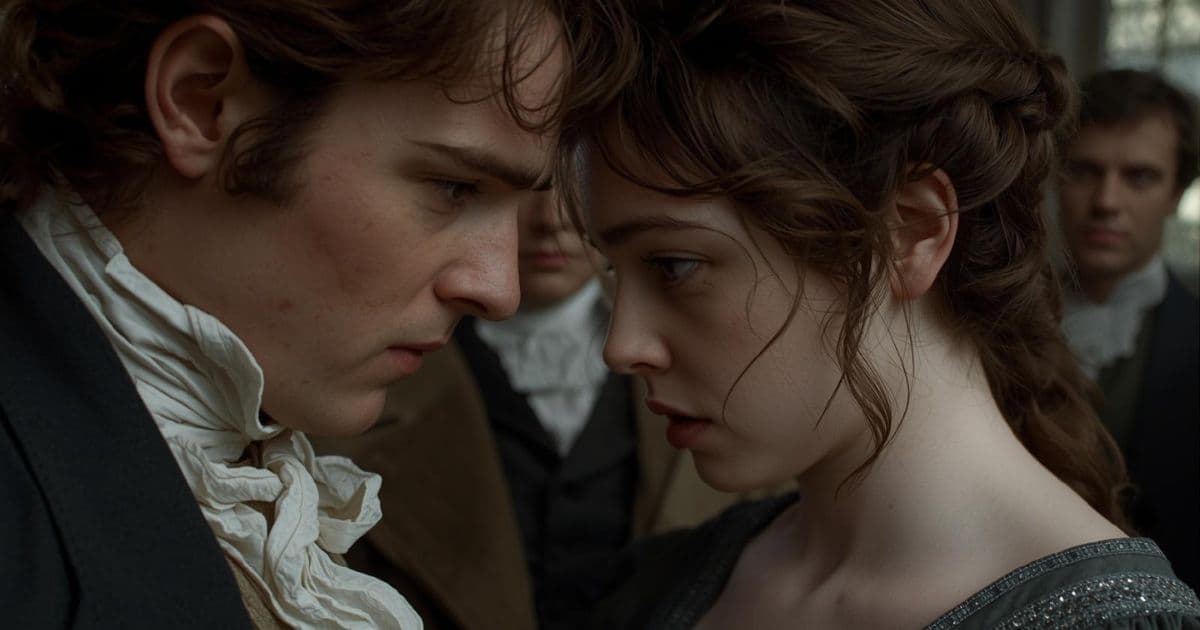
An excerpt from the original text.(complete · 4314 words)
o misfortune occurred, again to prevent the ball. The day approached,
the day arrived; and after a morning of some anxious watching, Frank
Churchill, in all the certainty of his own self, reached Randalls
before dinner, and every thing was safe.
No second meeting had there yet been between him and Emma. The room at
the Crown was to witness it;—but it would be better than a common
meeting in a crowd. Mr. Weston had been so very earnest in his
entreaties for her arriving there as soon as possible after themselves,
for the purpose of taking her opinion as to the propriety and comfort
of the rooms before any other persons came, that she could not refuse
him, and must therefore spend some quiet interval in the young man’s
company. She was to convey Harriet, and they drove to the Crown in good
time, the Randalls party just sufficiently before them.
Frank Churchill seemed to have been on the watch; and though he did not
say much, his eyes declared that he meant to have a delightful evening.
They all walked about together, to see that every thing was as it
should be; and within a few minutes were joined by the contents of
another carriage, which Emma could not hear the sound of at first,
without great surprize. “So unreasonably early!” she was going to
exclaim; but she presently found that it was a family of old friends,
who were coming, like herself, by particular desire, to help Mr.
Weston’s judgment; and they were so very closely followed by another
carriage of cousins, who had been entreated to come early with the same
distinguishing earnestness, on the same errand, that it seemed as if
half the company might soon be collected together for the purpose of
preparatory inspection.
Emma perceived that her taste was not the only taste on which Mr.
Weston depended, and felt, that to be the favourite and intimate of a
man who had so many intimates and confidantes, was not the very first
distinction in the scale of vanity. She liked his open manners, but a
little less of open-heartedness would have made him a higher
character.—General benevolence, but not general friendship, made a man
what he ought to be.—She could fancy such a man. The whole party walked
about, and looked, and praised again; and then, having nothing else to
do, formed a sort of half-circle round the fire, to observe in their
various modes, till other subjects were started, that, though May, a
fire in the evening was still very pleasant.
Emma found that it was not Mr. Weston’s fault that the number of privy
councillors was not yet larger. They had stopped at Mrs. Bates’s door
to offer the use of their carriage, but the aunt and niece were to be
brought by the Eltons.
Frank was standing by her, but not steadily; there was a restlessness,
which shewed a mind not at ease. He was looking about, he was going to
the door, he was watching for the sound of other carriages,—impatient
to begin, or afraid of being always near her.
Mrs. Elton was spoken of. “I think she must be here soon,” said he. “I
have a great curiosity to see Mrs. Elton, I have heard so much of her.
It cannot be long, I think, before she comes.”
A carriage was heard. He was on the move immediately; but coming back,
said,
“I am forgetting that I am not acquainted with her. I have never seen
either Mr. or Mrs. Elton. I have no business to put myself forward.”
Mr. and Mrs. Elton appeared; and all the smiles and the proprieties
passed.
“But Miss Bates and Miss Fairfax!” said Mr. Weston, looking about. “We
thought you were to bring them.”
The mistake had been slight. The carriage was sent for them now. Emma
longed to know what Frank’s first opinion of Mrs. Elton might be; how
he was affected by the studied elegance of her dress, and her smiles of
graciousness. He was immediately qualifying himself to form an opinion,
by giving her very proper attention, after the introduction had passed.
In a few minutes the carriage returned.—Somebody talked of rain.—“I
will see that there are umbrellas, sir,” said Frank to his father:
“Miss Bates must not be forgotten:” and away he went. Mr. Weston was
following; but Mrs. Elton detained him, to gratify him by her opinion
of his son; and so briskly did she begin, that the young man himself,
though by no means moving slowly, could hardly be out of hearing.
“A very fine young man indeed, Mr. Weston. You know I candidly told you
I should form my own opinion; and I am happy to say that I am extremely
pleased with him.—You may believe me. I never compliment. I think him a
very handsome young man, and his manners are precisely what I like and
approve—so truly the gentleman, without the least conceit or puppyism.
You must know I have a vast dislike to puppies—quite a horror of them.
They were never tolerated at Maple Grove. Neither Mr. Suckling nor me
had ever any patience with them; and we used sometimes to say very
cutting things! Selina, who is mild almost to a fault, bore with them
much better.”
While she talked of his son, Mr. Weston’s attention was chained; but
when she got to Maple Grove, he could recollect that there were ladies
just arriving to be attended to, and with happy smiles must hurry away.
Mrs. Elton turned to Mrs. Weston. “I have no doubt of its being our
carriage with Miss Bates and Jane. Our coachman and horses are so
extremely expeditious!—I believe we drive faster than any body.—What a
pleasure it is to send one’s carriage for a friend!—I understand you
were so kind as to offer, but another time it will be quite
unnecessary. You may be very sure I shall always take care of them.”
Miss Bates and Miss Fairfax, escorted by the two gentlemen, walked into
the room; and Mrs. Elton seemed to think it as much her duty as Mrs.
Weston’s to receive them. Her gestures and movements might be
understood by any one who looked on like Emma; but her words, every
body’s words, were soon lost under the incessant flow of Miss Bates,
who came in talking, and had not finished her speech under many minutes
after her being admitted into the circle at the fire. As the door
opened she was heard,
“So very obliging of you!—No rain at all. Nothing to signify. I do not
care for myself. Quite thick shoes. And Jane declares—Well!—(as soon as
she was within the door) Well! This is brilliant indeed!—This is
admirable!—Excellently contrived, upon my word. Nothing wanting. Could
not have imagined it.—So well lighted up!—Jane, Jane, look!—did you
ever see any thing? Oh! Mr. Weston, you must really have had Aladdin’s
lamp. Good Mrs. Stokes would not know her own room again. I saw her as
I came in; she was standing in the entrance. ‘Oh! Mrs. Stokes,’ said
I—but I had not time for more.” She was now met by Mrs. Weston.—“Very
well, I thank you, ma’am. I hope you are quite well. Very happy to hear
it. So afraid you might have a headache!—seeing you pass by so often,
and knowing how much trouble you must have. Delighted to hear it
indeed. Ah! dear Mrs. Elton, so obliged to you for the
carriage!—excellent time. Jane and I quite ready. Did not keep the
horses a moment. Most comfortable carriage.—Oh! and I am sure our
thanks are due to you, Mrs. Weston, on that score. Mrs. Elton had most
kindly sent Jane a note, or we should have been.—But two such offers in
one day!—Never were such neighbours. I said to my mother, ‘Upon my
word, ma’am—.’ Thank you, my mother is remarkably well. Gone to Mr.
Woodhouse’s. I made her take her shawl—for the evenings are not
warm—her large new shawl— Mrs. Dixon’s wedding-present.—So kind of her
to think of my mother! Bought at Weymouth, you know—Mr. Dixon’s choice.
There were three others, Jane says, which they hesitated about some
time. Colonel Campbell rather preferred an olive. My dear Jane, are you
sure you did not wet your feet?—It was but a drop or two, but I am so
afraid:—but Mr. Frank Churchill was so extremely—and there was a mat to
step upon—I shall never forget his extreme politeness.—Oh! Mr. Frank
Churchill, I must tell you my mother’s spectacles have never been in
fault since; the rivet never came out again. My mother often talks of
your good-nature. Does not she, Jane?—Do not we often talk of Mr. Frank
Churchill?—Ah! here’s Miss Woodhouse.—Dear Miss Woodhouse, how do you
do?—Very well I thank you, quite well. This is meeting quite in
fairy-land!—Such a transformation!—Must not compliment, I know (eyeing
Emma most complacently)—that would be rude—but upon my word, Miss
Woodhouse, you do look—how do you like Jane’s hair?—You are a
judge.—She did it all herself. Quite wonderful how she does her
hair!—No hairdresser from London I think could.—Ah! Dr. Hughes I
declare—and Mrs. Hughes. Must go and speak to Dr. and Mrs. Hughes for a
moment.—How do you do? How do you do?—Very well, I thank you. This is
delightful, is not it?—Where’s dear Mr. Richard?—Oh! there he is. Don’t
disturb him. Much better employed talking to the young ladies. How do
you do, Mr. Richard?—I saw you the other day as you rode through the
town—Mrs. Otway, I protest!—and good Mr. Otway, and Miss Otway and Miss
Caroline.—Such a host of friends!—and Mr. George and Mr. Arthur!—How do
you do? How do you all do?—Quite well, I am much obliged to you. Never
better.—Don’t I hear another carriage?—Who can this be?—very likely the
worthy Coles.—Upon my word, this is charming to be standing about among
such friends! And such a noble fire!—I am quite roasted. No coffee, I
thank you, for me—never take coffee.—A little tea if you please, sir,
by and bye,—no hurry—Oh! here it comes. Every thing so good!”
Frank Churchill returned to his station by Emma; and as soon as Miss
Bates was quiet, she found herself necessarily overhearing the
discourse of Mrs. Elton and Miss Fairfax, who were standing a little
way behind her.—He was thoughtful. Whether he were overhearing too, she
could not determine. After a good many compliments to Jane on her dress
and look, compliments very quietly and properly taken, Mrs. Elton was
evidently wanting to be complimented herself—and it was, “How do you
like my gown?—How do you like my trimming?—How has Wright done my
hair?”—with many other relative questions, all answered with patient
politeness. Mrs. Elton then said, “Nobody can think less of dress in
general than I do—but upon such an occasion as this, when every body’s
eyes are so much upon me, and in compliment to the Westons—who I have
no doubt are giving this ball chiefly to do me honour—I would not wish
to be inferior to others. And I see very few pearls in the room except
mine.—So Frank Churchill is a capital dancer, I understand.—We shall
see if our styles suit.—A fine young man certainly is Frank Churchill.
I like him very well.”
At this moment Frank began talking so vigorously, that Emma could not
but imagine he had overheard his own praises, and did not want to hear
more;—and the voices of the ladies were drowned for a while, till
another suspension brought Mrs. Elton’s tones again distinctly
forward.—Mr. Elton had just joined them, and his wife was exclaiming,
“Oh! you have found us out at last, have you, in our seclusion?—I was
this moment telling Jane, I thought you would begin to be impatient for
tidings of us.”
“Jane!”—repeated Frank Churchill, with a look of surprize and
displeasure.—“That is easy—but Miss Fairfax does not disapprove it, I
suppose.”
“How do you like Mrs. Elton?” said Emma in a whisper.
“Not at all.”
“You are ungrateful.”
“Ungrateful!—What do you mean?” Then changing from a frown to a
smile—“No, do not tell me—I do not want to know what you mean.—Where is
my father?—When are we to begin dancing?”
Emma could hardly understand him; he seemed in an odd humour. He walked
off to find his father, but was quickly back again with both Mr. and
Mrs. Weston. He had met with them in a little perplexity, which must be
laid before Emma. It had just occurred to Mrs. Weston that Mrs. Elton
must be asked to begin the ball; that she would expect it; which
interfered with all their wishes of giving Emma that distinction.—Emma
heard the sad truth with fortitude.
“And what are we to do for a proper partner for her?” said Mr. Weston.
“She will think Frank ought to ask her.”
Frank turned instantly to Emma, to claim her former promise; and
boasted himself an engaged man, which his father looked his most
perfect approbation of—and it then appeared that Mrs. Weston was
wanting him to dance with Mrs. Elton himself, and that their business
was to help to persuade him into it, which was done pretty soon.—Mr.
Weston and Mrs. Elton led the way, Mr. Frank Churchill and Miss
Woodhouse followed. Emma must submit to stand second to Mrs. Elton,
though she had always considered the ball as peculiarly for her. It was
almost enough to make her think of marrying. Mrs. Elton had undoubtedly
the advantage, at this time, in vanity completely gratified; for though
she had intended to begin with Frank Churchill, she could not lose by
the change. Mr. Weston might be his son’s superior.—In spite of this
little rub, however, Emma was smiling with enjoyment, delighted to see
the respectable length of the set as it was forming, and to feel that
she had so many hours of unusual festivity before her.—She was more
disturbed by Mr. Knightley’s not dancing than by any thing else.—There
he was, among the standers-by, where he ought not to be; he ought to be
dancing,—not classing himself with the husbands, and fathers, and
whist-players, who were pretending to feel an interest in the dance
till their rubbers were made up,—so young as he looked!—He could not
have appeared to greater advantage perhaps anywhere, than where he had
placed himself. His tall, firm, upright figure, among the bulky forms
and stooping shoulders of the elderly men, was such as Emma felt must
draw every body’s eyes; and, excepting her own partner, there was not
one among the whole row of young men who could be compared with him.—He
moved a few steps nearer, and those few steps were enough to prove in
how gentlemanlike a manner, with what natural grace, he must have
danced, would he but take the trouble.—Whenever she caught his eye, she
forced him to smile; but in general he was looking grave. She wished he
could love a ballroom better, and could like Frank Churchill better.—He
seemed often observing her. She must not flatter herself that he
thought of her dancing, but if he were criticising her behaviour, she
did not feel afraid. There was nothing like flirtation between her and
her partner. They seemed more like cheerful, easy friends, than lovers.
That Frank Churchill thought less of her than he had done, was
indubitable.
The ball proceeded pleasantly. The anxious cares, the incessant
attentions of Mrs. Weston, were not thrown away. Every body seemed
happy; and the praise of being a delightful ball, which is seldom
bestowed till after a ball has ceased to be, was repeatedly given in
the very beginning of the existence of this. Of very important, very
recordable events, it was not more productive than such meetings
usually are. There was one, however, which Emma thought something
of.—The two last dances before supper were begun, and Harriet had no
partner;—the only young lady sitting down;—and so equal had been
hitherto the number of dancers, that how there could be any one
disengaged was the wonder!—But Emma’s wonder lessened soon afterwards,
on seeing Mr. Elton sauntering about. He would not ask Harriet to dance
if it were possible to be avoided: she was sure he would not—and she
was expecting him every moment to escape into the card-room.
Escape, however, was not his plan. He came to the part of the room
where the sitters-by were collected, spoke to some, and walked about in
front of them, as if to shew his liberty, and his resolution of
maintaining it. He did not omit being sometimes directly before Miss
Smith, or speaking to those who were close to her.—Emma saw it. She was
not yet dancing; she was working her way up from the bottom, and had
therefore leisure to look around, and by only turning her head a little
she saw it all. When she was half-way up the set, the whole group were
exactly behind her, and she would no longer allow her eyes to watch;
but Mr. Elton was so near, that she heard every syllable of a dialogue
which just then took place between him and Mrs. Weston; and she
perceived that his wife, who was standing immediately above her, was
not only listening also, but even encouraging him by significant
glances.—The kind-hearted, gentle Mrs. Weston had left her seat to join
him and say, “Do not you dance, Mr. Elton?” to which his prompt reply
was, “Most readily, Mrs. Weston, if you will dance with me.”
“Me!—oh! no—I would get you a better partner than myself. I am no
dancer.”
“If Mrs. Gilbert wishes to dance,” said he, “I shall have great
pleasure, I am sure—for, though beginning to feel myself rather an old
married man, and that my dancing days are over, it would give me very
great pleasure at any time to stand up with an old friend like Mrs.
Gilbert.”
“Mrs. Gilbert does not mean to dance, but there is a young lady
disengaged whom I should be very glad to see dancing—Miss Smith.” “Miss
Smith!—oh!—I had not observed.—You are extremely obliging—and if I were
not an old married man.—But my dancing days are over, Mrs. Weston. You
will excuse me. Any thing else I should be most happy to do, at your
command—but my dancing days are over.”
Mrs. Weston said no more; and Emma could imagine with what surprize and
mortification she must be returning to her seat. This was Mr. Elton!
the amiable, obliging, gentle Mr. Elton.—She looked round for a moment;
he had joined Mr. Knightley at a little distance, and was arranging
himself for settled conversation, while smiles of high glee passed
between him and his wife.
She would not look again. Her heart was in a glow, and she feared her
face might be as hot.
In another moment a happier sight caught her;—Mr. Knightley leading
Harriet to the set!—Never had she been more surprized, seldom more
delighted, than at that instant. She was all pleasure and gratitude,
both for Harriet and herself, and longed to be thanking him; and though
too distant for speech, her countenance said much, as soon as she could
catch his eye again.
His dancing proved to be just what she had believed it, extremely good;
and Harriet would have seemed almost too lucky, if it had not been for
the cruel state of things before, and for the very complete enjoyment
and very high sense of the distinction which her happy features
announced. It was not thrown away on her, she bounded higher than ever,
flew farther down the middle, and was in a continual course of smiles.
Mr. Elton had retreated into the card-room, looking (Emma trusted) very
foolish. She did not think he was quite so hardened as his wife, though
growing very like her;—she spoke some of her feelings, by observing
audibly to her partner,
“Knightley has taken pity on poor little Miss Smith!—Very good-natured,
I declare.”
Supper was announced. The move began; and Miss Bates might be heard
from that moment, without interruption, till her being seated at table
and taking up her spoon.
“Jane, Jane, my dear Jane, where are you?—Here is your tippet. Mrs.
Weston begs you to put on your tippet. She says she is afraid there
will be draughts in the passage, though every thing has been done—One
door nailed up—Quantities of matting—My dear Jane, indeed you must. Mr.
Churchill, oh! you are too obliging! How well you put it on!—so
gratified! Excellent dancing indeed!—Yes, my dear, I ran home, as I
said I should, to help grandmama to bed, and got back again, and nobody
missed me.—I set off without saying a word, just as I told you.
Grandmama was quite well, had a charming evening with Mr. Woodhouse, a
vast deal of chat, and backgammon.—Tea was made downstairs, biscuits
and baked apples and wine before she came away: amazing luck in some of
her throws: and she inquired a great deal about you, how you were
amused, and who were your partners. ‘Oh!’ said I, ‘I shall not
forestall Jane; I left her dancing with Mr. George Otway; she will love
to tell you all about it herself to-morrow: her first partner was Mr.
Elton, I do not know who will ask her next, perhaps Mr. William Cox.’
My dear sir, you are too obliging.—Is there nobody you would not
rather?—I am not helpless. Sir, you are most kind. Upon my word, Jane
on one arm, and me on the other!—Stop, stop, let us stand a little
back, Mrs. Elton is going; dear Mrs. Elton, how elegant she
looks!—Beautiful lace!—Now we all follow in her train. Quite the queen
of the evening!—Well, here we are at the passage. Two steps, Jane, take
care of the two steps. Oh! no, there is but one. Well, I was persuaded
there were two. How very odd! I was convinced there were two, and there
is but one. I never saw any thing equal to the comfort and
style—Candles everywhere.—I was telling you of your grandmama,
Jane,—There was a little disappointment.—The baked apples and biscuits,
excellent in their way, you know; but there was a delicate fricassee of
sweetbread and some asparagus brought in at first, and good Mr.
Woodhouse, not thinking the asparagus quite boiled enough, sent it all
out again. Now there is nothing grandmama loves better than sweetbread
and asparagus—so she was rather disappointed, but we agreed we would
not speak of it to any body, for fear of its getting round to dear Miss
Woodhouse, who would be so very much concerned!—Well, this is
brilliant! I am all amazement! could not have supposed any thing!—Such
elegance and profusion!—I have seen nothing like it since—Well, where
shall we sit? where shall we sit? Anywhere, so that Jane is not in a
draught. Where I sit is of no consequence. Oh! do you recommend this
side?—Well, I am sure, Mr. Churchill—only it seems too good—but just as
you please. What you direct in this house cannot be wrong. Dear Jane,
how shall we ever recollect half the dishes for grandmama? Soup too!
Bless me! I should not be helped so soon, but it smells most excellent,
and I cannot help beginning.”
Emma had no opportunity of speaking to Mr. Knightley till after supper;
but, when they were all in the ballroom again, her eyes invited him
irresistibly to come to her and be thanked. He was warm in his
reprobation of Mr. Elton’s conduct; it had been unpardonable rudeness;
and Mrs. Elton’s looks also received the due share of censure.
“They aimed at wounding more than Harriet,” said he. “Emma, why is it
that they are your enemies?”
He looked with smiling penetration; and, on receiving no answer, added,
“She ought not to be angry with you, I suspect, whatever he may
be.—To that surmise, you say nothing, of course; but confess, Emma,
that you did want him to marry Harriet.”
“I did,” replied Emma, “and they cannot forgive me.”
He shook his head; but there was a smile of indulgence with it, and he
only said,
“I shall not scold you. I leave you to your own reflections.”
“Can you trust me with such flatterers?—Does my vain spirit ever tell
me I am wrong?”
“Not your vain spirit, but your serious spirit.—If one leads you wrong,
I am sure the other tells you of it.”
“I do own myself to have been completely mistaken in Mr. Elton. There
is a littleness about him which you discovered, and which I did not:
and I was fully convinced of his being in love with Harriet. It was
through a series of strange blunders!”
“And, in return for your acknowledging so much, I will do you the
justice to say, that you would have chosen for him better than he has
chosen for himself.—Harriet Smith has some first-rate qualities, which
Mrs. Elton is totally without. An unpretending, single-minded, artless
girl—infinitely to be preferred by any man of sense and taste to such a
woman as Mrs. Elton. I found Harriet more conversable than I expected.”
Emma was extremely gratified.—They were interrupted by the bustle of
Mr. Weston calling on every body to begin dancing again.
“Come Miss Woodhouse, Miss Otway, Miss Fairfax, what are you all
doing?—Come Emma, set your companions the example. Every body is lazy!
Every body is asleep!”
“I am ready,” said Emma, “whenever I am wanted.”
“Whom are you going to dance with?” asked Mr. Knightley.
She hesitated a moment, and then replied, “With you, if you will ask
me.”
“Will you?” said he, offering his hand.
“Indeed I will. You have shewn that you can dance, and you know we are
not really so much brother and sister as to make it at all improper.”
“Brother and sister! no, indeed.”
Master this chapter. Complete your experience
Purchase the complete book to access all chapters and support classic literature
As an Amazon Associate, we earn a small commission from qualifying purchases at no additional cost to you.
Available in paperback, hardcover, and e-book formats
Let's Analyse the Pattern
The Moment of Truth Test
Stressful situations that require choosing between self-protection and kindness instantly reveal true character.
Why This Matters
Connect literature to life
This chapter teaches how stress and social pressure strip away pretense to reveal who people really are.
Practice This Today
This week, notice when someone needs help or support—watch who steps up without being asked and who finds excuses to look away.
Now let's explore the literary elements.
Key Quotes & Analysis
"Mr. Elton had retreated into the card-room, looking (Emma trusted) very foolish."
Context: After Elton refuses to dance with Harriet and retreats from the social consequences
Shows how cruel behavior often backfires socially. Elton thought he was demonstrating superiority but instead revealed his pettiness to everyone watching.
In Today's Words:
He slunk away looking like the jerk everyone now knew he was.
"Her dancing days were over; none but the young could be perfectly certain of being properly partnered."
Context: His excuse for refusing to dance with Harriet while other married men are dancing
A transparent lie that fools no one - he's making excuses to avoid acknowledging Harriet's worth. His words reveal both prejudice and cowardice.
In Today's Words:
I'm too good to be seen with her, but I'll make up some excuse so I don't look bad.
"If I had not thought of it myself, I am sure Mrs. Weston would have asked you to dance."
Context: Speaking to Harriet as he asks her to dance
Shows genuine kindness without making himself the hero - he deflects credit while doing the right thing. His humility makes the gesture more powerful, not less.
In Today's Words:
Someone should have included you already - let me fix that.
Thematic Threads
Class
In This Chapter
Mr. Elton's refusal to dance with Harriet exposes how class prejudice operates through social exclusion
Development
Evolved from Emma's earlier class-based matchmaking mistakes to showing how class cruelty actually functions
In Your Life:
You might see this when coworkers treat service workers differently or when people's attitudes shift based on someone's job title
True Gentility
In This Chapter
Mr. Knightley demonstrates that real class comes from protecting the vulnerable, not from titles or money
Development
Builds on his earlier corrections of Emma to show positive modeling of genuine character
In Your Life:
You recognize this in people who treat everyone with equal respect regardless of their position or background
Social Masks
In This Chapter
The ball strips away everyone's pretenses—the Eltons show their pettiness, Frank his selfishness, Knightley his goodness
Development
Culminates the ongoing theme of appearance versus reality that's run throughout Emma's social observations
In Your Life:
You see this during stressful times when people's true priorities and values become visible
Recognition
In This Chapter
Emma finally sees Mr. Knightley's true worth and chooses to dance with him over Frank Churchill
Development
Marks Emma's growing ability to distinguish between superficial charm and genuine character
In Your Life:
You experience this when you start valuing reliability and kindness over excitement and drama
Power Dynamics
In This Chapter
Those with social power (Eltons) use it to exclude, while those with true strength (Knightley) use it to include
Development
Shows how different characters handle the power and influence they possess
In Your Life:
You notice this in how supervisors, parents, or anyone with authority chooses to use their position
You now have the context. Time to form your own thoughts.
Discussion Questions
- 1
What exactly happened when Harriet was left without a dance partner, and how did different people respond?
analysis • surface - 2
Why do you think Mr. Elton refused to dance with Harriet when he was clearly capable of dancing?
analysis • medium - 3
When have you seen someone's true character revealed during a moment of social pressure or when someone needed help?
application • medium - 4
How do you prepare yourself to choose kindness when it might be socially awkward or inconvenient?
application • deep - 5
What does this scene teach us about the difference between real class and just having money or status?
reflection • deep
Critical Thinking Exercise
Map Your Character-Revealing Moments
Think about the last month and identify three moments when you had to choose between helping someone or protecting yourself socially. Write down what happened, what choice you made, and what it revealed about your priorities. Then identify one upcoming situation where you might face a similar test.
Consider:
- •These moments often happen quickly - the choice between gossiping or defending someone
- •Small acts of inclusion or exclusion reveal as much as big dramatic gestures
- •How you treat people who can't help you back shows your true character
Journaling Prompt
Write about a time when someone showed you unexpected kindness during an awkward or difficult moment. How did it change how you saw them? How did it make you want to treat others?
Coming Up Next...
Chapter 39: The Rescue and the Matchmaker's Hope
The morning after the ball brings unexpected revelations that will change everything Emma thought she knew about the relationships around her. A shocking announcement threatens to upend the careful social order of Highbury.