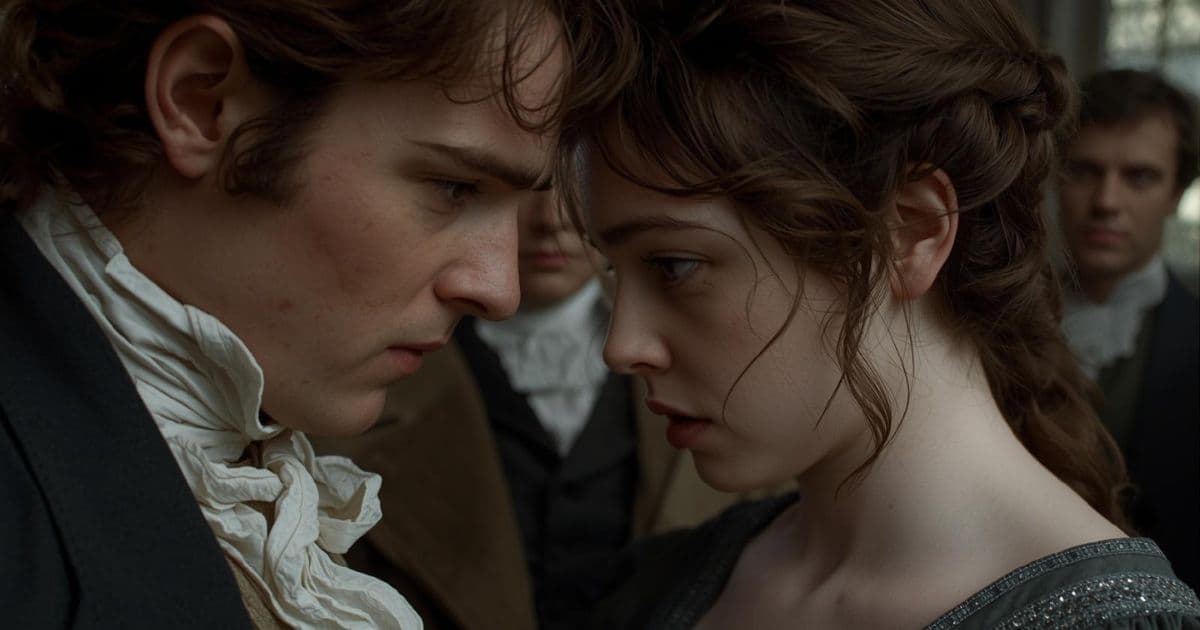
An excerpt from the original text.(complete · 2188 words)
hen the ladies returned to the drawing-room after dinner, Emma found
it hardly possible to prevent their making two distinct parties;—with
so much perseverance in judging and behaving ill did Mrs. Elton engross
Jane Fairfax and slight herself. She and Mrs. Weston were obliged to be
almost always either talking together or silent together. Mrs. Elton
left them no choice. If Jane repressed her for a little time, she soon
began again; and though much that passed between them was in a
half-whisper, especially on Mrs. Elton’s side, there was no avoiding a
knowledge of their principal subjects: The post-office—catching
cold—fetching letters—and friendship, were long under discussion; and
to them succeeded one, which must be at least equally unpleasant to
Jane—inquiries whether she had yet heard of any situation likely to
suit her, and professions of Mrs. Elton’s meditated activity.
“Here is April come!” said she, “I get quite anxious about you. June
will soon be here.”
“But I have never fixed on June or any other month—merely looked
forward to the summer in general.”
“But have you really heard of nothing?”
“I have not even made any inquiry; I do not wish to make any yet.”
“Oh! my dear, we cannot begin too early; you are not aware of the
difficulty of procuring exactly the desirable thing.”
“I not aware!” said Jane, shaking her head; “dear Mrs. Elton, who can
have thought of it as I have done?”
“But you have not seen so much of the world as I have. You do not know
how many candidates there always are for the first situations. I saw
a vast deal of that in the neighbourhood round Maple Grove. A cousin of
Mr. Suckling, Mrs. Bragge, had such an infinity of applications; every
body was anxious to be in her family, for she moves in the first
circle. Wax-candles in the schoolroom! You may imagine how desirable!
Of all houses in the kingdom Mrs. Bragge’s is the one I would most wish
to see you in.”
“Colonel and Mrs. Campbell are to be in town again by midsummer,” said
Jane. “I must spend some time with them; I am sure they will want
it;—afterwards I may probably be glad to dispose of myself. But I would
not wish you to take the trouble of making any inquiries at present.”
“Trouble! aye, I know your scruples. You are afraid of giving me
trouble; but I assure you, my dear Jane, the Campbells can hardly be
more interested about you than I am. I shall write to Mrs. Partridge in
a day or two, and shall give her a strict charge to be on the look-out
for any thing eligible.”
“Thank you, but I would rather you did not mention the subject to her;
till the time draws nearer, I do not wish to be giving any body
trouble.”
“But, my dear child, the time is drawing near; here is April, and June,
or say even July, is very near, with such business to accomplish before
us. Your inexperience really amuses me! A situation such as you
deserve, and your friends would require for you, is no everyday
occurrence, is not obtained at a moment’s notice; indeed, indeed, we
must begin inquiring directly.”
“Excuse me, ma’am, but this is by no means my intention; I make no
inquiry myself, and should be sorry to have any made by my friends.
When I am quite determined as to the time, I am not at all afraid of
being long unemployed. There are places in town, offices, where inquiry
would soon produce something—Offices for the sale—not quite of human
flesh—but of human intellect.”
“Oh! my dear, human flesh! You quite shock me; if you mean a fling at
the slave-trade, I assure you Mr. Suckling was always rather a friend
to the abolition.”
“I did not mean, I was not thinking of the slave-trade,” replied Jane;
“governess-trade, I assure you, was all that I had in view; widely
different certainly as to the guilt of those who carry it on; but as to
the greater misery of the victims, I do not know where it lies. But I
only mean to say that there are advertising offices, and that by
applying to them I should have no doubt of very soon meeting with
something that would do.”
“Something that would do!” repeated Mrs. Elton. “Aye, that may suit
your humble ideas of yourself;—I know what a modest creature you are;
but it will not satisfy your friends to have you taking up with any
thing that may offer, any inferior, commonplace situation, in a family
not moving in a certain circle, or able to command the elegancies of
life.”
“You are very obliging; but as to all that, I am very indifferent; it
would be no object to me to be with the rich; my mortifications, I
think, would only be the greater; I should suffer more from comparison.
A gentleman’s family is all that I should condition for.”
“I know you, I know you; you would take up with any thing; but I shall
be a little more nice, and I am sure the good Campbells will be quite
on my side; with your superior talents, you have a right to move in the
first circle. Your musical knowledge alone would entitle you to name
your own terms, have as many rooms as you like, and mix in the family
as much as you chose;—that is—I do not know—if you knew the harp, you
might do all that, I am very sure; but you sing as well as play;—yes, I
really believe you might, even without the harp, stipulate for what you
chose;—and you must and shall be delightfully, honourably and
comfortably settled before the Campbells or I have any rest.”
“You may well class the delight, the honour, and the comfort of such a
situation together,” said Jane, “they are pretty sure to be equal;
however, I am very serious in not wishing any thing to be attempted at
present for me. I am exceedingly obliged to you, Mrs. Elton, I am
obliged to any body who feels for me, but I am quite serious in wishing
nothing to be done till the summer. For two or three months longer I
shall remain where I am, and as I am.”
“And I am quite serious too, I assure you,” replied Mrs. Elton gaily,
“in resolving to be always on the watch, and employing my friends to
watch also, that nothing really unexceptionable may pass us.”
In this style she ran on; never thoroughly stopped by any thing till
Mr. Woodhouse came into the room; her vanity had then a change of
object, and Emma heard her saying in the same half-whisper to Jane,
“Here comes this dear old beau of mine, I protest!—Only think of his
gallantry in coming away before the other men!—what a dear creature he
is;—I assure you I like him excessively. I admire all that quaint,
old-fashioned politeness; it is much more to my taste than modern ease;
modern ease often disgusts me. But this good old Mr. Woodhouse, I wish
you had heard his gallant speeches to me at dinner. Oh! I assure you I
began to think my cara sposo would be absolutely jealous. I fancy I am
rather a favourite; he took notice of my gown. How do you like
it?—Selina’s choice—handsome, I think, but I do not know whether it is
not over-trimmed; I have the greatest dislike to the idea of being
over-trimmed—quite a horror of finery. I must put on a few ornaments
now, because it is expected of me. A bride, you know, must appear like
a bride, but my natural taste is all for simplicity; a simple style of
dress is so infinitely preferable to finery. But I am quite in the
minority, I believe; few people seem to value simplicity of dress,—show
and finery are every thing. I have some notion of putting such a
trimming as this to my white and silver poplin. Do you think it will
look well?”
The whole party were but just reassembled in the drawing-room when Mr.
Weston made his appearance among them. He had returned to a late
dinner, and walked to Hartfield as soon as it was over. He had been too
much expected by the best judges, for surprize—but there was great joy.
Mr. Woodhouse was almost as glad to see him now, as he would have been
sorry to see him before. John Knightley only was in mute
astonishment.—That a man who might have spent his evening quietly at
home after a day of business in London, should set off again, and walk
half a mile to another man’s house, for the sake of being in mixed
company till bed-time, of finishing his day in the efforts of civility
and the noise of numbers, was a circumstance to strike him deeply. A
man who had been in motion since eight o’clock in the morning, and
might now have been still, who had been long talking, and might have
been silent, who had been in more than one crowd, and might have been
alone!—Such a man, to quit the tranquillity and independence of his own
fireside, and on the evening of a cold sleety April day rush out again
into the world!—Could he by a touch of his finger have instantly taken
back his wife, there would have been a motive; but his coming would
probably prolong rather than break up the party. John Knightley looked
at him with amazement, then shrugged his shoulders, and said, “I could
not have believed it even of him.”
Mr. Weston meanwhile, perfectly unsuspicious of the indignation he was
exciting, happy and cheerful as usual, and with all the right of being
principal talker, which a day spent anywhere from home confers, was
making himself agreeable among the rest; and having satisfied the
inquiries of his wife as to his dinner, convincing her that none of all
her careful directions to the servants had been forgotten, and spread
abroad what public news he had heard, was proceeding to a family
communication, which, though principally addressed to Mrs. Weston, he
had not the smallest doubt of being highly interesting to every body in
the room. He gave her a letter, it was from Frank, and to herself; he
had met with it in his way, and had taken the liberty of opening it.
“Read it, read it,” said he, “it will give you pleasure; only a few
lines—will not take you long; read it to Emma.”
The two ladies looked over it together; and he sat smiling and talking
to them the whole time, in a voice a little subdued, but very audible
to every body.
“Well, he is coming, you see; good news, I think. Well, what do you say
to it?—I always told you he would be here again soon, did not I?—Anne,
my dear, did not I always tell you so, and you would not believe me?—In
town next week, you see—at the latest, I dare say; for she is as
impatient as the black gentleman when any thing is to be done; most
likely they will be there to-morrow or Saturday. As to her illness, all
nothing of course. But it is an excellent thing to have Frank among us
again, so near as town. They will stay a good while when they do come,
and he will be half his time with us. This is precisely what I wanted.
Well, pretty good news, is not it? Have you finished it? Has Emma read
it all? Put it up, put it up; we will have a good talk about it some
other time, but it will not do now. I shall only just mention the
circumstance to the others in a common way.”
Mrs. Weston was most comfortably pleased on the occasion. Her looks and
words had nothing to restrain them. She was happy, she knew she was
happy, and knew she ought to be happy. Her congratulations were warm
and open; but Emma could not speak so fluently. She was a little
occupied in weighing her own feelings, and trying to understand the
degree of her agitation, which she rather thought was considerable.
Mr. Weston, however, too eager to be very observant, too communicative
to want others to talk, was very well satisfied with what she did say,
and soon moved away to make the rest of his friends happy by a partial
communication of what the whole room must have overheard already.
It was well that he took every body’s joy for granted, or he might not
have thought either Mr. Woodhouse or Mr. Knightley particularly
delighted. They were the first entitled, after Mrs. Weston and Emma, to
be made happy;—from them he would have proceeded to Miss Fairfax, but
she was so deep in conversation with John Knightley, that it would have
been too positive an interruption; and finding himself close to Mrs.
Elton, and her attention disengaged, he necessarily began on the
subject with her.
Master this chapter. Complete your experience
Purchase the complete book to access all chapters and support classic literature
As an Amazon Associate, we earn a small commission from qualifying purchases at no additional cost to you.
Available in paperback, hardcover, and e-book formats
Let's Analyse the Pattern
Using offers of assistance as a way to control others, boost one's own ego, and establish social dominance while making the recipient feel obligated and trapped.
Why This Matters
Connect literature to life
This chapter teaches how to distinguish between genuine support and help that serves the helper's ego while controlling the recipient.
Practice This Today
This week, notice when someone offers help but ignores your stated preferences or timeline—that's a red flag that their 'help' is really about them feeling important.
Now let's explore the literary elements.
Key Quotes & Analysis
"I have not even made any inquiry; I do not wish to make any yet."
Context: Jane firmly tells Mrs. Elton she doesn't want help finding a job right now
This shows Jane trying to maintain control over her own life timeline. Her repetition of 'I do not wish' is as firm as politeness allows, but Mrs. Elton ignores these clear boundaries.
In Today's Words:
I'm not ready to job hunt yet, and I don't want your help with it.
"Oh! my dear, we cannot begin too early; you are not aware of the difficulty of procuring exactly the desirable thing."
Context: Mrs. Elton dismisses Jane's wishes and pushes her own timeline
Mrs. Elton assumes she knows better than Jane about Jane's own situation. The phrase 'you are not aware' is particularly condescending—she's telling Jane she doesn't understand her own circumstances.
In Today's Words:
You don't know how hard it is to find a good job, so you need to start now whether you want to or not.
"I not aware! dear Mrs. Elton, who can have thought of it as I have done?"
Context: Jane's rare moment of showing irritation at Mrs. Elton's presumption
This is Jane's most direct pushback in the conversation. Her exclamation shows how insulting it is to be told she doesn't understand her own desperate situation—she's the one who will live with the consequences.
In Today's Words:
Are you kidding me? Nobody has thought about this more than I have!
Thematic Threads
Boundaries
In This Chapter
Jane repeatedly states her preferences about timing and autonomy, but Mrs. Elton bulldozes through every boundary
Development
Building from earlier themes of social pressure—now showing how boundaries become battlegrounds
In Your Life:
You might recognize this when someone keeps pushing after you've said no, making you feel guilty for having preferences
Economic Vulnerability
In This Chapter
Jane's comparison of governess work to slavery reveals how financial dependence strips away choice and dignity
Development
Deepening the class themes—showing how economic pressure makes people vulnerable to exploitation
In Your Life:
You might feel this when job insecurity makes you accept treatment you wouldn't normally tolerate
Social Performance
In This Chapter
Mrs. Elton performs generosity and importance through her helping campaign, using Jane as a prop
Development
Continuing the theme of performative behavior—now showing how 'helping' becomes performance
In Your Life:
You might see this in people who make a big show of their generosity or constantly post about their good deeds
Emotional Avoidance
In This Chapter
Emma feels agitated by Frank's return but can't identify why, avoiding examining her true feelings
Development
Ongoing theme of Emma's self-deception—her emotional intelligence remains limited
In Your Life:
You might recognize this when unexpected news makes you uncomfortable but you can't pinpoint why
You now have the context. Time to form your own thoughts.
Discussion Questions
- 1
How does Mrs. Elton respond when Jane repeatedly asks her to wait before looking for governess positions?
analysis • surface - 2
Why does Mrs. Elton keep pushing to help Jane despite Jane's clear resistance?
analysis • medium - 3
Where have you seen people use 'helping' as a way to control others or make themselves feel important?
application • medium - 4
How would you handle someone like Mrs. Elton who won't respect your boundaries about unwanted help?
application • deep - 5
What does this chapter reveal about the difference between genuine support and weaponized helping?
reflection • deep
Critical Thinking Exercise
Decode the Helper's Real Motivation
Think of someone who frequently offers unwanted help or advice in your life. Write down what they say they're trying to do for you, then write what they might actually be getting out of it. Look for patterns like feeling superior, staying involved in your business, or positioning themselves as the expert.
Consider:
- •Notice if they respect your 'no' or keep pushing their agenda
- •Pay attention to whether they ask what you need or assume they know
- •Consider if their help comes with strings attached or makes you feel obligated
Journaling Prompt
Write about a time when someone's 'help' made you feel controlled rather than supported. How did you handle it, and what would you do differently now?
Coming Up Next...
Chapter 36: Social Climbing and Frank's Return
Frank Churchill's imminent return sets hearts racing and minds spinning. Emma must face feelings she's been avoiding, while the social dynamics of Highbury prepare for another shake-up.