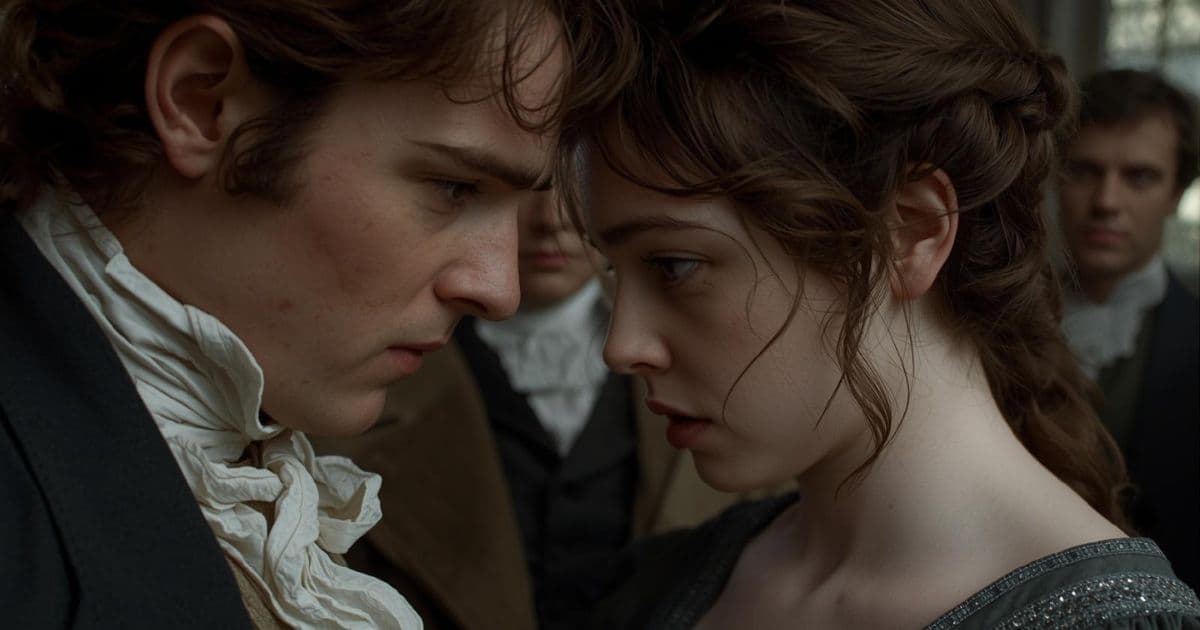
An excerpt from the original text.(complete · 3049 words)
very body in and about Highbury who had ever visited Mr. Elton, was
disposed to pay him attention on his marriage. Dinner-parties and
evening-parties were made for him and his lady; and invitations flowed
in so fast that she had soon the pleasure of apprehending they were
never to have a disengaged day.
“I see how it is,” said she. “I see what a life I am to lead among you.
Upon my word we shall be absolutely dissipated. We really seem quite
the fashion. If this is living in the country, it is nothing very
formidable. From Monday next to Saturday, I assure you we have not a
disengaged day!—A woman with fewer resources than I have, need not have
been at a loss.”
No invitation came amiss to her. Her Bath habits made evening-parties
perfectly natural to her, and Maple Grove had given her a taste for
dinners. She was a little shocked at the want of two drawing rooms, at
the poor attempt at rout-cakes, and there being no ice in the Highbury
card-parties. Mrs. Bates, Mrs. Perry, Mrs. Goddard and others, were a
good deal behind-hand in knowledge of the world, but she would soon
shew them how every thing ought to be arranged. In the course of the
spring she must return their civilities by one very superior party—in
which her card-tables should be set out with their separate candles and
unbroken packs in the true style—and more waiters engaged for the
evening than their own establishment could furnish, to carry round the
refreshments at exactly the proper hour, and in the proper order.
Emma, in the meanwhile, could not be satisfied without a dinner at
Hartfield for the Eltons. They must not do less than others, or she
should be exposed to odious suspicions, and imagined capable of pitiful
resentment. A dinner there must be. After Emma had talked about it for
ten minutes, Mr. Woodhouse felt no unwillingness, and only made the
usual stipulation of not sitting at the bottom of the table himself,
with the usual regular difficulty of deciding who should do it for him.
The persons to be invited, required little thought. Besides the Eltons,
it must be the Westons and Mr. Knightley; so far it was all of
course—and it was hardly less inevitable that poor little Harriet must
be asked to make the eighth:—but this invitation was not given with
equal satisfaction, and on many accounts Emma was particularly pleased
by Harriet’s begging to be allowed to decline it. “She would rather not
be in his company more than she could help. She was not yet quite able
to see him and his charming happy wife together, without feeling
uncomfortable. If Miss Woodhouse would not be displeased, she would
rather stay at home.” It was precisely what Emma would have wished, had
she deemed it possible enough for wishing. She was delighted with the
fortitude of her little friend—for fortitude she knew it was in her to
give up being in company and stay at home; and she could now invite the
very person whom she really wanted to make the eighth, Jane Fairfax.—
Since her last conversation with Mrs. Weston and Mr. Knightley, she was
more conscience-stricken about Jane Fairfax than she had often
been.—Mr. Knightley’s words dwelt with her. He had said that Jane
Fairfax received attentions from Mrs. Elton which nobody else paid her.
“This is very true,” said she, “at least as far as relates to me, which
was all that was meant—and it is very shameful.—Of the same age—and
always knowing her—I ought to have been more her friend.—She will never
like me now. I have neglected her too long. But I will shew her greater
attention than I have done.”
Every invitation was successful. They were all disengaged and all
happy.—The preparatory interest of this dinner, however, was not yet
over. A circumstance rather unlucky occurred. The two eldest little
Knightleys were engaged to pay their grandpapa and aunt a visit of some
weeks in the spring, and their papa now proposed bringing them, and
staying one whole day at Hartfield—which one day would be the very day
of this party.—His professional engagements did not allow of his being
put off, but both father and daughter were disturbed by its happening
so. Mr. Woodhouse considered eight persons at dinner together as the
utmost that his nerves could bear—and here would be a ninth—and Emma
apprehended that it would be a ninth very much out of humour at not
being able to come even to Hartfield for forty-eight hours without
falling in with a dinner-party.
She comforted her father better than she could comfort herself, by
representing that though he certainly would make them nine, yet he
always said so little, that the increase of noise would be very
immaterial. She thought it in reality a sad exchange for herself, to
have him with his grave looks and reluctant conversation opposed to her
instead of his brother.
The event was more favourable to Mr. Woodhouse than to Emma. John
Knightley came; but Mr. Weston was unexpectedly summoned to town and
must be absent on the very day. He might be able to join them in the
evening, but certainly not to dinner. Mr. Woodhouse was quite at ease;
and the seeing him so, with the arrival of the little boys and the
philosophic composure of her brother on hearing his fate, removed the
chief of even Emma’s vexation.
The day came, the party were punctually assembled, and Mr. John
Knightley seemed early to devote himself to the business of being
agreeable. Instead of drawing his brother off to a window while they
waited for dinner, he was talking to Miss Fairfax. Mrs. Elton, as
elegant as lace and pearls could make her, he looked at in
silence—wanting only to observe enough for Isabella’s information—but
Miss Fairfax was an old acquaintance and a quiet girl, and he could
talk to her. He had met her before breakfast as he was returning from a
walk with his little boys, when it had been just beginning to rain. It
was natural to have some civil hopes on the subject, and he said,
“I hope you did not venture far, Miss Fairfax, this morning, or I am
sure you must have been wet.—We scarcely got home in time. I hope you
turned directly.”
“I went only to the post-office,” said she, “and reached home before
the rain was much. It is my daily errand. I always fetch the letters
when I am here. It saves trouble, and is a something to get me out. A
walk before breakfast does me good.”
“Not a walk in the rain, I should imagine.”
“No, but it did not absolutely rain when I set out.”
Mr. John Knightley smiled, and replied,
“That is to say, you chose to have your walk, for you were not six
yards from your own door when I had the pleasure of meeting you; and
Henry and John had seen more drops than they could count long before.
The post-office has a great charm at one period of our lives. When you
have lived to my age, you will begin to think letters are never worth
going through the rain for.”
There was a little blush, and then this answer,
“I must not hope to be ever situated as you are, in the midst of every
dearest connexion, and therefore I cannot expect that simply growing
older should make me indifferent about letters.”
“Indifferent! Oh! no—I never conceived you could become indifferent.
Letters are no matter of indifference; they are generally a very
positive curse.”
“You are speaking of letters of business; mine are letters of
friendship.”
“I have often thought them the worst of the two,” replied he coolly.
“Business, you know, may bring money, but friendship hardly ever does.”
“Ah! you are not serious now. I know Mr. John Knightley too well—I am
very sure he understands the value of friendship as well as any body. I
can easily believe that letters are very little to you, much less than
to me, but it is not your being ten years older than myself which makes
the difference, it is not age, but situation. You have every body
dearest to you always at hand, I, probably, never shall again; and
therefore till I have outlived all my affections, a post-office, I
think, must always have power to draw me out, in worse weather than
to-day.”
“When I talked of your being altered by time, by the progress of
years,” said John Knightley, “I meant to imply the change of situation
which time usually brings. I consider one as including the other. Time
will generally lessen the interest of every attachment not within the
daily circle—but that is not the change I had in view for you. As an
old friend, you will allow me to hope, Miss Fairfax, that ten years
hence you may have as many concentrated objects as I have.”
It was kindly said, and very far from giving offence. A pleasant “thank
you” seemed meant to laugh it off, but a blush, a quivering lip, a tear
in the eye, shewed that it was felt beyond a laugh. Her attention was
now claimed by Mr. Woodhouse, who being, according to his custom on
such occasions, making the circle of his guests, and paying his
particular compliments to the ladies, was ending with her—and with all
his mildest urbanity, said,
“I am very sorry to hear, Miss Fairfax, of your being out this morning
in the rain. Young ladies should take care of themselves.—Young ladies
are delicate plants. They should take care of their health and their
complexion. My dear, did you change your stockings?”
“Yes, sir, I did indeed; and I am very much obliged by your kind
solicitude about me.”
“My dear Miss Fairfax, young ladies are very sure to be cared for.—I
hope your good grand-mama and aunt are well. They are some of my very
old friends. I wish my health allowed me to be a better neighbour. You
do us a great deal of honour to-day, I am sure. My daughter and I are
both highly sensible of your goodness, and have the greatest
satisfaction in seeing you at Hartfield.”
The kind-hearted, polite old man might then sit down and feel that he
had done his duty, and made every fair lady welcome and easy.
By this time, the walk in the rain had reached Mrs. Elton, and her
remonstrances now opened upon Jane.
“My dear Jane, what is this I hear?—Going to the post-office in the
rain!—This must not be, I assure you.—You sad girl, how could you do
such a thing?—It is a sign I was not there to take care of you.”
Jane very patiently assured her that she had not caught any cold.
“Oh! do not tell me. You really are a very sad girl, and do not know
how to take care of yourself.—To the post-office indeed! Mrs. Weston,
did you ever hear the like? You and I must positively exert our
authority.”
“My advice,” said Mrs. Weston kindly and persuasively, “I certainly do
feel tempted to give. Miss Fairfax, you must not run such risks.—Liable
as you have been to severe colds, indeed you ought to be particularly
careful, especially at this time of year. The spring I always think
requires more than common care. Better wait an hour or two, or even
half a day for your letters, than run the risk of bringing on your
cough again. Now do not you feel that you had? Yes, I am sure you are
much too reasonable. You look as if you would not do such a thing
again.”
“Oh! she shall not do such a thing again,” eagerly rejoined Mrs.
Elton. “We will not allow her to do such a thing again:”—and nodding
significantly—“there must be some arrangement made, there must indeed.
I shall speak to Mr. E. The man who fetches our letters every morning
(one of our men, I forget his name) shall inquire for yours too and
bring them to you. That will obviate all difficulties you know; and
from us I really think, my dear Jane, you can have no scruple to
accept such an accommodation.”
“You are extremely kind,” said Jane; “but I cannot give up my early
walk. I am advised to be out of doors as much as I can, I must walk
somewhere, and the post-office is an object; and upon my word, I have
scarcely ever had a bad morning before.”
“My dear Jane, say no more about it. The thing is determined, that is
(laughing affectedly) as far as I can presume to determine any thing
without the concurrence of my lord and master. You know, Mrs. Weston,
you and I must be cautious how we express ourselves. But I do flatter
myself, my dear Jane, that my influence is not entirely worn out. If I
meet with no insuperable difficulties therefore, consider that point as
settled.”
“Excuse me,” said Jane earnestly, “I cannot by any means consent to
such an arrangement, so needlessly troublesome to your servant. If the
errand were not a pleasure to me, it could be done, as it always is
when I am not here, by my grandmama’s.”
“Oh! my dear; but so much as Patty has to do!—And it is a kindness to
employ our men.”
Jane looked as if she did not mean to be conquered; but instead of
answering, she began speaking again to Mr. John Knightley.
“The post-office is a wonderful establishment!” said she.—“The
regularity and despatch of it! If one thinks of all that it has to do,
and all that it does so well, it is really astonishing!”
“It is certainly very well regulated.”
“So seldom that any negligence or blunder appears! So seldom that a
letter, among the thousands that are constantly passing about the
kingdom, is even carried wrong—and not one in a million, I suppose,
actually lost! And when one considers the variety of hands, and of bad
hands too, that are to be deciphered, it increases the wonder.”
“The clerks grow expert from habit.—They must begin with some quickness
of sight and hand, and exercise improves them. If you want any farther
explanation,” continued he, smiling, “they are paid for it. That is the
key to a great deal of capacity. The public pays and must be served
well.”
The varieties of handwriting were farther talked of, and the usual
observations made.
“I have heard it asserted,” said John Knightley, “that the same sort of
handwriting often prevails in a family; and where the same master
teaches, it is natural enough. But for that reason, I should imagine
the likeness must be chiefly confined to the females, for boys have
very little teaching after an early age, and scramble into any hand
they can get. Isabella and Emma, I think, do write very much alike. I
have not always known their writing apart.”
“Yes,” said his brother hesitatingly, “there is a likeness. I know what
you mean—but Emma’s hand is the strongest.”
“Isabella and Emma both write beautifully,” said Mr. Woodhouse; “and
always did. And so does poor Mrs. Weston”—with half a sigh and half a
smile at her.
“I never saw any gentleman’s handwriting”—Emma began, looking also at
Mrs. Weston; but stopped, on perceiving that Mrs. Weston was attending
to some one else—and the pause gave her time to reflect, “Now, how am I
going to introduce him?—Am I unequal to speaking his name at once
before all these people? Is it necessary for me to use any roundabout
phrase?—Your Yorkshire friend—your correspondent in Yorkshire;—that
would be the way, I suppose, if I were very bad.—No, I can pronounce
his name without the smallest distress. I certainly get better and
better.—Now for it.”
Mrs. Weston was disengaged and Emma began again—“Mr. Frank Churchill
writes one of the best gentleman’s hands I ever saw.”
“I do not admire it,” said Mr. Knightley. “It is too small—wants
strength. It is like a woman’s writing.”
This was not submitted to by either lady. They vindicated him against
the base aspersion. “No, it by no means wanted strength—it was not a
large hand, but very clear and certainly strong. Had not Mrs. Weston
any letter about her to produce?” No, she had heard from him very
lately, but having answered the letter, had put it away.
“If we were in the other room,” said Emma, “if I had my writing-desk, I
am sure I could produce a specimen. I have a note of his.—Do not you
remember, Mrs. Weston, employing him to write for you one day?”
“He chose to say he was employed”—
“Well, well, I have that note; and can shew it after dinner to convince
Mr. Knightley.”
“Oh! when a gallant young man, like Mr. Frank Churchill,” said Mr.
Knightley dryly, “writes to a fair lady like Miss Woodhouse, he will,
of course, put forth his best.”
Dinner was on table.—Mrs. Elton, before she could be spoken to, was
ready; and before Mr. Woodhouse had reached her with his request to be
allowed to hand her into the dining-parlour, was saying—
“Must I go first? I really am ashamed of always leading the way.”
Jane’s solicitude about fetching her own letters had not escaped Emma.
She had heard and seen it all; and felt some curiosity to know whether
the wet walk of this morning had produced any. She suspected that it
had; that it would not have been so resolutely encountered but in
full expectation of hearing from some one very dear, and that it had
not been in vain. She thought there was an air of greater happiness
than usual—a glow both of complexion and spirits.
She could have made an inquiry or two, as to the expedition and the
expense of the Irish mails;—it was at her tongue’s end—but she
abstained. She was quite determined not to utter a word that should
hurt Jane Fairfax’s feelings; and they followed the other ladies out of
the room, arm in arm, with an appearance of good-will highly becoming
to the beauty and grace of each.
Master this chapter. Complete your experience
Purchase the complete book to access all chapters and support classic literature
As an Amazon Associate, we earn a small commission from qualifying purchases at no additional cost to you.
Available in paperback, hardcover, and e-book formats
Let's Analyse the Pattern
When people disguise their need for control as generous offers to help, creating dependency while positioning themselves as indispensable.
Why This Matters
Connect literature to life
This chapter teaches how to recognize when someone's offer of assistance is really about gaining control over your choices.
Practice This Today
This week, notice when someone offers help you didn't ask for—watch their reaction if you decline, and trust your instincts about their true motives.
Now let's explore the literary elements.
Key Quotes & Analysis
"Upon my word we shall be absolutely dissipated. We really seem quite the fashion."
Context: Boasting about their busy social calendar to establish their importance
Mrs. Elton immediately positions herself as the center of Highbury society, using fashionable language to show her sophistication. Her tone reveals both pride and a need to prove her status to these 'country people.'
In Today's Words:
OMG, we're going to be so busy! Everyone wants to hang out with us - we're basically celebrities here.
"She would soon shew them how every thing ought to be arranged."
Context: Describing Mrs. Elton's plans to educate Highbury about proper entertaining
This reveals Mrs. Elton's arrogance and need to control others under the guise of improvement. She sees herself as bringing civilization to the provinces, which will create conflict with established residents.
In Today's Words:
She was going to teach these people how things should really be done.
"Oh! yes, I always take care of myself in that respect. I never trust the post-office."
Context: Firmly refusing Mrs. Elton's offer to have her servant collect Jane's mail
Jane's emphatic refusal reveals both her independence and the importance of her correspondence. Her strong reaction suggests these letters are too precious to risk losing or having others handle.
In Today's Words:
No way, I handle my own mail. I don't trust anyone else with it.
"The post-office has a great charm at one period of our lives."
Context: Making a knowing comment about why young people might eagerly await mail
John's subtle hint about romantic correspondence makes Jane blush and become defensive. His lawyer's intuition has detected her secret, and his comment suggests he understands she's receiving love letters.
In Today's Words:
Getting mail is pretty exciting when you're young and in love.
Thematic Threads
Control
In This Chapter
Mrs. Elton immediately tries to manage Jane's mail delivery routine, disguising control as helpfulness
Development
Evolved from Mr. Elton's attempted control over Emma's emotions to his wife's social manipulation
In Your Life:
You might see this when someone keeps offering solutions to problems you haven't complained about
Independence
In This Chapter
Jane firmly refuses Mrs. Elton's offer, insisting on maintaining her daily routine despite inconvenience
Development
Jane's quiet strength emerges as she protects something meaningful from social interference
In Your Life:
You might recognize this when you have to defend choices that work for you but seem strange to others
Social Performance
In This Chapter
The dinner party becomes a stage where Mrs. Elton performs her role as social improver and Jane performs polite resistance
Development
Continues from Emma's matchmaking performances, now showing how newcomers establish their social position
In Your Life:
You might see this in how people act differently at work events versus casual gatherings
Hidden Motives
In This Chapter
Jane's daily walks to the post office clearly serve a deeper purpose than just mail collection
Development
Builds on the theme of characters pursuing secret agendas while maintaining public facades
In Your Life:
You might notice this when someone's routine seems unnecessarily complicated until you understand what they're really protecting
Class Assumptions
In This Chapter
Mrs. Elton assumes her social position gives her the right to reorganize how others live their lives
Development
Deepens from earlier class tensions to show how people use perceived status to justify interference
In Your Life:
You might experience this when someone assumes their job title or background makes them an expert on your situation
You now have the context. Time to form your own thoughts.
Discussion Questions
- 1
Why does Mrs. Elton immediately offer to have her servant collect Jane's mail, and why does Jane refuse so firmly?
analysis • surface - 2
What does Mrs. Elton's reaction to Jane's refusal reveal about her true motivations for 'helping'?
analysis • medium - 3
Think of someone in your life who always offers unsolicited help or advice. How do they respond when you decline their suggestions?
application • medium - 4
How can you tell the difference between someone who genuinely wants to help and someone who needs to feel important by controlling others?
application • deep - 5
What does Jane's insistence on maintaining her independence teach us about protecting our autonomy while staying open to genuine support?
reflection • deep
Critical Thinking Exercise
Decode the Helper's True Agenda
Think of a recent situation where someone offered you help you didn't ask for. Write down exactly what they said, how they said it, and how they reacted when you responded. Then analyze: What did they really want from this interaction? What would have happened if you'd accepted their help?
Consider:
- •Notice if they got defensive or pushy when you declined
- •Consider whether their 'help' would have made them feel important or necessary
- •Examine if accepting would have created ongoing dependence or obligation
Journaling Prompt
Write about a time when you had to set boundaries with someone who disguised control as kindness. How did you handle it, and what would you do differently now?
Coming Up Next...
Chapter 35: When Help Becomes Harassment
The dinner party continues with more revealing conversations and social tensions. Emma's observations about Jane's mysterious correspondence will lead to new discoveries about the secrets being kept in Highbury's seemingly transparent social circle.