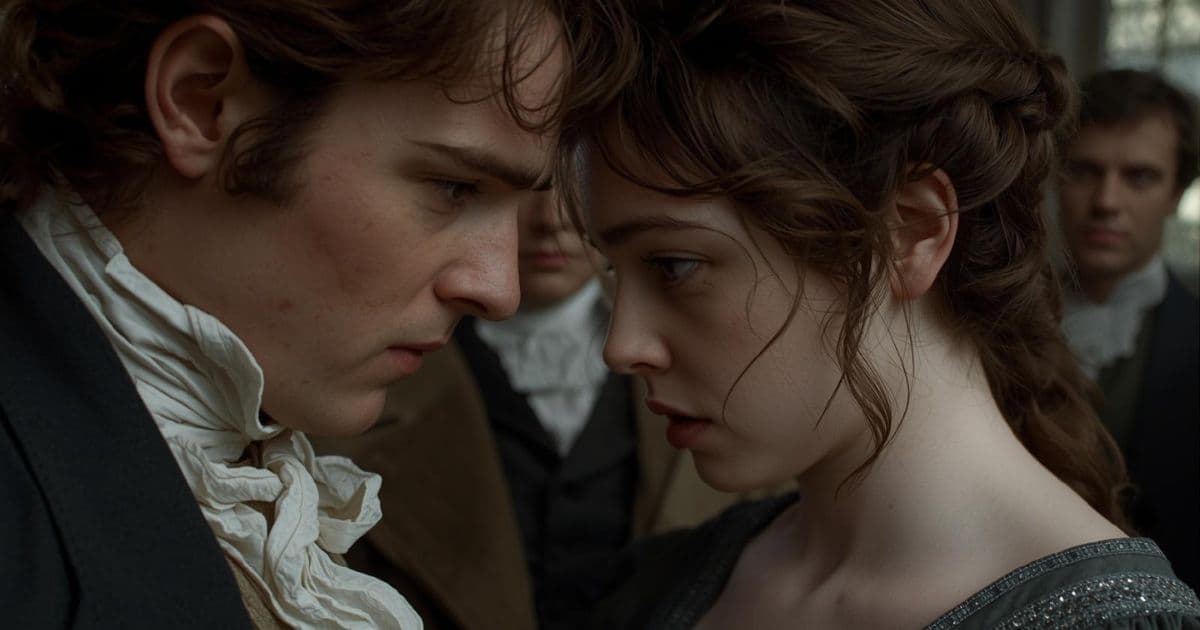
An excerpt from the original text.(complete · 2906 words)
mma was not required, by any subsequent discovery, to retract her ill
opinion of Mrs. Elton. Her observation had been pretty correct. Such as
Mrs. Elton appeared to her on this second interview, such she appeared
whenever they met again,—self-important, presuming, familiar, ignorant,
and ill-bred. She had a little beauty and a little accomplishment, but
so little judgment that she thought herself coming with superior
knowledge of the world, to enliven and improve a country neighbourhood;
and conceived Miss Hawkins to have held such a place in society as Mrs.
Elton’s consequence only could surpass.
There was no reason to suppose Mr. Elton thought at all differently
from his wife. He seemed not merely happy with her, but proud. He had
the air of congratulating himself on having brought such a woman to
Highbury, as not even Miss Woodhouse could equal; and the greater part
of her new acquaintance, disposed to commend, or not in the habit of
judging, following the lead of Miss Bates’s good-will, or taking it for
granted that the bride must be as clever and as agreeable as she
professed herself, were very well satisfied; so that Mrs. Elton’s
praise passed from one mouth to another as it ought to do, unimpeded by
Miss Woodhouse, who readily continued her first contribution and talked
with a good grace of her being “very pleasant and very elegantly
dressed.”
In one respect Mrs. Elton grew even worse than she had appeared at
first. Her feelings altered towards Emma.—Offended, probably, by the
little encouragement which her proposals of intimacy met with, she drew
back in her turn and gradually became much more cold and distant; and
though the effect was agreeable, the ill-will which produced it was
necessarily increasing Emma’s dislike. Her manners, too—and Mr.
Elton’s, were unpleasant towards Harriet. They were sneering and
negligent. Emma hoped it must rapidly work Harriet’s cure; but the
sensations which could prompt such behaviour sunk them both very
much.—It was not to be doubted that poor Harriet’s attachment had been
an offering to conjugal unreserve, and her own share in the story,
under a colouring the least favourable to her and the most soothing to
him, had in all likelihood been given also. She was, of course, the
object of their joint dislike.—When they had nothing else to say, it
must be always easy to begin abusing Miss Woodhouse; and the enmity
which they dared not shew in open disrespect to her, found a broader
vent in contemptuous treatment of Harriet.
Mrs. Elton took a great fancy to Jane Fairfax; and from the first. Not
merely when a state of warfare with one young lady might be supposed to
recommend the other, but from the very first; and she was not satisfied
with expressing a natural and reasonable admiration—but without
solicitation, or plea, or privilege, she must be wanting to assist and
befriend her.—Before Emma had forfeited her confidence, and about the
third time of their meeting, she heard all Mrs. Elton’s knight-errantry
on the subject.—
“Jane Fairfax is absolutely charming, Miss Woodhouse.—I quite rave
about Jane Fairfax.—A sweet, interesting creature. So mild and
ladylike—and with such talents!—I assure you I think she has very
extraordinary talents. I do not scruple to say that she plays extremely
well. I know enough of music to speak decidedly on that point. Oh! she
is absolutely charming! You will laugh at my warmth—but, upon my word,
I talk of nothing but Jane Fairfax.—And her situation is so calculated
to affect one!—Miss Woodhouse, we must exert ourselves and endeavour to
do something for her. We must bring her forward. Such talent as hers
must not be suffered to remain unknown.—I dare say you have heard those
charming lines of the poet,
‘Full many a flower is born to blush unseen,
‘And waste its fragrance on the desert air.’
We must not allow them to be verified in sweet Jane Fairfax.”
“I cannot think there is any danger of it,” was Emma’s calm answer—“and
when you are better acquainted with Miss Fairfax’s situation and
understand what her home has been, with Colonel and Mrs. Campbell, I
have no idea that you will suppose her talents can be unknown.”
“Oh! but dear Miss Woodhouse, she is now in such retirement, such
obscurity, so thrown away.—Whatever advantages she may have enjoyed
with the Campbells are so palpably at an end! And I think she feels it.
I am sure she does. She is very timid and silent. One can see that she
feels the want of encouragement. I like her the better for it. I must
confess it is a recommendation to me. I am a great advocate for
timidity—and I am sure one does not often meet with it.—But in those
who are at all inferior, it is extremely prepossessing. Oh! I assure
you, Jane Fairfax is a very delightful character, and interests me more
than I can express.”
“You appear to feel a great deal—but I am not aware how you or any of
Miss Fairfax’s acquaintance here, any of those who have known her
longer than yourself, can shew her any other attention than”—
“My dear Miss Woodhouse, a vast deal may be done by those who dare to
act. You and I need not be afraid. If we set the example, many will
follow it as far as they can; though all have not our situations. We
have carriages to fetch and convey her home, and we live in a style
which could not make the addition of Jane Fairfax, at any time, the
least inconvenient.—I should be extremely displeased if Wright were to
send us up such a dinner, as could make me regret having asked more
than Jane Fairfax to partake of it. I have no idea of that sort of
thing. It is not likely that I should, considering what I have been
used to. My greatest danger, perhaps, in housekeeping, may be quite the
other way, in doing too much, and being too careless of expense. Maple
Grove will probably be my model more than it ought to be—for we do not
at all affect to equal my brother, Mr. Suckling, in income.—However, my
resolution is taken as to noticing Jane Fairfax.—I shall certainly have
her very often at my house, shall introduce her wherever I can, shall
have musical parties to draw out her talents, and shall be constantly
on the watch for an eligible situation. My acquaintance is so very
extensive, that I have little doubt of hearing of something to suit her
shortly.—I shall introduce her, of course, very particularly to my
brother and sister when they come to us. I am sure they will like her
extremely; and when she gets a little acquainted with them, her fears
will completely wear off, for there really is nothing in the manners of
either but what is highly conciliating.—I shall have her very often
indeed while they are with me, and I dare say we shall sometimes find a
seat for her in the barouche-landau in some of our exploring parties.”
“Poor Jane Fairfax!”—thought Emma.—“You have not deserved this. You may
have done wrong with regard to Mr. Dixon, but this is a punishment
beyond what you can have merited!—The kindness and protection of Mrs.
Elton!—‘Jane Fairfax and Jane Fairfax.’ Heavens! Let me not suppose
that she dares go about, Emma Woodhouse-ing me!—But upon my honour,
there seems no limits to the licentiousness of that woman’s tongue!”
Emma had not to listen to such paradings again—to any so exclusively
addressed to herself—so disgustingly decorated with a “dear Miss
Woodhouse.” The change on Mrs. Elton’s side soon afterwards appeared,
and she was left in peace—neither forced to be the very particular
friend of Mrs. Elton, nor, under Mrs. Elton’s guidance, the very active
patroness of Jane Fairfax, and only sharing with others in a general
way, in knowing what was felt, what was meditated, what was done.
She looked on with some amusement.—Miss Bates’s gratitude for Mrs.
Elton’s attentions to Jane was in the first style of guileless
simplicity and warmth. She was quite one of her worthies—the most
amiable, affable, delightful woman—just as accomplished and
condescending as Mrs. Elton meant to be considered. Emma’s only
surprize was that Jane Fairfax should accept those attentions and
tolerate Mrs. Elton as she seemed to do. She heard of her walking with
the Eltons, sitting with the Eltons, spending a day with the Eltons!
This was astonishing!—She could not have believed it possible that the
taste or the pride of Miss Fairfax could endure such society and
friendship as the Vicarage had to offer.
“She is a riddle, quite a riddle!” said she.—“To chuse to remain here
month after month, under privations of every sort! And now to chuse the
mortification of Mrs. Elton’s notice and the penury of her
conversation, rather than return to the superior companions who have
always loved her with such real, generous affection.”
Jane had come to Highbury professedly for three months; the Campbells
were gone to Ireland for three months; but now the Campbells had
promised their daughter to stay at least till Midsummer, and fresh
invitations had arrived for her to join them there. According to Miss
Bates—it all came from her—Mrs. Dixon had written most pressingly.
Would Jane but go, means were to be found, servants sent, friends
contrived—no travelling difficulty allowed to exist; but still she had
declined it!
“She must have some motive, more powerful than appears, for refusing
this invitation,” was Emma’s conclusion. “She must be under some sort
of penance, inflicted either by the Campbells or herself. There is
great fear, great caution, great resolution somewhere.—She is not to
be with the Dixons. The decree is issued by somebody. But why must
she consent to be with the Eltons?—Here is quite a separate puzzle.”
Upon her speaking her wonder aloud on that part of the subject, before
the few who knew her opinion of Mrs. Elton, Mrs. Weston ventured this
apology for Jane.
“We cannot suppose that she has any great enjoyment at the Vicarage, my
dear Emma—but it is better than being always at home. Her aunt is a
good creature, but, as a constant companion, must be very tiresome. We
must consider what Miss Fairfax quits, before we condemn her taste for
what she goes to.”
“You are right, Mrs. Weston,” said Mr. Knightley warmly, “Miss Fairfax
is as capable as any of us of forming a just opinion of Mrs. Elton.
Could she have chosen with whom to associate, she would not have chosen
her. But (with a reproachful smile at Emma) she receives attentions
from Mrs. Elton, which nobody else pays her.”
Emma felt that Mrs. Weston was giving her a momentary glance; and she
was herself struck by his warmth. With a faint blush, she presently
replied,
“Such attentions as Mrs. Elton’s, I should have imagined, would rather
disgust than gratify Miss Fairfax. Mrs. Elton’s invitations I should
have imagined any thing but inviting.”
“I should not wonder,” said Mrs. Weston, “if Miss Fairfax were to have
been drawn on beyond her own inclination, by her aunt’s eagerness in
accepting Mrs. Elton’s civilities for her. Poor Miss Bates may very
likely have committed her niece and hurried her into a greater
appearance of intimacy than her own good sense would have dictated, in
spite of the very natural wish of a little change.”
Both felt rather anxious to hear him speak again; and after a few
minutes silence, he said,
“Another thing must be taken into consideration too—Mrs. Elton does not
talk to Miss Fairfax as she speaks of her. We all know the
difference between the pronouns he or she and thou, the plainest spoken
amongst us; we all feel the influence of a something beyond common
civility in our personal intercourse with each other—a something more
early implanted. We cannot give any body the disagreeable hints that we
may have been very full of the hour before. We feel things differently.
And besides the operation of this, as a general principle, you may be
sure that Miss Fairfax awes Mrs. Elton by her superiority both of mind
and manner; and that, face to face, Mrs. Elton treats her with all the
respect which she has a claim to. Such a woman as Jane Fairfax probably
never fell in Mrs. Elton’s way before—and no degree of vanity can
prevent her acknowledging her own comparative littleness in action, if
not in consciousness.”
“I know how highly you think of Jane Fairfax,” said Emma. Little Henry
was in her thoughts, and a mixture of alarm and delicacy made her
irresolute what else to say.
“Yes,” he replied, “any body may know how highly I think of her.”
“And yet,” said Emma, beginning hastily and with an arch look, but soon
stopping—it was better, however, to know the worst at once—she hurried
on—“And yet, perhaps, you may hardly be aware yourself how highly it
is. The extent of your admiration may take you by surprize some day or
other.”
Mr. Knightley was hard at work upon the lower buttons of his thick
leather gaiters, and either the exertion of getting them together, or
some other cause, brought the colour into his face, as he answered,
“Oh! are you there?—But you are miserably behindhand. Mr. Cole gave me
a hint of it six weeks ago.”
He stopped.—Emma felt her foot pressed by Mrs. Weston, and did not
herself know what to think. In a moment he went on—
“That will never be, however, I can assure you. Miss Fairfax, I dare
say, would not have me if I were to ask her—and I am very sure I shall
never ask her.”
Emma returned her friend’s pressure with interest; and was pleased
enough to exclaim,
“You are not vain, Mr. Knightley. I will say that for you.”
He seemed hardly to hear her; he was thoughtful—and in a manner which
shewed him not pleased, soon afterwards said,
“So you have been settling that I should marry Jane Fairfax?”
“No indeed I have not. You have scolded me too much for match-making,
for me to presume to take such a liberty with you. What I said just
now, meant nothing. One says those sort of things, of course, without
any idea of a serious meaning. Oh! no, upon my word I have not the
smallest wish for your marrying Jane Fairfax or Jane any body. You
would not come in and sit with us in this comfortable way, if you were
married.”
Mr. Knightley was thoughtful again. The result of his reverie was, “No,
Emma, I do not think the extent of my admiration for her will ever take
me by surprize.—I never had a thought of her in that way, I assure
you.” And soon afterwards, “Jane Fairfax is a very charming young
woman—but not even Jane Fairfax is perfect. She has a fault. She has
not the open temper which a man would wish for in a wife.”
Emma could not but rejoice to hear that she had a fault. “Well,” said
she, “and you soon silenced Mr. Cole, I suppose?”
“Yes, very soon. He gave me a quiet hint; I told him he was mistaken;
he asked my pardon and said no more. Cole does not want to be wiser or
wittier than his neighbours.”
“In that respect how unlike dear Mrs. Elton, who wants to be wiser and
wittier than all the world! I wonder how she speaks of the Coles—what
she calls them! How can she find any appellation for them, deep enough
in familiar vulgarity? She calls you, Knightley—what can she do for Mr.
Cole? And so I am not to be surprized that Jane Fairfax accepts her
civilities and consents to be with her. Mrs. Weston, your argument
weighs most with me. I can much more readily enter into the temptation
of getting away from Miss Bates, than I can believe in the triumph of
Miss Fairfax’s mind over Mrs. Elton. I have no faith in Mrs. Elton’s
acknowledging herself the inferior in thought, word, or deed; or in her
being under any restraint beyond her own scanty rule of good-breeding.
I cannot imagine that she will not be continually insulting her visitor
with praise, encouragement, and offers of service; that she will not be
continually detailing her magnificent intentions, from the procuring
her a permanent situation to the including her in those delightful
exploring parties which are to take place in the barouche-landau.”
“Jane Fairfax has feeling,” said Mr. Knightley—“I do not accuse her of
want of feeling. Her sensibilities, I suspect, are strong—and her
temper excellent in its power of forbearance, patience, self-control;
but it wants openness. She is reserved, more reserved, I think, than
she used to be—And I love an open temper. No—till Cole alluded to my
supposed attachment, it had never entered my head. I saw Jane Fairfax
and conversed with her, with admiration and pleasure always—but with no
thought beyond.”
“Well, Mrs. Weston,” said Emma triumphantly when he left them, “what do
you say now to Mr. Knightley’s marrying Jane Fairfax?”
“Why, really, dear Emma, I say that he is so very much occupied by the
idea of not being in love with her, that I should not wonder if it
were to end in his being so at last. Do not beat me.”
Master this chapter. Complete your experience
Purchase the complete book to access all chapters and support classic literature
As an Amazon Associate, we earn a small commission from qualifying purchases at no additional cost to you.
Available in paperback, hardcover, and e-book formats
Let's Analyse the Pattern
Using acts of help or generosity to gain social status, control, or leverage over others rather than genuinely serving their needs.
Why This Matters
Connect literature to life
This chapter teaches how to recognize when someone uses helping as a way to gain power and social status rather than genuinely supporting others.
Practice This Today
This week, notice when someone's offer to help seems more about making them look good than addressing your actual needs—trust your discomfort and maintain clear boundaries about what assistance you actually want.
Now let's explore the literary elements.
Key Quotes & Analysis
"She had a little beauty and a little accomplishment, but so little judgment that she thought herself coming with superior knowledge of the world, to enliven and improve a country neighbourhood"
Context: Describing Mrs. Elton's inflated sense of her own importance
This perfectly captures how a little bit of knowledge can make someone dangerous. Mrs. Elton's small advantages have given her massive overconfidence.
In Today's Words:
She was decent-looking and had some skills, but was so clueless she thought she was doing everyone a favor just by showing up.
"Poor Jane Fairfax!"
Context: Emma's reaction to Mrs. Elton's patronizing treatment of Jane
Shows Emma's growing empathy and ability to see how others suffer from social manipulation. It's a moment of genuine compassion.
In Today's Words:
That poor girl - she has no idea what she's gotten herself into.
"I have not the presumption to suppose that I might not be equally attracted by her if I had known her as you do"
Context: Explaining to Emma why he's not romantically interested in Jane
Knightley shows remarkable self-awareness about his preferences while being respectful of Jane. He knows what works for him without putting others down.
In Today's Words:
Look, she might be great, but we're just not compatible - I need someone more open.
Thematic Threads
Class
In This Chapter
Mrs. Elton uses her perceived social position to patronize Jane, treating her like a charity case despite Jane's superior education and refinement
Development
Evolved from earlier focus on Emma's class assumptions to showing how newcomers manipulate class dynamics
In Your Life:
You might encounter people who use their job title, income, or connections to talk down to you while pretending to help
Identity
In This Chapter
Mrs. Elton constructs her identity around being a benefactor and patron, needing others to be inferior so she can feel superior
Development
Builds on Emma's identity struggles by showing how some people build identity through manufactured superiority
In Your Life:
You might know someone who always needs to be the helper, the advice-giver, or the person others depend on
Boundaries
In This Chapter
Jane's discomfort with Mrs. Elton's unwanted attention shows how hard it is to reject help without seeming ungrateful
Development
Introduced here as a new theme about protecting autonomy while navigating social expectations
In Your Life:
You might struggle to say no to help that feels controlling because rejecting it seems rude or ungrateful
Authentic Relationships
In This Chapter
Knightley's honest assessment of his feelings for Jane contrasts with Mrs. Elton's performative concern
Development
Continues the theme of genuine versus artificial connections from earlier chapters
In Your Life:
You might notice the difference between people who are honest about their limitations and those who perform caring for an audience
Social Performance
In This Chapter
Mrs. Elton's public displays of generosity toward Jane are designed for the audience, not for Jane's benefit
Development
Builds on earlier themes about social theater by showing how charity can become performance
In Your Life:
You might see people who make a big show of their generosity on social media or in public settings
You now have the context. Time to form your own thoughts.
Discussion Questions
- 1
What specific behaviors does Mrs. Elton display toward Jane Fairfax that reveal her true motivations?
analysis • surface - 2
Why does Mrs. Elton's 'charity' make Emma uncomfortable, even though helping Jane seems like a good thing?
analysis • medium - 3
Where do you see this pattern of weaponized charity in your workplace, family, or community today?
application • medium - 4
How would you handle someone who insists on 'helping' you in ways that feel controlling or condescending?
application • deep - 5
What's the difference between genuine support and charity that comes with invisible strings attached?
reflection • deep
Critical Thinking Exercise
Decode the Helper's True Agenda
Think of someone in your life who frequently offers help or advice. Write down what they say they're doing versus what they might actually be getting from the situation. Look for patterns: Do they help publicly or privately? Do they remind you of their help later? Do they seem more invested in being seen as helpful than in your actual needs?
Consider:
- •Notice if their help creates dependency rather than independence
- •Pay attention to whether they respect your boundaries when you decline help
- •Consider if their assistance comes with expectations or strings attached
Journaling Prompt
Write about a time when someone's help felt controlling or uncomfortable. What red flags did you notice? How did you handle it, and what would you do differently now?
Coming Up Next...
Chapter 34: Social Maneuvering and Hidden Letters
As Mrs. Elton's schemes for Jane Fairfax continue to unfold, the social dynamics of Highbury grow more complex. New developments will test the relationships between all the major characters.