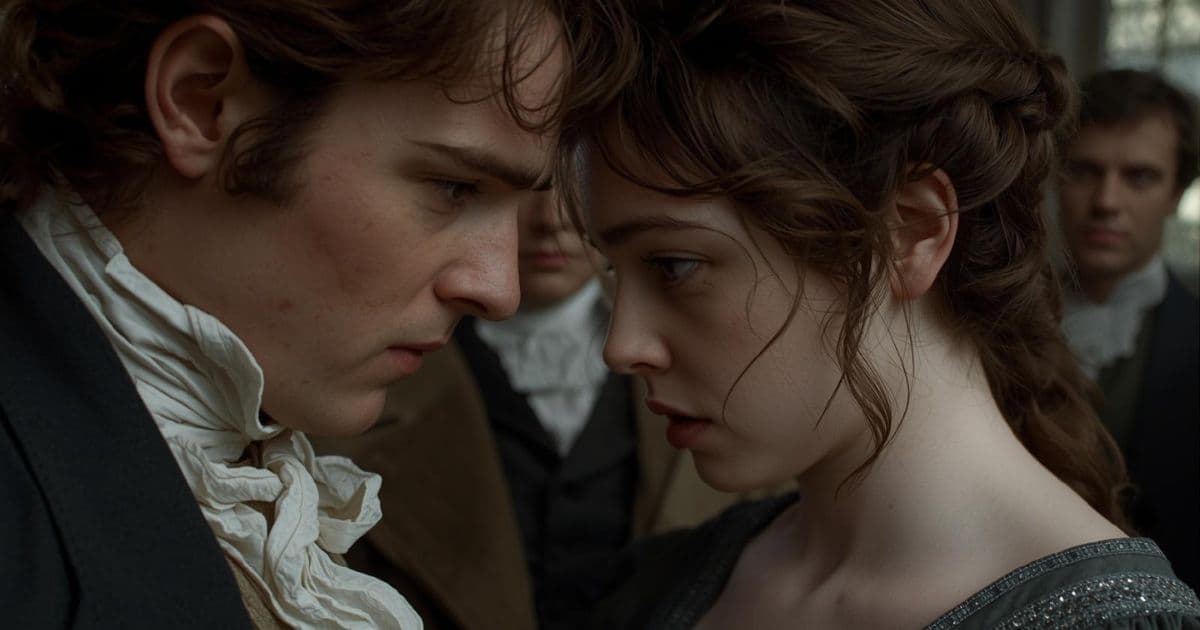
An excerpt from the original text.(complete · 3760 words)
rs. Elton was first seen at church: but though devotion might be
interrupted, curiosity could not be satisfied by a bride in a pew, and
it must be left for the visits in form which were then to be paid, to
settle whether she were very pretty indeed, or only rather pretty, or
not pretty at all.
Emma had feelings, less of curiosity than of pride or propriety, to
make her resolve on not being the last to pay her respects; and she
made a point of Harriet’s going with her, that the worst of the
business might be gone through as soon as possible.
She could not enter the house again, could not be in the same room to
which she had with such vain artifice retreated three months ago, to
lace up her boot, without recollecting. A thousand vexatious thoughts
would recur. Compliments, charades, and horrible blunders; and it was
not to be supposed that poor Harriet should not be recollecting too;
but she behaved very well, and was only rather pale and silent. The
visit was of course short; and there was so much embarrassment and
occupation of mind to shorten it, that Emma would not allow herself
entirely to form an opinion of the lady, and on no account to give one,
beyond the nothing-meaning terms of being “elegantly dressed, and very
pleasing.”
She did not really like her. She would not be in a hurry to find fault,
but she suspected that there was no elegance;—ease, but not elegance.—
She was almost sure that for a young woman, a stranger, a bride, there
was too much ease. Her person was rather good; her face not unpretty;
but neither feature, nor air, nor voice, nor manner, were elegant. Emma
thought at least it would turn out so.
As for Mr. Elton, his manners did not appear—but no, she would not
permit a hasty or a witty word from herself about his manners. It was
an awkward ceremony at any time to be receiving wedding visits, and a
man had need be all grace to acquit himself well through it. The woman
was better off; she might have the assistance of fine clothes, and the
privilege of bashfulness, but the man had only his own good sense to
depend on; and when she considered how peculiarly unlucky poor Mr.
Elton was in being in the same room at once with the woman he had just
married, the woman he had wanted to marry, and the woman whom he had
been expected to marry, she must allow him to have the right to look as
little wise, and to be as much affectedly, and as little really easy as
could be.
“Well, Miss Woodhouse,” said Harriet, when they had quitted the house,
and after waiting in vain for her friend to begin; “Well, Miss
Woodhouse, (with a gentle sigh,) what do you think of her?—Is not she
very charming?”
There was a little hesitation in Emma’s answer.
“Oh! yes—very—a very pleasing young woman.”
“I think her beautiful, quite beautiful.”
“Very nicely dressed, indeed; a remarkably elegant gown.”
“I am not at all surprized that he should have fallen in love.”
“Oh! no—there is nothing to surprize one at all.—A pretty fortune; and
she came in his way.”
“I dare say,” returned Harriet, sighing again, “I dare say she was very
much attached to him.”
“Perhaps she might; but it is not every man’s fate to marry the woman
who loves him best. Miss Hawkins perhaps wanted a home, and thought
this the best offer she was likely to have.”
“Yes,” said Harriet earnestly, “and well she might, nobody could ever
have a better. Well, I wish them happy with all my heart. And now, Miss
Woodhouse, I do not think I shall mind seeing them again. He is just as
superior as ever;—but being married, you know, it is quite a different
thing. No, indeed, Miss Woodhouse, you need not be afraid; I can sit
and admire him now without any great misery. To know that he has not
thrown himself away, is such a comfort!—She does seem a charming young
woman, just what he deserves. Happy creature! He called her ‘Augusta.’
How delightful!”
When the visit was returned, Emma made up her mind. She could then see
more and judge better. From Harriet’s happening not to be at Hartfield,
and her father’s being present to engage Mr. Elton, she had a quarter
of an hour of the lady’s conversation to herself, and could composedly
attend to her; and the quarter of an hour quite convinced her that Mrs.
Elton was a vain woman, extremely well satisfied with herself, and
thinking much of her own importance; that she meant to shine and be
very superior, but with manners which had been formed in a bad school,
pert and familiar; that all her notions were drawn from one set of
people, and one style of living; that if not foolish she was ignorant,
and that her society would certainly do Mr. Elton no good.
Harriet would have been a better match. If not wise or refined herself,
she would have connected him with those who were; but Miss Hawkins, it
might be fairly supposed from her easy conceit, had been the best of
her own set. The rich brother-in-law near Bristol was the pride of the
alliance, and his place and his carriages were the pride of him.
The very first subject after being seated was Maple Grove, “My brother
Mr. Suckling’s seat;”—a comparison of Hartfield to Maple Grove. The
grounds of Hartfield were small, but neat and pretty; and the house was
modern and well-built. Mrs. Elton seemed most favourably impressed by
the size of the room, the entrance, and all that she could see or
imagine. “Very like Maple Grove indeed!—She was quite struck by the
likeness!—That room was the very shape and size of the morning-room at
Maple Grove; her sister’s favourite room.”—Mr. Elton was appealed
to.—“Was not it astonishingly like?—She could really almost fancy
herself at Maple Grove.”
“And the staircase—You know, as I came in, I observed how very like the
staircase was; placed exactly in the same part of the house. I really
could not help exclaiming! I assure you, Miss Woodhouse, it is very
delightful to me, to be reminded of a place I am so extremely partial
to as Maple Grove. I have spent so many happy months there! (with a
little sigh of sentiment). A charming place, undoubtedly. Every body
who sees it is struck by its beauty; but to me, it has been quite a
home. Whenever you are transplanted, like me, Miss Woodhouse, you will
understand how very delightful it is to meet with any thing at all like
what one has left behind. I always say this is quite one of the evils
of matrimony.”
Emma made as slight a reply as she could; but it was fully sufficient
for Mrs. Elton, who only wanted to be talking herself.
“So extremely like Maple Grove! And it is not merely the house—the
grounds, I assure you, as far as I could observe, are strikingly like.
The laurels at Maple Grove are in the same profusion as here, and stand
very much in the same way—just across the lawn; and I had a glimpse of
a fine large tree, with a bench round it, which put me so exactly in
mind! My brother and sister will be enchanted with this place. People
who have extensive grounds themselves are always pleased with any thing
in the same style.”
Emma doubted the truth of this sentiment. She had a great idea that
people who had extensive grounds themselves cared very little for the
extensive grounds of any body else; but it was not worth while to
attack an error so double-dyed, and therefore only said in reply,
“When you have seen more of this country, I am afraid you will think
you have overrated Hartfield. Surry is full of beauties.”
“Oh! yes, I am quite aware of that. It is the garden of England, you
know. Surry is the garden of England.”
“Yes; but we must not rest our claims on that distinction. Many
counties, I believe, are called the garden of England, as well as
Surry.”
“No, I fancy not,” replied Mrs. Elton, with a most satisfied smile. “I
never heard any county but Surry called so.”
Emma was silenced.
“My brother and sister have promised us a visit in the spring, or
summer at farthest,” continued Mrs. Elton; “and that will be our time
for exploring. While they are with us, we shall explore a great deal, I
dare say. They will have their barouche-landau, of course, which holds
four perfectly; and therefore, without saying any thing of our
carriage, we should be able to explore the different beauties extremely
well. They would hardly come in their chaise, I think, at that season
of the year. Indeed, when the time draws on, I shall decidedly
recommend their bringing the barouche-landau; it will be so very much
preferable. When people come into a beautiful country of this sort, you
know, Miss Woodhouse, one naturally wishes them to see as much as
possible; and Mr. Suckling is extremely fond of exploring. We explored
to King’s-Weston twice last summer, in that way, most delightfully,
just after their first having the barouche-landau. You have many
parties of that kind here, I suppose, Miss Woodhouse, every summer?”
“No; not immediately here. We are rather out of distance of the very
striking beauties which attract the sort of parties you speak of; and
we are a very quiet set of people, I believe; more disposed to stay at
home than engage in schemes of pleasure.”
“Ah! there is nothing like staying at home for real comfort. Nobody can
be more devoted to home than I am. I was quite a proverb for it at
Maple Grove. Many a time has Selina said, when she has been going to
Bristol, ‘I really cannot get this girl to move from the house. I
absolutely must go in by myself, though I hate being stuck up in the
barouche-landau without a companion; but Augusta, I believe, with her
own good-will, would never stir beyond the park paling.’ Many a time
has she said so; and yet I am no advocate for entire seclusion. I
think, on the contrary, when people shut themselves up entirely from
society, it is a very bad thing; and that it is much more advisable to
mix in the world in a proper degree, without living in it either too
much or too little. I perfectly understand your situation, however,
Miss Woodhouse—(looking towards Mr. Woodhouse), Your father’s state of
health must be a great drawback. Why does not he try Bath?—Indeed he
should. Let me recommend Bath to you. I assure you I have no doubt of
its doing Mr. Woodhouse good.”
“My father tried it more than once, formerly; but without receiving any
benefit; and Mr. Perry, whose name, I dare say, is not unknown to you,
does not conceive it would be at all more likely to be useful now.”
“Ah! that’s a great pity; for I assure you, Miss Woodhouse, where the
waters do agree, it is quite wonderful the relief they give. In my Bath
life, I have seen such instances of it! And it is so cheerful a place,
that it could not fail of being of use to Mr. Woodhouse’s spirits,
which, I understand, are sometimes much depressed. And as to its
recommendations to you, I fancy I need not take much pains to dwell
on them. The advantages of Bath to the young are pretty generally
understood. It would be a charming introduction for you, who have lived
so secluded a life; and I could immediately secure you some of the best
society in the place. A line from me would bring you a little host of
acquaintance; and my particular friend, Mrs. Partridge, the lady I have
always resided with when in Bath, would be most happy to shew you any
attentions, and would be the very person for you to go into public
with.”
It was as much as Emma could bear, without being impolite. The idea of
her being indebted to Mrs. Elton for what was called an
introduction—of her going into public under the auspices of a friend
of Mrs. Elton’s—probably some vulgar, dashing widow, who, with the help
of a boarder, just made a shift to live!—The dignity of Miss Woodhouse,
of Hartfield, was sunk indeed!
She restrained herself, however, from any of the reproofs she could
have given, and only thanked Mrs. Elton coolly; “but their going to
Bath was quite out of the question; and she was not perfectly convinced
that the place might suit her better than her father.” And then, to
prevent farther outrage and indignation, changed the subject directly.
“I do not ask whether you are musical, Mrs. Elton. Upon these
occasions, a lady’s character generally precedes her; and Highbury has
long known that you are a superior performer.”
“Oh! no, indeed; I must protest against any such idea. A superior
performer!—very far from it, I assure you. Consider from how partial a
quarter your information came. I am doatingly fond of
music—passionately fond;—and my friends say I am not entirely devoid of
taste; but as to any thing else, upon my honour my performance is
mediocre to the last degree. You, Miss Woodhouse, I well know, play
delightfully. I assure you it has been the greatest satisfaction,
comfort, and delight to me, to hear what a musical society I am got
into. I absolutely cannot do without music. It is a necessary of life
to me; and having always been used to a very musical society, both at
Maple Grove and in Bath, it would have been a most serious sacrifice. I
honestly said as much to Mr. E. when he was speaking of my future home,
and expressing his fears lest the retirement of it should be
disagreeable; and the inferiority of the house too—knowing what I had
been accustomed to—of course he was not wholly without apprehension.
When he was speaking of it in that way, I honestly said that the
world I could give up—parties, balls, plays—for I had no fear of
retirement. Blessed with so many resources within myself, the world was
not necessary to me. I could do very well without it. To those who
had no resources it was a different thing; but my resources made me
quite independent. And as to smaller-sized rooms than I had been used
to, I really could not give it a thought. I hoped I was perfectly equal
to any sacrifice of that description. Certainly I had been accustomed
to every luxury at Maple Grove; but I did assure him that two carriages
were not necessary to my happiness, nor were spacious apartments.
‘But,’ said I, ‘to be quite honest, I do not think I can live without
something of a musical society. I condition for nothing else; but
without music, life would be a blank to me.’”
“We cannot suppose,” said Emma, smiling, “that Mr. Elton would hesitate
to assure you of there being a very musical society in Highbury; and
I hope you will not find he has outstepped the truth more than may be
pardoned, in consideration of the motive.”
“No, indeed, I have no doubts at all on that head. I am delighted to
find myself in such a circle. I hope we shall have many sweet little
concerts together. I think, Miss Woodhouse, you and I must establish a
musical club, and have regular weekly meetings at your house, or ours.
Will not it be a good plan? If we exert ourselves, I think we shall
not be long in want of allies. Something of that nature would be
particularly desirable for me, as an inducement to keep me in
practice; for married women, you know—there is a sad story against
them, in general. They are but too apt to give up music.”
“But you, who are so extremely fond of it—there can be no danger,
surely?”
“I should hope not; but really when I look around among my
acquaintance, I tremble. Selina has entirely given up music—never
touches the instrument—though she played sweetly. And the same may be
said of Mrs. Jeffereys—Clara Partridge, that was—and of the two
Milmans, now Mrs. Bird and Mrs. James Cooper; and of more than I can
enumerate. Upon my word it is enough to put one in a fright. I used to
be quite angry with Selina; but really I begin now to comprehend that a
married woman has many things to call her attention. I believe I was
half an hour this morning shut up with my housekeeper.”
“But every thing of that kind,” said Emma, “will soon be in so regular
a train—”
“Well,” said Mrs. Elton, laughing, “we shall see.”
Emma, finding her so determined upon neglecting her music, had nothing
more to say; and, after a moment’s pause, Mrs. Elton chose another
subject.
“We have been calling at Randalls,” said she, “and found them both at
home; and very pleasant people they seem to be. I like them extremely.
Mr. Weston seems an excellent creature—quite a first-rate favourite
with me already, I assure you. And she appears so truly good—there is
something so motherly and kind-hearted about her, that it wins upon one
directly. She was your governess, I think?”
Emma was almost too much astonished to answer; but Mrs. Elton hardly
waited for the affirmative before she went on.
“Having understood as much, I was rather astonished to find her so very
lady-like! But she is really quite the gentlewoman.”
“Mrs. Weston’s manners,” said Emma, “were always particularly good.
Their propriety, simplicity, and elegance, would make them the safest
model for any young woman.”
“And who do you think came in while we were there?”
Emma was quite at a loss. The tone implied some old acquaintance—and
how could she possibly guess?
“Knightley!” continued Mrs. Elton; “Knightley himself!—Was not it
lucky?—for, not being within when he called the other day, I had never
seen him before; and of course, as so particular a friend of Mr. E.’s,
I had a great curiosity. ‘My friend Knightley’ had been so often
mentioned, that I was really impatient to see him; and I must do my
cara sposo the justice to say that he need not be ashamed of his
friend. Knightley is quite the gentleman. I like him very much.
Decidedly, I think, a very gentleman-like man.”
Happily, it was now time to be gone. They were off; and Emma could
breathe.
“Insufferable woman!” was her immediate exclamation. “Worse than I had
supposed. Absolutely insufferable! Knightley!—I could not have believed
it. Knightley!—never seen him in her life before, and call him
Knightley!—and discover that he is a gentleman! A little upstart,
vulgar being, with her Mr. E., and her caro sposo, and her
resources, and all her airs of pert pretension and underbred finery.
Actually to discover that Mr. Knightley is a gentleman! I doubt whether
he will return the compliment, and discover her to be a lady. I could
not have believed it! And to propose that she and I should unite to
form a musical club! One would fancy we were bosom friends! And Mrs.
Weston!—Astonished that the person who had brought me up should be a
gentlewoman! Worse and worse. I never met with her equal. Much beyond
my hopes. Harriet is disgraced by any comparison. Oh! what would Frank
Churchill say to her, if he were here? How angry and how diverted he
would be! Ah! there I am—thinking of him directly. Always the first
person to be thought of! How I catch myself out! Frank Churchill comes
as regularly into my mind!”—
All this ran so glibly through her thoughts, that by the time her
father had arranged himself, after the bustle of the Eltons’ departure,
and was ready to speak, she was very tolerably capable of attending.
“Well, my dear,” he deliberately began, “considering we never saw her
before, she seems a very pretty sort of young lady; and I dare say she
was very much pleased with you. She speaks a little too quick. A little
quickness of voice there is which rather hurts the ear. But I believe I
am nice; I do not like strange voices; and nobody speaks like you and
poor Miss Taylor. However, she seems a very obliging, pretty-behaved
young lady, and no doubt will make him a very good wife. Though I think
he had better not have married. I made the best excuses I could for not
having been able to wait on him and Mrs. Elton on this happy occasion;
I said that I hoped I should in the course of the summer. But I ought
to have gone before. Not to wait upon a bride is very remiss. Ah! it
shews what a sad invalid I am! But I do not like the corner into
Vicarage Lane.”
“I dare say your apologies were accepted, sir. Mr. Elton knows you.”
“Yes: but a young lady—a bride—I ought to have paid my respects to her
if possible. It was being very deficient.”
“But, my dear papa, you are no friend to matrimony; and therefore why
should you be so anxious to pay your respects to a bride? It ought to
be no recommendation to you. It is encouraging people to marry if you
make so much of them.”
“No, my dear, I never encouraged any body to marry, but I would always
wish to pay every proper attention to a lady—and a bride, especially,
is never to be neglected. More is avowedly due to her. A bride, you
know, my dear, is always the first in company, let the others be who
they may.”
“Well, papa, if this is not encouragement to marry, I do not know what
is. And I should never have expected you to be lending your sanction to
such vanity-baits for poor young ladies.”
“My dear, you do not understand me. This is a matter of mere common
politeness and good-breeding, and has nothing to do with any
encouragement to people to marry.”
Emma had done. Her father was growing nervous, and could not understand
her. Her mind returned to Mrs. Elton’s offences, and long, very long,
did they occupy her.
Master this chapter. Complete your experience
Purchase the complete book to access all chapters and support classic literature
As an Amazon Associate, we earn a small commission from qualifying purchases at no additional cost to you.
Available in paperback, hardcover, and e-book formats
Let's Analyse the Pattern
Insecure people aggressively display superiority to mask their uncertainty about their true position in social hierarchies.
Why This Matters
Connect literature to life
This chapter teaches how to distinguish between genuine authority and desperate status-seeking through behavioral patterns rather than surface presentations.
Practice This Today
This week, notice when someone constantly references external credentials or connections to establish their position—it usually signals insecurity about their actual standing.
Now let's explore the literary elements.
Key Quotes & Analysis
"She did not really like her. She would not be in a hurry to find fault, but she suspected that there was no elegance; ease, but not elegance."
Context: Emma's first impression after the formal visit
This distinction between ease and elegance is crucial - Mrs. Elton is confident and comfortable, but lacks the natural refinement that comes from genuine breeding. Emma's restraint in judgment shows her own maturity.
In Today's Words:
She seemed confident enough, but something felt off - like she was trying too hard to prove she belonged.
"A little upstart, vulgar being, with her Mr. E., and her caro sposo, and her resources, and all her airs of pert pretension and underbred finery."
Context: Emma's private assessment after Mrs. Elton's return visit
The Italian phrases and constant references to resources reveal Mrs. Elton's desperate need to display her sophistication and wealth. Emma sees through the performance to the insecurity underneath.
In Today's Words:
She's a show-off with her fancy words and designer bags, but you can tell she's not used to having money.
"Knightley! I do not know who could have told you that he was. I think you must be mistaken."
Context: When Mrs. Elton refers to Mr. Knightley too casually
Emma's shock at the improper familiarity reveals how seriously she takes social respect. Mrs. Elton's casual use of his surname shows she doesn't understand the community's social structure.
In Today's Words:
Excuse me? You don't get to call him by his last name like you're buddies - you just got here.
Thematic Threads
Class
In This Chapter
Mrs. Elton's vulgar displays of wealth and connections contrast sharply with true gentility
Development
Deepened from earlier explorations of social hierarchy and breeding versus money
In Your Life:
You might see this when someone with new money or position talks down to people with genuine experience or character.
Identity
In This Chapter
Mrs. Elton constructs her identity entirely through external references and comparisons
Development
Continues theme of how people define themselves through relationships and possessions
In Your Life:
You might recognize this in yourself when you feel the need to mention your achievements or connections to feel valued.
Social Expectations
In This Chapter
Mrs. Elton violates unspoken rules about respect and proper introductions
Development
Builds on ongoing tension between formal manners and authentic relationships
In Your Life:
You might encounter this when someone new to your workplace or community ignores established customs and relationships.
Recognition
In This Chapter
Emma immediately sees through Mrs. Elton's pretensions while others might be fooled
Development
Shows Emma's growing ability to read people accurately
In Your Life:
You might find yourself being the one who spots fake behavior while others are still charmed by the performance.
Protection
In This Chapter
Emma's anger stems from protective instincts toward Mr. Knightley and Mrs. Weston
Development
Reveals Emma's capacity for genuine care beneath her sometimes selfish behavior
In Your Life:
You might feel this defensive anger when someone disrespects people you care about, even if those people can handle themselves.
You now have the context. Time to form your own thoughts.
Discussion Questions
- 1
What specific behaviors does Mrs. Elton display that reveal her insecurity about her social position?
analysis • surface - 2
Why does Mrs. Elton's constant reference to Maple Grove actually undermine rather than establish her credibility?
analysis • medium - 3
Where have you seen someone try to establish dominance in a new environment by immediately criticizing or reorganizing what's already there?
application • medium - 4
How would you respond if someone like Mrs. Elton tried to 'educate' you about your own community or dismiss people you respect?
application • deep - 5
What's the difference between confidence that comes from genuine security versus confidence that masks insecurity?
reflection • deep
Critical Thinking Exercise
Decode the Status Performance
Think of someone you know who constantly name-drops, brags about connections, or tries to establish their importance through what they own or who they know. List their specific behaviors, then identify what insecurity each behavior might be covering. Finally, consider how understanding their fear changes how you might interact with them.
Consider:
- •Status anxiety often shows up as aggressive superiority rather than quiet confidence
- •People who feel secure don't need to constantly prove their worth to others
- •The loudest claims about status are usually covering the deepest doubts
Journaling Prompt
Write about a time when you felt insecure about fitting in somewhere new. What did you do to try to establish your place? How might you handle that situation differently now?
Coming Up Next...
Chapter 33: Mrs. Elton's Patronizing Schemes
Emma's frustration with Mrs. Elton's presumptions will only grow as the new bride continues to establish herself in Highbury society. Meanwhile, other romantic entanglements in the village are about to become more complicated.