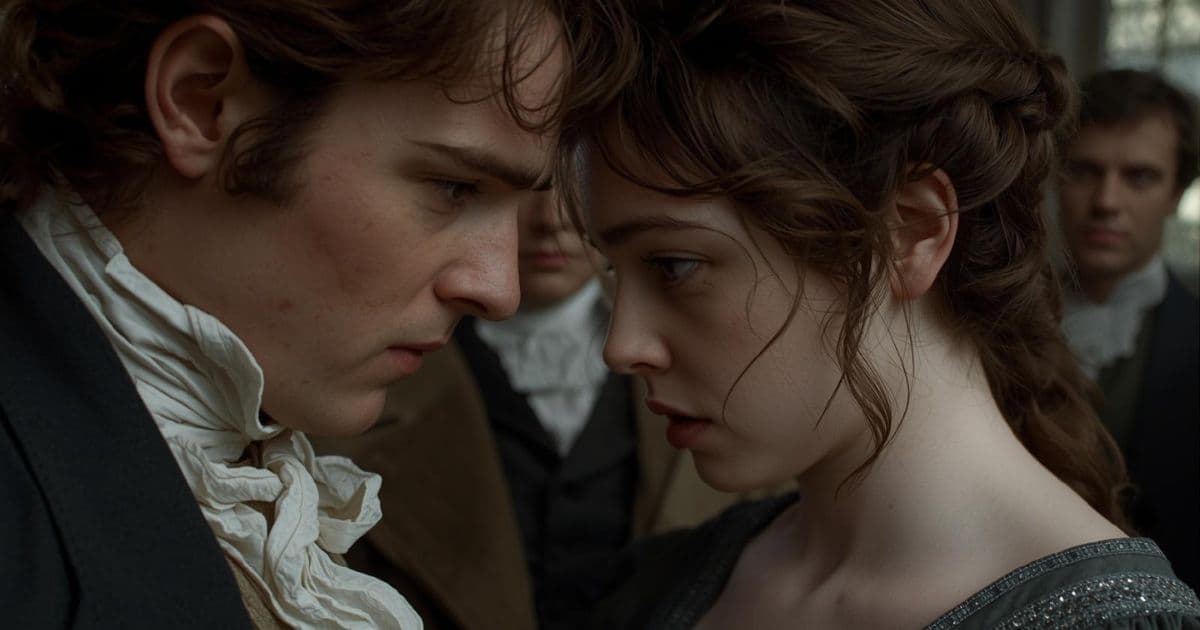
An excerpt from the original text.(complete · 1930 words)
mma continued to entertain no doubt of her being in love. Her ideas
only varied as to the how much. At first, she thought it was a good
deal; and afterwards, but little. She had great pleasure in hearing
Frank Churchill talked of; and, for his sake, greater pleasure than
ever in seeing Mr. and Mrs. Weston; she was very often thinking of him,
and quite impatient for a letter, that she might know how he was, how
were his spirits, how was his aunt, and what was the chance of his
coming to Randalls again this spring. But, on the other hand, she could
not admit herself to be unhappy, nor, after the first morning, to be
less disposed for employment than usual; she was still busy and
cheerful; and, pleasing as he was, she could yet imagine him to have
faults; and farther, though thinking of him so much, and, as she sat
drawing or working, forming a thousand amusing schemes for the progress
and close of their attachment, fancying interesting dialogues, and
inventing elegant letters; the conclusion of every imaginary
declaration on his side was that she refused him. Their affection
was always to subside into friendship. Every thing tender and charming
was to mark their parting; but still they were to part. When she became
sensible of this, it struck her that she could not be very much in
love; for in spite of her previous and fixed determination never to
quit her father, never to marry, a strong attachment certainly must
produce more of a struggle than she could foresee in her own feelings.
“I do not find myself making any use of the word sacrifice,” said
she.—“In not one of all my clever replies, my delicate negatives, is
there any allusion to making a sacrifice. I do suspect that he is not
really necessary to my happiness. So much the better. I certainly will
not persuade myself to feel more than I do. I am quite enough in love.
I should be sorry to be more.”
Upon the whole, she was equally contented with her view of his
feelings.
“He is undoubtedly very much in love—every thing denotes it—very much
in love indeed!—and when he comes again, if his affection continue, I
must be on my guard not to encourage it.—It would be most inexcusable
to do otherwise, as my own mind is quite made up. Not that I imagine he
can think I have been encouraging him hitherto. No, if he had believed
me at all to share his feelings, he would not have been so wretched.
Could he have thought himself encouraged, his looks and language at
parting would have been different.—Still, however, I must be on my
guard. This is in the supposition of his attachment continuing what it
now is; but I do not know that I expect it will; I do not look upon him
to be quite the sort of man—I do not altogether build upon his
steadiness or constancy.—His feelings are warm, but I can imagine them
rather changeable.—Every consideration of the subject, in short, makes
me thankful that my happiness is not more deeply involved.—I shall do
very well again after a little while—and then, it will be a good thing
over; for they say every body is in love once in their lives, and I
shall have been let off easily.”
When his letter to Mrs. Weston arrived, Emma had the perusal of it; and
she read it with a degree of pleasure and admiration which made her at
first shake her head over her own sensations, and think she had
undervalued their strength. It was a long, well-written letter, giving
the particulars of his journey and of his feelings, expressing all the
affection, gratitude, and respect which was natural and honourable, and
describing every thing exterior and local that could be supposed
attractive, with spirit and precision. No suspicious flourishes now of
apology or concern; it was the language of real feeling towards Mrs.
Weston; and the transition from Highbury to Enscombe, the contrast
between the places in some of the first blessings of social life was
just enough touched on to shew how keenly it was felt, and how much
more might have been said but for the restraints of propriety.—The
charm of her own name was not wanting. Miss Woodhouse appeared more
than once, and never without a something of pleasing connexion, either
a compliment to her taste, or a remembrance of what she had said; and
in the very last time of its meeting her eye, unadorned as it was by
any such broad wreath of gallantry, she yet could discern the effect of
her influence and acknowledge the greatest compliment perhaps of all
conveyed. Compressed into the very lowest vacant corner were these
words—“I had not a spare moment on Tuesday, as you know, for Miss
Woodhouse’s beautiful little friend. Pray make my excuses and adieus to
her.” This, Emma could not doubt, was all for herself. Harriet was
remembered only from being her friend. His information and prospects
as to Enscombe were neither worse nor better than had been anticipated;
Mrs. Churchill was recovering, and he dared not yet, even in his own
imagination, fix a time for coming to Randalls again.
Gratifying, however, and stimulative as was the letter in the material
part, its sentiments, she yet found, when it was folded up and returned
to Mrs. Weston, that it had not added any lasting warmth, that she
could still do without the writer, and that he must learn to do without
her. Her intentions were unchanged. Her resolution of refusal only grew
more interesting by the addition of a scheme for his subsequent
consolation and happiness. His recollection of Harriet, and the words
which clothed it, the “beautiful little friend,” suggested to her the
idea of Harriet’s succeeding her in his affections. Was it
impossible?—No.—Harriet undoubtedly was greatly his inferior in
understanding; but he had been very much struck with the loveliness of
her face and the warm simplicity of her manner; and all the
probabilities of circumstance and connexion were in her favour.—For
Harriet, it would be advantageous and delightful indeed.
“I must not dwell upon it,” said she.—“I must not think of it. I know
the danger of indulging such speculations. But stranger things have
happened; and when we cease to care for each other as we do now, it
will be the means of confirming us in that sort of true disinterested
friendship which I can already look forward to with pleasure.”
It was well to have a comfort in store on Harriet’s behalf, though it
might be wise to let the fancy touch it seldom; for evil in that
quarter was at hand. As Frank Churchill’s arrival had succeeded Mr.
Elton’s engagement in the conversation of Highbury, as the latest
interest had entirely borne down the first, so now upon Frank
Churchill’s disappearance, Mr. Elton’s concerns were assuming the most
irresistible form.—His wedding-day was named. He would soon be among
them again; Mr. Elton and his bride. There was hardly time to talk over
the first letter from Enscombe before “Mr. Elton and his bride” was in
every body’s mouth, and Frank Churchill was forgotten. Emma grew sick
at the sound. She had had three weeks of happy exemption from Mr.
Elton; and Harriet’s mind, she had been willing to hope, had been
lately gaining strength. With Mr. Weston’s ball in view at least, there
had been a great deal of insensibility to other things; but it was now
too evident that she had not attained such a state of composure as
could stand against the actual approach—new carriage, bell-ringing, and
all.
Poor Harriet was in a flutter of spirits which required all the
reasonings and soothings and attentions of every kind that Emma could
give. Emma felt that she could not do too much for her, that Harriet
had a right to all her ingenuity and all her patience; but it was heavy
work to be for ever convincing without producing any effect, for ever
agreed to, without being able to make their opinions the same. Harriet
listened submissively, and said “it was very true—it was just as Miss
Woodhouse described—it was not worth while to think about them—and she
would not think about them any longer” but no change of subject could
avail, and the next half-hour saw her as anxious and restless about the
Eltons as before. At last Emma attacked her on another ground.
“Your allowing yourself to be so occupied and so unhappy about Mr.
Elton’s marrying, Harriet, is the strongest reproach you can make me.
You could not give me a greater reproof for the mistake I fell into. It
was all my doing, I know. I have not forgotten it, I assure
you.—Deceived myself, I did very miserably deceive you—and it will be a
painful reflection to me for ever. Do not imagine me in danger of
forgetting it.”
Harriet felt this too much to utter more than a few words of eager
exclamation. Emma continued,
“I have not said, exert yourself Harriet for my sake; think less, talk
less of Mr. Elton for my sake; because for your own sake rather, I
would wish it to be done, for the sake of what is more important than
my comfort, a habit of self-command in you, a consideration of what is
your duty, an attention to propriety, an endeavour to avoid the
suspicions of others, to save your health and credit, and restore your
tranquillity. These are the motives which I have been pressing on you.
They are very important—and sorry I am that you cannot feel them
sufficiently to act upon them. My being saved from pain is a very
secondary consideration. I want you to save yourself from greater pain.
Perhaps I may sometimes have felt that Harriet would not forget what
was due—or rather what would be kind by me.”
This appeal to her affections did more than all the rest. The idea of
wanting gratitude and consideration for Miss Woodhouse, whom she really
loved extremely, made her wretched for a while, and when the violence
of grief was comforted away, still remained powerful enough to prompt
to what was right and support her in it very tolerably.
“You, who have been the best friend I ever had in my life—Want
gratitude to you!—Nobody is equal to you!—I care for nobody as I do for
you!—Oh! Miss Woodhouse, how ungrateful I have been!”
Such expressions, assisted as they were by every thing that look and
manner could do, made Emma feel that she had never loved Harriet so
well, nor valued her affection so highly before.
“There is no charm equal to tenderness of heart,” said she afterwards
to herself. “There is nothing to be compared to it. Warmth and
tenderness of heart, with an affectionate, open manner, will beat all
the clearness of head in the world, for attraction, I am sure it will.
It is tenderness of heart which makes my dear father so generally
beloved—which gives Isabella all her popularity.—I have it not—but I
know how to prize and respect it.—Harriet is my superior in all the
charm and all the felicity it gives. Dear Harriet!—I would not change
you for the clearest-headed, longest-sighted, best-judging female
breathing. Oh! the coldness of a Jane Fairfax!—Harriet is worth a
hundred such—And for a wife—a sensible man’s wife—it is invaluable. I
mention no names; but happy the man who changes Emma for Harriet!”
Master this chapter. Complete your experience
Purchase the complete book to access all chapters and support classic literature
As an Amazon Associate, we earn a small commission from qualifying purchases at no additional cost to you.
Available in paperback, hardcover, and e-book formats
Let's Analyse the Pattern
Mistaking the social performance of an emotion or desire for the genuine experience of that emotion or desire.
Why This Matters
Connect literature to life
This chapter teaches how to recognize when you're acting out emotions for social validation rather than genuinely feeling them.
Practice This Today
This week, notice when you feel good about something only when others are watching - that's usually performance rather than authentic feeling.
Now let's explore the literary elements.
Key Quotes & Analysis
"The conclusion of every imaginary declaration on his side was that she refused him."
Context: Emma realizes that in all her romantic fantasies about Frank Churchill, she always imagines turning him down
This reveals Emma's subconscious knowledge that she's not truly in love. Real love would involve wanting to say yes, not constantly imagining rejection scenarios.
In Today's Words:
Every time she daydreamed about him confessing his feelings, she pictured herself saying no.
"When she became sensible of this, it struck her that she could not be very much in love."
Context: Emma's moment of self-realization about her true feelings
Shows Emma's growing emotional intelligence and ability to be honest with herself about her feelings rather than getting caught up in the idea of being in love.
In Today's Words:
When she realized this, it hit her that she wasn't actually that into him.
"Their affection was always to subside into friendship."
Context: Emma's imagined future with Frank Churchill always ends platonically
Reveals Emma's unconscious understanding that their connection lacks the depth for lasting romance, defaulting instead to the safer territory of friendship.
In Today's Words:
In her mind, they always ended up as just friends.
Thematic Threads
Self-Knowledge
In This Chapter
Emma conducts an honest audit of her feelings for Frank and discovers she's been performing attraction rather than feeling it
Development
Major breakthrough from earlier self-deception—Emma is finally looking at her motivations honestly
In Your Life:
You might catch yourself going through motions in relationships or jobs because they look right, not because they feel right
Social Performance
In This Chapter
Emma enjoys the validation and attention of being courted more than she actually likes Frank himself
Development
Builds on her constant need for social approval, now revealing how it distorts even romantic feelings
In Your Life:
You might maintain relationships or behaviors because they get positive reactions from others, not because they fulfill you
Responsibility
In This Chapter
Emma takes full blame for misleading Harriet about Elton's feelings and commits to helping her heal
Development
First time Emma fully owns the consequences of her manipulation without making excuses
In Your Life:
You might need to take responsibility for advice you gave that hurt someone, even if your intentions were good
Emotional Intelligence
In This Chapter
Emma recognizes that Harriet's tender heart has value that her own intellectual pride lacks
Development
Growing appreciation for emotional wisdom over intellectual superiority
In Your Life:
You might realize that someone you considered 'simple' actually has emotional skills you lack
Real vs. Fantasy
In This Chapter
Emma distinguishes between enjoying romantic fantasies and feeling genuine love that demands sacrifice
Development
New theme—Emma learning to separate imagination from reality in relationships
In Your Life:
You might catch yourself enjoying the idea of something more than the actual experience of it
You now have the context. Time to form your own thoughts.
Discussion Questions
- 1
What does Emma discover about her feelings for Frank Churchill when she honestly examines them?
analysis • surface - 2
Why does Emma always imagine herself rejecting Frank in her daydreams, even though she thinks she likes him?
analysis • medium - 3
Where do you see people performing emotions or relationships for social validation rather than genuine feeling in today's world?
application • medium - 4
How can you tell the difference between genuinely feeling something and just performing it because it gets positive reactions?
application • deep - 5
What does Emma's self-discovery reveal about how social expectations can override our authentic feelings?
reflection • deep
Critical Thinking Exercise
Audit Your Performances
Think of a relationship, hobby, or commitment in your life that others praise you for. Write down what you get from it versus what it actually costs you emotionally. Then ask: Am I doing this because I genuinely want to, or because it gets me positive attention? Look for the Emma pattern - enjoying the validation while feeling hollow underneath.
Consider:
- •Real emotions have weight and make you willing to sacrifice something
- •Performed emotions feel good when witnessed but empty when alone
- •The gap between public praise and private feelings is your clue
Journaling Prompt
Write about a time when you realized you were going through the motions in a relationship or situation. What were you really seeking? How did recognizing the performance change your choices?
Coming Up Next...
Chapter 32: Meeting Mrs. Elton's True Colors
As Mr. Elton's wedding day approaches, the entire social fabric of Highbury shifts. Emma must navigate the awkwardness of his return while protecting Harriet from further heartbreak, but new complications are brewing that will test everyone's carefully maintained composure.