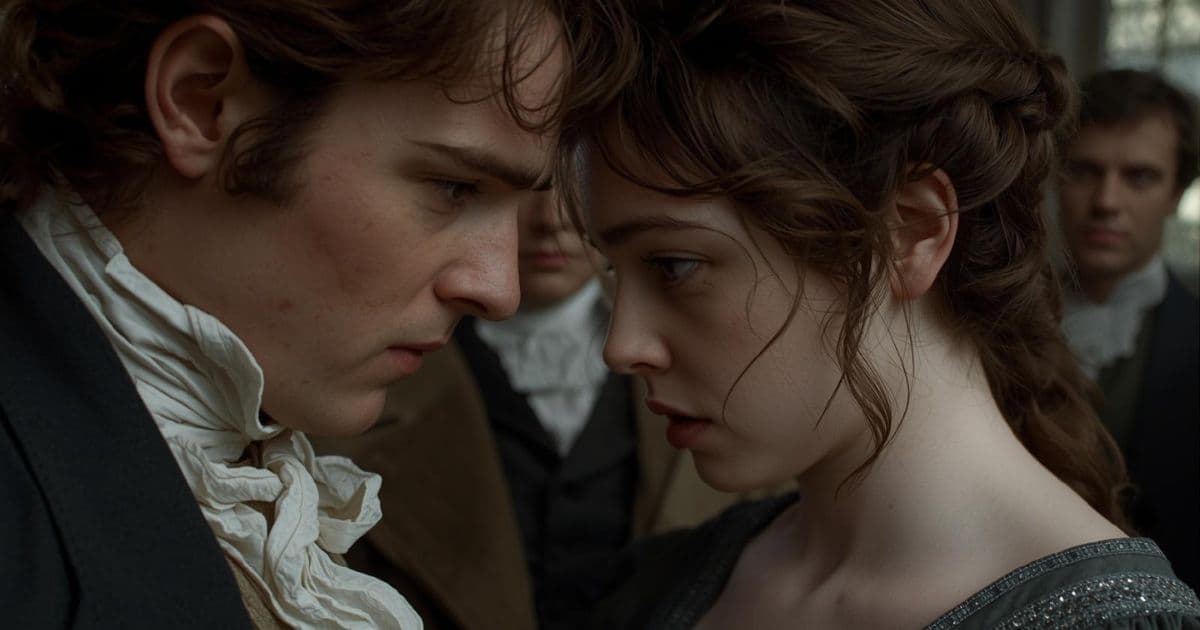
An excerpt from the original text.(complete · 2781 words)
“ hope I shall soon have the pleasure of introducing my son to you,”
said Mr. Weston.
Mrs. Elton, very willing to suppose a particular compliment intended
her by such a hope, smiled most graciously.
“You have heard of a certain Frank Churchill, I presume,” he
continued—“and know him to be my son, though he does not bear my name.”
“Oh! yes, and I shall be very happy in his acquaintance. I am sure Mr.
Elton will lose no time in calling on him; and we shall both have great
pleasure in seeing him at the Vicarage.”
“You are very obliging.—Frank will be extremely happy, I am sure.— He
is to be in town next week, if not sooner. We have notice of it in a
letter to-day. I met the letters in my way this morning, and seeing my
son’s hand, presumed to open it—though it was not directed to me—it was
to Mrs. Weston. She is his principal correspondent, I assure you. I
hardly ever get a letter.”
“And so you absolutely opened what was directed to her! Oh! Mr.
Weston—(laughing affectedly) I must protest against that.—A most
dangerous precedent indeed!—I beg you will not let your neighbours
follow your example.—Upon my word, if this is what I am to expect, we
married women must begin to exert ourselves!—Oh! Mr. Weston, I could
not have believed it of you!”
“Aye, we men are sad fellows. You must take care of yourself, Mrs.
Elton.—This letter tells us—it is a short letter—written in a hurry,
merely to give us notice—it tells us that they are all coming up to
town directly, on Mrs. Churchill’s account—she has not been well the
whole winter, and thinks Enscombe too cold for her—so they are all to
move southward without loss of time.”
“Indeed!—from Yorkshire, I think. Enscombe is in Yorkshire?”
“Yes, they are about one hundred and ninety miles from London, a
considerable journey.”
“Yes, upon my word, very considerable. Sixty-five miles farther than
from Maple Grove to London. But what is distance, Mr. Weston, to people
of large fortune?—You would be amazed to hear how my brother, Mr.
Suckling, sometimes flies about. You will hardly believe me—but twice
in one week he and Mr. Bragge went to London and back again with four
horses.”
“The evil of the distance from Enscombe,” said Mr. Weston, “is, that
Mrs. Churchill, as we understand, has not been able to leave the
sofa for a week together. In Frank’s last letter she complained, he
said, of being too weak to get into her conservatory without having
both his arm and his uncle’s! This, you know, speaks a great degree of
weakness—but now she is so impatient to be in town, that she means to
sleep only two nights on the road.—So Frank writes word. Certainly,
delicate ladies have very extraordinary constitutions, Mrs. Elton. You
must grant me that.”
“No, indeed, I shall grant you nothing. I always take the part of my
own sex. I do indeed. I give you notice—You will find me a formidable
antagonist on that point. I always stand up for women—and I assure you,
if you knew how Selina feels with respect to sleeping at an inn, you
would not wonder at Mrs. Churchill’s making incredible exertions to
avoid it. Selina says it is quite horror to her—and I believe I have
caught a little of her nicety. She always travels with her own sheets;
an excellent precaution. Does Mrs. Churchill do the same?”
“Depend upon it, Mrs. Churchill does every thing that any other fine
lady ever did. Mrs. Churchill will not be second to any lady in the
land for”—
Mrs. Elton eagerly interposed with,
“Oh! Mr. Weston, do not mistake me. Selina is no fine lady, I assure
you. Do not run away with such an idea.”
“Is not she? Then she is no rule for Mrs. Churchill, who is as thorough
a fine lady as any body ever beheld.”
Mrs. Elton began to think she had been wrong in disclaiming so warmly.
It was by no means her object to have it believed that her sister was
not a fine lady; perhaps there was want of spirit in the pretence of
it;—and she was considering in what way she had best retract, when Mr.
Weston went on.
“Mrs. Churchill is not much in my good graces, as you may suspect—but
this is quite between ourselves. She is very fond of Frank, and
therefore I would not speak ill of her. Besides, she is out of health
now; but that indeed, by her own account, she has always been. I
would not say so to every body, Mrs. Elton, but I have not much faith
in Mrs. Churchill’s illness.”
“If she is really ill, why not go to Bath, Mr. Weston?—To Bath, or to
Clifton?” “She has taken it into her head that Enscombe is too cold for
her. The fact is, I suppose, that she is tired of Enscombe. She has now
been a longer time stationary there, than she ever was before, and she
begins to want change. It is a retired place. A fine place, but very
retired.”
“Aye—like Maple Grove, I dare say. Nothing can stand more retired from
the road than Maple Grove. Such an immense plantation all round it! You
seem shut out from every thing—in the most complete retirement.—And
Mrs. Churchill probably has not health or spirits like Selina to enjoy
that sort of seclusion. Or, perhaps she may not have resources enough
in herself to be qualified for a country life. I always say a woman
cannot have too many resources—and I feel very thankful that I have so
many myself as to be quite independent of society.”
“Frank was here in February for a fortnight.”
“So I remember to have heard. He will find an addition to the society
of Highbury when he comes again; that is, if I may presume to call
myself an addition. But perhaps he may never have heard of there being
such a creature in the world.”
This was too loud a call for a compliment to be passed by, and Mr.
Weston, with a very good grace, immediately exclaimed,
“My dear madam! Nobody but yourself could imagine such a thing
possible. Not heard of you!—I believe Mrs. Weston’s letters lately have
been full of very little else than Mrs. Elton.”
He had done his duty and could return to his son.
“When Frank left us,” continued he, “it was quite uncertain when we
might see him again, which makes this day’s news doubly welcome. It has
been completely unexpected. That is, I always had a strong persuasion
he would be here again soon, I was sure something favourable would turn
up—but nobody believed me. He and Mrs. Weston were both dreadfully
desponding. ‘How could he contrive to come? And how could it be
supposed that his uncle and aunt would spare him again?’ and so forth—I
always felt that something would happen in our favour; and so it has,
you see. I have observed, Mrs. Elton, in the course of my life, that if
things are going untowardly one month, they are sure to mend the next.”
“Very true, Mr. Weston, perfectly true. It is just what I used to say
to a certain gentleman in company in the days of courtship, when,
because things did not go quite right, did not proceed with all the
rapidity which suited his feelings, he was apt to be in despair, and
exclaim that he was sure at this rate it would be May before Hymen’s
saffron robe would be put on for us. Oh! the pains I have been at to
dispel those gloomy ideas and give him cheerfuller views! The
carriage—we had disappointments about the carriage;—one morning, I
remember, he came to me quite in despair.”
She was stopped by a slight fit of coughing, and Mr. Weston instantly
seized the opportunity of going on.
“You were mentioning May. May is the very month which Mrs. Churchill is
ordered, or has ordered herself, to spend in some warmer place than
Enscombe—in short, to spend in London; so that we have the agreeable
prospect of frequent visits from Frank the whole spring—precisely the
season of the year which one should have chosen for it: days almost at
the longest; weather genial and pleasant, always inviting one out, and
never too hot for exercise. When he was here before, we made the best
of it; but there was a good deal of wet, damp, cheerless weather; there
always is in February, you know, and we could not do half that we
intended. Now will be the time. This will be complete enjoyment; and I
do not know, Mrs. Elton, whether the uncertainty of our meetings, the
sort of constant expectation there will be of his coming in to-day or
to-morrow, and at any hour, may not be more friendly to happiness than
having him actually in the house. I think it is so. I think it is the
state of mind which gives most spirit and delight. I hope you will be
pleased with my son; but you must not expect a prodigy. He is generally
thought a fine young man, but do not expect a prodigy. Mrs. Weston’s
partiality for him is very great, and, as you may suppose, most
gratifying to me. She thinks nobody equal to him.”
“And I assure you, Mr. Weston, I have very little doubt that my opinion
will be decidedly in his favour. I have heard so much in praise of Mr.
Frank Churchill.—At the same time it is fair to observe, that I am one
of those who always judge for themselves, and are by no means
implicitly guided by others. I give you notice that as I find your son,
so I shall judge of him.—I am no flatterer.”
Mr. Weston was musing.
“I hope,” said he presently, “I have not been severe upon poor Mrs.
Churchill. If she is ill I should be sorry to do her injustice; but
there are some traits in her character which make it difficult for me
to speak of her with the forbearance I could wish. You cannot be
ignorant, Mrs. Elton, of my connexion with the family, nor of the
treatment I have met with; and, between ourselves, the whole blame of
it is to be laid to her. She was the instigator. Frank’s mother would
never have been slighted as she was but for her. Mr. Churchill has
pride; but his pride is nothing to his wife’s: his is a quiet,
indolent, gentlemanlike sort of pride that would harm nobody, and only
make himself a little helpless and tiresome; but her pride is arrogance
and insolence! And what inclines one less to bear, she has no fair
pretence of family or blood. She was nobody when he married her, barely
the daughter of a gentleman; but ever since her being turned into a
Churchill she has out-Churchill’d them all in high and mighty claims:
but in herself, I assure you, she is an upstart.”
“Only think! well, that must be infinitely provoking! I have quite a
horror of upstarts. Maple Grove has given me a thorough disgust to
people of that sort; for there is a family in that neighbourhood who
are such an annoyance to my brother and sister from the airs they give
themselves! Your description of Mrs. Churchill made me think of them
directly. People of the name of Tupman, very lately settled there, and
encumbered with many low connexions, but giving themselves immense
airs, and expecting to be on a footing with the old established
families. A year and a half is the very utmost that they can have lived
at West Hall; and how they got their fortune nobody knows. They came
from Birmingham, which is not a place to promise much, you know, Mr.
Weston. One has not great hopes from Birmingham. I always say there is
something direful in the sound: but nothing more is positively known of
the Tupmans, though a good many things I assure you are suspected; and
yet by their manners they evidently think themselves equal even to my
brother, Mr. Suckling, who happens to be one of their nearest
neighbours. It is infinitely too bad. Mr. Suckling, who has been eleven
years a resident at Maple Grove, and whose father had it before him—I
believe, at least—I am almost sure that old Mr. Suckling had completed
the purchase before his death.”
They were interrupted. Tea was carrying round, and Mr. Weston, having
said all that he wanted, soon took the opportunity of walking away.
After tea, Mr. and Mrs. Weston, and Mr. Elton sat down with Mr.
Woodhouse to cards. The remaining five were left to their own powers,
and Emma doubted their getting on very well; for Mr. Knightley seemed
little disposed for conversation; Mrs. Elton was wanting notice, which
nobody had inclination to pay, and she was herself in a worry of
spirits which would have made her prefer being silent.
Mr. John Knightley proved more talkative than his brother. He was to
leave them early the next day; and he soon began with—
“Well, Emma, I do not believe I have any thing more to say about the
boys; but you have your sister’s letter, and every thing is down at
full length there we may be sure. My charge would be much more concise
than her’s, and probably not much in the same spirit; all that I have
to recommend being comprised in, do not spoil them, and do not physic
them.”
“I rather hope to satisfy you both,” said Emma, “for I shall do all in
my power to make them happy, which will be enough for Isabella; and
happiness must preclude false indulgence and physic.”
“And if you find them troublesome, you must send them home again.”
“That is very likely. You think so, do not you?”
“I hope I am aware that they may be too noisy for your father—or even
may be some encumbrance to you, if your visiting engagements continue
to increase as much as they have done lately.”
“Increase!”
“Certainly; you must be sensible that the last half-year has made a
great difference in your way of life.”
“Difference! No indeed I am not.”
“There can be no doubt of your being much more engaged with company
than you used to be. Witness this very time. Here am I come down for
only one day, and you are engaged with a dinner-party!—When did it
happen before, or any thing like it? Your neighbourhood is increasing,
and you mix more with it. A little while ago, every letter to Isabella
brought an account of fresh gaieties; dinners at Mr. Cole’s, or balls
at the Crown. The difference which Randalls, Randalls alone makes in
your goings-on, is very great.”
“Yes,” said his brother quickly, “it is Randalls that does it all.”
“Very well—and as Randalls, I suppose, is not likely to have less
influence than heretofore, it strikes me as a possible thing, Emma,
that Henry and John may be sometimes in the way. And if they are, I
only beg you to send them home.”
“No,” cried Mr. Knightley, “that need not be the consequence. Let them
be sent to Donwell. I shall certainly be at leisure.”
“Upon my word,” exclaimed Emma, “you amuse me! I should like to know
how many of all my numerous engagements take place without your being
of the party; and why I am to be supposed in danger of wanting leisure
to attend to the little boys. These amazing engagements of mine—what
have they been? Dining once with the Coles—and having a ball talked of,
which never took place. I can understand you—(nodding at Mr. John
Knightley)—your good fortune in meeting with so many of your friends at
once here, delights you too much to pass unnoticed. But you, (turning
to Mr. Knightley,) who know how very, very seldom I am ever two hours
from Hartfield, why you should foresee such a series of dissipation for
me, I cannot imagine. And as to my dear little boys, I must say, that
if Aunt Emma has not time for them, I do not think they would fare much
better with Uncle Knightley, who is absent from home about five hours
where she is absent one—and who, when he is at home, is either reading
to himself or settling his accounts.”
Mr. Knightley seemed to be trying not to smile; and succeeded without
difficulty, upon Mrs. Elton’s beginning to talk to him.
VOLUME III
Master this chapter. Complete your experience
Purchase the complete book to access all chapters and support classic literature
As an Amazon Associate, we earn a small commission from qualifying purchases at no additional cost to you.
Available in paperback, hardcover, and e-book formats
Let's Analyse the Pattern
When people feel their position threatened, they unconsciously perform superiority through name-dropping, credential-flashing, and comparison-making to protect their social standing.
Why This Matters
Connect literature to life
This chapter teaches how to recognize when someone's bragging actually reveals their insecurity and fear of not belonging.
Practice This Today
This week, notice when someone constantly mentions their credentials or connections - ask yourself what they might be afraid of losing rather than judging their performance.
Now let's explore the literary elements.
Key Quotes & Analysis
"Oh! Mr. Weston, I could not have believed it of you!"
Context: When Mr. Weston admits to opening a letter addressed to his wife
Mrs. Elton's exaggerated shock is performative - she's trying to appear proper and moral while also flirting. Her affected response shows how she uses social rules to draw attention to herself.
In Today's Words:
OMG, I can't believe you just did that!
"We married women must begin to exert ourselves!"
Context: Still reacting to Mr. Weston opening his wife's mail
She's positioning herself as a leader among wives while creating fake drama. This shows her need to be the center of attention and her tendency to turn everything into a performance.
In Today's Words:
Us wives need to stand up for ourselves!
"Your numerous engagements lately"
Context: Commenting on Emma's social activities
His word choice 'numerous' reveals how outsiders can misperceive our lives. What feels normal to us can look excessive to others, especially those who prefer quieter lifestyles.
In Today's Words:
You've been super busy with social stuff lately
Thematic Threads
Class Anxiety
In This Chapter
Mrs. Elton's constant references to Maple Grove and Mr. Weston's calling Mrs. Churchill an 'upstart' both reveal deep insecurity about social positioning
Development
Introduced here - shows how class consciousness creates defensive behaviors
In Your Life:
Notice when you feel the need to mention your job title, education, or connections to establish credibility with new people.
Social Performance
In This Chapter
Characters use name-dropping and comparison as shields against perceived social threats, performing status rather than being authentic
Development
Introduced here - reveals how social anxiety drives performative behavior
In Your Life:
Watch for moments when you're working harder to impress than to connect genuinely.
Perception vs Reality
In This Chapter
John Knightley assumes Emma has become socially busy, but she reveals her 'numerous engagements' are actually quite modest
Development
Builds on earlier misunderstandings - shows how we project our assumptions onto others' lives
In Your Life:
Question your assumptions about how busy, successful, or happy others really are based on limited observations.
Defensive Superiority
In This Chapter
Both Mrs. Elton and Mr. Weston attack others' social legitimacy while protecting their own positions
Development
Introduced here - demonstrates how insecurity manifests as judgment of others
In Your Life:
Notice when you find yourself criticizing others' qualifications or worthiness - it often signals your own insecurity.
You now have the context. Time to form your own thoughts.
Discussion Questions
- 1
Why does Mrs. Elton constantly bring up Maple Grove and Mr. Suckling in every conversation?
analysis • surface - 2
What makes Mr. Weston call Mrs. Churchill an 'upstart' while simultaneously worrying about Frank's acceptance in Highbury?
analysis • medium - 3
Where do you see people today using name-dropping or credential-flashing the way Mrs. Elton uses Maple Grove?
application • medium - 4
When you catch yourself or others performing status, what's usually the underlying fear driving that behavior?
application • deep - 5
Why do people trust authenticity more than constant proof of credentials or connections?
reflection • deep
Critical Thinking Exercise
Track Your Status Signals
For the next 24 hours, notice when you mention your job, education, connections, or achievements in conversation. Write down three instances: what you said, who you were talking to, and what you think triggered that mention. Look for the pattern between feeling uncertain or threatened and performing credentials.
Consider:
- •Pay attention to moments when you feel the need to establish credibility
- •Notice if certain people or situations trigger more status signaling than others
- •Consider whether the credential-sharing actually helped the conversation or relationship
Journaling Prompt
Write about a time when someone's authenticity and vulnerability impressed you more than their achievements. What made that person memorable, and how did it change how you saw them?
Coming Up Next...
Chapter 37: When Distance Creates Clarity
Volume III begins with new developments that will test the relationships and social dynamics established in Highbury. Frank Churchill's anticipated arrival promises to shake up the carefully balanced social world Emma has known.