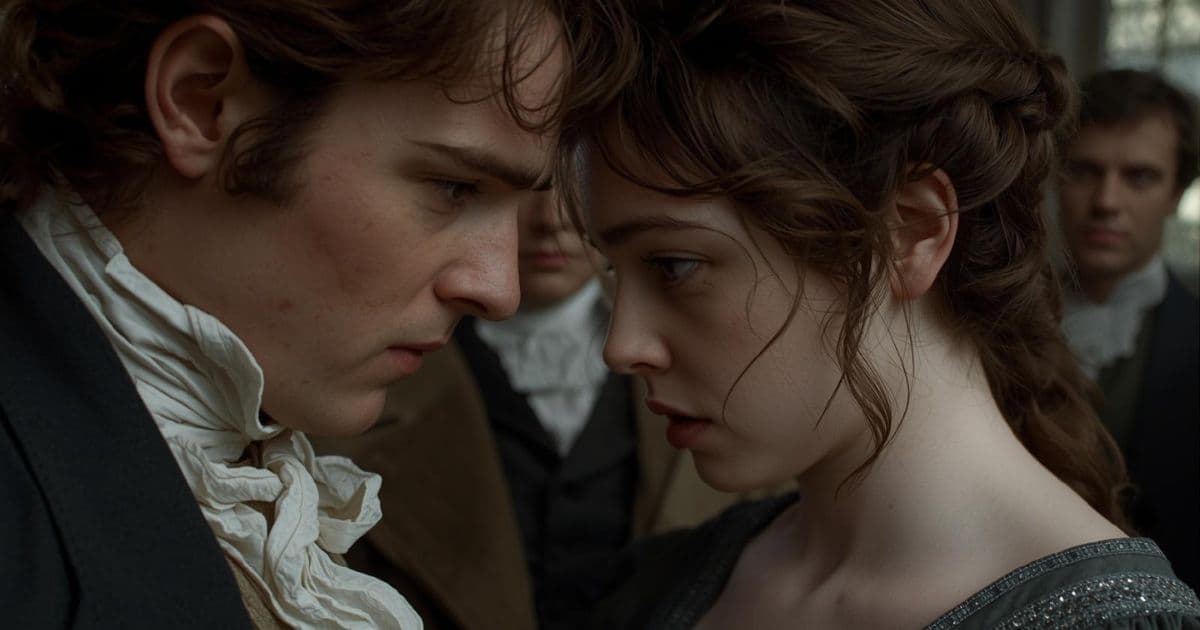
An excerpt from the original text.(complete · 3847 words)
mma could not forgive her;—but as neither provocation nor resentment
were discerned by Mr. Knightley, who had been of the party, and had
seen only proper attention and pleasing behaviour on each side, he was
expressing the next morning, being at Hartfield again on business with
Mr. Woodhouse, his approbation of the whole; not so openly as he might
have done had her father been out of the room, but speaking plain
enough to be very intelligible to Emma. He had been used to think her
unjust to Jane, and had now great pleasure in marking an improvement.
“A very pleasant evening,” he began, as soon as Mr. Woodhouse had been
talked into what was necessary, told that he understood, and the papers
swept away;—“particularly pleasant. You and Miss Fairfax gave us some
very good music. I do not know a more luxurious state, sir, than
sitting at one’s ease to be entertained a whole evening by two such
young women; sometimes with music and sometimes with conversation. I am
sure Miss Fairfax must have found the evening pleasant, Emma. You left
nothing undone. I was glad you made her play so much, for having no
instrument at her grandmother’s, it must have been a real indulgence.”
“I am happy you approved,” said Emma, smiling; “but I hope I am not
often deficient in what is due to guests at Hartfield.”
“No, my dear,” said her father instantly; “that I am sure you are
not. There is nobody half so attentive and civil as you are. If any
thing, you are too attentive. The muffin last night—if it had been
handed round once, I think it would have been enough.”
“No,” said Mr. Knightley, nearly at the same time; “you are not often
deficient; not often deficient either in manner or comprehension. I
think you understand me, therefore.”
An arch look expressed—“I understand you well enough;” but she said
only, “Miss Fairfax is reserved.”
“I always told you she was—a little; but you will soon overcome all
that part of her reserve which ought to be overcome, all that has its
foundation in diffidence. What arises from discretion must be
honoured.”
“You think her diffident. I do not see it.”
“My dear Emma,” said he, moving from his chair into one close by her,
“you are not going to tell me, I hope, that you had not a pleasant
evening.”
“Oh! no; I was pleased with my own perseverance in asking questions;
and amused to think how little information I obtained.”
“I am disappointed,” was his only answer.
“I hope every body had a pleasant evening,” said Mr. Woodhouse, in his
quiet way. “I had. Once, I felt the fire rather too much; but then I
moved back my chair a little, a very little, and it did not disturb me.
Miss Bates was very chatty and good-humoured, as she always is, though
she speaks rather too quick. However, she is very agreeable, and Mrs.
Bates too, in a different way. I like old friends; and Miss Jane
Fairfax is a very pretty sort of young lady, a very pretty and a very
well-behaved young lady indeed. She must have found the evening
agreeable, Mr. Knightley, because she had Emma.”
“True, sir; and Emma, because she had Miss Fairfax.”
Emma saw his anxiety, and wishing to appease it, at least for the
present, said, and with a sincerity which no one could question—
“She is a sort of elegant creature that one cannot keep one’s eyes
from. I am always watching her to admire; and I do pity her from my
heart.”
Mr. Knightley looked as if he were more gratified than he cared to
express; and before he could make any reply, Mr. Woodhouse, whose
thoughts were on the Bates’s, said—
“It is a great pity that their circumstances should be so confined! a
great pity indeed! and I have often wished—but it is so little one can
venture to do—small, trifling presents, of any thing uncommon—Now we
have killed a porker, and Emma thinks of sending them a loin or a leg;
it is very small and delicate—Hartfield pork is not like any other
pork—but still it is pork—and, my dear Emma, unless one could be sure
of their making it into steaks, nicely fried, as ours are fried,
without the smallest grease, and not roast it, for no stomach can bear
roast pork—I think we had better send the leg—do not you think so, my
dear?”
“My dear papa, I sent the whole hind-quarter. I knew you would wish it.
There will be the leg to be salted, you know, which is so very nice,
and the loin to be dressed directly in any manner they like.”
“That’s right, my dear, very right. I had not thought of it before, but
that is the best way. They must not over-salt the leg; and then, if it
is not over-salted, and if it is very thoroughly boiled, just as Serle
boils ours, and eaten very moderately of, with a boiled turnip, and a
little carrot or parsnip, I do not consider it unwholesome.”
“Emma,” said Mr. Knightley presently, “I have a piece of news for you.
You like news—and I heard an article in my way hither that I think will
interest you.”
“News! Oh! yes, I always like news. What is it?—why do you smile
so?—where did you hear it?—at Randalls?”
He had time only to say,
“No, not at Randalls; I have not been near Randalls,” when the door was
thrown open, and Miss Bates and Miss Fairfax walked into the room. Full
of thanks, and full of news, Miss Bates knew not which to give
quickest. Mr. Knightley soon saw that he had lost his moment, and that
not another syllable of communication could rest with him.
“Oh! my dear sir, how are you this morning? My dear Miss Woodhouse—I
come quite over-powered. Such a beautiful hind-quarter of pork! You are
too bountiful! Have you heard the news? Mr. Elton is going to be
married.”
Emma had not had time even to think of Mr. Elton, and she was so
completely surprized that she could not avoid a little start, and a
little blush, at the sound.
“There is my news:—I thought it would interest you,” said Mr.
Knightley, with a smile which implied a conviction of some part of what
had passed between them.
“But where could you hear it?” cried Miss Bates. “Where could you
possibly hear it, Mr. Knightley? For it is not five minutes since I
received Mrs. Cole’s note—no, it cannot be more than five—or at least
ten—for I had got my bonnet and spencer on, just ready to come out—I
was only gone down to speak to Patty again about the pork—Jane was
standing in the passage—were not you, Jane?—for my mother was so afraid
that we had not any salting-pan large enough. So I said I would go down
and see, and Jane said, ‘Shall I go down instead? for I think you have
a little cold, and Patty has been washing the kitchen.’—‘Oh! my dear,’
said I—well, and just then came the note. A Miss Hawkins—that’s all I
know. A Miss Hawkins of Bath. But, Mr. Knightley, how could you
possibly have heard it? for the very moment Mr. Cole told Mrs. Cole of
it, she sat down and wrote to me. A Miss Hawkins—”
“I was with Mr. Cole on business an hour and a half ago. He had just
read Elton’s letter as I was shewn in, and handed it to me directly.”
“Well! that is quite—I suppose there never was a piece of news more
generally interesting. My dear sir, you really are too bountiful. My
mother desires her very best compliments and regards, and a thousand
thanks, and says you really quite oppress her.”
“We consider our Hartfield pork,” replied Mr. Woodhouse—“indeed it
certainly is, so very superior to all other pork, that Emma and I
cannot have a greater pleasure than—”
“Oh! my dear sir, as my mother says, our friends are only too good to
us. If ever there were people who, without having great wealth
themselves, had every thing they could wish for, I am sure it is us. We
may well say that ‘our lot is cast in a goodly heritage.’ Well, Mr.
Knightley, and so you actually saw the letter; well—”
“It was short—merely to announce—but cheerful, exulting, of course.”—
Here was a sly glance at Emma. “He had been so fortunate as to—I forget
the precise words—one has no business to remember them. The information
was, as you state, that he was going to be married to a Miss Hawkins.
By his style, I should imagine it just settled.”
“Mr. Elton going to be married!” said Emma, as soon as she could speak.
“He will have every body’s wishes for his happiness.”
“He is very young to settle,” was Mr. Woodhouse’s observation. “He had
better not be in a hurry. He seemed to me very well off as he was. We
were always glad to see him at Hartfield.”
“A new neighbour for us all, Miss Woodhouse!” said Miss Bates,
joyfully; “my mother is so pleased!—she says she cannot bear to have
the poor old Vicarage without a mistress. This is great news, indeed.
Jane, you have never seen Mr. Elton!—no wonder that you have such a
curiosity to see him.”
Jane’s curiosity did not appear of that absorbing nature as wholly to
occupy her.
“No—I have never seen Mr. Elton,” she replied, starting on this appeal;
“is he—is he a tall man?”
“Who shall answer that question?” cried Emma. “My father would say
‘yes,’ Mr. Knightley ‘no;’ and Miss Bates and I that he is just the
happy medium. When you have been here a little longer, Miss Fairfax,
you will understand that Mr. Elton is the standard of perfection in
Highbury, both in person and mind.”
“Very true, Miss Woodhouse, so she will. He is the very best young
man—But, my dear Jane, if you remember, I told you yesterday he was
precisely the height of Mr. Perry. Miss Hawkins,—I dare say, an
excellent young woman. His extreme attention to my mother—wanting her
to sit in the vicarage pew, that she might hear the better, for my
mother is a little deaf, you know—it is not much, but she does not hear
quite quick. Jane says that Colonel Campbell is a little deaf. He
fancied bathing might be good for it—the warm bath—but she says it did
him no lasting benefit. Colonel Campbell, you know, is quite our angel.
And Mr. Dixon seems a very charming young man, quite worthy of him. It
is such a happiness when good people get together—and they always do.
Now, here will be Mr. Elton and Miss Hawkins; and there are the Coles,
such very good people; and the Perrys—I suppose there never was a
happier or a better couple than Mr. and Mrs. Perry. I say, sir,”
turning to Mr. Woodhouse, “I think there are few places with such
society as Highbury. I always say, we are quite blessed in our
neighbours.—My dear sir, if there is one thing my mother loves better
than another, it is pork—a roast loin of pork—”
“As to who, or what Miss Hawkins is, or how long he has been acquainted
with her,” said Emma, “nothing I suppose can be known. One feels that
it cannot be a very long acquaintance. He has been gone only four
weeks.”
Nobody had any information to give; and, after a few more wonderings,
Emma said,
“You are silent, Miss Fairfax—but I hope you mean to take an interest
in this news. You, who have been hearing and seeing so much of late on
these subjects, who must have been so deep in the business on Miss
Campbell’s account—we shall not excuse your being indifferent about Mr.
Elton and Miss Hawkins.”
“When I have seen Mr. Elton,” replied Jane, “I dare say I shall be
interested—but I believe it requires that with me. And as it is some
months since Miss Campbell married, the impression may be a little worn
off.”
“Yes, he has been gone just four weeks, as you observe, Miss
Woodhouse,” said Miss Bates, “four weeks yesterday.—A Miss
Hawkins!—Well, I had always rather fancied it would be some young lady
hereabouts; not that I ever—Mrs. Cole once whispered to me—but I
immediately said, ‘No, Mr. Elton is a most worthy young man—but’—In
short, I do not think I am particularly quick at those sort of
discoveries. I do not pretend to it. What is before me, I see. At the
same time, nobody could wonder if Mr. Elton should have aspired—Miss
Woodhouse lets me chatter on, so good-humouredly. She knows I would not
offend for the world. How does Miss Smith do? She seems quite recovered
now. Have you heard from Mrs. John Knightley lately? Oh! those dear
little children. Jane, do you know I always fancy Mr. Dixon like Mr.
John Knightley. I mean in person—tall, and with that sort of look—and
not very talkative.”
“Quite wrong, my dear aunt; there is no likeness at all.”
“Very odd! but one never does form a just idea of any body beforehand.
One takes up a notion, and runs away with it. Mr. Dixon, you say, is
not, strictly speaking, handsome?”
“Handsome! Oh! no—far from it—certainly plain. I told you he was
plain.”
“My dear, you said that Miss Campbell would not allow him to be plain,
and that you yourself—”
“Oh! as for me, my judgment is worth nothing. Where I have a regard, I
always think a person well-looking. But I gave what I believed the
general opinion, when I called him plain.”
“Well, my dear Jane, I believe we must be running away. The weather
does not look well, and grandmama will be uneasy. You are too obliging,
my dear Miss Woodhouse; but we really must take leave. This has been a
most agreeable piece of news indeed. I shall just go round by Mrs.
Cole’s; but I shall not stop three minutes: and, Jane, you had better
go home directly—I would not have you out in a shower!—We think she is
the better for Highbury already. Thank you, we do indeed. I shall not
attempt calling on Mrs. Goddard, for I really do not think she cares
for any thing but boiled pork: when we dress the leg it will be
another thing. Good morning to you, my dear sir. Oh! Mr. Knightley is
coming too. Well, that is so very!—I am sure if Jane is tired, you will
be so kind as to give her your arm.—Mr. Elton, and Miss Hawkins!—Good
morning to you.”
Emma, alone with her father, had half her attention wanted by him while
he lamented that young people would be in such a hurry to marry—and to
marry strangers too—and the other half she could give to her own view
of the subject. It was to herself an amusing and a very welcome piece
of news, as proving that Mr. Elton could not have suffered long; but
she was sorry for Harriet: Harriet must feel it—and all that she could
hope was, by giving the first information herself, to save her from
hearing it abruptly from others. It was now about the time that she was
likely to call. If she were to meet Miss Bates in her way!—and upon its
beginning to rain, Emma was obliged to expect that the weather would be
detaining her at Mrs. Goddard’s, and that the intelligence would
undoubtedly rush upon her without preparation.
The shower was heavy, but short; and it had not been over five minutes,
when in came Harriet, with just the heated, agitated look which
hurrying thither with a full heart was likely to give; and the “Oh!
Miss Woodhouse, what do you think has happened!” which instantly burst
forth, had all the evidence of corresponding perturbation. As the blow
was given, Emma felt that she could not now shew greater kindness than
in listening; and Harriet, unchecked, ran eagerly through what she had
to tell. “She had set out from Mrs. Goddard’s half an hour ago—she had
been afraid it would rain—she had been afraid it would pour down every
moment—but she thought she might get to Hartfield first—she had hurried
on as fast as possible; but then, as she was passing by the house where
a young woman was making up a gown for her, she thought she would just
step in and see how it went on; and though she did not seem to stay
half a moment there, soon after she came out it began to rain, and she
did not know what to do; so she ran on directly, as fast as she could,
and took shelter at Ford’s.”—Ford’s was the principal woollen-draper,
linen-draper, and haberdasher’s shop united; the shop first in size and
fashion in the place.—“And so, there she had set, without an idea of
any thing in the world, full ten minutes, perhaps—when, all of a
sudden, who should come in—to be sure it was so very odd!—but they
always dealt at Ford’s—who should come in, but Elizabeth Martin and her
brother!—Dear Miss Woodhouse! only think. I thought I should have
fainted. I did not know what to do. I was sitting near the
door—Elizabeth saw me directly; but he did not; he was busy with the
umbrella. I am sure she saw me, but she looked away directly, and took
no notice; and they both went to quite the farther end of the shop; and
I kept sitting near the door!—Oh! dear; I was so miserable! I am sure I
must have been as white as my gown. I could not go away you know,
because of the rain; but I did so wish myself anywhere in the world but
there.—Oh! dear, Miss Woodhouse—well, at last, I fancy, he looked round
and saw me; for instead of going on with her buyings, they began
whispering to one another. I am sure they were talking of me; and I
could not help thinking that he was persuading her to speak to me—(do
you think he was, Miss Woodhouse?)—for presently she came forward—came
quite up to me, and asked me how I did, and seemed ready to shake
hands, if I would. She did not do any of it in the same way that she
used; I could see she was altered; but, however, she seemed to try to
be very friendly, and we shook hands, and stood talking some time; but
I know no more what I said—I was in such a tremble!—I remember she said
she was sorry we never met now; which I thought almost too kind! Dear,
Miss Woodhouse, I was absolutely miserable! By that time, it was
beginning to hold up, and I was determined that nothing should stop me
from getting away—and then—only think!—I found he was coming up towards
me too—slowly you know, and as if he did not quite know what to do; and
so he came and spoke, and I answered—and I stood for a minute, feeling
dreadfully, you know, one can’t tell how; and then I took courage, and
said it did not rain, and I must go; and so off I set; and I had not
got three yards from the door, when he came after me, only to say, if I
was going to Hartfield, he thought I had much better go round by Mr.
Cole’s stables, for I should find the near way quite floated by this
rain. Oh! dear, I thought it would have been the death of me! So I
said, I was very much obliged to him: you know I could not do less; and
then he went back to Elizabeth, and I came round by the stables—I
believe I did—but I hardly knew where I was, or any thing about it. Oh!
Miss Woodhouse, I would rather done any thing than have it happen: and
yet, you know, there was a sort of satisfaction in seeing him behave so
pleasantly and so kindly. And Elizabeth, too. Oh! Miss Woodhouse, do
talk to me and make me comfortable again.”
Very sincerely did Emma wish to do so; but it was not immediately in
her power. She was obliged to stop and think. She was not thoroughly
comfortable herself. The young man’s conduct, and his sister’s, seemed
the result of real feeling, and she could not but pity them. As Harriet
described it, there had been an interesting mixture of wounded
affection and genuine delicacy in their behaviour. But she had believed
them to be well-meaning, worthy people before; and what difference did
this make in the evils of the connexion? It was folly to be disturbed
by it. Of course, he must be sorry to lose her—they must be all sorry.
Ambition, as well as love, had probably been mortified. They might all
have hoped to rise by Harriet’s acquaintance: and besides, what was the
value of Harriet’s description?—So easily pleased—so little
discerning;—what signified her praise?
She exerted herself, and did try to make her comfortable, by
considering all that had passed as a mere trifle, and quite unworthy of
being dwelt on,
“It might be distressing, for the moment,” said she; “but you seem to
have behaved extremely well; and it is over—and may never—can never, as
a first meeting, occur again, and therefore you need not think about
it.”
Harriet said, “very true,” and she “would not think about it;” but
still she talked of it—still she could talk of nothing else; and Emma,
at last, in order to put the Martins out of her head, was obliged to
hurry on the news, which she had meant to give with so much tender
caution; hardly knowing herself whether to rejoice or be angry, ashamed
or only amused, at such a state of mind in poor Harriet—such a
conclusion of Mr. Elton’s importance with her!
Mr. Elton’s rights, however, gradually revived. Though she did not feel
the first intelligence as she might have done the day before, or an
hour before, its interest soon increased; and before their first
conversation was over, she had talked herself into all the sensations
of curiosity, wonder and regret, pain and pleasure, as to this
fortunate Miss Hawkins, which could conduce to place the Martins under
proper subordination in her fancy.
Emma learned to be rather glad that there had been such a meeting. It
had been serviceable in deadening the first shock, without retaining
any influence to alarm. As Harriet now lived, the Martins could not get
at her, without seeking her, where hitherto they had wanted either the
courage or the condescension to seek her; for since her refusal of the
brother, the sisters never had been at Mrs. Goddard’s; and a
twelvemonth might pass without their being thrown together again, with
any necessity, or even any power of speech.
Master this chapter. Complete your experience
Purchase the complete book to access all chapters and support classic literature
As an Amazon Associate, we earn a small commission from qualifying purchases at no additional cost to you.
Available in paperback, hardcover, and e-book formats
Let's Analyse the Pattern
Our spontaneous emotional responses to unexpected news expose feelings we thought we had resolved or moved past.
Why This Matters
Connect literature to life
This chapter teaches how to interpret the feelings that surface when we're caught off guard, recognizing them as valuable information about our true emotional state.
Practice This Today
This week, notice when you have a stronger reaction than expected to news or encounters, and ask yourself what that reaction might be revealing about feelings you thought you'd resolved.
Now let's explore the literary elements.
Key Quotes & Analysis
"I never can be thankful, Mr. Knightley, for any thing you do for me. I know that such a compliment ought to be followed by some expression of gratitude, but I cannot feel it."
Context: Emma responds to Mr. Knightley's compliments about her behavior toward Jane Fairfax
Emma's honesty reveals her discomfort with praise when she knows her motives aren't pure. She's trying to improve her behavior toward Jane but struggles with genuine feeling versus social performance.
In Today's Words:
I can't pretend to be grateful when we both know I'm just going through the motions.
"Mr. Elton is going to be married."
Context: He announces the engagement news to Emma
The simple, direct delivery of shocking news. Mr. Knightley watches Emma's reaction to see how she truly feels about Mr. Elton, testing whether she's as indifferent as she claims.
In Today's Words:
Your ex is engaged.
"They met by accident. She had left her umbrella there, I suppose, and had come back for it."
Context: Harriet explains how she encountered Robert Martin at Ford's shop
The mundane details of an awkward encounter that carries huge emotional weight. Sometimes the most ordinary moments force us to face the consequences of our choices.
In Today's Words:
I ran into him at the store and it was so awkward I wanted to disappear.
Thematic Threads
Self-Deception
In This Chapter
Emma believes she's over the Elton situation until his engagement news unsettles her more than expected
Development
Evolved from Emma's earlier denial about her matchmaking motives to now confronting buried feelings
In Your Life:
You might catch yourself having strong reactions to news you thought wouldn't bother you, revealing unfinished emotional business.
Class Consequences
In This Chapter
Harriet faces the awkward aftermath of rejecting Robert Martin due to Emma's class-based advice
Development
Developed from earlier class manipulation to showing the lasting human cost of those decisions
In Your Life:
You might see how decisions based on status or others' expectations create ongoing awkwardness with good people you've dismissed.
Emotional Honesty
In This Chapter
Both Emma and Harriet discover their true feelings through unexpected encounters and news
Development
Building from Emma's growing self-awareness to moments of involuntary emotional truth
In Your Life:
You might find that your immediate reactions to surprising news reveal feelings you've been hiding from yourself.
Manipulation Aftermath
In This Chapter
Emma must help Harriet process the emotional fallout from advice that seemed harmless at the time
Development
Evolved from active manipulation to dealing with the ongoing human consequences
In Your Life:
You might realize that your well-meaning advice to others has created complications you now need to help them navigate.
Recognition and Regret
In This Chapter
Harriet sees Robert Martin's genuine kindness and his sister's hurt, understanding what she gave up
Development
Developed from blind following of Emma's advice to painful clarity about missed opportunities
In Your Life:
You might have moments where you clearly see the good things you walked away from based on someone else's judgment.
You now have the context. Time to form your own thoughts.
Discussion Questions
- 1
Why does Emma feel more unsettled by Mr. Elton's engagement news than she expected to be?
analysis • surface - 2
What does Harriet's strong reaction to seeing Robert Martin reveal about her true feelings, despite having rejected his proposal?
analysis • medium - 3
Think of a time when unexpected news triggered a stronger reaction in you than you anticipated. What did that reaction tell you about your real feelings?
application • medium - 4
How can you tell the difference between thinking you're over something and actually being at peace with it?
application • deep - 5
What does this chapter suggest about how our immediate, unguarded reactions reveal truths we might be hiding from ourselves?
reflection • deep
Critical Thinking Exercise
Track Your Unexpected Reactions
For the next week, notice moments when you have a stronger reaction to news or encounters than you expected. Write down what happened and what your immediate feeling was, before you explained it away or rationalized it. Look for patterns in what triggers these unexpected responses.
Consider:
- •Don't judge the reaction as good or bad - just observe it as information
- •Pay attention to the gap between what you think you should feel and what you actually feel
- •Notice if certain types of situations consistently catch you off guard emotionally
Journaling Prompt
Write about a situation where you thought you had moved on from something, but an unexpected encounter or piece of news revealed you still had unresolved feelings. What did you learn about yourself from that reaction?
Coming Up Next...
Chapter 22: The Rebound Romance
Emma must now help Harriet navigate her complicated feelings about both encounters, while processing her own unexpected reactions to Mr. Elton's engagement news. How will she handle the delicate task of managing Harriet's emotions while confronting her own?