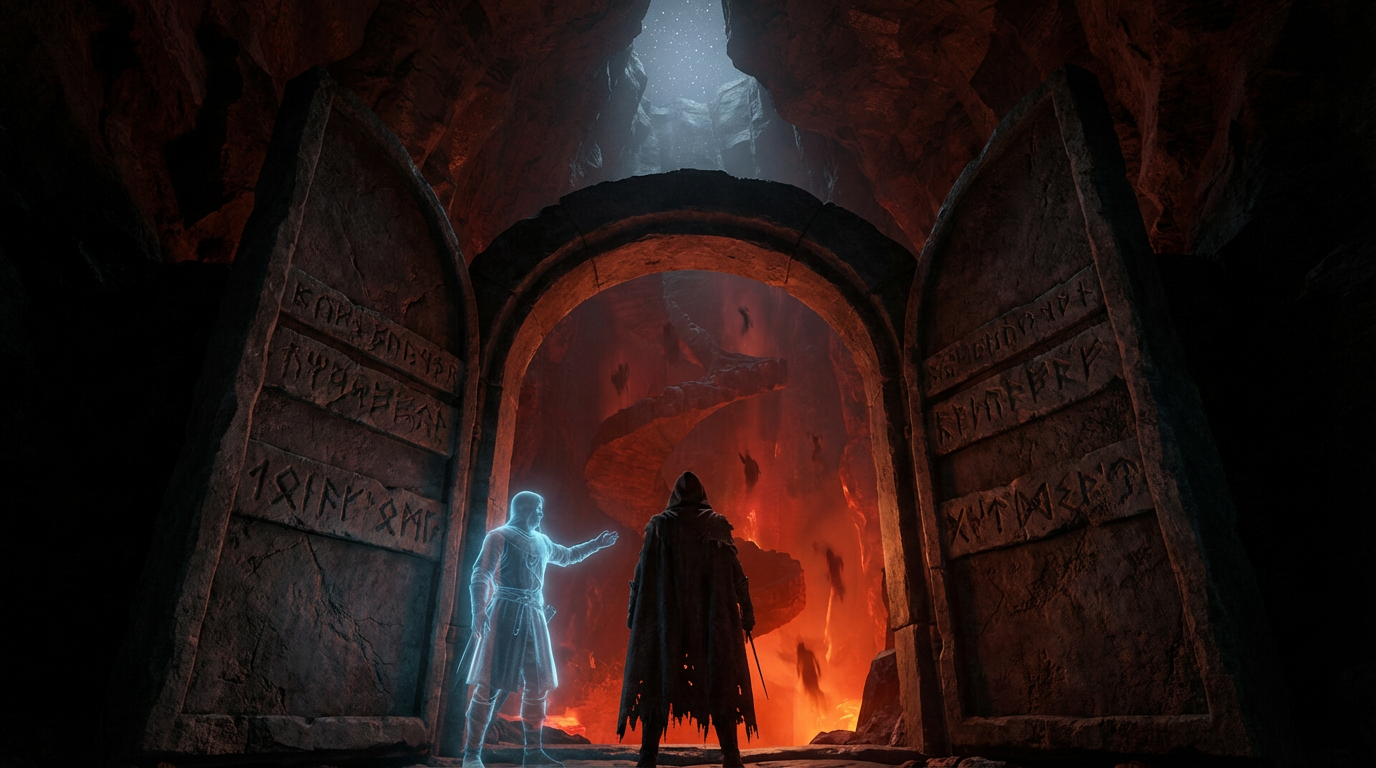
An excerpt from the original text.(complete · 1065 words)
“Hosanna Sanctus Deus Sabaoth
Superillustrans claritate tua
Felices ignes horum malahoth!”
Thus chanting saw I turn that substance bright
With fourfold lustre to its orb again,
Revolving; and the rest unto their dance
With it mov’d also; and like swiftest sparks,
In sudden distance from my sight were veil’d.

Me doubt possess’d, and “Speak,” it whisper’d me,
“Speak, speak unto thy lady, that she quench
Thy thirst with drops of sweetness.” Yet blank awe,
Which lords it o’er me, even at the sound
Of Beatrice’s name, did bow me down
As one in slumber held. Not long that mood
Beatrice suffer’d: she, with such a smile,
As might have made one blest amid the flames,
Beaming upon me, thus her words began:
“Thou in thy thought art pond’ring (as I deem,
And what I deem is truth how just revenge
Could be with justice punish’d: from which doubt
I soon will free thee; so thou mark my words;
For they of weighty matter shall possess thee.

“That man, who was unborn, himself condemn’d,
And, in himself, all, who since him have liv’d,
His offspring: whence, below, the human kind
Lay sick in grievous error many an age;
Until it pleas’d the Word of God to come
Amongst them down, to his own person joining
The nature, from its Maker far estrang’d,
By the mere act of his eternal love.
Contemplate here the wonder I unfold.
The nature with its Maker thus conjoin’d,
Created first was blameless, pure and good;
But through itself alone was driven forth
From Paradise, because it had eschew’d
The way of truth and life, to evil turn’d.
Ne’er then was penalty so just as that
Inflicted by the cross, if thou regard
The nature in assumption doom’d: ne’er wrong
So great, in reference to him, who took
Such nature on him, and endur’d the doom.
God therefore and the Jews one sentence pleased:
So different effects flow’d from one act,
And heav’n was open’d, though the earth did quake.
Count it not hard henceforth, when thou dost hear
That a just vengeance was by righteous court
Justly reveng’d. But yet I see thy mind
By thought on thought arising sore perplex’d,
And with how vehement desire it asks
Solution of the maze. What I have heard,
Is plain, thou sayst: but wherefore God this way
For our redemption chose, eludes my search.

“Brother! no eye of man not perfected,
Nor fully ripen’d in the flame of love,
May fathom this decree. It is a mark,
In sooth, much aim’d at, and but little kenn’d:
And I will therefore show thee why such way
Was worthiest. The celestial love, that spume
All envying in its bounty, in itself
With such effulgence blazeth, as sends forth
All beauteous things eternal. What distils
Immediate thence, no end of being knows,
Bearing its seal immutably impress’d.
Whatever thence immediate falls, is free,
Free wholly, uncontrollable by power
Of each thing new: by such conformity
More grateful to its author, whose bright beams,
Though all partake their shining, yet in those
Are liveliest, which resemble him the most.
These tokens of pre-eminence on man
Largely bestow’d, if any of them fail,
He needs must forfeit his nobility,
No longer stainless. Sin alone is that,
Which doth disfranchise him, and make unlike
To the chief good; for that its light in him
Is darken’d. And to dignity thus lost
Is no return; unless, where guilt makes void,
He for ill pleasure pay with equal pain.
Your nature, which entirely in its seed
Trangress’d, from these distinctions fell, no less
Than from its state in Paradise; nor means
Found of recovery (search all methods out
As strickly as thou may) save one of these,
The only fords were left through which to wade,
Either that God had of his courtesy
Releas’d him merely, or else man himself
For his own folly by himself aton’d.

“Fix now thine eye, intently as thou canst,
On th’ everlasting counsel, and explore,
Instructed by my words, the dread abyss.

“Man in himself had ever lack’d the means
Of satisfaction, for he could not stoop
Obeying, in humility so low,
As high he, disobeying, thought to soar:
And for this reason he had vainly tried
Out of his own sufficiency to pay
The rigid satisfaction. Then behooved
That God should by his own ways lead him back
Unto the life, from whence he fell, restor’d:
By both his ways, I mean, or one alone.
But since the deed is ever priz’d the more,
The more the doer’s good intent appears,
Goodness celestial, whose broad signature
Is on the universe, of all its ways
To raise ye up, was fain to leave out none,
Nor aught so vast or so magnificent,
Either for him who gave or who receiv’d
Between the last night and the primal day,
Was or can be. For God more bounty show’d.
Giving himself to make man capable
Of his return to life, than had the terms
Been mere and unconditional release.
And for his justice, every method else
Were all too scant, had not the Son of God
Humbled himself to put on mortal flesh.

“Now, to fulfil each wish of thine, remains
I somewhat further to thy view unfold.
That thou mayst see as clearly as myself.

“I see, thou sayst, the air, the fire I see,
The earth and water, and all things of them
Compounded, to corruption turn, and soon
Dissolve. Yet these were also things create,
Because, if what were told me, had been true
They from corruption had been therefore free.

“The angels, O my brother! and this clime
Wherein thou art, impassible and pure,
I call created, as indeed they are
In their whole being. But the elements,
Which thou hast nam’d, and what of them is made,
Are by created virtue’ inform’d: create
Their substance, and create the’ informing virtue
In these bright stars, that round them circling move
The soul of every brute and of each plant,
The ray and motion of the sacred lights,
With complex potency attract and turn.
But this our life the’ eternal good inspires
Immediate, and enamours of itself;
So that our wishes rest for ever here.

“And hence thou mayst by inference conclude
Our resurrection certain, if thy mind
Consider how the human flesh was fram’d,
When both our parents at the first were made.”
Master this chapter. Complete your experience
Purchase the complete book to access all chapters and support classic literature
As an Amazon Associate, we earn a small commission from qualifying purchases at no additional cost to you.
Available in paperback, hardcover, and e-book formats
Let's Analyse the Pattern
Problems that create the very conditions that prevent their individual solution, requiring external intervention to break the cycle.
Why This Matters
Connect literature to life
This chapter teaches how to distinguish between problems you can solve with more effort versus those requiring external resources or intervention.
Practice This Today
This week, notice when you're spinning your wheels on the same problem—ask yourself: 'Is this something I can solve with more effort, or do I need help from outside my current capacity?'
Now let's explore the literary elements.
Key Quotes & Analysis
"That man, who was unborn, himself condemn'd, And, in himself, all, who since him have liv'd, His offspring"
Context: Explaining how Adam's sin affected all humanity
This reveals the interconnectedness of human choices and consequences. One person's decision can ripple through generations, creating problems that descendants inherit but didn't choose.
In Today's Words:
Adam screwed up and took all of us down with him
"Until it pleas'd the Word of God to come Amongst them down, to his own person joining The nature, from its Maker far estrang'd"
Context: Describing God's decision to become human
This shows divine love taking action to solve a problem humans created but couldn't fix. God doesn't just forgive from a distance but enters into human experience completely.
In Today's Words:
God had to come down here himself to clean up our mess
"Me doubt possess'd, and 'Speak,' it whisper'd me, 'Speak, speak unto thy lady, that she quench Thy thirst with drops of sweetness'"
Context: Dante's inner voice urging him to ask Beatrice his burning question
This captures the human need to voice our deepest confusions and seek answers from those we trust. The metaphor of thirst shows how desperately we need understanding.
In Today's Words:
I was dying to ask the question that was eating at me
Thematic Threads
Pride
In This Chapter
Pride both causes humanity's fall and prevents its recovery—you can't humble yourself enough to undo ultimate pride
Development
Evolved from earlier punishment themes to reveal pride as a self-perpetuating trap
In Your Life:
You might see this when your ego prevents you from asking for help with problems your ego created.
Justice
In This Chapter
Divine justice appears paradoxical—punishment is both deserved and undeserved simultaneously
Development
Deepened from simple punishment/reward to complex understanding of systemic justice
In Your Life:
You might recognize this in situations where fairness seems impossible because everyone is both victim and perpetrator.
Class
In This Chapter
Humans occupy a unique position—neither pure spirit nor pure matter, requiring both body and soul
Development
Expanded from social hierarchy to fundamental human nature and resurrection promise
In Your Life:
You might see this in how you need both practical skills and deeper meaning to feel fully human.
Identity
In This Chapter
Human identity is fundamentally dual—requiring both material and spiritual elements to be complete
Development
Evolved from personal identity confusion to understanding essential human nature
In Your Life:
You might notice this when purely material success leaves you feeling empty, or when spiritual pursuits ignore practical needs.
You now have the context. Time to form your own thoughts.
Discussion Questions
- 1
According to Beatrice, why couldn't humans solve the problem of separation from God on their own?
analysis • surface - 2
How does pride create a trap that makes its own solution impossible?
analysis • medium - 3
Where do you see 'impossible debts' in modern life - problems that get worse the harder someone tries to solve them alone?
application • medium - 4
When facing a problem you can't solve alone, how do you decide between trying harder versus seeking outside help?
application • deep - 5
What does this chapter reveal about the difference between individual problems and structural problems?
reflection • deep
Critical Thinking Exercise
Map Your Impossible Debt
Think of a problem in your life that seems to get worse the harder you try to fix it alone. Draw or write out the feedback loop: How does the problem create conditions that make solving it harder? What external resources might break the cycle?
Consider:
- •Consider whether this is truly an individual problem or a structural one
- •Look for patterns where your efforts might be making things worse
- •Identify what kind of outside help or perspective might actually work
Journaling Prompt
Write about a time when admitting you needed help felt like giving up, but actually led to a breakthrough. What made you finally reach out?
Coming Up Next...
Chapter 75: The Soul of a King Speaks
The journey shifts to Venus, the sphere of love, where Dante encounters souls who were overcome by earthly passion but found redemption. Here he'll learn how even misdirected love can be transformed into something divine.