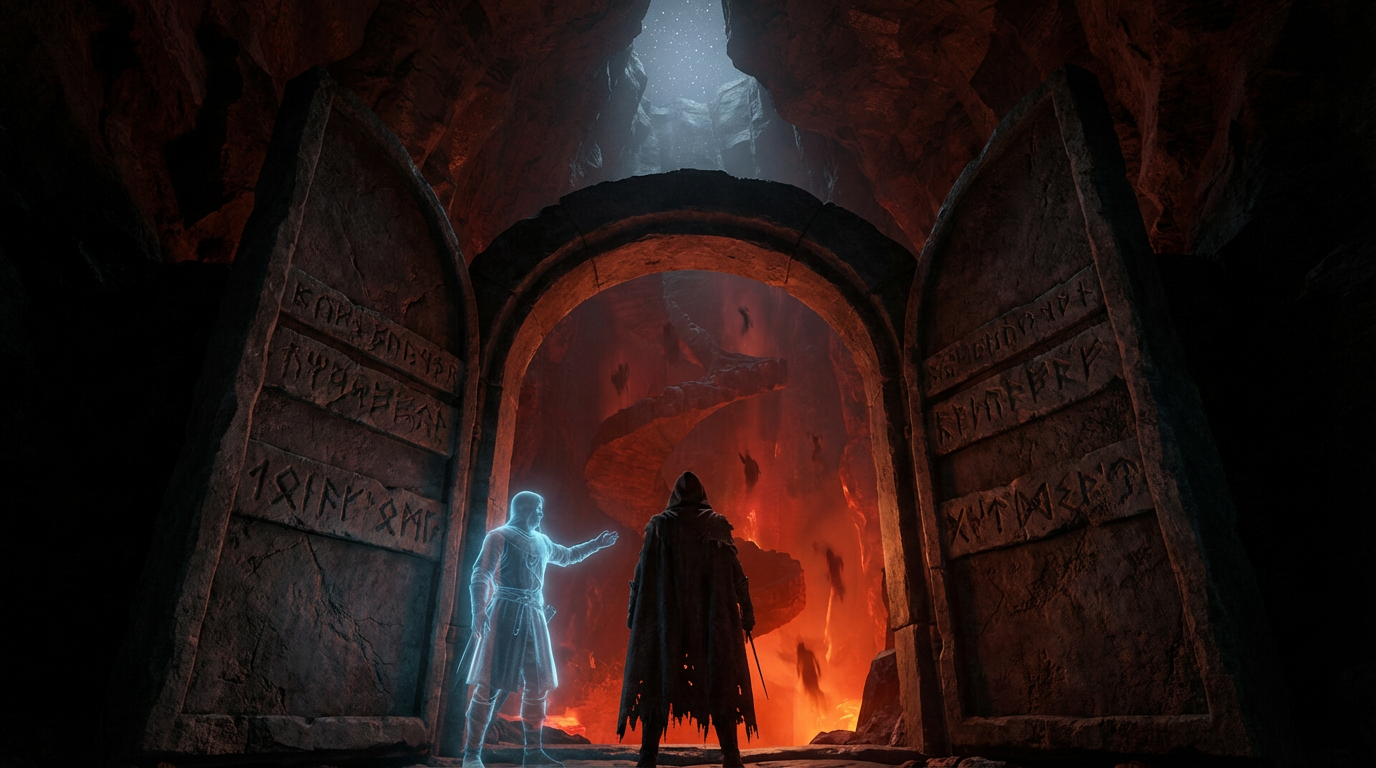
An excerpt from the original text.(complete · 1120 words)
“After that Constantine the eagle turn’d
Against the motions of the heav’n, that roll’d
Consenting with its course, when he of yore,
Lavinia’s spouse, was leader of the flight,
A hundred years twice told and more, his seat
At Europe’s extreme point, the bird of Jove
Held, near the mountains, whence he issued first.
There, under shadow of his sacred plumes
Swaying the world, till through successive hands
To mine he came devolv’d. Caesar I was,
And am Justinian; destin’d by the will
Of that prime love, whose influence I feel,
From vain excess to clear th’ encumber’d laws.
Or ere that work engag’d me, I did hold
Christ’s nature merely human, with such faith
Contented. But the blessed Agapete,
Who was chief shepherd, he with warning voice
To the true faith recall’d me. I believ’d
His words: and what he taught, now plainly see,
As thou in every contradiction seest
The true and false oppos’d. Soon as my feet
Were to the church reclaim’d, to my great task,
By inspiration of God’s grace impell’d,
I gave me wholly, and consign’d mine arms
To Belisarius, with whom heaven’s right hand
Was link’d in such conjointment, ’twas a sign
That I should rest. To thy first question thus
I shape mine answer, which were ended here,
But that its tendency doth prompt perforce
To some addition; that thou well, mayst mark
What reason on each side they have to plead,
By whom that holiest banner is withstood,
Both who pretend its power and who oppose.
    “Beginning from that hour, when Pallas died
To give it rule, behold the valorous deeds
Have made it worthy reverence. Not unknown
To thee, how for three hundred years and more
It dwelt in Alba, up to those fell lists
Where for its sake were met the rival three;
Nor aught unknown to thee, which it achiev’d
Down to the Sabines’ wrong to Lucrece’ woe,
With its sev’n kings conqu’ring the nation round;
Nor all it wrought, by Roman worthies home
’Gainst Brennus and th’ Epirot prince, and hosts
Of single chiefs, or states in league combin’d
Of social warfare; hence Torquatus stern,
And Quintius nam’d of his neglected locks,
The Decii, and the Fabii hence acquir’d
Their fame, which I with duteous zeal embalm.
By it the pride of Arab hordes was quell’d,
When they led on by Hannibal o’erpass’d
The Alpine rocks, whence glide thy currents, Po!
Beneath its guidance, in their prime of days
Scipio and Pompey triumph’d; and that hill,
Under whose summit thou didst see the light,
Rued its stern bearing. After, near the hour,
When heav’n was minded that o’er all the world
His own deep calm should brood, to Caesar’s hand
Did Rome consign it; and what then it wrought
From Var unto the Rhine, saw Isere’s flood,
Saw Loire and Seine, and every vale, that fills
The torrent Rhone. What after that it wrought,
When from Ravenna it came forth, and leap’d
The Rubicon, was of so bold a flight,
That tongue nor pen may follow it. Tow’rds Spain
It wheel’d its bands, then tow’rd Dyrrachium smote,
And on Pharsalia with so fierce a plunge,
E’en the warm Nile was conscious to the pang;
Its native shores Antandros, and the streams
Of Simois revisited, and there
Where Hector lies; then ill for Ptolemy
His pennons shook again; lightning thence fell
On Juba; and the next upon your west,
At sound of the Pompeian trump, return’d.

“What following and in its next bearer’s gripe
It wrought, is now by Cassius and Brutus
Bark’d off in hell, and by Perugia’s sons
And Modena’s was mourn’d. Hence weepeth still
Sad Cleopatra, who, pursued by it,
Took from the adder black and sudden death.
With him it ran e’en to the Red Sea coast;
With him compos’d the world to such a peace,
That of his temple Janus barr’d the door.

“But all the mighty standard yet had wrought,
And was appointed to perform thereafter,
Throughout the mortal kingdom which it sway’d,
Falls in appearance dwindled and obscur’d,
If one with steady eye and perfect thought
On the third Caesar look; for to his hands,
The living Justice, in whose breath I move,
Committed glory, e’en into his hands,
To execute the vengeance of its wrath.

“Hear now and wonder at what next I tell.
After with Titus it was sent to wreak
Vengeance for vengeance of the ancient sin,
And, when the Lombard tooth, with fangs impure,
Did gore the bosom of the holy church,
Under its wings victorious, Charlemagne
Sped to her rescue. Judge then for thyself
Of those, whom I erewhile accus’d to thee,
What they are, and how grievous their offending,
Who are the cause of all your ills. The one
Against the universal ensign rears
The yellow lilies, and with partial aim
That to himself the other arrogates:
So that ’tis hard to see which more offends.
Be yours, ye Ghibellines, to veil your arts
Beneath another standard: ill is this
Follow’d of him, who severs it and justice:
And let not with his Guelphs the new-crown’d Charles
Assail it, but those talons hold in dread,
Which from a lion of more lofty port
Have rent the easing. Many a time ere now
The sons have for the sire’s transgression wail’d;
Nor let him trust the fond belief, that heav’n
Will truck its armour for his lilied shield.

“This little star is furnish’d with good spirits,
Whose mortal lives were busied to that end,
That honour and renown might wait on them:
And, when desires thus err in their intention,
True love must needs ascend with slacker beam.
But it is part of our delight, to measure
Our wages with the merit; and admire
The close proportion. Hence doth heav’nly justice
Temper so evenly affection in us,
It ne’er can warp to any wrongfulness.
Of diverse voices is sweet music made:
So in our life the different degrees
Render sweet harmony among these wheels.

“Within the pearl, that now encloseth us,
Shines Romeo’s light, whose goodly deed and fair
Met ill acceptance. But the Provencals,
That were his foes, have little cause for mirth.
Ill shapes that man his course, who makes his wrong
Of other’s worth. Four daughters were there born
To Raymond Berenger, and every one
Became a queen; and this for him did Romeo,
Though of mean state and from a foreign land.
Yet envious tongues incited him to ask
A reckoning of that just one, who return’d
Twelve fold to him for ten. Aged and poor
He parted thence: and if the world did know
The heart he had, begging his life by morsels,
’Twould deem the praise, it yields him, scantly dealt.”
Master this chapter. Complete your experience
Purchase the complete book to access all chapters and support classic literature
As an Amazon Associate, we earn a small commission from qualifying purchases at no additional cost to you.
Available in paperback, hardcover, and e-book formats
Let's Analyse the Pattern
When moral certainty creates tunnel vision that leads to decisions destroying the very values we believe we're protecting.
Why This Matters
Connect literature to life
This chapter teaches how to recognize when moral certainty is making you miss crucial information about the people you're affecting.
Practice This Today
This week, notice when you feel most justified in a decision affecting others - that's your cue to pause and ask what perspective you might be missing.
Now let's explore the literary elements.
Key Quotes & Analysis
"Caesar I was, And am Justinian; destin'd by the will Of that prime love, whose influence I feel, From vain excess to clear th' encumber'd laws."
Context: Justinian introduces himself and explains his divine mission to reform Roman law.
This shows how Justinian sees his legal work as serving God's will, not just human ambition. He was chosen to cut through legal chaos and create clear justice.
In Today's Words:
I was Caesar, now I'm Justinian, and God chose me to clean up all these messy, contradictory laws.
"But the blessed Agapete, Who was chief shepherd, he with warning voice To the true faith recall'd me."
Context: Justinian admits a church leader corrected his wrong beliefs about Christ.
Even the most powerful emperor needed spiritual correction. This shows humility and the importance of being open to guidance from those with better understanding.
In Today's Words:
But this wise church leader called me out and set me straight about what I should believe.
"Romeo he was; and his reward how mean For his great deeds, may hence be understood."
Context: Justinian introduces Romeo's story of faithful service and unjust treatment.
This sets up the contrast between Romeo's excellent work and the poor treatment he received. It highlights how earthly recognition often fails good people.
In Today's Words:
This was Romeo, and you can see how badly he got rewarded for all his great work.
Thematic Threads
Class
In This Chapter
Romeo, despite his competence and loyalty, is destroyed by aristocratic jealousy and his lack of political connections to defend himself
Development
Continues the pattern of merit being crushed by social positioning established in earlier circles
In Your Life:
You might excel at your job but get undermined by colleagues with better office relationships or family connections.
Identity
In This Chapter
Justinian transforms from heretic emperor to divine guide, while Romeo's identity as faithful servant is twisted into 'threat to the realm'
Development
Builds on how identity can be completely rewritten by circumstances and other people's perceptions
In Your Life:
You might find your reputation at work or in your community completely redefined by a single incident or misunderstanding.
Social Expectations
In This Chapter
Romeo is expected to accept exile quietly despite his innocence, while Justinian is expected to represent perfect imperial justice
Development
Shows how social roles trap people in impossible positions regardless of their actual character
In Your Life:
You might be expected to 'take the high road' and accept unfair treatment to maintain peace in your family or workplace.
Personal Growth
In This Chapter
Justinian admits his heretical past and spiritual correction, showing that even emperors need guidance and humility
Development
Introduces the idea that growth requires admitting fundamental errors in judgment
In Your Life:
You might need to admit that beliefs you've held strongly were wrong, especially about people or situations you judged harshly.
Human Relationships
In This Chapter
The count's relationship with Romeo is poisoned by courtiers who manipulate loyalty and trust for their own gain
Development
Continues exploring how third parties can destroy genuine relationships through manipulation
In Your Life:
You might have a good relationship with someone that gets damaged by others who spread rumors or create unnecessary drama.
You now have the context. Time to form your own thoughts.
Discussion Questions
- 1
Why did Count Raymond turn against Romeo, his most loyal and successful administrator?
analysis • surface - 2
How did the count's desire to 'protect his realm' actually harm it by driving away his best servant?
analysis • medium - 3
Where have you seen someone get punished or fired despite doing excellent work, and what drove that decision?
application • medium - 4
When you feel most justified in your anger or decisions, what questions should you ask yourself before acting?
application • deep - 5
What does Romeo's story reveal about the difference between being right and being believed?
reflection • deep
Critical Thinking Exercise
Find the Romeo in Your Situation
Think of a current conflict or tension in your workplace, family, or community where someone is being criticized or pushed out. Write down what the critics are saying, then imagine you're Romeo's advocate. What evidence would you present to defend this person? What might the critics be missing because they're so sure they're right?
Consider:
- •Look for someone whose actual results don't match their reputation
- •Notice if the criticism comes from people who feel threatened or jealous
- •Ask whether the person being criticized lacks political skills rather than actual competence
Journaling Prompt
Write about a time when you were absolutely certain you were right about someone, only to discover later that you'd misjudged them. What blinded you to the truth, and how did that experience change how you evaluate people now?
Coming Up Next...
Chapter 74: Divine Justice and Human Redemption
The souls in Mercury burst into a magnificent hymn of praise, their lights spinning and dancing in celebration. As their divine song fills the heavens, Dante prepares to ascend to an even higher sphere where greater mysteries await.