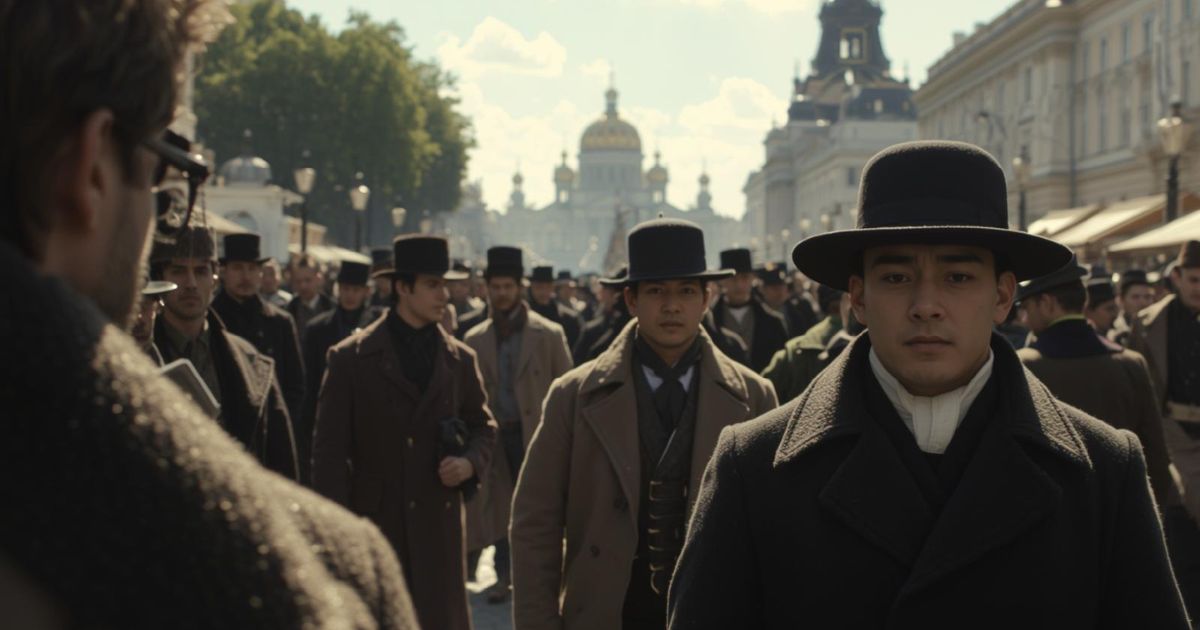
An excerpt from the original text.(complete · 4883 words)
he door was as before opened a tiny crack, and again two sharp and
suspicious eyes stared at him out of the darkness. Then Raskolnikov lost
his head and nearly made a great mistake.
Fearing the old woman would be frightened by their being alone, and not
hoping that the sight of him would disarm her suspicions, he took
hold of the door and drew it towards him to prevent the old woman from
attempting to shut it again. Seeing this she did not pull the door back,
but she did not let go the handle so that he almost dragged her out with
it on to the stairs. Seeing that she was standing in the doorway not
allowing him to pass, he advanced straight upon her. She stepped back
in alarm, tried to say something, but seemed unable to speak and stared
with open eyes at him.
“Good evening, Alyona Ivanovna,” he began, trying to speak easily, but
his voice would not obey him, it broke and shook. “I have come... I have
brought something... but we’d better come in... to the light....”
And leaving her, he passed straight into the room uninvited. The old
woman ran after him; her tongue was unloosed.
“Good heavens! What it is? Who is it? What do you want?”
“Why, Alyona Ivanovna, you know me... Raskolnikov... here, I brought you
the pledge I promised the other day...” And he held out the pledge.
The old woman glanced for a moment at the pledge, but at once stared in
the eyes of her uninvited visitor. She looked intently, maliciously and
mistrustfully. A minute passed; he even fancied something like a sneer
in her eyes, as though she had already guessed everything. He felt that
he was losing his head, that he was almost frightened, so frightened
that if she were to look like that and not say a word for another half
minute, he thought he would have run away from her.
“Why do you look at me as though you did not know me?” he said suddenly,
also with malice. “Take it if you like, if not I’ll go elsewhere, I am
in a hurry.”
He had not even thought of saying this, but it was suddenly said of
itself. The old woman recovered herself, and her visitor’s resolute tone
evidently restored her confidence.
“But why, my good sir, all of a minute.... What is it?” she asked,
looking at the pledge.
“The silver cigarette case; I spoke of it last time, you know.”
She held out her hand.
“But how pale you are, to be sure... and your hands are trembling too?
Have you been bathing, or what?”
“Fever,” he answered abruptly. “You can’t help getting pale... if you’ve
nothing to eat,” he added, with difficulty articulating the words.
His strength was failing him again. But his answer sounded like the
truth; the old woman took the pledge.
“What is it?” she asked once more, scanning Raskolnikov intently, and
weighing the pledge in her hand.
“A thing... cigarette case.... Silver.... Look at it.”
“It does not seem somehow like silver.... How he has wrapped it up!”
Trying to untie the string and turning to the window, to the light (all
her windows were shut, in spite of the stifling heat), she left
him altogether for some seconds and stood with her back to him. He
unbuttoned his coat and freed the axe from the noose, but did not yet
take it out altogether, simply holding it in his right hand under the
coat. His hands were fearfully weak, he felt them every moment growing
more numb and more wooden. He was afraid he would let the axe slip and
fall.... A sudden giddiness came over him.
“But what has he tied it up like this for?” the old woman cried with
vexation and moved towards him.
He had not a minute more to lose. He pulled the axe quite out, swung
it with both arms, scarcely conscious of himself, and almost without
effort, almost mechanically, brought the blunt side down on her head. He
seemed not to use his own strength in this. But as soon as he had once
brought the axe down, his strength returned to him.
The old woman was as always bareheaded. Her thin, light hair, streaked
with grey, thickly smeared with grease, was plaited in a rat’s tail and
fastened by a broken horn comb which stood out on the nape of her neck.
As she was so short, the blow fell on the very top of her skull. She
cried out, but very faintly, and suddenly sank all of a heap on the
floor, raising her hands to her head. In one hand she still held “the
pledge.” Then he dealt her another and another blow with the blunt side
and on the same spot. The blood gushed as from an overturned glass, the
body fell back. He stepped back, let it fall, and at once bent over her
face; she was dead. Her eyes seemed to be starting out of their sockets,
the brow and the whole face were drawn and contorted convulsively.
He laid the axe on the ground near the dead body and felt at once in her
pocket (trying to avoid the streaming body)--the same right-hand pocket
from which she had taken the key on his last visit. He was in full
possession of his faculties, free from confusion or giddiness, but his
hands were still trembling. He remembered afterwards that he had been
particularly collected and careful, trying all the time not to get
smeared with blood.... He pulled out the keys at once, they were all,
as before, in one bunch on a steel ring. He ran at once into the bedroom
with them. It was a very small room with a whole shrine of holy images.
Against the other wall stood a big bed, very clean and covered with
a silk patchwork wadded quilt. Against a third wall was a chest of
drawers. Strange to say, so soon as he began to fit the keys into the
chest, so soon as he heard their jingling, a convulsive shudder passed
over him. He suddenly felt tempted again to give it all up and go
away. But that was only for an instant; it was too late to go back.
He positively smiled at himself, when suddenly another terrifying idea
occurred to his mind. He suddenly fancied that the old woman might be
still alive and might recover her senses. Leaving the keys in the chest,
he ran back to the body, snatched up the axe and lifted it once more
over the old woman, but did not bring it down. There was no doubt that
she was dead. Bending down and examining her again more closely, he saw
clearly that the skull was broken and even battered in on one side. He
was about to feel it with his finger, but drew back his hand and indeed
it was evident without that. Meanwhile there was a perfect pool of
blood. All at once he noticed a string on her neck; he tugged at it, but
the string was strong and did not snap and besides, it was soaked
with blood. He tried to pull it out from the front of the dress, but
something held it and prevented its coming. In his impatience he raised
the axe again to cut the string from above on the body, but did not
dare, and with difficulty, smearing his hand and the axe in the blood,
after two minutes’ hurried effort, he cut the string and took it off
without touching the body with the axe; he was not mistaken--it was a
purse. On the string were two crosses, one of Cyprus wood and one of
copper, and an image in silver filigree, and with them a small greasy
chamois leather purse with a steel rim and ring. The purse was stuffed
very full; Raskolnikov thrust it in his pocket without looking at it,
flung the crosses on the old woman’s body and rushed back into the
bedroom, this time taking the axe with him.
He was in terrible haste, he snatched the keys, and began trying them
again. But he was unsuccessful. They would not fit in the locks. It
was not so much that his hands were shaking, but that he kept making
mistakes; though he saw for instance that a key was not the right one
and would not fit, still he tried to put it in. Suddenly he remembered
and realised that the big key with the deep notches, which was hanging
there with the small keys could not possibly belong to the chest of
drawers (on his last visit this had struck him), but to some strong box,
and that everything perhaps was hidden in that box. He left the chest
of drawers, and at once felt under the bedstead, knowing that old
women usually keep boxes under their beds. And so it was; there was a
good-sized box under the bed, at least a yard in length, with an arched
lid covered with red leather and studded with steel nails. The notched
key fitted at once and unlocked it. At the top, under a white sheet, was
a coat of red brocade lined with hareskin; under it was a silk dress,
then a shawl and it seemed as though there was nothing below but
clothes. The first thing he did was to wipe his blood-stained hands on
the red brocade. “It’s red, and on red blood will be less noticeable,”
the thought passed through his mind; then he suddenly came to himself.
“Good God, am I going out of my senses?” he thought with terror.
But no sooner did he touch the clothes than a gold watch slipped from
under the fur coat. He made haste to turn them all over. There turned
out to be various articles made of gold among the clothes--probably
all pledges, unredeemed or waiting to be redeemed--bracelets, chains,
ear-rings, pins and such things. Some were in cases, others simply
wrapped in newspaper, carefully and exactly folded, and tied round with
tape. Without any delay, he began filling up the pockets of his trousers
and overcoat without examining or undoing the parcels and cases; but he
had not time to take many....
He suddenly heard steps in the room where the old woman lay. He stopped
short and was still as death. But all was quiet, so it must have been
his fancy. All at once he heard distinctly a faint cry, as though
someone had uttered a low broken moan. Then again dead silence for
a minute or two. He sat squatting on his heels by the box and waited
holding his breath. Suddenly he jumped up, seized the axe and ran out of
the bedroom.
In the middle of the room stood Lizaveta with a big bundle in her arms.
She was gazing in stupefaction at her murdered sister, white as a sheet
and seeming not to have the strength to cry out. Seeing him run out
of the bedroom, she began faintly quivering all over, like a leaf, a
shudder ran down her face; she lifted her hand, opened her mouth, but
still did not scream. She began slowly backing away from him into the
corner, staring intently, persistently at him, but still uttered no
sound, as though she could not get breath to scream. He rushed at her
with the axe; her mouth twitched piteously, as one sees babies’ mouths,
when they begin to be frightened, stare intently at what frightens them
and are on the point of screaming. And this hapless Lizaveta was so
simple and had been so thoroughly crushed and scared that she did not
even raise a hand to guard her face, though that was the most necessary
and natural action at the moment, for the axe was raised over her face.
She only put up her empty left hand, but not to her face, slowly holding
it out before her as though motioning him away. The axe fell with the
sharp edge just on the skull and split at one blow all the top of the
head. She fell heavily at once. Raskolnikov completely lost his head,
snatching up her bundle, dropped it again and ran into the entry.
Fear gained more and more mastery over him, especially after this
second, quite unexpected murder. He longed to run away from the place
as fast as possible. And if at that moment he had been capable of seeing
and reasoning more correctly, if he had been able to realise all the
difficulties of his position, the hopelessness, the hideousness and the
absurdity of it, if he could have understood how many obstacles and,
perhaps, crimes he had still to overcome or to commit, to get out of
that place and to make his way home, it is very possible that he would
have flung up everything, and would have gone to give himself up, and
not from fear, but from simple horror and loathing of what he had
done. The feeling of loathing especially surged up within him and grew
stronger every minute. He would not now have gone to the box or even
into the room for anything in the world.
But a sort of blankness, even dreaminess, had begun by degrees to take
possession of him; at moments he forgot himself, or rather, forgot what
was of importance, and caught at trifles. Glancing, however, into the
kitchen and seeing a bucket half full of water on a bench, he bethought
him of washing his hands and the axe. His hands were sticky with blood.
He dropped the axe with the blade in the water, snatched a piece of soap
that lay in a broken saucer on the window, and began washing his hands
in the bucket. When they were clean, he took out the axe, washed the
blade and spent a long time, about three minutes, washing the wood where
there were spots of blood rubbing them with soap. Then he wiped it all
with some linen that was hanging to dry on a line in the kitchen and
then he was a long while attentively examining the axe at the window.
There was no trace left on it, only the wood was still damp. He
carefully hung the axe in the noose under his coat. Then as far as was
possible, in the dim light in the kitchen, he looked over his overcoat,
his trousers and his boots. At the first glance there seemed to be
nothing but stains on the boots. He wetted the rag and rubbed the boots.
But he knew he was not looking thoroughly, that there might be something
quite noticeable that he was overlooking. He stood in the middle of the
room, lost in thought. Dark agonising ideas rose in his mind--the idea
that he was mad and that at that moment he was incapable of reasoning,
of protecting himself, that he ought perhaps to be doing something
utterly different from what he was now doing. “Good God!” he muttered,
“I must fly, fly,” and he rushed into the entry. But here a shock of
terror awaited him such as he had never known before.
He stood and gazed and could not believe his eyes: the door, the outer
door from the stairs, at which he had not long before waited and rung,
was standing unfastened and at least six inches open. No lock, no bolt,
all the time, all that time! The old woman had not shut it after him
perhaps as a precaution. But, good God! Why, he had seen Lizaveta
afterwards! And how could he, how could he have failed to reflect that
she must have come in somehow! She could not have come through the wall!
He dashed to the door and fastened the latch.
“But no, the wrong thing again! I must get away, get away....”
He unfastened the latch, opened the door and began listening on the
staircase.
He listened a long time. Somewhere far away, it might be in the gateway,
two voices were loudly and shrilly shouting, quarrelling and scolding.
“What are they about?” He waited patiently. At last all was still, as
though suddenly cut off; they had separated. He was meaning to go out,
but suddenly, on the floor below, a door was noisily opened and someone
began going downstairs humming a tune. “How is it they all make such
a noise?” flashed through his mind. Once more he closed the door and
waited. At last all was still, not a soul stirring. He was just taking a
step towards the stairs when he heard fresh footsteps.
The steps sounded very far off, at the very bottom of the stairs, but
he remembered quite clearly and distinctly that from the first sound he
began for some reason to suspect that this was someone coming there,
to the fourth floor, to the old woman. Why? Were the sounds somehow
peculiar, significant? The steps were heavy, even and unhurried. Now
he had passed the first floor, now he was mounting higher, it was
growing more and more distinct! He could hear his heavy breathing. And
now the third storey had been reached. Coming here! And it seemed to
him all at once that he was turned to stone, that it was like a dream
in which one is being pursued, nearly caught and will be killed, and is
rooted to the spot and cannot even move one’s arms.
At last when the unknown was mounting to the fourth floor, he suddenly
started, and succeeded in slipping neatly and quickly back into the
flat and closing the door behind him. Then he took the hook and softly,
noiselessly, fixed it in the catch. Instinct helped him. When he had
done this, he crouched holding his breath, by the door. The unknown
visitor was by now also at the door. They were now standing opposite one
another, as he had just before been standing with the old woman, when
the door divided them and he was listening.
The visitor panted several times. “He must be a big, fat man,” thought
Raskolnikov, squeezing the axe in his hand. It seemed like a dream
indeed. The visitor took hold of the bell and rang it loudly.
As soon as the tin bell tinkled, Raskolnikov seemed to be aware of
something moving in the room. For some seconds he listened quite
seriously. The unknown rang again, waited and suddenly tugged violently
and impatiently at the handle of the door. Raskolnikov gazed in horror
at the hook shaking in its fastening, and in blank terror expected every
minute that the fastening would be pulled out. It certainly did seem
possible, so violently was he shaking it. He was tempted to hold the
fastening, but he might be aware of it. A giddiness came over him
again. “I shall fall down!” flashed through his mind, but the unknown
began to speak and he recovered himself at once.
“What’s up? Are they asleep or murdered? D-damn them!” he bawled in a
thick voice, “Hey, Alyona Ivanovna, old witch! Lizaveta Ivanovna, hey,
my beauty! open the door! Oh, damn them! Are they asleep or what?”
And again, enraged, he tugged with all his might a dozen times at
the bell. He must certainly be a man of authority and an intimate
acquaintance.
At this moment light hurried steps were heard not far off, on the
stairs. Someone else was approaching. Raskolnikov had not heard them at
first.
“You don’t say there’s no one at home,” the new-comer cried in a
cheerful, ringing voice, addressing the first visitor, who still went on
pulling the bell. “Good evening, Koch.”
“From his voice he must be quite young,” thought Raskolnikov.
“Who the devil can tell? I’ve almost broken the lock,” answered Koch.
“But how do you come to know me?”
“Why! The day before yesterday I beat you three times running at
billiards at Gambrinus’.”
“Oh!”
“So they are not at home? That’s queer. It’s awfully stupid though.
Where could the old woman have gone? I’ve come on business.”
“Yes; and I have business with her, too.”
“Well, what can we do? Go back, I suppose, Aie--aie! And I was hoping to
get some money!” cried the young man.
“We must give it up, of course, but what did she fix this time for? The
old witch fixed the time for me to come herself. It’s out of my way.
And where the devil she can have got to, I can’t make out. She sits here
from year’s end to year’s end, the old hag; her legs are bad and yet
here all of a sudden she is out for a walk!”
“Hadn’t we better ask the porter?”
“What?”
“Where she’s gone and when she’ll be back.”
“Hm.... Damn it all!... We might ask.... But you know she never does go
anywhere.”
And he once more tugged at the door-handle.
“Damn it all. There’s nothing to be done, we must go!”
“Stay!” cried the young man suddenly. “Do you see how the door shakes if
you pull it?”
“Well?”
“That shows it’s not locked, but fastened with the hook! Do you hear how
the hook clanks?”
“Well?”
“Why, don’t you see? That proves that one of them is at home. If they
were all out, they would have locked the door from the outside with the
key and not with the hook from inside. There, do you hear how the hook
is clanking? To fasten the hook on the inside they must be at home,
don’t you see? So there they are sitting inside and don’t open the
door!”
“Well! And so they must be!” cried Koch, astonished. “What are they
about in there?” And he began furiously shaking the door.
“Stay!” cried the young man again. “Don’t pull at it! There must be
something wrong.... Here, you’ve been ringing and pulling at the door
and still they don’t open! So either they’ve both fainted or...”
“What?”
“I tell you what. Let’s go fetch the porter, let him wake them up.”
“All right.”
Both were going down.
“Stay. You stop here while I run down for the porter.”
“What for?”
“Well, you’d better.”
“All right.”
“I’m studying the law you see! It’s evident, e-vi-dent there’s something
wrong here!” the young man cried hotly, and he ran downstairs.
Koch remained. Once more he softly touched the bell which gave one
tinkle, then gently, as though reflecting and looking about him, began
touching the door-handle pulling it and letting it go to make sure once
more that it was only fastened by the hook. Then puffing and panting he
bent down and began looking at the keyhole: but the key was in the lock
on the inside and so nothing could be seen.
Raskolnikov stood keeping tight hold of the axe. He was in a sort of
delirium. He was even making ready to fight when they should come in.
While they were knocking and talking together, the idea several times
occurred to him to end it all at once and shout to them through the
door. Now and then he was tempted to swear at them, to jeer at them,
while they could not open the door! “Only make haste!” was the thought
that flashed through his mind.
“But what the devil is he about?...” Time was passing, one minute, and
another--no one came. Koch began to be restless.
“What the devil?” he cried suddenly and in impatience deserting his
sentry duty, he, too, went down, hurrying and thumping with his heavy
boots on the stairs. The steps died away.
“Good heavens! What am I to do?”
Raskolnikov unfastened the hook, opened the door--there was no sound.
Abruptly, without any thought at all, he went out, closing the door as
thoroughly as he could, and went downstairs.
He had gone down three flights when he suddenly heard a loud voice
below--where could he go! There was nowhere to hide. He was just going
back to the flat.
“Hey there! Catch the brute!”
Somebody dashed out of a flat below, shouting, and rather fell than ran
down the stairs, bawling at the top of his voice.
“Mitka! Mitka! Mitka! Mitka! Mitka! Blast him!”
The shout ended in a shriek; the last sounds came from the yard; all was
still. But at the same instant several men talking loud and fast began
noisily mounting the stairs. There were three or four of them. He
distinguished the ringing voice of the young man. “Hey!”
Filled with despair he went straight to meet them, feeling “come what
must!” If they stopped him--all was lost; if they let him pass--all was
lost too; they would remember him. They were approaching; they were only
a flight from him--and suddenly deliverance! A few steps from him on the
right, there was an empty flat with the door wide open, the flat on the
second floor where the painters had been at work, and which, as though
for his benefit, they had just left. It was they, no doubt, who had just
run down, shouting. The floor had only just been painted, in the middle
of the room stood a pail and a broken pot with paint and brushes. In one
instant he had whisked in at the open door and hidden behind the wall
and only in the nick of time; they had already reached the landing.
Then they turned and went on up to the fourth floor, talking loudly. He
waited, went out on tiptoe and ran down the stairs.
No one was on the stairs, nor in the gateway. He passed quickly through
the gateway and turned to the left in the street.
He knew, he knew perfectly well that at that moment they were at the
flat, that they were greatly astonished at finding it unlocked, as
the door had just been fastened, that by now they were looking at the
bodies, that before another minute had passed they would guess and
completely realise that the murderer had just been there, and had
succeeded in hiding somewhere, slipping by them and escaping. They would
guess most likely that he had been in the empty flat, while they were
going upstairs. And meanwhile he dared not quicken his pace much, though
the next turning was still nearly a hundred yards away. “Should he
slip through some gateway and wait somewhere in an unknown street? No,
hopeless! Should he fling away the axe? Should he take a cab? Hopeless,
hopeless!”
At last he reached the turning. He turned down it more dead than alive.
Here he was half way to safety, and he understood it; it was less risky
because there was a great crowd of people, and he was lost in it like a
grain of sand. But all he had suffered had so weakened him that he could
scarcely move. Perspiration ran down him in drops, his neck was all wet.
“My word, he has been going it!” someone shouted at him when he came out
on the canal bank.
He was only dimly conscious of himself now, and the farther he went the
worse it was. He remembered however, that on coming out on to the canal
bank, he was alarmed at finding few people there and so being more
conspicuous, and he had thought of turning back. Though he was almost
falling from fatigue, he went a long way round so as to get home from
quite a different direction.
He was not fully conscious when he passed through the gateway of his
house! He was already on the staircase before he recollected the axe.
And yet he had a very grave problem before him, to put it back and to
escape observation as far as possible in doing so. He was of course
incapable of reflecting that it might perhaps be far better not to
restore the axe at all, but to drop it later on in somebody’s yard. But
it all happened fortunately, the door of the porter’s room was closed
but not locked, so that it seemed most likely that the porter was at
home. But he had so completely lost all power of reflection that he
walked straight to the door and opened it. If the porter had asked him,
“What do you want?” he would perhaps have simply handed him the axe. But
again the porter was not at home, and he succeeded in putting the axe
back under the bench, and even covering it with the chunk of wood as
before. He met no one, not a soul, afterwards on the way to his room;
the landlady’s door was shut. When he was in his room, he flung himself
on the sofa just as he was--he did not sleep, but sank into blank
forgetfulness. If anyone had come into his room then, he would have
jumped up at once and screamed. Scraps and shreds of thoughts were
simply swarming in his brain, but he could not catch at one, he could
not rest on one, in spite of all his efforts....
Master this chapter. Complete your experience
Purchase the complete book to access all chapters and support classic literature
As an Amazon Associate, we earn a small commission from qualifying purchases at no additional cost to you.
Available in paperback, hardcover, and e-book formats
Let's Analyse the Pattern
Why This Matters
Connect literature to life
This chapter teaches how one justified breach can trigger escalating consequences that quickly outrun original intentions.
Now let's explore the literary elements.
Key Quotes & Analysis
"The door opens, and Raskolnikov's philosophical theory collides with brutal reality."
Context: Entry into Alyona's room
Defines the chapter's core reversal: abstract moral certainty disintegrates under concrete violence.
"As she turns to examine his fake pledge, he pulls out the axe and strikes her on the head - once, twice..."
Context: Moment of first murder
Shows violence as repetitive and chaotic rather than precise, exposing the lie of clean ideological execution.
"He had not a minute more to lose... He was in a sort of delirium."
Context: During escape pressure
Captures cognitive overload and the rapid shift from agency fantasy to sheer reactive survival.
Thematic Threads
Violence
In This Chapter
The act unfolds as physical chaos, not abstract justice.
Development
Confirms that once initiated, violence exceeds the planner's narrative control.
Control vs Contingency
In This Chapter
Unexpected interruptions and witness arrival force rapid improvisation.
Development
Shifts the story from planned intention to unstable, high-stakes reaction.
Moral Disintegration
In This Chapter
One transgression necessitates further harms and concealment behavior.
Development
Shows how boundary crossing accelerates both ethical and psychological collapse.
Identity Rupture
In This Chapter
Raskolnikov can no longer inhabit his 'extraordinary man' self-image after embodied violence.
Development
Transforms philosophical self-concept into trauma-laden self-estrangement.
You now have the context. Time to form your own thoughts.
Discussion Questions
- 1
Where does Chapter 7 most clearly show the gap between Raskolnikov's theory and lived reality?
- 2
How does Lizaveta's unexpected arrival transform both the moral stakes and practical risks?
- 3
Which moments reveal panic replacing planning, and why does that matter?
- 4
What modern situations follow a similar one-breach-to-cascade pattern?
- 5
What early intervention could have prevented escalation once the first act occurred?
Critical Thinking Exercise
Map an Escalation Chain
Think of a situation where one bad decision forced a series of reactive choices. Write the first breach, then list each downstream consequence and response in order. Mark where truth-telling or accountability could have stopped the chain.
Consider:
- •Distinguish planned outcomes from actual outcomes
- •Identify the first point where control was clearly lost
- •Name one safeguard that would prevent similar cascades
Coming Up Next...
Chapter 8: Fever and Flight
Raskolnikov wakes in his room, and slowly the full horror of what he's done begins to surface. But before guilt can fully take hold, a summons arrives that sends him into immediate panic: the police want to see him.