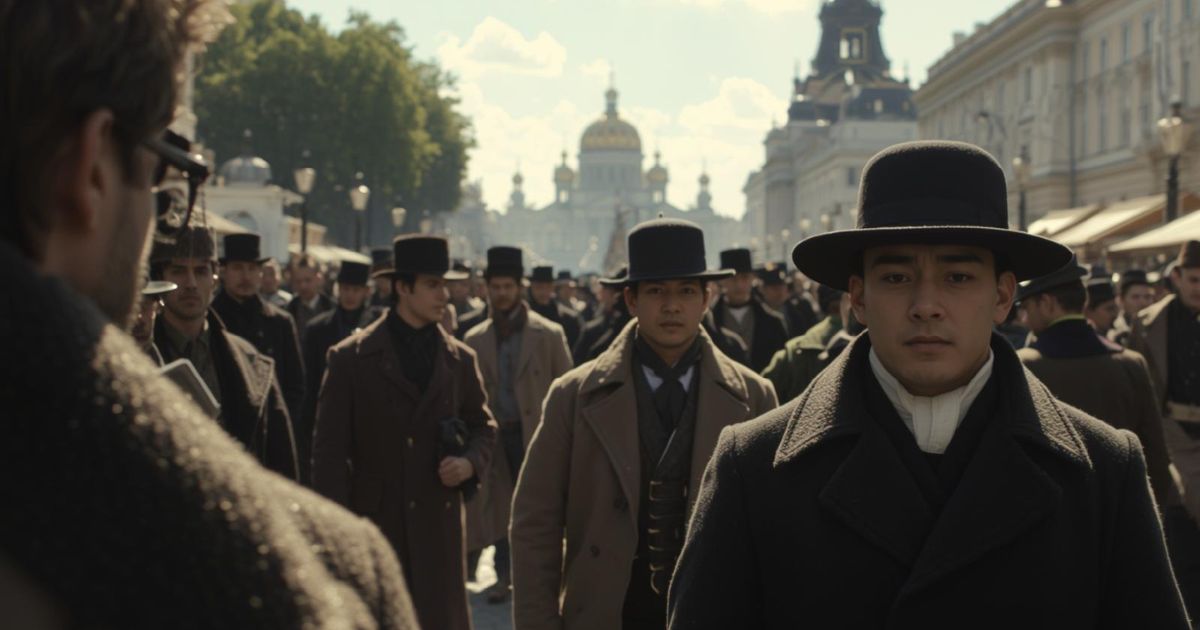
An excerpt from the original text.(complete · 6130 words)
he morning that followed the fateful interview with Dounia and
her mother brought sobering influences to bear on Pyotr Petrovitch.
Intensely unpleasant as it was, he was forced little by little to accept
as a fact beyond recall what had seemed to him only the day before
fantastic and incredible. The black snake of wounded vanity had been
gnawing at his heart all night. When he got out of bed, Pyotr Petrovitch
immediately looked in the looking-glass. He was afraid that he had
jaundice. However his health seemed unimpaired so far, and looking at
his noble, clear-skinned countenance which had grown fattish of
late, Pyotr Petrovitch for an instant was positively comforted in the
conviction that he would find another bride and, perhaps, even a better
one. But coming back to the sense of his present position, he turned
aside and spat vigorously, which excited a sarcastic smile in Andrey
Semyonovitch Lebeziatnikov, the young friend with whom he was staying.
That smile Pyotr Petrovitch noticed, and at once set it down against his
young friend’s account. He had set down a good many points against him
of late. His anger was redoubled when he reflected that he ought not to
have told Andrey Semyonovitch about the result of yesterday’s interview.
That was the second mistake he had made in temper, through impulsiveness
and irritability.... Moreover, all that morning one unpleasantness
followed another. He even found a hitch awaiting him in his legal case
in the senate. He was particularly irritated by the owner of the flat
which had been taken in view of his approaching marriage and was being
redecorated at his own expense; the owner, a rich German tradesman,
would not entertain the idea of breaking the contract which had just
been signed and insisted on the full forfeit money, though Pyotr
Petrovitch would be giving him back the flat practically redecorated. In
the same way the upholsterers refused to return a single rouble of the
instalment paid for the furniture purchased but not yet removed to the
flat.
“Am I to get married simply for the sake of the furniture?” Pyotr
Petrovitch ground his teeth and at the same time once more he had a
gleam of desperate hope. “Can all that be really so irrevocably over?
Is it no use to make another effort?” The thought of Dounia sent a
voluptuous pang through his heart. He endured anguish at that moment,
and if it had been possible to slay Raskolnikov instantly by wishing it,
Pyotr Petrovitch would promptly have uttered the wish.
“It was my mistake, too, not to have given them money,” he thought, as
he returned dejectedly to Lebeziatnikov’s room, “and why on earth was I
such a Jew? It was false economy! I meant to keep them without a penny
so that they should turn to me as their providence, and look at them!
foo! If I’d spent some fifteen hundred roubles on them for the trousseau
and presents, on knick-knacks, dressing-cases, jewellery, materials, and
all that sort of trash from Knopp’s and the English shop, my position
would have been better and... stronger! They could not have refused me
so easily! They are the sort of people that would feel bound to return
money and presents if they broke it off; and they would find it hard to
do it! And their conscience would prick them: how can we dismiss a man
who has hitherto been so generous and delicate?.... H’m! I’ve made a
blunder.”
And grinding his teeth again, Pyotr Petrovitch called himself a
fool--but not aloud, of course.
He returned home, twice as irritated and angry as before. The
preparations for the funeral dinner at Katerina Ivanovna’s excited
his curiosity as he passed. He had heard about it the day before; he
fancied, indeed, that he had been invited, but absorbed in his own cares
he had paid no attention. Inquiring of Madame Lippevechsel who was busy
laying the table while Katerina Ivanovna was away at the cemetery, he
heard that the entertainment was to be a great affair, that all the
lodgers had been invited, among them some who had not known the dead
man, that even Andrey Semyonovitch Lebeziatnikov was invited in spite of
his previous quarrel with Katerina Ivanovna, that he, Pyotr Petrovitch,
was not only invited, but was eagerly expected as he was the most
important of the lodgers. Amalia Ivanovna herself had been invited with
great ceremony in spite of the recent unpleasantness, and so she was
very busy with preparations and was taking a positive pleasure in them;
she was moreover dressed up to the nines, all in new black silk, and she
was proud of it. All this suggested an idea to Pyotr Petrovitch and he
went into his room, or rather Lebeziatnikov’s, somewhat thoughtful. He
had learnt that Raskolnikov was to be one of the guests.
Andrey Semyonovitch had been at home all the morning. The attitude of
Pyotr Petrovitch to this gentleman was strange, though perhaps natural.
Pyotr Petrovitch had despised and hated him from the day he came to stay
with him and at the same time he seemed somewhat afraid of him. He
had not come to stay with him on his arrival in Petersburg simply from
parsimony, though that had been perhaps his chief object. He had heard
of Andrey Semyonovitch, who had once been his ward, as a leading young
progressive who was taking an important part in certain interesting
circles, the doings of which were a legend in the provinces. It had
impressed Pyotr Petrovitch. These powerful omniscient circles who
despised everyone and showed everyone up had long inspired in him a
peculiar but quite vague alarm. He had not, of course, been able to form
even an approximate notion of what they meant. He, like everyone, had
heard that there were, especially in Petersburg, progressives of some
sort, nihilists and so on, and, like many people, he exaggerated and
distorted the significance of those words to an absurd degree. What for
many years past he had feared more than anything was being shown
up and this was the chief ground for his continual uneasiness at the
thought of transferring his business to Petersburg. He was afraid of
this as little children are sometimes panic-stricken. Some years before,
when he was just entering on his own career, he had come upon two cases
in which rather important personages in the province, patrons of his,
had been cruelly shown up. One instance had ended in great scandal
for the person attacked and the other had very nearly ended in serious
trouble. For this reason Pyotr Petrovitch intended to go into the
subject as soon as he reached Petersburg and, if necessary, to
anticipate contingencies by seeking the favour of “our younger
generation.” He relied on Andrey Semyonovitch for this and before
his visit to Raskolnikov he had succeeded in picking up some current
phrases. He soon discovered that Andrey Semyonovitch was a commonplace
simpleton, but that by no means reassured Pyotr Petrovitch. Even if he
had been certain that all the progressives were fools like him, it
would not have allayed his uneasiness. All the doctrines, the ideas, the
systems, with which Andrey Semyonovitch pestered him had no interest for
him. He had his own object--he simply wanted to find out at once what
was happening here. Had these people any power or not? Had he anything
to fear from them? Would they expose any enterprise of his? And what
precisely was now the object of their attacks? Could he somehow make up
to them and get round them if they really were powerful? Was this the
thing to do or not? Couldn’t he gain something through them? In fact
hundreds of questions presented themselves.
Andrey Semyonovitch was an anæmic, scrofulous little man, with strangely
flaxen mutton-chop whiskers of which he was very proud. He was a clerk
and had almost always something wrong with his eyes. He was rather
soft-hearted, but self-confident and sometimes extremely conceited in
speech, which had an absurd effect, incongruous with his little figure.
He was one of the lodgers most respected by Amalia Ivanovna, for he did
not get drunk and paid regularly for his lodgings. Andrey Semyonovitch
really was rather stupid; he attached himself to the cause of progress
and “our younger generation” from enthusiasm. He was one of the numerous
and varied legion of dullards, of half-animate abortions, conceited,
half-educated coxcombs, who attach themselves to the idea most in
fashion only to vulgarise it and who caricature every cause they serve,
however sincerely.
Though Lebeziatnikov was so good-natured, he, too, was beginning to
dislike Pyotr Petrovitch. This happened on both sides unconsciously.
However simple Andrey Semyonovitch might be, he began to see that Pyotr
Petrovitch was duping him and secretly despising him, and that “he was
not the right sort of man.” He had tried expounding to him the system of
Fourier and the Darwinian theory, but of late Pyotr Petrovitch began to
listen too sarcastically and even to be rude. The fact was he had begun
instinctively to guess that Lebeziatnikov was not merely a commonplace
simpleton, but, perhaps, a liar, too, and that he had no connections of
any consequence even in his own circle, but had simply picked things up
third-hand; and that very likely he did not even know much about his own
work of propaganda, for he was in too great a muddle. A fine person he
would be to show anyone up! It must be noted, by the way, that Pyotr
Petrovitch had during those ten days eagerly accepted the strangest
praise from Andrey Semyonovitch; he had not protested, for instance,
when Andrey Semyonovitch belauded him for being ready to contribute to
the establishment of the new “commune,” or to abstain from christening
his future children, or to acquiesce if Dounia were to take a lover a
month after marriage, and so on. Pyotr Petrovitch so enjoyed hearing
his own praises that he did not disdain even such virtues when they were
attributed to him.
Pyotr Petrovitch had had occasion that morning to realise some
five-per-cent bonds and now he sat down to the table and counted over
bundles of notes. Andrey Semyonovitch who hardly ever had any money
walked about the room pretending to himself to look at all those bank
notes with indifference and even contempt. Nothing would have convinced
Pyotr Petrovitch that Andrey Semyonovitch could really look on the money
unmoved, and the latter, on his side, kept thinking bitterly that Pyotr
Petrovitch was capable of entertaining such an idea about him and
was, perhaps, glad of the opportunity of teasing his young friend by
reminding him of his inferiority and the great difference between them.
He found him incredibly inattentive and irritable, though he, Andrey
Semyonovitch, began enlarging on his favourite subject, the foundation
of a new special “commune.” The brief remarks that dropped from Pyotr
Petrovitch between the clicking of the beads on the reckoning frame
betrayed unmistakable and discourteous irony. But the “humane” Andrey
Semyonovitch ascribed Pyotr Petrovitch’s ill-humour to his recent breach
with Dounia and he was burning with impatience to discourse on that
theme. He had something progressive to say on the subject which
might console his worthy friend and “could not fail” to promote his
development.
“There is some sort of festivity being prepared at that... at the
widow’s, isn’t there?” Pyotr Petrovitch asked suddenly, interrupting
Andrey Semyonovitch at the most interesting passage.
“Why, don’t you know? Why, I was telling you last night what I think
about all such ceremonies. And she invited you too, I heard. You were
talking to her yesterday...”
“I should never have expected that beggarly fool would have spent on
this feast all the money she got from that other fool, Raskolnikov. I
was surprised just now as I came through at the preparations there, the
wines! Several people are invited. It’s beyond everything!” continued
Pyotr Petrovitch, who seemed to have some object in pursuing the
conversation. “What? You say I am asked too? When was that? I don’t
remember. But I shan’t go. Why should I? I only said a word to her in
passing yesterday of the possibility of her obtaining a year’s salary as
a destitute widow of a government clerk. I suppose she has invited me on
that account, hasn’t she? He-he-he!”
“I don’t intend to go either,” said Lebeziatnikov.
“I should think not, after giving her a thrashing! You might well
hesitate, he-he!”
“Who thrashed? Whom?” cried Lebeziatnikov, flustered and blushing.
“Why, you thrashed Katerina Ivanovna a month ago. I heard so
yesterday... so that’s what your convictions amount to... and the woman
question, too, wasn’t quite sound, he-he-he!” and Pyotr Petrovitch, as
though comforted, went back to clicking his beads.
“It’s all slander and nonsense!” cried Lebeziatnikov, who was always
afraid of allusions to the subject. “It was not like that at all, it
was quite different. You’ve heard it wrong; it’s a libel. I was simply
defending myself. She rushed at me first with her nails, she pulled
out all my whiskers.... It’s permissable for anyone, I should hope,
to defend himself and I never allow anyone to use violence to me on
principle, for it’s an act of despotism. What was I to do? I simply
pushed her back.”
“He-he-he!” Luzhin went on laughing maliciously.
“You keep on like that because you are out of humour yourself.... But
that’s nonsense and it has nothing, nothing whatever to do with the
woman question! You don’t understand; I used to think, indeed, that
if women are equal to men in all respects, even in strength (as is
maintained now) there ought to be equality in that, too. Of course, I
reflected afterwards that such a question ought not really to arise,
for there ought not to be fighting and in the future society fighting is
unthinkable... and that it would be a queer thing to seek for equality
in fighting. I am not so stupid... though, of course, there is
fighting... there won’t be later, but at present there is... confound
it! How muddled one gets with you! It’s not on that account that I
am not going. I am not going on principle, not to take part in the
revolting convention of memorial dinners, that’s why! Though, of course,
one might go to laugh at it.... I am sorry there won’t be any priests at
it. I should certainly go if there were.”
“Then you would sit down at another man’s table and insult it and those
who invited you. Eh?”
“Certainly not insult, but protest. I should do it with a good object. I
might indirectly assist the cause of enlightenment and propaganda. It’s
a duty of every man to work for enlightenment and propaganda and the
more harshly, perhaps, the better. I might drop a seed, an idea.... And
something might grow up from that seed. How should I be insulting them?
They might be offended at first, but afterwards they’d see I’d done them
a service. You know, Terebyeva (who is in the community now) was blamed
because when she left her family and... devoted... herself, she wrote to
her father and mother that she wouldn’t go on living conventionally and
was entering on a free marriage and it was said that that was too harsh,
that she might have spared them and have written more kindly. I think
that’s all nonsense and there’s no need of softness; on the contrary,
what’s wanted is protest. Varents had been married seven years, she
abandoned her two children, she told her husband straight out in a
letter: ‘I have realised that I cannot be happy with you. I can never
forgive you that you have deceived me by concealing from me that there
is another organisation of society by means of the communities. I have
only lately learned it from a great-hearted man to whom I have given
myself and with whom I am establishing a community. I speak plainly
because I consider it dishonest to deceive you. Do as you think best.
Do not hope to get me back, you are too late. I hope you will be happy.’
That’s how letters like that ought to be written!”
“Is that Terebyeva the one you said had made a third free marriage?”
“No, it’s only the second, really! But what if it were the fourth, what
if it were the fifteenth, that’s all nonsense! And if ever I regretted
the death of my father and mother, it is now, and I sometimes think
if my parents were living what a protest I would have aimed at them! I
would have done something on purpose... I would have shown them! I would
have astonished them! I am really sorry there is no one!”
“To surprise! He-he! Well, be that as you will,” Pyotr Petrovitch
interrupted, “but tell me this; do you know the dead man’s daughter, the
delicate-looking little thing? It’s true what they say about her, isn’t
it?”
“What of it? I think, that is, it is my own personal conviction that
this is the normal condition of women. Why not? I mean, distinguons.
In our present society it is not altogether normal, because it is
compulsory, but in the future society it will be perfectly normal,
because it will be voluntary. Even as it is, she was quite right: she
was suffering and that was her asset, so to speak, her capital which
she had a perfect right to dispose of. Of course, in the future
society there will be no need of assets, but her part will have another
significance, rational and in harmony with her environment. As to Sofya
Semyonovna personally, I regard her action as a vigorous protest against
the organisation of society, and I respect her deeply for it; I rejoice
indeed when I look at her!”
“I was told that you got her turned out of these lodgings.”
Lebeziatnikov was enraged.
“That’s another slander,” he yelled. “It was not so at all! That was all
Katerina Ivanovna’s invention, for she did not understand! And I never
made love to Sofya Semyonovna! I was simply developing her, entirely
disinterestedly, trying to rouse her to protest.... All I wanted was her
protest and Sofya Semyonovna could not have remained here anyway!”
“Have you asked her to join your community?”
“You keep on laughing and very inappropriately, allow me to tell
you. You don’t understand! There is no such rôle in a community. The
community is established that there should be no such rôles. In a
community, such a rôle is essentially transformed and what is stupid
here is sensible there, what, under present conditions, is unnatural
becomes perfectly natural in the community. It all depends on the
environment. It’s all the environment and man himself is nothing. And
I am on good terms with Sofya Semyonovna to this day, which is a proof
that she never regarded me as having wronged her. I am trying now to
attract her to the community, but on quite, quite a different footing.
What are you laughing at? We are trying to establish a community of
our own, a special one, on a broader basis. We have gone further in our
convictions. We reject more! And meanwhile I’m still developing Sofya
Semyonovna. She has a beautiful, beautiful character!”
“And you take advantage of her fine character, eh? He-he!”
“No, no! Oh, no! On the contrary.”
“Oh, on the contrary! He-he-he! A queer thing to say!”
“Believe me! Why should I disguise it? In fact, I feel it strange myself
how timid, chaste and modern she is with me!”
“And you, of course, are developing her... he-he! trying to prove to her
that all that modesty is nonsense?”
“Not at all, not at all! How coarsely, how stupidly--excuse me saying
so--you misunderstand the word development! Good heavens, how... crude
you still are! We are striving for the freedom of women and you have
only one idea in your head.... Setting aside the general question
of chastity and feminine modesty as useless in themselves and indeed
prejudices, I fully accept her chastity with me, because that’s for her
to decide. Of course if she were to tell me herself that she wanted me,
I should think myself very lucky, because I like the girl very much; but
as it is, no one has ever treated her more courteously than I, with more
respect for her dignity... I wait in hopes, that’s all!”
“You had much better make her a present of something. I bet you never
thought of that.”
“You don’t understand, as I’ve told you already! Of course, she is in
such a position, but it’s another question. Quite another question!
You simply despise her. Seeing a fact which you mistakenly consider
deserving of contempt, you refuse to take a humane view of a fellow
creature. You don’t know what a character she is! I am only sorry that
of late she has quite given up reading and borrowing books. I used
to lend them to her. I am sorry, too, that with all the energy and
resolution in protesting--which she has already shown once--she has
little self-reliance, little, so to say, independence, so as to
break free from certain prejudices and certain foolish ideas. Yet she
thoroughly understands some questions, for instance about kissing of
hands, that is, that it’s an insult to a woman for a man to kiss her
hand, because it’s a sign of inequality. We had a debate about it and
I described it to her. She listened attentively to an account of the
workmen’s associations in France, too. Now I am explaining the question
of coming into the room in the future society.”
“And what’s that, pray?”
“We had a debate lately on the question: Has a member of the community
the right to enter another member’s room, whether man or woman, at any
time... and we decided that he has!”
“It might be at an inconvenient moment, he-he!”
Lebeziatnikov was really angry.
“You are always thinking of something unpleasant,” he cried with
aversion. “Tfoo! How vexed I am that when I was expounding our system, I
referred prematurely to the question of personal privacy! It’s always
a stumbling-block to people like you, they turn it into ridicule before
they understand it. And how proud they are of it, too! Tfoo! I’ve often
maintained that that question should not be approached by a novice till
he has a firm faith in the system. And tell me, please, what do you
find so shameful even in cesspools? I should be the first to be ready
to clean out any cesspool you like. And it’s not a question of
self-sacrifice, it’s simply work, honourable, useful work which is
as good as any other and much better than the work of a Raphael and a
Pushkin, because it is more useful.”
“And more honourable, more honourable, he-he-he!”
“What do you mean by ‘more honourable’? I don’t understand such
expressions to describe human activity. ‘More honourable,’ ‘nobler’--all
those are old-fashioned prejudices which I reject. Everything which is
of use to mankind is honourable. I only understand one word: useful!
You can snigger as much as you like, but that’s so!”
Pyotr Petrovitch laughed heartily. He had finished counting the money
and was putting it away. But some of the notes he left on the table. The
“cesspool question” had already been a subject of dispute between them.
What was absurd was that it made Lebeziatnikov really angry, while it
amused Luzhin and at that moment he particularly wanted to anger his
young friend.
“It’s your ill-luck yesterday that makes you so ill-humoured and
annoying,” blurted out Lebeziatnikov, who in spite of his “independence”
and his “protests” did not venture to oppose Pyotr Petrovitch and still
behaved to him with some of the respect habitual in earlier years.
“You’d better tell me this,” Pyotr Petrovitch interrupted with haughty
displeasure, “can you... or rather are you really friendly enough with
that young person to ask her to step in here for a minute? I think
they’ve all come back from the cemetery... I heard the sound of
steps... I want to see her, that young person.”
“What for?” Lebeziatnikov asked with surprise.
“Oh, I want to. I am leaving here to-day or to-morrow and therefore I
wanted to speak to her about... However, you may be present during the
interview. It’s better you should be, indeed. For there’s no knowing
what you might imagine.”
“I shan’t imagine anything. I only asked and, if you’ve anything to say
to her, nothing is easier than to call her in. I’ll go directly and you
may be sure I won’t be in your way.”
Five minutes later Lebeziatnikov came in with Sonia. She came in very
much surprised and overcome with shyness as usual. She was always shy in
such circumstances and was always afraid of new people, she had been as
a child and was even more so now.... Pyotr Petrovitch met her “politely
and affably,” but with a certain shade of bantering familiarity which in
his opinion was suitable for a man of his respectability and weight
in dealing with a creature so young and so interesting as she. He
hastened to “reassure” her and made her sit down facing him at the
table. Sonia sat down, looked about her--at Lebeziatnikov, at the notes
lying on the table and then again at Pyotr Petrovitch and her eyes
remained riveted on him. Lebeziatnikov was moving to the door. Pyotr
Petrovitch signed to Sonia to remain seated and stopped Lebeziatnikov.
“Is Raskolnikov in there? Has he come?” he asked him in a whisper.
“Raskolnikov? Yes. Why? Yes, he is there. I saw him just come in....
Why?”
“Well, I particularly beg you to remain here with us and not to leave
me alone with this... young woman. I only want a few words with her,
but God knows what they may make of it. I shouldn’t like Raskolnikov to
repeat anything.... You understand what I mean?”
“I understand!” Lebeziatnikov saw the point. “Yes, you are right.... Of
course, I am convinced personally that you have no reason to be uneasy,
but... still, you are right. Certainly I’ll stay. I’ll stand here at the
window and not be in your way... I think you are right...”
Pyotr Petrovitch returned to the sofa, sat down opposite Sonia, looked
attentively at her and assumed an extremely dignified, even severe
expression, as much as to say, “don’t you make any mistake, madam.”
Sonia was overwhelmed with embarrassment.
“In the first place, Sofya Semyonovna, will you make my excuses to your
respected mamma.... That’s right, isn’t it? Katerina Ivanovna stands
in the place of a mother to you?” Pyotr Petrovitch began with great
dignity, though affably.
It was evident that his intentions were friendly.
“Quite so, yes; the place of a mother,” Sonia answered, timidly and
hurriedly.
“Then will you make my apologies to her? Through inevitable
circumstances I am forced to be absent and shall not be at the dinner in
spite of your mamma’s kind invitation.”
“Yes... I’ll tell her... at once.”
And Sonia hastily jumped up from her seat.
“Wait, that’s not all,” Pyotr Petrovitch detained her, smiling at her
simplicity and ignorance of good manners, “and you know me little, my
dear Sofya Semyonovna, if you suppose I would have ventured to trouble
a person like you for a matter of so little consequence affecting myself
only. I have another object.”
Sonia sat down hurriedly. Her eyes rested again for an instant on the
grey-and-rainbow-coloured notes that remained on the table, but she
quickly looked away and fixed her eyes on Pyotr Petrovitch. She felt it
horribly indecorous, especially for her, to look at another person’s
money. She stared at the gold eye-glass which Pyotr Petrovitch held
in his left hand and at the massive and extremely handsome ring with a
yellow stone on his middle finger. But suddenly she looked away and, not
knowing where to turn, ended by staring Pyotr Petrovitch again straight
in the face. After a pause of still greater dignity he continued.
“I chanced yesterday in passing to exchange a couple of words with
Katerina Ivanovna, poor woman. That was sufficient to enable me to
ascertain that she is in a position--preternatural, if one may so
express it.”
“Yes... preternatural...” Sonia hurriedly assented.
“Or it would be simpler and more comprehensible to say, ill.”
“Yes, simpler and more comprehen... yes, ill.”
“Quite so. So then from a feeling of humanity and so to speak
compassion, I should be glad to be of service to her in any way,
foreseeing her unfortunate position. I believe the whole of this
poverty-stricken family depends now entirely on you?”
“Allow me to ask,” Sonia rose to her feet, “did you say something to her
yesterday of the possibility of a pension? Because she told me you had
undertaken to get her one. Was that true?”
“Not in the slightest, and indeed it’s an absurdity! I merely hinted at
her obtaining temporary assistance as the widow of an official who had
died in the service--if only she has patronage... but apparently your
late parent had not served his full term and had not indeed been in the
service at all of late. In fact, if there could be any hope, it would be
very ephemeral, because there would be no claim for assistance in
that case, far from it.... And she is dreaming of a pension already,
he-he-he!... A go-ahead lady!”
“Yes, she is. For she is credulous and good-hearted, and she believes
everything from the goodness of her heart and... and... and she is like
that... yes... You must excuse her,” said Sonia, and again she got up to
go.
“But you haven’t heard what I have to say.”
“No, I haven’t heard,” muttered Sonia.
“Then sit down.” She was terribly confused; she sat down again a third
time.
“Seeing her position with her unfortunate little ones, I should be glad,
as I have said before, so far as lies in my power, to be of service,
that is, so far as is in my power, not more. One might for instance get
up a subscription for her, or a lottery, something of the sort, such as
is always arranged in such cases by friends or even outsiders desirous
of assisting people. It was of that I intended to speak to you; it might
be done.”
“Yes, yes... God will repay you for it,” faltered Sonia, gazing intently
at Pyotr Petrovitch.
“It might be, but we will talk of it later. We might begin it to-day, we
will talk it over this evening and lay the foundation so to speak. Come
to me at seven o’clock. Mr. Lebeziatnikov, I hope, will assist us. But
there is one circumstance of which I ought to warn you beforehand and
for which I venture to trouble you, Sofya Semyonovna, to come here. In
my opinion money cannot be, indeed it’s unsafe to put it into Katerina
Ivanovna’s own hands. The dinner to-day is a proof of that. Though she
has not, so to speak, a crust of bread for to-morrow and... well, boots
or shoes, or anything; she has bought to-day Jamaica rum, and even,
I believe, Madeira and... and coffee. I saw it as I passed through.
To-morrow it will all fall upon you again, they won’t have a crust of
bread. It’s absurd, really, and so, to my thinking, a subscription ought
to be raised so that the unhappy widow should not know of the money, but
only you, for instance. Am I right?”
“I don’t know... this is only to-day, once in her life.... She was
so anxious to do honour, to celebrate the memory.... And she is very
sensible... but just as you think and I shall be very, very... they will
all be... and God will reward... and the orphans...”
Sonia burst into tears.
“Very well, then, keep it in mind; and now will you accept for the
benefit of your relation the small sum that I am able to spare, from me
personally. I am very anxious that my name should not be mentioned in
connection with it. Here... having so to speak anxieties of my own, I
cannot do more...”
And Pyotr Petrovitch held out to Sonia a ten-rouble note carefully
unfolded. Sonia took it, flushed crimson, jumped up, muttered something
and began taking leave. Pyotr Petrovitch accompanied her ceremoniously
to the door. She got out of the room at last, agitated and distressed,
and returned to Katerina Ivanovna, overwhelmed with confusion.
All this time Lebeziatnikov had stood at the window or walked about the
room, anxious not to interrupt the conversation; when Sonia had gone he
walked up to Pyotr Petrovitch and solemnly held out his hand.
“I heard and saw everything,” he said, laying stress on the last verb.
“That is honourable, I mean to say, it’s humane! You wanted to avoid
gratitude, I saw! And although I cannot, I confess, in principle
sympathise with private charity, for it not only fails to eradicate the
evil but even promotes it, yet I must admit that I saw your action with
pleasure--yes, yes, I like it.”
“That’s all nonsense,” muttered Pyotr Petrovitch, somewhat disconcerted,
looking carefully at Lebeziatnikov.
“No, it’s not nonsense! A man who has suffered distress and annoyance as
you did yesterday and who yet can sympathise with the misery of others,
such a man... even though he is making a social mistake--is still
deserving of respect! I did not expect it indeed of you, Pyotr
Petrovitch, especially as according to your ideas... oh, what a drawback
your ideas are to you! How distressed you are for instance by your
ill-luck yesterday,” cried the simple-hearted Lebeziatnikov, who felt
a return of affection for Pyotr Petrovitch. “And, what do you want with
marriage, with legal marriage, my dear, noble Pyotr Petrovitch? Why do
you cling to this legality of marriage? Well, you may beat me if you
like, but I am glad, positively glad it hasn’t come off, that you are
free, that you are not quite lost for humanity.... you see, I’ve spoken
my mind!”
“Because I don’t want in your free marriage to be made a fool of and
to bring up another man’s children, that’s why I want legal marriage,”
Luzhin replied in order to make some answer.
He seemed preoccupied by something.
“Children? You referred to children,” Lebeziatnikov started off like
a warhorse at the trumpet call. “Children are a social question and a
question of first importance, I agree; but the question of children has
another solution. Some refuse to have children altogether, because they
suggest the institution of the family. We’ll speak of children later,
but now as to the question of honour, I confess that’s my weak point.
That horrid, military, Pushkin expression is unthinkable in the
dictionary of the future. What does it mean indeed? It’s nonsense,
there will be no deception in a free marriage! That is only the natural
consequence of a legal marriage, so to say, its corrective, a protest.
So that indeed it’s not humiliating... and if I ever, to suppose an
absurdity, were to be legally married, I should be positively glad of
it. I should say to my wife: ‘My dear, hitherto I have loved you, now
I respect you, for you’ve shown you can protest!’ You laugh! That’s
because you are incapable of getting away from prejudices. Confound
it all! I understand now where the unpleasantness is of being deceived
in a legal marriage, but it’s simply a despicable consequence of a
despicable position in which both are humiliated. When the deception is
open, as in a free marriage, then it does not exist, it’s unthinkable.
Your wife will only prove how she respects you by considering you
incapable of opposing her happiness and avenging yourself on her for
her new husband. Damn it all! I sometimes dream if I were to be married,
pfoo! I mean if I were to marry, legally or not, it’s just the same,
I should present my wife with a lover if she had not found one for
herself. ‘My dear,’ I should say, ‘I love you, but even more than that I
desire you to respect me. See!’ Am I not right?”
Pyotr Petrovitch sniggered as he listened, but without much merriment.
He hardly heard it indeed. He was preoccupied with something else and
even Lebeziatnikov at last noticed it. Pyotr Petrovitch seemed excited
and rubbed his hands. Lebeziatnikov remembered all this and reflected
upon it afterwards.
Master this chapter. Complete your experience
Purchase the complete book to access all chapters and support classic literature
As an Amazon Associate, we earn a small commission from qualifying purchases at no additional cost to you.
Available in paperback, hardcover, and e-book formats
Let's Analyse the Pattern
Why This Matters
Connect literature to life
This chapter helps readers identify how stress reshapes judgment, power, and relationship dynamics in real time.
Now let's explore the literary elements.
Key Quotes & Analysis
"A bizarre dinner party brings together the novel's main characters in one chaotic scene."
Context: Core movement described by the chapter summary
This line captures the chapter's central pressure point and the shift it creates in character behavior.
"Actions under pressure expose deeper motives and limits."
Context: Interpreting this chapter's conflict
The chapter emphasizes that crisis does not invent character; it reveals structure already present.
Thematic Threads
Consequence
In This Chapter
Prior choices narrow present options and increase emotional stakes.
Development
The chapter advances from abstract tension to concrete cost.
Power
In This Chapter
Status, dependence, or leverage shape who can define reality in the scene.
Development
Control shifts through conversation, framing, and reaction.
Identity
In This Chapter
Characters struggle to maintain a coherent self-story under contradiction.
Development
Internal narratives are tested against observable behavior.
Relationship Strain
In This Chapter
Trust and communication degrade when secrecy or fear dominate interaction.
Development
The chapter escalates interpersonal risk alongside plot risk.
You now have the context. Time to form your own thoughts.
Discussion Questions
- 1
What pressure in this chapter most strongly drives behavior change?
- 2
Which character controls the frame of the conflict, and how?
- 3
Where does self-justification break down into visible consequence?
- 4
How do status and vulnerability shape what each person can safely say?
- 5
What alternative choice might have reduced downstream harm?
Critical Thinking Exercise
Pressure Map
Map one chapter decision with four columns: pressure source, available options, likely short-term relief, and long-term consequence. Then identify which option best preserves integrity under constraint.
Consider:
- •Separate immediate emotion from structural incentives
- •Track who bears risk versus who controls terms
- •Define one boundary that prevents escalation
Coming Up Next...
Chapter 28: A Mother's Farewell
Having confessed to Sonia, Raskolnikov now faces an even harder choice - whether to follow her advice and turn himself in. But first, he must navigate the dangerous game with Porfiry, who seems to know more than he's letting on.