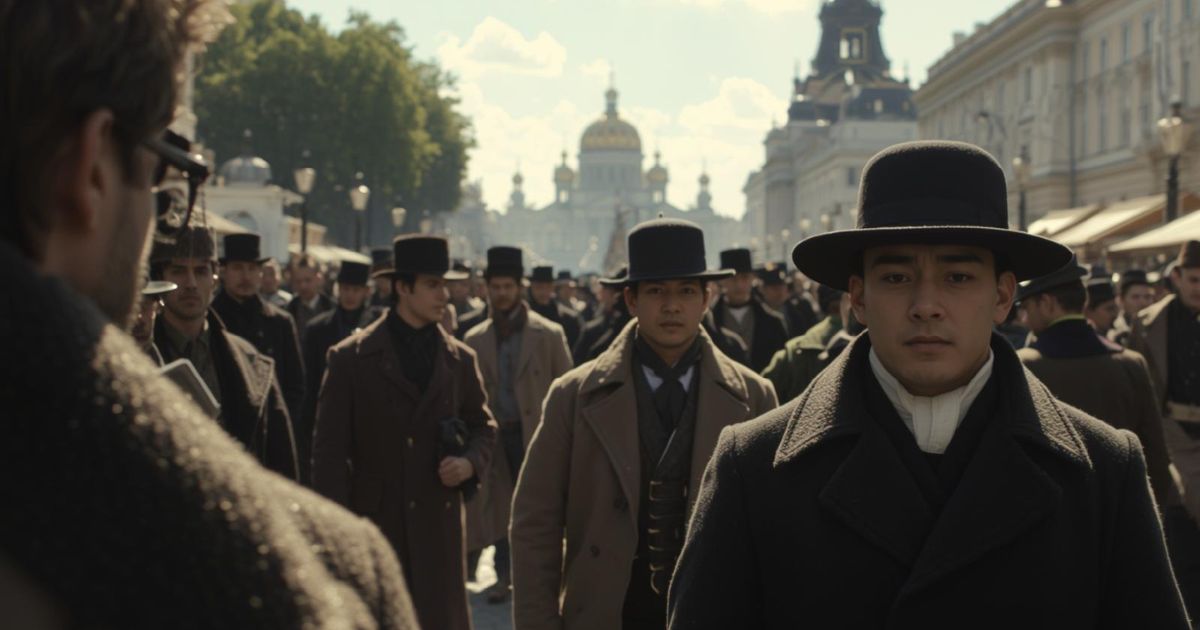
An excerpt from the original text.(complete · 7505 words)
ut as soon as she went out, he got up, latched the door, undid the
parcel which Razumihin had brought in that evening and had tied up again
and began dressing. Strange to say, he seemed immediately to have become
perfectly calm; not a trace of his recent delirium nor of the panic
fear that had haunted him of late. It was the first moment of a strange
sudden calm. His movements were precise and definite; a firm purpose was
evident in them. “To-day, to-day,” he muttered to himself. He understood
that he was still weak, but his intense spiritual concentration gave him
strength and self-confidence. He hoped, moreover, that he would not
fall down in the street. When he had dressed in entirely new clothes, he
looked at the money lying on the table, and after a moment’s thought
put it in his pocket. It was twenty-five roubles. He took also all the
copper change from the ten roubles spent by Razumihin on the clothes.
Then he softly unlatched the door, went out, slipped downstairs and
glanced in at the open kitchen door. Nastasya was standing with her back
to him, blowing up the landlady’s samovar. She heard nothing. Who would
have dreamed of his going out, indeed? A minute later he was in the
street.
It was nearly eight o’clock, the sun was setting. It was as stifling as
before, but he eagerly drank in the stinking, dusty town air. His head
felt rather dizzy; a sort of savage energy gleamed suddenly in his
feverish eyes and his wasted, pale and yellow face. He did not know and
did not think where he was going, he had one thought only: “that all
this must be ended to-day, once for all, immediately; that he would
not return home without it, because he would not go on living like
that.” How, with what to make an end? He had not an idea about it,
he did not even want to think of it. He drove away thought; thought
tortured him. All he knew, all he felt was that everything must be
changed “one way or another,” he repeated with desperate and immovable
self-confidence and determination.
From old habit he took his usual walk in the direction of the Hay
Market. A dark-haired young man with a barrel organ was standing in
the road in front of a little general shop and was grinding out a very
sentimental song. He was accompanying a girl of fifteen, who stood
on the pavement in front of him. She was dressed up in a crinoline, a
mantle and a straw hat with a flame-coloured feather in it, all very
old and shabby. In a strong and rather agreeable voice, cracked and
coarsened by street singing, she sang in hope of getting a copper from
the shop. Raskolnikov joined two or three listeners, took out a five
copeck piece and put it in the girl’s hand. She broke off abruptly on a
sentimental high note, shouted sharply to the organ grinder “Come on,”
and both moved on to the next shop.
“Do you like street music?” said Raskolnikov, addressing a middle-aged
man standing idly by him. The man looked at him, startled and wondering.
“I love to hear singing to a street organ,” said Raskolnikov, and his
manner seemed strangely out of keeping with the subject--“I like it
on cold, dark, damp autumn evenings--they must be damp--when all the
passers-by have pale green, sickly faces, or better still when wet
snow is falling straight down, when there’s no wind--you know what I
mean?--and the street lamps shine through it...”
“I don’t know.... Excuse me...” muttered the stranger, frightened by the
question and Raskolnikov’s strange manner, and he crossed over to the
other side of the street.
Raskolnikov walked straight on and came out at the corner of the Hay
Market, where the huckster and his wife had talked with Lizaveta; but
they were not there now. Recognising the place, he stopped, looked round
and addressed a young fellow in a red shirt who stood gaping before a
corn chandler’s shop.
“Isn’t there a man who keeps a booth with his wife at this corner?”
“All sorts of people keep booths here,” answered the young man, glancing
superciliously at Raskolnikov.
“What’s his name?”
“What he was christened.”
“Aren’t you a Zaraïsky man, too? Which province?”
The young man looked at Raskolnikov again.
“It’s not a province, your excellency, but a district. Graciously
forgive me, your excellency!”
“Is that a tavern at the top there?”
“Yes, it’s an eating-house and there’s a billiard-room and you’ll find
princesses there too.... La-la!”
Raskolnikov crossed the square. In that corner there was a dense crowd
of peasants. He pushed his way into the thickest part of it, looking
at the faces. He felt an unaccountable inclination to enter into
conversation with people. But the peasants took no notice of him; they
were all shouting in groups together. He stood and thought a little and
took a turning to the right in the direction of V.
He had often crossed that little street which turns at an angle, leading
from the market-place to Sadovy Street. Of late he had often felt drawn
to wander about this district, when he felt depressed, that he might
feel more so.
Now he walked along, thinking of nothing. At that point there is a great
block of buildings, entirely let out in dram shops and eating-houses;
women were continually running in and out, bare-headed and in their
indoor clothes. Here and there they gathered in groups, on the pavement,
especially about the entrances to various festive establishments in
the lower storeys. From one of these a loud din, sounds of singing, the
tinkling of a guitar and shouts of merriment, floated into the street.
A crowd of women were thronging round the door; some were sitting on the
steps, others on the pavement, others were standing talking. A drunken
soldier, smoking a cigarette, was walking near them in the road,
swearing; he seemed to be trying to find his way somewhere, but had
forgotten where. One beggar was quarrelling with another, and a man dead
drunk was lying right across the road. Raskolnikov joined the throng of
women, who were talking in husky voices. They were bare-headed and wore
cotton dresses and goatskin shoes. There were women of forty and some
not more than seventeen; almost all had blackened eyes.
He felt strangely attracted by the singing and all the noise and
uproar in the saloon below.... someone could be heard within dancing
frantically, marking time with his heels to the sounds of the guitar
and of a thin falsetto voice singing a jaunty air. He listened intently,
gloomily and dreamily, bending down at the entrance and peeping
inquisitively in from the pavement.
“Oh, my handsome soldier
Don’t beat me for nothing,”
trilled the thin voice of the singer. Raskolnikov felt a great desire to
make out what he was singing, as though everything depended on that.
“Shall I go in?” he thought. “They are laughing. From drink. Shall I get
drunk?”
“Won’t you come in?” one of the women asked him. Her voice was
still musical and less thick than the others, she was young and not
repulsive--the only one of the group.
“Why, she’s pretty,” he said, drawing himself up and looking at her.
She smiled, much pleased at the compliment.
“You’re very nice looking yourself,” she said.
“Isn’t he thin though!” observed another woman in a deep bass. “Have you
just come out of a hospital?”
“They’re all generals’ daughters, it seems, but they have all snub
noses,” interposed a tipsy peasant with a sly smile on his face, wearing
a loose coat. “See how jolly they are.”
“Go along with you!”
“I’ll go, sweetie!”
And he darted down into the saloon below. Raskolnikov moved on.
“I say, sir,” the girl shouted after him.
“What is it?”
She hesitated.
“I’ll always be pleased to spend an hour with you, kind gentleman, but
now I feel shy. Give me six copecks for a drink, there’s a nice young
man!”
Raskolnikov gave her what came first--fifteen copecks.
“Ah, what a good-natured gentleman!”
“What’s your name?”
“Ask for Duclida.”
“Well, that’s too much,” one of the women observed, shaking her head
at Duclida. “I don’t know how you can ask like that. I believe I should
drop with shame....”
Raskolnikov looked curiously at the speaker. She was a pock-marked wench
of thirty, covered with bruises, with her upper lip swollen. She made
her criticism quietly and earnestly. “Where is it,” thought Raskolnikov.
“Where is it I’ve read that someone condemned to death says or thinks,
an hour before his death, that if he had to live on some high rock,
on such a narrow ledge that he’d only room to stand, and the ocean,
everlasting darkness, everlasting solitude, everlasting tempest around
him, if he had to remain standing on a square yard of space all his
life, a thousand years, eternity, it were better to live so than to die
at once! Only to live, to live and live! Life, whatever it may be!...
How true it is! Good God, how true! Man is a vile creature!... And vile
is he who calls him vile for that,” he added a moment later.
He went into another street. “Bah, the Palais de Cristal! Razumihin
was just talking of the Palais de Cristal. But what on earth was it
I wanted? Yes, the newspapers.... Zossimov said he’d read it in the
papers. Have you the papers?” he asked, going into a very spacious and
positively clean restaurant, consisting of several rooms, which were,
however, rather empty. Two or three people were drinking tea, and in a
room further away were sitting four men drinking champagne. Raskolnikov
fancied that Zametov was one of them, but he could not be sure at that
distance. “What if it is?” he thought.
“Will you have vodka?” asked the waiter.
“Give me some tea and bring me the papers, the old ones for the last
five days, and I’ll give you something.”
“Yes, sir, here’s to-day’s. No vodka?”
The old newspapers and the tea were brought. Raskolnikov sat down and
began to look through them.
“Oh, damn... these are the items of intelligence. An accident on a
staircase, spontaneous combustion of a shopkeeper from alcohol, a fire
in Peski... a fire in the Petersburg quarter... another fire in the
Petersburg quarter... and another fire in the Petersburg quarter....
Ah, here it is!” He found at last what he was seeking and began to
read it. The lines danced before his eyes, but he read it all and began
eagerly seeking later additions in the following numbers. His hands
shook with nervous impatience as he turned the sheets. Suddenly someone
sat down beside him at his table. He looked up, it was the head clerk
Zametov, looking just the same, with the rings on his fingers and the
watch-chain, with the curly, black hair, parted and pomaded, with the
smart waistcoat, rather shabby coat and doubtful linen. He was in a good
humour, at least he was smiling very gaily and good-humouredly. His dark
face was rather flushed from the champagne he had drunk.
“What, you here?” he began in surprise, speaking as though he’d known
him all his life. “Why, Razumihin told me only yesterday you were
unconscious. How strange! And do you know I’ve been to see you?”
Raskolnikov knew he would come up to him. He laid aside the papers and
turned to Zametov. There was a smile on his lips, and a new shade of
irritable impatience was apparent in that smile.
“I know you have,” he answered. “I’ve heard it. You looked for my
sock.... And you know Razumihin has lost his heart to you? He says
you’ve been with him to Luise Ivanovna’s--you know, the woman you tried
to befriend, for whom you winked to the Explosive Lieutenant and he
would not understand. Do you remember? How could he fail to
understand--it was quite clear, wasn’t it?”
“What a hot head he is!”
“The explosive one?”
“No, your friend Razumihin.”
“You must have a jolly life, Mr. Zametov; entrance free to the most
agreeable places. Who’s been pouring champagne into you just now?”
“We’ve just been... having a drink together.... You talk about pouring
it into me!”
“By way of a fee! You profit by everything!” Raskolnikov laughed, “it’s
all right, my dear boy,” he added, slapping Zametov on the shoulder. “I
am not speaking from temper, but in a friendly way, for sport, as that
workman of yours said when he was scuffling with Dmitri, in the case of
the old woman....”
“How do you know about it?”
“Perhaps I know more about it than you do.”
“How strange you are.... I am sure you are still very unwell. You
oughtn’t to have come out.”
“Oh, do I seem strange to you?”
“Yes. What are you doing, reading the papers?”
“Yes.”
“There’s a lot about the fires.”
“No, I am not reading about the fires.” Here he looked mysteriously at
Zametov; his lips were twisted again in a mocking smile. “No, I am not
reading about the fires,” he went on, winking at Zametov. “But confess
now, my dear fellow, you’re awfully anxious to know what I am reading
about?”
“I am not in the least. Mayn’t I ask a question? Why do you keep
on...?”
“Listen, you are a man of culture and education?”
“I was in the sixth class at the gymnasium,” said Zametov with some
dignity.
“Sixth class! Ah, my cock-sparrow! With your parting and your rings--you
are a gentleman of fortune. Foo! what a charming boy!” Here Raskolnikov
broke into a nervous laugh right in Zametov’s face. The latter drew
back, more amazed than offended.
“Foo! how strange you are!” Zametov repeated very seriously. “I can’t
help thinking you are still delirious.”
“I am delirious? You are fibbing, my cock-sparrow! So I am strange? You
find me curious, do you?”
“Yes, curious.”
“Shall I tell you what I was reading about, what I was looking for? See
what a lot of papers I’ve made them bring me. Suspicious, eh?”
“Well, what is it?”
“You prick up your ears?”
“How do you mean--‘prick up my ears’?”
“I’ll explain that afterwards, but now, my boy, I declare to you... no,
better ‘I confess’... No, that’s not right either; ‘I make a deposition
and you take it.’ I depose that I was reading, that I was looking and
searching....” he screwed up his eyes and paused. “I was searching--and
came here on purpose to do it--for news of the murder of the old
pawnbroker woman,” he articulated at last, almost in a whisper, bringing
his face exceedingly close to the face of Zametov. Zametov looked at him
steadily, without moving or drawing his face away. What struck Zametov
afterwards as the strangest part of it all was that silence followed for
exactly a minute, and that they gazed at one another all the while.
“What if you have been reading about it?” he cried at last, perplexed
and impatient. “That’s no business of mine! What of it?”
“The same old woman,” Raskolnikov went on in the same whisper, not
heeding Zametov’s explanation, “about whom you were talking in the
police-office, you remember, when I fainted. Well, do you understand
now?”
“What do you mean? Understand... what?” Zametov brought out, almost
alarmed.
Raskolnikov’s set and earnest face was suddenly transformed, and he
suddenly went off into the same nervous laugh as before, as though
utterly unable to restrain himself. And in one flash he recalled with
extraordinary vividness of sensation a moment in the recent past, that
moment when he stood with the axe behind the door, while the latch
trembled and the men outside swore and shook it, and he had a sudden
desire to shout at them, to swear at them, to put out his tongue at
them, to mock them, to laugh, and laugh, and laugh!
“You are either mad, or...” began Zametov, and he broke off, as though
stunned by the idea that had suddenly flashed into his mind.
“Or? Or what? What? Come, tell me!”
“Nothing,” said Zametov, getting angry, “it’s all nonsense!”
Both were silent. After his sudden fit of laughter Raskolnikov became
suddenly thoughtful and melancholy. He put his elbow on the table and
leaned his head on his hand. He seemed to have completely forgotten
Zametov. The silence lasted for some time.
“Why don’t you drink your tea? It’s getting cold,” said Zametov.
“What! Tea? Oh, yes....” Raskolnikov sipped the glass, put a morsel of
bread in his mouth and, suddenly looking at Zametov, seemed to remember
everything and pulled himself together. At the same moment his face
resumed its original mocking expression. He went on drinking tea.
“There have been a great many of these crimes lately,” said Zametov.
“Only the other day I read in the Moscow News that a whole gang of
false coiners had been caught in Moscow. It was a regular society. They
used to forge tickets!”
“Oh, but it was a long time ago! I read about it a month ago,”
Raskolnikov answered calmly. “So you consider them criminals?” he added,
smiling.
“Of course they are criminals.”
“They? They are children, simpletons, not criminals! Why, half a hundred
people meeting for such an object--what an idea! Three would be too
many, and then they want to have more faith in one another than in
themselves! One has only to blab in his cups and it all collapses.
Simpletons! They engaged untrustworthy people to change the notes--what
a thing to trust to a casual stranger! Well, let us suppose that these
simpletons succeed and each makes a million, and what follows for the
rest of their lives? Each is dependent on the others for the rest of his
life! Better hang oneself at once! And they did not know how to change
the notes either; the man who changed the notes took five thousand
roubles, and his hands trembled. He counted the first four thousand,
but did not count the fifth thousand--he was in such a hurry to get the
money into his pocket and run away. Of course he roused suspicion. And
the whole thing came to a crash through one fool! Is it possible?”
“That his hands trembled?” observed Zametov, “yes, that’s quite
possible. That, I feel quite sure, is possible. Sometimes one can’t
stand things.”
“Can’t stand that?”
“Why, could you stand it then? No, I couldn’t. For the sake of a hundred
roubles to face such a terrible experience? To go with false notes
into a bank where it’s their business to spot that sort of thing! No, I
should not have the face to do it. Would you?”
Raskolnikov had an intense desire again “to put his tongue out.” Shivers
kept running down his spine.
“I should do it quite differently,” Raskolnikov began. “This is how I
would change the notes: I’d count the first thousand three or four times
backwards and forwards, looking at every note and then I’d set to the
second thousand; I’d count that half-way through and then hold some
fifty-rouble note to the light, then turn it, then hold it to the light
again--to see whether it was a good one. ‘I am afraid,’ I would say, ‘a
relation of mine lost twenty-five roubles the other day through a
false note,’ and then I’d tell them the whole story. And after I began
counting the third, ‘No, excuse me,’ I would say, ‘I fancy I made a
mistake in the seventh hundred in that second thousand, I am not sure.’
And so I would give up the third thousand and go back to the second and
so on to the end. And when I had finished, I’d pick out one from the
fifth and one from the second thousand and take them again to the light
and ask again, ‘Change them, please,’ and put the clerk into such a stew
that he would not know how to get rid of me. When I’d finished and had
gone out, I’d come back, ‘No, excuse me,’ and ask for some explanation.
That’s how I’d do it.”
“Foo! what terrible things you say!” said Zametov, laughing. “But all
that is only talk. I dare say when it came to deeds you’d make a slip.
I believe that even a practised, desperate man cannot always reckon on
himself, much less you and I. To take an example near home--that old
woman murdered in our district. The murderer seems to have been a
desperate fellow, he risked everything in open daylight, was saved by
a miracle--but his hands shook, too. He did not succeed in robbing the
place, he couldn’t stand it. That was clear from the...”
Raskolnikov seemed offended.
“Clear? Why don’t you catch him then?” he cried, maliciously gibing at
Zametov.
“Well, they will catch him.”
“Who? You? Do you suppose you could catch him? You’ve a tough job! A
great point for you is whether a man is spending money or not. If he had
no money and suddenly begins spending, he must be the man. So that any
child can mislead you.”
“The fact is they always do that, though,” answered Zametov. “A man will
commit a clever murder at the risk of his life and then at once he goes
drinking in a tavern. They are caught spending money, they are not all
as cunning as you are. You wouldn’t go to a tavern, of course?”
Raskolnikov frowned and looked steadily at Zametov.
“You seem to enjoy the subject and would like to know how I should
behave in that case, too?” he asked with displeasure.
“I should like to,” Zametov answered firmly and seriously. Somewhat too
much earnestness began to appear in his words and looks.
“Very much?”
“Very much!”
“All right then. This is how I should behave,” Raskolnikov began, again
bringing his face close to Zametov’s, again staring at him and speaking
in a whisper, so that the latter positively shuddered. “This is what
I should have done. I should have taken the money and jewels, I should
have walked out of there and have gone straight to some deserted place
with fences round it and scarcely anyone to be seen, some kitchen garden
or place of that sort. I should have looked out beforehand some stone
weighing a hundredweight or more which had been lying in the corner from
the time the house was built. I would lift that stone--there would sure
to be a hollow under it, and I would put the jewels and money in that
hole. Then I’d roll the stone back so that it would look as before,
would press it down with my foot and walk away. And for a year or two,
three maybe, I would not touch it. And, well, they could search! There’d
be no trace.”
“You are a madman,” said Zametov, and for some reason he too spoke in a
whisper, and moved away from Raskolnikov, whose eyes were glittering. He
had turned fearfully pale and his upper lip was twitching and quivering.
He bent down as close as possible to Zametov, and his lips began to move
without uttering a word. This lasted for half a minute; he knew what he
was doing, but could not restrain himself. The terrible word trembled on
his lips, like the latch on that door; in another moment it will break
out, in another moment he will let it go, he will speak out.
“And what if it was I who murdered the old woman and Lizaveta?” he said
suddenly and--realised what he had done.
Zametov looked wildly at him and turned white as the tablecloth. His
face wore a contorted smile.
“But is it possible?” he brought out faintly. Raskolnikov looked
wrathfully at him.
“Own up that you believed it, yes, you did?”
“Not a bit of it, I believe it less than ever now,” Zametov cried
hastily.
“I’ve caught my cock-sparrow! So you did believe it before, if now you
believe less than ever?”
“Not at all,” cried Zametov, obviously embarrassed. “Have you been
frightening me so as to lead up to this?”
“You don’t believe it then? What were you talking about behind my
back when I went out of the police-office? And why did the explosive
lieutenant question me after I fainted? Hey, there,” he shouted to the
waiter, getting up and taking his cap, “how much?”
“Thirty copecks,” the latter replied, running up.
“And there is twenty copecks for vodka. See what a lot of money!” he
held out his shaking hand to Zametov with notes in it. “Red notes and
blue, twenty-five roubles. Where did I get them? And where did my new
clothes come from? You know I had not a copeck. You’ve cross-examined my
landlady, I’ll be bound.... Well, that’s enough! Assez causé! Till we
meet again!”
He went out, trembling all over from a sort of wild hysterical
sensation, in which there was an element of insufferable rapture. Yet he
was gloomy and terribly tired. His face was twisted as after a fit.
His fatigue increased rapidly. Any shock, any irritating sensation
stimulated and revived his energies at once, but his strength failed as
quickly when the stimulus was removed.
Zametov, left alone, sat for a long time in the same place, plunged in
thought. Raskolnikov had unwittingly worked a revolution in his brain on
a certain point and had made up his mind for him conclusively.
“Ilya Petrovitch is a blockhead,” he decided.
Raskolnikov had hardly opened the door of the restaurant when he
stumbled against Razumihin on the steps. They did not see each other
till they almost knocked against each other. For a moment they stood
looking each other up and down. Razumihin was greatly astounded, then
anger, real anger gleamed fiercely in his eyes.
“So here you are!” he shouted at the top of his voice--“you ran away
from your bed! And here I’ve been looking for you under the sofa! We
went up to the garret. I almost beat Nastasya on your account. And here
he is after all. Rodya! What is the meaning of it? Tell me the whole
truth! Confess! Do you hear?”
“It means that I’m sick to death of you all and I want to be alone,”
Raskolnikov answered calmly.
“Alone? When you are not able to walk, when your face is as white as a
sheet and you are gasping for breath! Idiot!... What have you been doing
in the Palais de Cristal? Own up at once!”
“Let me go!” said Raskolnikov and tried to pass him. This was too much
for Razumihin; he gripped him firmly by the shoulder.
“Let you go? You dare tell me to let you go? Do you know what I’ll do
with you directly? I’ll pick you up, tie you up in a bundle, carry you
home under my arm and lock you up!”
“Listen, Razumihin,” Raskolnikov began quietly, apparently calm--“can’t
you see that I don’t want your benevolence? A strange desire you have to
shower benefits on a man who... curses them, who feels them a burden in
fact! Why did you seek me out at the beginning of my illness? Maybe I
was very glad to die. Didn’t I tell you plainly enough to-day that
you were torturing me, that I was... sick of you! You seem to want to
torture people! I assure you that all that is seriously hindering my
recovery, because it’s continually irritating me. You saw Zossimov
went away just now to avoid irritating me. You leave me alone too, for
goodness’ sake! What right have you, indeed, to keep me by force? Don’t
you see that I am in possession of all my faculties now? How, how can
I persuade you not to persecute me with your kindness? I may be
ungrateful, I may be mean, only let me be, for God’s sake, let me be!
Let me be, let me be!”
He began calmly, gloating beforehand over the venomous phrases he was
about to utter, but finished, panting for breath, in a frenzy, as he had
been with Luzhin.
Razumihin stood a moment, thought and let his hand drop.
“Well, go to hell then,” he said gently and thoughtfully. “Stay,” he
roared, as Raskolnikov was about to move. “Listen to me. Let me tell
you, that you are all a set of babbling, posing idiots! If you’ve any
little trouble you brood over it like a hen over an egg. And you are
plagiarists even in that! There isn’t a sign of independent life in
you! You are made of spermaceti ointment and you’ve lymph in your veins
instead of blood. I don’t believe in anyone of you! In any circumstances
the first thing for all of you is to be unlike a human being! Stop!” he
cried with redoubled fury, noticing that Raskolnikov was again making
a movement--“hear me out! You know I’m having a house-warming this
evening, I dare say they’ve arrived by now, but I left my uncle there--I
just ran in--to receive the guests. And if you weren’t a fool, a common
fool, a perfect fool, if you were an original instead of a translation...
you see, Rodya, I recognise you’re a clever fellow, but you’re a
fool!--and if you weren’t a fool you’d come round to me this evening
instead of wearing out your boots in the street! Since you have gone
out, there’s no help for it! I’d give you a snug easy chair, my landlady
has one... a cup of tea, company.... Or you could lie on the sofa--any
way you would be with us.... Zossimov will be there too. Will you come?”
“No.”
“R-rubbish!” Razumihin shouted, out of patience. “How do you know?
You can’t answer for yourself! You don’t know anything about it....
Thousands of times I’ve fought tooth and nail with people and run back
to them afterwards.... One feels ashamed and goes back to a man! So
remember, Potchinkov’s house on the third storey....”
“Why, Mr. Razumihin, I do believe you’d let anybody beat you from sheer
benevolence.”
“Beat? Whom? Me? I’d twist his nose off at the mere idea! Potchinkov’s
house, 47, Babushkin’s flat....”
“I shall not come, Razumihin.” Raskolnikov turned and walked away.
“I bet you will,” Razumihin shouted after him. “I refuse to know you if
you don’t! Stay, hey, is Zametov in there?”
“Yes.”
“Did you see him?”
“Yes.”
“Talked to him?”
“Yes.”
“What about? Confound you, don’t tell me then. Potchinkov’s house, 47,
Babushkin’s flat, remember!”
Raskolnikov walked on and turned the corner into Sadovy Street.
Razumihin looked after him thoughtfully. Then with a wave of his hand he
went into the house but stopped short of the stairs.
“Confound it,” he went on almost aloud. “He talked sensibly but yet...
I am a fool! As if madmen didn’t talk sensibly! And this was just what
Zossimov seemed afraid of.” He struck his finger on his forehead. “What
if... how could I let him go off alone? He may drown himself.... Ach,
what a blunder! I can’t.” And he ran back to overtake Raskolnikov, but
there was no trace of him. With a curse he returned with rapid steps to
the Palais de Cristal to question Zametov.
Raskolnikov walked straight to X---- Bridge, stood in the middle, and
leaning both elbows on the rail stared into the distance. On parting
with Razumihin, he felt so much weaker that he could scarcely reach this
place. He longed to sit or lie down somewhere in the street. Bending
over the water, he gazed mechanically at the last pink flush of the
sunset, at the row of houses growing dark in the gathering twilight, at
one distant attic window on the left bank, flashing as though on fire in
the last rays of the setting sun, at the darkening water of the canal,
and the water seemed to catch his attention. At last red circles flashed
before his eyes, the houses seemed moving, the passers-by, the canal
banks, the carriages, all danced before his eyes. Suddenly he started,
saved again perhaps from swooning by an uncanny and hideous sight. He
became aware of someone standing on the right side of him; he looked
and saw a tall woman with a kerchief on her head, with a long, yellow,
wasted face and red sunken eyes. She was looking straight at him, but
obviously she saw nothing and recognised no one. Suddenly she leaned her
right hand on the parapet, lifted her right leg over the railing, then
her left and threw herself into the canal. The filthy water parted and
swallowed up its victim for a moment, but an instant later the drowning
woman floated to the surface, moving slowly with the current, her head
and legs in the water, her skirt inflated like a balloon over her back.
“A woman drowning! A woman drowning!” shouted dozens of voices; people
ran up, both banks were thronged with spectators, on the bridge people
crowded about Raskolnikov, pressing up behind him.
“Mercy on it! it’s our Afrosinya!” a woman cried tearfully close by.
“Mercy! save her! kind people, pull her out!”
“A boat, a boat!” was shouted in the crowd. But there was no need of a
boat; a policeman ran down the steps to the canal, threw off his great
coat and his boots and rushed into the water. It was easy to reach her:
she floated within a couple of yards from the steps, he caught hold of
her clothes with his right hand and with his left seized a pole which a
comrade held out to him; the drowning woman was pulled out at once. They
laid her on the granite pavement of the embankment. She soon recovered
consciousness, raised her head, sat up and began sneezing and coughing,
stupidly wiping her wet dress with her hands. She said nothing.
“She’s drunk herself out of her senses,” the same woman’s voice wailed
at her side. “Out of her senses. The other day she tried to hang
herself, we cut her down. I ran out to the shop just now, left my little
girl to look after her--and here she’s in trouble again! A neighbour,
gentleman, a neighbour, we live close by, the second house from the end,
see yonder....”
The crowd broke up. The police still remained round the woman, someone
mentioned the police station.... Raskolnikov looked on with a strange
sensation of indifference and apathy. He felt disgusted. “No, that’s
loathsome... water... it’s not good enough,” he muttered to himself.
“Nothing will come of it,” he added, “no use to wait. What about the
police office...? And why isn’t Zametov at the police office? The police
office is open till ten o’clock....” He turned his back to the railing
and looked about him.
“Very well then!” he said resolutely; he moved from the bridge and
walked in the direction of the police office. His heart felt hollow and
empty. He did not want to think. Even his depression had passed, there
was not a trace now of the energy with which he had set out “to make an
end of it all.” Complete apathy had succeeded to it.
“Well, it’s a way out of it,” he thought, walking slowly and listlessly
along the canal bank. “Anyway, I’ll make an end, for I want to.... But
is it a way out? What does it matter! There’ll be the square yard of
space--ha! But what an end! Is it really the end? Shall I tell them or
not? Ah... damn! How tired I am! If I could find somewhere to sit or lie
down soon! What I am most ashamed of is its being so stupid. But I don’t
care about that either! What idiotic ideas come into one’s head.”
To reach the police office he had to go straight forward and take the
second turning to the left. It was only a few paces away. But at the
first turning he stopped and, after a minute’s thought, turned into a
side street and went two streets out of his way, possibly without any
object, or possibly to delay a minute and gain time. He walked, looking
at the ground; suddenly someone seemed to whisper in his ear; he lifted
his head and saw that he was standing at the very gate of the house.
He had not passed it, he had not been near it since that evening.
An overwhelming, unaccountable prompting drew him on. He went into the
house, passed through the gateway, then into the first entrance on the
right, and began mounting the familiar staircase to the fourth storey.
The narrow, steep staircase was very dark. He stopped at each landing
and looked round him with curiosity; on the first landing the framework
of the window had been taken out. “That wasn’t so then,” he thought.
Here was the flat on the second storey where Nikolay and Dmitri had been
working. “It’s shut up and the door newly painted. So it’s to let.” Then
the third storey and the fourth. “Here!” He was perplexed to find the
door of the flat wide open. There were men there, he could hear voices;
he had not expected that. After brief hesitation he mounted the last
stairs and went into the flat. It, too, was being done up; there were
workmen in it. This seemed to amaze him; he somehow fancied that he
would find everything as he left it, even perhaps the corpses in the
same places on the floor. And now, bare walls, no furniture; it seemed
strange. He walked to the window and sat down on the window-sill. There
were two workmen, both young fellows, but one much younger than the
other. They were papering the walls with a new white paper covered with
lilac flowers, instead of the old, dirty, yellow one. Raskolnikov for
some reason felt horribly annoyed by this. He looked at the new paper
with dislike, as though he felt sorry to have it all so changed.
The workmen had obviously stayed beyond their time and now they were
hurriedly rolling up their paper and getting ready to go home. They took
no notice of Raskolnikov’s coming in; they were talking. Raskolnikov
folded his arms and listened.
“She comes to me in the morning,” said the elder to the younger, “very
early, all dressed up. ‘Why are you preening and prinking?’ says I. ‘I
am ready to do anything to please you, Tit Vassilitch!’ That’s a way of
going on! And she dressed up like a regular fashion book!”
“And what is a fashion book?” the younger one asked. He obviously
regarded the other as an authority.
“A fashion book is a lot of pictures, coloured, and they come to the
tailors here every Saturday, by post from abroad, to show folks how
to dress, the male sex as well as the female. They’re pictures. The
gentlemen are generally wearing fur coats and for the ladies’ fluffles,
they’re beyond anything you can fancy.”
“There’s nothing you can’t find in Petersburg,” the younger cried
enthusiastically, “except father and mother, there’s everything!”
“Except them, there’s everything to be found, my boy,” the elder
declared sententiously.
Raskolnikov got up and walked into the other room where the strong box,
the bed, and the chest of drawers had been; the room seemed to him very
tiny without furniture in it. The paper was the same; the paper in the
corner showed where the case of ikons had stood. He looked at it and
went to the window. The elder workman looked at him askance.
“What do you want?” he asked suddenly.
Instead of answering Raskolnikov went into the passage and pulled the
bell. The same bell, the same cracked note. He rang it a second and
a third time; he listened and remembered. The hideous and agonisingly
fearful sensation he had felt then began to come back more and more
vividly. He shuddered at every ring and it gave him more and more
satisfaction.
“Well, what do you want? Who are you?” the workman shouted, going out to
him. Raskolnikov went inside again.
“I want to take a flat,” he said. “I am looking round.”
“It’s not the time to look at rooms at night! and you ought to come up
with the porter.”
“The floors have been washed, will they be painted?” Raskolnikov went
on. “Is there no blood?”
“What blood?”
“Why, the old woman and her sister were murdered here. There was a
perfect pool there.”
“But who are you?” the workman cried, uneasy.
“Who am I?”
“Yes.”
“You want to know? Come to the police station, I’ll tell you.”
The workmen looked at him in amazement.
“It’s time for us to go, we are late. Come along, Alyoshka. We must lock
up,” said the elder workman.
“Very well, come along,” said Raskolnikov indifferently, and going
out first, he went slowly downstairs. “Hey, porter,” he cried in the
gateway.
At the entrance several people were standing, staring at the passers-by;
the two porters, a peasant woman, a man in a long coat and a few others.
Raskolnikov went straight up to them.
“What do you want?” asked one of the porters.
“Have you been to the police office?”
“I’ve just been there. What do you want?”
“Is it open?”
“Of course.”
“Is the assistant there?”
“He was there for a time. What do you want?”
Raskolnikov made no reply, but stood beside them lost in thought.
“He’s been to look at the flat,” said the elder workman, coming forward.
“Which flat?”
“Where we are at work. ‘Why have you washed away the blood?’ says he.
‘There has been a murder here,’ says he, ‘and I’ve come to take it.’
And he began ringing at the bell, all but broke it. ‘Come to the police
station,’ says he. ‘I’ll tell you everything there.’ He wouldn’t leave
us.”
The porter looked at Raskolnikov, frowning and perplexed.
“Who are you?” he shouted as impressively as he could.
“I am Rodion Romanovitch Raskolnikov, formerly a student, I live in
Shil’s house, not far from here, flat Number 14, ask the porter, he
knows me.” Raskolnikov said all this in a lazy, dreamy voice, not
turning round, but looking intently into the darkening street.
“Why have you been to the flat?”
“To look at it.”
“What is there to look at?”
“Take him straight to the police station,” the man in the long coat
jerked in abruptly.
Raskolnikov looked intently at him over his shoulder and said in the
same slow, lazy tones:
“Come along.”
“Yes, take him,” the man went on more confidently. “Why was he going
into that, what’s in his mind, eh?”
“He’s not drunk, but God knows what’s the matter with him,” muttered the
workman.
“But what do you want?” the porter shouted again, beginning to get angry
in earnest--“Why are you hanging about?”
“You funk the police station then?” said Raskolnikov jeeringly.
“How funk it? Why are you hanging about?”
“He’s a rogue!” shouted the peasant woman.
“Why waste time talking to him?” cried the other porter, a huge peasant
in a full open coat and with keys on his belt. “Get along! He is a rogue
and no mistake. Get along!”
And seizing Raskolnikov by the shoulder he flung him into the street. He
lurched forward, but recovered his footing, looked at the spectators in
silence and walked away.
“Strange man!” observed the workman.
“There are strange folks about nowadays,” said the woman.
“You should have taken him to the police station all the same,” said the
man in the long coat.
“Better have nothing to do with him,” decided the big porter. “A regular
rogue! Just what he wants, you may be sure, but once take him up, you
won’t get rid of him.... We know the sort!”
“Shall I go there or not?” thought Raskolnikov, standing in the middle
of the thoroughfare at the cross-roads, and he looked about him, as
though expecting from someone a decisive word. But no sound came, all
was dead and silent like the stones on which he walked, dead to him, to
him alone.... All at once at the end of the street, two hundred yards
away, in the gathering dusk he saw a crowd and heard talk and shouts.
In the middle of the crowd stood a carriage.... A light gleamed in the
middle of the street. “What is it?” Raskolnikov turned to the right
and went up to the crowd. He seemed to clutch at everything and smiled
coldly when he recognised it, for he had fully made up his mind to go to
the police station and knew that it would all soon be over.
Master this chapter. Complete your experience
Purchase the complete book to access all chapters and support classic literature
As an Amazon Associate, we earn a small commission from qualifying purchases at no additional cost to you.
Available in paperback, hardcover, and e-book formats
Let's Analyse the Pattern
Why This Matters
Connect literature to life
This chapter teaches how to identify when your mind shifts from crisis mode to clarity mode, so you can use these crucial windows for actual problem-solving.
Now let's explore the literary elements.
Key Quotes & Analysis
"He was conscious of a new and infinite sense of freedom and peace in his mind."
Context: As Raskolnikov wakes up with his fever finally broken
This marks the turning point in the entire novel. After chapters of mental torment, Raskolnikov experiences his first moment of genuine peace since the murders, suggesting that healing is possible.
"Love had raised them from the dead, and the heart of each held infinite sources of life for the heart of the other."
Context: Raskolnikov thinking about his connection with Sonia
This shows that Raskolnikov is beginning to understand that love and human connection - not isolation and superiority - are what make life meaningful and healing possible.
"They were renewed by love; the heart of each held infinite sources of life for the heart of the other."
Context: Describing the transformative power of genuine human connection
Dostoevsky is showing us that redemption comes through relationships with others, not through intellectual theories or self-imposed isolation. This is the opposite of everything Raskolnikov believed before.
Thematic Threads
Clarity
In This Chapter
Raskolnikov's fever breaks and he sees his situation clearly for the first time since the murders
Development
Introduced here as the beginning of his psychological recovery
Recovery
In This Chapter
Physical and mental healing begins simultaneously as his defenses finally drop
Development
Marks a turning point from the spiraling illness that's dominated recent chapters
Hope
In This Chapter
For the first time, Raskolnikov thinks of Sonia and feels something positive about the future
Development
Emerges as guilt and paranoia begin to recede
Identity
In This Chapter
He sees his room and himself differently, as if meeting himself for the first time
Development
Evolution from his fractured sense of self throughout the novel
Redemption
In This Chapter
The possibility of becoming someone different begins to emerge in his consciousness
Development
First glimpse of the redemptive arc that will define his path forward
You now have the context. Time to form your own thoughts.
Discussion Questions
- 1
What physical and mental changes does Raskolnikov experience when he wakes up, and how are they different from how he's been feeling?
- 2
Why does the breaking of his fever represent more than just getting over being sick - what was his mind actually doing during the illness?
- 3
When have you seen someone in your life hit rock bottom and then suddenly see their situation more clearly than they had in months or years?
- 4
If you were helping someone who just had this kind of 'clarity moment' after a crisis, what would you tell them to do first and what would you warn them not to do?
- 5
What does Raskolnikov's experience teach us about the relationship between hitting bottom and finding the strength to change?
Critical Thinking Exercise
Map Your Clarity Moments
Think of a time when a crisis or difficult period in your life ended and you suddenly saw things clearly that you couldn't see before. Write down what you were defending or avoiding during the difficult time, and what became obvious once you stopped fighting reality. Then identify what you learned about yourself that you couldn't learn any other way.
Consider:
- •Consider how much mental energy you were spending on maintaining illusions or excuses
- •Notice the difference between what you thought the problem was versus what it actually was
- •Think about whether you used that clarity to build something better or went back to old patterns
Coming Up Next...
Chapter 14: Luzhin's Proposal
With his mind finally clear, Raskolnikov must decide what to do with this newfound clarity. Will he reach out to those he's pushed away, or will old patterns of thinking drag him back into darkness?