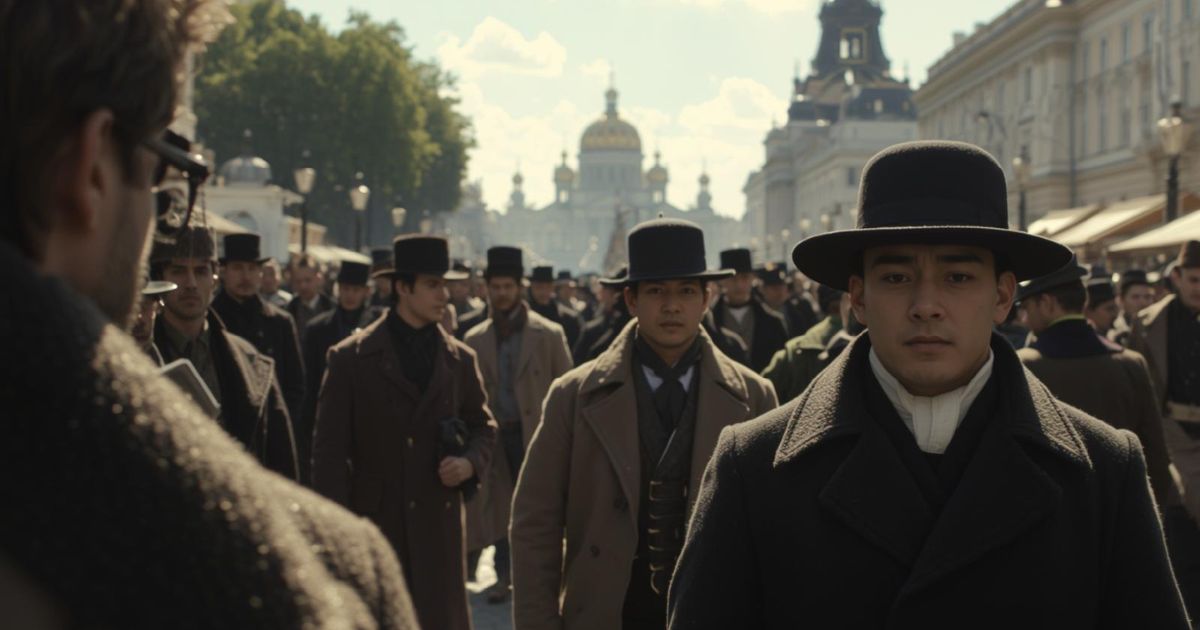
An excerpt from the original text.(complete · 3326 words)
n an exceptionally hot evening early in July a young man came out of
the garret in which he lodged in S. Place and walked slowly, as though
in hesitation, towards K. bridge.
He had successfully avoided meeting his landlady on the staircase. His
garret was under the roof of a high, five-storied house and was more
like a cupboard than a room. The landlady who provided him with garret,
dinners, and attendance, lived on the floor below, and every time
he went out he was obliged to pass her kitchen, the door of which
invariably stood open. And each time he passed, the young man had a
sick, frightened feeling, which made him scowl and feel ashamed. He was
hopelessly in debt to his landlady, and was afraid of meeting her.
This was not because he was cowardly and abject, quite the contrary; but
for some time past he had been in an overstrained irritable condition,
verging on hypochondria. He had become so completely absorbed in
himself, and isolated from his fellows that he dreaded meeting, not
only his landlady, but anyone at all. He was crushed by poverty, but the
anxieties of his position had of late ceased to weigh upon him. He had
given up attending to matters of practical importance; he had lost all
desire to do so. Nothing that any landlady could do had a real terror
for him. But to be stopped on the stairs, to be forced to listen to her
trivial, irrelevant gossip, to pestering demands for payment, threats
and complaints, and to rack his brains for excuses, to prevaricate, to
lie--no, rather than that, he would creep down the stairs like a cat and
slip out unseen.
This evening, however, on coming out into the street, he became acutely
aware of his fears.
“I want to attempt a thing like that and am frightened by these
trifles,” he thought, with an odd smile. “Hm... yes, all is in a man’s
hands and he lets it all slip from cowardice, that’s an axiom. It would
be interesting to know what it is men are most afraid of. Taking a new
step, uttering a new word is what they fear most.... But I am talking
too much. It’s because I chatter that I do nothing. Or perhaps it is
that I chatter because I do nothing. I’ve learned to chatter this
last month, lying for days together in my den thinking... of Jack the
Giant-killer. Why am I going there now? Am I capable of that? Is
that serious? It is not serious at all. It’s simply a fantasy to amuse
myself; a plaything! Yes, maybe it is a plaything.”
The heat in the street was terrible: and the airlessness, the bustle
and the plaster, scaffolding, bricks, and dust all about him, and that
special Petersburg stench, so familiar to all who are unable to get out
of town in summer--all worked painfully upon the young man’s already
overwrought nerves. The insufferable stench from the pot-houses, which
are particularly numerous in that part of the town, and the drunken men
whom he met continually, although it was a working day, completed
the revolting misery of the picture. An expression of the profoundest
disgust gleamed for a moment in the young man’s refined face. He was,
by the way, exceptionally handsome, above the average in height, slim,
well-built, with beautiful dark eyes and dark brown hair. Soon he sank
into deep thought, or more accurately speaking into a complete blankness
of mind; he walked along not observing what was about him and not caring
to observe it. From time to time, he would mutter something, from the
habit of talking to himself, to which he had just confessed. At these
moments he would become conscious that his ideas were sometimes in a
tangle and that he was very weak; for two days he had scarcely tasted
food.
He was so badly dressed that even a man accustomed to shabbiness would
have been ashamed to be seen in the street in such rags. In that quarter
of the town, however, scarcely any shortcoming in dress would have
created surprise. Owing to the proximity of the Hay Market, the number
of establishments of bad character, the preponderance of the trading
and working class population crowded in these streets and alleys in the
heart of Petersburg, types so various were to be seen in the streets
that no figure, however queer, would have caused surprise. But there was
such accumulated bitterness and contempt in the young man’s heart, that,
in spite of all the fastidiousness of youth, he minded his rags least
of all in the street. It was a different matter when he met with
acquaintances or with former fellow students, whom, indeed, he disliked
meeting at any time. And yet when a drunken man who, for some unknown
reason, was being taken somewhere in a huge waggon dragged by a heavy
dray horse, suddenly shouted at him as he drove past: “Hey there, German
hatter” bawling at the top of his voice and pointing at him--the young
man stopped suddenly and clutched tremulously at his hat. It was a tall
round hat from Zimmerman’s, but completely worn out, rusty with age, all
torn and bespattered, brimless and bent on one side in a most unseemly
fashion. Not shame, however, but quite another feeling akin to terror
had overtaken him.
“I knew it,” he muttered in confusion, “I thought so! That’s the worst
of all! Why, a stupid thing like this, the most trivial detail might
spoil the whole plan. Yes, my hat is too noticeable.... It looks absurd
and that makes it noticeable.... With my rags I ought to wear a cap, any
sort of old pancake, but not this grotesque thing. Nobody wears such
a hat, it would be noticed a mile off, it would be remembered.... What
matters is that people would remember it, and that would give them
a clue. For this business one should be as little conspicuous as
possible.... Trifles, trifles are what matter! Why, it’s just such
trifles that always ruin everything....”
He had not far to go; he knew indeed how many steps it was from the gate
of his lodging house: exactly seven hundred and thirty. He had counted
them once when he had been lost in dreams. At the time he had put no
faith in those dreams and was only tantalising himself by their hideous
but daring recklessness. Now, a month later, he had begun to look upon
them differently, and, in spite of the monologues in which he jeered at
his own impotence and indecision, he had involuntarily come to regard
this “hideous” dream as an exploit to be attempted, although he
still did not realise this himself. He was positively going now for a
“rehearsal” of his project, and at every step his excitement grew more
and more violent.
With a sinking heart and a nervous tremor, he went up to a huge house
which on one side looked on to the canal, and on the other into the
street. This house was let out in tiny tenements and was inhabited by
working people of all kinds--tailors, locksmiths, cooks, Germans of
sorts, girls picking up a living as best they could, petty clerks, etc.
There was a continual coming and going through the two gates and in the
two courtyards of the house. Three or four door-keepers were employed on
the building. The young man was very glad to meet none of them, and
at once slipped unnoticed through the door on the right, and up the
staircase. It was a back staircase, dark and narrow, but he was familiar
with it already, and knew his way, and he liked all these surroundings:
in such darkness even the most inquisitive eyes were not to be dreaded.
“If I am so scared now, what would it be if it somehow came to pass that
I were really going to do it?” he could not help asking himself as he
reached the fourth storey. There his progress was barred by some porters
who were engaged in moving furniture out of a flat. He knew that the
flat had been occupied by a German clerk in the civil service, and his
family. This German was moving out then, and so the fourth floor on this
staircase would be untenanted except by the old woman. “That’s a good
thing anyway,” he thought to himself, as he rang the bell of the old
woman’s flat. The bell gave a faint tinkle as though it were made of
tin and not of copper. The little flats in such houses always have bells
that ring like that. He had forgotten the note of that bell, and now
its peculiar tinkle seemed to remind him of something and to bring it
clearly before him.... He started, his nerves were terribly overstrained
by now. In a little while, the door was opened a tiny crack: the old
woman eyed her visitor with evident distrust through the crack, and
nothing could be seen but her little eyes, glittering in the darkness.
But, seeing a number of people on the landing, she grew bolder, and
opened the door wide. The young man stepped into the dark entry, which
was partitioned off from the tiny kitchen. The old woman stood facing
him in silence and looking inquiringly at him. She was a diminutive,
withered up old woman of sixty, with sharp malignant eyes and a sharp
little nose. Her colourless, somewhat grizzled hair was thickly smeared
with oil, and she wore no kerchief over it. Round her thin long neck,
which looked like a hen’s leg, was knotted some sort of flannel rag,
and, in spite of the heat, there hung flapping on her shoulders, a mangy
fur cape, yellow with age. The old woman coughed and groaned at every
instant. The young man must have looked at her with a rather peculiar
expression, for a gleam of mistrust came into her eyes again.
“Raskolnikov, a student, I came here a month ago,” the young man made
haste to mutter, with a half bow, remembering that he ought to be more
polite.
“I remember, my good sir, I remember quite well your coming here,” the
old woman said distinctly, still keeping her inquiring eyes on his face.
“And here... I am again on the same errand,” Raskolnikov continued, a
little disconcerted and surprised at the old woman’s mistrust. “Perhaps
she is always like that though, only I did not notice it the other
time,” he thought with an uneasy feeling.
The old woman paused, as though hesitating; then stepped on one side,
and pointing to the door of the room, she said, letting her visitor pass
in front of her:
“Step in, my good sir.”
The little room into which the young man walked, with yellow paper on
the walls, geraniums and muslin curtains in the windows, was brightly
lighted up at that moment by the setting sun.
“So the sun will shine like this then too!” flashed as it were by
chance through Raskolnikov’s mind, and with a rapid glance he scanned
everything in the room, trying as far as possible to notice and
remember its arrangement. But there was nothing special in the room. The
furniture, all very old and of yellow wood, consisted of a sofa with
a huge bent wooden back, an oval table in front of the sofa, a
dressing-table with a looking-glass fixed on it between the windows,
chairs along the walls and two or three half-penny prints in yellow
frames, representing German damsels with birds in their hands--that was
all. In the corner a light was burning before a small ikon. Everything
was very clean; the floor and the furniture were brightly polished;
everything shone.
“Lizaveta’s work,” thought the young man. There was not a speck of dust
to be seen in the whole flat.
“It’s in the houses of spiteful old widows that one finds such
cleanliness,” Raskolnikov thought again, and he stole a curious glance
at the cotton curtain over the door leading into another tiny room, in
which stood the old woman’s bed and chest of drawers and into which he
had never looked before. These two rooms made up the whole flat.
“What do you want?” the old woman said severely, coming into the room
and, as before, standing in front of him so as to look him straight in
the face.
“I’ve brought something to pawn here,” and he drew out of his pocket
an old-fashioned flat silver watch, on the back of which was engraved a
globe; the chain was of steel.
“But the time is up for your last pledge. The month was up the day
before yesterday.”
“I will bring you the interest for another month; wait a little.”
“But that’s for me to do as I please, my good sir, to wait or to sell
your pledge at once.”
“How much will you give me for the watch, Alyona Ivanovna?”
“You come with such trifles, my good sir, it’s scarcely worth anything.
I gave you two roubles last time for your ring and one could buy it
quite new at a jeweler’s for a rouble and a half.”
“Give me four roubles for it, I shall redeem it, it was my father’s. I
shall be getting some money soon.”
“A rouble and a half, and interest in advance, if you like!”
“A rouble and a half!” cried the young man.
“Please yourself”--and the old woman handed him back the watch. The
young man took it, and was so angry that he was on the point of going
away; but checked himself at once, remembering that there was nowhere
else he could go, and that he had had another object also in coming.
“Hand it over,” he said roughly.
The old woman fumbled in her pocket for her keys, and disappeared behind
the curtain into the other room. The young man, left standing alone in
the middle of the room, listened inquisitively, thinking. He could hear
her unlocking the chest of drawers.
“It must be the top drawer,” he reflected. “So she carries the keys in
a pocket on the right. All in one bunch on a steel ring.... And there’s
one key there, three times as big as all the others, with deep notches;
that can’t be the key of the chest of drawers... then there must be some
other chest or strong-box... that’s worth knowing. Strong-boxes always
have keys like that... but how degrading it all is.”
The old woman came back.
“Here, sir: as we say ten copecks the rouble a month, so I must take
fifteen copecks from a rouble and a half for the month in advance. But
for the two roubles I lent you before, you owe me now twenty copecks
on the same reckoning in advance. That makes thirty-five copecks
altogether. So I must give you a rouble and fifteen copecks for the
watch. Here it is.”
“What! only a rouble and fifteen copecks now!”
“Just so.”
The young man did not dispute it and took the money. He looked at the
old woman, and was in no hurry to get away, as though there was still
something he wanted to say or to do, but he did not himself quite know
what.
“I may be bringing you something else in a day or two, Alyona
Ivanovna--a valuable thing--silver--a cigarette-box, as soon as I get it
back from a friend...” he broke off in confusion.
“Well, we will talk about it then, sir.”
“Good-bye--are you always at home alone, your sister is not here with
you?” He asked her as casually as possible as he went out into the
passage.
“What business is she of yours, my good sir?”
“Oh, nothing particular, I simply asked. You are too quick.... Good-day,
Alyona Ivanovna.”
Raskolnikov went out in complete confusion. This confusion became more
and more intense. As he went down the stairs, he even stopped short, two
or three times, as though suddenly struck by some thought. When he was
in the street he cried out, “Oh, God, how loathsome it all is! and
can I, can I possibly.... No, it’s nonsense, it’s rubbish!” he added
resolutely. “And how could such an atrocious thing come into my head?
What filthy things my heart is capable of. Yes, filthy above all,
disgusting, loathsome, loathsome!--and for a whole month I’ve been....”
But no words, no exclamations, could express his agitation. The feeling
of intense repulsion, which had begun to oppress and torture his heart
while he was on his way to the old woman, had by now reached such a
pitch and had taken such a definite form that he did not know what to
do with himself to escape from his wretchedness. He walked along the
pavement like a drunken man, regardless of the passers-by, and jostling
against them, and only came to his senses when he was in the next
street. Looking round, he noticed that he was standing close to a tavern
which was entered by steps leading from the pavement to the basement.
At that instant two drunken men came out at the door, and abusing and
supporting one another, they mounted the steps. Without stopping to
think, Raskolnikov went down the steps at once. Till that moment he had
never been into a tavern, but now he felt giddy and was tormented by a
burning thirst. He longed for a drink of cold beer, and attributed his
sudden weakness to the want of food. He sat down at a sticky little
table in a dark and dirty corner; ordered some beer, and eagerly drank
off the first glassful. At once he felt easier; and his thoughts became
clear.
“All that’s nonsense,” he said hopefully, “and there is nothing in it
all to worry about! It’s simply physical derangement. Just a glass of
beer, a piece of dry bread--and in one moment the brain is stronger,
the mind is clearer and the will is firm! Phew, how utterly petty it all
is!”
But in spite of this scornful reflection, he was by now looking cheerful
as though he were suddenly set free from a terrible burden: and he gazed
round in a friendly way at the people in the room. But even at that
moment he had a dim foreboding that this happier frame of mind was also
not normal.
There were few people at the time in the tavern. Besides the two drunken
men he had met on the steps, a group consisting of about five men and
a girl with a concertina had gone out at the same time. Their departure
left the room quiet and rather empty. The persons still in the tavern
were a man who appeared to be an artisan, drunk, but not extremely so,
sitting before a pot of beer, and his companion, a huge, stout man with
a grey beard, in a short full-skirted coat. He was very drunk: and had
dropped asleep on the bench; every now and then, he began as though in
his sleep, cracking his fingers, with his arms wide apart and the upper
part of his body bounding about on the bench, while he hummed some
meaningless refrain, trying to recall some such lines as these:
“His wife a year he fondly loved
His wife a--a year he--fondly loved.”
Or suddenly waking up again:
“Walking along the crowded row
He met the one he used to know.”
But no one shared his enjoyment: his silent companion looked with
positive hostility and mistrust at all these manifestations. There was
another man in the room who looked somewhat like a retired government
clerk. He was sitting apart, now and then sipping from his pot and
looking round at the company. He, too, appeared to be in some agitation.
Master this chapter. Complete your experience
Purchase the complete book to access all chapters and support classic literature
As an Amazon Associate, we earn a small commission from qualifying purchases at no additional cost to you.
Available in paperback, hardcover, and e-book formats
Let's Analyse the Pattern
Why This Matters
Connect literature to life
This chapter teaches how to recognize when desperation starts making wrong choices seem reasonable—before you cross lines you can't uncross.
Now let's explore the literary elements.
Key Quotes & Analysis
"I want to attempt a thing like that and am frightened by these trifles!"
Context: He's walking through the streets, amazed that he fears small social interactions when he's planning something much worse.
This reveals the disconnect between his grand, terrible plan and his inability to handle everyday life. It shows how isolation and obsession can warp someone's sense of proportion and reality.
"Am I capable of that? Is that serious? It is not serious at all."
Context: His internal debate about whether he can actually carry out his mysterious plan.
The repetition shows his mind going in circles, trying to convince himself. This self-questioning reveals he still has a conscience fighting against his rationalization - he's not yet completely lost.
"On an exceptionally hot evening early in July a young man came out of the garret in which he lodged in S. Place and walked slowly, as though in hesitation, towards K. bridge."
Context: The opening lines of the novel, setting the scene.
The hesitation in his walk mirrors his mental state - he's moving toward something but unsure. The oppressive heat reflects his fevered mental condition and the pressure building inside him.
Thematic Threads
Pride
In This Chapter
Raskolnikov's refusal to accept help or acknowledge his desperate circumstances, preferring dangerous isolation to wounded dignity
Development
Introduced here
Class
In This Chapter
The crushing weight of poverty forcing an educated man to pawn family heirlooms while his landlady demands rent he cannot pay
Development
Introduced here
Isolation
In This Chapter
Raskolnikov's self-imposed confinement in his coffin-like room, cutting himself off from human connection when he needs it most
Development
Introduced here
Rationalization
In This Chapter
The 'terrible idea' that haunts him—his mind working to justify something his conscience rejects
Development
Introduced here
Identity
In This Chapter
The gap between who he was (law student) and who he's become (desperate pauper), creating internal conflict about his worth and options
Development
Introduced here
You now have the context. Time to form your own thoughts.
Discussion Questions
- 1
What specific circumstances have trapped Raskolnikov in his tiny room, and what 'terrible idea' is consuming his thoughts?
- 2
How does Raskolnikov's pride prevent him from accepting help or finding legitimate solutions to his poverty?
- 3
Where do you see people today convincing themselves that desperate circumstances justify questionable actions?
- 4
If you had a friend like Raskolnikov, spiraling into dangerous thinking due to desperation, how would you intervene?
- 5
What does this chapter reveal about how isolation and pride can transform good people into potential wrongdoers?
Critical Thinking Exercise
Map Your Rationalization Red Flags
Think of a time when you were under serious pressure—financial, work, family, or personal. Write down the thoughts that went through your head about 'bending the rules' or doing something you normally wouldn't consider. Then identify what warning signs could have helped you recognize when desperation was affecting your judgment.
Consider:
- •Notice how isolation made questionable options seem more reasonable
- •Identify which emotions (pride, anger, fear) were driving your thinking
- •Consider what support or perspective could have helped you navigate differently
Coming Up Next...
Chapter 2: Marmeladov's Confession
Raskolnikov's mysterious 'rehearsal' takes him to a pawnbroker's apartment, where he studies the old woman's routine with disturbing intensity. The terrible idea that's been consuming him starts to take concrete shape.