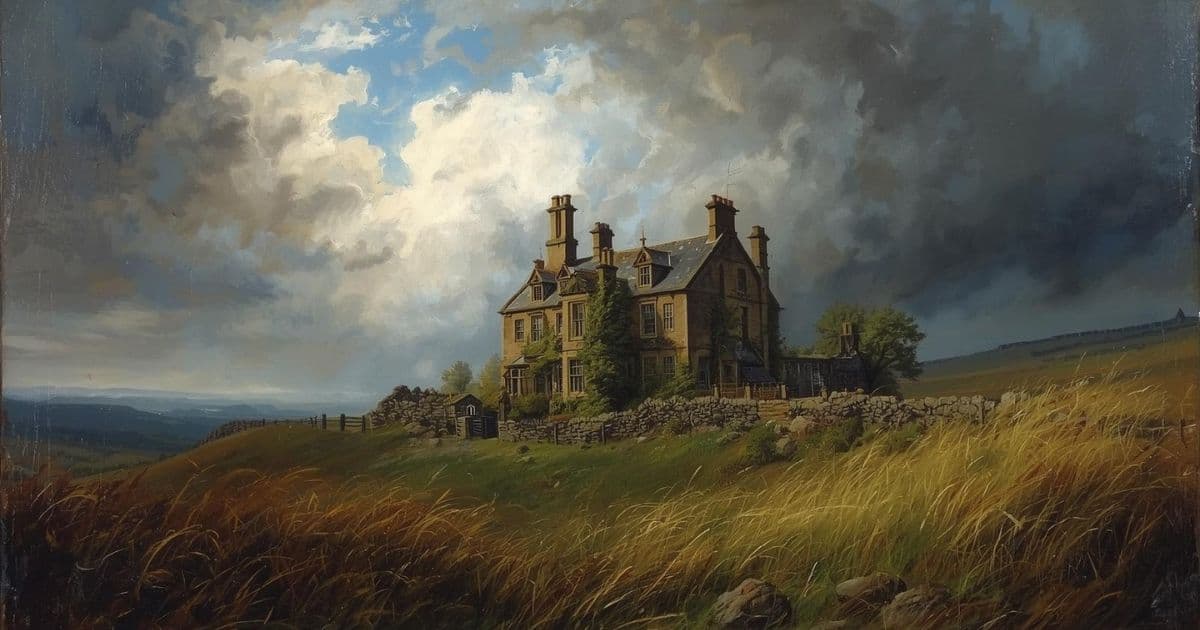
An excerpt from the original text.(complete · 1911 words)
he temporary stable, a wooden shed, had been put up close to the race
course, and there his mare was to have been taken the previous day. He
had not yet seen her there.
During the last few days he had not ridden her out for exercise
himself, but had put her in the charge of the trainer, and so now he
positively did not know in what condition his mare had arrived
yesterday and was today. He had scarcely got out of his carriage when
his groom, the so-called “stable boy,” recognizing the carriage some
way off, called the trainer. A dry-looking Englishman, in high boots
and a short jacket, clean-shaven, except for a tuft below his chin,
came to meet him, walking with the uncouth gait of jockey, turning his
elbows out and swaying from side to side.
“Well, how’s Frou-Frou?” Vronsky asked in English.
“All right, sir,” the Englishman’s voice responded somewhere in the
inside of his throat. “Better not go in,” he added, touching his hat.
“I’ve put a muzzle on her, and the mare’s fidgety. Better not go in,
it’ll excite the mare.”
“No, I’m going in. I want to look at her.”
“Come along, then,” said the Englishman, frowning, and speaking with
his mouth shut, and, with swinging elbows, he went on in front with his
disjointed gait.
They went into the little yard in front of the shed. A stable boy,
spruce and smart in his holiday attire, met them with a broom in his
hand, and followed them. In the shed there were five horses in their
separate stalls, and Vronsky knew that his chief rival, Gladiator, a
very tall chestnut horse, had been brought there, and must be standing
among them. Even more than his mare, Vronsky longed to see Gladiator,
whom he had never seen. But he knew that by the etiquette of the race
course it was not merely impossible for him to see the horse, but
improper even to ask questions about him. Just as he was passing along
the passage, the boy opened the door into the second horse-box on the
left, and Vronsky caught a glimpse of a big chestnut horse with white
legs. He knew that this was Gladiator, but, with the feeling of a man
turning away from the sight of another man’s open letter, he turned
round and went into Frou-Frou’s stall.
“The horse is here belonging to Mak... Mak... I never can say the
name,” said the Englishman, over his shoulder, pointing his big finger
and dirty nail towards Gladiator’s stall.
“Mahotin? Yes, he’s my most serious rival,” said Vronsky.
“If you were riding him,” said the Englishman, “I’d bet on you.”
“Frou-Frou’s more nervous; he’s stronger,” said Vronsky, smiling at the
compliment to his riding.
“In a steeplechase it all depends on riding and on pluck,” said the
Englishman.
Of pluck—that is, energy and courage—Vronsky did not merely feel that
he had enough; what was of far more importance, he was firmly convinced
that no one in the world could have more of this “pluck” than he had.
“Don’t you think I want more thinning down?”
“Oh, no,” answered the Englishman. “Please, don’t speak loud. The
mare’s fidgety,” he added, nodding towards the horse-box, before which
they were standing, and from which came the sound of restless stamping
in the straw.
He opened the door, and Vronsky went into the horse-box, dimly lighted
by one little window. In the horse-box stood a dark bay mare, with a
muzzle on, picking at the fresh straw with her hoofs. Looking round him
in the twilight of the horse-box, Vronsky unconsciously took in once
more in a comprehensive glance all the points of his favorite mare.
Frou-Frou was a beast of medium size, not altogether free from
reproach, from a breeder’s point of view. She was small-boned all over;
though her chest was extremely prominent in front, it was narrow. Her
hind-quarters were a little drooping, and in her fore-legs, and still
more in her hind-legs, there was a noticeable curvature. The muscles of
both hind- and fore-legs were not very thick; but across her shoulders
the mare was exceptionally broad, a peculiarity specially striking now
that she was lean from training. The bones of her legs below the knees
looked no thicker than a finger from in front, but were extraordinarily
thick seen from the side. She looked altogether, except across the
shoulders, as it were, pinched in at the sides and pressed out in
depth. But she had in the highest degree the quality that makes all
defects forgotten: that quality was blood, the blood that tells, as
the English expression has it. The muscles stood up sharply under the
network of sinews, covered with the delicate, mobile skin, soft as
satin, and they were hard as bone. Her clean-cut head, with prominent,
bright, spirited eyes, broadened out at the open nostrils, that showed
the red blood in the cartilage within. About all her figure, and
especially her head, there was a certain expression of energy, and, at
the same time, of softness. She was one of those creatures which seem
only not to speak because the mechanism of their mouth does not allow
them to.
To Vronsky, at any rate, it seemed that she understood all he felt at
that moment, looking at her.
Directly Vronsky went towards her, she drew in a deep breath, and,
turning back her prominent eye till the white looked bloodshot, she
started at the approaching figures from the opposite side, shaking her
muzzle, and shifting lightly from one leg to the other.
“There, you see how fidgety she is,” said the Englishman.
“There, darling! There!” said Vronsky, going up to the mare and
speaking soothingly to her.
But the nearer he came, the more excited she grew. Only when he stood
by her head, she was suddenly quieter, while the muscles quivered under
her soft, delicate coat. Vronsky patted her strong neck, straightened
over her sharp withers a stray lock of her mane that had fallen on the
other side, and moved his face near her dilated nostrils, transparent
as a bat’s wing. She drew a loud breath and snorted out through her
tense nostrils, started, pricked up her sharp ear, and put out her
strong, black lip towards Vronsky, as though she would nip hold of his
sleeve. But remembering the muzzle, she shook it and again began
restlessly stamping one after the other her shapely legs.
“Quiet, darling, quiet!” he said, patting her again over her
hind-quarters; and with a glad sense that his mare was in the best
possible condition, he went out of the horse-box.
The mare’s excitement had infected Vronsky. He felt that his heart was
throbbing, and that he, too, like the mare, longed to move, to bite; it
was both dreadful and delicious.
“Well, I rely on you, then,” he said to the Englishman; “half-past six
on the ground.”
“All right,” said the Englishman. “Oh, where are you going, my lord?”
he asked suddenly, using the title “my lord,” which he had scarcely
ever used before.
Vronsky in amazement raised his head, and stared, as he knew how to
stare, not into the Englishman’s eyes, but at his forehead, astounded
at the impertinence of his question. But realizing that in asking this
the Englishman had been looking at him not as an employer, but as a
jockey, he answered:
“I’ve got to go to Bryansky’s; I shall be home within an hour.”
“How often I’m asked that question today!” he said to himself, and he
blushed, a thing which rarely happened to him. The Englishman looked
gravely at him; and, as though he, too, knew where Vronsky was going,
he added:
“The great thing’s to keep quiet before a race,” said he; “don’t get
out of temper or upset about anything.”
“All right,” answered Vronsky, smiling; and jumping into his carriage,
he told the man to drive to Peterhof.
Before he had driven many paces away, the dark clouds that had been
threatening rain all day broke, and there was a heavy downpour of rain.
“What a pity!” thought Vronsky, putting up the roof of the carriage.
“It was muddy before, now it will be a perfect swamp.” As he sat in
solitude in the closed carriage, he took out his mother’s letter and
his brother’s note, and read them through.
Yes, it was the same thing over and over again. Everyone, his mother,
his brother, everyone thought fit to interfere in the affairs of his
heart. This interference aroused in him a feeling of angry hatred—a
feeling he had rarely known before. “What business is it of theirs? Why
does everybody feel called upon to concern himself about me? And why do
they worry me so? Just because they see that this is something they
can’t understand. If it were a common, vulgar, worldly intrigue, they
would have left me alone. They feel that this is something different,
that this is not a mere pastime, that this woman is dearer to me than
life. And this is incomprehensible, and that’s why it annoys them.
Whatever our destiny is or may be, we have made it ourselves, and we do
not complain of it,” he said, in the word we linking himself with
Anna. “No, they must needs teach us how to live. They haven’t an idea
of what happiness is; they don’t know that without our love, for us
there is neither happiness nor unhappiness—no life at all,” he thought.
He was angry with all of them for their interference just because he
felt in his soul that they, all these people, were right. He felt that
the love that bound him to Anna was not a momentary impulse, which
would pass, as worldly intrigues do pass, leaving no other traces in
the life of either but pleasant or unpleasant memories. He felt all the
torture of his own and her position, all the difficulty there was for
them, conspicuous as they were in the eye of all the world, in
concealing their love, in lying and deceiving; and in lying, deceiving,
feigning, and continually thinking of others, when the passion that
united them was so intense that they were both oblivious of everything
else but their love.
He vividly recalled all the constantly recurring instances of
inevitable necessity for lying and deceit, which were so against his
natural bent. He recalled particularly vividly the shame he had more
than once detected in her at this necessity for lying and deceit. And
he experienced the strange feeling that had sometimes come upon him
since his secret love for Anna. This was a feeling of loathing for
something—whether for Alexey Alexandrovitch, or for himself, or for the
whole world, he could not have said. But he always drove away this
strange feeling. Now, too, he shook it off and continued the thread of
his thoughts.
“Yes, she was unhappy before, but proud and at peace; and now she
cannot be at peace and feel secure in her dignity, though she does not
show it. Yes, we must put an end to it,” he decided.
And for the first time the idea clearly presented itself that it was
essential to put an end to this false position, and the sooner the
better. “Throw up everything, she and I, and hide ourselves somewhere
alone with our love,” he said to himself.
Master this chapter. Complete your experience
Purchase the complete book to access all chapters and support classic literature
As an Amazon Associate, we earn a small commission from qualifying purchases at no additional cost to you.
Available in paperback, hardcover, and e-book formats
Let's Analyse the Pattern
When emotional chaos overwhelms the mind, engaging the body in meaningful physical work can restore mental equilibrium and clarity.
Why This Matters
Connect literature to life
This chapter teaches how to identify when your mental system is overwhelmed and needs a different kind of intervention than more thinking.
Practice This Today
This week, notice when your thoughts start racing in circles—that's your signal to engage your hands instead of your head.
Now let's explore the literary elements.
Key Quotes & Analysis
"The longer Levin mowed, the oftener he felt the moments of unconsciousness in which it seemed not his hands that swung the scythe, but the scythe mowing of itself."
Context: As Levin gets into the rhythm of the physical work
This describes the meditative state that comes from repetitive physical work. Levin finds peace when his conscious mind stops overthinking and his body takes over.
In Today's Words:
The work got so automatic that his mind finally shut up and his hands just did what they knew how to do.
"He felt himself, and did not want to be anyone else and to be anywhere else."
Context: During Levin's moments of peace while working
This captures the rare moment when Levin stops questioning his place in the world. Physical work gives him a sense of belonging he can't find in social situations.
In Today's Words:
For once, he wasn't wishing he was somebody else or somewhere else - he was exactly where he needed to be.
"What he had been thinking about so unceasingly, he could not remember."
Context: After hours of intense physical work
The work has successfully quieted Levin's anxious mind. His romantic troubles and social anxieties temporarily fade when his body is fully engaged.
In Today's Words:
All that stuff that was eating at him? He couldn't even remember what he'd been so worked up about.
Thematic Threads
Authenticity
In This Chapter
Levin finds genuine peace in honest farm work, contrasting with the artificial social performances of Moscow
Development
Building from his earlier discomfort at social gatherings—he's discovering where he truly belongs
In Your Life:
You might feel most yourself when doing work that matches your values rather than impressing others
Class
In This Chapter
Levin works alongside peasants as equals in the field, temporarily bridging social divisions through shared labor
Development
Continues his ongoing struggle with his position as landowner versus his democratic ideals
In Your Life:
You might find unexpected connection with people when working toward common goals rather than maintaining social barriers
Healing
In This Chapter
Physical exhaustion provides relief from emotional pain that intellectual solutions couldn't touch
Development
First major example of Levin finding practical coping mechanisms for his internal struggles
In Your Life:
You might discover that moving your body helps heal your heart when talking doesn't work
Purpose
In This Chapter
The simple act of cutting hay provides meaning and satisfaction that social activities lacked
Development
Introduces Levin's lifelong search for meaningful work versus empty social obligations
In Your Life:
You might feel most fulfilled when your daily work serves a clear, tangible purpose
Escape
In This Chapter
Farm work offers temporary refuge from romantic disappointment and social anxiety
Development
Shows Levin's pattern of seeking solitude and nature when overwhelmed by human relationships
In Your Life:
You might need physical spaces and activities that offer respite from emotional complexity
You now have the context. Time to form your own thoughts.
Discussion Questions
- 1
What does Levin do to cope with his emotional pain after his failed proposal, and how does his body respond to this choice?
analysis • surface - 2
Why does physical farm work quiet Levin's racing thoughts about Kitty and Moscow society when sitting and thinking couldn't?
analysis • medium - 3
Think of someone you know who uses physical work to handle stress or emotional problems. How does their approach compare to Levin's hay-cutting?
application • medium - 4
When you're emotionally overwhelmed, what type of physical work could you use to reset your mental state, and how would you know it's working?
application • deep - 5
What does Levin's need for physical work reveal about the relationship between our bodies and minds when dealing with life's disappointments?
reflection • deep
Critical Thinking Exercise
Design Your Physical Reset Menu
Create a personal 'reset menu' of physical activities you can turn to when emotionally overwhelmed. List 5-7 activities that require your hands and attention but don't demand complex thinking. For each activity, note what supplies you need and how long it typically takes. Consider activities you already know how to do and ones you could easily learn.
Consider:
- •Choose activities that match your living situation and available time
- •Include both quick options (15 minutes) and longer ones (2+ hours) for different situations
- •Think about what your body naturally wants to do when you're stressed versus what actually helps
Journaling Prompt
Write about a time when physical work helped you think more clearly about a problem. What was the work, what was the problem, and how did the combination of body and mind lead you to insights you couldn't reach by thinking alone?
Coming Up Next...
Chapter 56
As Levin finds temporary peace in farm work, Anna's world grows more complicated when an unexpected visitor arrives with news that will change everything. Meanwhile, Kitty begins to recover from her illness, but her perspective on love and marriage has shifted dramatically.