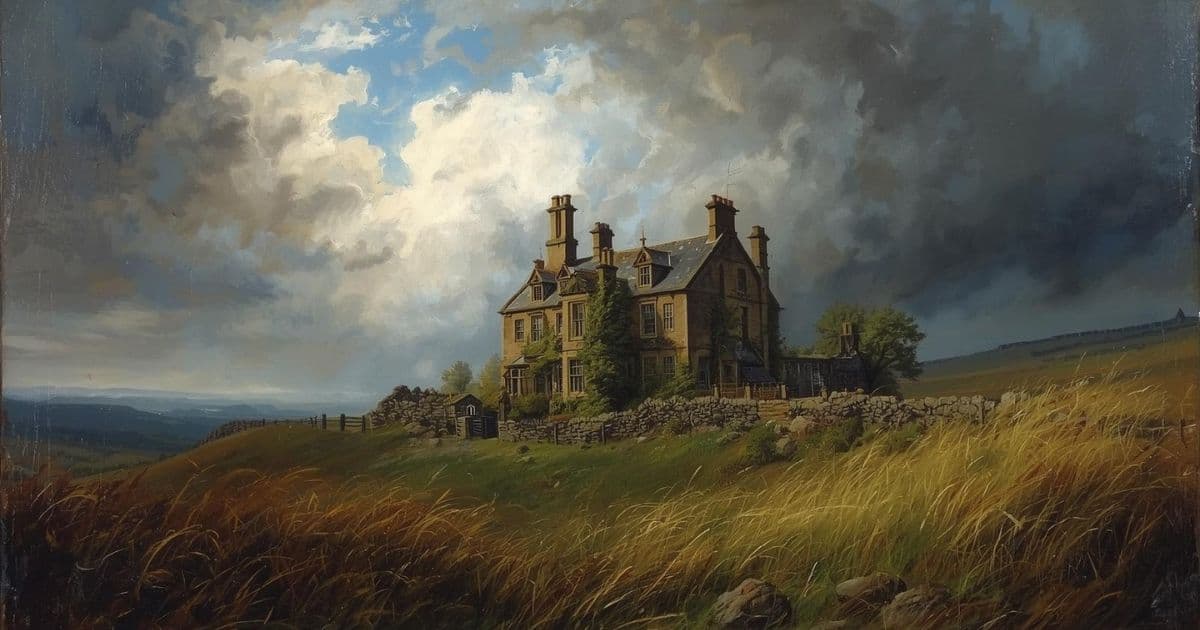
An excerpt from the original text.(complete · 2598 words)
evin put on his big boots, and, for the first time, a cloth jacket,
instead of his fur cloak, and went out to look after his farm, stepping
over streams of water that flashed in the sunshine and dazzled his
eyes, and treading one minute on ice and the next into sticky mud.
Spring is the time of plans and projects. And, as he came out into the
farmyard, Levin, like a tree in spring that knows not what form will be
taken by the young shoots and twigs imprisoned in its swelling buds,
hardly knew what undertakings he was going to begin upon now in the
farm work that was so dear to him. But he felt that he was full of the
most splendid plans and projects. First of all he went to the cattle.
The cows had been let out into their paddock, and their smooth sides
were already shining with their new, sleek, spring coats; they basked
in the sunshine and lowed to go to the meadow. Levin gazed admiringly
at the cows he knew so intimately to the minutest detail of their
condition, and gave orders for them to be driven out into the meadow,
and the calves to be let into the paddock. The herdsman ran gaily to
get ready for the meadow. The cowherd girls, picking up their
petticoats, ran splashing through the mud with bare legs, still white,
not yet brown from the sun, waving brush wood in their hands, chasing
the calves that frolicked in the mirth of spring.
After admiring the young ones of that year, who were particularly
fine—the early calves were the size of a peasant’s cow, and Pava’s
daughter, at three months old, was as big as a yearling—Levin gave
orders for a trough to be brought out and for them to be fed in the
paddock. But it appeared that as the paddock had not been used during
the winter, the hurdles made in the autumn for it were broken. He sent
for the carpenter, who, according to his orders, ought to have been at
work at the thrashing machine. But it appeared that the carpenter was
repairing the harrows, which ought to have been repaired before Lent.
This was very annoying to Levin. It was annoying to come upon that
everlasting slovenliness in the farm work against which he had been
striving with all his might for so many years. The hurdles, as he
ascertained, being not wanted in winter, had been carried to the
cart-horses’ stable; and there broken, as they were of light
construction, only meant for feeding calves. Moreover, it was apparent
also that the harrows and all the agricultural implements, which he had
directed to be looked over and repaired in the winter, for which very
purpose he had hired three carpenters, had not been put into repair,
and the harrows were being repaired when they ought to have been
harrowing the field. Levin sent for his bailiff, but immediately went
off himself to look for him. The bailiff, beaming all over, like
everyone that day, in a sheepskin bordered with astrachan, came out of
the barn, twisting a bit of straw in his hands.
“Why isn’t the carpenter at the thrashing machine?”
“Oh, I meant to tell you yesterday, the harrows want repairing. Here
it’s time they got to work in the fields.”
“But what were they doing in the winter, then?”
“But what did you want the carpenter for?”
“Where are the hurdles for the calves’ paddock?”
“I ordered them to be got ready. What would you have with those
peasants!” said the bailiff, with a wave of his hand.
“It’s not those peasants but this bailiff!” said Levin, getting angry.
“Why, what do I keep you for?” he cried. But, bethinking himself that
this would not help matters, he stopped short in the middle of a
sentence, and merely sighed. “Well, what do you say? Can sowing begin?”
he asked, after a pause.
“Behind Turkin tomorrow or the next day they might begin.”
“And the clover?”
“I’ve sent Vassily and Mishka; they’re sowing. Only I don’t know if
they’ll manage to get through; it’s so slushy.”
“How many acres?”
“About fifteen.”
“Why not sow all?” cried Levin.
That they were only sowing the clover on fifteen acres, not on all the
forty-five, was still more annoying to him. Clover, as he knew, both
from books and from his own experience, never did well except when it
was sown as early as possible, almost in the snow. And yet Levin could
never get this done.
“There’s no one to send. What would you have with such a set of
peasants? Three haven’t turned up. And there’s Semyon....”
“Well, you should have taken some men from the thatching.”
“And so I have, as it is.”
“Where are the peasants, then?”
“Five are making compôte” (which meant compost), “four are shifting the
oats for fear of a touch of mildew, Konstantin Dmitrievitch.”
Levin knew very well that “a touch of mildew” meant that his English
seed oats were already ruined. Again they had not done as he had
ordered.
“Why, but I told you during Lent to put in pipes,” he cried.
“Don’t put yourself out; we shall get it all done in time.”
Levin waved his hand angrily, went into the granary to glance at the
oats, and then to the stable. The oats were not yet spoiled. But the
peasants were carrying the oats in spades when they might simply let
them slide down into the lower granary; and arranging for this to be
done, and taking two workmen from there for sowing clover, Levin got
over his vexation with the bailiff. Indeed, it was such a lovely day
that one could not be angry.
“Ignat!” he called to the coachman, who, with his sleeves tucked up,
was washing the carriage wheels, “saddle me....”
“Which, sir?”
“Well, let it be Kolpik.”
“Yes, sir.”
While they were saddling his horse, Levin again called up the bailiff,
who was hanging about in sight, to make it up with him, and began
talking to him about the spring operations before them, and his plans
for the farm.
The wagons were to begin carting manure earlier, so as to get all done
before the early mowing. And the ploughing of the further land to go on
without a break so as to let it ripen lying fallow. And the mowing to
be all done by hired labor, not on half-profits. The bailiff listened
attentively, and obviously made an effort to approve of his employer’s
projects. But still he had that look Levin knew so well that always
irritated him, a look of hopelessness and despondency. That look said:
“That’s all very well, but as God wills.”
Nothing mortified Levin so much as that tone. But it was the tone
common to all the bailiffs he had ever had. They had all taken up that
attitude to his plans, and so now he was not angered by it, but
mortified, and felt all the more roused to struggle against this, as it
seemed, elemental force continually ranged against him, for which he
could find no other expression than “as God wills.”
“If we can manage it, Konstantin Dmitrievitch,” said the bailiff.
“Why ever shouldn’t you manage it?”
“We positively must have another fifteen laborers. And they don’t turn
up. There were some here today asking seventy roubles for the summer.”
Levin was silent. Again he was brought face to face with that opposing
force. He knew that however much they tried, they could not hire more
than forty—thirty-seven perhaps or thirty-eight—laborers for a
reasonable sum. Some forty had been taken on, and there were no more.
But still he could not help struggling against it.
“Send to Sury, to Tchefirovka; if they don’t come we must look for
them.”
“Oh, I’ll send, to be sure,” said Vassily Fedorovitch despondently.
“But there are the horses, too, they’re not good for much.”
“We’ll get some more. I know, of course,” Levin added laughing, “you
always want to do with as little and as poor quality as possible; but
this year I’m not going to let you have things your own way. I’ll see
to everything myself.”
“Why, I don’t think you take much rest as it is. It cheers us up to
work under the master’s eye....”
“So they’re sowing clover behind the Birch Dale? I’ll go and have a
look at them,” he said, getting on to the little bay cob, Kolpik, who
was led up by the coachman.
“You can’t get across the streams, Konstantin Dmitrievitch,” the
coachman shouted.
“All right, I’ll go by the forest.”
And Levin rode through the slush of the farmyard to the gate and out
into the open country, his good little horse, after his long
inactivity, stepping out gallantly, snorting over the pools, and
asking, as it were, for guidance. If Levin had felt happy before in the
cattle pens and farmyard, he felt happier yet in the open country.
Swaying rhythmically with the ambling paces of his good little cob,
drinking in the warm yet fresh scent of the snow and the air, as he
rode through his forest over the crumbling, wasted snow, still left in
parts, and covered with dissolving tracks, he rejoiced over every tree,
with the moss reviving on its bark and the buds swelling on its shoots.
When he came out of the forest, in the immense plain before him, his
grass fields stretched in an unbroken carpet of green, without one bare
place or swamp, only spotted here and there in the hollows with patches
of melting snow. He was not put out of temper even by the sight of the
peasants’ horses and colts trampling down his young grass (he told a
peasant he met to drive them out), nor by the sarcastic and stupid
reply of the peasant Ipat, whom he met on the way, and asked, “Well,
Ipat, shall we soon be sowing?” “We must get the ploughing done first,
Konstantin Dmitrievitch,” answered Ipat. The further he rode, the
happier he became, and plans for the land rose to his mind each better
than the last; to plant all his fields with hedges along the southern
borders, so that the snow should not lie under them; to divide them up
into six fields of arable and three of pasture and hay; to build a
cattle yard at the further end of the estate, and to dig a pond and to
construct movable pens for the cattle as a means of manuring the land.
And then eight hundred acres of wheat, three hundred of potatoes, and
four hundred of clover, and not one acre exhausted.
Absorbed in such dreams, carefully keeping his horse by the hedges, so
as not to trample his young crops, he rode up to the laborers who had
been sent to sow clover. A cart with the seed in it was standing, not
at the edge, but in the middle of the crop, and the winter corn had
been torn up by the wheels and trampled by the horse. Both the laborers
were sitting in the hedge, probably smoking a pipe together. The earth
in the cart, with which the seed was mixed, was not crushed to powder,
but crusted together or adhering in clods. Seeing the master, the
laborer, Vassily, went towards the cart, while Mishka set to work
sowing. This was not as it should be, but with the laborers Levin
seldom lost his temper. When Vassily came up, Levin told him to lead
the horse to the hedge.
“It’s all right, sir, it’ll spring up again,” responded Vassily.
“Please don’t argue,” said Levin, “but do as you’re told.”
“Yes, sir,” answered Vassily, and he took the horse’s head. “What a
sowing, Konstantin Dmitrievitch,” he said, hesitating; “first rate.
Only it’s a work to get about! You drag a ton of earth on your shoes.”
“Why is it you have earth that’s not sifted?” said Levin.
“Well, we crumble it up,” answered Vassily, taking up some seed and
rolling the earth in his palms.
Vassily was not to blame for their having filled up his cart with
unsifted earth, but still it was annoying.
Levin had more than once already tried a way he knew for stifling his
anger, and turning all that seemed dark right again, and he tried that
way now. He watched how Mishka strode along, swinging the huge clods of
earth that clung to each foot; and getting off his horse, he took the
sieve from Vassily and started sowing himself.
“Where did you stop?”
Vassily pointed to the mark with his foot, and Levin went forward as
best he could, scattering the seed on the land. Walking was as
difficult as on a bog, and by the time Levin had ended the row he was
in a great heat, and he stopped and gave up the sieve to Vassily.
“Well, master, when summer’s here, mind you don’t scold me for these
rows,” said Vassily.
“Eh?” said Levin cheerily, already feeling the effect of his method.
“Why, you’ll see in the summer time. It’ll look different. Look you
where I sowed last spring. How I did work at it! I do my best,
Konstantin Dmitrievitch, d’ye see, as I would for my own father. I
don’t like bad work myself, nor would I let another man do it. What’s
good for the master’s good for us too. To look out yonder now,” said
Vassily, pointing, “it does one’s heart good.”
“It’s a lovely spring, Vassily.”
“Why, it’s a spring such as the old men don’t remember the like of. I
was up home; an old man up there has sown wheat too, about an acre of
it. He was saying you wouldn’t know it from rye.”
“Have you been sowing wheat long?”
“Why, sir, it was you taught us the year before last. You gave me two
measures. We sold about eight bushels and sowed a rood.”
“Well, mind you crumble up the clods,” said Levin, going towards his
horse, “and keep an eye on Mishka. And if there’s a good crop you shall
have half a rouble for every acre.”
“Humbly thankful. We are very well content, sir, as it is.”
Levin got on his horse and rode towards the field where was last year’s
clover, and the one which was ploughed ready for the spring corn.
The crop of clover coming up in the stubble was magnificent. It had
survived everything, and stood up vividly green through the broken
stalks of last year’s wheat. The horse sank in up to the pasterns, and
he drew each hoof with a sucking sound out of the half-thawed ground.
Over the ploughland riding was utterly impossible; the horse could only
keep a foothold where there was ice, and in the thawing furrows he sank
deep in at each step. The ploughland was in splendid condition; in a
couple of days it would be fit for harrowing and sowing. Everything was
capital, everything was cheering. Levin rode back across the streams,
hoping the water would have gone down. And he did in fact get across,
and startled two ducks. “There must be snipe too,” he thought, and just
as he reached the turning homewards he met the forest keeper, who
confirmed his theory about the snipe.
Levin went home at a trot, so as to have time to eat his dinner and get
his gun ready for the evening.
Master this chapter. Complete your experience
Purchase the complete book to access all chapters and support classic literature
As an Amazon Associate, we earn a small commission from qualifying purchases at no additional cost to you.
Available in paperback, hardcover, and e-book formats
Let's Analyse the Pattern
The moment when a major life decision crosses from reversible choice to irreversible commitment, requiring you to become the person that choice demands.
Why This Matters
Connect literature to life
This chapter teaches how to identify when you're crossing from considering a major change to actually becoming someone new.
Practice This Today
This week, notice when you catch yourself saying 'I'm the type of person who...' about something that used to be just an idea—that's your identity shifting in real time.
Now let's explore the literary elements.
Key Quotes & Analysis
"She was leaving forever, but the parting was as painful as death."
Context: As Anna prepares to leave her home and life behind
Tolstoy shows how major life changes feel like a kind of death - the death of who we used to be. Anna isn't just leaving a place, she's killing off her former identity as respectable wife and present mother.
In Today's Words:
Starting over feels like dying inside, even when you choose it.
"What am I doing? Why am I here?"
Context: Anna questioning herself while packing her belongings
This shows the moment when the reality hits - when you're in the middle of a life-changing decision and suddenly can't remember why it seemed like a good idea. Anna's confidence wavers as the consequences become real.
In Today's Words:
What the hell am I doing with my life?
"She felt she was doing something shameful, but she could not stop herself."
Context: Describing Anna's internal conflict about her decision
This captures the awful feeling of knowing you're making a choice others will judge harshly, but feeling powerless to choose differently. Anna is trapped between her heart and society's expectations.
In Today's Words:
I know this looks bad, but I can't help myself.
Thematic Threads
Identity
In This Chapter
Anna must transform from respectable wife to social exile, becoming someone entirely new
Development
Evolution from earlier identity conflicts—now she must fully inhabit her choice
In Your Life:
You might face this when changing careers, ending relationships, or making any major life transition that requires becoming someone new
Social Expectations
In This Chapter
Her servants' mixed sympathy and judgment reflect society's conflicted view of women choosing passion over duty
Development
Deepened from earlier social pressure—now she faces actual social consequences
In Your Life:
You see this when your choices challenge what others expected of you, from family disapproval of career changes to judgment about parenting decisions
Loss
In This Chapter
Anna grieves her old life and relationship with Seryozha while trying to embrace her new path
Development
Intensified from earlier internal conflicts—now loss becomes tangible and immediate
In Your Life:
You experience this whenever growth requires leaving something behind, like outgrowing friendships or leaving familiar places for opportunities
Class
In This Chapter
Anna's exile from her social position forces her to navigate a world where her choices have real consequences
Development
Culmination of earlier class tensions—now she faces actual social demotion
In Your Life:
You might encounter this when job loss affects your social standing or when education changes how others perceive your place in society
Personal Growth
In This Chapter
Anna must develop new strength and identity to survive her choice, even when uncertain about who she'll become
Development
Forced evolution from earlier tentative steps toward independence
In Your Life:
You face this during any major transition that pushes you beyond your comfort zone and forces you to discover new capabilities
You now have the context. Time to form your own thoughts.
Discussion Questions
- 1
What specific actions does Anna take as she prepares to leave, and how do the people around her react to her decision?
analysis • surface - 2
Why does packing her belongings and saying goodbye to her home make Anna's decision feel more final and irreversible?
analysis • medium - 3
Think about a major life change you've witnessed or experienced - moving, changing jobs, ending a relationship. What moment made it feel like there was no going back?
application • medium - 4
If you were Anna's friend, what advice would you give her about preparing emotionally for the identity shift her choice requires?
application • deep - 5
What does Anna's experience reveal about the difference between making a decision in your head versus actually living with the consequences of that decision?
reflection • deep
Critical Thinking Exercise
Map Your Point of No Return
Think of a major decision you're considering or have recently made. Draw a timeline showing the progression from 'just thinking about it' to 'point of no return' to 'new identity.' Mark the specific actions or moments that would make (or made) going back impossible. Then identify what kind of person this choice requires you to become.
Consider:
- •What external actions signal to others that you've committed to this path?
- •How will your daily routine, relationships, and responsibilities change?
- •What new skills, mindset, or support system will you need to develop?
Journaling Prompt
Write about a time when you crossed a point of no return in your life. What surprised you about the identity shift that followed? What would you tell someone approaching a similar threshold?
Coming Up Next...
Chapter 48
Anna's journey to St. Petersburg becomes a meditation on the bridges we burn and the futures we can't yet see. The train carries her toward Vronsky, but also toward an uncertain destiny that will test everything she believes about love and sacrifice.