
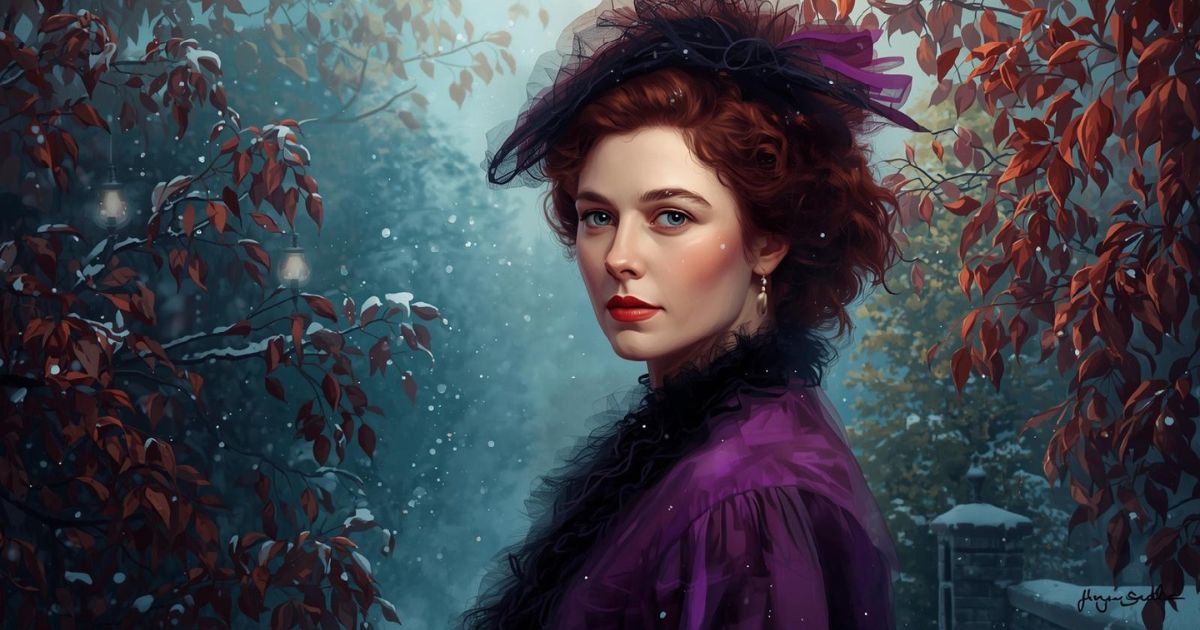
An excerpt from the original text.(complete · 1642 words)
he coachman pulled up his four horses and looked round to the right,
to a field of rye, where some peasants were sitting on a cart. The
counting-house clerk was just going to jump down, but on second
thoughts he shouted peremptorily to the peasants instead, and beckoned
to them to come up. The wind, that seemed to blow as they drove,
dropped when the carriage stood still; gadflies settled on the steaming
horses that angrily shook them off. The metallic clank of a whetstone
against a scythe, that came to them from the cart, ceased. One of the
peasants got up and came towards the carriage.
“Well, you are slow!” the counting-house clerk shouted angrily to the
peasant who was stepping slowly with his bare feet over the ruts of the
rough dry road. “Come along, do!”
A curly-headed old man with a bit of bast tied round his hair, and his
bent back dark with perspiration, came towards the carriage, quickening
his steps, and took hold of the mud-guard with his sunburnt hand.
“Vozdvizhenskoe, the manor house? the count’s?” he repeated; “go on to
the end of this track. Then turn to the left. Straight along the avenue
and you’ll come right upon it. But whom do you want? The count
himself?”
“Well, are they at home, my good man?” Darya Alexandrovna said vaguely,
not knowing how to ask about Anna, even of this peasant.
“At home for sure,” said the peasant, shifting from one bare foot to
the other, and leaving a distinct print of five toes and a heel in the
dust. “Sure to be at home,” he repeated, evidently eager to talk. “Only
yesterday visitors arrived. There’s a sight of visitors come. What do
you want?” He turned round and called to a lad, who was shouting
something to him from the cart. “Oh! They all rode by here not long
since, to look at a reaping machine. They’ll be home by now. And who
will you be belonging to?...”
“We’ve come a long way,” said the coachman, climbing onto the box. “So
it’s not far?”
“I tell you, it’s just here. As soon as you get out....” he said,
keeping hold all the while of the carriage.
A healthy-looking, broad-shouldered young fellow came up too.
“What, is it laborers they want for the harvest?” he asked.
“I don’t know, my boy.”
“So you keep to the left, and you’ll come right on it,” said the
peasant, unmistakably loth to let the travelers go, and eager to
converse.
The coachman started the horses, but they were only just turning off
when the peasant shouted: “Stop! Hi, friend! Stop!” called the two
voices. The coachman stopped.
“They’re coming! They’re yonder!” shouted the peasant. “See what a
turn-out!” he said, pointing to four persons on horseback, and two in a
char-à-banc, coming along the road.
They were Vronsky with a jockey, Veslovsky and Anna on horseback, and
Princess Varvara and Sviazhsky in the char-à-banc. They had gone out
to look at the working of a new reaping machine.
When the carriage stopped, the party on horseback were coming at a
walking pace. Anna was in front beside Veslovsky. Anna, quietly walking
her horse, a sturdy English cob with cropped mane and short tail, her
beautiful head with her black hair straying loose under her high hat,
her full shoulders, her slender waist in her black riding habit, and
all the ease and grace of her deportment, impressed Dolly.
For the first minute it seemed to her unsuitable for Anna to be on
horseback. The conception of riding on horseback for a lady was, in
Darya Alexandrovna’s mind, associated with ideas of youthful flirtation
and frivolity, which, in her opinion, was unbecoming in Anna’s
position. But when she had scrutinized her, seeing her closer, she was
at once reconciled to her riding. In spite of her elegance, everything
was so simple, quiet, and dignified in the attitude, the dress and the
movements of Anna, that nothing could have been more natural.
Beside Anna, on a hot-looking gray cavalry horse, was Vassenka
Veslovsky in his Scotch cap with floating ribbons, his stout legs
stretched out in front, obviously pleased with his own appearance.
Darya Alexandrovna could not suppress a good-humored smile as she
recognized him. Behind rode Vronsky on a dark bay mare, obviously
heated from galloping. He was holding her in, pulling at the reins.
After him rode a little man in the dress of a jockey. Sviazhsky and
Princess Varvara in a new char-à-banc with a big, raven-black
trotting horse, overtook the party on horseback.
Anna’s face suddenly beamed with a joyful smile at the instant when, in
the little figure huddled in a corner of the old carriage, she
recognized Dolly. She uttered a cry, started in the saddle, and set her
horse into a gallop. On reaching the carriage she jumped off without
assistance, and holding up her riding habit, she ran up to greet Dolly.
“I thought it was you and dared not think it. How delightful! You can’t
fancy how glad I am!” she said, at one moment pressing her face against
Dolly and kissing her, and at the next holding her off and examining
her with a smile.
“Here’s a delightful surprise, Alexey!” she said, looking round at
Vronsky, who had dismounted, and was walking towards them.
Vronsky, taking off his tall gray hat, went up to Dolly.
“You wouldn’t believe how glad we are to see you,” he said, giving
peculiar significance to the words, and showing his strong white teeth
in a smile.
Vassenka Veslovsky, without getting off his horse, took off his cap and
greeted the visitor by gleefully waving the ribbons over his head.
“That’s Princess Varvara,” Anna said in reply to a glance of inquiry
from Dolly as the char-à-banc drove up.
“Ah!” said Darya Alexandrovna, and unconsciously her face betrayed her
dissatisfaction.
Princess Varvara was her husband’s aunt, and she had long known her,
and did not respect her. She knew that Princess Varvara had passed her
whole life toadying on her rich relations, but that she should now be
sponging on Vronsky, a man who was nothing to her, mortified Dolly on
account of her kinship with her husband. Anna noticed Dolly’s
expression, and was disconcerted by it. She blushed, dropped her riding
habit, and stumbled over it.
Darya Alexandrovna went up to the char-à-banc and coldly greeted
Princess Varvara. Sviazhsky too she knew. He inquired how his queer
friend with the young wife was, and running his eyes over the
ill-matched horses and the carriage with its patched mud-guards,
proposed to the ladies that they should get into the char-à-banc.
“And I’ll get into this vehicle,” he said. “The horse is quiet, and the
princess drives capitally.”
“No, stay as you were,” said Anna, coming up, “and we’ll go in the
carriage,” and taking Dolly’s arm, she drew her away.
Darya Alexandrovna’s eyes were fairly dazzled by the elegant carriage
of a pattern she had never seen before, the splendid horses, and the
elegant and gorgeous people surrounding her. But what struck her most
of all was the change that had taken place in Anna, whom she knew so
well and loved. Any other woman, a less close observer, not knowing
Anna before, or not having thought as Darya Alexandrovna had been
thinking on the road, would not have noticed anything special in Anna.
But now Dolly was struck by that temporary beauty, which is only found
in women during the moments of love, and which she saw now in Anna’s
face. Everything in her face, the clearly marked dimples in her cheeks
and chin, the line of her lips, the smile which, as it were, fluttered
about her face, the brilliance of her eyes, the grace and rapidity of
her movements, the fulness of the notes of her voice, even the manner
in which, with a sort of angry friendliness, she answered Veslovsky
when he asked permission to get on her cob, so as to teach it to gallop
with the right leg foremost—it was all peculiarly fascinating, and it
seemed as if she were herself aware of it, and rejoicing in it.
When both the women were seated in the carriage, a sudden embarrassment
came over both of them. Anna was disconcerted by the intent look of
inquiry Dolly fixed upon her. Dolly was embarrassed because after
Sviazhsky’s phrase about “this vehicle,” she could not help feeling
ashamed of the dirty old carriage in which Anna was sitting with her.
The coachman Philip and the counting-house clerk were experiencing the
same sensation. The counting-house clerk, to conceal his confusion,
busied himself settling the ladies, but Philip the coachman became
sullen, and was bracing himself not to be overawed in future by this
external superiority. He smiled ironically, looking at the raven horse,
and was already deciding in his own mind that this smart trotter in the
char-à-banc was only good for promenage, and wouldn’t do thirty
miles straight off in the heat.
The peasants had all got up from the cart and were inquisitively and
mirthfully staring at the meeting of the friends, making their comments
on it.
“They’re pleased, too; haven’t seen each other for a long while,” said
the curly-headed old man with the bast round his hair.
“I say, Uncle Gerasim, if we could take that raven horse now, to cart
the corn, that ’ud be quick work!”
“Look-ee! Is that a woman in breeches?” said one of them, pointing to
Vassenka Veslovsky sitting in a side saddle.
“Nay, a man! See how smartly he’s going it!”
“Eh, lads! seems we’re not going to sleep, then?”
“What chance of sleep today!” said the old man, with a sidelong look at
the sun. “Midday’s past, look-ee! Get your hooks, and come along!”
Master this chapter. Complete your experience
Purchase the complete book to access all chapters and support classic literature
As an Amazon Associate, we earn a small commission from qualifying purchases at no additional cost to you.
Available in paperback, hardcover, and e-book formats
Let's Analyse the Pattern
The tendency to analyze and question our blessings until we can no longer simply enjoy them.
Why This Matters
Connect literature to life
This chapter teaches how to identify when your mind is sabotaging your contentment by demanding meaning from moments that are meant to be simply experienced.
Practice This Today
This week, notice when you catch yourself asking 'what's the point?' about good things in your life, and practice responding with gratitude instead of analysis.
Now let's explore the literary elements.
Key Quotes & Analysis
"What am I living for? What is the meaning of my existence?"
Context: Levin's internal questioning while working in the fields
This captures the heart of existential crisis - having material success but feeling spiritually empty. It shows how achievement doesn't automatically bring meaning.
In Today's Words:
I've got everything I wanted, so why do I still feel like something's missing?
"They know what they live for. They have no doubt."
Context: Observing his peasant workers
This reveals Levin's envy of simple faith and certainty. He recognizes that less education sometimes means less anxiety about life's big questions.
In Today's Words:
These guys just get up and do their jobs without overthinking everything like I do.
"My reason has taught me nothing of what I really need to know."
Context: Reflecting on his intellectual struggles
This shows the limitation of pure rationalism in providing life meaning. Sometimes the heart knows what the head cannot figure out.
In Today's Words:
All my thinking and analyzing hasn't actually helped me figure out what really matters.
Thematic Threads
Class
In This Chapter
Levin envies the peasants' simple certainty while his education brings only anxiety
Development
Continues exploring how different social positions create different psychological burdens
In Your Life:
You might notice how your education or awareness sometimes makes you less happy than people who think less about things.
Identity
In This Chapter
Levin struggles with who he is when his rational mind conflicts with his need for spiritual meaning
Development
His identity crisis deepens as he questions the value of his intellectual sophistication
In Your Life:
You might feel torn between different parts of yourself—the logical part and the part that just wants to believe in something.
Personal Growth
In This Chapter
Levin's philosophical crisis represents a necessary stage before finding authentic purpose
Development
His growth requires breaking down his assumptions before building something new
In Your Life:
You might recognize times when feeling lost or confused was actually preparation for a breakthrough.
Work
In This Chapter
Physical labor usually brings Levin peace, but today even honest work can't quiet his existential doubts
Development
Introduced here as a theme about how different types of work affect our mental state
In Your Life:
You might notice how certain kinds of work calm your mind while others leave you more anxious.
Faith
In This Chapter
The peasants' simple faith provides them with certainty that Levin's rational mind cannot access
Development
Introduced here as a contrast between intellectual questioning and spiritual acceptance
In Your Life:
You might feel envious of people who seem to have simple, unquestioning beliefs about life's purpose.
You now have the context. Time to form your own thoughts.
Discussion Questions
- 1
What specific thoughts are tormenting Levin even though his life is going well?
analysis • surface - 2
Why does Levin envy the peasants' certainty when he has more education and advantages than they do?
analysis • medium - 3
Where do you see people today overthinking their blessings instead of simply enjoying them?
application • medium - 4
What strategies could someone use to stop analyzing their happiness to death?
application • deep - 5
When is thinking too much about life actually harmful to living it well?
reflection • deep
Critical Thinking Exercise
Create Your Gratitude Circuit Breaker
Think of something good in your life that you've been overthinking or questioning lately. Design a simple ritual or routine that would help you appreciate this blessing without analyzing it to death. Write out your 'circuit breaker' - a specific action you can take when you catch yourself overthinking your good fortune.
Consider:
- •What simple activities help you feel grateful without thinking too hard?
- •How do the people around you who seem content approach their blessings?
- •What would change if you trusted that good things don't need to be perfectly understood to be valuable?
Journaling Prompt
Write about a time when overthinking something good in your life made you less happy. What would have happened if you had simply accepted and enjoyed it instead?
Coming Up Next...
Chapter 175
Levin's philosophical turmoil reaches a breaking point as he encounters something that will challenge everything he believes about faith and meaning. A simple conversation is about to change his entire worldview.



