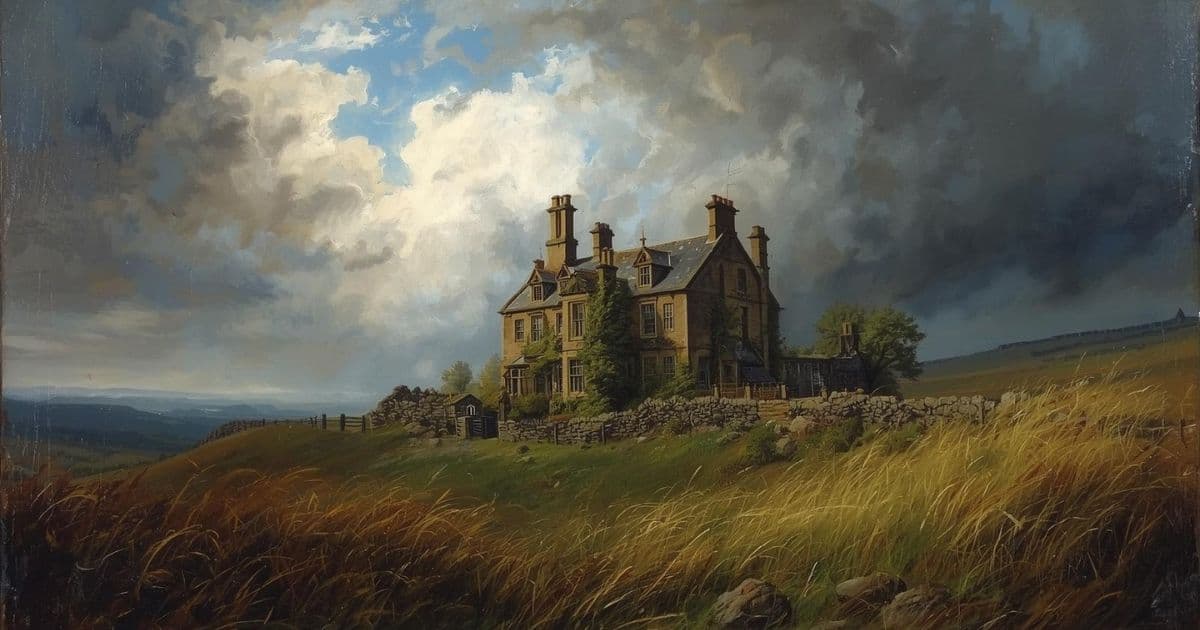
An excerpt from the original text.(complete · 1476 words)
ext day, before the ladies were up, the wagonette and a trap for the
shooting party were at the door, and Laska, aware since early morning
that they were going shooting, after much whining and darting to and
fro, had sat herself down in the wagonette beside the coachman, and,
disapproving of the delay, was excitedly watching the door from which
the sportsmen still did not come out. The first to come out was
Vassenka Veslovsky, in new high boots that reached half-way up his
thick thighs, in a green blouse, with a new Russian leather
cartridge-belt, and in his Scotch cap with ribbons, with a brand-new
English gun without a sling. Laska flew up to him, welcomed him, and
jumping up, asked him in her own way whether the others were coming
soon, but getting no answer from him, she returned to her post of
observation and sank into repose again, her head on one side, and one
ear pricked up to listen. At last the door opened with a creak, and
Stepan Arkadyevitch’s spot-and-tan pointer Krak flew out, running round
and round and turning over in the air. Stepan Arkadyevitch himself
followed with a gun in his hand and a cigar in his mouth.
“Good dog, good dog, Krak!” he cried encouragingly to the dog, who put
his paws up on his chest, catching at his game bag. Stepan Arkadyevitch
was dressed in rough leggings and spats, in torn trousers and a short
coat. On his head there was a wreck of a hat of indefinite form, but
his gun of a new patent was a perfect gem, and his game bag and
cartridge belt, though worn, were of the very best quality.
Vassenka Veslovsky had had no notion before that it was truly chic
for a sportsman to be in tatters, but to have his shooting outfit of
the best quality. He saw it now as he looked at Stepan Arkadyevitch,
radiant in his rags, graceful, well-fed, and joyous, a typical Russian
nobleman. And he made up his mind that next time he went shooting he
would certainly adopt the same get-up.
“Well, and what about our host?” he asked.
“A young wife,” said Stepan Arkadyevitch, smiling.
“Yes, and such a charming one!”
“He came down dressed. No doubt he’s run up to her again.”
Stepan Arkadyevitch guessed right. Levin had run up again to his wife
to ask her once more if she forgave him for his idiocy yesterday, and,
moreover, to beg her for Christ’s sake to be more careful. The great
thing was for her to keep away from the children—they might any minute
push against her. Then he had once more to hear her declare that she
was not angry with him for going away for two days, and to beg her to
be sure to send him a note next morning by a servant on horseback, to
write him, if it were but two words only, to let him know that all was
well with her.
Kitty was distressed, as she always was, at parting for a couple of
days from her husband, but when she saw his eager figure, looking big
and strong in his shooting-boots and his white blouse, and a sort of
sportsman elation and excitement incomprehensible to her, she forgot
her own chagrin for the sake of his pleasure, and said good-bye to him
cheerfully.
“Pardon, gentlemen!” he said, running out onto the steps. “Have you put
the lunch in? Why is the chestnut on the right? Well, it doesn’t
matter. Laska, down; go and lie down!”
“Put it with the herd of oxen,” he said to the herdsman, who was
waiting for him at the steps with some question. “Excuse me, here comes
another villain.”
Levin jumped out of the wagonette, in which he had already taken his
seat, to meet the carpenter, who came towards the steps with a rule in
his hand.
“You didn’t come to the counting house yesterday, and now you’re
detaining me. Well, what is it?”
“Would your honor let me make another turning? It’s only three steps to
add. And we make it just fit at the same time. It will be much more
convenient.”
“You should have listened to me,” Levin answered with annoyance. “I
said: Put the lines and then fit in the steps. Now there’s no setting
it right. Do as I told you, and make a new staircase.”
The point was that in the lodge that was being built the carpenter had
spoiled the staircase, fitting it together without calculating the
space it was to fill, so that the steps were all sloping when it was
put in place. Now the carpenter wanted, keeping the same staircase, to
add three steps.
“It will be much better.”
“But where’s your staircase coming out with its three steps?”
“Why, upon my word, sir,” the carpenter said with a contemptuous smile.
“It comes out right at the very spot. It starts, so to speak,” he said,
with a persuasive gesture; “it comes down, and comes down, and comes
out.”
“But three steps will add to the length too ... where is it to come
out?”
“Why, to be sure, it’ll start from the bottom and go up and go up, and
come out so,” the carpenter said obstinately and convincingly.
“It’ll reach the ceiling and the wall.”
“Upon my word! Why, it’ll go up, and up, and come out like this.”
Levin took out a ramrod and began sketching him the staircase in the
dust.
“There, do you see?”
“As your honor likes,” said the carpenter, with a sudden gleam in his
eyes, obviously understanding the thing at last. “It seems it’ll be
best to make a new one.”
“Well, then, do it as you’re told,” Levin shouted, seating himself in
the wagonette. “Down! Hold the dogs, Philip!”
Levin felt now at leaving behind all his family and household cares
such an eager sense of joy in life and expectation that he was not
disposed to talk. Besides that, he had that feeling of concentrated
excitement that every sportsman experiences as he approaches the scene
of action. If he had anything on his mind at that moment, it was only
the doubt whether they would start anything in the Kolpensky marsh,
whether Laska would show to advantage in comparison with Krak, and
whether he would shoot well that day himself. Not to disgrace himself
before a new spectator—not to be outdone by Oblonsky—that too was a
thought that crossed his brain.
Oblonsky was feeling the same, and he too was not talkative. Vassenka
Veslovsky kept up alone a ceaseless flow of cheerful chatter. As he
listened to him now, Levin felt ashamed to think how unfair he had been
to him the day before. Vassenka was really a nice fellow, simple,
good-hearted, and very good-humored. If Levin had met him before he was
married, he would have made friends with him. Levin rather disliked his
holiday attitude to life and a sort of free and easy assumption of
elegance. It was as though he assumed a high degree of importance in
himself that could not be disputed, because he had long nails and a
stylish cap, and everything else to correspond; but this could be
forgiven for the sake of his good nature and good breeding. Levin liked
him for his good education, for speaking French and English with such
an excellent accent, and for being a man of his world.
Vassenka was extremely delighted with the left horse, a horse of the
Don Steppes. He kept praising him enthusiastically. “How fine it must
be galloping over the steppes on a steppe horse! Eh? isn’t it?” he
said. He had imagined riding on a steppe horse as something wild and
romantic, and it turned out nothing of the sort. But his simplicity,
particularly in conjunction with his good looks, his amiable smile, and
the grace of his movements, was very attractive. Either because his
nature was sympathetic to Levin, or because Levin was trying to atone
for his sins of the previous evening by seeing nothing but what was
good in him, anyway he liked his society.
After they had driven over two miles from home, Veslovsky all at once
felt for a cigar and his pocketbook, and did not know whether he had
lost them or left them on the table. In the pocketbook there were
thirty-seven pounds, and so the matter could not be left in
uncertainty.
“Do you know what, Levin, I’ll gallop home on that left trace-horse.
That will be splendid. Eh?” he said, preparing to get out.
“No, why should you?” answered Levin, calculating that Vassenka could
hardly weigh less than seventeen stone. “I’ll send the coachman.”
The coachman rode back on the trace-horse, and Levin himself drove the
remaining pair.
Master this chapter. Complete your experience
Purchase the complete book to access all chapters and support classic literature
As an Amazon Associate, we earn a small commission from qualifying purchases at no additional cost to you.
Available in paperback, hardcover, and e-book formats
Let's Analyse the Pattern
When mental overthinking creates paralysis, purposeful physical work can break the cycle and restore clarity.
Why This Matters
Connect literature to life
This chapter teaches how to identify when thinking becomes counterproductive spinning that needs to be interrupted, not continued.
Practice This Today
This week, notice when you've been thinking about the same problem for more than 30 minutes without making progress—that's your cue to move your body instead of your mind.
Now let's explore the literary elements.
Key Quotes & Analysis
"The longer Levin mowed, the oftener he felt the moments of unconsciousness in which it seemed not his hands that swung the scythe, but the scythe mowing of itself."
Context: As Levin gets into the rhythm of the work and enters a flow state
This captures the essence of flow state - when conscious effort gives way to unconscious mastery. Tolstoy shows how physical work can quiet mental chatter and create a meditative experience where the body takes over.
In Today's Words:
The more he worked, the more he got into the zone where his body just took over and did the work automatically.
"He felt only the joy of movement, the pleasure of swinging the scythe and breathing the fresh air."
Context: Describing Levin's experience during the mowing work
Shows how simple physical activity can provide immediate, uncomplicated happiness. This contrasts sharply with Levin's usual mental anguish about life's meaning - sometimes joy is found in the body, not the mind.
In Today's Words:
He just felt good moving his body and breathing fresh air - nothing complicated about it.
"The old man moved along, swinging his scythe with easy, long sweeps, as though he were playing."
Context: Levin observing Tit's effortless technique
Illustrates how mastery makes difficult work look effortless. Tit represents the wisdom of experience and the dignity of skilled labor. His ease serves as both inspiration and gentle rebuke to Levin's overthinking approach to life.
In Today's Words:
The old guy made the hard work look like a game - smooth and easy.
Thematic Threads
Class
In This Chapter
Levin works alongside peasants as an equal, finding wisdom in their physical knowledge rather than his intellectual education
Development
Evolution from earlier class anxiety—now he's learning from working people instead of feeling guilty about them
In Your Life:
You might discover that the person doing 'simple' work at your job has insights your college-educated colleagues missed
Identity
In This Chapter
Levin finds his authentic self through physical labor rather than intellectual pursuits or social position
Development
Major breakthrough from his previous identity crisis—he's discovering who he is through what he does
In Your Life:
You might find your real self emerges more clearly when you're focused on useful work than when you're trying to figure yourself out
Personal Growth
In This Chapter
Growth comes through embodied experience and skill-building rather than abstract thinking
Development
Shift from his earlier pattern of trying to think his way to enlightenment
In Your Life:
Your biggest insights about yourself might come while you're busy doing something challenging with your hands
Purpose
In This Chapter
Levin finds meaning in contributing tangible value through physical work
Development
First time he's felt genuinely useful rather than just privileged and guilty
In Your Life:
You might feel most purposeful when you can see the direct results of your effort in the world
Mental Health
In This Chapter
Physical exhaustion and focused work provide relief from anxiety and overthinking
Development
Introduced here as a practical solution to his mental struggles
In Your Life:
When your mind won't stop racing, your body might hold the key to finding peace
You now have the context. Time to form your own thoughts.
Discussion Questions
- 1
What changes in Levin's mental state when he starts working in the fields with the peasants?
analysis • surface - 2
Why does physical labor succeed in calming Levin's mind when thinking and analyzing failed?
analysis • medium - 3
Where do you see people today using physical work or activities to escape mental stress or overthinking?
application • medium - 4
When you're stuck in your head worrying about something, what kind of physical activity helps you break out of that cycle?
application • deep - 5
What does Levin's experience teach us about the relationship between our bodies and our peace of mind?
reflection • deep
Critical Thinking Exercise
Design Your Mental Reset Menu
Create a personal toolkit of physical activities you can use when your mind won't stop racing. Think of three different scenarios: when you have 10 minutes, 30 minutes, or 2 hours. For each time frame, identify a specific physical activity that requires enough focus to quiet mental chatter but is accessible to you right now.
Consider:
- •Choose activities that require skill or attention, not just movement
- •Consider what you already know how to do or could easily learn
- •Think about what's available to you at different times and places
Journaling Prompt
Write about a time when you discovered that doing something with your hands helped clear your head. What was the activity, and why do you think it worked for you?
Coming Up Next...
Chapter 166
The shooting party reaches the marsh. Will Levin's sporting honor survive the competition with Oblonsky and Veslovsky's admiration?