
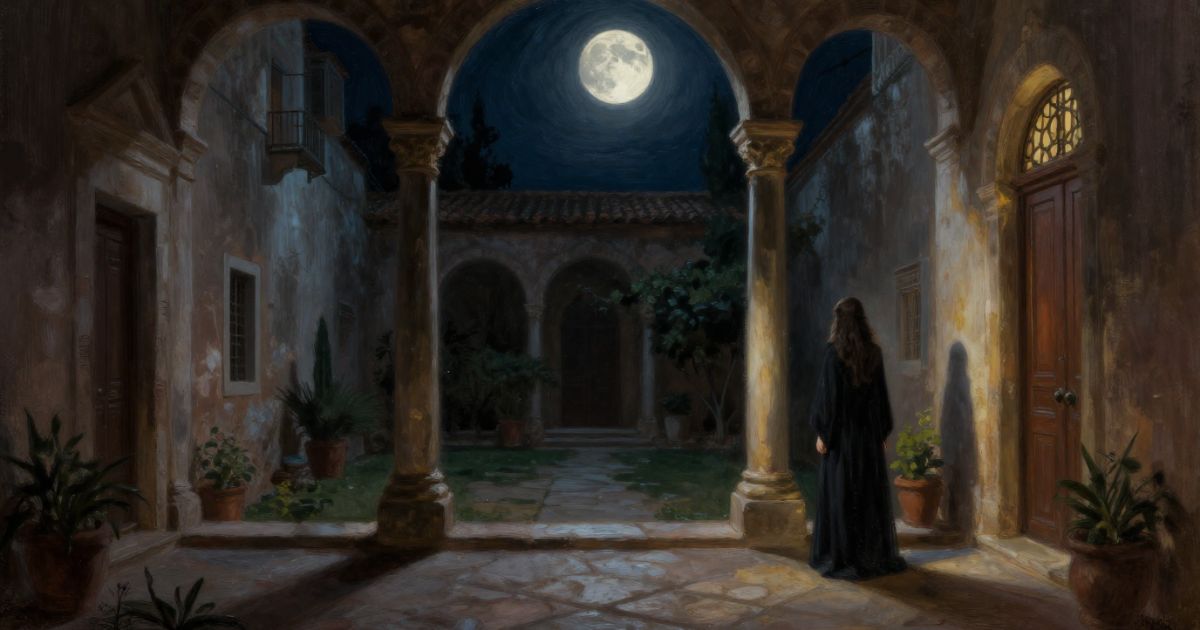
An excerpt from the original text.(complete · 6255 words)
he nuptial morn, so justly dreaded by Julia, and so impatiently
awaited by the marquis, now arrived. The marriage was to be celebrated
with a magnificence which demonstrated the joy it occasioned to the
marquis. The castle was fitted up in a style of grandeur superior to
any thing that had been before seen in it. The neighbouring nobility
were invited to an entertainment which was to conclude with a splendid
ball and supper, and the gates were to be thrown open to all who chose
to partake of the bounty of the marquis. At an early hour the duke,
attended by a numerous retinue, entered the castle. Ferdinand heard
from his dungeon, where the rigour and the policy of the marquis still
confined him, the loud clattering of hoofs in the courtyard above, the
rolling of the carriage wheels, and all the tumultuous bustle which
the entrance of the duke occasioned. He too well understood the cause
of this uproar, and it awakened in him sensations resembling those
which the condemned criminal feels, when his ears are assailed by the
dreadful sounds that precede his execution. When he was able to think
of himself, he wondered by what means the marquis would reconcile his
absence to the guests. He, however, knew too well the dissipated
character of the Sicilian nobility, to doubt that whatever story
should be invented would be very readily believed by them; who, even
if they knew the truth, would not suffer a discovery of their
knowledge to interrupt the festivity which was offered them.
The marquis and marchioness received the duke in the outer hall, and
conducted him to the saloon, where he partook of the refreshments
prepared for him, and from thence retired to the chapel. The marquis
now withdrew to lead Julia to the altar, and Emilia was ordered to
attend at the door of the chapel, in which the priest and a numerous
company were already assembled. The marchioness, a prey to the
turbulence of succeeding passions, exulted in the near completion of
her favorite scheme.--A disappointment, however, was prepared for her,
which would at once crush the triumph of her malice and her pride. The
marquis, on entering the prison of Julia, found it empty! His
astonishment and indignation upon the discovery almost overpowered his
reason. Of the servants of the castle, who were immediately summoned,
he enquired concerning her escape, with a mixture of fury and sorrow
which left them no opportunity to reply. They had, however, no
information to give, but that her woman had not appeared during the
whole morning. In the prison were found the bridal habiliments which
the marchioness herself had sent on the preceding night, together with
a letter addressed to Emilia, which contained the following words:
'Adieu, dear Emilia; never more will you see your wretched sister, who
flies from the cruel fate now prepared for her, certain that she can
never meet one more dreadful.--In happiness or misery--in hope or
despair--whatever may be your situation--still remember me with pity
and affection. Dear Emilia, adieu!--You will always be the sister of
my heart--may you never be the partner of my misfortunes!'
While the marquis was reading this letter, the marchioness, who
supposed the delay occasioned by some opposition from Julia, flew to
the apartment. By her orders all the habitable parts of the castle
were explored, and she herself assisted in the search. At length the
intelligence was communicated to the chapel, and the confusion became
universal. The priest quitted the altar, and the company returned to
the saloon.
The letter, when it was given to Emilia, excited emotions which she
found it impossible to disguise, but which did not, however, protect
her from a suspicion that she was concerned in the transaction, her
knowledge of which this letter appeared intended to conceal.
The marquis immediately dispatched servants upon the fleetest horses
of his stables, with directions to take different routs, and to scour
every corner of the island in pursuit of the fugitives. When these
exertions had somewhat quieted his mind, he began to consider by what
means Julia could have effected her escape. She had been confined in a
small room in a remote part of the castle, to which no person had been
admitted but her own woman and Robert, the confidential servant of the
marquis. Even Lisette had not been suffered to enter, unless
accompanied by Robert, in whose room, since the night of the fatal
discovery, the keys had been regularly deposited. Without them it was
impossible she could have escaped: the windows of the apartment being
barred and grated, and opening into an inner court, at a prodigious
height from the ground. Besides, who could she depend upon for
protection--or whither could she intend to fly for concealment?--The
associates of her former elopement were utterly unable to assist her
even with advice. Ferdinand himself a prisoner, had been deprived of
any means of intercourse with her, and Hippolitus had been carried
lifeless on board a vessel, which had immediately sailed for Italy.
Robert, to whom the keys had been entrusted, was severely interrogated
by the marquis. He persisted in a simple and uniform declaration of
his innocence; but as the marquis believed it impossible that Julia
could have escaped without his knowledge, he was ordered into
imprisonment till he should confess the fact.
The pride of the duke was severely wounded by this elopement, which
proved the excess of Julia's aversion, and compleated the disgraceful
circumstances of his rejection. The marquis had carefully concealed
from him her prior attempt at elopement, and her consequent
confinement; but the truth now burst from disguise, and stood revealed
with bitter aggravation. The duke, fired with indignation at the
duplicity of the marquis, poured forth his resentment in terms of
proud and bitter invective; and the marquis, galled by recent
disappointment, was in no mood to restrain the impetuosity of his
nature. He retorted with acrimony; and the consequence would have been
serious, had not the friends of each party interposed for their
preservation. The disputants were at length reconciled; it was agreed
to pursue Julia with united, and indefatigable search; and that
whenever she should be found, the nuptials should be solemnized
without further delay. With the character of the duke, this conduct
was consistent. His passions, inflamed by disappointment, and
strengthened by repulse, now defied the power of obstacle; and those
considerations which would have operated with a more delicate mind to
overcome its original inclination, served only to encrease the
violence of his.
Madame de Menon, who loved Julia with maternal affection, was an
interested observer of all that passed at the castle. The cruel fate
to which the marquis destined his daughter she had severely lamented,
yet she could hardly rejoice to find that this had been avoided by
elopement. She trembled for the future safety of her pupil; and her
tranquillity, which was thus first disturbed for the welfare of
others, she was not soon suffered to recover.
The marchioness had long nourished a secret dislike to Madame de
Menon, whose virtues were a silent reproof to her vices. The
contrariety of their disposition created in the marchioness an
aversion which would have amounted to contempt, had not that dignity
of virtue which strongly characterized the manners of madame,
compelled the former to fear what she wished to despise. Her
conscience whispered her that the dislike was mutual; and she now
rejoiced in the opportunity which seemed to offer itself of lowering
the proud integrity of madame's character. Pretending, therefore, to
believe that she had encouraged Ferdinand to disobey his father's
commands, and had been accessary to the elopement, she accused her of
these offences, and stimulated the marquis to reprehend her conduct.
But the integrity of Madame de Menon was not to be questioned with
impunity. Without deigning to answer the imputation, she desired to
resign an office of which she was no longer considered worthy, and to
quit the castle immediately. This the policy of the marquis would not
suffer; and he was compelled to make such ample concessions to madame,
as induced her for the present to continue at the castle.
The news of Julia's elopement at length reached the ears of Ferdinand,
whose joy at this event was equalled only by his surprize. He lost,
for a moment, the sense of his own situation, and thought only of the
escape of Julia. But his sorrow soon returned with accumulated force
when he recollected that Julia might then perhaps want that assistance
which his confinement alone could prevent his affording her.
The servants, who had been sent in pursuit, returned to the castle
without any satisfactory information. Week after week elapsed in
fruitless search, yet the duke was strenuous in continuing the
pursuit. Emissaries were dispatched to Naples, and to the several
estates of the Count Vereza, but they returned without any
satisfactory information. The count had not been heard of since he
quitted Naples for Sicily.
During these enquiries a new subject of disturbance broke out in the
castle of Mazzini. On the night so fatal to the hopes of Hippolitus
and Julia, when the tumult was subsided, and all was still, a light
was observed by a servant as he passed by the window of the great
stair-case in the way to his chamber, to glimmer through the casement
before noticed in the southern buildings. While he stood observing it,
it vanished, and presently reappeared. The former mysterious
circumstances relative to these buildings rushed upon his mind; and
fired with wonder, he roused some of his fellow servants to come and
behold this phenomenon.
As they gazed in silent terror, the light disappeared, and soon after,
they saw a small door belonging to the south tower open, and a figure
bearing a light issue forth, which gliding along the castle walls, was
quickly lost to their view. Overcome with fear they hurried back to
their chambers, and revolved all the late wonderful occurrences. They
doubted not, that this was the figure formerly seen by the lady Julia.
The sudden change of Madame de Menon's apartments had not passed
unobserved by the servants, but they now no longer hesitated to what
to attribute the removal. They collected each various and uncommon
circumstance attendant on this part of the fabric; and, comparing them
with the present, their superstitious fears were confirmed, and their
terror heightened to such a degree, that many of them resolved to quit
the service of the marquis.
The marquis surprized at this sudden desertion, enquired into its
cause, and learned the truth. Shocked by this discovery, he yet
resolved to prevent, if possible, the ill effects which might be
expected from a circulation of the report. To this end it was
necessary to quiet the minds of his people, and to prevent their
quitting his service. Having severely reprehended them for the idle
apprehension they encouraged, he told them that, to prove the fallacy
of their surmises, he would lead them over that part of the castle
which was the subject of their fears, and ordered them to attend him
at the return of night in the north hall. Emilia and Madame de Menon,
surprised at this procedure, awaited the issue in silent expectation.
The servants, in obedience to the commands of the marquis, assembled
at night in the north hall. The air of desolation which reigned
through the south buildings, and the circumstance of their having been
for so many years shut up, would naturally tend to inspire awe; but to
these people, who firmly believed them to be the haunt of an unquiet
spirit, terror was the predominant sentiment.
The marquis now appeared with the keys of these buildings in his
hands, and every heart thrilled with wild expectation. He ordered
Robert to precede him with a torch, and the rest of the servants
following, he passed on. A pair of iron gates were unlocked, and they
proceeded through a court, whose pavement was wildly overgrown with
long grass, to the great door of the south fabric. Here they met with
some difficulty, for the lock, which had not been turned for many
years, was rusted.
During this interval, the silence of expectation sealed the lips of
all present. At length the lock yielded. That door which had not been
passed for so many years, creaked heavily upon its hinges, and
disclosed the hall of black marble which Ferdinand had formerly
crossed. 'Now,' cried the marquis, in a tone of irony as he entered,
'expect to encounter the ghosts of which you tell me; but if you fail
to conquer them, prepare to quit my service. The people who live with
me shall at least have courage and ability sufficient to defend me
from these spiritual attacks. All I apprehend is, that the enemy will
not appear, and in this case your valour will go untried.'
No one dared to answer, but all followed, in silent fear, the marquis,
who ascended the great stair-case, and entered the gallery. 'Unlock
that door,' said he, pointing to one on the left, 'and we will soon
unhouse these ghosts.' Robert applied the key, but his hand shook so
violently that he could not turn it. 'Here is a fellow,' cried the
marquis, 'fit to encounter a whole legion of spirits. Do you, Anthony,
take the key, and try your valour.'
'Please you, my lord,' replied Anthony, 'I never was a good one at
unlocking a door in my life, but here is Gregory will do it.'--'No, my
lord, an' please you,' said Gregory, 'here is Richard.'--'Stand off,'
said the marquis, 'I will shame your cowardice, and do it myself.'
Saying this he turned the key, and was rushing on, but the door
refused to yield; it shook under his hands, and seemed as if partially
held by some person on the other side. The marquis was surprized, and
made several efforts to move it, without effect. He then ordered his
servants to burst it open, but, shrinking back with one accord, they
cried, 'For God's sake, my lord, go no farther; we are satisfied here
are no ghosts, only let us get back.'
'It is now then my turn to be satisfied,' replied the marquis, 'and
till I am, not one of you shall stir. Open me that door.'--'My
lord!'--'Nay,' said the marquis, assuming a look of stern
authority--'dispute not my commands. I am not to be trifled with.'
They now stepped forward, and applied their strength to the door, when
a loud and sudden noise burst from within, and resounded through the
hollow chambers! The men started back in affright, and were rushing
headlong down the stair-case, when the voice of the marquis arrested
their flight. They returned, with hearts palpitating with terror.
'Observe what I say,' said the marquis, 'and behave like men. Yonder
door,' pointing to one at some distance, 'will lead us through other
rooms to this chamber--unlock it therefore, for I will know the cause
of these sounds.' Shocked at this determination, the servants again
supplicated the marquis to go no farther; and to be obeyed, he was
obliged to exert all his authority. The door was opened, and
discovered a long narrow passage, into which they descended by a few
steps. It led to a gallery that terminated in a back stair-case, where
several doors appeared, one of which the marquis unclosed. A spacious
chamber appeared beyond, whose walls, decayed and discoloured by the
damps, exhibited a melancholy proof of desertion.
They passed on through a long suite of lofty and noble apartments,
which were in the same ruinous condition. At length they came to the
chamber whence the noise had issued. 'Go first, Robert, with the
light,' said the marquis, as they approached the door; 'this is the
key.' Robert trembled--but obeyed, and the other servants followed in
silence. They stopped a moment at the door to listen, but all was
still within. The door was opened, and disclosed a large vaulted
chamber, nearly resembling those they had passed, and on looking
round, they discovered at once the cause of the alarm.--A part of the
decayed roof was fallen in, and the stones and rubbish of the ruin
falling against the gallery door, obstructed the passage. It was
evident, too, whence the noise which occasioned their terror had
arisen; the loose stones which were piled against the door being shook
by the effort made to open it, had given way, and rolled to the floor.
After surveying the place, they returned to the back stairs, which
they descended, and having pursued the several windings of a long
passage, found themselves again in the marble hall. 'Now,' said the
marquis, 'what think ye? What evil spirits infest these walls?
Henceforth be cautious how ye credit the phantasms of idleness, for ye
may not always meet with a master who will condescend to undeceive
ye.'--They acknowledged the goodness of the marquis, and professing
themselves perfectly conscious of the error of their former
suspicions, desired they might search no farther. 'I chuse to leave
nothing to your imagination,' replied the marquis, 'lest hereafter it
should betray you into a similar error. Follow me, therefore; you
shall see the whole of these buildings.' Saying this, he led them to
the south tower. They remembered, that from a door of this tower the
figure which caused their alarm had issued; and notwithstanding the
late assertion of their suspicions being removed, fear still operated
powerfully upon their minds, and they would willingly have been
excused from farther research. 'Would any of you chuse to explore this
tower?' said the marquis, pointing to the broken stair-case; 'for
myself, I am mortal, and therefore fear to venture; but you, who hold
communion with disembodied spirits, may partake something of their
nature; if so, you may pass without apprehension where the ghost has
probably passed before.' They shrunk at this reproof, and were silent.
The marquis turning to a door on his right hand, ordered it to be
unlocked. It opened upon the country, and the servants knew it to be
the same whence the figure had appeared. Having relocked it, 'Lift
that trapdoor; we will desend into the vaults,' said the marquis.
'What trapdoor, my Lord?' said Robert, with encreased agitation; 'I
see none.' The marquis pointed, and Robert, perceived a door, which
lay almost concealed beneath the stones that had fallen from the
stair-case above. He began to remove them, when the marquis suddenly
turning--'I have already sufficiently indulged your folly,' said he,
'and am weary of this business. If you are capable of receiving
conviction from truth, you must now be convinced that these buildings
are not the haunt of a supernatural being; and if you are incapable,
it would be entirely useless to proceed. You, Robert, may therefore
spare yourself the trouble of removing the rubbish; we will quit this
part of the fabric.'
The servants joyfully obeyed, and the marquis locking the several
doors, returned with the keys to the habitable part of the castle.
Every enquiry after Julia had hitherto proved fruitless; and the
imperious nature of the marquis, heightened by the present vexation,
became intolerably oppressive to all around him. As the hope of
recovering Julia declined, his opinion that Emilia had assisted her to
escape strengthened, and he inflicted upon her the severity of his
unjust suspicions. She was ordered to confine herself to her apartment
till her innocence should be cleared, or her sister discovered. From
Madame de Menon she received a faithful sympathy, which was the sole
relief of her oppressed heart. Her anxiety concerning Julia daily
encreased, and was heightened into the most terrifying apprehensions
for her safety. She knew of no person in whom her sister could
confide, or of any place where she could find protection; the most
deplorable evils were therefore to be expected.
One day, as she was sitting at the window of her apartment, engaged in
melancholy reflection, she saw a man riding towards the castle on full
speed. Her heart beat with fear and expectation; for his haste made
her suspect he brought intelligence of Julia; and she could scarcely
refrain from breaking through the command of the marquis, and rushing
into the hall to learn something of his errand. She was right in her
conjecture; the person she had seen was a spy of the marquis's, and
came to inform him that the lady Julia was at that time concealed in a
cottage of the forest of Marentino. The marquis, rejoiced at this
intelligence, gave the man a liberal reward. He learned also, that she
was accompanied by a young cavalier; which circumstance surprized him
exceedingly; for he knew of no person except the Count de Vereza with
whom she could have entrusted herself, and the count had fallen by his
sword! He immediately ordered a party of his people to accompany the
messenger to the forest of Marentino, and to suffer neither Julia nor
the cavalier to escape them, on pain of death.
When the Duke de Luovo was informed of this discovery, he entreated
and obtained permission of the marquis to join in the pursuit. He
immediately set out on the expedition, armed, and followed by a number
of his servants. He resolved to encounter all hazards, and to practice
the most desperate extremes, rather than fail in the object of his
enterprize. In a short time he overtook the marquis's people, and they
proceeded together with all possible speed. The forest lay several
leagues distant from the castle of Mazzini, and the day was closing
when they entered upon the borders. The thick foliage of the trees
spread a deeper shade around; and they were obliged to proceed with
caution. Darkness had long fallen upon the earth when they reached
the cottage, to which they were directed by a light that glimmered
from afar among the trees. The duke left his people at some distance;
and dismounted, and accompanied only by one servant, approached the
cottage. When he reached it he stopped, and looking through the
window, observed a man and woman in the habit of peasants seated at
their supper. They were conversing with earnestness, and the duke,
hoping to obtain farther intelligence of Julia, endeavoured to listen
to their discourse. They were praising the beauty of a lady, whom the
duke did not doubt to be Julia, and the woman spoke much in praise of
the cavalier. 'He has a noble heart,' said she; 'and I am sure, by
his look, belongs to some great family.'--'Nay,' replied her
companion, 'the lady is as good as he. I have been at Palermo, and
ought to know what great folks are, and if she is not one of them,
never take my word again. Poor thing, how she does take on! It made my
heart ache to see her.'
They were some time silent. The duke knocked at the door, and enquired
of the man who opened it concerning the lady and cavalier then in his
cottage. He was assured there were no other persons in the cottage
than those he then saw. The duke persisted in affirming that the
persons he enquired for were there concealed; which the man being as
resolute in denying, he gave the signal, and his people approached,
and surrounded the cottage. The peasants, terrified by this
circumstance, confessed that a lady and cavalier, such as the duke
described, had been for some time concealed in the cottage; but that
they were now departed.
Suspicious of the truth of the latter assertion, the duke ordered his
people to search the cottage, and that part of the forest contiguous
to it. The search ended in disappointment. The duke, however,
resolved to obtain all possible information concerning the fugitives;
and assuming, therefore, a stern air, bade the peasant, on pain of
instant death, discover all he knew of them.
The man replied, that on a very dark and stormy night, about a week
before, two persons had come to the cottage, and desired shelter. That
they were unattended; but seemed to be persons of consequence in
disguise. That they paid very liberally for what they had; and that
they departed from the cottage a few hours before the arrival of the
duke.
The duke enquired concerning the course they had taken, and having
received information, remounted his horse, and set forward in pursuit.
The road lay for several leagues through the forest, and the darkness,
and the probability of encountering banditti, made the journey
dangerous. About the break of day they quitted the forest, and entered
upon a wild and mountainous country, in which they travelled some
miles without perceiving a hut, or a human being. No vestige of
cultivation appeared, and no sounds reached them but those of their
horses feet, and the roaring of the winds through the deep forests
that overhung the mountains. The pursuit was uncertain, but the duke
resolved to persevere.
They came at length to a cottage, where he repeated his enquiries, and
learned to his satisfaction that two persons, such as he described,
had stopped there for refreshment about two hours before. He found it
now necessary to stop for the same purpose. Bread and milk, the only
provisions of the place, were set before him, and his attendants would
have been well contented, had there been sufficient of this homely
fare to have satisfied their hunger.
Having dispatched an hasty meal, they again set forward in the way
pointed out to them as the route of the fugitives. The country
assumed a more civilized aspect. Corn, vineyards, olives, and groves
of mulberry-trees adorned the hills. The vallies, luxuriant in shade,
were frequently embellished by the windings of a lucid stream, and
diversified by clusters of half-seen cottages. Here the rising turrets
of a monastery appeared above the thick trees with which they were
surrounded; and there the savage wilds the travellers had passed,
formed a bold and picturesque background to the scene.
To the questions put by the duke to the several persons he met, he
received answers that encouraged him to proceed. At noon he halted at
a village to refresh himself and his people. He could gain no
intelligence of Julia, and was perplexed which way to chuse; but
determined at length to pursue the road he was then in, and
accordingly again set forward. He travelled several miles without
meeting any person who could give the necessary information, and began
to despair of success. The lengthened shadows of the mountains, and
the fading light gave signals of declining day; when having gained the
summit of a high hill, he observed two persons travelling on horseback
in the plains below. On one of them he distinguished the habiliments
of a woman; and in her air he thought he discovered that of Julia.
While he stood attentively surveying them, they looked towards the
hill, when, as if urged by a sudden impulse of terror, they set off on
full speed over the plains. The duke had no doubt that these were the
persons he sought; and he, therefore, ordered some of his people to
pursue them, and pushed his horse into a full gallop. Before he
reached the plains, the fugitives, winding round an abrupt hill, were
lost to his view. The duke continued his course, and his people, who
were a considerable way before him, at length reached the hill, behind
which the two persons had disappeared. No traces of them were to be
seen, and they entered a narrow defile between two ranges of high and
savage mountains; on the right of which a rapid stream rolled along,
and broke with its deep resounding murmurs the solemn silence of the
place. The shades of evening now fell thick, and the scene was soon
enveloped in darkness; but to the duke, who was animated by a strong
and impetuous passion, these were unimportant circumstances. Although
he knew that the wilds of Sicily were frequently infested with
banditti, his numbers made him fearless of attack. Not so his
attendants, many of whom, as the darkness increased, testified
emotions not very honourable to their courage: starting at every bush,
and believing it concealed a murderer. They endeavoured to dissuade
the duke from proceeding, expressing uncertainty of their being in the
right route, and recommending the open plains. But the duke, whose eye
had been vigilant to mark the flight of the fugitives, and who was not
to be dissuaded from his purpose, quickly repressed their arguments.
They continued their course without meeting a single person.
The moon now rose, and afforded them a shadowy imperfect view of the
surrounding objects. The prospect was gloomy and vast, and not a human
habitation met their eyes. They had now lost every trace of the
fugitives, and found themselves bewildered in a wild and savage
country. Their only remaining care was to extricate themselves from so
forlorn a situation, and they listened at every step with anxious
attention for some sound that might discover to them the haunts of
men. They listened in vain; the stillness of night was undisturbed but
by the wind, which broke at intervals in low and hollow murmurs from
among the mountains.
As they proceeded with silent caution, they perceived a light break
from among the rocks at some distance. The duke hesitated whether to
approach, since it might probably proceed from a party of the banditti
with which these mountains were said to be infested. While he
hesitated, it disappeared; but he had not advanced many steps when it
returned. He now perceived it to issue from the mouth of a cavern, and
cast a bright reflection upon the overhanging rocks and shrubs.
He dismounted, and followed by two of his people, leaving the rest at
some distance, moved with slow and silent steps towards the cave. As
he drew near, he heard the sound of many voices in high carousal.
Suddenly the uproar ceased, and the following words were sung by a
clear and manly voice:
SONG
Pour the rich libation high;
The sparkling cup to Bacchus fill;
His joys shall dance in ev'ry eye,
And chace the forms of future ill!
Quick the magic raptures steal
O'er the fancy-kindling brain.
Warm the heart with social zeal,
And song and laughter reign.
Then visions of pleasure shall float on our sight,
While light bounding our spirits shall flow;
And the god shall impart a fine sense of delight
Which in vain sober mortals would know.
The last verse was repeated in loud chorus. The duke listened with
astonishment! Such social merriment amid a scene of such savage
wildness, appeared more like enchantment than reality. He would not
have hesitated to pronounce this a party of banditti, had not the
delicacy of expression preserved in the song appeared unattainable by
men of their class.
He had now a full view of the cave; and the moment which convinced him
of his error served only to encrease his surprize. He beheld, by the
light of a fire, a party of banditti seated within the deepest recess
of the cave round a rude kind of table formed in the rock. The table
was spread with provisions, and they were regaling themselves with
great eagerness and joy. The countenances of the men exhibited a
strange mixture of fierceness and sociality; and the duke could almost
have imagined he beheld in these robbers a band of the early Romans
before knowledge had civilized, or luxury had softened them. But he
had not much time for meditation; a sense of his danger bade him fly
while to fly was yet in his power. As he turned to depart, he observed
two saddle-horses grazing upon the herbage near the mouth of the cave.
It instantly occurred to him that they belonged to Julia and her
companion. He hesitated, and at length determined to linger awhile,
and listen to the conversation of the robbers, hoping from thence to
have his doubts resolved. They talked for some time in a strain of
high conviviality, and recounted in exultation many of their exploits.
They described also the behaviour of several people whom they had
robbed, with highly ludicrous allusions, and with much rude humour,
while the cave re-echoed with loud bursts of laughter and applause.
They were thus engaged in tumultuous merriment, till one of them
cursing the scanty plunder of their late adventure, but praising the
beauty of a lady, they all lowered their voices together, and seemed
as if debating upon a point uncommonly interesting to them. The
passions of the duke were roused, and he became certain that it was
Julia of whom they had spoken. In the first impulse of feeling he drew
his sword; but recollecting the number of his adversaries, restrained
his fury. He was turning from the cave with a design of summoning his
people, when the light of the fire glittering upon the bright blade of
his weapon, caught the eye of one of the banditti. He started from
his seat, and his comrades instantly rising in consternation,
discovered the duke. They rushed with loud vociferation towards the
mouth of the cave. He endeavoured to escape to his people; but two of
the banditti mounting the horses which were grazing near, quickly
overtook and seized him. His dress and air proclaimed him to be a
person of distinction; and, rejoicing in their prospect of plunder,
they forced him towards the cave. Here their comrades awaited them;
but what were the emotions of the duke, when he discovered in the
person of the principal robber his own son! who, to escape the galling
severity of his father, had fled from his castle some years before,
and had not been heard of since.
He had placed himself at the head of a party of banditti, and, pleased
with the liberty which till then he had never tasted, and with the
power which his new situation afforded him, he became so much attached
to this wild and lawless mode of life, that he determined never to
quit it till death should dissolve those ties which now made his rank
only oppressive. This event seemed at so great a distance, that he
seldom allowed himself to think of it. Whenever it should happen, he
had no doubt that he might either resume his rank without danger of
discovery, or might justify his present conduct as a frolic which a
few acts of generosity would easily excuse. He knew his power would
then place him beyond the reach of censure, in a country where the
people are accustomed to implicit subordination, and seldom dare to
scrutinize the actions of the nobility.
His sensations, however, on discovering his father, were not very
pleasing; but proclaiming the duke, he protected him from farther
outrage.
With the duke, whose heart was a stranger to the softer affections,
indignation usurped the place of parental feeling. His pride was the
only passion affected by the discovery; and he had the rashness to
express the indignation, which the conduct of his son had excited, in
terms of unrestrained invective. The banditti, inflamed by the
opprobium with which he loaded their order, threatened instant
punishment to his temerity; and the authority of Riccardo could hardly
restrain them within the limits of forbearance.
The menaces, and at length entreaties of the duke, to prevail with his
son to abandon his present way of life, were equally ineffectual.
Secure in his own power, Riccardo laughed at the first, and was
insensible to the latter; and his father was compelled to relinquish
the attempt. The duke, however, boldly and passionately accused him of
having plundered and secreted a lady and cavalier, his friends, at the
same time describing Julia, for whose liberation he offered large
rewards. Riccardo denied the fact, which so much exasperated the duke,
that he drew his sword with an intention of plunging it in the breast
of his son. His arm was arrested by the surrounding banditti, who
half unsheathed their swords, and stood suspended in an attitude of
menace. The fate of the father now hung upon the voice of the son.
Riccardo raised his arm, but instantly dropped it, and turned away.
The banditti sheathed their weapons, and stepped back.
Riccardo solemnly swearing that he knew nothing of the persons
described, the duke at length became convinced of the truth of the
assertion, and departing from the cave, rejoined his people. All the
impetuous passions of his nature were roused and inflamed by the
discovery of his son in a situation so wretchedly disgraceful. Yet it
was his pride rather than his virtue that was hurt; and when he wished
him dead, it was rather to save himself from disgrace, than his son
from the real indignity of vice. He had no means of reclaiming him; to
have attempted it by force, would have been at this time the excess of
temerity, for his attendants, though numerous, were undisciplined, and
would have fallen certain victims to the power of a savage and
dexterous banditti.
With thoughts agitated in fierce and agonizing conflict, he pursued
his journey; and having lost all trace of Julia, sought only for an
habitation which might shelter him from the night, and afford
necessary refreshment for himself and his people. With this, however,
there appeared little hope of meeting.
Master this chapter. Complete your experience
Purchase the complete book to access all chapters and support classic literature
As an Amazon Associate, we earn a small commission from qualifying purchases at no additional cost to you.
Available in paperback, hardcover, and e-book formats
Let's Analyse the Pattern
When control becomes suffocating, people will choose dangerous freedom over safe captivity, regardless of consequences.
Why This Matters
Connect literature to life
This chapter teaches how to spot when control is tightening toward an inevitable breaking point, allowing you to intervene before crisis hits.
Practice This Today
This week, notice when someone starts increasing pressure on you—more texts, more rules, more guilt trips—and ask yourself: what small freedom can I claim now before this becomes an ultimatum?
Now let's explore the literary elements.
Key Quotes & Analysis
"The nuptial morn, so justly dreaded by Julia, and so impatiently awaited by the marquis, now arrived."
Context: Opening line describing the wedding day that Julia has escaped
This contrast between 'dreaded' and 'impatiently awaited' immediately shows us how differently the bride and her father view this marriage. The word 'justly' suggests Julia has good reason to fear this day.
In Today's Words:
The wedding day Julia had been terrifying about finally came, while her father couldn't wait for it.
"He too well understood the cause of this uproar, and it awakened in him sensations resembling those which the condemned criminal feels, when his ears are assailed by the dreadful sounds that precede his execution."
Context: Ferdinand hearing the Duke's arrival from his prison cell
This comparison to a condemned criminal shows how helpless Ferdinand feels. He knows his sister is about to be forced into marriage and he can do nothing to stop it.
In Today's Words:
He knew exactly what all that noise meant, and it made him feel like someone on death row hearing them prepare the electric chair.
"Whatever story should be invented would be very readily believed by them; who, even if they knew the truth, would not suffer a discovery."
Context: Ferdinand thinking about how the nobility will accept any excuse for his absence
This reveals the corrupt nature of their social circle - these people will believe convenient lies and won't speak up even if they know the truth. It shows a society where appearances matter more than reality.
In Today's Words:
They'll believe whatever story he tells them, and even if they figure out the truth, they won't say anything.
Thematic Threads
Desperate Choices
In This Chapter
Julia chooses the dangerous forest over forced marriage, while the Duke must choose between pursuing her and confronting his estranged son
Development
Escalated from earlier hints of rebellion to actual life-changing decisions
In Your Life:
You might face this when staying in a bad situation feels safer than the unknown consequences of leaving.
Family Loyalty
In This Chapter
The Duke discovers his own son leading the bandits, creating an impossible conflict between duty and blood
Development
Introduced here as a shocking twist that complicates the pursuit
In Your Life:
You might experience this when family members make choices that force you to choose between supporting them and your own values.
Power's Limits
In This Chapter
Despite his authority and resources, the Marquis cannot control Julia's heart or retrieve his daughter
Development
Evolved from earlier displays of patriarchal control to complete failure of that control
In Your Life:
You might see this when you realize that having authority over someone doesn't mean you can make them truly comply.
Identity
In This Chapter
Julia transforms from obedient daughter to fugitive, while Riccardo has become someone his father no longer recognizes
Development
Developed from earlier questions about who characters really are versus who they're expected to be
In Your Life:
You might face this when the person you've become conflicts with who others expect you to be.
Social Expectations
In This Chapter
The Duke feels publicly humiliated by Julia's rejection, showing how social standing depends on others' compliance
Development
Continued theme showing how social pressure drives destructive behavior
In Your Life:
You might experience this when worrying about what others think pushes you to make decisions that aren't right for you.
You now have the context. Time to form your own thoughts.
Discussion Questions
- 1
What specific actions does Julia take to escape her situation, and how does each person in power respond to her disappearance?
analysis • surface - 2
Why does Julia choose the dangerous uncertainty of the forest over the guaranteed comfort of marrying the Duke?
analysis • medium - 3
Where do you see this same pattern today—someone choosing risky freedom over safe but suffocating circumstances?
application • medium - 4
If you were advising someone feeling trapped like Julia, what steps would you suggest they take before reaching the breaking point of total escape?
application • deep - 5
What does the confrontation between the Duke and his bandit son reveal about how family expectations can backfire when pushed too hard?
reflection • deep
Critical Thinking Exercise
Map Your Breaking Points
Think of a current situation where you feel pressured or controlled. Draw a simple timeline showing: 1) What the pressure looks like now, 2) What small freedoms you could negotiate, 3) What your breaking point would be, and 4) What your 'forest escape' might look like. This isn't about making dramatic decisions—it's about understanding your own patterns before you hit the wall.
Consider:
- •Small freedoms often prevent the need for big escapes
- •Breaking points usually build gradually, not suddenly
- •Having an escape plan can actually make you feel less trapped
Journaling Prompt
Write about a time when you stayed in a bad situation too long because it felt safe, or when you made a risky change that turned out better than expected. What did that teach you about your own relationship with security versus freedom?
Coming Up Next...
Chapter 5: False Leads and Bitter Discoveries
With Julia still missing and the Duke's pursuit ended in failure, new mysteries emerge at the castle. The abandoned wing holds secrets that the Marquis's investigation barely scratched, and Ferdinand's fate hangs in the balance as his father's rage continues to build.



