
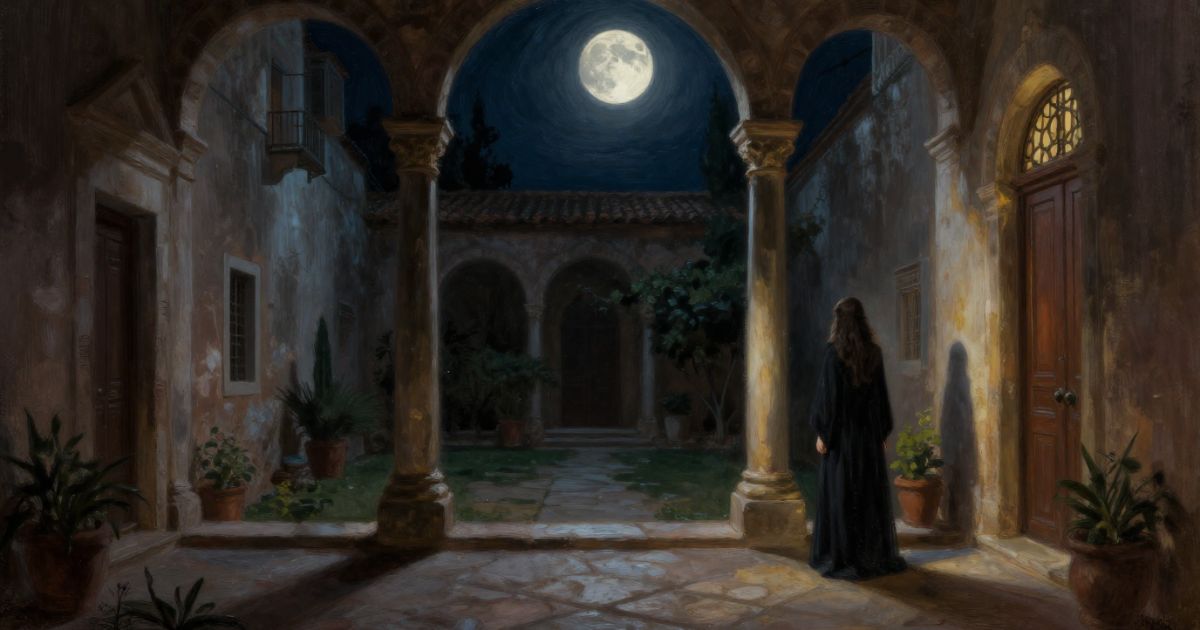
An excerpt from the original text.(complete · 2443 words)
he night grew stormy. The hollow winds swept over the mountains, and
blew bleak and cold around; the clouds were driven swiftly over the
face of the moon, and the duke and his people were frequently involved
in total darkness. They had travelled on silently and dejectedly for
some hours, and were bewildered in the wilds, when they suddenly heard
the bell of a monastery chiming for midnight-prayer. Their hearts
revived at the sound, which they endeavoured to follow, but they had
not gone far, when the gale wafted it away, and they were abandoned to
the uncertain guide of their own conjectures.
They had pursued for some time the way which they judged led to the
monastery, when the note of the bell returned upon the wind, and
discovered to them that they had mistaken their route. After much
wandering and difficulty they arrived, overcome with weariness, at the
gates of a large and gloomy fabric. The bell had ceased, and all was
still. By the moonlight, which through broken clouds now streamed upon
the building, they became convinced it was the monastery they had
sought, and the duke himself struck loudly upon the gate.
Several minutes elapsed, no person appeared, and he repeated the
stroke. A step was presently heard within, the gate was unbarred, and
a thin shivering figure presented itself. The duke solicited
admission, but was refused, and reprimanded for disturbing the convent
at the hour sacred to prayer. He then made known his rank, and bade
the friar inform the Superior that he requested shelter from the
night. The friar, suspicious of deceit, and apprehensive of robbers,
refused with much firmness, and repeated that the convent was engaged
in prayer; he had almost closed the gate, when the duke, whom hunger
and fatigue made desperate, rushed by him, and passed into the court.
It was his intention to present himself to the Superior, and he had
not proceeded far when the sound of laughter, and of many voices in
loud and mirthful jollity, attracted his steps. It led him through
several passages to a door, through the crevices of which light
appeared. He paused a moment, and heard within a wild uproar of
merriment and song. He was struck with astonishment, and could
scarcely credit his senses!
He unclosed the door, and beheld in a large room, well lighted, a
company of friars, dressed in the habit of their order, placed round a
table, which was profusely spread with wines and fruits. The Superior,
whose habit distinguished him from his associates, appeared at the
head of the table. He was lifting a large goblet of wine to his lips,
and was roaring out, 'Profusion and confusion,' at the moment when the
duke entered. His appearance caused a general alarm; that part of the
company who were not too much intoxicated, arose from their seats; and
the Superior, dropping the goblet from his hands, endeavoured to
assume a look of austerity, which his rosy countenance belied. The
duke received a reprimand, delivered in the lisping accents of
intoxication, and embellished with frequent interjections of hiccup.
He made known his quality, his distress, and solicited a night's
lodging for himself and his people. When the Superior understood the
distinction of his guest, his features relaxed into a smile of joyous
welcome; and taking him by the hand, he placed him by his side.
The table was quickly covered with luxurious provisions, and orders
were given that the duke's people should be admitted, and taken care
of. He was regaled with a variety of the finest wines, and at length,
highly elevated by monastic hospitality, he retired to the apartment
allotted him, leaving the Superior in a condition which precluded all
ceremony.
He departed in the morning, very well pleased with the accommodating
principles of monastic religion. He had been told that the enjoyment
of the good things of this life was the surest sign of our gratitude
to Heaven; and it appeared, that within the walls of a Sicilian
monastery, the precept and the practice were equally enforced.
He was now at a loss what course to chuse, for he had no clue to
direct him towards the object of his pursuit; but hope still
invigorated, and urged him to perseverance. He was not many leagues
from the coast; and it occurred to him that the fugitives might make
towards it with a design of escaping into Italy. He therefore
determined to travel towards the sea and proceed along the shore.
At the house where he stopped to dine, he learned that two persons,
such as he described, had halted there about an hour before his
arrival, and had set off again in much seeming haste. They had taken
the road towards the coast, whence it was obvious to the duke they
designed to embark. He stayed not to finish the repast set before
him, but instantly remounted to continue the pursuit.
To the enquiries he made of the persons he chanced to meet, favorable
answers were returned for a time, but he was at length bewildered in
uncertainity, and travelled for some hours in a direction which
chance, rather than judgment, prompted him to take.
The falling evening again confused his prospects, and unsettled his
hopes. The shades were deepened by thick and heavy clouds that
enveloped the horizon, and the deep sounding air foretold a tempest.
The thunder now rolled at a distance, and the accumulated clouds grew
darker. The duke and his people were on a wild and dreary heath, round
which they looked in vain for shelter, the view being terminated on
all sides by the same desolate scene. They rode, however, as hard as
their horses would carry them; and at length one of the attendants
spied on the skirts of the waste a large mansion, towards which they
immediately directed their course.
They were overtaken by the storm, and at the moment when they reached
the building, a peal of thunder, which seemed to shake the pile, burst
over their heads. They now found themselves in a large and ancient
mansion, which seemed totally deserted, and was falling to decay. The
edifice was distinguished by an air of magnificence, which ill
accorded with the surrounding scenery, and which excited some degree
of surprize in the mind of the duke, who, however, fully justified the
owner in forsaking a spot which presented to the eye only views of
rude and desolated nature.
The storm increased with much violence, and threatened to detain the
duke a prisoner in his present habitation for the night. The hall, of
which he and his people had taken possession, exhibited in every
feature marks of ruin and desolation. The marble pavement was in many
places broken, the walls were mouldering in decay, and round the high
and shattered windows the long grass waved to the lonely gale.
Curiosity led him to explore the recesses of the mansion. He quitted
the hall, and entered upon a passage which conducted him to a remote
part of the edifice. He wandered through the wild and spacious
apartments in gloomy meditation, and often paused in wonder at the
remains of magnificence which he beheld.
The mansion was irregular and vast, and he was bewildered in its
intricacies. In endeavouring to find his way back, he only perplexed
himself more, till at length he arrived at a door, which he believed
led into the hall he first quitted. On opening it he discovered, by
the faint light of the moon, a large place which he scarcely knew
whether to think a cloister, a chapel, or a hall. It retired in long
perspective, in arches, and terminated in a large iron gate, through
which appeared the open country.
The lighting flashed thick and blue around, which, together with the
thunder that seemed to rend the wide arch of heaven, and the
melancholy aspect of the place, so awed the duke, that he
involuntarily called to his people. His voice was answered only by the
deep echoes which ran in murmurs through the place, and died away at a
distance; and the moon now sinking behind a cloud, left him in total
darkness.
He repeated the call more loudly, and at length heard the approach of
footsteps. A few moments relieved him from his anxiety, for his people
appeared. The storm was yet loud, and the heavy and sulphureous
appearance of the atmosphere promised no speedy abatement of it. The
duke endeavoured to reconcile himself to pass the night in his present
situation, and ordered a fire to be lighted in the place he was in.
This with much difficulty was accomplished. He then threw himself on
the pavement before it, and tried to endure the abstinence which he
had so ill observed in the monastery on the preceding night. But to
his great joy his attendants, more provident than himself, had not
scrupled to accept a comfortable quantity of provisions which had been
offered them at the monastery; and which they now drew forth from a
wallet. They were spread upon the pavement; and the duke, after
refreshing himself, delivered up the remains to his people. Having
ordered them to watch by turns at the gate, he wrapt his cloak round
him, and resigned himself to repose.
The night passed without any disturbance. The morning arose fresh and
bright; the Heavens exhibited a clear and unclouded concave; even the
wild heath, refreshed by the late rains, smiled around, and sent up
with the morning gale a stream of fragrance.
The duke quitted the mansion, re-animated by the cheerfulness of morn,
and pursued his journey. He could gain no intelligence of the
fugitives. About noon he found himself in a beautiful romantic
country; and having reached the summit of some wild cliffs, he rested,
to view the picturesque imagery of the scene below. A shadowy
sequestered dell appeared buried deep among the rocks, and in the
bottom was seen a lake, whose clear bosom reflected the impending
cliffs, and the beautiful luxuriance of the overhanging shades.
But his attention was quickly called from the beauties of inanimate
nature, to objects more interesting; for he observed two persons, whom
he instantly recollected to be the same that he had formerly pursued
over the plains. They were seated on the margin of the lake, under the
shade of some high trees at the foot of the rocks, and seemed
partaking of a repast which was spread upon the grass. Two horses were
grazing near. In the lady the duke saw the very air and shape of
Julia, and his heart bounded at the sight. They were seated with
their backs to the cliffs upon which the duke stood, and he therefore
surveyed them unobserved. They were now almost within his power, but
the difficulty was how to descend the rocks, whose stupendous heights
and craggy steeps seemed to render them impassable. He examined them
with a scrutinizing eye, and at length espied, where the rock receded,
a narrow winding sort of path. He dismounted, and some of his
attendants doing the same, followed their lord down the cliffs,
treading lightly, lest their steps should betray them. Immediately
upon their reaching the bottom, they were perceived by the lady, who
fled among the rocks, and was presently pursued by the duke's people.
The cavalier had no time to escape, but drew his sword, and defended
himself against the furious assault of the duke.
The combat was sustained with much vigour and dexterity on both sides
for some minutes, when the duke received the point of his adversary's
sword, and fell. The cavalier, endeavouring to escape, was seized by
the duke's people, who now appeared with the fair fugitive; but what
was the disappointment--the rage of the duke, when in the person of
the lady he discovered a stranger! The astonishment was mutual, but
the accompanying feelings were, in the different persons, of a very
opposite nature. In the duke, astonishment was heightened by vexation,
and embittered by disappointment:--in the lady, it was softened by the
joy of unexpected deliverance.
This lady was the younger daughter of a Sicilian nobleman, whose
avarice, or necessities, had devoted her to a convent. To avoid the
threatened fate, she fled with the lover to whom her affections had
long been engaged, and whose only fault, even in the eye of her
father, was inferiority of birth. They were now on their way to the
coast, whence they designed to pass over to Italy, where the church
would confirm the bonds which their hearts had already formed. There
the friends of the cavalier resided, and with them they expected to
find a secure retreat.
The duke, who was not materially wounded, after the first transport of
his rage had subsided, suffered them to depart. Relieved from their
fears, they joyfully set forward, leaving their late pursuer to the
anguish of defeat, and fruitless endeavour. He was remounted on his
horse; and having dispatched two of his people in search of a house
where he might obtain some relief, he proceeded slowly on his return
to the castle of Mazzini.
It was not long ere he recollected a circumstance which, in the first
tumult of his disappointment, had escaped him, but which so
essentially affected the whole tenour of his hopes, as to make him
again irresolute how to proceed. He considered that, although these
were the fugitives he had pursued over the plains, they might not be
the same who had been secreted in the cottage, and it was therefore
possible that Julia might have been the person whom they had for some
time followed from thence. This suggestion awakened his hopes, which
were however quickly destroyed; for he remembered that the only
persons who could have satisfied his doubts, were now gone beyond the
power of recall. To pursue Julia, when no traces of her flight
remained, was absurd; and he was, therefore, compelled to return to
the marquis, as ignorant and more hopeless than he had left him. With
much pain he reached the village which his emissaries had discovered,
when fortunately he obtained some medical assistance. Here he was
obliged by indisposition to rest. The anguish of his mind equalled
that of his body. Those impetuous passions which so strongly marked
his nature, were roused and exasperated to a degree that operated
powerfully upon his constitution, and threatened him with the most
alarming consequences. The effect of his wound was heightened by the
agitation of his mind; and a fever, which quickly assumed a very
serious aspect, co-operated to endanger his life.
Master this chapter. Complete your experience
Purchase the complete book to access all chapters and support classic literature
As an Amazon Associate, we earn a small commission from qualifying purchases at no additional cost to you.
Available in paperback, hardcover, and e-book formats
Let's Analyse the Pattern
The more desperately we need something to be true, the more our minds will filter reality to provide false confirmation.
Why This Matters
Connect literature to life
This chapter teaches how to recognize when desperate wanting creates false certainty that blinds us to actual evidence.
Practice This Today
This week, notice when you feel absolutely certain about something you really need to be true—that's your cue to ask someone neutral what they see.
Now let's explore the literary elements.
Key Quotes & Analysis
"Several minutes elapsed, no person appeared, and he repeated the stroke."
Context: The Duke knocking desperately at the monastery gate in the storm
Shows the Duke's persistence even when ignored - he won't take silence for an answer. This moment foreshadows how his refusal to accept rejection will lead to bigger problems. The repeated knocking reveals someone who believes force and persistence will get him what he wants.
In Today's Words:
He kept banging on the door even when nobody answered the first time.
"The bell had ceased, and all was still."
Context: When they arrive at the monastery after following the sound
The silence after the bell represents false hope - they followed what they thought would lead to sanctuary, but found emptiness instead. This mirrors the Duke's entire pursuit of Julia. The stillness suggests death or abandonment of the spiritual ideals the bell represented.
In Today's Words:
The music stopped and everything went quiet - not the good kind of quiet.
"After much wandering and difficulty they arrived, overcome with weariness, at the gates of a large and gloomy fabric."
Context: The Duke's party finally reaching what they hope is shelter
The 'wandering and difficulty' reflects the Duke's entire quest - he's lost, exhausted, but still pushing forward. The 'gloomy fabric' suggests this isn't the salvation he hoped for. Physical weariness mirrors his spiritual and emotional exhaustion, but he can't stop.
In Today's Words:
After getting completely lost and worn out, they finally made it to this big, depressing building.
Thematic Threads
Obsession
In This Chapter
The Duke's relentless pursuit blinds him to reality and leads to violent confrontation with innocent people
Development
Escalated from earlier romantic fixation to dangerous delusion with real victims
In Your Life:
You might recognize this in your own inability to let go of a relationship, job, or goal that's clearly not working.
Social Hypocrisy
In This Chapter
The monks appear pious but are drunk and feasting, showing the gap between public image and private reality
Development
Continues the book's pattern of exposing false appearances across all social classes
In Your Life:
You see this in workplaces where management preaches values they don't practice, or in your own tendency to present a perfect image while struggling privately.
Class Assumptions
In This Chapter
The Duke assumes his noble status gives him the right to pursue and capture others regardless of their wishes
Development
Shows how aristocratic entitlement justifies increasingly violent behavior
In Your Life:
You might catch yourself assuming your position, experience, or education gives you the right to override others' boundaries.
Physical Consequences
In This Chapter
The Duke's fever and illness finally force his body to reflect the chaos his obsession has created in his mind
Development
First time the book shows mental turmoil manifesting as physical breakdown
In Your Life:
You've probably experienced how stress, denial, or obsessive behavior eventually shows up in headaches, insomnia, or illness.
Mistaken Identity
In This Chapter
The Duke's targets turn out to be completely different people fleeing their own oppressive situation
Development
Introduced here as a major plot revelation that undermines everything the Duke believed
In Your Life:
You might recognize this in assumptions you've made about people's motivations, relationships, or situations that turned out to be completely wrong.
You now have the context. Time to form your own thoughts.
Discussion Questions
- 1
What convinced the Duke he had found Julia, and what was the reality of the situation?
analysis • surface - 2
Why did the Duke become so certain he was tracking the right people, despite having limited evidence?
analysis • medium - 3
Where do you see people today becoming absolutely certain about something they desperately want to be true?
application • medium - 4
How would you design a system to check yourself when you're feeling too certain about something important?
application • deep - 5
What does the Duke's physical illness at the end reveal about the connection between our mental state and our body's response to reality?
reflection • deep
Critical Thinking Exercise
Test Your Certainty
Think of something you feel absolutely certain about right now—a relationship, a work situation, a family member's behavior, or a personal goal. Write down three pieces of evidence that support your certainty. Then force yourself to find three pieces of evidence that might contradict it or suggest you could be wrong. Notice how your brain resists this second task.
Consider:
- •Pay attention to how uncomfortable it feels to look for contradicting evidence
- •Notice if you find yourself explaining away evidence that doesn't fit your certainty
- •Consider whether your emotional investment in being right might be affecting what you see
Journaling Prompt
Write about a time when you were absolutely certain about something that turned out to be wrong. What signs did you miss? What would you do differently now?
Coming Up Next...
Chapter 6: Voices from the Depths
As the Duke recovers from his wounds and fever, new developments unfold back at the castle that will change everything. Meanwhile, Julia's true fate begins to reveal itself in ways no one expected.



