
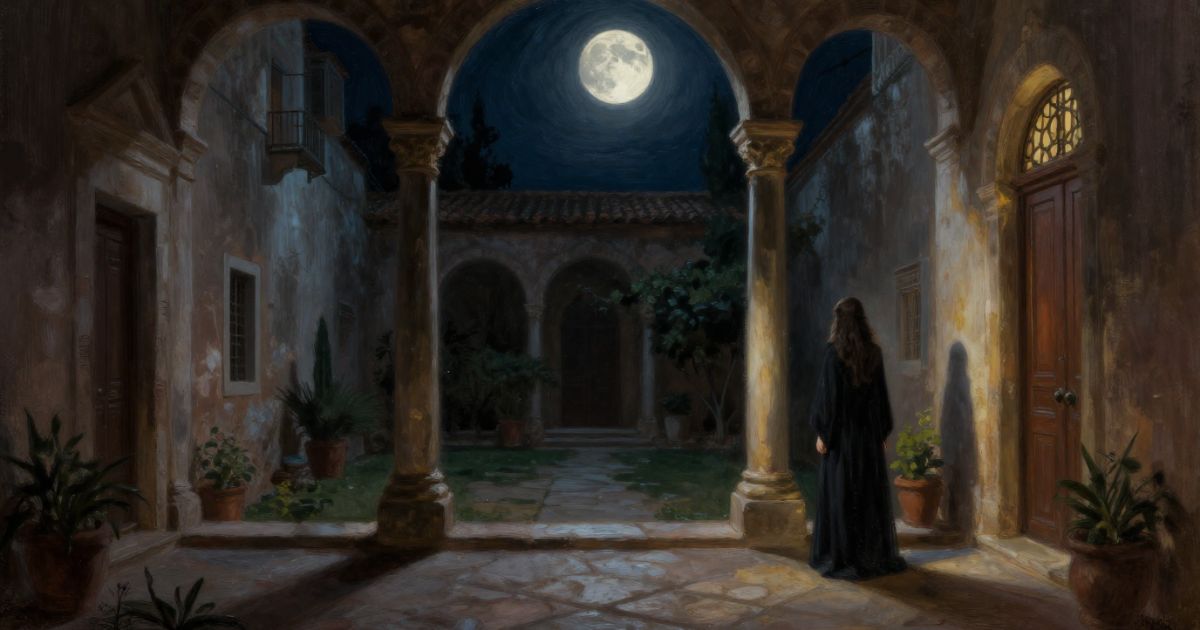
An excerpt from the original text.(complete · 11126 words)
he castle was buried in sleep when Ferdinand again joined his sisters
in madame's apartment. With anxious curiosity they followed him to the
chamber. The room was hung with tapestry. Ferdinand carefully sounded
the wall which communicated with the southern buildings. From one part
of it a sound was returned, which convinced him there was something
less solid than stone. He removed the tapestry, and behind it
appeared, to his inexpressible satisfaction, a small door. With a hand
trembling through eagerness, he undrew the bolts, and was rushing
forward, when he perceived that a lock withheld his passage. The keys
of madame and his sisters were applied in vain, and he was compelled
to submit to disappointment at the very moment when he congratulated
himself on success, for he had with him no means of forcing the door.
He stood gazing on the door, and inwardly lamenting, when a low hollow
sound was heard from beneath. Emilia and Julia seized his arm; and
almost sinking with apprehension, listened in profound silence. A
footstep was distinctly heard, as if passing through the apartment
below, after which all was still. Ferdinand, fired by this
confirmation of the late report, rushed on to the door, and again
tried to burst his way, but it resisted all the efforts of his
strength. The ladies now rejoiced in that circumstance which they so
lately lamented; for the sounds had renewed their terror, and though
the night passed without further disturbance, their fears were very
little abated.
Ferdinand, whose mind was wholly occupied with wonder, could with
difficulty await the return of night. Emilia and Julia were scarcely
less impatient. They counted the minutes as they passed; and when the
family retired to rest, hastened with palpitating hearts to the
apartment of madame. They were soon after joined by Ferdinand, who
brought with him tools for cutting away the lock of the door. They
paused a few moments in the chamber in fearful silence, but no sound
disturbed the stillness of night. Ferdinand applied a knife to the
door, and in a short time separated the lock. The door yielded, and
disclosed a large and gloomy gallery. He took a light. Emilia and
Julia, fearful of remaining in the chamber, resolved to accompany him,
and each seizing an arm of madame, they followed in silence. The
gallery was in many parts falling to decay, the ceiling was broke, and
the window-shutters shattered, which, together with the dampness of
the walls, gave the place an air of wild desolation.
They passed lightly on, for their steps ran in whispering echoes
through the gallery, and often did Julia cast a fearful glance around.
The gallery terminated in a large old stair-case, which led to a hall
below; on the left appeared several doors which seemed to lead to
separate apartments. While they hesitated which course to pursue, a
light flashed faintly up the stair-case, and in a moment after passed
away; at the same time was heard the sound of a distant footstep.
Ferdinand drew his sword and sprang forward; his companions, screaming
with terror, ran back to madame's apartment.
Ferdinand descended a large vaulted hall; he crossed it towards a low
arched door, which was left half open, and through which streamed a
ray of light. The door opened upon a narrow winding passage; he
entered, and the light retiring, was quickly lost in the windings of
the place. Still he went on. The passage grew narrower, and the
frequent fragments of loose stone made it now difficult to proceed. A
low door closed the avenue, resembling that by which he had entered.
He opened it, and discovered a square room, from whence rose a winding
stair-case, which led up the south tower of the castle. Ferdinand
paused to listen; the sound of steps was ceased, and all was
profoundly silent. A door on the right attracted his notice; he tried
to open it, but it was fastened. He concluded, therefore, that the
person, if indeed a human being it was that bore the light he had
seen, had passed up the tower. After a momentary hesitation, he
determined to ascend the stair-case, but its ruinous condition made
this an adventure of some difficulty. The steps were decayed and
broken, and the looseness of the stones rendered a footing very
insecure. Impelled by an irresistible curiosity, he was undismayed,
and began the ascent. He had not proceeded very far, when the stones
of a step which his foot had just quitted, loosened by his weight,
gave way; and dragging with them those adjoining, formed a chasm in
the stair-case that terrified even Ferdinand, who was left tottering
on the suspended half of the steps, in momentary expectation of
falling to the bottom with the stone on which he rested. In the terror
which this occasioned, he attempted to save himself by catching at a
kind of beam which projected over the stairs, when the lamp dropped
from his hand, and he was left in total darkness. Terror now usurped
the place of every other interest, and he was utterly perplexed how to
proceed. He feared to go on, lest the steps above, as infirm as those
below, should yield to his weight;--to return was impracticable, for
the darkness precluded the possibility of discovering a means. He
determined, therefore, to remain in this situation till light should
dawn through the narrow grates in the walls, and enable him to
contrive some method of letting himself down to the ground.
He had remained here above an hour, when he suddenly heard a voice
from below. It seemed to come from the passage leading to the tower,
and perceptibly drew nearer. His agitation was now extreme, for he
had no power of defending himself, and while he remained in this state
of torturing expectation, a blaze of light burst upon the stair-case
beneath him. In the succeeding moment he heard his own name sounded
from below. His apprehensions instantly vanished, for he distinguished
the voices of madame and his sisters.
They had awaited his return in all the horrors of apprehension, till
at length all fear for themselves was lost in their concern for him;
and they, who so lately had not dared to enter this part of the
edifice, now undauntedly searched it in quest of Ferdinand. What were
their emotions when they discovered his perilous situation!
The light now enabled him to take a more accurate survey of the place.
He perceived that some few stones of the steps which had fallen still
remained attached to the wall, but he feared to trust to their support
only. He observed, however, that the wall itself was partly decayed,
and consequently rugged with the corners of half-worn stones. On these
small projections he contrived, with the assistance of the steps
already mentioned, to suspend himself, and at length gained the
unbroken part of the stairs in safety. It is difficult to determine
which individual of the party rejoiced most at this escape. The
morning now dawned, and Ferdinand desisted for the present from
farther enquiry.
The interest which these mysterious circumstances excited in the mind
of Julia, had withdrawn her attention from a subject more dangerous to
its peace. The image of Vereza, notwithstanding, would frequently
intrude upon her fancy; and, awakening the recollection of happy
emotions, would call forth a sigh which all her efforts could not
suppress. She loved to indulge the melancholy of her heart in the
solitude of the woods. One evening she took her lute to a favorite
spot on the seashore, and resigning herself to a pleasing sadness,
touched some sweet and plaintive airs. The purple flush of evening was
diffused over the heavens. The sun, involved in clouds of splendid and
innumerable hues, was setting o'er the distant waters, whose clear
bosom glowed with rich reflection. The beauty of the scene, the
soothing murmur of the high trees, waved by the light air which
overshadowed her, and the soft shelling of the waves that flowed
gently in upon the shores, insensibly sunk her mind into a state of
repose. She touched the chords of her lute in sweet and wild melody,
and sung the following ode:
EVENING
Evening veil'd in dewy shades,
Slowly sinks upon the main;
See th'empurpled glory fades,
Beneath her sober, chasten'd reign.
Around her car the pensive Hours,
In sweet illapses meet the sight,
Crown'd their brows with closing flow'rs
Rich with chrystal dews of night.
Her hands, the dusky hues arrange
O'er the fine tints of parting day;
Insensibly the colours change,
And languish into soft decay.
Wide o'er the waves her shadowy veil she draws.
As faint they die along the distant shores;
Through the still air I mark each solemn pause,
Each rising murmur which the wild wave pours.
A browner shadow spreads upon the air,
And o'er the scene a pensive grandeur throws;
The rocks--the woods a wilder beauty wear,
And the deep wave in softer music flows;
And now the distant view where vision fails,
Twilight and grey obscurity pervade;
Tint following tint each dark'ning object veils,
Till all the landscape sinks into the shade.
Oft from the airy steep of some lone hill,
While sleeps the scene beneath the purple glow:
And evening lives o'er all serene and still,
Wrapt let me view the magic world below!
And catch the dying gale that swells remote,
That steals the sweetness from the shepherd's flute:
The distant torrent's melancholy note
And the soft warblings of the lover's lute.
Still through the deep'ning gloom of bow'ry shades
To Fancy's eye fantastic forms appear;
Low whisp'ring echoes steal along the glades
And thrill the ear with wildly-pleasing fear.
Parent of shades!--of silence!--dewy airs!
Of solemn musing, and of vision wild!
To thee my soul her pensive tribute bears,
And hails thy gradual step, thy influence mild.
Having ceased to sing, her fingers wandered over the lute in
melancholy symphony, and for some moments she remained lost in the
sweet sensations which the music and the scenery had inspired. She was
awakened from her reverie, by a sigh that stole from among the trees,
and directing her eyes whence it came, beheld--Hippolitus! A thousand
sweet and mingled emotions pressed upon her heart, yet she scarcely
dared to trust the evidence of sight. He advanced, and throwing
himself at her feet: 'Suffer me,' said he, in a tremulous voice, 'to
disclose to you the sentiments which you have inspired, and to offer
you the effusions of a heart filled only with love and admiration.'
'Rise, my lord,' said Julia, moving from her seat with an air of
dignity, 'that attitude is neither becoming you to use, or me to
suffer. The evening is closing, and Ferdinand will be impatient to see
you.'
'Never will I rise, madam,' replied the count, with an impassioned
air, 'till'--He was interrupted by the marchioness, who at this moment
entered the grove. On observing the position of the count she was
retiring. 'Stay, madam,' said Julia, almost sinking under her
confusion. 'By no means,' replied the marchioness, in a tone of irony,
'my presence would only interrupt a very agreeable scene. The count, I
see, is willing to pay you his earliest respects.' Saying this she
disappeared, leaving Julia distressed and offended, and the count
provoked at the intrusion. He attempted to renew the subject, but
Julia hastily followed the steps of the marchioness, and entered the
castle.
The scene she had witnessed, raised in the marchioness a tumult of
dreadful emotions. Love, hatred, and jealousy, raged by turns in her
heart, and defied all power of controul. Subjected to their alternate
violence, she experienced a misery more acute than any she had yet
known. Her imagination, invigorated by opposition, heightened to her
the graces of Hippolitus; her bosom glowed with more intense passion,
and her brain was at length exasperated almost to madness.
In Julia this sudden and unexpected interview excited a mingled
emotion of love and vexation, which did not soon subside. At length,
however, the delightful consciousness of Vereza's love bore her high
above every other sensation; again the scene more brightly glowed, and
again her fancy overcame the possibility of evil.
During the evening a tender and timid respect distinguished the
behaviour of the count towards Julia, who, contented with the
certainty of being loved, resolved to conceal her sentiments till an
explanation of his abrupt departure from Mazzini, and subsequent
absence, should have dissipated the shadow of mystery which hung over
this part of his conduct. She observed that the marchioness pursued
her with steady and constant observation, and she carefully avoided
affording the count an opportunity of renewing the subject of the
preceding interview, which, whenever he approached her, seemed to
tremble on his lips.
Night returned, and Ferdinand repaired to the chamber of Julia to
pursue his enquiry. Here he had not long remained, when the strange
and alarming sounds which had been heard on the preceding night were
repeated. The circumstance that now sunk in terror the minds of Emilia
and Julia, fired with new wonder that of Ferdinand, who seizing a
light, darted through the discovered door, and almost instantly
disappeared.
He descended into the same wild hall he had passed on the preceding
night. He had scarcely reached the bottom of the stair-case, when a
feeble light gleamed across the hall, and his eye caught the glimpse
of a figure retiring through the low arched door which led to the
south tower. He drew his sword and rushed on. A faint sound died away
along the passage, the windings of which prevented his seeing the
figure he pursued. Of this, indeed, he had obtained so slight a view,
that he scarcely knew whether it bore the impression of a human form.
The light quickly disappeared, and he heard the door that opened upon
the tower suddenly close. He reached it, and forcing it open, sprang
forward; but the place was dark and solitary, and there was no
appearance of any person having passed along it. He looked up the
tower, and the chasm which the stair-case exhibited, convinced him
that no human being could have passed up. He stood silent and amazed;
examining the place with an eye of strict enquiry, he perceived a
door, which was partly concealed by hanging stairs, and which till now
had escaped his notice. Hope invigorated curiosity, but his
expectation was quickly disappointed, for this door also was fastened.
He tried in vain to force it. He knocked, and a hollow sullen sound
ran in echoes through the place, and died away at a distance. It was
evident that beyond this door were chambers of considerable extent,
but after long and various attempts to reach them, he was obliged to
desist, and he quitted the tower as ignorant and more dissatisfied
than he had entered it. He returned to the hall, which he now for the
first time deliberately surveyed. It was a spacious and desolate
apartment, whose lofty roof rose into arches supported by pillars of
black marble. The same substance inlaid the floor, and formed the
stair-case. The windows were high and gothic. An air of proud
sublimity, united with singular wildness, characterized the place, at
the extremity of which arose several gothic arches, whose dark shade
veiled in obscurity the extent beyond. On the left hand appeared two
doors, each of which was fastened, and on the right the grand entrance
from the courts. Ferdinand determined to explore the dark recess which
terminated his view, and as he traversed the hall, his imagination,
affected by the surrounding scene, often multiplied the echoes of his
footsteps into uncertain sounds of strange and fearful import.
He reached the arches, and discovered beyond a kind of inner hall, of
considerable extent, which was closed at the farther end by a pair of
massy folding-doors, heavily ornamented with carving. They were
fastened by a lock, and defied his utmost strength.
As he surveyed the place in silent wonder, a sullen groan arose from
beneath the spot where he stood. His blood ran cold at the sound, but
silence returning, and continuing unbroken, he attributed his alarm to
the illusion of a fancy, which terror had impregnated. He made another
effort to force the door, when a groan was repeated more hollow, and
more dreadful than the first. At this moment all his courage forsook
him; he quitted the door, and hastened to the stair-case, which he
ascended almost breathless with terror.
He found Madame de Menon and his sisters awaiting his return in the
most painful anxiety; and, thus disappointed in all his endeavours to
penetrate the secret of these buildings, and fatigued with fruitless
search, he resolved to suspend farther enquiry.
When he related the circumstances of his late adventure, the terror of
Emilia and Julia was heightened to a degree that overcame every
prudent consideration. Their apprehension of the marquis's displeasure
was lost in a stronger feeling, and they resolved no longer to remain
in apartments which offered only terrific images to their fancy.
Madame de Menon almost equally alarmed, and more perplexed, by this
combination of strange and unaccountable circumstances, ceased to
oppose their design. It was resolved, therefore, that on the following
day madame should acquaint the marchioness with such particulars of
the late occurrence as their purpose made it necessary she should
know, concealing their knowledge of the hidden door, and the incidents
immediately dependant on it; and that madame should entreat a change
of apartments.
Madame accordingly waited on the marchioness. The marchioness having
listened to the account at first with surprise, and afterwards with
indifference, condescended to reprove madame for encouraging
superstitious belief in the minds of her young charge. She concluded
with ridiculing as fanciful the circumstances related, and with
refusing, on account of the numerous visitants at the castle, the
request preferred to her.
It is true the castle was crowded with visitors; the former apartments
of Madame de Menon were the only ones unoccupied, and these were in
magnificent preparation for the pleasure of the marchioness, who was
unaccustomed to sacrifice her own wishes to the comfort of those
around her. She therefore treated lightly the subject, which,
seriously attended to, would have endangered her new plan of delight.
But Emilia and Julia were too seriously terrified to obey the scruples
of delicacy, or to be easily repulsed. They prevailed on Ferdinand to
represent their situation to the marquis.
Meanwhile Hippolitus, who had passed the night in a state of sleepless
anxiety, watched, with busy impatience, an opportunity of more fully
disclosing to Julia the passion which glowed in his heart. The first
moment in which he beheld her, had awakened in him an admiration which
had since ripened into a sentiment more tender. He had been prevented
formally declaring his passion by the circumstance which so suddenly
called him to Naples. This was the dangerous illness of the Marquis de
Lomelli, his near and much-valued relation. But it was a task too
painful to depart in silence, and he contrived to inform Julia of his
sentiments in the air which she heard so sweetly sung beneath her
window.
When Hippolitus reached Naples, the marquis was yet living, but
expired a few days after his arrival, leaving the count heir to the
small possessions which remained from the extravagance of their
ancestors.
The business of adjusting his rights had till now detained him from
Sicily, whither he came for the sole purpose of declaring his love.
Here unexpected obstacles awaited him. The jealous vigilance of the
marchioness conspired with the delicacy of Julia, to withhold from him
the opportunity he so anxiously sought.
When Ferdinand entered upon the subject of the southern buildings to
the marquis, he carefully avoided mentioning the hidden door. The
marquis listened for some time to the relation in gloomy silence, but
at length assuming an air of displeasure, reprehended Ferdinand for
yielding his confidence to those idle alarms, which he said were the
suggestions of a timid imagination. 'Alarms,' continued he, 'which
will readily find admittance to the weak mind of a woman, but which
the firmer nature of man should disdain.--Degenerate boy! Is it thus
you reward my care? Do I live to see my son the sport of every idle
tale a woman may repeat? Learn to trust reason and your senses, and
you will then be worthy of my attention.'
The marquis was retiring, and Ferdinand now perceived it necessary to
declare, that he had himself witnessed the sounds he mentioned.
'Pardon me, my lord,' said he, 'in the late instance I have been just
to your command--my senses have been the only evidences I have
trusted. I have heard those sounds which I cannot doubt.' The marquis
appeared shocked. Ferdinand perceived the change, and urged the
subject so vigorously, that the marquis, suddenly assuming a look of
grave importance, commanded him to attend him in the evening in his
closet.
Ferdinand in passing from the marquis met Hippolitus. He was pacing
the gallery in much seeming agitation, but observing Ferdinand, he
advanced to him. 'I am ill at heart,' said he, in a melancholy tone,
'assist me with your advice. We will step into this apartment, where
we can converse without interruption.'
'You are not ignorant,' said he, throwing himself into a chair, 'of
the tender sentiments which your sister Julia has inspired. I entreat
you by that sacred friendship which has so long united us, to afford
me an opportunity of pleading my passion. Her heart, which is so
susceptible of other impressions, is, I fear, insensible to love.
Procure me, however, the satisfaction of certainty upon a point where
the tortures of suspence are surely the most intolerable.'
'Your penetration,' replied Ferdinand, 'has for once forsaken you,
else you would now be spared the tortures of which you complain, for
you would have discovered what I have long observed, that Julia
regards you with a partial eye.'
'Do not,' said Hippolitus, 'make disappointment more terrible by
flattery; neither suffer the partiality of friendship to mislead your
judgment. Your perceptions are affected by the warmth of your
feelings, and because you think I deserve her distinction, you believe
I possess it. Alas! you deceive yourself, but not me!'
'The very reverse,' replied Ferdinand; 'tis you who deceive yourself,
or rather it is the delicacy of the passion which animates you, and
which will ever operate against your clear perception of a truth in
which your happiness is so deeply involved. Believe me, I speak not
without reason:--she loves you.'
At these words Hippolitus started from his seat, and clasping his
hands in fervent joy, 'Enchanting sounds!' cried he, in a voice
tenderly impassioned; 'could I but believe ye!--could I but
believe ye-this world were paradise!'
During this exclamation, the emotions of Julia, who sat in her closet
adjoining, can with difficulty be imagined. A door which opened into
it from the apartment where this conversation was held, was only half
closed. Agitated with the pleasure this declaration excited, she yet
trembled with apprehension lest she should be discovered. She hardly
dared to breathe, much less to move across the closet to the door,
which opened upon the gallery, whence she might probably have escaped
unnoticed, lest the sound of her step should betray her. Compelled,
therefore, to remain where she was, she sat in a state of fearful
distress, which no colour of language can paint.
'Alas!' resumed Hippolitus, 'I too eagerly admit the possibility of
what I wish. If you mean that I should really believe you, confirm
your assertion by some proof.'--'Readily,' rejoined Ferdinand.
The heart of Julia beat quick.
'When you was so suddenly called to Naples upon the illness of the
Marquis Lomelli, I marked her conduct well, and in that read the
sentiments of her heart. On the following morning, I observed in her
countenance a restless anxiety which I had never seen before. She
watched the entrance of every person with an eager expectation, which
was as often succeeded by evident disappointment. At dinner your
departure was mentioned:--she spilt the wine she was carrying to her
lips, and for the remainder of the day was spiritless and melancholy.
I saw her ineffectual struggles to conceal the oppression at her
heart. Since that time she has seized every opportunity of
withdrawing from company. The gaiety with which she was so lately
charmed--charmed her no longer; she became pensive, retired, and I
have often heard her singing in some lonely spot, the most moving and
tender airs. Your return produced a visible and instantaneous
alteration; she has now resumed her gaiety; and the soft confusion of
her countenance, whenever you approach, might alone suffice to
convince you of the truth of my assertion.'
'O! talk for ever thus!' sighed Hippolitus. 'These words are so sweet,
so soothing to my soul, that I could listen till I forgot I had a wish
beyond them. Yes!--Ferdinand, these circumstances are not to be
doubted, and conviction opens upon my mind a flow of extacy I never
knew till now. O! lead me to her, that I may speak the sentiments
which swell my heart.'
They arose, when Julia, who with difficulty had supported herself, now
impelled by an irresistible fear of instant discovery, rose also, and
moved softly towards the gallery. The sound of her step alarmed the
count, who, apprehensive lest his conversation had been overheard, was
anxious to be satisfied whether any person was in the closet. He
rushed in, and discovered Julia! She caught at a chair to support her
trembling frame; and overwhelmed with mortifying sensations, sunk into
it, and hid her face in her robe. Hippolitus threw himself at her
feet, and seizing her hand, pressed it to his lips in expressive
silence. Some moments passed before the confusion of either would
suffer them to speak. At length recovering his voice, 'Can you,
madam,' said he, 'forgive this intrusion, so unintentional? or will it
deprive me of that esteem which I have but lately ventured to believe
I possessed, and which I value more than existence itself. O! speak my
pardon! Let me not believe that a single accident has destroyed my
peace for ever.'--'If your peace, sir, depends upon a knowledge of my
esteem,' said Julia, in a tremulous voice, 'that peace is already
secure. If I wished even to deny the partiality I feel, it would now
be useless; and since I no longer wish this, it would also be
painful.' Hippolitus could only weep his thanks over the hand he still
held. 'Be sensible, however, of the delicacy of my situation,'
continued she, rising, 'and suffer me to withdraw.' Saying this she
quitted the closet, leaving Hippolitus overcome with this sweet
confirmation of his wishes, and Ferdinand not yet recovered from the
painful surprize which the discovery of Julia had excited. He was
deeply sensible of the confusion he had occasioned her, and knew that
apologies would not restore the composure he had so cruelly yet
unwarily disturbed.
Ferdinand awaited the hour appointed by the marquis in impatient
curiosity. The solemn air which the marquis assumed when he commanded
him to attend, had deeply impressed his mind. As the time drew nigh,
expectation increased, and every moment seemed to linger into hours.
At length he repaired to the closet, where he did not remain long
before the marquis entered. The same chilling solemnity marked his
manner. He locked the door of the closet, and seating himself,
addressed Ferdinand as follows:--
'I am now going to repose in you a confidence which will severely
prove the strength of your honour. But before I disclose a secret,
hitherto so carefully concealed, and now reluctantly told, you must
swear to preserve on this subject an eternal silence. If you doubt the
steadiness of your discretion--now declare it, and save yourself from
the infamy, and the fatal consequences, which may attend a breach of
your oath;--if, on the contrary, you believe yourself capable of a
strict integrity--now accept the terms, and receive the secret I
offer.' Ferdinand was awed by this exordium--the impatience of
curiosity was for a while suspended, and he hesitated whether he
should receive the secret upon such terms. At length he signified his
consent, and the marquis arising, drew his sword from the
scabbard.--'Here,' said he, offering it to Ferdinand, 'seal your
vows--swear by this sacred pledge of honor never to repeat what I
shall now reveal.' Ferdinand vowed upon the sword, and raising his
eyes to heaven, solemnly swore. The marquis then resumed his seat, and
proceeded.
'You are now to learn that, about a century ago, this castle was in
the possession of Vincent, third marquis of Mazzini, my grandfather.
At that time there existed an inveterate hatred between our family and
that of della Campo. I shall not now revert to the origin of the
animosity, or relate the particulars of the consequent feuds--suffice
it to observe, that by the power of our family, the della Campos were
unable to preserve their former consequence in Sicily, and they have
therefore quitted it for a foreign land to live in unmolested
security. To return to my subject.--My grandfather, believing his life
endangered by his enemy, planted spies upon him. He employed some of
the numerous banditti who sought protection in his service, and after
some weeks past in waiting for an opportunity, they seized Henry della
Campo, and brought him secretly to this castle. He was for some time
confined in a close chamber of the southern buildings, where he
expired; by what means I shall forbear to mention. The plan had been
so well conducted, and the secrecy so strictly preserved, that every
endeavour of his family to trace the means of his disappearance proved
ineffectual. Their conjectures, if they fell upon our family, were
supported by no proof; and the della Campos are to this day ignorant
of the mode of his death. A rumour had prevailed long before the death
of my father, that the southern buildings of the castle were haunted.
I disbelieved the fact, and treated it accordingly. One night, when
every human being of the castle, except myself, was retired to rest, I
had such strong and dreadful proofs of the general assertion, that
even at this moment I cannot recollect them without horror. Let me, if
possible, forget them. From that moment I forsook those buildings;
they have ever since been shut up, and the circumstance I have
mentioned, is the true reason why I have resided so little at the
castle.'
Ferdinand listened to this narrative in silent horror. He remembered
the temerity with which he had dared to penetrate those
apartments--the light, and figure he had seen--and, above all, his
situation in the stair-case of the tower. Every nerve thrilled at the
recollection; and the terrors of remembrance almost equalled those of
reality.
The marquis permitted his daughters to change their apartments, but he
commanded Ferdinand to tell them, that, in granting their request, he
consulted their ease only, and was himself by no means convinced of
its propriety. They were accordingly reinstated in their former
chambers, and the great room only of madame's apartments was reserved
for the marchioness, who expressed her discontent to the marquis in
terms of mingled censure and lamentation. The marquis privately
reproved his daughters, for what he termed the idle fancies of a weak
mind; and desired them no more to disturb the peace of the castle with
the subject of their late fears. They received this reproof with
silent submission--too much pleased with the success of their suit to
be susceptible of any emotion but joy.
Ferdinand, reflecting on the late discovery, was shocked to learn,
what was now forced upon his belief, that he was the descendant of a
murderer. He now knew that innocent blood had been shed in the castle,
and that the walls were still the haunt of an unquiet spirit, which
seemed to call aloud for retribution on the posterity of him who had
disturbed its eternal rest. Hippolitus perceived his dejection, and
entreated that he might participate his uneasiness; but Ferdinand, who
had hitherto been frank and ingenuous, was now inflexibly reserved.
'Forbear,' said he, 'to urge a discovery of what I am not permitted to
reveal; this is the only point upon which I conjure you to be silent,
and this even to you, I cannot explain.' Hippolitus was surprized, but
pressed the subject no farther.
Julia, though she had been extremely mortified by the circumstances
attendant on the discovery of her sentiments to Hippolitus,
experienced, after the first shock had subsided, an emotion more
pleasing than painful. The late conversation had painted in strong
colours the attachment of her lover. His diffidence--his slowness to
perceive the effect of his merit--his succeeding rapture, when
conviction was at length forced upon his mind; and his conduct upon
discovering Julia, proved to her at once the delicacy and the strength
of his passion, and she yielded her heart to sensations of pure and
unmixed delight. She was roused from this state of visionary
happiness, by a summons from the marquis to attend him in the library.
A circumstance so unusual surprized her, and she obeyed with trembling
curiosity. She found him pacing the room in deep thought, and she had
shut the door before he perceived her. The authoritative severity in
his countenance alarmed her, and prepared her for a subject of
importance. He seated himself by her, and continued a moment silent.
At length, steadily observing her, 'I sent for you, my child,' said
he, 'to declare the honor which awaits you. The Duke de Luovo has
solicited your hand. An alliance so splendid was beyond my
expectation. You will receive the distinction with the gratitude it
claims, and prepare for the celebration of the nuptials.'
This speech fell like the dart of death upon the heart of Julia. She
sat motionless--stupified and deprived of the power of utterance. The
marquis observed her consternation; and mistaking its cause, 'I
acknowledge,' said he, 'that there is somewhat abrupt in this affair;
but the joy occasioned by a distinction so unmerited on your part,
ought to overcome the little feminine weakness you might otherwise
indulge. Retire and compose yourself; and observe,' continued he, in a
stern voice, 'this is no time for finesse.' These words roused Julia
from her state of horrid stupefaction. 'O! sir,' said she, throwing
herself at his feet, 'forbear to enforce authority upon a point where
to obey you would be worse than death; if, indeed, to obey you were
possible.'--'Cease,' said the marquis, 'this affectation, and practice
what becomes you.'--'Pardon me, my lord,' she replied, 'my distress
is, alas! unfeigned. I cannot love the duke.'--'Away!' interrupted the
marquis, 'nor tempt my rage with objections thus childish and
absurd.'--'Yet hear me, my lord,' said Julia, tears swelling in her
eyes, 'and pity the sufferings of a child, who never till this moment
has dared to dispute your commands.'
'Nor shall she now,' said the marquis. 'What--when wealth, honor, and
distinction, are laid at my feet, shall they be refused, because a
foolish girl--a very baby, who knows not good from evil, cries, and
says she cannot love! Let me not think of it--My just anger may,
perhaps, out-run discretion, and tempt me to chastise your
folly.--Attend to what I say--accept the duke, or quit this castle for
ever, and wander where you will.' Saying this, he burst away, and
Julia, who had hung weeping upon his knees, fell prostrate upon the
floor. The violence of the fall completed the effect of her distress,
and she fainted. In this state she remained a considerable time. When
she recovered her senses, the recollection of her calamity burst upon
her mind with a force that almost again overwhelmed her. She at length
raised herself from the ground, and moved towards her own apartment,
but had scarcely reached the great gallery, when Hippolitus entered
it. Her trembling limbs would no longer support her; she caught at a
bannister to save herself; and Hippolitus, with all his speed, was
scarcely in time to prevent her falling. The pale distress exhibited
in her countenance terrified him, and he anxiously enquired concerning
it. She could answer him only with her tears, which she found it
impossible to suppress; and gently disengaging herself, tottered to
her closet. Hippolitus followed her to the door, but desisted from
further importunity. He pressed her hand to his lips in tender
silence, and withdrew, surprized and alarmed.
Julia, resigning herself to despair, indulged in solitude the excess
of her grief. A calamity, so dreadful as the present, had never before
presented itself to her imagination. The union proposed would have
been hateful to her, even if she had no prior attachment; what then
must have been her distress, when she had given her heart to him who
deserved all her admiration, and returned all her affection.
The Duke de Luovo was of a character very similar to that of the
marquis. The love of power was his ruling passion;--with him no gentle
or generous sentiment meliorated the harshness of authority, or
directed it to acts of beneficence. He delighted in simple undisguised
tyranny. He had been twice married, and the unfortunate women
subjected to his power, had fallen victims to the slow but corroding
hand of sorrow. He had one son, who some years before had escaped the
tyranny of his father, and had not been since heard of. At the late
festival the duke had seen Julia; and her beauty made so strong an
impression upon him, that he had been induced now to solicit her hand.
The marquis, delighted with the prospect of a connection so flattering
to his favorite passion, readily granted his consent, and immediately
sealed it with a promise.
Julia remained for the rest of the day shut up in her closet, where
the tender efforts of Madame and Emilia were exerted to soften her
distress. Towards the close of evening Ferdinand entered. Hippolitus,
shocked at her absence, had requested him to visit her, to alleviate
her affliction, and, if possible, to discover its cause. Ferdinand,
who tenderly loved his sister, was alarmed by the words of Hippolitus,
and immediately sought her. Her eyes were swelled with weeping, and
her countenance was but too expressive of the state of her mind.
Ferdinand's distress, when told of his father's conduct, was scarcely
less than her own. He had pleased himself with the hope of uniting the
sister of his heart with the friend whom he loved. An act of cruel
authority now dissolved the fairy dream of happiness which his fancy
had formed, and destroyed the peace of those most dear to him. He sat
for a long time silent and dejected; at length, starting from his
melancholy reverie, he bad Julia good-night, and returned to
Hippolitus, who was waiting for him with anxious impatience in the
north hall.
Ferdinand dreaded the effect of that despair, which the intelligence
he had to communicate would produce in the mind of Hippolitus. He
revolved some means of softening the dreadful truth; but Hippolitus,
quick to apprehend the evil which love taught him to fear, seized at
once upon the reality. 'Tell me all,' said he, in a tone of assumed
firmness. 'I am prepared for the worst.' Ferdinand related the decree
of the marquis, and Hippolitus soon sunk into an excess of grief which
defied, as much as it required, the powers of alleviation.
Julia, at length, retired to her chamber, but the sorrow which
occupied her mind withheld the blessings of sleep. Distracted and
restless she arose, and gently opened the window of her apartment. The
night was still, and not a breath disturbed the surface of the waters.
The moon shed a mild radiance over the waves, which in gentle
undulations flowed upon the sands. The scene insensibly tranquilized
her spirits. A tender and pleasing melancholy diffused itself over her
mind; and as she mused, she heard the dashing of distant oars.
Presently she perceived upon the light surface of the sea a small
boat. The sound of the oars ceased, and a solemn strain of harmony
(such as fancy wafts from the abodes of the blessed) stole upon the
silence of night. A chorus of voices now swelled upon the air, and
died away at a distance. In the strain Julia recollected the midnight
hymn to the virgin, and holy enthusiasm filled her heart. The chorus
was repeated, accompanied by a solemn striking of oars. A sigh of
exstacy stole from her bosom. Silence returned. The divine melody she
had heard calmed the tumult of her mind, and she sunk in sweet repose.
She arose in the morning refreshed by light slumbers; but the
recollection of her sorrows soon returned with new force, and
sickening faintness overcame her. In this situation she received a
message from the marquis to attend him instantly. She obeyed, and he
bade her prepare to receive the duke, who that morning purposed to
visit the castle. He commanded her to attire herself richly, and to
welcome him with smiles. Julia submitted in silence. She saw the
marquis was inflexibly resolved, and she withdrew to indulge the
anguish of her heart, and prepare for this detested interview.
The clock had struck twelve, when a flourish of trumpets announced the
approach of the duke. The heart of Julia sunk at the sound, and she
threw herself on a sopha, overwhelmed with bitter sensations. Here she
was soon disturbed by a message from the marquis. She arose, and
tenderly embracing Emilia, their tears for some moments flowed
together. At length, summoning all her fortitude, she descended to the
hall, where she was met by the marquis. He led her to the saloon in
which the duke sat, with whom having conversed a short time, he
withdrew. The emotion of Julia at this instant was beyond any thing
she had before suffered; but by a sudden and strange exertion of
fortitude, which the force of desperate calamity sometimes affords us,
but which inferior sorrow toils after in vain, she recovered her
composure, and resumed her natural dignity. For a moment she wondered
at herself, and she formed the dangerous resolution of throwing
herself upon the generosity of the duke, by acknowledging her
reluctance to the engagement, and soliciting him to withdraw his suit.
The duke approached her with an air of proud condescension; and taking
her hand, placed himself beside her. Having paid some formal and
general compliments to her beauty, he proceeded to profess himself her
admirer. She listened for some time to his professions, and when he
appeared willing to hear her, she addressed him--'I am justly
sensible, my lord, of the distinction you offer me, and must lament
that respectful gratitude is the only sentiment I can return. Nothing
can more strongly prove my confidence in your generosity, than when I
confess to you, that parental authority urges me to give my hand
whither my heart cannot accompany it.'
She paused--the duke continued silent.--''Tis you only, my lord, who
can release me from a situation so distressing; and to your goodness
and justice I appeal, certain that necessity will excuse the
singularity of my conduct, and that I shall not appeal in vain.'
The duke was embarrassed--a flush of pride overspread his countenance,
and he seemed endeavouring to stifle the feelings that swelled his
heart. 'I had been prepared, madam,' said he, 'to expect a very
different reception, and had certainly no reason to believe that the
Duke de Luovo was likely to sue in vain. Since, however, madam, you
acknowledge that you have already disposed of your affections, I shall
certainly be very willing, if the marquis will release me from our
mutual engagements, to resign you to a more favored lover.'
'Pardon me, my lord,' said Julia, blushing, 'suffer me to'--'I am not
easily deceived, madam,' interrupted the duke,--'your conduct can be
attributed only to the influence of a prior attachment; and though for
so young a lady, such a circumstance is somewhat extraordinary, I have
certainly no right to arraign your choice. Permit me to wish you a
good morning.' He bowed low, and quitted the room. Julia now
experienced a new distress; she dreaded the resentment of the marquis,
when he should be informed of her conversation with the duke, of whose
character she now judged too justly not to repent the confidence she
had reposed in him.
The duke, on quitting Julia, went to the marquis, with whom he
remained in conversation some hours. When he had left the castle, the
marquis sent for his daughter, and poured forth his resentment with
all the violence of threats, and all the acrimony of contempt. So
severely did he ridicule the idea of her disposing of her heart, and
so dreadfully did he denounce vengeance on her disobedience, that she
scarcely thought herself safe in his presence. She stood trembling
and confused, and heard his reproaches without the power to reply. At
length the marquis informed her, that the nuptials would be solemnized
on the third day from the present; and as he quitted the room, a flood
of tears came to her relief, and saved her from fainting.
Julia passed the remainder of the day in her closet with Emilia. Night
returned, but brought her no peace. She sat long after the departure
of Emilia; and to beguile recollection, she selected a favorite
author, endeavouring to revive those sensations his page had once
excited. She opened to a passage, the tender sorrow of which was
applicable to her own situation, and her tears flowed wean. Her grief
was soon suspended by apprehension. Hitherto a deadly silence had
reigned through the castle, interrupted only by the wind, whose low
sound crept at intervals through the galleries. She now thought she
heard a footstep near her door, but presently all was still, for she
believed she had been deceived by the wind. The succeeding moment,
however, convinced her of her error, for she distinguished the low
whisperings of some persons in the gallery. Her spirits, already
weakened by sorrow, deserted her: she was seized with an universal
terror, and presently afterwards a low voice called her from without,
and the door was opened by Ferdinand.
She shrieked, and fainted. On recovering, she found herself supported
by Ferdinand and Hippolitus, who had stolen this moment of silence and
security to gain admittance to her presence. Hippolitus came to urge a
proposal which despair only could have suggested. 'Fly,' said he,
'from the authority of a father who abuses his power, and assert the
liberty of choice, which nature assigned you. Let the desperate
situation of my hopes plead excuse for the apparent boldness of this
address, and let the man who exists but for you be the means of saving
you from destruction. Alas! madam, you are silent, and perhaps I have
forfeited, by this proposal, the confidence I so lately flattered
myself I possessed. If so, I will submit to my fate in silence, and
will to-morrow quit a scene which presents only images of distress to
my mind.'
Julia could speak but with her tears. A variety of strong and
contending emotions struggled at her breast, and suppressed the power
of utterance. Ferdinand seconded the proposal of the count. 'It is
unnecessary,' my sister, said he, 'to point out the misery which
awaits you here. I love you too well tamely to suffer you to be
sacrificed to ambition, and to a passion still more hateful. I now
glory in calling Hippolitus my friend--let me ere long receive him as
a brother. I can give no stronger testimony of my esteem for his
character, than in the wish I now express. Believe me he has a heart
worthy of your acceptance--a heart noble and expansive as your
own.'--'Ah, cease,' said Julia, 'to dwell upon a character of whose
worth I am fully sensible. Your kindness and his merit can never be
forgotten by her whose misfortunes you have so generously suffered to
interest you.' She paused in silent hesitation. A sense of delicacy
made her hesitate upon the decision which her heart so warmly
prompted. If she fled with Hippolitus, she would avoid one evil, and
encounter another. She would escape the dreadful destiny awaiting her,
but must, perhaps, sully the purity of that reputation, which was
dearer to her than existence. In a mind like hers, exquisitely
susceptible of the pride of honor, this fear was able to counteract
every other consideration, and to keep her intentions in a state of
painful suspense. She sighed deeply, and continued silent. Hippolitus
was alarmed by the calm distress which her countenance exhibited. 'O!
Julia,' said he, 'relieve me from this dreadful suspense!--speak to
me--explain this silence.' She looked mournfully upon him--her lips
moved, but no sounds were uttered. As he repeated his question, she
waved her hand, and sunk back in her chair. She had not fainted, but
continued some time in a state of stupor not less alarming. The
importance of the present question, operating upon her mind, already
harassed by distress, had produced a temporary suspension of reason.
Hippolitus hung over her in an agony not to be described, and
Ferdinand vainly repeated her name. At length uttering a deep sigh,
she raised herself, and, like one awakened from a dream, gazed around
her. Hippolitus thanked God fervently in his heart. 'Tell me but that
you are well,' said he, 'and that I may dare to hope, and we will
leave you to repose.'--'My sister,' said Ferdinand, 'consult only your
own wishes, and leave the rest to me. Suffer a confidence in me to
dissipate the doubts with which you are agitated.'--'Ferdinand,' said
Julia, emphatically, 'how shall I express the gratitude your kindness
has excited?'--'Your gratitude,' said he, 'will be best shown in
consulting your own wishes; for be assured, that whatever procures
your happiness, will most effectually establish mine. Do not suffer
the prejudices of education to render you miserable. Believe me, that
a choice which involves the happiness or misery of your whole life,
ought to be decided only by yourself.'
'Let us forbear for the present,' said Hippolitus, 'to urge the
subject. Repose is necessary for you,' addressing Julia, 'and I will
not suffer a selfish consideration any longer to with-hold you from
it.--Grant me but this request--that at this hour to-morrow night, I
may return hither to receive my doom.' Julia having consented to
receive Hippolitus and Ferdinand, they quitted the closet. In turning
into the grand gallery, they were surprised by the appearance of a
light, which gleamed upon the wall that terminated their view. It
seemed to proceed from a door which opened upon a back stair-case.
They pushed on, but it almost instantly disappeared, and upon the
stair-case all was still. They then separated, and retired to their
apartments, somewhat alarmed by this circumstance, which induced them
to suspect that their visit to Julia had been observed.
Julia passed the night in broken slumbers, and anxious consideration.
On her present decision hung the crisis of her fate. Her consciousness
of the influence of Hippolitus over her heart, made her fear to
indulge its predilection, by trusting to her own opinion of its
fidelity. She shrunk from the disgraceful idea of an elopement; yet
she saw no means of avoiding this, but by rushing upon the fate so
dreadful to her imagination.
On the following night, when the inhabitants of the castle were
retired to rest, Hippolitus, whose expectation had lengthened the
hours into ages, accompanied by Ferdinand, revisited the closet.
Julia, who had known no interval of rest since they last left her,
received them with much agitation. The vivid glow of health had fled
her cheek, and was succeeded by a languid delicacy, less beautiful,
but more interesting. To the eager enquiries of Hippolitus, she
returned no answer, but faintly smiling through her tears, presented
him her hand, and covered her face with her robe. 'I receive it,'
cried he, 'as the pledge of my happiness;--yet--yet let your voice
ratify the gift.' 'If the present concession does not sink me in your
esteem,' said Julia, in a low tone, 'this hand is yours.'--'The
concession, my love, (for by that tender name I may now call you)
would, if possible, raise you in my esteem; but since that has been
long incapable of addition, it can only heighten my opinion of myself,
and increase my gratitude to you: gratitude which I will endeavour to
shew by an anxious care of your happiness, and by the tender
attentions of a whole life. From this blessed moment,' continued he,
in a voice of rapture, 'permit me, in thought, to hail you as my wife.
From this moment let me banish every vestige of sorrow;--let me dry
those tears,' gently pressing her cheek with his lips, 'never to
spring again.'--The gratitude and joy which Ferdinand expressed upon
this occasion, united with the tenderness of Hippolitus to soothe the
agitated spirits of Julia, and she gradually recovered her
complacency.
They now arranged their plan of escape; in the execution of which, no
time was to be lost, since the nuptials with the duke were to be
solemnized on the day after the morrow. Their scheme, whatever it was
that should be adopted, they, therefore, resolved to execute on the
following night. But when they descended from the first warmth of
enterprize, to minuter examination, they soon found the difficulties
of the undertaking. The keys of the castle were kept by Robert, the
confidential servant of the marquis, who every night deposited them in
an iron chest in his chamber. To obtain them by stratagem seemed
impossible, and Ferdinand feared to tamper with the honesty of this
man, who had been many years in the service of the marquis. Dangerous
as was the attempt, no other alternative appeared, and they were
therefore compelled to rest all their hopes upon the experiment. It
was settled, that if the keys could be procured, Ferdinand and
Hippolitus should meet Julia in the closet; that they should convey
her to the seashore, from whence a boat, which was to be kept in
waiting, would carry them to the opposite coast of Calabria, where the
marriage might be solemnized without danger of interruption. But, as
it was necessary that Ferdinand should not appear in the affair, it
was agreed that he should return to the castle immediately upon the
embarkation of his sister. Having thus arranged their plan of
operation, they separated till the following night, which was to
decide the fate of Hippolitus and Julia.
Julia, whose mind was soothed by the fraternal kindness of Ferdinand,
and the tender assurances of Hippolitus, now experienced an interval
of repose. At the return of day she awoke refreshed, and tolerably
composed. She selected a few clothes which were necessary, and
prepared them for her journey. A sentiment of generosity justified her
in the reserve she preserved to Emilia and Madame de Menon, whose
faithfulness and attachment she could not doubt, but whom she
disdained to involve in the disgrace that must fall upon them, should
their knowledge of her flight be discovered.
In the mean time the castle was a scene of confusion. The magnificent
preparations which were making for the nuptials, engaged all eyes, and
busied all hands. The marchioness had the direction of the whole; and
the alacrity with which she acquitted herself, testified how much she
was pleased with the alliance, and created a suspicion, that it had
not been concerted without some exertion of her influence. Thus was
Julia designed the joint victim of ambition and illicit love.
The composure of Julia declined with the day, whose hours had crept
heavily along. As the night drew on, her anxiety for the success of
Ferdinand's negociation with Robert increased to a painful degree. A
variety of new emotions pressed at her heart, and subdued her spirits.
When she bade Emilia good night, she thought she beheld her for the
last time. The ideas of the distance which would separate them, of the
dangers she was going to encounter, with a train of wild and fearful
anticipations, crouded upon her mind, tears sprang in her eyes, and it
was with difficulty she avoided betraying her emotions. Of madame,
too, her heart took a tender farewell. At length she heard the marquis
retire to his apartment, and the doors belonging to the several
chambers of the guests successively close. She marked with trembling
attention the gradual change from bustle to quiet, till all was still.
She now held herself in readiness to depart at the moment in which
Ferdinand and Hippolitus, for whose steps in the gallery she eagerly
listened, should appear. The castle clock struck twelve. The sound
seemed to shake the pile. Julia felt it thrill upon her heart. 'I hear
you,' sighed she, 'for the last time.' The stillness of death
succeeded. She continued to listen; but no sound met her ear. For a
considerable time she sat in a state of anxious expectation not to be
described. The clock chimed the successive quarters; and her fear rose
to each additional sound. At length she heard it strike one. Hollow
was that sound, and dreadful to her hopes; for neither Hippolitus nor
Ferdinand appeared. She grew faint with fear and disappointment. Her
mind, which for two hours had been kept upon the stretch of
expectation, now resigned itself to despair. She gently opened the
door of her closet, and looked upon the gallery; but all was lonely
and silent. It appeared that Robert had refused to be accessary to
their scheme; and it was probable that he had betrayed it to the
marquis. Overwhelmed with bitter reflections, she threw herself upon
the sopha in the first distraction of despair. Suddenly she thought
she heard a noise in the gallery; and as she started from her posture
to listen to the sound, the door of her closet was gently opened by
Ferdinand. 'Come, my love,' said he, 'the keys are ours, and we have
not a moment to lose; our delay has been unavoidable; but this is no
time for explanation.' Julia, almost fainting, gave her hand to
Ferdinand, and Hippolitus, after some short expression of his
thankfulness, followed. They passed the door of madame's chamber; and
treading the gallery with slow and silent steps, descended to the
hall. This they crossed towards a door, after opening which, they
were to find their way, through various passages, to a remote part of
the castle, where a private door opened upon the walls. Ferdinand
carried the several keys. They fastened the hall door after them, and
proceeded through a narrow passage terminating in a stair-case.
They descended, and had hardly reached the bottom, when they heard a
loud noise at the door above, and presently the voices of several
people. Julia scarcely felt the ground she trod on, and Ferdinand flew
to unlock a door that obstructed their way. He applied the different
keys, and at length found the proper one; but the lock was rusted, and
refused to yield. Their distress was not now to be conceived. The
noise above increased; and it seemed as if the people were forcing the
door. Hippolitus and Ferdinand vainly tried to turn the key. A sudden
crash from above convinced them that the door had yielded, when making
another desperate effort, the key broke in the lock. Trembling and
exhausted, Julia gave herself up for lost. As she hung upon Ferdinand,
Hippolitus vainly endeavoured to sooth her--the noise suddenly ceased.
They listened, dreading to hear the sounds renewed; but, to their
utter astonishment, the silence of the place remained undisturbed.
They had now time to breathe, and to consider the possibility of
effecting their escape; for from the marquis they had no mercy to
hope. Hippolitus, in order to ascertain whether the people had quitted
the door above, began to ascend the passage, in which he had not gone
many steps when the noise was renewed with increased violence. He
instantly retreated; and making a desperate push at the door below,
which obstructed their passage, it seemed to yield, and by another
effort of Ferdinand, burst open. They had not an instant to lose; for
they now heard the steps of persons descending the stairs. The avenue
they were in opened into a kind of chamber, whence three passages
branched, of which they immediately chose the first. Another door now
obstructed their passage; and they were compelled to wait while
Ferdinand applied the keys. 'Be quick,' said Julia, 'or we are lost.
O! if this lock too is rusted!'--'Hark!' said Ferdinand. They now
discovered what apprehension had before prevented them from
perceiving, that the sounds of pursuit were ceased, and all again was
silent. As this could happen only by the mistake of their pursuers, in
taking the wrong route, they resolved to preserve their advantage,
by concealing the light, which Ferdinand now covered with his cloak.
The door was opened, and they passed on; but they were perplexed in
the intricacies of the place, and wandered about in vain endeavour to
find their way. Often did they pause to listen, and often did fancy
give them sounds of fearful import. At length they entered on the
passage which Ferdinand knew led directly to a door that opened on the
woods. Rejoiced at this certainty, they soon reached the spot which
was to give them liberty.
Ferdinand turned the key; the door unclosed, and, to their infinite
joy, discovered to them the grey dawn. 'Now, my love,' said
Hippolitus, 'you are safe, and I am happy.'--Immediately a loud voice
from without exclaimed, 'Take, villain, the reward of your perfidy!'
At the same instant Hippolitus received a sword in his body, and
uttering a deep sigh, fell to the ground. Julia shrieked and fainted;
Ferdinand drawing his sword, advanced towards the assassin, upon whose
countenance the light of his lamp then shone, and discovered to him
his father! The sword fell from his grasp, and he started back in an
agony of horror. He was instantly surrounded, and seized by the
servants of the marquis, while the marquis himself denounced vengeance
upon his head, and ordered him to be thrown into the dungeon of the
castle. At this instant the servants of the count, who were awaiting
his arrival on the seashore, hearing the tumult, hastened to the
scene, and there beheld their beloved master lifeless and weltering in
his blood. They conveyed the bleeding body, with loud lamentations,
on board the vessel which had been prepared for him, and immediately
set sail for Italy.
Julia, on recovering her senses, found herself in a small room, of
which she had no remembrance, with her maid weeping over her.
Recollection, when it returned, brought to her mind an energy of
grief, which exceeded even all former conceptions of sufferings. Yet
her misery was heightened by the intelligence which she now received.
She learned that Hippolitus had been borne away lifeless by his
people, that Ferdinand was confined in a dungeon by order of the
marquis, and that herself was a prisoner in a remote room, from which,
on the day after the morrow, she was to be removed to the chapel of
the castle, and there sacrificed to the ambition of her father, and
the absurd love of the Duke de Luovo.
This accumulation of evil subdued each power of resistance, and
reduced Julia to a state little short of distraction. No person was
allowed to approach her but her maid, and the servant who brought her
food. Emilia, who, though shocked by Julia's apparent want of
confidence, severely sympathized in her distress, solicited to see
her; but the pain of denial was so sharply aggravated by rebuke, that
she dared not again to urge the request.
In the mean time Ferdinand, involved in the gloom of a dungeon, was
resigned to the painful recollection of the past, and a horrid
anticipation of the future. From the resentment of the marquis, whose
passions were wild and terrible, and whose rank gave him an unlimited
power of life and death in his own territories, Ferdinand had much to
fear. Yet selfish apprehension soon yielded to a more noble sorrow.
He mourned the fate of Hippolitus, and the sufferings of Julia. He
could attribute the failure of their scheme only to the treachery of
Robert, who had, however, met the wishes of Ferdinand with strong
apparent sincerity, and generous interest in the cause of Julia. On
the night of the intended elopement, he had consigned the keys to
Ferdinand, who, immediately on receiving them, went to the apartment
of Hippolitus. There they were detained till after the clock had
struck one by a low noise, which returned at intervals, and convinced
them that some part of the family was not yet retired to rest. This
noise was undoubtedly occasioned by the people whom the marquis had
employed to watch, and whose vigilance was too faithful to suffer the
fugitives to escape. The very caution of Ferdinand defeated its
purpose; for it is probable, that had he attempted to quit the castle
by the common entrance, he might have escaped. The keys of the grand
door, and those of the courts, remaining in the possession of Robert,
the marquis was certain of the intended place of their departure; and
was thus enabled to defeat their hopes at the very moment when they
exulted in their success.
When the marchioness learned the fate of Hippolitus, the resentment of
jealous passion yielded to emotions of pity. Revenge was satisfied,
and she could now lament the sufferings of a youth whose personal
charms had touched her heart as much as his virtues had disappointed
her hopes. Still true to passion, and inaccessible to reason, she
poured upon the defenceless Julia her anger for that calamity of which
she herself was the unwilling cause. By a dextrous adaptation of her
powers, she had worked upon the passions of the marquis so as to
render him relentless in the pursuit of ambitious purposes, and
insatiable in revenging his disappointment. But the effects of her
artifices exceeded her intention in exerting them; and when she meant
only to sacrifice a rival to her love, she found she had given up its
object to revenge.
Master this chapter. Complete your experience
Purchase the complete book to access all chapters and support classic literature
As an Amazon Associate, we earn a small commission from qualifying purchases at no additional cost to you.
Available in paperback, hardcover, and e-book formats
Let's Analyse the Pattern
When people use moral righteousness to justify increasingly cruel actions, believing their harm serves a higher purpose.
Why This Matters
Connect literature to life
This chapter teaches how to recognize when people use noble motivations to excuse cruel actions, making them more dangerous than simple anger.
Practice This Today
This week, notice when someone says they're hurting you 'for your own good' or 'to protect' something—that's your signal to prioritize safety over their approval.
Now let's explore the literary elements.
Key Quotes & Analysis
"The keys of madame and his sisters were applied in vain, and he was compelled to submit to disappointment at the very moment when he congratulated himself on success"
Context: Ferdinand finds a hidden door but can't unlock it to investigate the mysterious sounds
This captures the frustrating pattern of getting so close to answers or freedom, only to be stopped by one final obstacle. It foreshadows how the escape attempt will also fail at the crucial moment.
In Today's Words:
Just when he thought he'd figured it out, he hit another roadblock that stopped him cold
"Though the night passed without further disturbance, their fears were renewed"
Context: After hearing mysterious footsteps, the siblings remain terrified despite the quiet
Shows how trauma and fear linger even when the immediate threat passes. Once you know danger exists, silence doesn't bring peace - it brings anxiety about what might happen next.
In Today's Words:
Even though nothing else happened that night, they couldn't shake the feeling that something was still very wrong
"Her heart belongs elsewhere"
Context: Julia's honest confession to the Duke about her feelings
This simple, brave statement represents Julia's attempt to assert her own agency and feelings. Her honesty is both courageous and tragic, as it's completely dismissed by the men controlling her fate.
In Today's Words:
I'm already in love with someone else
Thematic Threads
Power
In This Chapter
The marquis wields absolute authority over his children's bodies and futures, viewing their resistance as rebellion rather than self-preservation
Development
Escalated from earlier displays of control to actual violence
In Your Life:
You might see this when authority figures treat your boundaries as disrespect rather than legitimate self-protection
Identity
In This Chapter
Julia's identity is completely erased—her feelings, choices, and even her confession of love are dismissed as irrelevant to her own marriage
Development
Developed from earlier hints that her preferences don't matter
In Your Life:
You might experience this when others make major decisions about your life without consulting what you actually want
Class
In This Chapter
The duke's wealth and status make him an acceptable husband despite his history of destroying wives through cruelty
Development
Continues the theme of social position trumping human decency
In Your Life:
You might see this when people overlook red flags because someone has money, credentials, or social connections
Secrets
In This Chapter
Family secrets multiply—the buried murder, the forced marriage plans, the escape attempt—each one requiring more violence to maintain
Development
Evolved from mysterious sounds to revealed murders to active cover-ups
In Your Life:
You might notice this when keeping one secret requires telling bigger lies and taking more extreme actions
Relationships
In This Chapter
Love becomes dangerous—Hippolitus nearly dies for it, Julia faces imprisonment, and Ferdinand risks everything to help
Development
Progressed from romantic hope to life-threatening consequences
In Your Life:
You might face this when caring about someone puts you at odds with people who have power over your life
You now have the context. Time to form your own thoughts.
Discussion Questions
- 1
What does the marquis reveal about his father's crime, and how does he justify his own violent actions against Hippolitus?
analysis • surface - 2
Why does the marquis believe stabbing Hippolitus is the right thing to do? What does he think he's protecting?
analysis • medium - 3
Where have you seen people justify cruel behavior by claiming they're protecting something important - family reputation, workplace standards, or community values?
application • medium - 4
If you were Julia or Ferdinand witnessing this violence justified as 'family honor,' how would you protect yourself while trapped in this situation?
application • deep - 5
What makes someone who believes their violence serves justice more dangerous than someone who's simply angry?
reflection • deep
Critical Thinking Exercise
Decode the Justified Violence Script
Think of someone in your life who has hurt others while claiming they were doing the right thing. Write down their exact words or phrases they used to justify their actions. Then identify what they claimed to be protecting. Finally, note what they actually accomplished versus what they said they were protecting.
Consider:
- •People using justified violence often use phrases like 'for your own good,' 'someone has to,' or 'this hurts me more than you'
- •Look for the gap between what they claim to protect and what actually gets damaged
- •Notice how they position themselves as reluctant heroes rather than choosing cruelty
Journaling Prompt
Write about a time when you caught yourself justifying harsh treatment of someone else. What were you really protecting, and what did your actions actually accomplish?
Coming Up Next...
Chapter 4: The Wedding That Never Was
As Julia faces her forced wedding to the duke, Ferdinand languishes in the dungeon while mysterious forces still stir in the castle's depths. But is Hippolitus truly dead, and what other secrets lie buried in the Mazzini family's bloody past?



